

Residential neighbourhood greenspace is associated with reduced risk of incident diabetes in older people: a prospective cohort study
Open accessThe DOI matches its Crossref record; 48 of the 48 references it cites were found in a registry or an index.
Abstract
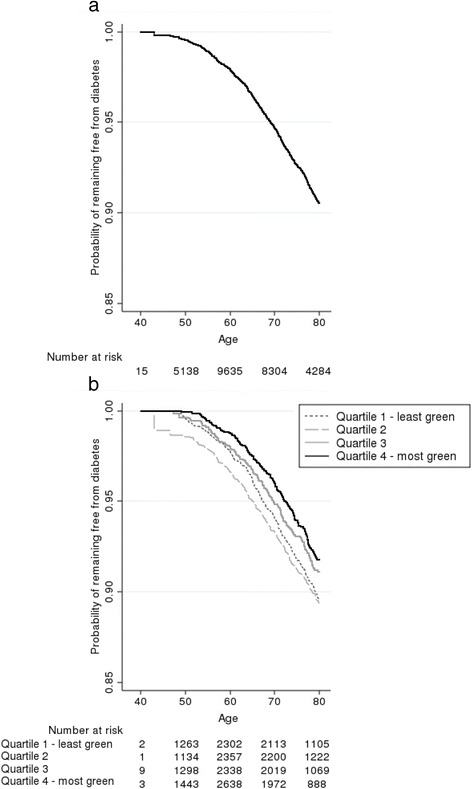
BACKGROUND: Three cross sectional studies suggest that neighbourhood greenspace may protect against incident diabetes. This study uses data from a longitudinal study with a large sample size to investigate the association between greenspace and the occurrence of incident diabetes over time. METHODS: Data was from the European Prospective Investigation of Cancer Norfolk, UK, cohort, recruitment 1993-2007 (N = 23,865). Neighbourhoods were defined as 800 m circular buffers around participants' home locations, according to their home postcode (zip code). Greenspace exposure was defined as the percentage of the home neighbourhood that was woodland, grassland, arable land, mountain, heath and bog, according to the UK Land Cover Map. Cox proportional hazards regression examined the association between neighbourhood greenspace exposure and incident diabetes. The population attributable fraction assessed the proportion of diabetes cases attributable to exposure to least green neighbourhoods. Mediation analysis assessed if physical activity explained associations between greenspace and diabetes. Interaction analysis was used to test for the modifying effect of rurality and socio-economic status on the relationship between greenspace and diabetes. Models were adjusted for known and hypothesised confounders. RESULTS: The mean age of participants was 59 years at baseline and 55.1% were female. The mean follow-up time was 11.3 years. Individuals living in the greenest neighbourhood quartile had a 19% lower relative hazard of developing diabetes (HR 0.81; 95% CI 0.67, 0.99; p = 0.035; linear trend p = 0.010). The hazard ratio remained similar (HR 0.81; 95% CI 0.65, 0.99; p = 0.042) after adjusting for age, sex, BMI, whether a parent had been diagnosed with diabetes and socio-economic status at the individual and neighbourhood level. A HR of 0.97 was attributed to the pathway through physical activity in a fully adjusted model, although this was non-significant (95% CI 0.88, 1.08; p = 0.603). The incidence of diabetes in the least green neighbourhoods (with 20% greenspace on average) would fall by 10.7% (95% CI -2.1%, 25.2%; p = 0.106) if they were as green as the average neighbourhood observed across the whole cohort (59% greenspace on average). There were no significant interactions between rurality or socio-economic status and level of greenspace. CONCLUSIONS: Greener home neighbourhoods may protect against risk of diabetes in older adults, although this study does not support a mediation role for physical activity. Causal mechanisms underlying the associations require further investigation.
Overview
The claims and statistics of this paper haven’t been checked yet.
Free: it reads the open-access text and checks the first 5 claims that cite a source we can check. Create a free account to check every claim.
Integrity signals
Registry
Cites
Statistics
Figures
Verification
Claims the paper makes
The claims and statistics of this paper haven’t been checked yet.
Free: it reads the open-access text and checks the first 5 claims that cite a source we can check. Create a free account to check every claim.
Claims other papers make about this one
Each is checked against this paper’s own text: does it say what the citing paper says it does?
The cited source says what the claim attributes to it.
In the citing paper
“A limited number of longitudinal studies also support the hypothesis that exposure to greenspace may promote improved health outcomes, such as self-reported mental health and the incidence of type 2 diabetes, independently of increased physical activity [37,38,39].”
From Walking Green: Developing an Evidence Base for Nature Prescriptions (2019) · cites this paper as [39]
Self-check
Percentages, sums and reported differences re-computed from the paper’s own numbers.
The self-check needs the paper’s full text.
Citations
Cites
Baron, R. M., & Kenny, D. A. (1986) · Journal of Personality and Social Psychology · doi:10.1037/0022-3514.51.6.1173 · Cited by 91,532
Nonparametric Estimation from Incomplete Observations
Kaplan, E. L., & Meier, P. (1992) · Springer Series in Statistics · doi:10.1007/978-1-4612-4380-9_25 · Cited by 45,181
Nonparametric Estimation from Incomplete Observations
Kaplan, E. L., & Meier, P. (1958) · Journal of the American Statistical Association · doi:10.1080/01621459.1958.10501452 · Cited by 39,158
SPSS and SAS procedures for estimating indirect effects in simple mediation models
Preacher, K. J., & Hayes, A. F. (2004) · Behavior Research Methods, Instruments, & Computers · doi:10.3758/bf03206553 · Cited by 17,383
International Diabetes Federation 2017
Carracher, A. M., Marathe, P. H., & Close, K. L. (2018) · Journal of Diabetes · doi:10.1111/1753-0407.12644 · Cited by 13,418
Lee, I.-M., Shiroma, E. J., Lobelo, F., Puska, P., Blair, S. N., & Katzmarzyk, P. T. (2012) · The Lancet · doi:10.1016/s0140-6736(12)61031-9 · Cited by 8,215
Global estimates of diabetes prevalence for 2013 and projections for 2035
Guariguata, L., Whiting, D. R., Hambleton, I., Beagley, J., Linnenkamp, U., & Shaw, J. E. (2014) · Diabetes Research and Clinical Practice · doi:10.1016/j.diabres.2013.11.002 · Cited by 4,642 · cited 1×
“The prevalence of type 2 diabetes is increasing at a fast rate and is anticipated to rise by 55% by 2035 [2].”
BackgroundPromoting ecosystem and human health in urban areas using Green Infrastructure: A literature review
Tzoulas, K., Korpela, K., Venn, S., Yli-Pelkonen, V., Kaźmierczak, A., Niemela, J., & James, P. (2007) · Landscape and Urban Planning · doi:10.1016/j.landurbplan.2007.02.001 · Cited by 2,810
Fit Yourself and Take Your Lungs to Heart
Palange, P., & Bonini, M. (2013) · Respiration · doi:10.1159/000350831 · Cited by 2,779
Modelling for Survival Data in Medical Research
(1995) · Technometrics · doi:10.1080/00401706.1995.10485920 · Cited by 2,145
The health benefits of urban green spaces: a review of the evidence
Lee, A. C. K., & Maheswaran, R. (2011) · Journal of Public Health · doi:10.1093/pubmed/fdq068 · Cited by 1,551
Health and Deprivation: Inequality and the North
Townsend, P. D., Phillimore, P., & Beattie, A. (1987) · DOAJ (DOAJ: Directory of Open Access Journals) · Cited by 1,473
Thompson Coon, J., Boddy, K., Stein, K., Whear, R., Barton, J., & Depledge, M. H. (2011) · Environmental Science & Technology · doi:10.1021/es102947t · Cited by 1,391
Social contacts as a possible mechanism behind the relation between green space and health
Maas, J., van Dillen, S. M. E., Verheij, R. A., & Groenewegen, P. P. (2009) · Health & Place · doi:10.1016/j.healthplace.2008.09.006 · Cited by 1,195
Morbidity is related to a green living environment
Maas, J., Verheij, R. A., de Vries, S., Spreeuwenberg, P., Schellevis, F. G., & Groenewegen, P. P. (2009) · Journal of Epidemiology and Community Health · doi:10.1136/jech.2008.079038 · Cited by 1,133
Type 2 diabetes incidence and socio-economic position: a systematic review and meta-analysis
Agardh, E., Allebeck, P., Hallqvist, J., Moradi, T., & Sidorchuk, A. (2011) · International Journal of Epidemiology · doi:10.1093/ije/dyr029 · Cited by 1,014
McCormack, G. R., & Shiell, A. (2011) · International Journal of Behavioral Nutrition and Physical Activity · doi:10.1186/1479-5868-8-125 · Cited by 896
Wareham, N. J., Jakes, R. W., Rennie, K. L., Schuit, J., Mitchell, J., Hennings, S., & Day, N. E. (2003) · Public Health Nutrition · doi:10.1079/phn2002439 · Cited by 850
Self-citationDay, N., Oakes, S., Luben, R., Khaw, K., Bingham, S., Welch, A., & Wareham, N. (1999) · Nature · doi:10.17863/cam.89388 · Cited by 780
Self-citationRook, G. A. (2013) · Proceedings of the National Academy of Sciences · doi:10.1073/pnas.1313731110 · Cited by 760 · cited 2×
“Potential explanatory mechanisms include the physiological and psychological benefits of seeing greenspace [13], the health benefits from the immunoregulatory effects of exposure to microorganisms found in natural environments [14], the role of greenspace in creating a sense of attachment to place and community [15],…”
BackgroundModelling Survival Data in Medical Research
Collett, D. (2015) · Chapman & Hall/CRC eBooks · doi:10.1201/b18041 · Cited by 759
Health and deprivation. Inequality and the North
Mackenbach, J. P. (1988) · Health Policy · doi:10.1016/0168-8510(88)90006-1 · Cited by 661
Greenspace and obesity: a systematic review of the evidence
Lachowycz, K., & Jones, A. P. (2011) · Obesity Reviews · doi:10.1111/j.1467-789x.2010.00827.x · Cited by 602
Self-citationRisk models and scores for type 2 diabetes: systematic review
Noble, D., Mathur, R., Dent, T., Meads, C., & Greenhalgh, T. (2011) · BMJ · doi:10.1136/bmj.d7163 · Cited by 551 · cited 1×
“Ethnicity has been found to be associated with diabetes risk [31], however it was not included in this analysis as 99.”
BackgroundLachowycz, K., & Jones, A. P. (2013) · Landscape and Urban Planning · doi:10.1016/j.landurbplan.2012.10.012 · Cited by 518 · cited 3×
“Physical activity is also a potential mediator of the relationship between exposure to greenspace and diabetes incidence [12], yet previous studies have not tested this [9, 10].”
BackgroundMethodResultSelf-citationVan Cauwenberg, J., De Bourdeaudhuij, I., De Meester, F., Van Dyck, D., Salmon, J., Clarys, P., & Deforche, B. (2011) · Health & Place · doi:10.1016/j.healthplace.2010.11.010 · Cited by 503
A Simple Unified Approach for Estimating Natural Direct and Indirect Effects
Lange, T., Vansteelandt, S., & Bekaert, M. (2012) · American Journal of Epidemiology · doi:10.1093/aje/kwr525 · Cited by 456
Diabetes risk score: towards earlier detection of Type 2 diabetes in general practice
Griffin, S. J., Little, P. S., Hales, C. N., Kinmonth, A. L., & Wareham, N. J. (2000) · Diabetes/Metabolism Research and Reviews · doi:10.1002/1520-7560(200005/06)16:3<164::aid-dmrr103>3.0.co;2-r · Cited by 402
Self-citationGraffiti, greenery, and obesity in adults: secondary analysis of European cross sectional survey
Ellaway, A., Macintyre, S., & Bonnefoy, X. (2005) · BMJ · doi:10.1136/bmj.38575.664549.f7 · Cited by 389
Modelling Survival Data in Medical Research (2nd ed.) (Book)
Cowles, M. K. (2004) · Quarterly Publications of the American Statistical Association · Cited by 369
Ekelund, U., Ward, H. A., Norat, T., Luan, J., May, A. M., Weiderpass, E., Sharp, S. J., Overvad, K., Østergaard, J. N., Tjønneland, A., et al. (2015) · The American Journal of Clinical Nutrition · doi:10.3945/ajcn.114.100065 · Cited by 347 · cited 1×
“This used the Stata command ‘punafcc’ , a method used previously with survival data [38].”
MethodSelf-citationSharma, M., Nazareth, I., & Petersen, I. (2016) · BMJ Open · doi:10.1136/bmjopen-2015-010210 · Cited by 291 · cited 1×
“per 1000 person-years follow-up [49], compared to an expected incidence of type 1 diabetes of around 8 per 100,000 person-years follow-up [50].”
BackgroundEPIC-Norfolk: Study design and characteristics of the cohort
Day, N., Oakes, S., Luben, R., Khaw, K., Bingham, S., Welch, A., & Wareham, N. (1999) · UEA Digital Repository (University of East Anglia) · Cited by 261
Self-citationValidity of a short questionnaire to assess physical activity in 10 European countries
The InterAct Consortium (2012) · European Journal of Epidemiology · doi:10.1007/s10654-011-9625-y · Cited by 230
Astell-Burt, T., Feng, X., & Kolt, G. S. (2014) · Diabetes Care · doi:10.2337/dc13-1325 · Cited by 229
The InterAct Consortium (2011) · Diabetologia · doi:10.1007/s00125-011-2182-9 · Cited by 208 · cited 2×
“Incident type 2 diabetes cases were ascertained using multiple data sources, including self-report of doctor-diagnosed diabetes from the second health check or follow-up health and lifestyle questionnaires, self-report of diabetes-specific medication in either of the two follow-up questionnaires or medication brought…”
MethodAguiar, E. J., Morgan, P. J., Collins, C. E., Plotnikoff, R. C., & Callister, R. (2014) · International Journal of Behavioral Nutrition and Physical Activity · doi:10.1186/1479-5868-11-2 · Cited by 135
Assessing Natural Direct and Indirect Effects Through Multiple Pathways
Lange, T., Rasmussen, M., & Thygesen, L. C. (2014) · American Journal of Epidemiology · doi:10.1093/aje/kwt270 · Cited by 130
Bodicoat, D. H., O'Donovan, G., Dalton, A. M., Gray, L. J., Yates, T., Edwardson, C., Hill, S., Webb, D. R., Khunti, K., Davies, M. J., et al. (2014) · BMJ Open · doi:10.1136/bmjopen-2014-006076 · Cited by 127
Self-citationJohnson, M., Jones, R., Freeman, C., Woods, H. B., Gillett, M., Goyder, E., & Payne, N. (2013) · Diabetic Medicine · doi:10.1111/dme.12018 · Cited by 123
Systematic review and metaanalysis of air pollution exposure and risk of diabetes
Janghorbani, M., Momeni, F., & Mansourian, M. (2014) · European Journal of Epidemiology · doi:10.1007/s10654-014-9907-2 · Cited by 121
Is level of neighbourhood green space associated with physical activity in green space?
Ord, K., Mitchell, R., & Pearce, J. (2013) · International Journal of Behavioral Nutrition and Physical Activity · doi:10.1186/1479-5868-10-127 · Cited by 107
Home Versus Nonhome Neighborhood
Hurvitz, P. M., & Moudon, A. V. (2012) · American Journal of Preventive Medicine · doi:10.1016/j.amepre.2011.11.015 · Cited by 102
Dalton, A. M., Jones, A., Panter, J., & Ogilvie, D. (2013) · PLoS ONE · doi:10.1371/journal.pone.0067575 · Cited by 102
Self-citationThe InterAct Consortium (2012) · Diabetologia · doi:10.1007/s00125-012-2532-2 · Cited by 91
Mediation analysis of the relationship between institutional research activity and patient survival
Rochon, J., du Bois, A., & Lange, T. (2014) · BMC Medical Research Methodology · doi:10.1186/1471-2288-14-9 · Cited by 76
Ascertainment and verification of diabetes in the EPIC-NL study.
Sluijs, I., van der A, D. L., Beulens, J. W. J., Spijkerman, A. M. W., Ros, M. M., Grobbee, D. E., & van der Schouw, Y. T. (2010) · PubMed · Cited by 51
Bruno, G., Gruden, G., & Songini, M. (2016) · Acta Diabetologica · doi:10.1007/s00592-015-0835-8 · Cited by 26
Research works printed but not linked: 5
- International Diabetes Federation IDF diabetes atlas 2015 Brussels IDF
- National Institute for Health and Clinical Excellence (NICE) Type 2 diabetes prevention: population and community-level interventions. Public health guideline 2011 Manchester NICE
- ESRI ArcGIS 10.1 2012 California ESRI
- R Development Core Team. R A language and environment for statistical computing 2014 Vienna, Austria R Foundation for Statistical Computing
- Corp S Stata/SE 13.0 for Unix 2013 College Station, Texas Stata Corp
Cited by
Green spaces and mortality: a systematic review and meta-analysis of cohort studies
Rojas-Rueda, D., Nieuwenhuijsen, M. J., Gascon, M., Perez-Leon, D., & Mudu, P. (2019) · The Lancet Planetary Health · doi:10.1016/s2542-5196(19)30215-3 · Cited by 604
Rigolon, A., Browning, M. H. E. M., McAnirlin, O., & Yoon, H. (. (2021) · International Journal of Environmental Research and Public Health · doi:10.3390/ijerph18052563 · Cited by 557
“(2016) [109] SES Green land cover Diabetes Europe de Keijzer et al.”
BackgroundWhere greenspace matters most: A systematic review of urbanicity, greenspace, and physical health
Browning, M. H. E. M., Rigolon, A., McAnirlin, O., & Yoon, H. (. (2022) · Landscape and Urban Planning · doi:10.1016/j.landurbplan.2021.104233 · Cited by 311
Dzhambov, A., Hartig, T., Markevych, I., Tilov, B., & Dimitrova, D. (2018) · Environmental Research · doi:10.1016/j.envres.2017.09.015 · Cited by 303
Dzhambov, A. M., Browning, M. H. E. M., Markevych, I., Hartig, T., & Lercher, P. (2020) · Environmental Research · doi:10.1016/j.envres.2020.109613 · Cited by 287
Metadata
- Authors
- Dalton, A. M., Jones, A. P., Sharp, S. J., Cooper, A. J. M., Griffin, S., & Wareham, N. J.
- Affiliations
- University of East Anglia (GB)
- University of Cambridge (GB)
- Corresponding author
- Dalton, Alice M.
- Venue
- BMC Public Health
- Published
- 2016-11-18
- Volume
- 16
- Issue
- 1
- Pages
- 1171-1171
- ISSN
- 1471-2458 (ISSN-L)
- PMC
- PMC5116148
- OpenAlex
- W2554478873
- Cited by
- 111
- References
- 48
- Citations by year
- 2026: 9 · 2025: 8 · 2024: 12 · 2023: 12 · 2022: 12 · 2021: 17 · 2020: 10 · 2019: 20 · 2018: 9 · 2017: 2
- FWCI
- 6.50
- Type
- journal article
- Language
- en
- Open access
- gold
- doi.org
- Licence
- Locations
- BMC Public Health (publishedVersion, cc-by)
- PubMed Central (publishedVersion, cc-by)
- PubMed (publishedVersion)
- UEA Digital Repository (University of East Anglia) (acceptedVersion)
- DOAJ (DOAJ: Directory of Open Access Journals) (submittedVersion, cc-by-sa)
- Apollo (University of Cambridge) (submittedVersion, cc-by)
- Apollo (cc-by)
- Apollo
- Funders
- Medical Research Council (MR/K025147/1)
- Topics
- Social Sciences › Urban Studies › Urban Green Space and Health
- Social Sciences › Health › Health disparities and outcomes
- Social Sciences › Transportation › Urban Transport and Accessibility
- Keywords
- new-onset diabetes, older adults, physical activity, rurality, socioeconomic status, population attributable fraction, mediation analysis, land cover, green space exposure, diabetes prevention, urban green space, socioeconomic gradient in health, health disparities
- MeSH terms
- Adult, Aged, Cross-Sectional Studies, Diabetes Mellitus, Environment, Female, Follow-Up Studies, United Kingdom, Humans, Longitudinal Studies, Male, Middle Aged, Prospective Studies, Residence Characteristics, Risk Factors, Rural Population, Social Class, Socioeconomic Factors, Exercise, Incidence, Proportional Hazards Models
About these checks
Registry, retraction, Cites and statistics results are computed, not judged, with one exception: a printed reference that no index lists is read once by a model before it counts as a citation error. Claims are extracted by a model and kept only when their quote appears verbatim in the text; each cited source is then checked, with a model’s help, for whether it says what the claim relies on. Those verdicts can be wrong — read the claim’s quote and the cited source before relying on one.
Statistics and arithmetic are recomputed, not judged.
Confidence bands are shown only for fields calibrated on our annotated test set. None is calibrated yet, so no band is shown.
What counts as a claim ›How we measure confidence ›How we check this ›
Are you an author, or do you see a problem with this page? Request a review
Data sources
Bibliographic data: Semantic Scholar, OpenAlex, Crossref.
Contains information from the Semantic Scholar Academic Graph Datasets, made available under the ODC Attribution License (ODC-BY 1.0).
Semantic Scholar’s data is described in: Kinney, R., et al. (2023). The Semantic Scholar Open Data Platform. arXiv:2301.10140.
