

Socially isolated individuals are more prone to have newly diagnosed and prevalent type 2 diabetes mellitus - the Maastricht study
Open accessThe DOI matches its Crossref record; 30 of the 30 references it cites were found in a registry or an index.
Abstract
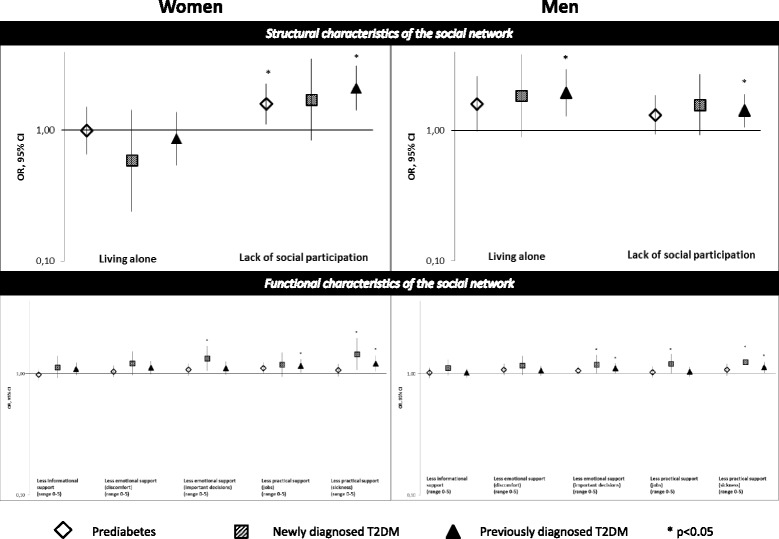
BACKGROUND: Social isolation is associated with type 2 diabetes (T2DM), but it is unclear which elements play a crucial role in this association. Therefore, we assessed the associations of a broad range of structural and functional social network characteristics with normal glucose metabolism, pre-diabetes, newly diagnosed T2DM and previously diagnosed T2DM. METHODS: Participants originated from The Maastricht Study, a population-based cohort study (n = 2861, mean age 60.0 ± 8.2 years, 49% female, 28.8% T2DM (oversampled)). Social network characteristics were assessed through a name generator questionnaire. Diabetes status was determined by an oral glucose tolerance test. We used multinomial regression analyses to investigate the associations between social network characteristics and diabetes status, stratified by sex. RESULTS: More socially isolated individuals (smaller social network size) more frequently had newly diagnosed and previously diagnosed T2DM, while this association was not observed with pre-diabetes. In women, proximity and the type of relationship was associated with newly diagnosed and previously diagnosed T2DM. A lack of social participation was associated with pre-diabetes as well as with previously diagnosed T2DM in women, and with previously diagnosed T2DM in men. Living alone was associated with higher odds of previously diagnosed T2DM in men, but not in women. Less emotional support related to important decisions, less practical support related to jobs, and less practical support for sickness were associated with newly diagnosed and previously diagnosed T2DM in men and women, but not in pre-diabetes. CONCLUSION: This study shows that several aspects of structural and functional characteristics of the social network were associated with newly and previously diagnosed T2DM, partially different for men and women. These results may provide useful targets for T2DM prevention efforts.
Overview
The claims and statistics of this paper haven’t been checked yet.
Free: it reads the open-access text and checks the first 5 claims that cite a source we can check. Create a free account to check every claim.
Integrity signals
Registry
Cites
Statistics
Figures
Verification
Claims the paper makes
The claims and statistics of this paper haven’t been checked yet.
Free: it reads the open-access text and checks the first 5 claims that cite a source we can check. Create a free account to check every claim.
Claims other papers make about this one
Each is checked against this paper’s own text: does it say what the citing paper says it does?
The source backs part of the claim, not all of it — or backs it for a different population, condition or comparison.
In the citing paper
“There is also a growing body of evidence relating social isolation with nonfatal physical health outcomes, including increased risk for cardiovascular disease and stroke [33], pre-diabetes and type 2 diabetes [34], and poorer cognitive functioning [35].”
From Social isolation: an underappreciated determinant of physical health (2022) · cites this paper as [34]
Experimental — accuracy not yet measured
Self-check
Percentages, sums and reported differences re-computed from the paper’s own numbers.
The self-check needs the paper’s full text.
Citations
Cites
Wild, S., Roglic, G., Green, A., Sicree, R., & King, H. (2004) · Diabetes Care · doi:10.2337/diacare.27.5.1047 · Cited by 15,297
Barnett, K., Mercer, S. W., Norbury, M., Watt, G., Wyke, S., & Guthrie, B. (2012) · The Lancet · doi:10.1016/s0140-6736(12)60240-2 · Cited by 6,972 · cited 2×
“Moreover, targeting social network characteristics may also have benefits for other chronic conditions, as it has been shown that most of those with a long-term disorder are multimorbid [3], and social network characteristics have been found to associate with cardiovascular, endocrine, and immune function [29].”
BackgroundLoneliness and Social Isolation as Risk Factors for Mortality: A Meta-Analytic Review
Holt-Lunstad, J., Smith, T. B., Baker, M., Harris, T., & Stephenson, D. (2015) · Perspectives on Psychological Science · doi:10.1177/1745691614568352 · Cited by 6,043
Mechanisms linking obesity to insulin resistance and type 2 diabetes
Kahn, S. E., Hull, R. L., & Utzschneider, K. M. (2006) · Nature · doi:10.1038/nature05482 · Cited by 5,448
Uchino, B. N., Cacioppo, J. T., & Kiecolt-Glaser, J. K. (1996) · Psychological Bulletin · doi:10.1037/0033-2909.119.3.488 · Cited by 2,727 · cited 1×
“Moreover, targeting social network characteristics may also have benefits for other chronic conditions, as it has been shown that most of those with a long-term disorder are multimorbid [3], and social network characteristics have been found to associate with cardiovascular, endocrine, and immune function [29].”
BackgroundDiabetes Mellitus, Fasting Glucose, and Risk of Cause-Specific Death
The Emerging Risk Factors Collaboration (2011) · New England Journal of Medicine · doi:10.1056/nejmoa1008862 · Cited by 2,726 · cited 2×
“Ware JE, Koskinski M, Keller SD. SF-36 physical and mental health summary scales: a user's manual 2nd ed.”
MethodSOCIAL NETWORKS AND SOCIAL SUPPORT
(2016) · The Gerontologist · doi:10.1093/geront/gnw162.1463 · Cited by 1,004
Depression as a risk factor for the onset of type 2 diabetes mellitus. A meta-analysis
Knol, M. J., Twisk, J. W. R., Beekman, A. T. F., Heine, R. J., Snoek, F. J., & Pouwer, F. (2006) · Diabetologia · doi:10.1007/s00125-006-0159-x · Cited by 974
Physical Activity/Exercise and Type 2 Diabetes
Sigal, R. J., Kenny, G. P., Wasserman, D. H., Castaneda-Sceppa, C., & White, R. D. (2006) · Diabetes Care · doi:10.2337/dc06-9910 · Cited by 949
Social Networks and Health: Models, Methods, and Applications
Valente, T. W. (2010) · doi:10.1093/acprof:oso/9780195301014.001.0001 · Cited by 933
Social Networks and Health: Models, Methods, and Applications
Valente, T. W. (2010) · Cited by 600
A Procedure for Surveying Personal Networks
McCallister, L., & Fischer, C. S. (1978) · Sociological Methods & Research · doi:10.1177/004912417800700202 · Cited by 529 · cited 1×
“Data on individual social networks were collected through a questionnaire using a name generator method [24, 25].”
MethodSocial support in diabetes: a systematic review of controlled intervention studies
van Dam, H. A., van der Horst, F. G., Knoops, L., Ryckman, R. M., Crebolder, H. F. J. M., & van den Borne, B. H. W. (2005) · Patient Education and Counseling · doi:10.1016/j.pec.2004.11.001 · Cited by 467 · cited 1×
“Among individuals with T2DM, beneficial effects of social support have been reported on diabetes care [19], activation for self-management [20], and health/health-related behaviors [21].”
BackgroundSchram, M. T., Sep, S. J. S., van der Kallen, C. J., Dagnelie, P. C., Koster, A., Schaper, N., Henry, R. M. A., & Stehouwer, C. D. A. (2014) · European Journal of Epidemiology · doi:10.1007/s10654-014-9889-0 · Cited by 457 · cited 5×
“Further information on The Maastricht study can be found elsewhere [22].”
BackgroundMethodInfluentialSelf-citationKim, D. A., Hwong, A. R., Stafford, D., Hughes, D. A., O'Malley, A. J., Fowler, J. H., & Christakis, N. A. (2015) · The Lancet · doi:10.1016/s0140-6736(15)60095-2 · Cited by 350 · cited 1×
“, physical activity) may also tailor to the social network of the participant, as it has been shown that network targeting can be used to increase the adoption of specific public health interventions [17].”
BackgroundMeasurement of Individual Social Capital
Van Der Gaag, M., & Webber, M. (2008) · Social Capital and Health · doi:10.1007/978-0-387-71311-3_2 · Cited by 349
Are respondents more likely to list alters with certain characteristics?
Marin, A. (2004) · Social Networks · doi:10.1016/j.socnet.2004.06.001 · Cited by 293 · cited 1×
“the use of a name generator, one of the best known, most detailed and most widely used instruments to examine ego-centered network data [28].”
Bos-Touwen, I., Schuurmans, M., Monninkhof, E. M., Korpershoek, Y., Spruit-Bentvelzen, L., Ertugrul-van der Graaf, I., de Wit, N., & Trappenburg, J. (2015) · PLOS ONE · doi:10.1371/journal.pone.0126400 · Cited by 230 · cited 1×
“Among individuals with T2DM, beneficial effects of social support have been reported on diabetes care [19], activation for self-management [20], and health/health-related behaviors [21].”
Backgroundde Jonge, P., & Rosmalen, J. G. M. (2006) · Diabetologia · doi:10.1007/s00125-006-0389-y · Cited by 148
Norberg, M., Stenlund, H. C., Lindahl, B., Andersson, C., Eriksson, J. W., & Weinehall, L. (2006) · Diabetes Research and Clinical Practice · doi:10.1016/j.diabres.2006.09.002 · Cited by 139 · cited 7×
“Both Norberg et al. (2007) and Jones et al. (2015) showed that low emotional support was associated with T2DM in women [7] and older adults [8], although their methods used to assess functional support were less detailed.”
BackgroundMethodInfluentialKoetsenruijter, J., van Lieshout, J., Lionis, C. D., Portillo, M. C., Vassilev, I., Todorova, E., Foss, C., Serrano‐Gil, M., Knutsen, I. R., Angelaki, A., et al. (2015) · PLoS ONE · doi:10.1371/journal.pone.0135079 · Cited by 98 · cited 1×
“Among individuals with T2DM, beneficial effects of social support have been reported on diabetes care [19], activation for self-management [20], and health/health-related behaviors [21].”
BackgroundEffect of social networks intervention in type 2 diabetes: a partial randomised study
Shaya, F. T., Chirikov, V. V., Howard, D., Foster, C., Costas, J., Snitker, S., Frimpter, J., & Kucharski, K. (2014) · Journal of Epidemiology and Community Health · doi:10.1136/jech-2013-203274 · Cited by 83
Gallo, L. C., Fortmann, A. L., McCurley, J. L., Isasi, C. R., Penedo, F. J., Daviglus, M. L., Roesch, S. C., Talavera, G. A., Gouskova, N., Gonzalez, F., et al. (2014) · Journal of Behavioral Medicine · doi:10.1007/s10865-014-9588-z · Cited by 73
Meisinger, C., Kandler, U., & Ladwig, K.-H. (2009) · Psychosomatic Medicine · doi:10.1097/psy.0b013e3181ae5770 · Cited by 56 · cited 3×
“Furthermore, several studies have found that living alone was an independent predictor of T2DM in men, but not in women [7, 11, 12].”
BackgroundResultLidfeldt, J., Nerbrand, C., Samsioe, G., & Agardh, C.-D. (2005) · Diabetes Care · doi:10.2337/diacare.28.10.2531 · Cited by 55
Altevers, J., Lukaschek, K., Baumert, J. J., Kruse, J., Meisinger, C., Emeny, R. T., & Ladwig, K. (2015) · Diabetic Medicine · doi:10.1111/dme.12951 · Cited by 51 · cited 5×
“Therefore, their non-significant findings in women may be attributable to low power [9].”
BackgroundInfluentialConnecting social environment variables to the onset of major specific health outcomes
Hill, P. L., Weston, S. J., & Jackson, J. J. (2014) · Psychology and Health · doi:10.1080/08870446.2014.884221 · Cited by 43 · cited 1×
“Negative friend support increases the odds of T2DM by 30% in both men and women [14].”
BackgroundHilding, A., Shen, C., & Östenson, C. (2014) · Diabetes Research and Clinical Practice · doi:10.1016/j.diabres.2014.09.057 · Cited by 39 · cited 9×
“This finding is consistent with previous longitudinal studies that identified living alone as a risk factor for T2DM [11, 27], while having a partner decreases the risk for T2DM [12] in men but not in women.”
BackgroundResultInfluentialA psychometric examination of multimorbidity and mental health in older adults
Jones, S. M. W., Amtmann, D., & Gell, N. (2015) · Aging & Mental Health · doi:10.1080/13607863.2015.1008988 · Cited by 32 · cited 2×
“(2015) showed that low emotional support was associated with T2DM in women [7] and older adults [8], although their methods used to assess functional support were less detailed.”
BackgroundSex differences in the association of social network satisfaction and the risk for type 2 diabetes
Lukaschek, K., Baumert, J. J., Kruse, J., Meisinger, C., & Ladwig, K. (2017) · BMC Public Health · doi:10.1186/s12889-017-4323-7 · Cited by 23 · cited 4×
“Recently, it has been shown that low social network satisfaction is associated with increased risk of T2DM [27].”
BackgroundResultInfluential
Research works printed but not linked: 2
- World Health Organization Definition and Diagnosis of Diabetes Mellitus and Intermediate Hyperglycaemia 2006 Geneva WHO
- Ware JE Koskinski M Keller SD SF-36 physical and mental health summary scales: a user's manual 2nd ed 1994 Boston MA The Health Institute
Cited by
Holt‐Lunstad, J. (2024) · World Psychiatry · doi:10.1002/wps.21224 · Cited by 415
“For example, people with smaller social networks were more likely to have been recently di agnosed with type 2 diabetes, to have previously been diagnosed with this condition, and to have diabetic complications 48,49 .”
A metabolic handbook for the COVID-19 pandemic
Ayres, J. S. (2020) · Nature Metabolism · doi:10.1038/s42255-020-0237-2 · Cited by 292
Social isolation: an underappreciated determinant of physical health
Holt-Lunstad, J., & Steptoe, A. (2022) · Current Opinion in Psychology · doi:10.1016/j.copsyc.2021.07.012 · Cited by 216
Wang, X., Ma, H., Li, X., Heianza, Y., Fonseca, V. A., & Qi, L. (2023) · European Heart Journal · doi:10.1093/eurheartj/ehad306 · Cited by 165
Social networks and type 2 diabetes: a narrative review
Schram, M. T., Assendelft, W. J., van Tilburg, T. G., & Dukers–Muijrers, N. H. T. M. (2021) · Diabetologia · doi:10.1007/s00125-021-05496-2 · Cited by 76
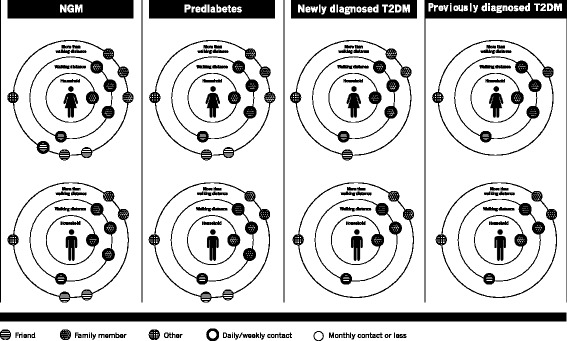
“Figure 2 depicts the composition of structural network characteristics in men and women with and without type 2 diabetes, according to data from the populationbased Maastricht Study [11].”
BackgroundMethodInfluentialSelf-citation
Metadata
- Authors
- Brinkhues, S., Dukers-Muijrers, N. H. T. M., Hoebe, C. J. P. A., van der Kallen, C. J. H., Dagnelie, P. C., Koster, A., Henry, R. M. A., Sep, S. J. S., Schaper, N. C., Stehouwer, C. D. A., Bosma, H., Savelkoul, P. H. M., & Schram, M. T.
- Affiliations
- Maastricht University Medical Centre (NL)
- Maastricht University (NL)
- Corresponding author
- Schram, Miranda T.
- ORCID
- Venue
- BMC Public Health
- Published
- 2017-12
- Volume
- 17
- Issue
- 1
- Pages
- 955-955
- ISSN
- 1471-2458 (ISSN-L)
- PMC
- PMC5735891
- OpenAlex
- W2771709538
- Cited by
- 97
- References
- 30
- Citations by year
- 2026: 11 · 2025: 9 · 2024: 18 · 2023: 19 · 2022: 8 · 2021: 9 · 2020: 10 · 2019: 10 · 2018: 3
- FWCI
- 7.00
- Type
- journal article
- Language
- en
- Open access
- gold
- doi.org
- Licence
- cc-by
- Locations
- BMC Public Health (publishedVersion, cc-by)
- Europe PMC (PubMed Central) (publishedVersion, cc-by)
- PubMed Central (publishedVersion, cc-by)
- PubMed (publishedVersion)
- Research Publications (Maastricht University) (publishedVersion, cc-by)
- Pure Amsterdam UMC (publishedVersion, other-oa)
- DOAJ (DOAJ: Directory of Open Access Journals) (submittedVersion)
- Amsterdam UMC (VU Amsterdam) - Institutional Repository (submittedVersion)
- Research Publications (Maastricht University) (submittedVersion, other-oa)
- Data Archiving and Networked Services (DANS) (submittedVersion)
- Funders
- Sanofi
- Health Foundation Limburg
- Novo Nordisk
- Stichting De Weijerhorst (31O.041)
- European Regional Development Fund (31O.041)
- CARIM School for Cardiovascular Diseases, Universiteit Maastricht
- Care and Public Health Research Institute, Universiteit Maastricht
- NUTRIM School of Nutrition and Translational Research in Metabolism
- Cilag
- Topics
- Social Sciences › Health › Health disparities and outcomes
- Health Sciences › Medicine › Endocrinology, Diabetes and Metabolism › Diabetes, Cardiovascular Risks, and Lipoproteins
- Health Sciences › Medicine › Endocrinology, Diabetes and Metabolism › Diabetes Management and Education
- Keywords
- social isolation, type 2 diabetes, social networks, social network size, prediabetes, newly diagnosed diabetes, social support, emotional support, practical support, living alone, sex differences, diabetes prevention, Maastricht Study
- MeSH terms
- Adult, Aged, Diabetes Mellitus, Type 2, Female, Glucose Tolerance Test, Humans, Male, Middle Aged, Netherlands, Prediabetic State, Surveys and Questionnaires, Social Isolation, Cohort Studies, Prevalence, Sex Distribution
About these checks
Registry, retraction, Cites and statistics results are computed, not judged, with one exception: a printed reference that no index lists is read once by a model before it counts as a citation error. Claims are extracted by a model and kept only when their quote appears verbatim in the text; each cited source is then checked, with a model’s help, for whether it says what the claim relies on. Those verdicts can be wrong — read the claim’s quote and the cited source before relying on one.
Statistics and arithmetic are recomputed, not judged.
Confidence bands are shown only for fields calibrated on our annotated test set. None is calibrated yet, so no band is shown.
What counts as a claim ›How we measure confidence ›How we check this ›
Are you an author, or do you see a problem with this page? Request a review
Data sources
Bibliographic data: Semantic Scholar, OpenAlex, Crossref.
Contains information from the Semantic Scholar Academic Graph Datasets, made available under the ODC Attribution License (ODC-BY 1.0).
Semantic Scholar’s data is described in: Kinney, R., et al. (2023). The Semantic Scholar Open Data Platform. arXiv:2301.10140.
