

Identifying factors influencing contraceptive use in Bangladesh: evidence from BDHS 2014 data
Open accessThe DOI matches its Crossref record; 41 of the 42 references it cites were found in a registry or an index.
Abstract
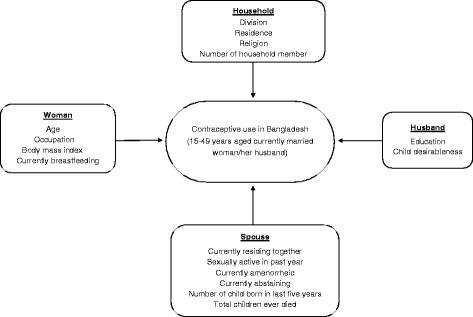
BACKGROUND: Birth control is the conscious control of the birth rate by methods which temporarily prevent conception by interfering with the normal process of ovulation, fertilization, and implantation. High contraceptive prevalence rate is always expected for controlling births for those countries that are experiencing high population growth rate. The factors that influence contraceptive prevalence are also important to know for policy implication purposes in Bangladesh. This study aims to explore the socio-economic, demographic and others key factors that influence the use of contraception in Bangladesh. METHODS: The contraception data are extracted from the 2014 Bangladesh Demographic and Health Survey (BDHS) data which were collected by using a two stage stratified random sampling technique that is a source of nested variability. The nested sources of variability must be incorporated in the model using random effects in order to model the actual parameter effects on contraceptive prevalence. A mixed effect logistic regression model has been implemented for the binary contraceptive data, where parameters are estimated through generalized estimating equation by assuming exchangeable correlation structure to explore and identify the factors that truly affect the use of contraception in Bangladesh. RESULTS: The prevalence of contraception use by currently married 15-49 years aged women or their husbands is 62.4%. Our study finds that administrative division, place of residence, religion, number of household members, woman's age, occupation, body mass index, breastfeeding practice, husband's education, wish for children, living status with wife, sexual activity in past year, women amenorrheic status, abstaining status, number of children born in last five years and total children ever died were significantly associated with contraception use in Bangladesh. CONCLUSIONS: The odds of women experiencing the outcome of interest are not independent due to the nested structure of the data. As a result, a mixed effect model is implemented for the binary variable 'contraceptive use' to produce true estimates for the significant determinants of contraceptive use in Bangladesh. Knowing such true estimates is important for attaining future goals including increasing contraception use from 62 to 75% by 2020 by the Bangladesh government's Health, Population & Nutrition Sector Development Program (HPNSDP).
Overview
The claims and statistics of this paper haven’t been checked yet.
Free: it reads the open-access text and checks the first 5 claims that cite a source we can check. Create a free account to check every claim.
Integrity signals
Registry
Cites
Statistics
Figures
Verification
Claims the paper makes
The claims and statistics of this paper haven’t been checked yet.
Free: it reads the open-access text and checks the first 5 claims that cite a source we can check. Create a free account to check every claim.
Claims other papers make about this one
Each is checked against this paper’s own text: does it say what the citing paper says it does?
The source backs part of the claim, not all of it — or backs it for a different population, condition or comparison.
In the citing paper
“Other factors, such as education and religiosity, also influence contraceptive use (e.g. [44, 45]).”
From Human fertility in relation to education, economy, religion, contraception, and family planning programs (2020) · cites this paper as [44]
Experimental — accuracy not yet measured
Self-check
Percentages, sums and reported differences re-computed from the paper’s own numbers.
The self-check needs the paper’s full text.
Citations
Cites
Longitudinal data analysis using generalized linear models
LIANG, K.-Y., & ZEGER, S. L. (1986) · Biometrika · doi:10.1093/biomet/73.1.13 · Cited by 18,550
Nepal Demographic And Health Survey 2006
Mohp, P., & Nepal (2007) · Cited by 1,312
The variability of female reproductive ageing
te Velde, E. R. (2002) · Human Reproduction Update · doi:10.1093/humupd/8.2.141 · Cited by 1,214 · cited 1×
“It is also evident that to avoid unwanted pregnancies, to choose the size of family and improve the spacing between the births of children, to reduce abortion and to allow spontaneous sex, contraceptives are inevitable and convenient for both men and women [6].”
BackgroundA Hierarchical Model for Studying School Effects
Raudenbush, S., & Bryk, A. S. (1986) · Sociology of Education · doi:10.2307/2112482 · Cited by 818
Pakistan Demographic and Health Survey 1990/1991.
Sathar], [. A. (1992) · Population and Development Review · doi:10.2307/1973773 · Cited by 639
Categorical Data Analysis, Second Edition
Chimka, J. R. (2003) · IIE Transactions · doi:10.1080/07408170304423 · Cited by 605
So, R., & Rojas, G. V. E. (2003) · Cited by 470
Factors Associated with Contraceptive Choice and Inconsistent Method Use, United States, 2004
Frost, J. J., & Darroch, J. E. (2008) · Perspectives on Sexual and Reproductive Health · doi:10.1363/4009408 · Cited by 381
Mixed Models: Theory and Applications with R
Demidenko, E. (2013) · Cited by 339
Medical History of Contraception
HIMES, N. E. (1934) · New England Journal of Medicine · doi:10.1056/nejm193403152101103 · Cited by 273
Research works printed but not linked: 6
- Kumar N “met and unmet needs for family planning: a global issue EC Gynaecol 2016 3 281 9
- National Institute of Population Studies (NIPS) [Pakistan] and ICF International. Pakistan Demographic and Health Survey 2012-13. Islamabad, Pakistan, and Calverton, Maryland, USA; 2013. Available at www.DHSprogram.com.
- Cleland J Phillips JF Amin S Kamal GM The determinants of reproductive change in Bangladesh. World Bank Regional and Sectoral Studies 1994 Washington The World Bank
- Kamal N Lim C Omar R Determinants of contraceptive use in the urban slums of Bangladesh: A multilevel model 2005 UK Department of Statistical Science, UCL
- Verbeke G Models for Discrete Longitudinal Data. Springer Series in Statistics 2005 New York Springer
- Das K Gautam V Das K Tripathy P Influence of age gap between couples on contraception and fertility J Fam Welf 2011 57 2 30 8
Cited by
Items 101–124 of 124
Shikpup, N. J., Mangdik, C. E., Idoko, S., Mary, D. K., Mwolchet, S., Lishika, A., Daniel, G. O., Ramyil, M. S., & Bulndi, L. B. (2024) · Path of Science · doi:10.22178/pos.100-42
Zewdia, W. F., Muchie, B. T., Kassie, M. Z., & Asfaw, M. A. (2024) · Research Square · doi:10.21203/rs.3.rs-4473196/v1
Rahman, F., Emma, T. A., Azrin, F., Patwary, M. H., & Ahmed, A. (2024) · Research Square · doi:10.21203/rs.3.rs-5275379/v1
Brahma, J., & Basumatary, K. (2025) · Universal Journal of Public Health · doi:10.13189/ujph.2025.130117
Abedin, M., & Hossain, M. B. (2025) · Research Square · doi:10.21203/rs.3.rs-5868830/v1
Self-citationHasan, M. R., Rabu, K. F., Muna, M. A., Hassan, S. M. N., & Rahman, S. (2025) · ASIDE Internal Medicine · doi:10.71079/aside.im.02232529 · Cited by 9
Nakitende, R., Modi, D., Newane, M., Kasagga, P., Pita, P., & Kalule, S. (2025) · doi:10.70572/agp.v2i2.74
Tadesse, K., Alemayehu, G. M., & Tesfa, E. (2025) · Healthcare in Low-resource Settings · doi:10.4081/hls.2025.13478
The Relationship Between Innovation and Family Planning Attitudes Among Women of Reproductive Age
Ekrem, E. C., Önal, Y., & Yiğit, M. C. (2025) · Doğu Karadeniz Sağlık Bilimleri Dergisi · doi:10.59312/ebshealth.1663207
Hossain, A., & Akter, S. (2025) · International Journal of Social Science Research and Review · doi:10.47814/ijssrr.v8i8.2795
Mimu, M. M., Hossain, S., Biswas, J., Mahbub, M., & Zabin, S. (2025) · Public Health Challenges · doi:10.1002/puh2.70104
Determinants of regional disparities in Contraceptive use among married women in IndiaPreprint
Hazowary, B. (2025) · Research Square · doi:10.21203/rs.3.rs-7190996/v1
Abedin, M., & Hossain, M. B. (2025) · PLoS ONE · doi:10.1371/journal.pone.0335543
“Like the current study, prior research in Bangladesh showed that irrespective of primary, secondary, or higher educational level of women, use of modern methods was lower [12,16] due to the fear of potential side-effects of pills, injectables, implants, etc. [12].”
Self-citationGötmark, F., & Andersson, M. (2020) · Figshare · doi:10.6084/m9.figshare.12023394
Abdi, B., Okal, J., Serour, G., Were, V., Temmerman, M., & Gichangi, P. (2024) · Figshare · doi:10.6084/m9.figshare.25025951
Ekrem, E. C., Bayrak, D., & Çaça, E. (2025) · Samsun Sağlık Bilimleri Dergisi · doi:10.47115/jshs.1776774
Ibrahim, G. M., Kuunibe, N., & Abdulai, M. G. (2026) · International Health · doi:10.1093/inthealth/ihag046
Das, P., Ghosh, T., Chouhan, P., Zaveri, A., Sarkar, A., Mandal, S., Roy, A., & Rahaman, M. (2026) · BMC Public Health · doi:10.1186/s12889-026-27987-w
“It might be due to declining fertility [51]and adopting sterilisation [58], which align directly with a low median age at first birth (21 years) and a low median age at sterilisation (26 years) in India [19].”
Women's family planning status in Ethiopia: A geo-additive modeling approach
Tegegne, M. A., Muluneh, E. K., Mitku, A. A., & Aweke, G. T. (2026) · Global Epidemiology · doi:10.1016/j.gloepi.2026.100275
“This result is consistent with studies conducted in Bangladesh and Pakistan [23,24], which similarly found that higher fertility desires reduce contraceptive uptake.”
Islam, S., Eya, M. E., & Alam, M. K. (2026) · BMC Public Health · doi:10.1186/s12889-026-28244-w
“On the other hand, separation between spouses, particularly when that is caused by international migration of males, is a tremendous obstacle [16].”
Farhana, Z., Rumman, N., Ara, R., Elora, A. L., Ali, M. Y., Chowdhury, S. H., Uddin, M. A., & Rahman, M. M. (2026) · Health Science Reports · doi:10.1002/hsr2.72853
“Contraceptive utilization is influenced by various sociodemographic factors, including age, education, husbands' education, number of living children, desire for more children, wealth index, geographic division, area of residence, women's autonomy, and knowledge of contraceptive methods [15, 17–20].”
Fitriangga, A., Alex, A., Putri, E. A., Novitarini, P., RAMDHANI, A., Fahdi, F. K., & Pramuwidya, A. (2026) · Research Square · doi:10.21203/rs.3.rs-9364017/v1
Metadata
- Authors
- Hossain, M., Khan, M., Ababneh, F., & Shaw, J.
- Affiliations
- BRAC (BD)
- Al-Hussein Bin Talal University (JO)
- University of Warwick (GB)
- ORCID
- Venue
- BMC Public Health
- Published
- 2018-01-30
- Volume
- 18
- Issue
- 1
- Pages
- 192-192
- ISSN
- 1471-2458 (ISSN-L)
- PMC
- PMC5789662
- OpenAlex
- W2786456849
- Semantic Scholar
- 339bc2f4df429d6f44d5b1b6191bd117013bec99
- Cited by
- 125
- References
- 42
- Citations by year
- 2026: 10 · 2025: 23 · 2024: 21 · 2023: 19 · 2022: 17 · 2021: 13 · 2020: 15 · 2019: 5 · 2018: 1
- FWCI
- 8.10
- Type
- journal article
- Language
- en
- Open access
- gold
- doi.org
- Licence
- cc-by
- Locations
- BMC Public Health (publishedVersion, cc-by)
- PubMed Central (publishedVersion, cc-by)
- PubMed (publishedVersion)
- Warwick Research Archive Portal (University of Warwick) (acceptedVersion)
- DOAJ (DOAJ: Directory of Open Access Journals) (submittedVersion)
- Funders
- University of Dhaka
- Topics
- Health Sciences › Medicine › Public Health, Environmental and Occupational Health › Reproductive Health and Contraception
- Social Sciences › Gender Studies › Demographic Trends and Gender Preferences
- Health Sciences › Medicine › Urology › Male Reproductive Health Studies
- Keywords
- contraceptive use, contraceptive prevalence, determinants of contraceptive use, married women of reproductive age, Bangladesh, socioeconomic factors, demographic factors, breastfeeding, amenorrhea, family planning policy, mixed-effects logistic regression
- MeSH terms
- Adolescent, Adult, Bangladesh, Contraception, Demography, Female, Humans, Male, Middle Aged, Socioeconomic Factors, Young Adult
About these checks
Registry, retraction, Cites and statistics results are computed, not judged, with one exception: a printed reference that no index lists is read once by a model before it counts as a citation error. Claims are extracted by a model and kept only when their quote appears verbatim in the text; each cited source is then checked, with a model’s help, for whether it says what the claim relies on. Those verdicts can be wrong — read the claim’s quote and the cited source before relying on one.
Statistics and arithmetic are recomputed, not judged.
Confidence bands are shown only for fields calibrated on our annotated test set. None is calibrated yet, so no band is shown.
What counts as a claim ›How we measure confidence ›How we check this ›
Are you an author, or do you see a problem with this page? Request a review
Data sources
Bibliographic data: Semantic Scholar, OpenAlex, Crossref.
Contains information from the Semantic Scholar Academic Graph Datasets, made available under the ODC Attribution License (ODC-BY 1.0).
Semantic Scholar’s data is described in: Kinney, R., et al. (2023). The Semantic Scholar Open Data Platform. arXiv:2301.10140.
