

The DOI matches its Crossref record; 36 of the 36 references it cites were found in a registry or an index.
Is screen time associated with anxiety or depression in young people? Results from a UK birth cohort
Open accessAbstract
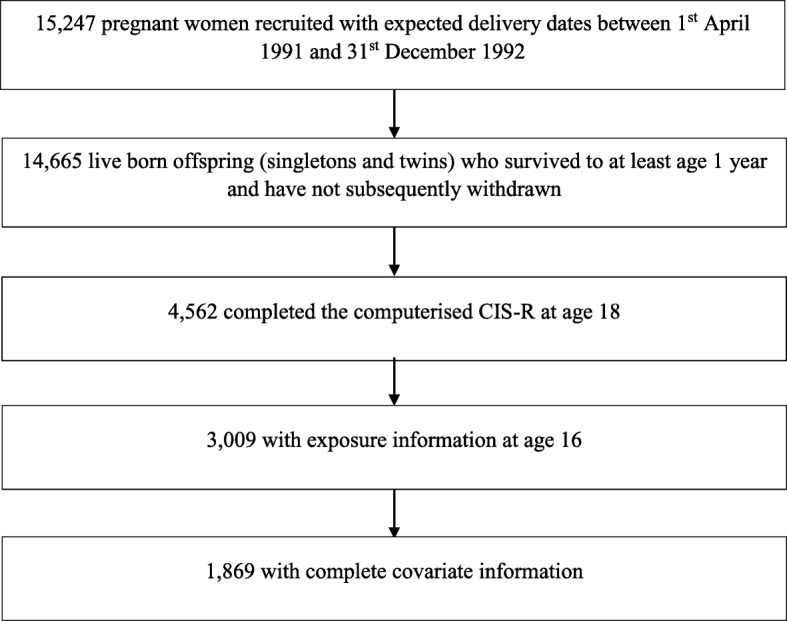
BACKGROUND: There is limited and conflicting evidence for associations between use of screen-based technology and anxiety and depression in young people. We examined associations between screen time measured at 16 years and anxiety and depression at 18. METHODS: Participants (n = 14,665; complete cases n = 1869) were from the Avon Longitudinal Study of Parents and Children, a UK-based prospective cohort study. We assessed associations between various types of screen time (watching television, using a computer, and texting, all measured via questionnaire at 16y), both on weekdays and at weekends, and anxiety and depression (measured via the Revised Clinical Interview Schedule at 18y). Using ordinal logistic regression, we adjusted for multiple confounders, particularly focussing on activities that might have been replaced by screen time (for example exercising or playing outdoors). RESULTS: More time spent using a computer on weekdays was associated with a small increased risk of anxiety (OR for 1-2 h = 1.17, 95% CI: 1.01 to 1.35; OR for 3+ hours = 1.30, 95% CI: 1.10 to 1.55, both compared to < 1 h, p for linear trend = 0.003). We found a similar association between computer use at weekends and anxiety (OR for 1-2 h = 1.17, 95% CI: 0.94 to 1.46; OR for 3+ hours = 1.28, 95% CI: 1.03 to 1.48, p for linear trend = 0.03). Greater time spent using a computer on weekend days only was associated with a small increased risk in depression (OR for 1-2 h = 1.12, 95% CI: 0.93 to 1.35; OR for 3+ hours = 1.35, 95% CI: 1.10 to 1.65, p for linear trend = 0.003). Adjusting for time spent alone attenuated effects for anxiety but not depression. There was little evidence for associations with texting or watching television. CONCLUSIONS: We found associations between increased screen time, particularly computer use, and a small increased risk of anxiety and depression. Time spent alone was found to attenuate some associations, and further research should explore this.
Overview
The claims and statistics of this paper haven’t been checked yet.
Run the check — free, no account needed. It reads the open-access text and checks the sources it cites.
Integrity signals
Registry
Cites
Statistics
Figures
Verification
Claims the paper makes
The claims and statistics of this paper haven’t been checked yet.
Run the check — free, no account needed. It reads the open-access text and checks the sources it cites.
Claims other papers make about this one
Each is checked against this paper’s own text: does it say what the citing paper says it does?
The source backs part of the claim, not all of it — or backs it for a different population, condition or comparison.
In the citing paper
“Fourteen studies identified in this systematic scoping review measured both ST and GT [234–238, 242–250].”
From Psychological impacts of “screen time” and “green time” for children and adolescents: A systematic scoping review (2020) · cites this paper as [238]
Experimental — accuracy not yet measuredThe source backs part of the claim, not all of it — or backs it for a different population, condition or comparison.
In the citing paper
“A Canadian study found a significant positive relationship between screen time and levels of anxiety and depression among students, particularly with computer use and video gaming, but not with television viewing (3).”
From Relationship of screen time with anxiety, depression, and sleep quality among adolescents: a cross-sectional study (2024) · cites this paper as [3]
Experimental — accuracy not yet measuredThe cited source says what the claim attributes to it.
In the citing paper
“There was a small positive association between computer use at age 16 and anxiety and depression two years later in one study [71].”
From The associations between screen time and mental health in adolescents: a systematic review (2023) · cites this paper as [71]
In the citing paper
“One study reported a small positive association between time spent using the computer (on both weekdays and weekend days) at baseline and subsequent anxiety symptoms (Khouja et al., 2019).”
From The relationship between screen time and mental health in young people: A systematic review of longitudinal studies (2021) · cites this paper as Khouja et al., 2019
In the citing paper
“One study reported no association between these variables (Khouja et al., 2019)”
From The relationship between screen time and mental health in young people: A systematic review of longitudinal studies (2021) · cites this paper as Khouja et al., 2019
In the citing paper
“However, this association was no longer significant when adjusting for time spent alone.”
From The relationship between screen time and mental health in young people: A systematic review of longitudinal studies (2021) · cites this paper as Khouja et al., 2019
In the citing paper
“Two studies found no association between television viewing and subsequent anxiety symptoms (Boers et al., 2020;Khouja et al., 2019).”
From The relationship between screen time and mental health in young people: A systematic review of longitudinal studies (2021) · cites this paper as Khouja et al., 2019
Self-check
Percentages, sums and reported differences re-computed from the paper’s own numbers.
The self-check needs the paper’s full text.
Citations
Cites
Detection of Postnatal Depression: Development of the 10-item Edinburgh Postnatal Depression Scale
Cox, J. L., Holden, J. M., & Sagovsky, R. (1987) · British Journal of Psychiatry · doi:10.1192/bjp.150.6.782 · Cited by 14,183
Boyd, A., Golding, J., Macleod, J., Lawlor, D. A., Fraser, A., Henderson, J., Molloy, L., Ness, A., Ring, S., & Davey Smith, G. (2013) · International Journal of Epidemiology · doi:10.1093/ije/dys064 · Cited by 2,996
Multiple imputation of discrete and continuous data by fully conditional specification
van Buuren, S. (2007) · Statistical Methods in Medical Research · doi:10.1177/0962280206074463 · Cited by 2,827
Cohort Profile: The Avon Longitudinal Study of Parents and Children: ALSPAC mothers cohort
Fraser, A., Macdonald-Wallis, C., Tilling, K., Boyd, A., Golding, J., Davey Smith, G., Henderson, J., Macleod, J., Molloy, L., Ness, A., et al. (2013) · International Journal of Epidemiology · doi:10.1093/ije/dys066 · Cited by 2,494
Self-citationAssessing proportionality in the proportional odds model for ordinal logistic regression.
Brant, R. (1990) · Biometrics · doi:10.2307/2532457 · Cited by 1,864
Goodman, R., Ford, T., Richards, H., Gatward, R., & Meltzer, H. (2000) · Journal of Child Psychology and Psychiatry · doi:10.1111/j.1469-7610.2000.tb02345.x · Cited by 1,755
Lewis, G., Pelosi, A. J., Araya, R., & Dunn, G. (1992) · Psychological Medicine · doi:10.1017/s0033291700030415 · Cited by 1,487
Psychiatric morbidity among adults living in private households, 2000
Singleton, N., Bumpstead, R., O'Brien, M. S., Lee, A., & Meltzer, H. (2003) · International Review of Psychiatry · doi:10.1080/0954026021000045967 · Cited by 896
Przybylski, A. K., & Weinstein, N. (2017) · Psychological Science · doi:10.1177/0956797616678438 · Cited by 890
Social Networking Sites, Depression, and Anxiety: A Systematic Review
Seabrook, E. M., Kern, M. L., & Rickard, N. S. (2016) · JMIR Mental Health · doi:10.2196/mental.5842 · Cited by 763 · cited 1×
“comparisons on social networking sites are related to higher levels of depression and anxiety [29].”
Background
Research works printed but not linked: 1
- Wechsler D. The Wechsler intelligence scale for children—third edition. 3rd ed. San Antonio: TX; 1992.
Cited by
Sorted by citations
Oswald, T. K., Rumbold, A. R., Kedzior, S. G. E., & Moore, V. M. (2020) · PLoS ONE · doi:10.1371/journal.pone.0237725 · Cited by 367
Wang, X., Li, Y., & Fan, H. (2019) · BMC Public Health · doi:10.1186/s12889-019-7904-9 · Cited by 299
The associations between screen time and mental health in adolescents: a systematic review
Santos, R. M. S., Mendes, C. G., Sen Bressani, G. Y., de Alcantara Ventura, S., de Almeida Nogueira, Y. J., de Miranda, D. M., & Romano-Silva, M. A. (2023) · BMC Psychology · doi:10.1186/s40359-023-01166-7 · Cited by 311
Coping With Stress and Burnout Associated With Telecommunication and Online Learning
Mheidly, N., Fares, M. Y., & Fares, J. (2020) · Frontiers in Public Health · doi:10.3389/fpubh.2020.574969 · Cited by 355
Tang, S., Werner-Seidler, A., Torok, M., Mackinnon, A. J., & Christensen, H. (2021) · Clinical Psychology Review · doi:10.1016/j.cpr.2021.102021 · Cited by 284
Metadata
- Authors
- Khouja, J. N., Munafò, M. R., Tilling, K., Wiles, N. J., Joinson, C., Etchells, P. J., John, A., Hayes, F. M., Gage, S. H., & Cornish, R. P.
- Affiliations
- University of Bristol (GB)
- Bath Spa University (GB)
- Swansea University (GB)
- University of Liverpool (GB)
- Corresponding author
- Khouja, Jasmine N.
- ORCID
- Venue
- BMC Public Health
- Published
- 2019-01-17
- Volume
- 19
- Issue
- 1
- Pages
- 82-82
- ISSN
- 1471-2458 (ISSN-L)
- PMC
- PMC6337855
- OpenAlex
- W2914648011
- Cited by
- 161
- References
- 36
- Citations by year
- 2026: 12 · 2025: 11 · 2024: 33 · 2023: 19 · 2022: 32 · 2021: 25 · 2020: 24 · 2019: 4
- FWCI
- 42.69
- Type
- journal article
- Language
- en
- Open access
- gold
- doi.org
- Licence
- Locations
- BMC Public Health (publishedVersion, cc-by)
- Europe PMC (PubMed Central) (publishedVersion, other-oa)
- PubMed Central (publishedVersion, cc-by)
- PubMed (publishedVersion)
- Bristol Research (University of Bristol) (publishedVersion, cc-by)
- Research Space (acceptedVersion)
- DOAJ (DOAJ: Directory of Open Access Journals) (submittedVersion, cc-by-sa)
- Funders
- Medical Research Council (102215/2/13/2, MM_UU_12013/6)
- Wellcome Trust (102215/2/13/2, 105612/Z/14/Z)
- Elizabeth Blackwell Institute for Health Research (105612/Z/14/Z)
- University of Bristol (105612/Z/14/Z)
- Topics
- Social Sciences › Sociology and Political Science › Impact of Technology on Adolescents
- Social Sciences › Education › Child Development and Digital Technology
- Health Sciences › Medicine › Public Health, Environmental and Occupational Health › Physical Activity and Health
- Keywords
- screen time, computer use, anxiety, depression, youth, adolescents, television viewing, text messaging, time spent alone, Avon Longitudinal Study of Parents and Children, mental health, sedentary behavior, digital technology use, self-esteem
- MeSH terms
- Screen Time, Adolescent, Anxiety, Computers, Depression, Female, United Kingdom, Humans, Male, Prospective Studies, Risk Factors, Time Factors
About these checks
Registry, retraction, Cites and statistics results are computed, not judged, with one exception: a printed reference that no index lists is read once by a model before it counts as a citation error. Claims are extracted by a model and kept only when their quote appears verbatim in the text; each cited source is then checked, with a model’s help, for whether it says what the claim relies on. Those verdicts can be wrong — read the claim’s quote and the cited source before relying on one.
Statistics and arithmetic are recomputed, not judged.
Confidence bands are shown only for fields calibrated on our annotated test set. None is calibrated yet, so no band is shown.
What counts as a claim ›How we measure confidence ›How we check this ›
Are you an author, or do you see a problem with this page? Request a review
