

The DOI matches its Crossref record; 60 of the 60 references it cites were found in a registry or an index.
The associations between screen time-based sedentary behavior and depression: a systematic review and meta-analysis
Open accessAbstract
Background: The use of computers/TV has become increasingly common worldwide after entering the twenty-first century and depression represents a growing public health burden. Understanding the association between screen time-based sedentary behavior (ST-SB) and the risk of depression is important to the development of prevention and intervention strategies. Methods: We searched the electronic databases of Medline, Embase and the Cochrane Library. The odds ratio (OR) with corresponding 95% confidence intervals (CIs) was adopted as the pooled measurement. Subgroup analyses were investigated by stratified meta-analyses based on age, gender and reference group (reference category of screen time, e.g. 2 h/day, 4 h/day). Results: There were 12 cross-sectional studies and 7 longitudinal studies met the inclusion criteria. Overall, the pooled OR was 1.28 with high heterogeneity (I 2 = 89%). Compared to those who reported less SB, persons reporting more SB had a significantly higher risk of depression. When the gender was stratified, the pooled OR was 1.18 in female groups while no significant association was observed in males. Among the 19 studies, 5 studies used a reference group with ST = 2 h/days (pooled OR = 1.46), 9 studies used ≥4 h as a reference group (pooled OR = 1.38), 2 studies used 1 h as a reference group (pooled OR = 1.07) and for the remaining 3 studies, hours of ST were calculated as a continuous variable (pooled OR = 1.04). Conclusions: ST-SB is associated with depression risk and the effects vary in different populations. In addition, valid objective measures of SB should be developed in future studies.
Overview
The claims and statistics of this paper haven’t been checked yet.
Run the check — free, no account needed. It reads the open-access text and checks the sources it cites.
Integrity signals
Registry
Cites
Statistics
Figures
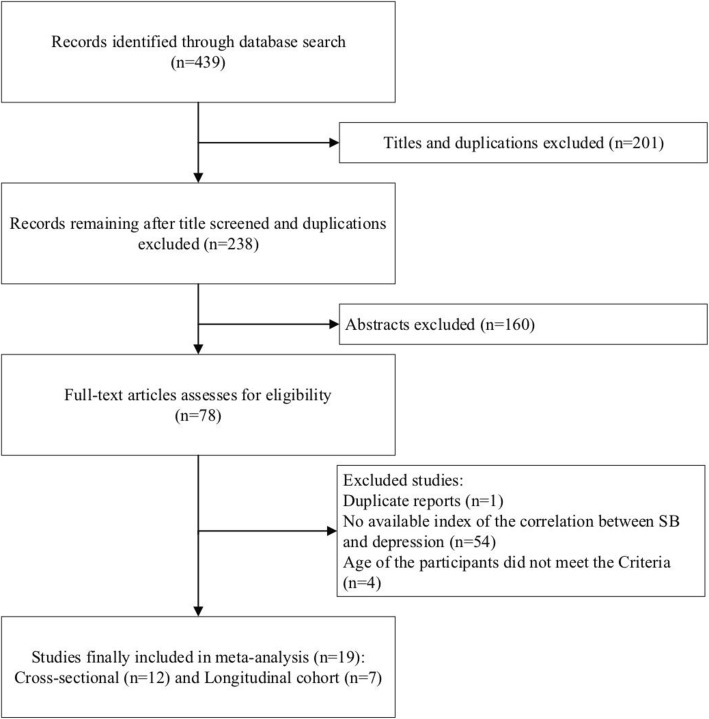
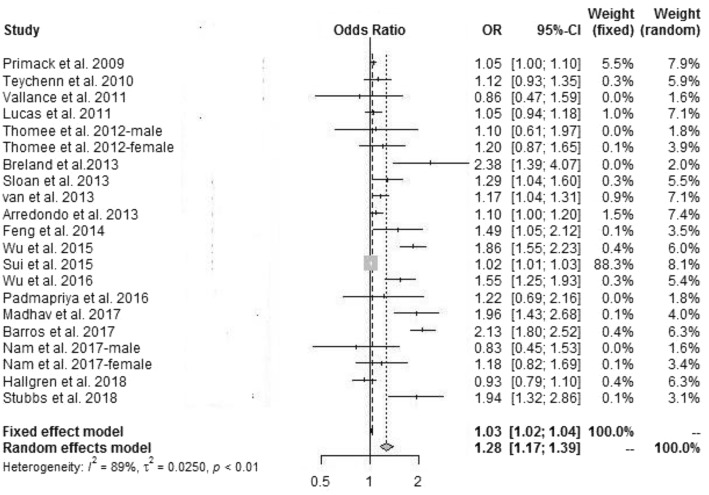
Verification
Claims the paper makes
The claims and statistics of this paper haven’t been checked yet.
Run the check — free, no account needed. It reads the open-access text and checks the sources it cites.
Claims other papers make about this one
Each is checked against this paper’s own text: does it say what the citing paper says it does?
In the citing paper
“More screen time has been associated with depressive symptoms among children and adolescents in several systematic reviews [11, 12, 43–50].”
From Screen time and mental health: a prospective analysis of the Adolescent Brain Cognitive Development (ABCD) Study (2024) · cites this paper as [49]
In the citing paper
“The results of the current review largely align with past systematic reviews, which have concluded that there is a positive association between screen time and depressive symptoms (Hoare et al., 2016;Liu et al., 2016;Stiglic & Viner, 2019;Wang et al., 2019), and a weak association between screen time and both anxiety and self-esteem (Stiglic & Viner, 2019).”
From The relationship between screen time and mental health in young people: A systematic review of longitudinal studies (2021) · cites this paper as Wang et al., 2019
Self-check
Percentages, sums and reported differences re-computed from the paper’s own numbers.
The self-check needs the paper’s full text.
Citations
Cites
Kessler, R. C., Berglund, P., Demler, O., Jin, R., Merikangas, K. R., & Walters, E. E. (2005) · Archives of General Psychiatry · doi:10.1001/archpsyc.62.6.593 · Cited by 20,391
Zhang, Q., Wang, C., Zheng, M., Li, Y., Li, J., Zhang, L., Shang, X., & Yan, C. (2014) · Cerebrovascular Diseases · doi:10.1159/000369778 · Cited by 11,609
Self-citationProjections of Global Mortality and Burden of Disease from 2002 to 2030
Mathers, C. D., & Loncar, D. (2006) · PLoS Medicine · doi:10.1371/journal.pmed.0030442 · Cited by 11,386
Murray, C. J. L., Vos, T., Lozano, R., Naghavi, M., Flaxman, A. D., Michaud, C., Ezzati, M., Shibuya, K., Salomon, J. A., Abdalla, S., et al. (2012) · The Lancet · doi:10.1016/s0140-6736(12)61689-4 · Cited by 8,888
Kessler, R. C., Berglund, P., Demler, O., Jin, R., Koretz, D., Merikangas, K. R., Rush, A. J., Walters, E. E., & Wang, P. S. (2003) · JAMA · doi:10.1001/jama.289.23.3095 · Cited by 7,988
The World Health Report 2002 - Reducing Risks, Promoting Healthy Life
Available, N. A. N. (2003) · Education for Health · doi:10.1080/1357628031000116808 · Cited by 6,078
Internet paradox: A social technology that reduces social involvement and psychological well-being?
Kraut, R., Patterson, M., Lundmark, V., Kiesler, S., Mukophadhyay, T., & Scherlis, W. (1998) · American Psychologist · doi:10.1037/0003-066x.53.9.1017 · Cited by 4,793 · cited 1×
“Another explanation refers to social interaction: prolonged sedentary behaviors, such as television viewing, may lead to social solitude and withdrawal from interpersonal relationships, which have been linked to increased feelings of social anxiety [48].”
BackgroundNo health without mental health
Prince, M. J., Patel, V., Saxena, S., Maj, M., Maselko, J., Phillips, M. R., & Rahman, A. (2007) · The Lancet · doi:10.1016/s0140-6736(07)61238-0 · Cited by 4,028
Kawachi, I. I. (2001) · Journal of Heredity · doi:10.1093/jurban/78.3.458 · Cited by 3,565
Systematic review of sedentary behaviour and health indicators in school-aged children and youth.
Tremblay, M. S., LeBlanc, A. G., Kho, M. E., Saunders, T. J., Larouche, R., Colley, R. C., Goldfield, G., & Gorber, S. (2011) · International Journal of Behavioral Nutrition and Physical Activity · doi:10.1186/1479-5868-8-98 · Cited by 2,085
Cited by
Sorted by citations
Firth, J., Solmi, M., Wootton, R. E., Vancampfort, D., Schuch, F. B., Hoare, E., Gilbody, S., Torous, J., Teasdale, S. B., Jackson, S. E., et al. (2020) · World Psychiatry · doi:10.1002/wps.20773 · Cited by 1,242
Biological, Psychological, and Social Determinants of Depression: A Review of Recent Literature
Remes, O., Mendes, J. F., & Templeton, P. (2021) · Brain Sciences · doi:10.3390/brainsci11121633 · Cited by 482
Maj, M., Stein, D. J., Parker, G., Zimmerman, M., Fava, G. A., De Hert, M., Demyttenaere, K., McIntyre, R. S., Widiger, T., & Wittchen, H. (2020) · World Psychiatry · doi:10.1002/wps.20771 · Cited by 435
Stein, D. J., Shoptaw, S. J., Vigo, D. V., Lund, C., Cuijpers, P., Bantjes, J., Sartorius, N., & Maj, M. (2022) · World Psychiatry · doi:10.1002/wps.20998 · Cited by 331
Tang, S., Werner-Seidler, A., Torok, M., Mackinnon, A. J., & Christensen, H. (2021) · Clinical Psychology Review · doi:10.1016/j.cpr.2021.102021 · Cited by 284
Metadata
- Authors
- Wang, X., Li, Y., & Fan, H.
- Affiliations
- Shanxi Medical University (CN)
- Southern Medical University (CN)
- Corresponding author
- Wang, Xiao
- Fan, Haoliang
- Venue
- BMC Public Health
- Published
- 2019-11-14
- Volume
- 19
- Issue
- 1
- Pages
- 1524-1524
- ISSN
- 1471-2458 (ISSN-L)
- PMC
- PMC6857327
- OpenAlex
- W2988909975
- Cited by
- 299
- References
- 60
- Citations by year
- 2026: 43 · 2025: 49 · 2024: 51 · 2023: 48 · 2022: 53 · 2021: 40 · 2020: 14
- FWCI
- 3.15
- Type
- journal article
- Language
- en
- Open access
- gold
- doi.org
- Locations
- BMC Public Health (publishedVersion, cc-by)
- PubMed Central (publishedVersion, cc-by)
- PubMed (publishedVersion)
- DOAJ (DOAJ: Directory of Open Access Journals) (submittedVersion, cc-by-sa)
- Funders
- Technology Plans to Youth R&D Innovation (QCXM201705)
- Topics
- Health Sciences › Medicine › Public Health, Environmental and Occupational Health › Physical Activity and Health
- Social Sciences › Human Factors and Ergonomics › Ergonomics and Musculoskeletal Disorders
- Social Sciences › Sociology and Political Science › Impact of Technology on Adolescents
- Keywords
- screen time, sedentary behavior, depression, depression risk, gender differences, reference groups, television viewing, computer use
- MeSH terms
- Screen Time, Adolescent, Adult, Aged, Aged, 80 and over, Computers, Cross-Sectional Studies, Depression, Depressive Disorder, Female, Humans, Male, Mental Health, Middle Aged, Television, Exercise, Young Adult, Sedentary Behavior
About these checks
Registry, retraction, Cites and statistics results are computed, not judged, with one exception: a printed reference that no index lists is read once by a model before it counts as a citation error. Claims are extracted by a model and kept only when their quote appears verbatim in the text; each cited source is then checked, with a model’s help, for whether it says what the claim relies on. Those verdicts can be wrong — read the claim’s quote and the cited source before relying on one.
Statistics and arithmetic are recomputed, not judged.
Confidence bands are shown only for fields calibrated on our annotated test set. None is calibrated yet, so no band is shown.
What counts as a claim ›How we measure confidence ›How we check this ›
Are you an author, or do you see a problem with this page? Request a review
