

The DOI matches its Crossref record; 60 of the 60 references it cites were found in a registry or an index.
The associations between screen time-based sedentary behavior and depression: a systematic review and meta-analysis
Open accessAbstract
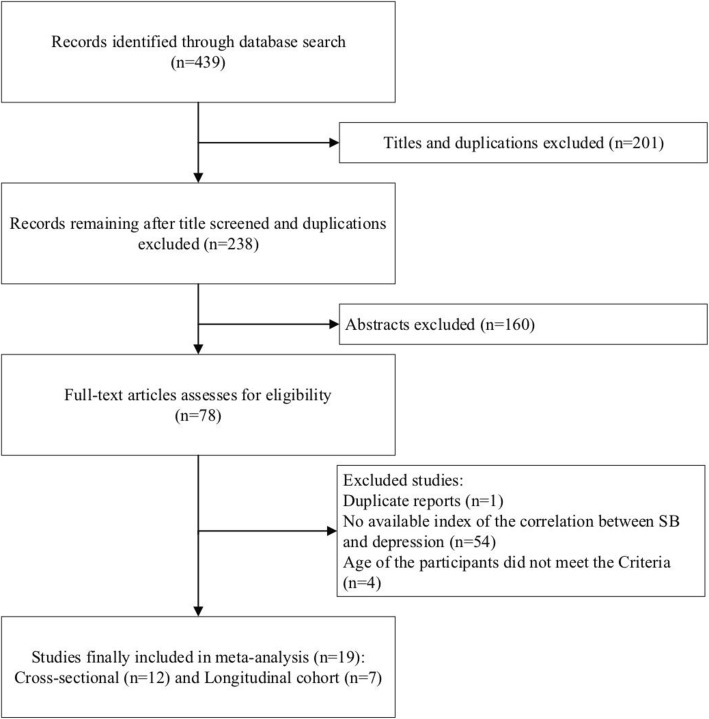
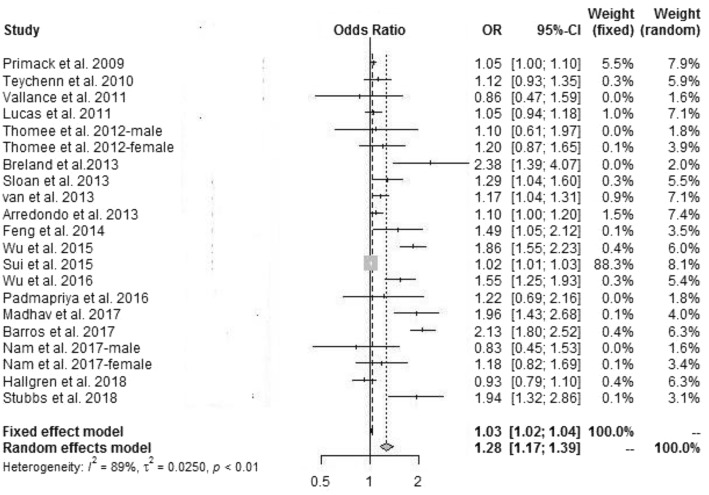
Background: The use of computers/TV has become increasingly common worldwide after entering the twenty-first century and depression represents a growing public health burden. Understanding the association between screen time-based sedentary behavior (ST-SB) and the risk of depression is important to the development of prevention and intervention strategies. Methods: We searched the electronic databases of Medline, Embase and the Cochrane Library. The odds ratio (OR) with corresponding 95% confidence intervals (CIs) was adopted as the pooled measurement. Subgroup analyses were investigated by stratified meta-analyses based on age, gender and reference group (reference category of screen time, e.g. 2 h/day, 4 h/day). Results: There were 12 cross-sectional studies and 7 longitudinal studies met the inclusion criteria. Overall, the pooled OR was 1.28 with high heterogeneity (I 2 = 89%). Compared to those who reported less SB, persons reporting more SB had a significantly higher risk of depression. When the gender was stratified, the pooled OR was 1.18 in female groups while no significant association was observed in males. Among the 19 studies, 5 studies used a reference group with ST = 2 h/days (pooled OR = 1.46), 9 studies used ≥4 h as a reference group (pooled OR = 1.38), 2 studies used 1 h as a reference group (pooled OR = 1.07) and for the remaining 3 studies, hours of ST were calculated as a continuous variable (pooled OR = 1.04). Conclusions: ST-SB is associated with depression risk and the effects vary in different populations. In addition, valid objective measures of SB should be developed in future studies.
Overview
The claims and statistics of this paper haven’t been checked yet.
Run the check — free, no account needed. It reads the open-access text and checks the sources it cites.
Integrity signals
Registry
Cites
Statistics
Figures
Verification
Claims the paper makes
The claims and statistics of this paper haven’t been checked yet.
Run the check — free, no account needed. It reads the open-access text and checks the sources it cites.
Claims other papers make about this one
Each is checked against this paper’s own text: does it say what the citing paper says it does?
In the citing paper
“More screen time has been associated with depressive symptoms among children and adolescents in several systematic reviews [11, 12, 43–50].”
From Screen time and mental health: a prospective analysis of the Adolescent Brain Cognitive Development (ABCD) Study (2024) · cites this paper as [49]
In the citing paper
“The results of the current review largely align with past systematic reviews, which have concluded that there is a positive association between screen time and depressive symptoms (Hoare et al., 2016;Liu et al., 2016;Stiglic & Viner, 2019;Wang et al., 2019), and a weak association between screen time and both anxiety and self-esteem (Stiglic & Viner, 2019).”
From The relationship between screen time and mental health in young people: A systematic review of longitudinal studies (2021) · cites this paper as Wang et al., 2019
Self-check
Percentages, sums and reported differences re-computed from the paper’s own numbers.
The self-check needs the paper’s full text.
Citations
Cites
Kessler, R. C., Berglund, P., Demler, O., Jin, R., Merikangas, K. R., & Walters, E. E. (2005) · Archives of General Psychiatry · doi:10.1001/archpsyc.62.6.593 · Cited by 20,391
Zhang, Q., Wang, C., Zheng, M., Li, Y., Li, J., Zhang, L., Shang, X., & Yan, C. (2014) · Cerebrovascular Diseases · doi:10.1159/000369778 · Cited by 11,609
Self-citationProjections of Global Mortality and Burden of Disease from 2002 to 2030
Mathers, C. D., & Loncar, D. (2006) · PLoS Medicine · doi:10.1371/journal.pmed.0030442 · Cited by 11,386
Murray, C. J. L., Vos, T., Lozano, R., Naghavi, M., Flaxman, A. D., Michaud, C., Ezzati, M., Shibuya, K., Salomon, J. A., Abdalla, S., et al. (2012) · The Lancet · doi:10.1016/s0140-6736(12)61689-4 · Cited by 8,888
Kessler, R. C., Berglund, P., Demler, O., Jin, R., Koretz, D., Merikangas, K. R., Rush, A. J., Walters, E. E., & Wang, P. S. (2003) · JAMA · doi:10.1001/jama.289.23.3095 · Cited by 7,988
The World Health Report 2002 - Reducing Risks, Promoting Healthy Life
Available, N. A. N. (2003) · Education for Health · doi:10.1080/1357628031000116808 · Cited by 6,078
Internet paradox: A social technology that reduces social involvement and psychological well-being?
Kraut, R., Patterson, M., Lundmark, V., Kiesler, S., Mukophadhyay, T., & Scherlis, W. (1998) · American Psychologist · doi:10.1037/0003-066x.53.9.1017 · Cited by 4,793 · cited 1×
“Another explanation refers to social interaction: prolonged sedentary behaviors, such as television viewing, may lead to social solitude and withdrawal from interpersonal relationships, which have been linked to increased feelings of social anxiety [48].”
BackgroundNo health without mental health
Prince, M. J., Patel, V., Saxena, S., Maj, M., Maselko, J., Phillips, M. R., & Rahman, A. (2007) · The Lancet · doi:10.1016/s0140-6736(07)61238-0 · Cited by 4,028
Kawachi, I. I. (2001) · Journal of Heredity · doi:10.1093/jurban/78.3.458 · Cited by 3,565
Systematic review of sedentary behaviour and health indicators in school-aged children and youth.
Tremblay, M. S., LeBlanc, A. G., Kho, M. E., Saunders, T. J., Larouche, R., Colley, R. C., Goldfield, G., & Gorber, S. (2011) · International Journal of Behavioral Nutrition and Physical Activity · doi:10.1186/1479-5868-8-98 · Cited by 2,085
Cited by
Sorted by citations
Firth, J., Solmi, M., Wootton, R. E., Vancampfort, D., Schuch, F. B., Hoare, E., Gilbody, S., Torous, J., Teasdale, S. B., Jackson, S. E., et al. (2020) · World Psychiatry · doi:10.1002/wps.20773 · Cited by 1,242
Biological, Psychological, and Social Determinants of Depression: A Review of Recent Literature
Remes, O., Mendes, J. F., & Templeton, P. (2021) · Brain Sciences · doi:10.3390/brainsci11121633 · Cited by 482
Maj, M., Stein, D. J., Parker, G., Zimmerman, M., Fava, G. A., De Hert, M., Demyttenaere, K., McIntyre, R. S., Widiger, T., & Wittchen, H. (2020) · World Psychiatry · doi:10.1002/wps.20771 · Cited by 435
Stein, D. J., Shoptaw, S. J., Vigo, D. V., Lund, C., Cuijpers, P., Bantjes, J., Sartorius, N., & Maj, M. (2022) · World Psychiatry · doi:10.1002/wps.20998 · Cited by 331
Tang, S., Werner-Seidler, A., Torok, M., Mackinnon, A. J., & Christensen, H. (2021) · Clinical Psychology Review · doi:10.1016/j.cpr.2021.102021 · Cited by 284
Trott, M., Driscoll, R., Iraldo, E., & Pardhan, S. (2022) · eClinicalMedicine · doi:10.1016/j.eclinm.2022.101452 · Cited by 266
“127,133,134 It is therefore recommended that screen time be reduced wherever possible (for example, leisure time screen time) to negate these negative outcomes.”
COVID-19 Confinement and Health Risk Behaviors in Spain
López‐Bueno, R., Calatayud, J., Casaña, J., Casajús, J. A., Smith, L., Tully, M. A., Andersen, L. L., & Sánchez, G. F. L. (2020) · Frontiers in Psychology · doi:10.3389/fpsyg.2020.01426 · Cited by 259
“The high values found in this study for daily screen time far exceed the recommended levels for adults, which could contribute to the experience of mental health disorders such as depression (Wang et al., 2019).”
BackgroundQin, F., Song, Y., Nassis, G. P., Zhao, L., Dong, Y., Zhao, C., Feng, Y., & Zhao, J. (2020) · International Journal of Environmental Research and Public Health · doi:10.3390/ijerph17145170 · Cited by 230
“Screen time exceeding 2 h/day was associated with a higher risk of depression, especially in the female population [34].”
BackgroundOberle, E., Ji, X. R., Kerai, S., Guhn, M., Schonert-Reichl, K. A., & Gadermann, A. M. (2020) · Preventive Medicine · doi:10.1016/j.ypmed.2020.106291 · Cited by 149
Liu, S., Yu, Q., Li, Z., Cunha, P. M., Zhang, Y., Kong, Z., Wang, L., Chen, S., & Cai, Y. (2020) · Frontiers in Psychology · doi:10.3389/fpsyg.2020.554915 · Cited by 161
“When EF are impaired, children generally show abnormalities in social functions, emotions, and cognition (Goodall et al., 2018; Wang et al., 2019), often accompanied by learning difficulties, conduct disorders, and maladaptive phenomena (Rocha et al.”
BackgroundMata, J., Wenz, A., Rettig, T., Reifenscheid, M., Möhring, K., Krieger, U., Friedel, S., Fikel, M., Cornesse, C., Blom, A. G., et al. (2021) · Social Science & Medicine · doi:10.1016/j.socscimed.2021.114333 · Cited by 148
“For example, longer screen times are related to poorer mental health and less physical activity (Allen et al., 2019; Wang et al., 2019).”
Kunugi, H. (2023) · Psychiatry and Clinical Neurosciences · doi:10.1111/pcn.13551 · Cited by 117
“looking at screens such as computers and televisions) and risk of depression.(179) A meta-analysis of studies on children and adolescents also reported an association between screen time and risk of depression, with 1 h per day having the lowest risk and with the risk of depression increasing as the number of hours in…”
BackgroundNagata, J. M., Al-Shoaibi, A. A. A., Leong, A. W., Zamora, G., Testa, A., Ganson, K. T., & Baker, F. C. (2024) · BMC Public Health · doi:10.1186/s12889-024-20102-x · Cited by 103
Digital screen time during the COVID-19 pandemic: a public health concern
Sultana, A., Tasnim, S., Hossain, M. M., Bhattacharya, S., & Purohit, N. (2021) · F1000Research · doi:10.12688/f1000research.50880.1 · Cited by 90
Almohamad, M., Krall, E. A., Mofleh, D. I., & Spartano, N. L. (2022) · Journal Of Clinical Periodontology · doi:10.1111/jcpe.13669 · Cited by 91
Zhang, J., Yang, S. X., Wang, L., Han, L. H., & Wu, X. (2022) · Journal of Affective Disorders · doi:10.1016/j.jad.2022.03.018 · Cited by 99
Musculoskeletal disorders in video gamers – a systematic review
Tholl, C., Bickmann, P., Wechsler, K., Froböse, I., & Grieben, C. (2022) · BMC Musculoskeletal Disorders · doi:10.1186/s12891-022-05614-0 · Cited by 103
“Moreover, plenty of other health risk factors like depression in adults [65] and children [66] or obesity in childhood [67] have been linked to screen-based activities.”
BackgroundBui, C., Lin, L.-Y., Wu, C.-Y., Chiu, Y.-W., & Chiou, H. (2021) · Nutrients · doi:10.3390/nu13082739 · Cited by 87
“As for sedentary behavior, similar to a recent study [55], we classified screen-time-based sedentary behavior as spending ≥2 h/day watching TV, playing video games, or using a computer/mobile phone.”
MethodCombined healthy lifestyle and depressive symptoms: a meta-analysis of observational studies
Wang, X., Arafa, A., Liu, K., Eshak, E. S., Hu, Y., & Dong, J.-Y. (2021) · Journal of Affective Disorders · doi:10.1016/j.jad.2021.04.030 · Cited by 69
“On the contrary, compared with those who reported less screen time-based sedentary behavior, persons reporting more sedentary behavior had a higher risk of depression (1.28 [1.17, 1.39]) (Wang et al., 2019).”
InfluentialSelf-citationScreen time and depression risk: A meta-analysis of cohort studies
Li, L., Zhang, Q., Zhu, L., Zeng, G., Huang, H., Zhuge, J., Kuang, X., Yang, S., Yang, D., Chen, Z., et al. (2022) · Frontiers in Psychiatry · doi:10.3389/fpsyt.2022.1058572 · Cited by 71
Paquin, V., Ferrari, M., Sekhon, H., & Rej, S. (2023) · JMIR Serious Games · doi:10.2196/43388 · Cited by 68
Sobolewska-Nowak, J., Wachowska, K., Nowak, A., Orzechowska, A., Szulc, A., Płaza, O., & Gałecki, P. (2023) · Biomedicines · doi:10.3390/biomedicines11071903 · Cited by 72
“Research has shown that physical inactivity can be considered a risk factor for depression [62].”
BackgroundFinnerty, R., Marshall, S. A., Imbault, C., & Trainor, L. J. (2021) · Frontiers in Psychology · doi:10.3389/fpsyg.2021.647402 · Cited by 82
Bourke, M., Wang, H., McNaughton, S. A., Thomas, G., Firth, J., Trott, M., & Cairney, J. (2025) · Clinical Psychology Review · doi:10.1016/j.cpr.2025.102585 · Cited by 65
Luo, Y., Li, Y., Xie, J., Duan, Y., Gan, G., Zhou, Y., Luo, X., Wang, J., Chen, Z., Zhang, Q., et al. (2022) · Journal of Affective Disorders · doi:10.1016/j.jad.2022.04.102 · Cited by 59
Self-citationDong, X., Ding, L., Zhang, R., Ding, M., Wang, B., & Yi, X. (2021) · Frontiers in Pediatrics · doi:10.3389/fped.2021.722079 · Cited by 64
Hammoudi, S. F., Mreydem, H. W., Ali, B. T. A., Saleh, N. O., Chung, S., Hallit, S. R., & Salameh, P. (2021) · Psychiatry Investigation · doi:10.30773/pi.2021.0120 · Cited by 50
Kandola, A., Owen, N., Dunstan, D. W., & Hallgren, M. (2022) · Psychological Medicine · doi:10.1017/s0033291721000258 · Cited by 48
“Another meta-analysis that included adults also found the association between screen time and depressive symptoms was not present in males (Wang, Li, & Fan, 2019).”
BackgroundValidated assessment tools for screen media use: a systematic review.
Perez, O., Garza, T., Hindera, O., Beltran, A., Musaad, S. M., Dibbs, T., Singh, A., Chug, S., Sisson, A., Kumar Vadathya, A., et al. (2023) · PLoS ONE · doi:10.1371/journal.pone.0283714 · Cited by 44
Yang, M.-B., Si, S., Zhang, K., Xi, M., & Zhang, W. (2024) · PsyCh Journal · doi:10.1002/pchj.756 · Cited by 54
“…relationship between physical exercise and mental health based on the sum-scores of psychological scales, the exact relationship between physical exercise and mental health remains unclear (Do et al., 2022; Recchia et al., 2023; Rossi et al., 2021; Vaquero-Solís et al., 2020; Wang et al., 2019).”
BackgroundMarino, C., Andrade, B. F., Montplaisir, J., Petit, D., Touchette, E., Paradis, H., Côté, S., Tremblay, R., Szatmari, P., & Boivin, M. (2022) · JAMA Network Open · doi:10.1001/jamanetworkopen.2022.27119 · Cited by 39
Kaewpradit, K., Ngamchaliew, P., & Buathong, N. (2025) · Frontiers in Psychiatry · doi:10.3389/fpsyt.2025.1535631 · Cited by 69
Lewis, R., Roden, L. C., Scheuermaier, K. D., Gómez-Olivé, F. X., Rae, D. E., Iacovides, S., Bentley, A., Davy, J., Christie, C. J.-A., Zschernack, S., et al. (2021) · Scientific Reports · doi:10.1038/s41598-021-02021-8 · Cited by 47
“Page 6/27 Before Lockdown During Lockdown ISI score 4 (0, 26)f 10 (0, 28)f Bedtime regularity 2 (1, 7)f 4 (1, 7)f Wake-up time regularity 1 (1, 7)f 3 (1, 7)f Sleep duration regularity 2 (1, 7)f 4 (1, 7)f MPA (min/day) 30 (0, 180)a 10 (0, 180)b VPA (min/day) 30 (0, 180)a 15 (0, 180)b Total screen time (min/day) 464 ± 2…”
Sedentary Behavior and Lack of Physical Activity among Children in Indonesia
Hanifah, L., Nasrulloh, N., & Sufyan, D. L. (2023) · Children · doi:10.3390/children10081283 · Cited by 124
“Unfortunately, this sedentary lifestyle has serious consequences for physical and mental health [45,46].”
BackgroundInternational trends in screen-based behaviours from 2012 to 2019
Harvey, D. L., Milton, K. E., Jones, A., & Atkin, A. J. (2021) · Preventive Medicine · doi:10.1016/j.ypmed.2021.106909 · Cited by 40
“research has linked higher amounts of screen time with negative physical and psychological health outcomes, including cardiovascular disease, all-cause mortality and depression (LeBlanc et al., 2017; Stamatakis et al., 2011; Wang et al., 2019).”
BackgroundLu, S., Cheval, B., Yu, Q., Hossain, M. M., Chen, S., Taylor, A., Bao, R., Doig, S. R., Li, J., Wang, T., et al. (2021) · Healthcare · doi:10.3390/healthcare9111532 · Cited by 41
“Such a newly developed research paradigm can help researchers to understand the association of meeting the 24-HMB guidelines with health outcomes in a more comprehensive manner [11,12,23].”
BackgroundPeiris, C. L., O’Donoghue, G., Rippon, L., Meyers, D., Hahne, A., De Noronha, M., Lynch, J., & Hanson, L. C. (2021) · International Journal of Environmental Research and Public Health · doi:10.3390/ijerph18115589 · Cited by 38
“Introduction High volumes of sedentary behaviour are associated with increased risk of poor health outcomes including all-cause mortality, obesity, cardiovascular disease, type 2 diabetes mellitus, cancer [1], depression [2] and anxiety [3].”
BackgroundSaunders, T. J., McIsaac, T., Campbell, J., Douillette, K., Janssen, I., Tomasone, J. R., Ross‐White, A., Prince, S. A., & Chaput, J. (2022) · Health Promotion and Chronic Disease Prevention in Canada · doi:10.24095/hpcdp.42.4.03 · Cited by 45
Effects of limiting digital screen use on well-being, mood, and biomarkers of stress in adults
Pedersen, J., Rasmussen, M. G. B., Sørensen, S. O., Mortensen, S. R., Olesen, L. G., Brage, S., Kristensen, P. L., Puterman, E. M., & Grøntved, A. (2022) · npj Mental Health Research · doi:10.1038/s44184-022-00015-6 · Cited by 39
Luo, L., Cao, Y., Hu, Y., Wen, S., Tang, K., Ding, L., & Song, N. (2022) · International Journal of Environmental Research and Public Health · doi:10.3390/ijerph192013407 · Cited by 39
“Previous studies carried out have found that the three guidelines of adequate physical activity (PA ≥ 150 min/week) [11,12], restricted sedentary time (sedentary time ≤ 480 min/day, and/or screen time ≤180 min/day) [13,14] and good sleep duration (to meet age-specific needs) [15,16] were each associated with physical…”
BackgroundDigital screen time during COVID-19 pandemic: A public health concernPreprint
Sultana, A., Tasnim, S., Bhattacharya, S., Hossain, M. M., & Purohit, N. (2020) · doi:10.31235/osf.io/e8sg7 · Cited by 36
The relationships between screen time and mental health problems among Chinese adults
Zhang, Y., Li, Q., Hu, W., Zhan, N., Zou, J., Wang, J., & Geng, F. (2021) · Journal of Psychiatric Research · doi:10.1016/j.jpsychires.2021.11.017 · Cited by 41
Johnstad, P. G. (2024) · Frontiers in Public Health · doi:10.3389/fpubh.2023.1268339 · Cited by 37
Cao, R., Gao, T.-T., Ren, H., Hu, Y.-Y., Qin, Z.-Y., Liang, L., Li, C., & Mei, S.-L. (2021) · International Journal of Social Psychiatry · doi:10.1177/0020764021996739 · Cited by 27
“In China, smoking and drinking among adolescents have been commonly reported (Wang et al., 2019).”
BackgroundBarbosa, B. C. R., de Menezes-Júnior, L. A. A., de Paula, W., Chagas, C. M. D. S., Machado, E. L., de Freitas, E. D., Cardoso, C. S., Vidigal, F. D. C., Nobre, L. N., da Silva, L. S., et al. (2024) · BMC Public Health · doi:10.1186/s12889-024-19345-5 · Cited by 41
“Epidemiological studies have demonstrated that increased time spent on SB is associated with adverse health outcomes, including chronic non-communicable diseases (NCDs), mental disorders, and premature mortality [14, 30, 31].”
BackgroundInfluentialLu, M., Li, M., Yi, L., Li, F., Feng, L., Ji, T., Zang, Y., & Qiu, J. (2022) · Journal of Exercise Science & Fitness · doi:10.1016/j.jesf.2022.01.001 · Cited by 36
Kayrouz, R., Karin, E., Staples, L., Dear, B. F., Nielssen, O. B., & Titov, N. (2025) · BMC Psychiatry · doi:10.1186/s12888-025-06848-7 · Cited by 45
Almeida, D., Monteiro, D., & Rodrigues, F. F. (2021) · Healthcare · doi:10.3390/healthcare9070787 · Cited by 30
Dog ownership and adults’ objectively-assessed sedentary behaviour and physical activity
Koohsari, M. J., Shibata, A., Ishii, K., Kurosawa, S., Yasunaga, A., Hanibuchi, T., Nakaya, T., McCormack, G. R., & Oka, K. (2020) · Scientific Reports · doi:10.1038/s41598-020-74365-6 · Cited by 30
Liu, N., Wang, Y., & Li, Z. (2024) · Journal of Affective Disorders · doi:10.1016/j.jad.2024.01.201 · Cited by 27
Nighttime smartphone use, sleep quality, and mental health: investigating a complex relationship
Andersen, T. O., Sejling, C., Jensen, A. K., Drews, H. J., Ritz, B. R., Varga, T. V., & Rod, N. H. (2023) · SLEEP · doi:10.1093/sleep/zsad256 · Cited by 31
The Associations Between Screen Time and Mental Health in Adults: A Systematic Review
Santos, R. M. S., Ventura, S. D. A., Nogueira, Y. J. D. A., Mendes, C. G., de Paula, J. J., de Miranda, D. M., & Romano‐Silva, M. A. (2024) · Journal of Technology in Behavioral Science · doi:10.1007/s41347-024-00398-7 · Cited by 38
“Currently, and even before the conditions of isolation, adults study or work in front of computers (Wang et al., 2019).”
The effect of two types of combined training on bio-motor ability adaptations in sedentary females
Nobarı, H., Ahmadi, M., Sá, M., Pérez‐Gómez, J., Clemente, F. M., Adsuar, J. C., Minasian, V., & Afonso, J. R. (2021) · The Journal of Sports Medicine and Physical Fitness · doi:10.23736/s0022-4707.20.11736-5 · Cited by 26
Varela, A., Vale, R. F., & Gómez, S. L. (2021) · Estudios sobre Educación · doi:10.15581/004.41.001 · Cited by 25
Fan, H., Zeng, Y., Wu, W., Liu, H., Xu, Q., Du, W., Hao, H., Liu, C., Ren, W., Wu, W., et al. (2021) · Electrophoresis · doi:10.1002/elps.202100037 · Cited by 25
Self-citationPérez-Lasierra, J. L., Moreno‐Franco, B., González‐Agüero, A., Lobo, E., & Casajús, J. A. (2022) · Scientific Reports · doi:10.1038/s41598-022-05563-7 · Cited by 22
Coping strategies for COVID-19 pandemic-related stress and mental health during pregnancy
Badon, S. E., Croen, L., Ferrara, A. M., Ames, J., Hedderson, M. M., Young‐Wolff, K. C., Zhu, Y., & Avalos, L. A. (2022) · Journal of Affective Disorders · doi:10.1016/j.jad.2022.04.146 · Cited by 24
Teno, S. C., Silva, M. N., & Júdice, P. B. (2024) · Advances in Mental Health · doi:10.1080/18387357.2024.2324099 · Cited by 25
Santos, J. P. L., Soehner, A. M., Biernesser, C. L., Ladouceur, C. D., & Versace, A. (2025) · Archives of Pediatrics and Adolescent Medicine · doi:10.1001/jamapediatrics.2025.1718 · Cited by 25
Meng, Z., Ao, B., Wang, W., Niu, T., Chen, Y., Ma, X., & Huang, Y. (2024) · Frontiers in Psychiatry · doi:10.3389/fpsyt.2024.1441191 · Cited by 22
Balanzá‐Martínez, V., & Cervera-Martínez, J. (2022) · International Journal of Environmental Research and Public Health · doi:10.3390/ijerph19095094 · Cited by 23
“In other studies, individuals who spent at least two hours per day of ST-based sedentary behavior were more likely to have depression [53].”
BackgroundDraper, C. E., Cook, C. J., Redinger, S., Rochat, T., Prioreschi, A., Rae, D. E., Ware, L. J., Lye, S. J., & Norris, S. A. (2022) · International Journal of Behavioral Nutrition and Physical Activity · doi:10.1186/s12966-022-01325-w · Cited by 27
“Evidence also exists for the inverse relationship between sedentary behaviour and mental health in adults [23, 24] and adolescents [22, 25, 26].”
BackgroundLund, J., Berring-Uldum, A. A., Colak, M., & Debes, N. M. (2021) · Neuropediatrics · doi:10.1055/s-0041-1740550 · Cited by 21
Li, T. M. H., Chan, N. Y., Li, C.-T., Chen, J., Chan, J. W. Y., Liu, Y., Li, S. X., Li, A. M., Zhang, J., & Wing, Y. K. (2022) · Frontiers in Psychiatry · doi:10.3389/fpsyt.2022.892583 · Cited by 21
Tashiro, T., Maeda, N., Tsutsumi, S., Komiya, M., Arima, S., Mizuta, R., Fukui, K., Nishikawa, Y., & Urabe, Y. (2022) · BMC Psychiatry · doi:10.1186/s12888-022-03997-x · Cited by 20
“Prolonged screen time-based sedentary behavior can affect the prevalence of depression by impairing biological functions such as central nervous system arousal and sleep disorders [10].”
BackgroundTsou, M.-T. (2022) · International Journal of Environmental Research and Public Health · doi:10.3390/ijerph19073770 · Cited by 19
“People who spend more than four hours using VDTs are at a higher risk of developing depression [14].”
BackgroundKohl, I. S., Luft, V. C., Patrão, A. L., Molina, M. D. C. B., Nunes, M. A., & Schmidt, M. I. (2022) · Journal of Affective Disorders · doi:10.1016/j.jad.2022.09.059 · Cited by 19
Gender Differences in Excessive Screen Time among Chinese High School Students in Henan Province
Cui, Z., Zou, P., Lin, Z., Cao, Y., & Luo, Y. (2022) · International Journal of Environmental Research and Public Health · doi:10.3390/ijerph20010721 · Cited by 19
“Excessive ST may reduce social interaction and engagement, thus increasing the risk of mental health problems, such as feelings of loneliness, the likelihood of depression, and anxiety [39].”
BackgroundHow much time in sedentary behavior is associated with probable sarcopenia in older adults?
de Souza, L. F., Danielewicz, A. L., Rech, C. R., d’Orsi, E., Mendonça, V. A., Lacerda, A. C. R., & de Avelar, N. C. P. (2022) · Geriatric Nursing · doi:10.1016/j.gerinurse.2022.09.007 · Cited by 19
Ashizawa, R., Honda, H., Yoshizawa, K., Kameyama, Y., & Yoshimoto, Y. (2022) · Journal of Stroke and Cerebrovascular Diseases · doi:10.1016/j.jstrokecerebrovasdis.2022.106641 · Cited by 19
Kanning, M. K., Niermann, C. Y. N., Ebner-Primer, U., & Giurgiu, M. (2021) · International Journal of Behavioral Nutrition and Physical Activity · doi:10.1186/s12966-021-01170-3 · Cited by 18
“A further meta-anlyses confirmed these findings but indicate a significant associations only in femals but not in males [15].”
ResultWilson, M. J., Seidler, Z. E., Oliffe, J. L., Toogood, N., Kealy, D., Ogrodniczuk, J. S., Walther, A., & Rice, S. (2022) · American Journal of Men s Health · doi:10.1177/15579883221099794 · Cited by 17
“This is potentially explained by increasing societal understanding of associations between excessive screen time and psychological distress (Wang et al., 2019).”
BackgroundRoy, S., Iktidar, M. A., Chowdhury, S., Pulock, O. S., Pinky, S. D., & Sharif, A. B. (2024) · BMJ Neurology Open · doi:10.1136/bmjno-2024-000656 · Cited by 16
Barros, M. B. D. A., Medina, L. D. P. B., Lima, M. G., de Azevedo, R. C. S., Sousa, N. F. D. S., & Malta, D. C. (2021) · Revista Brasileira de Epidemiologia · doi:10.1590/1980-549720210010.supl.2 · Cited by 21
Júdice, P. B., Sousa‐Sá, E., & Palmeira, A. L. (2023) · Journal of Prevention · doi:10.1007/s10935-023-00724-4 · Cited by 21
“Research has shown, quite consistently, that increased screen time (from 3 to 4 h/day) is associated with multiple adverse health outcomes (Dunstan et al., 2010; Wang et al., 2019) and all cause mortality (Celis-Morales et al., 2018), irrespective of PA levels.”
BackgroundSitting vs. standing: an urgent need to rebalance our world
Bonnet, C. T., & Cheval, B. (2022) · Health Psychology Review · doi:10.1080/17437199.2022.2150673 · Cited by 18
“…2019; Jones et al., 2019; Katzmarzyk et al., 2019; Labonté-LeMoyne et al., 2020; Magnon et al., 2018; Melvin et al., 2020; Patterson et al., 2018; Wang et al., 2019), cancers (Jones et al., 2019; Katzmarzyk et al., 2019; Magnon et al., 2018; Melvin et al., 2020; Owen et al., 2020; Patterson et…”
BackgroundInfluentialChen, M., Padmapriya, N., Chua, X. H., Escobosa, L. L. T., Tay, A. E., Tai, B. C., Petrunoff, N., & Müller‐Riemenschneider, F. (2024) · BMC Public Health · doi:10.1186/s12889-024-19608-1 · Cited by 18
“Past studies on television SV have produced inconsistent findings [20, 22, 58].”
BackgroundWang, D., Zhang, Y., Guo, Z., & Lu, S. (2025) · Frontiers in Psychology · doi:10.3389/fpsyg.2025.1542340 · Cited by 15
Mattiello, R., Ayala, C. O., Pedron, F. F., Ferreira, I. C. S., Ley, L. L. G., Paungartner, L. M., Martins, M. D. S., Bagatini, M. A., Batista, N. O. W., Cecagno, P. O. M., et al. (2022) · BMJ Open · doi:10.1136/bmjopen-2022-063902 · Cited by 17
Hökby, S., Westerlund, J., Alvarsson, J., Carli, V., & Hadlaczky, G. (2023) · International Journal of Environmental Research and Public Health · doi:10.3390/ijerph20043771 · Cited by 16
“A meta-analysis [34] further showed that pooled associations between screen-”
BackgroundLiang, Y., Jin, Q., Miao, J., Ni, X., Qian, X., Yi, X., Liu, Z., & Xue, H. (2024) · BMC Public Health · doi:10.1186/s12889-024-17722-8 · Cited by 19
“We also observed gender differences in the association between ST and MHP. Specifically, at the same level of ST (2–4 h/day), a slightly stronger association with MHP was observed in girls, these findings were in line with previous research [52, 53].”
ResultZarza-Rebollo, J. A., Molina, E., López‐Isac, E., Pérez-Gutiérrez, A. M., Gutiérrez, B., Cervilla, J. A., & Rivera, M. (2022) · International Journal of Environmental Research and Public Health · doi:10.3390/ijerph19042068 · Cited by 15
“Similarly, another recent meta-analysis reported an increased risk of developing depression when sedentary behaviour was higher [11].”
BackgroundResult24-Hour Rest-Activity Rhythm in Middle-Aged and Older Persons with Depression
Hayashi, M., Takeshima, M., Hosoya, T., & Kume, Y. (2023) · International Journal of Environmental Research and Public Health · doi:10.3390/ijerph20075275 · Cited by 14
“In a cross-sectional study targeting community-dwellers with mild to moderate depression and anxiety, longer sedentary times during 24 h daily periods were observed [7], and longer screen-times associated with sedentary behaviors were reported in a systematic review [8].”
BackgroundPrakasha, G. S., Kenneth, A., & Lapina, M. (2023) · Kontakt · doi:10.32725/kont.2023.021 · Cited by 14
“This is essentially a matter of concern for parents and teachers, because it is affecting students’ academic performance as well as their mental health (Adelantado‐Renau et al., 2019a; Horowitz-Kraus and Hutton, 2018; Kim et al., 2020; Wang et al., 2019).”
BackgroundYang, Y., Wang, Y., & Yang, L. (2024) · Journal of Affective Disorders · doi:10.1016/j.jad.2024.09.012 · Cited by 14
Wiguna, T., Minayati, K., Kaligis, F., Teh, S. D., Sourander, A., Dirjayanto, V. J., Krishnandita, M., Meriem, N., & Gilbert, S. (2024) · Heliyon · doi:10.1016/j.heliyon.2023.e23325 · Cited by 13
Finn, S., Bone, J. K., Fancourt, D. E., Warran, K., & Mak, H. W. (2025) · The Journals of Gerontology Series B · doi:10.1093/geronb/gbaf074 · Cited by 12
“Additionally, screen time (e.g., TV viewing) has been associated with poorer mental health (Wang et al., 2019) and cognitive decline (Fancourt & Steptoe, 2019b), which may also explain these differences.”
AlKhenaizi, A. K., Shakeeb, F. N., Fredericks, S., & Gaynor, D. (2025) · BMJ Open · doi:10.1136/bmjopen-2024-093655 · Cited by 17
Sakakibara, K. S., Miyanaka, D., Tokita, M., KAWADA, M., Mori, N., Hamsyah, F., Lin, Y., & Shimazu, A. (2023) · Journal of Occupational and Environmental Medicine · doi:10.1097/jom.0000000000002952 · Cited by 13
Bae, S., Jang, M., Kim, G.-M., Yang, J., Thapa, N., Park, H.-J., & Park, H. (2023) · Journal of Clinical Medicine · doi:10.3390/jcm12186009 · Cited by 13
“Patients with depression are typically inactive, and a sedentary lifestyle increases the risk of depression [3,4].”
Blaine, R. E., Bowling, A. B., Kaur, R., & Davison, K. K. (2021) · Childhood Obesity · doi:10.1089/chi.2020.0335 · Cited by 14
“30 However, perhaps especially troubling children with N/MHD is that increased screen time is also associated with reduced psychological well-being, 31 slowed learning, 32 and reduced cognitive development.”
Çiftçi, B., & Demirhan, F. (2022) · International Journal of Occupational Safety and Ergonomics · doi:10.1080/10803548.2022.2090132 · Cited by 13
Schroyer, D. (2020) · The Gerontologist · doi:10.1093/geront/gnaa095 · Cited by 13
Teuber, M., Leyhr, D., Moll, J., & Sudeck, G. (2022) · Frontiers in Sports and Active Living · doi:10.3389/fspor.2022.1024996 · Cited by 11
“Technological advances allowing students to study in the comfort of their own homes without changing locations, as well as higher screen time have also led to an increase in sedentary behaviors (6, 7).”
BackgroundIssa, R., Sfeir, M., Azzi, V., Salameh, P., Akiki, M., Akel, M., Hallit, S. R., Obeïd, S., Malaeb, D. N., & Hallit, R. R. (2023) · Healthcare · doi:10.3390/healthcare11192674 · Cited by 14
“Screen time was also positively 278 correlated with anxiety and depressive symptoms, as well as insomnia [27,42,43].”
González, R. L., Noriega, C., Espín‐Lorite, E. J., García-Sastre, M., Rodríguez‐Rojo, I. C., Cuesta‐Lozano, D., & Peñacoba, C. (2022) · International Journal of Mental Health Nursing · doi:10.1111/inm.13077 · Cited by 14
Liu, S., Coulter, R., Sui, W., Nuss, K. J., & Rhodes, R. E. (2023) · Applied Physiology, Nutrition, and Metabolism · doi:10.1139/apnm-2022-0379 · Cited by 15
Barbosa, B. C. R., de Menezes-Júnior, L. A. A., Fróis, L. F., Vidigal, M. C. A., de Paula, W., Chagas, C. M. D. S., Machado, E. L., Nobre, L. N., de Freitas, E. D., Vidigal, F. D. C., et al. (2025) · BMC Public Health · doi:10.1186/s12889-025-23523-4 · Cited by 13
“In contrast, SB, has been identified as a risk factor for mental disorders in the population [47, 49, 51, 52].”
Henríquez‐Beltrán, M., Zapata-Lamana, R., Ibarra-Mora, J., Sepúlveda-Martin, S., Martínez-González, L., & Cigarroa, I. (2022) · Andes pediatrica · doi:10.32641/andespediatr.v93i2.3734 · Cited by 11
“Resolución de tareas complejas†† Me cuesta mucho 45 (11,4) 64 (18,9) 109 (14,9) Tengo algunos problemas 146 (37,0) 133 (39,3) 279 (38,1) No tengo problemas 204 (51,6) 141 (41,7) 345 (47,1,)”
Bui, C., Lin, L.-Y., Lin, C.-J., Chiu, Y.-W., & Chiou, H.-Y. (2023) · Frontiers in Public Health · doi:10.3389/fpubh.2023.1049836 · Cited by 11
“There was additional evidence of the dose-response relationship between screen-based sedentary behavior and depression (15, 35).”
Background
Metadata
- Authors
- Wang, X., Li, Y., & Fan, H.
- Affiliations
- Shanxi Medical University (CN)
- Southern Medical University (CN)
- Corresponding author
- Wang, Xiao
- Fan, Haoliang
- Venue
- BMC Public Health
- Published
- 2019-11-14
- Volume
- 19
- Issue
- 1
- Pages
- 1524-1524
- ISSN
- 1471-2458 (ISSN-L)
- PMC
- PMC6857327
- OpenAlex
- W2988909975
- Cited by
- 299
- References
- 60
- Citations by year
- 2026: 43 · 2025: 49 · 2024: 51 · 2023: 48 · 2022: 53 · 2021: 40 · 2020: 14
- FWCI
- 3.15
- Type
- journal article
- Language
- en
- Open access
- gold
- doi.org
- Locations
- BMC Public Health (publishedVersion, cc-by)
- PubMed Central (publishedVersion, cc-by)
- PubMed (publishedVersion)
- DOAJ (DOAJ: Directory of Open Access Journals) (submittedVersion, cc-by-sa)
- Funders
- Technology Plans to Youth R&D Innovation (QCXM201705)
- Topics
- Health Sciences › Medicine › Public Health, Environmental and Occupational Health › Physical Activity and Health
- Social Sciences › Human Factors and Ergonomics › Ergonomics and Musculoskeletal Disorders
- Social Sciences › Sociology and Political Science › Impact of Technology on Adolescents
- Keywords
- screen time, sedentary behavior, depression, depression risk, gender differences, reference groups, television viewing, computer use
- MeSH terms
- Screen Time, Adolescent, Adult, Aged, Aged, 80 and over, Computers, Cross-Sectional Studies, Depression, Depressive Disorder, Female, Humans, Male, Mental Health, Middle Aged, Television, Exercise, Young Adult, Sedentary Behavior
About these checks
Registry, retraction, Cites and statistics results are computed, not judged, with one exception: a printed reference that no index lists is read once by a model before it counts as a citation error. Claims are extracted by a model and kept only when their quote appears verbatim in the text; each cited source is then checked, with a model’s help, for whether it says what the claim relies on. Those verdicts can be wrong — read the claim’s quote and the cited source before relying on one.
Statistics and arithmetic are recomputed, not judged.
Confidence bands are shown only for fields calibrated on our annotated test set. None is calibrated yet, so no band is shown.
What counts as a claim ›How we measure confidence ›How we check this ›
Are you an author, or do you see a problem with this page? Request a review
