

The DOI matches its Crossref record; 60 of the 60 references it cites were found in a registry or an index.
The associations between screen time-based sedentary behavior and depression: a systematic review and meta-analysis
Open accessAbstract
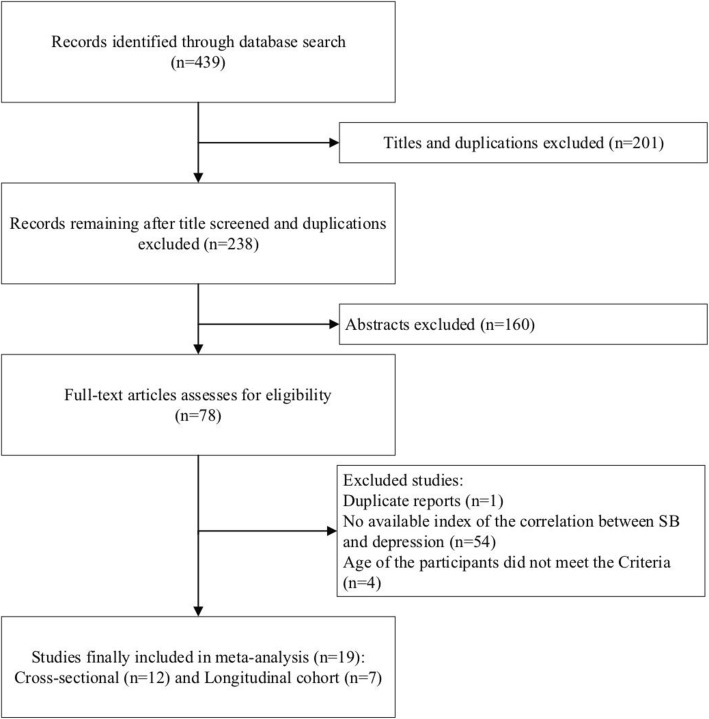
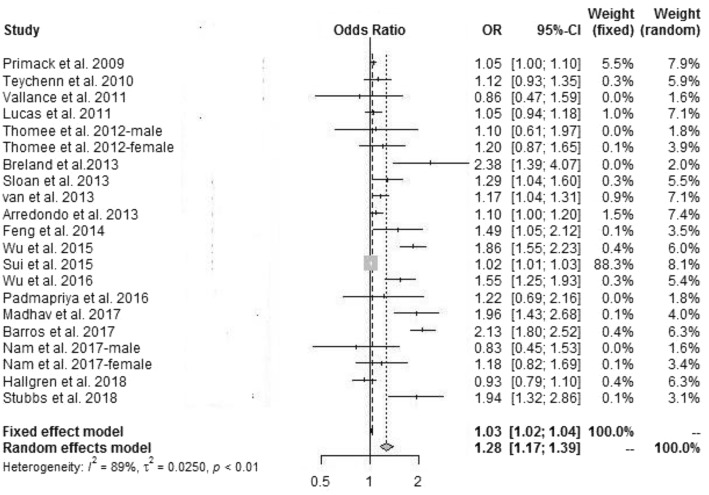
Background: The use of computers/TV has become increasingly common worldwide after entering the twenty-first century and depression represents a growing public health burden. Understanding the association between screen time-based sedentary behavior (ST-SB) and the risk of depression is important to the development of prevention and intervention strategies. Methods: We searched the electronic databases of Medline, Embase and the Cochrane Library. The odds ratio (OR) with corresponding 95% confidence intervals (CIs) was adopted as the pooled measurement. Subgroup analyses were investigated by stratified meta-analyses based on age, gender and reference group (reference category of screen time, e.g. 2 h/day, 4 h/day). Results: There were 12 cross-sectional studies and 7 longitudinal studies met the inclusion criteria. Overall, the pooled OR was 1.28 with high heterogeneity (I 2 = 89%). Compared to those who reported less SB, persons reporting more SB had a significantly higher risk of depression. When the gender was stratified, the pooled OR was 1.18 in female groups while no significant association was observed in males. Among the 19 studies, 5 studies used a reference group with ST = 2 h/days (pooled OR = 1.46), 9 studies used ≥4 h as a reference group (pooled OR = 1.38), 2 studies used 1 h as a reference group (pooled OR = 1.07) and for the remaining 3 studies, hours of ST were calculated as a continuous variable (pooled OR = 1.04). Conclusions: ST-SB is associated with depression risk and the effects vary in different populations. In addition, valid objective measures of SB should be developed in future studies.
Overview
The claims and statistics of this paper haven’t been checked yet.
Run the check — free, no account needed. It reads the open-access text and checks the sources it cites.
Integrity signals
Registry
Cites
Statistics
Figures
Verification
Claims the paper makes
The claims and statistics of this paper haven’t been checked yet.
Run the check — free, no account needed. It reads the open-access text and checks the sources it cites.
Claims other papers make about this one
Each is checked against this paper’s own text: does it say what the citing paper says it does?
In the citing paper
“More screen time has been associated with depressive symptoms among children and adolescents in several systematic reviews [11, 12, 43–50].”
From Screen time and mental health: a prospective analysis of the Adolescent Brain Cognitive Development (ABCD) Study (2024) · cites this paper as [49]
In the citing paper
“The results of the current review largely align with past systematic reviews, which have concluded that there is a positive association between screen time and depressive symptoms (Hoare et al., 2016;Liu et al., 2016;Stiglic & Viner, 2019;Wang et al., 2019), and a weak association between screen time and both anxiety and self-esteem (Stiglic & Viner, 2019).”
From The relationship between screen time and mental health in young people: A systematic review of longitudinal studies (2021) · cites this paper as Wang et al., 2019
Self-check
Percentages, sums and reported differences re-computed from the paper’s own numbers.
The self-check needs the paper’s full text.
Citations
Cites
Kessler, R. C., Berglund, P., Demler, O., Jin, R., Merikangas, K. R., & Walters, E. E. (2005) · Archives of General Psychiatry · doi:10.1001/archpsyc.62.6.593 · Cited by 20,391
Zhang, Q., Wang, C., Zheng, M., Li, Y., Li, J., Zhang, L., Shang, X., & Yan, C. (2014) · Cerebrovascular Diseases · doi:10.1159/000369778 · Cited by 11,609
Self-citationProjections of Global Mortality and Burden of Disease from 2002 to 2030
Mathers, C. D., & Loncar, D. (2006) · PLoS Medicine · doi:10.1371/journal.pmed.0030442 · Cited by 11,386
Murray, C. J. L., Vos, T., Lozano, R., Naghavi, M., Flaxman, A. D., Michaud, C., Ezzati, M., Shibuya, K., Salomon, J. A., Abdalla, S., et al. (2012) · The Lancet · doi:10.1016/s0140-6736(12)61689-4 · Cited by 8,888
Kessler, R. C., Berglund, P., Demler, O., Jin, R., Koretz, D., Merikangas, K. R., Rush, A. J., Walters, E. E., & Wang, P. S. (2003) · JAMA · doi:10.1001/jama.289.23.3095 · Cited by 7,988
The World Health Report 2002 - Reducing Risks, Promoting Healthy Life
Available, N. A. N. (2003) · Education for Health · doi:10.1080/1357628031000116808 · Cited by 6,078
Internet paradox: A social technology that reduces social involvement and psychological well-being?
Kraut, R., Patterson, M., Lundmark, V., Kiesler, S., Mukophadhyay, T., & Scherlis, W. (1998) · American Psychologist · doi:10.1037/0003-066x.53.9.1017 · Cited by 4,793 · cited 1×
“Another explanation refers to social interaction: prolonged sedentary behaviors, such as television viewing, may lead to social solitude and withdrawal from interpersonal relationships, which have been linked to increased feelings of social anxiety [48].”
BackgroundNo health without mental health
Prince, M. J., Patel, V., Saxena, S., Maj, M., Maselko, J., Phillips, M. R., & Rahman, A. (2007) · The Lancet · doi:10.1016/s0140-6736(07)61238-0 · Cited by 4,028
Kawachi, I. I. (2001) · Journal of Heredity · doi:10.1093/jurban/78.3.458 · Cited by 3,565
Systematic review of sedentary behaviour and health indicators in school-aged children and youth.
Tremblay, M. S., LeBlanc, A. G., Kho, M. E., Saunders, T. J., Larouche, R., Colley, R. C., Goldfield, G., & Gorber, S. (2011) · International Journal of Behavioral Nutrition and Physical Activity · doi:10.1186/1479-5868-8-98 · Cited by 2,085
Sex differences in unipolar depression: Evidence and theory.
Nolen–Hoeksema, S. (1987) · Psychological Bulletin · doi:10.1037/0033-2909.101.2.259 · Cited by 2,001
Armijo‐Olivo, S., Stiles, C. R., Hagen, N. A., Biondo, P. D., & Cummings, G. G. (2012) · Journal of Evaluation in Clinical Practice · doi:10.1111/j.1365-2753.2010.01516.x · Cited by 1,539
Thomée, S., Härenstam, A., & Hagberg, M. (2011) · BMC Public Health · doi:10.1186/1471-2458-11-66 · Cited by 1,269
Przybylski, A. K., & Weinstein, N. (2017) · Psychological Science · doi:10.1177/0956797616678438 · Cited by 890 · cited 1×
“Moreover, some studies have focused on the linear or nonlinear relationships between ST-SB and depression [57, 58].”
BackgroundGariepy, G., Nitka, D., & Schmitz, N. (2010) · International Journal of Obesity · doi:10.1038/ijo.2009.252 · Cited by 753
Physical activity and likelihood of depression in adults: a review
Teychenne, M., Ball, K., & Salmon, J. (2008) · Preventive Medicine · doi:10.1016/j.ypmed.2008.01.009 · Cited by 677
Canadian Sedentary Behaviour Guidelines for Children and Youth
Tremblay, M. S., LeBlanc, A. G., Janssen, I., Kho, M. E., Hicks, A. L., Murumets, K., Colley, R. C., & Duggan, M. (2011) · Applied Physiology, Nutrition, and Metabolism · doi:10.1139/h11-012 · Cited by 607
Kessler, R. C., Birnbaum, H., Bromet, E., Hwang, I., Sampson, N., & Shahly, V. (2010) · Psychological Medicine · doi:10.1017/s0033291709990213 · Cited by 542
Sedentary behaviour and cardiovascular disease: a review of prospective studies
Ford, E. S., & Caspersen, C. J. (2012) · International Journal of Epidemiology · doi:10.1093/ije/dys078 · Cited by 530
Wu, X., Tao, S., Zhang, Y., Zhang, S., & Tao, F. (2015) · PLoS ONE · doi:10.1371/journal.pone.0119607 · Cited by 403 · cited 2×
“2015 [36] China Crosssectional 4747 Mean(SD) age: 19.”
BackgroundInfluentialLiu, M., Wu, L., & Yao, S. (2016) · British Journal of Sports Medicine · doi:10.1136/bjsports-2015-095084 · Cited by 364
The association between sedentary behaviour and risk of anxiety: a systematic review
Teychenne, M., Costigan, S. A., & Parker, K. (2015) · BMC Public Health · doi:10.1186/s12889-015-1843-x · Cited by 351
Feng, Q., Zhang, Q.-L., Du, Y., Ye, Y.-L., & He, Q.-Q. (2014) · PLoS ONE · doi:10.1371/journal.pone.0100914 · Cited by 285
Prospective Study of Sedentary Behavior, Risk of Depression, and Cognitive Impairment
Hamer, M., & Stamatakis, E. (2014) · Medicine & Science in Sports & Exercise · doi:10.1249/mss.0000000000000156 · Cited by 254
Vallance, J. K., Winkler, E. A. H., Gardiner, P. A., Healy, G. N., Lynch, B. M., & Owen, N. (2011) · Preventive Medicine · doi:10.1016/j.ypmed.2011.07.013 · Cited by 238
Owen, N., Salmon, J., Koohsari, M. J., Turrell, G., & Giles-Corti, B. (2014) · British Journal of Sports Medicine · doi:10.1136/bjsports-2013-093107 · Cited by 208
Lucas, M., Mekary, R. A., Pan, A., Mirzaei, F., O’Reilly, É. J., Willett, W. C., Koenen, K. C., Okereke, O. I., & Ascherio, A. (2011) · American Journal of Epidemiology · doi:10.1093/aje/kwr218 · Cited by 201
Association between screen time and depression among US adults
Madhav, K. C., Sherchand, S. P., & Sherchan, S. P. (2017) · Preventive Medicine Reports · doi:10.1016/j.pmedr.2017.08.005 · Cited by 171
Sex and Age Differences in Depression: A Quantitative Synthesis of Published Research
Jorm, A. F. (1987) · Australian & New Zealand Journal of Psychiatry · doi:10.3109/00048678709160898 · Cited by 170
Thomée, S., Härenstam, A., & Hagberg, M. (2012) · BMC Psychiatry · doi:10.1186/1471-244x-12-176 · Cited by 163
Is screen time associated with anxiety or depression in young people? Results from a UK birth cohort
Khouja, J. N., Munafò, M. R., Tilling, K., Wiles, N. J., Joinson, C., Etchells, P. J., John, A., Hayes, F. M., Gage, S. H., & Cornish, R. P. (2019) · BMC Public Health · doi:10.1186/s12889-018-6321-9 · Cited by 161
Mitchell, J. A., Rodriguez, D., Schmitz, K. H., & Audrain-McGovern, J. E. (2013) · Obesity · doi:10.1002/oby.20157 · Cited by 156
Stubbs, B., Vancampfort, D., Firth, J., Schuch, F. B., Hallgren, M., Smith, L., Gardner, B., Kahl, K. G., Veronese, N., Solmi, M., et al. (2018) · Journal of Affective Disorders · doi:10.1016/j.jad.2017.12.104 · Cited by 138
Hallgren, M. Å., Owen, N. G., Stubbs, B., Zeebari, Z., Vancampfort, D., Schuch, F. B., Bellocco, R., Dunstan, D. W., & Lagerros, Y. T. (2018) · Journal of Affective Disorders · doi:10.1016/j.jad.2018.08.020 · Cited by 135
The Association of Television Viewing with Snacking Behavior and Body Weight of Young Adults
Thomson, M. D., Spence, J. C., Raine, K. D., & Laing, L. (2008) · American Journal of Health Promotion · doi:10.4278/ajhp.22.5.329 · Cited by 133
Age-Related Change in Physical Activity in Adolescent Girls
Pate, R. R., Stevens, J., Webber, L. S., Dowda, M. C., Murray, D. M., Young, D. R., & Going, S. B. (2008) · Journal of Adolescent Health · doi:10.1016/j.jadohealth.2008.07.003 · Cited by 122
Physical activity, sedentary behavior and depression among disadvantaged women
Teychenne, M. J., Ball, K., & Salmon, J. (2010) · Health Education Research · doi:10.1093/her/cyq008 · Cited by 110
Depression in the community: An investigation into age of onset.
Sorenson, S. B., Rutter, C. M., & Aneshensel, C. S. (1991) · Journal of Consulting and Clinical Psychology · doi:10.1037/0022-006x.59.4.541 · Cited by 102
Gender differences in depression severity and symptoms across depressive sub-types
Parker, G. B., Fletcher, K., Paterson, A., Anderson, J., & Hong, M. P. (2014) · Journal of Affective Disorders · doi:10.1016/j.jad.2014.06.018 · Cited by 93
Sloan, R. A., Sawada, S. S., Girdano, D. A., Liu, Y. T., Biddle, S., & Blair, S. N. (2013) · BMC Public Health · doi:10.1186/1471-2458-13-885 · Cited by 87 · cited 2×
“…computer time 2 h Strong Breland et al. 2013 [31] USA Crosssectional 535 18–96 years old PHQ-8 Self-reported screen time > 4 h Weak Sloan et al. 2013 [32] Singapore Crosssectional 4337 18–79 years old GHQ-12 GPAQ v2 2 h Strong Van et al.2013 [33] Australia Cohort 8950 50–55…”
BackgroundSitting-Time, Physical Activity, and Depressive Symptoms in Mid-Aged Women
van Uffelen, J. G. Z., van Gellecum, Y. R., Burton, N. W., Peeters, G. M. E. E., Heesch, K. C., & Brown, W. J. (2013) · American Journal of Preventive Medicine · doi:10.1016/j.amepre.2013.04.009 · Cited by 86
Aadahl, M., Andreasen, A. H., Hammer-Helmich, L., Buhelt, L. P., Jørgensen, T., & Glümer, C. (2013) · Scandinavian Journal of Public Health · doi:10.1177/1403494813493151 · Cited by 76 · cited 1×
“Moreover, ST-SB also influences mental health, such as sleep problems [10], anxiety disorders [11] and depression [12].”
BackgroundCumulative Risk Impact of Five Genetic Variants Associated with Papillary Thyroid Carcinoma
Liyanarachchi, S., Wójcicka, A., Li, W., Czetwertyńska, M., Stachlewska, E., Nagy, R. S., Hoag, K. W., Wen, B., Płoski, R., Ringel, M. D., et al. (2013) · Thyroid · doi:10.1089/thy.2013.0102 · Cited by 75
Impact of screen time on mental health problems progression in youth: a 1-year follow-up study
Wu, X., Tao, S., Zhang, S., Zhang, Y., Chen, K., Yang, Y., Hao, J., & Tao, F. (2016) · BMJ Open · doi:10.1136/bmjopen-2016-011533 · Cited by 69
On behalf of the GUSTO Study Group, Padmapriya, N., Bernard, J. Y., Shen, L., Loy, S. L., Shen, Z., Kwek, K. Y. C., Godfrey, K. M., Gluckman, P. D., Chong, Y. S., et al. (2016) · Archives of Women s Mental Health · doi:10.1007/s00737-016-0664-y · Cited by 61 · cited 2×
“…time Continuous Moderate Wu et al. 2016 [38] China Crosssectional 2521 Mean(SD) age: 18.43(0.96) years old CES-D (20-item) Self-reported screen time 2 h Strong Padmapriya et al. 2016 [39] Singapore Cohort 1144 30.7 ± 5.1 years old EPDS Self-reported sitting time > 4 h Strong Madhav et al.2017…”
BackgroundInfluentialPatterns of Physical Activity and Screen Time Among Brazilian Children
de Araújo, L. G. M., Turi, B. C., Locci, B., Mesquita, C. A. A., Fonsati, N. B., & Monteiro, H. L. (2018) · Journal of Physical Activity and Health · doi:10.1123/jpah.2016-0676 · Cited by 45
Desrosiers, J., Hébert, R., Bravo, G., & Rochette, A. (1998) · The Journals of Gerontology Series A · doi:10.1093/gerona/53a.5.b362 · Cited by 43
Maillard, S., Damiola, F., Cléro, É., Pertesi, M., Robinot, N. R., Rachédi, F., Boissin, J.-L., Sebbag, J., Shan, L., Bost‐Bezeaud, F., et al. (2015) · PLoS ONE · doi:10.1371/journal.pone.0123700 · Cited by 37
Screen time, physical activity and depression risk in minority women
Breland, J. Y., FOX, A. M., & Horowitz, C. R. (2012) · Mental health and physical activity · doi:10.1016/j.mhpa.2012.08.002 · Cited by 32
Sui, X., Brown, W. J., Lavie, C. J., West, D. S., Pate, R. R., Payne, J. P. W., & Blair, S. N. (2015) · Mayo Clinic Proceedings · doi:10.1016/j.mayocp.2014.12.006 · Cited by 31
Association Between Media Use in Adolescence and Depression in Young Adulthood: A Longitudinal Study
Primack, B. A., Swanier, B., Georgiopoulos, A. M., Land, S. R., & Fine, M. J. (2009) · Archives of General Psychiatry · doi:10.1001/archgenpsychiatry.2008.532 · Cited by 30
The relationship between sedentary behavior and depression among Latinos
Arredondo, E. M., Lemus, H., Elder, J. P., Molina, M., Martinez, S. M., Sumek, C., & Ayala, G. X. (2012) · Mental health and physical activity · doi:10.1016/j.mhpa.2012.10.005 · Cited by 28
Depression and health behaviors in Brazilian adults – PNS 2013
Barros, M. B. D. A., Lima, M. G., Azevedo, R. C. S. D., Medina, L. B. D. P., Lopes, C. D. S., Menezes, P. R., & Malta, D. C. (2017) · Revista de Saúde Pública · doi:10.1590/s1518-8787.2017051000084 · Cited by 26 · cited 1×
“2017 [41] Brazil Crosssectional 49,025 18–59 years old PHQ-9 Self-reported TV time > 4 h Strong”
BackgroundNam, J. Y., Kim, J., Cho, K. H., Choi, J. W., Shin, J., & Park, E. (2017) · BMC Psychiatry · doi:10.1186/s12888-017-1439-3 · Cited by 26
Sitting Behaviors and Mental Health among Workers and Nonworkers: The Role of Weight Status
Proper, K. I., Picavet, H. S. J., Bemelmans, W. J. E., Verschuren, W. M. M., & Wendel‐Vos, W. (2011) · Journal of Obesity · doi:10.1155/2012/607908 · Cited by 19
Park, S., Lee, M.-S., Shinfuku, N., Sartorius, N., & Park, Y. C. (2015) · Australian & New Zealand Journal of Psychiatry · doi:10.1177/0004867415579464 · Cited by 19
Physical activity and prolonged sedentary behavior in US working adults
Yang, Y. P., An, R., & Zhu, W. (2016) · Archives of Environmental & Occupational Health · doi:10.1080/19338244.2016.1151853 · Cited by 15
The Age of Onset of Unipolar Depression
Yalın, N., & Young, A. H. (2018) · Springer eBooks · doi:10.1007/978-3-319-72619-9_6 · Cited by 11
Diabetes Diagnosis and Screen-Based Sedentary Behavior Among US Adults
An, R., & Yan, Y. (2016) · American Journal of Lifestyle Medicine · doi:10.1177/1559827616650416 · Cited by 8 · cited 1×
“Previous studies have shown that screen time-based sedentary behavior (ST-SB) is associated with increased risk for a variety of physical diseases, such as cardiovascular disease [7], obesity [8], and diabetes [9].”
BackgroundHadgraft, N. T., Dunstan, D. W., Lynch, B. M., & Owen, N. G. (2014) · Journal of science and medicine in sport · doi:10.1016/j.jsams.2014.11.100 · Cited by 3 · cited 1×
“Background The use of computers/TV has become increasingly common worldwide after entering the twenty-first century [1], and there has been a large increase in the number of workers whose major job is computer-related [2, 3].”
Background
Cited by
Sorted by citations
Firth, J., Solmi, M., Wootton, R. E., Vancampfort, D., Schuch, F. B., Hoare, E., Gilbody, S., Torous, J., Teasdale, S. B., Jackson, S. E., et al. (2020) · World Psychiatry · doi:10.1002/wps.20773 · Cited by 1,242
Biological, Psychological, and Social Determinants of Depression: A Review of Recent Literature
Remes, O., Mendes, J. F., & Templeton, P. (2021) · Brain Sciences · doi:10.3390/brainsci11121633 · Cited by 482
Maj, M., Stein, D. J., Parker, G., Zimmerman, M., Fava, G. A., De Hert, M., Demyttenaere, K., McIntyre, R. S., Widiger, T., & Wittchen, H. (2020) · World Psychiatry · doi:10.1002/wps.20771 · Cited by 435
Stein, D. J., Shoptaw, S. J., Vigo, D. V., Lund, C., Cuijpers, P., Bantjes, J., Sartorius, N., & Maj, M. (2022) · World Psychiatry · doi:10.1002/wps.20998 · Cited by 331
Tang, S., Werner-Seidler, A., Torok, M., Mackinnon, A. J., & Christensen, H. (2021) · Clinical Psychology Review · doi:10.1016/j.cpr.2021.102021 · Cited by 284
Metadata
- Authors
- Wang, X., Li, Y., & Fan, H.
- Affiliations
- Shanxi Medical University (CN)
- Southern Medical University (CN)
- Corresponding author
- Wang, Xiao
- Fan, Haoliang
- Venue
- BMC Public Health
- Published
- 2019-11-14
- Volume
- 19
- Issue
- 1
- Pages
- 1524-1524
- ISSN
- 1471-2458 (ISSN-L)
- PMC
- PMC6857327
- OpenAlex
- W2988909975
- Cited by
- 299
- References
- 60
- Citations by year
- 2026: 43 · 2025: 49 · 2024: 51 · 2023: 48 · 2022: 53 · 2021: 40 · 2020: 14
- FWCI
- 3.15
- Type
- journal article
- Language
- en
- Open access
- gold
- doi.org
- Locations
- BMC Public Health (publishedVersion, cc-by)
- PubMed Central (publishedVersion, cc-by)
- PubMed (publishedVersion)
- DOAJ (DOAJ: Directory of Open Access Journals) (submittedVersion, cc-by-sa)
- Funders
- Technology Plans to Youth R&D Innovation (QCXM201705)
- Topics
- Health Sciences › Medicine › Public Health, Environmental and Occupational Health › Physical Activity and Health
- Social Sciences › Human Factors and Ergonomics › Ergonomics and Musculoskeletal Disorders
- Social Sciences › Sociology and Political Science › Impact of Technology on Adolescents
- Keywords
- screen time, sedentary behavior, depression, depression risk, gender differences, reference groups, television viewing, computer use
- MeSH terms
- Screen Time, Adolescent, Adult, Aged, Aged, 80 and over, Computers, Cross-Sectional Studies, Depression, Depressive Disorder, Female, Humans, Male, Mental Health, Middle Aged, Television, Exercise, Young Adult, Sedentary Behavior
About these checks
Registry, retraction, Cites and statistics results are computed, not judged, with one exception: a printed reference that no index lists is read once by a model before it counts as a citation error. Claims are extracted by a model and kept only when their quote appears verbatim in the text; each cited source is then checked, with a model’s help, for whether it says what the claim relies on. Those verdicts can be wrong — read the claim’s quote and the cited source before relying on one.
Statistics and arithmetic are recomputed, not judged.
Confidence bands are shown only for fields calibrated on our annotated test set. None is calibrated yet, so no band is shown.
What counts as a claim ›How we measure confidence ›How we check this ›
Are you an author, or do you see a problem with this page? Request a review
