

A pilot randomised trial comparing a mindfulness-based stress reduction course, a locally-developed stress reduction intervention and a waiting list control group in a real-life municipal health care setting
Open accessThe DOI matches its Crossref record; 46 of the 47 references it cites were found in a registry or an index; 12 of the 31 sources its claims cite were checked for support.
Abstract
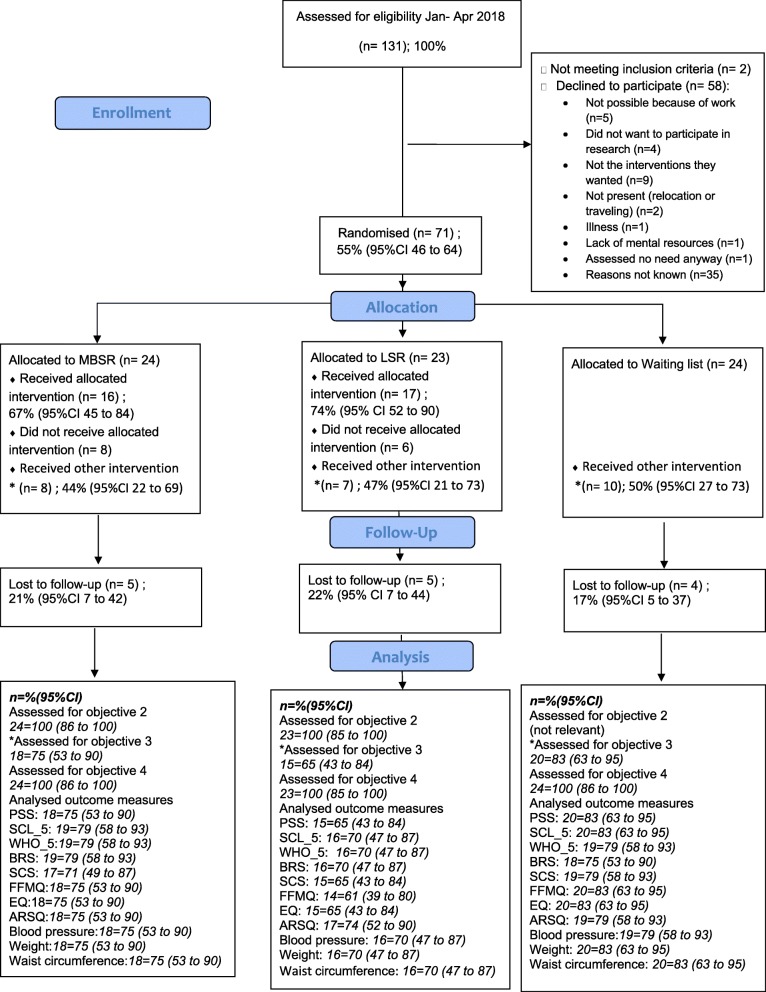
Background: The purpose of the present study was to conduct a pilot randomised controlled trial (RCT) to lend support to a larger effectiveness RCT comparing Mindfulness-Based Stress Reduction (MBSR), a locally-developed stress reduction intervention (LSR) and a waiting list control group in a Danish municipal health care center setting. Methods: A three-armed parallel pilot RCT was conducted among 71 adults who contacted a Danish municipal health care center due to stress-related problems. Recruitment was made between January and April 2018 and followed usual procedures. Exclusion criteria: 1) acute treatment-demanding clinical depression or diagnosis of psychosis or schizophrenia, 2) abuse of alcohol, drugs, medicine, 3) pregnancy. Randomisation was performed by an independent data manager using the REDCap electronic data capture tool. The primary outcome was a description of RCT feasibility (recruitment and retention rates regarding intervention participation and 12-week follow-up). Secondary outcomes were completion rates regarding questionnaire data and proposed effect-estimates of outcome measures considered to be used in the following real RCT. Type of intervention and outcome assessment were not blinded. Results: We recruited 71 of 129 eligible individuals from the target population (55, 95%CI: 46-64). Forty-two (59%) were females. Median age: 44 years (1-quartile:34, 3-quartile:50). Twenty-nine (41%) had < 16 years of education. Forty-eight (68%) were employed; 30 of these 48 (63%) were on sick leave. Mean scores for perceived stress (PSS): 25.4 ± 5.3; symptoms of anxiety and depression (SCL-5): 2.9 ± 0.6, and well-being (WHO-5): 31.7 ± 8.5 indicated a need for intervention. 16/24 (67, 95%CI: 45 to 84) who were allocated to MBSR and 17/23 (74, 95%CI: 52 to 90) who were allocated to LSR participated in ≥5 sessions. The loss to follow-up at 12 weeks: MBSR: 5 (21% (95% CI: 7 to 42), LSR: 5 (22% (95% CI: 7 to 44) and waiting list: 4 (17% (95% CI: 5 to 37). This was acceptable and evenly distributed. The results indicated MBSR to be superior. Conclusions: An RCT assessing the effectiveness of stress reduction interventions in a real-life municipal health care setting is feasible among adults with a clear need for stress reduction interventions based on scores on mental health. Trial registration: ClinicalTrials.gov. Identifier: NCT03663244. Registered September 10, 2018. © 2020 The Author(s).
Overview
CoChat Summary
## TL;DR
This pilot three-armed RCT tested whether a larger effectiveness trial comparing MBSR, a locally developed stress reduction intervention (LSR), and a waiting list control would be feasible in a Danish municipal health care setting. The trial was feasible, and the authors report indications that MBSR may have better mental health effects than wait-list and LSR, but the study was not powered to test effectiveness.
## Key findings
- The study recruited 71 of 129 eligible individuals (55%, 95% CI 46–64) from the target population, and 71 of the planned 72 participants were enrolled within the scheduled time-frame.
- Intervention uptake was acceptable: 16/24 (67%) in MBSR and 17/23 (74%) in LSR attended ≥5 sessions; 11/24 (46%) in MBSR and 16/23 (70%) in LSR attended ≥7 sessions.
- Loss to 12-week follow-up was similar across groups: MBSR 5/24 (21%), LSR 5/23 (22%), and waiting list 4/24 (17%).
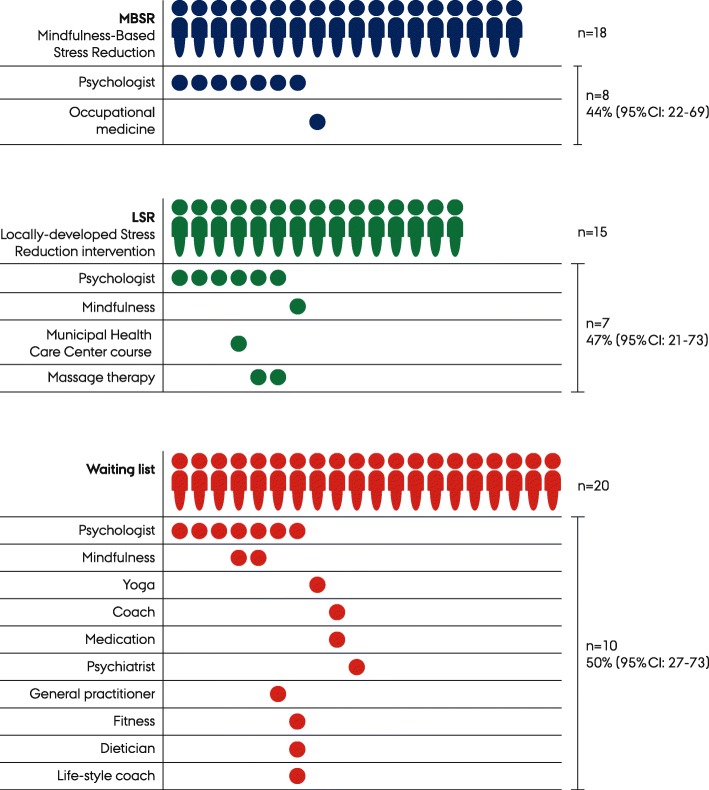
- The authors report that results “may indicate” positive effects of MBSR on well-being, resilience, stress, and symptoms of anxiety and depression versus waiting list, and that all mental outcome effect estimates favored MBSR vs LSR; they also note an unexpected waist circumference reduction in the waiting list group with no weight effects.
## Methods
- Design: Three-armed parallel pilot randomized controlled trial in the Municipality of Aarhus, Denmark; participants were randomized to MBSR, LSR, or waiting list. Randomization was done by an independent data manager using REDCap, and allocation was stratified by self-reported history of mental disorder.
- Sample/data: 71 adults who contacted the municipal health care center for stress-related problems; inclusion required being 18+ and able to understand, speak, and read Danish. Exclusions were acute treatment-demanding depression or psychosis/schizophrenia, substance/medicine abuse, and pregnancy.
- Main analysis: Feasibility outcomes were recruitment, retention, contamination, and questionnaire completion. The authors estimated proportions and effect estimates with 95% CIs; mental health outcomes were analyzed with linear regression adjusted for age, sex, education, history of mental disorder, and baseline scores, and clinical outcomes were adjusted additionally for baseline blood pressure, BMI, weight, and waist circumference.
## Limitations
- The paper states that socio-demographic data on individuals who declined participation were not available, limiting assessment of selection bias.
- The paper states that measurement staff were not blinded to group assignment; it also says participants could not be prevented from telling staff about their experiences at follow-up.
- Evident from the text: the trial was small and the authors note it was not powered for testing effectiveness, so the reported treatment effects are only indications with substantial uncertainty.
- Evident from the text: there was contamination/other intervention use—the authors report that almost half of participants across the three groups received other stress reduction interventions during the RCT, which could have diluted group differences.
Model-written summary. Check it against the paper before relying on it.
Integrity signals
Registry
Cites
Statistics
Figures
Verification
Claims the paper makes
10 Valid · 0 Not valid · 11 Not checked · 71 Own results and interpretations
Every source the paper cites for this claim was checked and supports it.
In the paper
“We assessed that this sample size was justified to meet the objectives of our pilot trial [24].”
§ A pilot randomised trial comparing a mindfulness-based stress reduction course, a locally-developed stress reduction intervention and a waiting list control group in a real-life municipal health care setting > Methods > Design
What the sources say
- Supportedcites [24] Billingham SA Whitehead AL Julious SA An audit of sample sizes for pilot and feasibility trials being undertaken in the United Kingdom registered in the United Kingdom clinical research network database BMC Med Res Methodol 2013 13 104 10.1186/1471-2288-13-104 23961782 PMC3765378 source
The Abstract says a pilot-trial sample-size justification should specify the minimum number needed to meet the trial’s objectives, and the Background says such a justification is required. The citing sentence presents the judgment about its own sample size as the citing authors’ assessment; the source supports the methodological principle behind that assessment. (LLM, conf=0.88)
plainn = 72- Asserted: passes — The authors put it forward as true.
- Checkable: passes — It can be checked against evidence.
- Load-bearing: unclear — It is unclear whether the paper’s conclusions depend on it.
- Based: passes — The paper gives a reason why it holds.
- Supported
The cited sources support only part of this claim — read each source’s verdict below.
In the paper
“Previous research indicates that self-reported history of mental disorder is associated with a smaller effect of MBSR [17].”
§ A pilot randomised trial comparing a mindfulness-based stress reduction course, a locally-developed stress reduction intervention and a waiting list control group in a real-life municipal health care setting > Methods > Process of the study The municipal health care center referred all individuals who contacted Aarhus Municipal Health Care Center with stress-related problems between January and April 2018 to the researchers in the project at Aarhus University. A member of the project team contacted each individual by telephone and gave information about the project according to a written guideline. Using a web-based booking system, individuals who met the inclusion and exclusion criteria had an appointment for baseline measurements. They also received detailed written information about the project via e-mail. At the appointment for baseline measurements, a member of the project team also verbally informed the individuals about the project to make sure that individuals fully understood the implications of participation. All attendants at the appointment for baseline measurements agreed to participate and provided written consent. A project team member collected baseline measurements and randomisation was performed. Data collection and randomisation were conducted using the REDCap electronic data capture tools hosted by Aarhus University. REDCap (Research Electronic Data Capture) is a secure, web-based application designed to support data capture for research studies [25]. An independent data manager had programmed the randomisation algorithm in REDCap. The randomisation was stratified for self-reported history of mental disorder. Previous research indicates that self-reported history of mental disorder is associated with a smaller effect of MBSR [17]. Two different staff members performed the baseline measurements using written guidelines, initiated the randomisation in REDCap and informed participants of the results of the randomisation process. The same staff members collected follow-up measurements. Hence, the data collectors were not blinded for group assignment.
What the sources say
- Partly supportedcites [17] Juul L Pallesen KJ Piet J Parsons C Fjorback LO Effectiveness of mindfulness-based stress reduction in a self-selecting and self-paying community setting Mindfulness (N Y) 2018 9 4 1288 1298 10.1007/s12671-017-0873-0 30100936 PMC6061242 sourceExperimental — accuracy not yet measured
The Discussion reports that participants without a self-reported current or previous mental disorder had a significantly larger reduction in perceived stress (PSS). The Results’ subgroup analysis found no significant difference by disorder history on the other two measures, so the broader claim of a smaller MBSR effect is supported only for perceived stress. (LLM, conf=0.86)
hedgedstates an association- Asserted: passes — The authors put it forward as true.
- Checkable: passes — It can be checked against evidence.
- Load-bearing: passes — The paper’s conclusions depend on it.
- Based: passes — The paper gives a reason why it holds.
- Partly supported
A result the paper reports from its own data — it cites no other source for it, so there is none to check. The quote shows it is in the paper.
In the paper
“well-being (WHO-5): 31.7 ± 8.5”
§ A pilot randomised trial comparing a mindfulness-based stress reduction course, a locally-developed stress reduction intervention and a waiting list control group in a real-life municipal health care setting > Abstract > Results
plain- Asserted: passes — The authors put it forward as true.
- Checkable: passes — It can be checked against evidence.
- Load-bearing: unclear — It is unclear whether the paper’s conclusions depend on it.
- Based: passes — The paper gives a reason why it holds.
A result the paper reports from its own data — it cites no other source for it, so there is none to check. The quote shows it is in the paper.
In the paper
“MBSR: 5 (21% (95% CI: 7 to 42)”
§ A pilot randomised trial comparing a mindfulness-based stress reduction course, a locally-developed stress reduction intervention and a waiting list control group in a real-life municipal health care setting > Abstract > Results
plainn = 5- Asserted: passes — The authors put it forward as true.
- Checkable: passes — It can be checked against evidence.
- Load-bearing: unclear — It is unclear whether the paper’s conclusions depend on it.
- Based: passes — The paper gives a reason why it holds.
A result the paper reports from its own data — it cites no other source for it, so there is none to check. The quote shows it is in the paper.
In the paper
“symptoms of anxiety and depression (SCL-5): 2.9 ± 0.6”
§ A pilot randomised trial comparing a mindfulness-based stress reduction course, a locally-developed stress reduction intervention and a waiting list control group in a real-life municipal health care setting > Abstract > Results
plain- Asserted: passes — The authors put it forward as true.
- Checkable: passes — It can be checked against evidence.
- Load-bearing: unclear — It is unclear whether the paper’s conclusions depend on it.
- Based: passes — The paper gives a reason why it holds.
40 more claims
Create a free account to see all 92 claims and to verify the 1 reference still open.
- Probably not a substantial claim. 34
- It may state two separate claims as one. 21
Citations
Cites
Harris, P. A., Taylor, R., Thielke, R., Payne, J., Gonzalez, N., & Conde, J. G. (2009) · Journal of Biomedical Informatics · doi:10.1016/j.jbi.2008.08.010 · Cited by 51,384
A Global Measure of Perceived Stress
Cohen, S., Kamarck, T., & Mermelstein, R. (1983) · Journal of Health and Social Behavior · doi:10.2307/2136404 · Cited by 32,807
Developing and evaluating complex interventions: the new Medical Research Council guidance
Craig, P., Dieppe, P., Macintyre, S., Michie, S., Nazareth, I., & Petticrew, M. (2008) · BMJ · doi:10.1136/bmj.a1655 · Cited by 10,995
Protective and Damaging Effects of Stress Mediators
McEwen, B. S. (1998) · New England Journal of Medicine · doi:10.1056/nejm199801153380307 · Cited by 6,733
The brief resilience scale: Assessing the ability to bounce back
Smith, B. W., Dalen, J., Wiggins, K., Tooley, E., Christopher, P., & Bernard, J. (2008) · International Journal of Behavioral Medicine · doi:10.1080/10705500802222972 · Cited by 6,439 · cited 2×
“A summary score is created that averages across the six items (range = 1–5), with higher scores indicating a greater perceived recovery from stress [34].”
BackgroundThe WHO-5 well-being index: A systematic review of the literature
Topp, C. W., Østergaard, S. D., Søndergaard, S., & Bech, P. (2015) · Psychotherapy and Psychosomatics · doi:10.1159/000376585 · Cited by 4,708
CONSORT 2010 statement: extension to randomised pilot and feasibility trials.
Eldridge, S. M., Chan, C. L., Campbell, M. J., Bond, C. M., Hopewell, S., Thabane, L., & Lancaster, G. A. (2016) · BMJ · doi:10.1136/bmj.i5239 · Cited by 3,404
Defining empirically supported therapies.
Chambless, D. L., & Hollon, S. D. (1998) · Journal of Consulting and Clinical Psychology · doi:10.1037/0022-006x.66.1.7 · Cited by 3,067
Construction and factorial validation of a short form of the Self-Compassion Scale
Raes, F., Pommier, E., Neff, K. D., & Van Gucht, D. (2011) · Clinical Psychology & Psychotherapy · doi:10.1002/cpp.702 · Cited by 2,997
CONSORT 2010 statement: extension to randomised pilot and feasibility trials
on behalf of the PAFS consensus group, Eldridge, S. M., Chan, C. L., Campbell, M. J., Bond, C. M., Hopewell, S., Thabane, L., & Lancaster, G. A. (2016) · Pilot and Feasibility Studies · doi:10.1186/s40814-016-0105-8 · Cited by 2,843 · cited 1×
“We present proposed effect estimates with 95% CIs without p values as suggested by the CONSORT statement, as pilot trials are not powered for testing hypotheses about effectiveness [22].”
MethodAllostatic load biomarkers of chronic stress and impact on health and cognition
Juster, R.-P., McEwen, B. S., & Lupien, S. J. (2010) · Neuroscience & Biobehavioral Reviews · doi:10.1016/j.neubiorev.2009.10.002 · Cited by 2,565
Garnefski, N., Kraaij, V., Schroevers, M. J., & Somsen, G. A. (2008) · Journal of Clinical Psychology in Medical Settings · doi:10.1007/s10880-008-9136-5 · Cited by 2,479
Rosengren, A., Hawken, S., Ôunpuu, S., Sliwa, K., Zubaid, M., Almahmeed, W. A., Blackett, K. N., Sitthi-amorn, C., Sato, H., & Yusuf, S. (2004) · The Lancet · doi:10.1016/s0140-6736(04)17019-0 · Cited by 2,414
Review of the Psychometric Evidence of the Perceived Stress Scale
Lee, E.-H. (2012) · Asian Nursing Research · doi:10.1016/j.anr.2012.08.004 · Cited by 2,305
Allostasis and Allostatic Load Implications for Neuropsychopharmacology
McEwen, B. (2000) · Neuropsychopharmacology · doi:10.1016/s0893-133x(99)00129-3 · Cited by 1,833
Improving the reporting of pragmatic trials: An extension of the CONSORT statement
Zwarenstein, M., Treweek, S., Gagnier, J. J., Altman, D. G., Tunis, S., Haynes, B., Oxman, A. D., Moher, D., & groups, F. T. C. A. P. T. I. H. (. (2008) · BMJ · doi:10.1136/bmj.a2390 · Cited by 1,813 · cited 2×
“recruiting participants in existing health care settings with established procedures and resources [19].”
BackgroundMindfulness-based stress reduction for healthy individuals: A meta-analysis
Khoury, B., Sharma, M., Rush, S. E., & Fournier, C. (2015) · Journal of Psychosomatic Research · doi:10.1016/j.jpsychores.2015.03.009 · Cited by 1,617
Allostatic load as a marker of cumulative biological risk: MacArthur studies of successful aging
Seeman, T. E., McEwen, B. S., Rowe, J. W., & Singer, B. H. (2001) · Proceedings of the National Academy of Sciences · doi:10.1073/pnas.081072698 · Cited by 1,385
Strand, B. H., Dalgard, O. S., Tambs, K., & Rognerud, M. (2003) · Nordic Journal of Psychiatry · doi:10.1080/08039480310000932 · Cited by 1,304 · cited 2×
“85 [32] A SCL-5 score > 2 has been found to predict mental illness as assessed independently by psychiatrists [32].”
Background(1990) · Cited by 1,282
Chronic stress at work and the metabolic syndrome: prospective study
Chandola, T., Brunner, E., & Marmot, M. (2006) · BMJ · doi:10.1136/bmj.38693.435301.80 · Cited by 1,075
Billingham, S. A., Whitehead, A. L., & Julious, S. A. (2013) · BMC Medical Research Methodology · doi:10.1186/1471-2288-13-104 · Cited by 962
Reenvisioning Clinical Science: Unifying the Discipline to Improve the Public Health
Onken, L. S., Carroll, K. M., Shoham, V., Cuthbert, B. N., & Riddle, M. (2014) · Clinical Psychological Science · doi:10.1177/2167702613497932 · Cited by 872
What defines mindfulness-based programs? The warp and the weft
Crane, R. S., Brewer, J., Feldman, C., Kabat-Zinn, J., Santorelli, S., Williams, J. M. G., & Kuyken, W. (2017) · Psychological Medicine · doi:10.1017/s0033291716003317 · Cited by 868 · cited 2×
“Self-compassion is proposed to be a contributing mediator of the effect of mindfulness [27] and increased selfcompassion has been found to mediate the beneficial effect of MBCT on post-treatment symptoms of depression [37].”
BackgroundFresco, D. M., Moore, M. T., van Dulmen, M. H. M., Segal, Z. V., Ma, S. H., Teasdale, J. D., & Williams, J. M. G. (2007) · Behavior Therapy · doi:10.1016/j.beth.2006.08.003 · Cited by 810
Neuroendocrinology and pathophysiology of the stress system
STRATAKIS, C. A., & CHROUSOS, G. P. (1995) · Annals of the New York Academy of Sciences · doi:10.1111/j.1749-6632.1995.tb44666.x · Cited by 533
Nyklíček, I., & Kuijpers, K. F. (2008) · Annals of Behavioral Medicine · doi:10.1007/s12160-008-9030-2 · Cited by 532
Rose's Strategy of Preventive Medicine
Rose, G., Khaw, K.-T., & Marmot, M. (2008) · doi:10.1093/acprof:oso/9780192630971.001.0001 · Cited by 490
The efficacy of Acceptance and Commitment Therapy: An updated systematic review and meta-analysis
Öst, L.-G. (2014) · Behaviour Research and Therapy · doi:10.1016/j.brat.2014.07.018 · Cited by 476
van der Velden, A. M., Kuyken, W., Wattar, U., Crane, C., Pallesen, K. J., Dahlgaard, J., Fjorback, L. O., & Piet, J. (2015) · Clinical Psychology Review · doi:10.1016/j.cpr.2015.02.001 · Cited by 455
Self-citationHow well can a few questionnaire items indicate anxiety and depression?
Tambs, K., & Moum, T. (1993) · Acta Psychiatrica Scandinavica · doi:10.1111/j.1600-0447.1993.tb03388.x · Cited by 445
Gu, J., Strauss, C., Crane, C., Barnhofer, T., Karl, A., Cavanagh, K., & Kuyken, W. (2016) · Psychological Assessment · doi:10.1037/pas0000263 · Cited by 431
Robins, C. J., Keng, S., Ekblad, A. G., & Brantley, J. G. (2012) · Journal of Clinical Psychology · doi:10.1002/jclp.20857 · Cited by 332
Prospects for a clinical science of mindfulness-based intervention
Dimidjian, S., & Segal, Z. V. (2015) · American Psychologist · doi:10.1037/a0039589 · Cited by 291
Psychological distress as a risk factor for coronary heart disease in the Whitehall II Study
Stansfeld, S. A., Fuhrer, R., Shipley, M. J., & Marmot, M. G. (2002) · International Journal of Epidemiology · doi:10.1093/ije/31.1.248 · Cited by 272
Stress and Type 2 Diabetes: A Review of How Stress Contributes to the Development of Type 2 Diabetes
Kelly, S. J., & Ismail, M. (2015) · Annual Review of Public Health · doi:10.1146/annurev-publhealth-031914-122921 · Cited by 256
de Vibe, M., Bjørndal, A., Tipton, E., Hammerstrøm, K., & Kowalski, K. (2012) · Campbell Systematic Reviews: Better Evidence for a Better World · doi:10.4073/csr.2012.3 · Cited by 253 · cited 1×
“In comparison with the majority of MBSR research, the current study population differed as we included more men and more individuals with a lower level of education [16, 46].”
ResultIntervention Research: Developing Social Programs
Fräser, M. W. (2009) · Cited by 217
Intervention Research: Developing Social Programs
Fraser, M. W., Richman, J. M., Galinsky, M. J., & Day, S. H. (2009) · doi:10.1093/oso/9780195325492.001.0001 · Cited by 204
Prior, A., Fenger-Grøn, M., Larsen, K. K., Larsen, F. B., Robinson, K. M., Nielsen, M. G., Christensen, K. S., Mercer, S. W., & Vestergaard, M. (2016) · American Journal of Epidemiology · doi:10.1093/aje/kwv324 · Cited by 202
deVibe, M., Bjørndal, A., Fattah, S., Dyrdal, G. M., Halland, E., & Tanner-Smith, E. E. (2017) · Campbell Systematic Reviews: Better Evidence for a Better World · doi:10.4073/csr.2017.11 · Cited by 198
Eskildsen, A., Dalgaard, V. L., Nielsen, K. J., Andersen, J. H., Zachariae, R., Olsen, L. R., Jørgensen, A., & Christiansen, D. H. (2015) · Scandinavian Journal of Work, Environment & Health · doi:10.5271/sjweh.3510 · Cited by 195
The Amsterdam Resting-State Questionnaire reveals multiple phenotypes of resting-state cognition
Diaz, B. A., Van Der Sluis, S., Moens, S., Benjamins, J. S., Migliorati, F., Stoffers, D., Den Braber, A., Poil, S.-S., Hardstone, R., Van't Ent, D., et al. (2013) · Frontiers in Human Neuroscience · doi:10.3389/fnhum.2013.00446 · Cited by 194 · cited 1×
“The scale consists of 21 statements scored on a Likert scale from 1 (completely disagree) to 5 (completely agree) [35].”
BackgroundGraphical method for depicting randomised trials of complex interventions
Perera, R., Heneghan, C., & Yudkin, P. (2007) · BMJ · doi:10.1136/bmj.39045.396817.68 · Cited by 182
Stress and Depression: Preclinical Research and Clinical Implications
Bartolomucci, A., & Leopardi, R. (2009) · PLoS ONE · doi:10.1371/journal.pone.0004265 · Cited by 111
Juul, L., Pallesen, K. J., Piet, J., Parsons, C., & Fjorback, L. O. (2018) · Mindfulness · doi:10.1007/s12671-017-0873-0 · Cited by 22
Self-citation
Research works printed but not linked: 2
- Larsen FBPM Lasgaard M Sørensen JB Christiansen J Lundberg A Pedersen SE Friis K National Health profile 2010–2013-2017. (in Danish: Hvordan har du det? 2017 – Sundhedsprofil for region og kommuner (bind 2). Udviklingen 2010–2013-2017). In 2018 Aarhus DEFACTUM, Region Midtjylland
- Cohen SWG OS SS Perceived stress in a probability sample in the United States The Social Psychology of Health: The Claremont Symposium on Applied Social Psychology 1988 Newbury Park SAGE Publications, Inc 31 67
Cited by
A systematic review and meta-analysis of psychological interventions to improve mental wellbeing
van Agteren, J., Iasiello, M., Lo, L., Bartholomaeus, J., Kopsaftis, Z., Carey, M., & Kyrios, M. (2021) · Nature Human Behaviour · doi:10.1038/s41562-021-01093-w · Cited by 510
The benefits of meditation and mindfulness practices during times of crisis such as COVID-19
Behan, C. (2020) · Irish Journal of Psychological Medicine · doi:10.1017/ipm.2020.38 · Cited by 276
“…using focused attention, MBSR and MBCT have shown reduced anxiety (Montero-Marin et al. 2019), depression and post-traumatic stress disorder (Khusid & Vythilingam, 2016), stress (Juul et al. 2020), blood pressure, cortisol levels and other physiologic markers of stress (Pascoe et al. 2017).”
Jia, L., Feng, J., Li, J., Liu, F.-Y., Xie, L., Luo, S.-J., & Han, F. (2021) · Evidence-based Complementary and Alternative Medicine · doi:10.1155/2021/5555315 · Cited by 57
“Since most of the current trials on meditation in the treatment of PCOS are small-scale, nonrandomized studies, more large-scale trials are needed to prove its efficacy on PCOS [135].”
BackgroundSaban, K. L., Collins, E. G., Mathews, H. L., Bryant, F. B., Tell, D., Gonzalez, B., Bhoopalam, S., Chroniak, C. P., & Janusek, L. W. (2022) · Journal of General Internal Medicine · doi:10.1007/s11606-022-07584-4 · Cited by 31
Pérula-de Torres, L., Verdes-Montenegro-Atalaya, J., Melús-Palazón, E., García-de Vinuesa, L., Valverde, F., Rodríguez, L., Lietor-Villajos, N., Bartolomé-Moreno, C., Moreno-Martos, H., García-Campayo, J., et al. (2021) · International Journal of Environmental Research and Public Health · doi:10.3390/ijerph18084340 · Cited by 28
Metadata
- Authors
- Juul, L., Pallesen, K. J., Bjerggaard, M., Nielsen, C., & Fjorback, L. O.
- Affiliations
- Aarhus University (DK)
- Corresponding author
- Juul, Lise
- Venue
- BMC Public Health
- Published
- 2020-03-30
- Volume
- 20
- Issue
- 1
- Pages
- 409-409
- ISSN
- 1471-2458 (ISSN-L)
- PMC
- PMC7106861
- OpenAlex
- W3013502347
- Cited by
- 29
- References
- 47
- Citations by year
- 2026: 2 · 2025: 3 · 2024: 2 · 2023: 4 · 2022: 5 · 2021: 11 · 2020: 2
- FWCI
- 2.19
- Type
- journal article
- Language
- en
- Open access
- gold
- doi.org
- Licence
- cc-by
- creativecommons.org/licenses/by/4.0/ (tdm)
- creativecommons.org/licenses/by/4.0/ (vor)
- Locations
- BMC Public Health (publishedVersion, cc-by)
- PubMed Central (publishedVersion, cc-by)
- PubMed (publishedVersion)
- DOAJ (DOAJ: Directory of Open Access Journals) (submittedVersion, cc-by-sa)
- Scopus (Elsevier) (submittedVersion)
- Funders
- TrygFonden (119327)
- Topics
- Social Sciences › Psychology › Clinical Psychology › Mindfulness and Compassion Interventions
- Social Sciences › Psychology › Applied Psychology › Digital Mental Health Interventions
- Social Sciences › Psychology › Clinical Psychology › Psychotherapy Techniques and Applications
- Keywords
- mindfulness-based stress reduction, municipal health care, feasibility, recruitment and retention, loss to follow-up, perceived stress, anxiety and depression, well-being, waitlist control, primary care mental health services, real-world environments, treatment acceptability
- MeSH terms
- Adult, Anxiety, Community Mental Health Services, Denmark, Depression, Feasibility Studies, Female, Humans, Male, Middle Aged, Pilot Projects, Surveys and Questionnaires, Stress, Psychological, Waiting Lists, Outcome Assessment, Health Care, Young Adult, Mindfulness
About these checks
Registry, retraction, Cites and statistics results are computed, not judged, with one exception: a printed reference that no index lists is read once by a model before it counts as a citation error. Claims are extracted by a model and kept only when their quote appears verbatim in the text; each cited source is then checked, with a model’s help, for whether it says what the claim relies on. Those verdicts can be wrong — read the claim’s quote and the cited source before relying on one.
The claim verdicts this report counts are experimental: their accuracy is not yet measured.
A language model drew the claims from the paper on 2026-10-11, under version 3 of the claim definition (model deepseek-v4.1-flash, prompt extract-v3).
A second model labelled each claim on 2026-10-11 (model jev-1.13-20260917, definition revision gold-guideline-v0.2).
Cited sources are checked with a language model’s help (gpt-6-sol).
Statistics and arithmetic are recomputed, not judged.
Confidence bands are shown only for fields calibrated on our annotated test set. None is calibrated yet, so no band is shown.
What counts as a claim ›How we measure confidence ›How we check this ›
Are you an author, or do you see a problem with this page? Request a review
Data sources
Bibliographic data: Semantic Scholar, OpenAlex, Crossref.
Contains information from the Semantic Scholar Academic Graph Datasets, made available under the ODC Attribution License (ODC-BY 1.0).
Semantic Scholar’s data is described in: Kinney, R., et al. (2023). The Semantic Scholar Open Data Platform. arXiv:2301.10140.
