

The DOI matches its Crossref record; 9 of the 9 references it cites were found in a registry or an index.
Stigma for common mental disorders in racial minorities and majorities a systematic review and meta-analysis
Published version of a preprint
Abstract
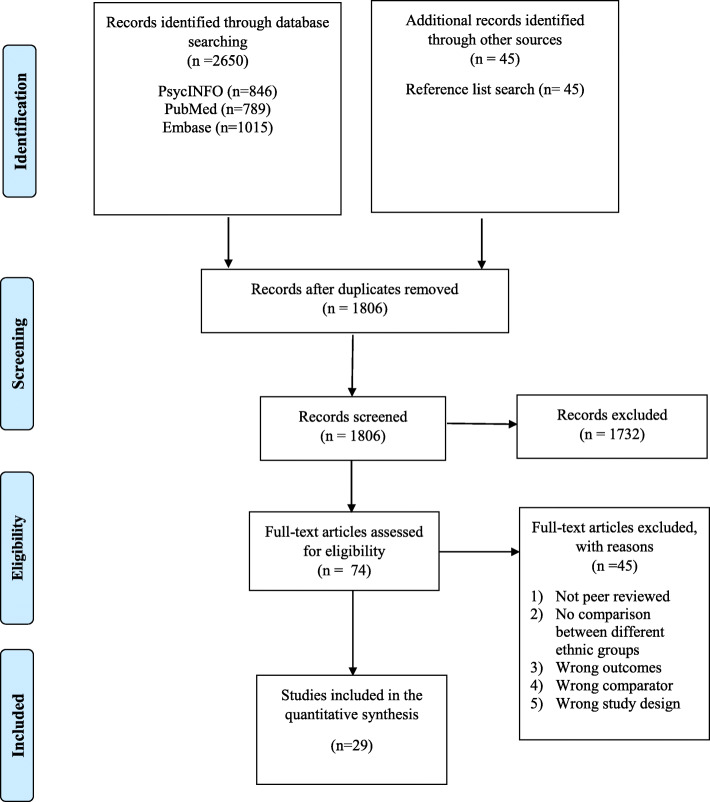
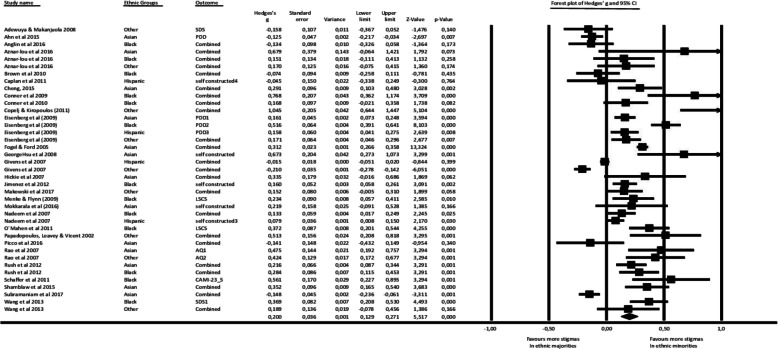
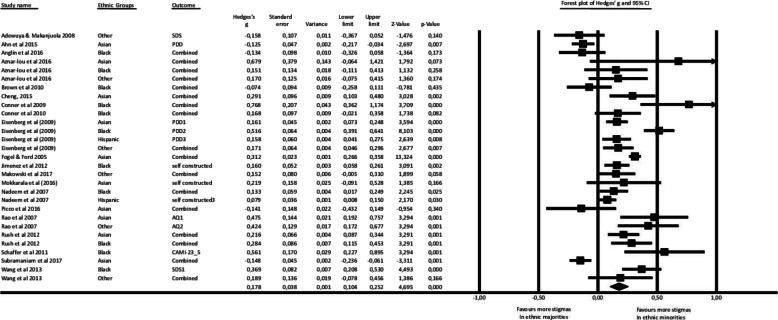
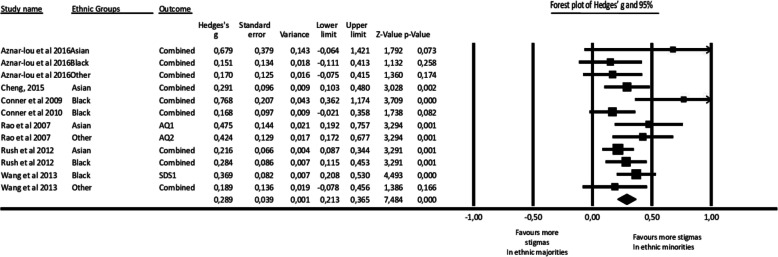
Background: There is a strong stigma attached to mental disorders preventing those affected from getting psychological help. The consequences of stigma are worse for racial and/or ethnic minorities compared to racial and/or ethnic majorities since the former often experience other social adversities such as poverty and discrimination within policies and institutions. This is the first systematic review and meta-analysis summarizing the evidence on the impact of differences in mental illness stigma between racial minorities and majorities. Methods: This systematic review and meta-analysis included cross-sectional studies comparing mental illness stigma between racial minorities and majorities. Systematic searches were conducted in the bibliographic databases of PubMed, PsycINFO and EMBASE until 20th December 2018. Outcomes were extracted from published reports, and meta-analyses, and meta-regression analyses were conducted in CMA software. Results: After screening 2787 abstracts, 29 studies with 193,418 participants ( N = 35,836 in racial minorities) were eligible for analyses. Racial minorities showed more stigma than racial majorities (g = 0.20 (95% CI: 0.12 ~ 0.27) for common mental disorders. Sensitivity analyses showed robustness of these results. Multivariate meta-regression analyses pointed to the possible moderating role of the number of studies with high risk of bias on the effect size. Racial minorities have more stigma for common mental disorders when compared with majorities. Limitations included moderate to high risk of bias, high heterogeneity, few studies in most comparisons, and the use of non-standardized outcome measures. Conclusions: Mental illness stigma is higher among ethnic minorities than majorities. An important clinical implication of these findings would be to tailor anti-stigma strategies related with mental illnesses according to specific racial and/or ethnic backgrounds with the intention to improve mental health outreach.
Overview
The claims and statistics of this paper haven’t been checked yet.
Run the check — free, no account needed. It reads the open-access text and checks the sources it cites.
Integrity signals
Registry
Cites
Statistics
Figures
Verification
Claims the paper makes
The claims and statistics of this paper haven’t been checked yet.
Run the check — free, no account needed. It reads the open-access text and checks the sources it cites.
Claims other papers make about this one
Each is checked against this paper’s own text: does it say what the citing paper says it does?
In the citing paper
“However, specific student populations, such as international students and those from diverse ethnic backgrounds, may have even higher rates of mental disorders, lower rates of help‐seeking behaviors and intentions, and greater barriers to seeking help (Crockett et al., 2024; Crockett, Martínez, & Caviedes, 2022; Eylem et al., 2020; Jamilah et al., 2021; Pei et al., 2024).”
From Research Review: Help‐seeking intentions, behaviors, and barriers in college students – a systematic review and meta‐analysis (2025) · cites this paper as Eylem et al., 2020
Self-check
Percentages, sums and reported differences re-computed from the paper’s own numbers.
The self-check needs the paper’s full text.
Citations
Cites
Crenshaw, K. (2018) · Feminist Legal Theory · doi:10.4324/9780429500480-5 · Cited by 9,510
The global prevalence of common mental disorders: a systematic review and meta-analysis 1980–2013
Steel, Z., Marnane, C., Iranpour, C., Chey, T., Jackson, J. W., Patel, V., & Silove, D. (2014) · International Journal of Epidemiology · doi:10.1093/ije/dyu038 · Cited by 2,846
The Epidemiology of Depression Across Cultures
Kessler, R. C., & Bromet, E. J. (2013) · Annual Review of Public Health · doi:10.1146/annurev-publhealth-031912-114409 · Cited by 2,657
Global burden of depressive disorders in the year 2000
Üstün, T. B., Ayuso-Mateos, J. L., Chatterji, S., Mathers, C., & Murray, C. J. L. (2004) · British Journal of Psychiatry · doi:10.1192/bjp.184.5.386 · Cited by 1,735
Stigma and Help Seeking for Mental Health Among College Students
Eisenberg, D., Downs, M. F., Golberstein, E., & Zivin, K. (2009) · Medical Care Research and Review · doi:10.1177/1077558709335173 · Cited by 1,193 · cited 6×
“Eisenberg 2009 [42] Self-report Low Low Low High Low Moderate”
BackgroundInfluentialMental health treatment seeking among older adults with depression: The impact of stigma and race
Conner, K. O., Copeland, V. C., Grote, N. K., Koeske, G., Rosen, D., Reynolds, C. F., & Brown, C. (2010) · The American Journal of Geriatric Psychiatry · doi:10.1097/jgp.0b013e3181cc0366 · Cited by 568 · cited 3×
“Some studies indicate that diagnosis of a CMD would reinforce the label indicating that the individual falls out of the societal expectations and therefore is unpredictable and/or dangerous (8-5271).”
BackgroundCuijpers, P., Muñoz, R. F., Clarke, G. N., & Lewinsohn, P. M. (2009) · Clinical Psychology Review · doi:10.1016/j.cpr.2009.04.005 · Cited by 336
Self-citationEthnicity and Preferences for Depression Treatment
Givens, J. L., Houston, T. K., Van Voorhees, B. W., Ford, D. E., & Cooper, L. A. (2007) · General Hospital Psychiatry · doi:10.1016/j.genhosppsych.2006.11.002 · Cited by 330
Attitudes in social context: A social identity perspective
Hogg, M. A., & Smith, J. R. (2007) · European Review of Social Psychology · doi:10.1080/10463280701592070 · Cited by 286
Research works printed but not linked: 62
- Cuijpers P, Eylem O, Karyotaki E, Zhou X, Sijbrandij M. Psychotherapy for depression and anxiety in low- and middle-income countries. In: Stein D, Bass J, editors. Global Mental Health and Psychotherapy: Adapting Psychotherapy for Low- and Middle-Income Countries. Elsevier; 2019. p. 173–92. https://doi.org/10.1016/b978-0-12-814932-4.00008-2. · DOI
- WHO Depression, Other Common Mental Disorders. Global Health Estimates. Geneva: World Health Organization; 2017. License: CC BY-NC-SA 3.0 IG.
- Korszun A, Sokratis D, Ahmed K, Bhui K. Medical student attitudes about mental illness: does medical-school education reduce stigma? Acad Psychiatry. 2012;36:197–204. · DOI
- Nadeem E, Lange JM, Edge D, Fongwa M, Belin T, Miranda J. Does stigma keep poor young immigrant and U.S.-born black and Latina women from seeking mental health care? Psychiatr Serv. 2007;58:1547–54. · DOI
- Lee S, Juon HS, Martinez G, Hsu CE, Robinson ES, Bawa J, Ma G. Model minority at risk: expressed needs of mental health by Asian American young adults. J Community Health. 2009;34:144–52. · DOI
- Clement S, Williams P, Farelly P, Hatch SL, Schauman O, Jeffery D, Henderson C, Thornicroft G. Mental health–related discrimination as a predictor of low engagement with mental health services. Psychiatr Serv. 2015;66:171–6. · DOI
- Fox AB, Taverna AC, Earnshaw VA, Vogt D. Conceptualizing and measuring mental illness stigma: the mental illness stigma framework and critical review of measures. Stigma Health. 2018;3:348–76. · DOI
- Corrigan PW, Watson AC. The stigma of psychiatric disorders and the gender, ethnicity, and education of the perceiver. Community Ment Health J. 2007;43:439–58. · DOI
- Cheng ZH. Asian Americans and European Americans’ stigma levels in response to biological and social explanations of depression. Soc Psychiatry Psychiatr Epidemiol. 2015;50:767–76. https://doi.org/10.1007/s00127-014-0999-5. · DOI
- Fogel J, Fogel DE. Stigma beliefs of Asian Americans with depression in an internet sample. Can J Psychiatr. 2005;50:470–8. · DOI
- Georg Hsu LK, Wan YM, Chang H, Summergrad P, Tsang Bill YP, Chen H. Stigma of depression is more severe in Chinese Americans than Caucasian Americans. Psychiatry. 2008;71(3):210–8. · DOI
- Anglin DM, Link BC, Phelan JC. Racial differences in stigmatizing attitudes toward people with mental illness. Psychiatr Serv. 2006;6:857–62. · DOI
- Brown C, Conner KO, Copeland VC, Grote N, Beach S, Battista D. Depression stigma, race, and treatment seeking behavior and attitudes. J Community Psychol. 2010;38:350–68. · DOI
- Conner K, Koeske G, Brown C. Racial differences in attitudes toward professional mental health treatment: the mediating effect of stigma. J Gerontol Soc Work. 2009;52(7):695–712 https://doi.org/10.1080/01634370902914372. · DOI
- Caplan S, Paris M, Whittemore R, Desai M, Dixon J, Alvidrez J, Escobar J, Scahill S. Correlates of religious, supernatural and psychosocial causal beliefs about depression among Latino immigrants in primary care. Ment Health Relig Cult. 2010;14(6):589–611 https://doi.org/10.1080/13674676.2010.497810. · DOI
- Jimenez DE, Bartels SJ, Gardenas V, Alegria M. Stigmatizing attitudes toward mental illness among racial/ ethnic older adults in primary care. Int J Geriatr Psychiatry. 2013;28:1061–8. · DOI
- Subramaniam M, Abdin E, Picco L, Pang S, Shafie S, Vaingankar JA, Kwok KW, Verma K, Chong SA. Stigma towards people with mental disorders and its components – a perspective from multi-ethnic Singapore. Epidemiol Psychiatr Serv. 2017;26:371–82. · DOI
- Makowski AC, von dem Knesebeck O. Depression stigma and migration – results of a survey from Germany. BMC Psychiatry. 2017;17:381. https://doi.org/10.1186/s12888-017-1549-y. · DOI
- Bhui K. Social determinants of mental health. In: Bhugra D, Bhui K, Yeung Shan Wong S, Gillman SE, editors. Oxford Textbook of Public Mental Health; 2019. p. 173–7.
- Gronholm PC, Henderson C, Deb T, Thornicroft G. Anti-stigma interventions: Theory and evidence. In: Bhugra D, Bhui K, Yeung Shan Wong S, Gillman SE, editors. Oxford Textbook of Public Mental Health; 2019. p. 411–21.
- Corrigan PW, Watson AC. Understanding the impact of stigma on people with mental illness. World J Psychiatry. 2002;1:1,16–20.
- Conelly R, Gayle V, Lambert PS. Ethnicity and ethnic group measures in social survey research. Method Innov. 2016;9:1–10.
- Unlu Ince B, Riper H, van’t Hof E, Cuijpers P. The effects of psychotherapy on depression among racial-ethnic minority groups: A meta-regression analysis. Psychiatr Serv. 2014;65:612–7. · DOI
- Cohen J. Statistical power analysis for the behavioral sciences. 2nd ed. Hillsdale: Erlbaum; 1988.
- Adewuya AO, Makanjuola Roger OA. Social distance towards people with mental illness in southwestern Nigeria. Aust N Z J Psychiatry. 2008;42:389–95. · DOI
- Ahn JH, Kim WH, Choi HJ, Jeon JY, Song IJ, Bae JN. Stigma of mental illnesses as perceived by north Korean defectors living in South Korea. Korean Neuropsychiatr Assoc. 2015:9–15. https://doi.org/10.4306/pi.2015.12.1.9. · DOI
- Aznar-Lou I, Serano-Blanco A, Fernandez A, Luciano JV, Rubio-Valera M. Attitudes and intended behaviour to mental disorders and associated factors in Catalan population, Spain: cross-sectional population-based survey. BMC Public Health. 2016;16:127 https://doi.org/10.1186/s12889-016-2815-5. · DOI
- Copelj A, Kiropoulos L. Knowledge of depression and depression related stigma in immigrants from former Yugoslavia. J Immigr Minor Health. 2011;13:1013–8. https://doi.org/10.1007/s10903-011-9463-8. · DOI
- Hickie IB, Davenport DA, Luscombe GM, Rong Y, Hickie ML, Bell MI. The assessment of depression awareness and help-seeking behaviour: Experiences with the International Depression Literacy Survey. BMC Psychiatry. 2007;7:48 https://doi.org/10.1186/1471-244X-7-48. · DOI
- Menke R, Flynn H. Relationships between stigma, depression, and treatment in white and African American primary care patients. J Nerv Ment Dis. 2009;197:407–11. · DOI
- Mokkarala S, O’Brien EK, Siegel JT. The relationship between shame and perceived biological origins of mental illness among South Asian and white American young adults. Psychol Health Med. 2016. https://doi.org/10.1080/13548506.2015.1090615. · DOI
- O’Mahen HA, Henshaw E, Jones JM, Flynn HA. Stigma and depression during pregnancy, does race matter? J Nerv Ment Dis. 1999;199:257–62. · DOI
- Papadopoulos C, Leavey G, Vincent C. Factors influencing stigma a comparison of Greek-Cypriot and English attitudes towards mental illness in North London. Soc Psychiatry Psychiatr Epidemiol. 2002;37:430–4. · DOI
- Picco L, Panga S, Laua YW, Jeyagurunathana A, Satgharea P, Abdina E, Vaingankara JA, Limb S, Pohc CL, Chonga SA, Subramaniam M. Internalized stigma among psychiatric outpatients: associations with quality of life, functioning, hope and self-esteem. Psychiatry Res. 2016;246:500–6. · DOI
- Rao D, Feinglass J, Corrigan P. Racial and ethnic disparities in mental illness stigma. J Nerv Ment Dis. 2007;195:1020–3. · DOI
- Rüsch N, Evans-Lacko S, Thornicroft G. What is a mental illness? Public views and their effects on attitudes and disclosure. Aust N Z J Psychiatry. 2012;46:641–50. · DOI
- Schafer T, Wood S, Williams R. A survey into student nurses` attitudes towards mental illness: implications for nurse training. Nurse Educ Today. 2011;31:328–32. · DOI
- Shamblaw AL, Botha FB, Dozois DJA. Accounting for differences in depression stigma between Canadian Asians and Europeans. J Cross-Cult Psychol. 2015;46:597–611. · DOI
- Wang D, Locke C, Chonody J. Differences by race in social work students’ social distancing, treatment options, and perceptions of causes of mental illness. J Soc Serv Res. 2013;39:646–61. https://doi.org/10.1080/01488376.2013.816410. · DOI
- Link BG. Understanding labeling effects in the area of mental disorders: an assessment of the effects of expectations of rejection. Am Sociol Rev. 1987;52:96–112. · DOI
- Ritsher JB, Otilingam PG, Grajales M. Internalized stigma of mental illness: Psychometric properties of a new measure. Psychiatry Res. 2003;121:31–49. https://doi.org/10.1016/j.psychres.08.008. · DOI
- Higgins JPT, Thompson SG, Deeks JJ, Altman DG. Measuring inconsistency in meta-analyses. BMJ. 2003;327:557–60. · DOI · Paper page
- Ioannidis JPA, Patsopoulos NA, Evangelou E. Uncertainty in heterogeneity estimates in meta-analyses. BMJ. 2007;335:914–6. · DOI · Paper page
- Orsini N, Bottai M, Higgins J, Buchan I. Heterogi: Stata module to quantify heterogeneity in a meta-analysis. St. Louis: Statistical Software Components; 2006. Available from: https://ideas.repec.org/c/boc/bocode/s449201.html.
- Duval S, Tweedie R. Trim and fill: a simple funnel-plot-based method of testing and adjusting for publication bias in meta-analysis. Biometrics. 2000;56:455–63. · DOI · Paper page
- Lavrakas PJ. Encyclopedia of survey research methods. Thousand Oaks: Sage Publications, Inc; 2008. https://doi.org/10.4135/9781412963947.n523. · DOI
- Keeble C, Richard Law G, Barber S, Baxter PD. Choosing a method to reduce selection bias: a tool for researchers. Open J Epidemiol. 2015;5:155–62. · DOI
- Miranda R, Soffer A, Polanco-Roman L, Wheeler A, Moore A. Mental health treatment barriers among racial/ethnic minority versus white young adults 6 months after intake at a college counseling center. J Am Coll Heal. 2015;63:291–9. · DOI
- Cuijpers P. Calculating and pooling effect sizes. In: Meta-analyses in Mental Health Research: A Practical Guide. The Netherlands: Vrije Universiteit Amsterdam; 2016. p. 67–91.
- Jorm AF, Oh E. Desire for social distance from people with mental disorders: a review. Aust N Z J Psychiatry. 2009;43:183–200. · DOI
- Halter MJ. The stigma of seeking care and depression. Arch Psychiatr Nurs. 2004;18:178–84. · DOI
- Augsberger A, Yeung A, Dougher M, Hahm HY. Factors influencing the underutilization of mental health services among Asian American women with a history of depression and suicide. BMC Health Serv Res. 2015;15:542. https://doi.org/10.1186/s12913-015-1191. · DOI
- Shefer G, Rose D, Nellums L, Thornicroft G, Henderson C, Evans-Lacko SO. Our community is the worst’: the influence of cultural beliefs on stigma, relationships with family and help-seeking in three ethnic communities in London. Int J Soc Psychiatry. 2012;59:535–44. · DOI
- Brenner MH. Social class and mental health: The impact of international recession and austerity. In: Bhugra D, Bhui K, Yeung Shan Wong S, Gillman SE, editors. Oxford Textbook of Public Mental Health; 2019. p. 159–73.
- Henkel KE, Brown K, Kalichman SC. AIDS-related stigma in individuals with other stigmatized identities in the USA: a review of layered stigmas. Soc Personal Psychol Compass. 2008;2:1586–99. · DOI
- Radcliffe J, Doty N, Hawkins LA, Gaskins CS, Beidas R, Rudy BJ. Stigma and sexual health risk in HIV-positive African American young men who have sex with men. AIDS Patient Care STDs. 2010;24:493–9. · DOI
- Logie CH, James LL, Tharao W, Loutfy MR. HIV, gender, race, sexual orientation, and sex work: a qualitative study of intersectional stigma experienced by HIV-positive women in Ontario, Canada. PLoS Med. 2011;8:e1001124. · DOI
- Corrigan PW. Lessons learned from unintended consequences about erasing the stigma of mental illness. World J Psychiatry. 2016;15:67–73. · DOI
- Dumensnil H, Verger P. Public awareness campaigns about depression and suicide: a review. Psychiatr Serv. 2009;60:1203–13. · DOI · Paper page
- Bhui K. Culture and complex interventions: lessons for evidence, policy and practice. Br J Psychiatry. 2010;197:172–3. https://doi.org/10.1192/bjp.bp.110.082719. · DOI
- Corrigan PW. How clinical diagnosis might exacerbate the stigma of mental illness? Soc Work. 2007;52:31–9. · DOI
- Pescosolido BA, Martin JK, Lang A, Olafsdottir S. Rethinking theoretical approaches to stigma: a framework integrating normative influences on stigma (FINIS). Soc Sci Med. 2008;67:431–44. · DOI
Cited by
Sorted by citations
Zhao, R., Amanvermez, Y., Pei, J., Castro‐Ramirez, F., Rapsey, C., Garcia, C., Ebert, D. D., Haro, J. M., Fodor, L. A., David, O. A., et al. (2025) · Journal of Child Psychology and Psychiatry · doi:10.1111/jcpp.14145 · Cited by 110
Self-citationZentner, K. E., Dueck, B. S., Le, J., & Lee, H. (2025) · Journal of Mental Health Counseling · doi:10.17744/mehc.47.3.02
Metadata
- Authors
- Eylem, O., de Wit, L., van Straten, A., Steubl, L., Melissourgaki, Z., Danışman, G. T., de Vries, R., Kerkhof, A. J. F. M., Bhui, K., & Cuijpers, P.
- ORCID
- Eylem, Ozlem
- Venue
- BMC Public Health
- Published
- 2020-06-08
- Volume
- 20
- Issue
- 1
- ISSN
- 1471-2458
- PMC
- PMC7278062
- Cited by
- 196
- References
- 9
- Language
- en
- Update notices
- correction (2020-09-01)
About these checks
Registry, retraction, Cites and statistics results are computed, not judged, with one exception: a printed reference that no index lists is read once by a model before it counts as a citation error. Claims are extracted by a model and kept only when their quote appears verbatim in the text; each cited source is then checked, with a model’s help, for whether it says what the claim relies on. Those verdicts can be wrong — read the claim’s quote and the cited source before relying on one.
Statistics and arithmetic are recomputed, not judged.
Confidence bands are shown only for fields calibrated on our annotated test set. None is calibrated yet, so no band is shown.
What counts as a claim ›How we measure confidence ›How we check this ›
Are you an author, or do you see a problem with this page? Request a review
How to cite
Cite CoChat for the checks on this page, and the paper for its own findings.
- This page
- CoChat. (2026). Citation check: Stigma for common mental disorders in racial minorities and majorities a systematic review and meta-analysis. https://app.cochat.ai/papers/10.1186/s12889-020-08964-3
- The paper
- Eylem, O., de Wit, L., van Straten, A., Steubl, L., Melissourgaki, Z., Danışman, G. T., de Vries, R., Kerkhof, A. J. F. M., Bhui, K., & Cuijpers, P. (2020). Stigma for common mental disorders in racial minorities and majorities a systematic review and meta-analysis. BMC Public Health. https://doi.org/10.1186/s12889-020-08964-3
