

Barriers to childhood immunization in sub-Saharan Africa: A systematic review
Open accessPublished version of a preprint
The DOI matches its Crossref record; 62 of the 62 references it cites were found in a registry or an index.
Abstract
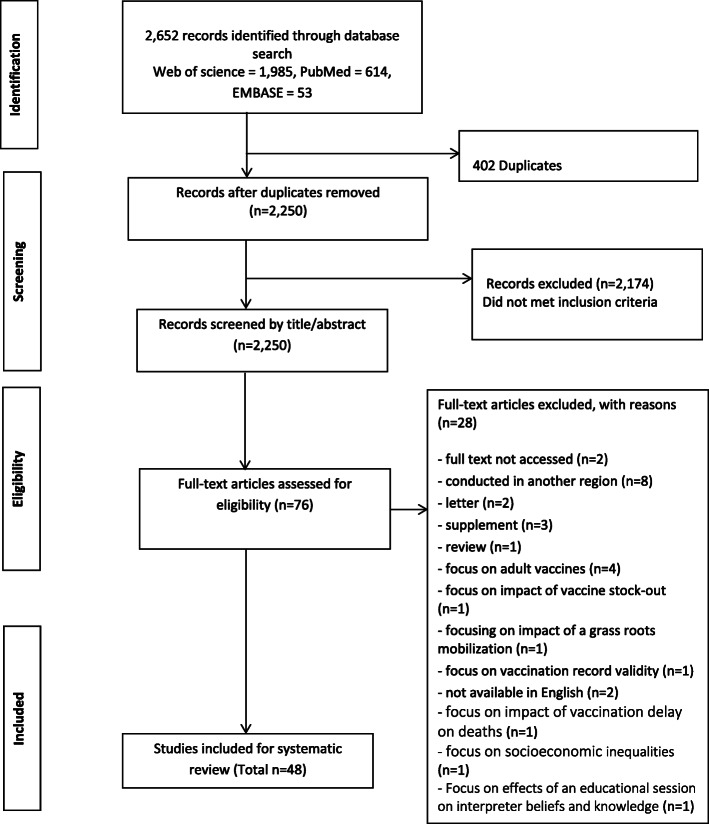
Background: Immunization to prevent infectious diseases is a core strategy to improve childhood health as well as survival. It remains a challenge for some African countries to attain the required childhood immunization coverage. We aim at identifying individual barriers confronting parents/caretakers, providers, and health systems that hinder childhood immunization coverage in Sub-Saharan Africa. Method: This systematic review searched PubMed/MEDLINE, Web of Science and EMBASE. We restricted to published articles in English that focused on childhood immunization barriers in sub-Saharan Africa from January 1988 to December 2019. We excluded studies if: focused on barriers to immunization for children in other regions of the world, studied adult immunization barriers; studies not available on the university library, they were editorial, reports, reviews, supplement, and bulletins. Study designs included were cross-sectional, second-hand data analysis; and case control. Results: Of the 2652 items identified, 48 met inclusion criteria. Parents/caretakers were the most common subjects. Nine articles were of moderate and 39 were of high methodological quality. Nine studies analyzed secondary data; 36 used cross-sectional designs and three employed case control method. Thirty studies reported national immunization coverage of key vaccines for children under one, eighteen did not. When reported, national immunization coverage of childhood vaccines is reported to be low. Parents/caretaker’ barriers included lack of knowledge of immunization, distance to access point, financial deprivation, lack of partners support, and distrust in vaccines and immunization programs. Other associated factors for low vaccine rates included the number of off-springs, lifestyle, migration, occupation and parent’s forgetfulness, inconvenient time and language barrier. Barriers at health system level cited by healthcare providers included limited human resources and inadequate infrastructures to maintain the cold chain and adequate supply of vaccines. Conclusion: In this review we identified more thoroughly the parents/caretakers’ barriers than those of providers and health systems. Factors that influenced decisions to get children vaccinated were mainly their gender, beliefs, socio-culture factors in the communities in which they live. Thus it is vital that immunization programs consider these barriers and address the people and societies in their communities across sub-Saharan Africa.
Overview
The claims and statistics of this paper haven’t been checked yet.
Free: it reads the open-access text and checks the first 5 claims that cite a source we can check. Create a free account to check every claim.
Integrity signals
Registry
Cites
Statistics
Figures
Verification
Claims the paper makes
The claims and statistics of this paper haven’t been checked yet.
Free: it reads the open-access text and checks the first 5 claims that cite a source we can check. Create a free account to check every claim.
Self-check
Percentages, sums and reported differences re-computed from the paper’s own numbers.
The self-check needs the paper’s full text.
Citations
Cites
Preferred Reporting Items for Systematic Reviews and Meta-Analyses: the PRISMA statement
Moher, D., Liberati, A., Tetzlaff, J., Altman, D. G., & for the PRISMA Group (2009) · BMJ · doi:10.1136/bmj.b2535 · Cited by 83,823
Preferred Reporting Items for Systematic Reviews and Meta-Analyses: The PRISMA Statement
Moher, D., Liberati, A., Tetzlaff, J., Altman, D. G., & The PRISMA Group (2009) · PLoS Medicine · doi:10.1371/journal.pmed.1000097 · Cited by 64,042
Preferred reporting items for systematic reviews and meta-analyses: the PRISMA Statement.
(2009) · PubMed Central · Cited by 44,859
Wang, G., Ma, R., Qiao, G., Wada, K., Aizawa, Y., & Satoh, T. (2015) · Integrative Medicine International · doi:10.1159/000368408 · Cited by 18,657
Naghavi, M., Abajobir, A. A., Abbafati, C., Abbas, K. M., Abd-Allah, F., Abera, S. F., Aboyans, V., Adetokunboh, O., Afshin, A., Agrawal, A., et al. (2017) · The Lancet · doi:10.1016/s0140-6736(17)32152-9 · Cited by 4,821
Schmid, P., Rauber, D., Betsch, C., Lidolt, G., & Denker, M.-L. (2017) · PLOS ONE · doi:10.1371/journal.pone.0170550 · Cited by 1,228 · cited 2×
“This is in line with previous review of Influenza Vaccine hesitancy, which pointed out that, a lack of confidence due to low perceived effectiveness of the vaccine was a hindrance to vaccine uptake [56].”
BackgroundResultRainey, J. J., Watkins, M., Ryman, T. K., Sandhu, P., Bo, A., & Banerjee, K. (2011) · Vaccine · doi:10.1016/j.vaccine.2011.08.096 · Cited by 426
Vaccine Hesitancy: Clarifying a Theoretical Framework for an Ambiguous Notion
Peretti-Watel, P., Ward, J. K., Schulz, W. S., Verger, P., & Larson, H. J. (2015) · PLoS Currents · doi:10.1371/currents.outbreaks.6844c80ff9f5b273f34c91f71b7fc289 · Cited by 343 · cited 1×
“A published article exploring vaccine hesitancy stated that various attitudes seems to result into specific categories; for instance, vaccine refusal attitude could be as a result of having little or no knowledge about vaccine, lack of trust on the vaccine or it could as well linked to financial limitations [64].”
BackgroundWiysonge, C. S., Uthman, O. A., Ndumbe, P. M., & Hussey, G. D. (2012) · PLoS ONE · doi:10.1371/journal.pone.0037905 · Cited by 251 · cited 3×
“This is mainly due to vaccinepreventable diseases [7].”
BackgroundEstimating teh costs of achieving the WHO-UNICEF Global Immunization Vision and Strategy, 2006-2015
Wolfson, L. (2008) · Bulletin of the World Health Organization · doi:10.2471/blt.07.045096 · Cited by 232
Research works printed but not linked: 1
- WHO - Ministerial Conference on Immunization in Africa. Historical Commitment from Africa Heads of States to Advance Immunization in Africa. Available from: http://immunizationinafrica2016.org/releases/2017/1/31/historic-commitment-from-african-heads-of-state-to-advance-immunization-in-africa. Accessed 9 Apr 2019.
Cited by
Items 101–200 of 390
Maintaining Immunizations for Vaccine-Preventable Diseases in a Changing World
Baidya, A., Willens, V., Wonodi, C. B., & Moss, W. J. (2024) · Annual Review of Public Health · doi:10.1146/annurev-publhealth-071723-111427 · Cited by 12
Gender Barriers to Immunization: A Synthesis of UNICEF’s Analyses to Advance Equity and Coverage
Mansilla, C., Kamlongera, A. P., & Dadari, I. (2025) · Vaccines · doi:10.3390/vaccines13101059 · Cited by 11
“Moreover, the existing literature emphasizes how gender-based discrimination, stigma, and structural exclusion affect both vaccine demand and service delivery [8,19].”
Birhanu, F., & Yitbarek, K. (2023) · PLoS ONE · doi:10.1371/journal.pone.0293522 · Cited by 9
Musuka, G., Moyo, E., Mano, O., Madziva, R., Gashema, P., Iradukunda, P. G., Sayem, A. S. M., Dhliwayo, T., Herrera, H., Mutata, C., et al. (2025) · Vaccine · doi:10.1016/j.vaccine.2025.127695 · Cited by 8
Childhood vaccination hesitancy in Saudi Arabia: are we still facing a problem?
Alamir, A. A. B. (2024) · Saudi Medical Journal · doi:10.15537/smj.2024.45.6.20240116 · Cited by 8
“12,13 Understanding the reasons for parents’ hesitation towards vaccines is crucial for developing effective interventions as, in some areas, up to 20% of children lack all recommended vaccinations.”
BackgroundNzilibili, S. M. M., Maziku, H. H., Araya, A., Kateule, R., Malamla, M. A., Salum, S., Kyesi, F., Gadau, L., Haonga, T., Tinuga, F., et al. (2025) · Vaccines · doi:10.3390/vaccines13010038 · Cited by 8
Jil, J. P. M. (2022) · Pan African Medical Journal · doi:10.11604/pamj.2022.41.258.31637 · Cited by 8
“Other reasons include vaccine-related reactions [41], vaccine provider ́s hostility and rude attitude [42], vaccine hesitancy [43], fear of side effects, busy schedules, poverty, long distance between home and health facility, non-availability of vaccine, long waiting time, forgetfulness, inconvenient time, and langua…”
BackgroundSabahelzain, M. M., Tagelsir, A., Elhadi, Y. A. M., & Abdalla, O. (2022) · Vaccines · doi:10.3390/vaccines10101674 · Cited by 8
“Perceived Accessibility to the Measles Vaccine—Uptake of the Measles Vaccine Contrary to the findings from different African countries [8,11,12], measles vaccine accessibility perception was not associated with measles vaccine uptake after controlling other potential social confounders, such as the mother’s age and th…”
BackgroundIslam, M. R., Rahman, M. M., Rahman, M. S., Abe, S. K., Akmatov, M. K., & Hashizume, M. (2024) · Frontiers in Public Health · doi:10.3389/fpubh.2024.1371258 · Cited by 7
Unpacking the impact of COVID-19 on child immunization: evidence from Ghana
Durizzo, K., Awoonor‐Williams, J. K., Harttgen, K., & Günther, I. (2024) · BMC Public Health · doi:10.1186/s12889-024-19033-4 · Cited by 7
“Despite this progress, ensuring that every child has access to basic immunization services remains challenging in many low-and middle-income countries (LMICs) [5–7] particularly during epidemics and pandemics, such as COVID-19.”
BackgroundEkholuenetale, M., Ochagu, V. A., Ilesanmi, O. S., Badejo, O. A., & Arora, A. (2024) · Global Pediatric Health · doi:10.1177/2333794x241310487 · Cited by 10
“14 Mothers in Burkina Faso who were aware of the preventive benefits of vaccination were more likely to vaccinate their children than those who were not.”
George, N. S., Bassey, A. E., Cruz, J. A. A., & Tambor, M. (2025) · Discover Public Health · doi:10.1186/s12982-025-00584-9 · Cited by 9
Saunders, M. J., Pereboom, M., Alvarez, J. L., Sherlock, M., & Gadroen, K. (2025) · BMJ Global Health · doi:10.1136/bmjgh-2025-019662 · Cited by 7
Dietrich, J. J., Tsotetsi, L., Dubazane, T., Tshabalala, G., Maimela, B., Weiss, M. H., & Mulaudzi, M. (2023) · Frontiers in Digital Health · doi:10.3389/fdgth.2022.1094754 · Cited by 7
Diawara, H., Grant, J., Dicko, A., Traore, S., Issiaka, D., Koita, F., Datoo, M. S., Sylla, M., Dicko, A. B., Sagara, I., et al. (2025) · BMJ Global Health · doi:10.1136/bmjgh-2024-015524 · Cited by 7
“24”
Omayo, L. N., Malande, O. O., Musyoki, A. M., Hoffman, P. X., & ADAMU, V. (2023) · Journal of the African Society for Paediatric Infectious Diseases · doi:10.15641/jafspidvol2pp1-29/1666 · Cited by 11
Tamuzi, J. L., Katoto, P. D., Ndwandwe, D. E., Wiysonge, C. S., & Nyasulu, P. S. (2025) · Human Vaccines & Immunotherapeutics · doi:10.1080/21645515.2025.2510714 · Cited by 7
“30,31 Worse, these barriers and challenges are likely to have been amplified by COVID-19 epidemic, as indicated in this study’s meta-regression.”
Kunieda, M. K., Manzo, M. L., Subramanian, S. V., & Jimba, M. (2022) · Vaccines · doi:10.3390/vaccines10091513 · Cited by 7
“Research has focused on determinants of full vaccination coverage [3–7], barriers [8] and vaccination acceptance [5,9].”
BackgroundPenyuluhan Kesehatan Tentang Pentingnya Imunisasi Di Puskesmas Antang Kota Makassar
Rosdiana, R., Saide, R., Pannyiwi, R., Malaha, N., & Sakriawati, M. (2023) · Sahabat Sosial Jurnal Pengabdian Masyarakat · doi:10.59585/sosisabdimas.v2i1.254 · Cited by 7
Wondie, W. T., Zemariam, A. B., Gedefaw, G. D., Lakew, G., Getachew, E., Mengistie, B. A., Shibabaw, A. A., Chereka, A. A., Kitil, G. W., Yirsaw, A. N., et al. (2025) · Frontiers in Public Health · doi:10.3389/fpubh.2025.1496931 · Cited by 7
Liebrenz, M., Bhugra, D., Buadze, A., & Schleifer, R. (2021) · Forensic Science International Mind and Law · doi:10.1016/j.fsiml.2021.100044 · Cited by 9
Developing vaccinology expertise for Africa: fifteen years and counting
Amponsah‐Dacosta, E., Muloiwa, R., Wiysonge, C. S., Gold, M., Hussey, G. D., & Kagina, B. M. N. (2021) · Pan African Medical Journal · doi:10.11604/pamj.2021.38.313.26744 · Cited by 7
Ahn, C., & Noh, G.-Y. (2021) · Frontiers in Public Health · doi:10.3389/fpubh.2021.756281 · Cited by 7
Inusah, A., Tahiru, M. M., Gbeti, C., Dzomeku, P., Head, M., & Ziblim, S.-D. (2026) · Pan African Medical Journal · doi:10.11604/pamj.2026.53.24.49809 · Cited by 7
“Strengthening trust and communication between health workers and nomadic populations will be critical to maintaining high coverage and preventing future outbreaks.”
Oli, A. N., Ogwaluonye, U. C., Onubogu, C. U., Ozumba, A. F., Agbaenyi, O. H., Okeke, K. N., Onah, S., Okoro, J. C., Ifezulike, C. C., & Emechebe, G. O. (2021) · Journal of Multidisciplinary Healthcare · doi:10.2147/jmdh.s279397 · Cited by 7
Phiri, M. M., Osman, R., Weldegebriel, S., Sabola, S., Ongadi, B. A., Beavis, C., Mwendera, C. A., & Nyirenda, D. (2025) · PLoS ONE · doi:10.1371/journal.pone.0319691 · Cited by 6
“These include inconsistent vaccine supply, limited healthcare infrastructure, and increased workloads for healthcare workers tasked with implementing new vaccines [10,11].”
Musuka, G., Moyo, E., Iradukunda, P. G., Gashema, P., Madziva, R., Herrera, H., Dhliwayo, T., Mutata, C., Mataruse, N., Mano, O., et al. (2025) · Tropical Medicine and Infectious Disease · doi:10.3390/tropicalmed10100286 · Cited by 7
“Conversely, maternal age above 40 years was positively associated with full immunisation (AOR = 7.37, CI: 1.65–32), suggesting that older caregivers may possess greater confidence, autonomy, or social capital [24].”
InfluentialCommunity-based health programs and child vaccinations: Evidence from Madagascar
Herrera‐Almanza, C., & Rosales-Rueda, M. F. (2023) · World Development · doi:10.1016/j.worlddev.2023.106322 · Cited by 7
Abdallah, G., Msuya, H. M., Mtenga, S., Festo, C., Mhalu, G., Shabani, J., Tillya, R., Mwengee, W., Masanja, H., & Mkopi, A. (2024) · American Journal of Tropical Medicine and Hygiene · doi:10.4269/ajtmh.23-0563 · Cited by 7
Avelino, I. C., Van-Dúnem, J., & Varandas, L. (2024) · International Journal of Environmental Research and Public Health · doi:10.3390/ijerph21121609 · Cited by 7
“The absence of vaccination increases the vulnerability of these infants to severe, preventable infectious diseases, including tuberculosis meningitis, miliary tuberculosis, and poliomyelitis, which are major contributors to neonatal mortality [66–69].”
Attahiru, A., Mohammed, Y., Mikailu, F., Waziri, H. S., Waziri, N. E., Mustapha, T., Sunusi, B., Mahmoud, M. N., Vollmer, N., Vargas, W., et al. (2025) · Vaccines · doi:10.3390/vaccines13070664 · Cited by 6
“…are more salient issues, echoing findings from a systematic review conducted in sub-Saharan Africa by Bangura and colleagues to uncover factors that hinder childhood immunization, where caregiver-related barriers were more pronounced than those of health care providers and health systems [36].”
Sigdel, B., Jin, Y., Dhakal, P., Luitel, T., Ghimire, P. K., & Wasti, S. P. (2023) · Dialogues in Health · doi:10.1016/j.dialog.2023.100140 · Cited by 6
“This fi nding is consistent with the study conducted in Ethiopia [26] and Sub-Saharan Africa [27].”
ResultAdamu, A. A., Essoh, T.-A., Jalo, R. I., & Wiysonge, C. S. (2023) · International Journal of Infectious Diseases · doi:10.1016/j.ijid.2023.09.017 · Cited by 6
Gamachu, M., Mussa, I., DERESSA, A. D., Tolera, M., Birhanu, A., Getachew, T., Negash, A., Jibro, U., Abdurahman, D., Motuma, A., et al. (2024) · Vaccine X · doi:10.1016/j.jvacx.2024.100428 · Cited by 6
“The consistent increases in immunization coverage over the past few decades, pro-urban, pro-rich, and pro-educated disparities in coverage have been noted in SSA countries [15].”
BackgroundThe Role of Medical Mistrust in Vaccination Decisions in Rural, Indigenous Namibian Communities
Prall, S. P., Scelza, B. A., & Davis, H. E. (2025) · Journal of Racial and Ethnic Health Disparities · doi:10.1007/s40615-025-02442-5 · Cited by 6
“These results are similar to findings elsewhere in sub-Saharan Africa, showing that COVID-19 vaccine acceptance is high but stymied by access at the local level [102], and remoteness and distance to receive vaccines have been highlighted as a barrier to vaccination in other contexts [103, 104].”
Effects of Immunisation on Child Mortality in West Africa
Obasaju, B. O., Adama, I. J., Ishola, O. P., Oloyede, F., Osabohien, R. A., Aregbesola, A., & Onabote, A. A. (2023) · International Conference on Science, Engineering and Business for Sustainable Development Goals (SEB-SDG) · doi:10.1109/seb-sdg57117.2023.10124485 · Cited by 6
“In recent years, the African continent has experienced some levels of variations as regards coverage of immunisation and child mortality [7].”
BackgroundAssimamaw, N. T., Endalamaw, A., Kelkay, M. M., Gonete, A. T., Terefe, B., & Zeleke, K. A. (2024) · International Journal of Pediatrics · doi:10.1155/2024/4213025 · Cited by 5
“In contrast, developing countries may have limited resources for public health campaigns and health education initiatives, leading to a lower awareness and understanding of vaccines among mothers [37, 60].”
BackgroundInfluentialOwuor, P. M., Odhiambo, S. A., Orero, W. O., Owuor, J., & Onyango, E. O. (2025) · PLOS Global Public Health · doi:10.1371/journal.pgph.0004220 · Cited by 6
Baruwa, O. J., Akokuwebe, M. E., Adeleye, O. J., & Gbadebo, B. M. (2025) · BMC Public Health · doi:10.1186/s12889-025-22143-2 · Cited by 6
“Second, people living in rural areas may have a greater understanding of the value of immunization as a preventative measure against common diseases that are common in these areas, as these populations frequently face unique health challenges [39–41].”
Nigeria introduces the world’s first Men5 CV meningitis vaccine
Aderinto, N., Olatunji, G. D., Kokori, E., Ogieuhi, I. J., Alao, A. E., Ajimotokan, O. I., Okam, O. V., Akinruli, O. A., & Olawoyin, M. T. (2025) · Discover Public Health · doi:10.1186/s12982-025-00592-9 · Cited by 5
“If successful, Nigeria’s model could inspire the Meningitis Belt, with WHO-and Gavi-backed campaigns planned for 2025, advancing the 2030 elimination vision [32, 38].”
Effect of tailored information of vaccination schedule on vaccine uptake in northern Nigeria
Sato, R., & Titus, T. (2021) · Human Vaccines & Immunotherapeutics · doi:10.1080/21645515.2021.1936861 · Cited by 5
Immunization of Children in Africa: Strides and Challenges
Olawuyi, D. A., Esanju, D., Olowolayemo, S. A., Asogwa, C. S., Salako, O. O., Kolajo, A. E., Akano, O. S., Ibekwe, J. L., Mbey, A. N., & Raji, A. H. (2023) · Nigerian Journal of Medicine · doi:10.4103/njm.njm_42_23 · Cited by 5
Shiferie, F., Gebremedhin, S., Andargie, G., Tsegaye, D. A., Alemayehu, W. A., & Fenta, T. G. (2024) · American Journal of Tropical Medicine and Hygiene · doi:10.4269/ajtmh.23-0816 · Cited by 5
Bakare, A. A., Akinsola, K. O., King, C., Sogbesan, A., Bakare, O. R., Fadahunsi, O. Y., Salako, J., Falade, A. G., & van Wees, S. H. (2024) · BMC Health Services Research · doi:10.1186/s12913-024-11623-7 · Cited by 5
“As a consequence of the decline in childhood vaccination coverage due to the COVID-19 pandemic, concerns have emerged regarding resilience of existing vaccination services [13, 14].”
BackgroundEnhancing vaccine delivery in Africa with implementation science
Adamu, A. A., Ndiaye, S. M., Jalo, R. I., Karamagi, H. C., Ngwakum, P., Ndwandwe, D. E., & Wiysonge, C. S. (2024) · Discover Public Health · doi:10.1186/s12982-024-00321-8 · Cited by 5
Bediako, V. B., Ackah, J. A., Yankey, T. J., Okyere, J., Acheampong, E., Owusu, B. A., Agbemavi, W., Nwameme, A. U., Kamau, E. M., & Asampong, E. (2025) · Scientific Reports · doi:10.1038/s41598-024-75408-y · Cited by 6
Izudi, J., Kiroro, F., Runyenje, C., Otieno, P. O., Mutua, M. K., Mbuthia, M. N., Donfouet, H. P. P., Treleaven, E., & Asiki, G. (2025) · International Journal of Epidemiology · doi:10.1093/ije/dyaf024 · Cited by 5
Knowledge and attitude on infant vaccination among university staff in Malaysian public university
Shaipuzaman, N. A., & Rahman, H. A. (2022) · Human Vaccines & Immunotherapeutics · doi:10.1080/21645515.2022.2029258 · Cited by 5
Mathew, M., Sanathan, S. R., Sebastian, J., Ravi, M. D., Joy, T., Theempalangad, R. M., & Gowda, P. (2024) · Therapeutic Advances in Vaccines and Immunotherapy · doi:10.1177/25151355241287705 · Cited by 5
Damien, G. B., Ou, W. V. A., Dahoun, M., Kaucley, L., & Aguèmon, B. (2024) · PubMed Central · doi:10.48327/mtsi.v4i1.2024.352 · Cited by 5
“La vaccination est une mesure de prévention efficace contre les maladies infectieuses [4] et représente l’un des meilleurs investissements en matière de santé publique [14].”
BackgroundAgbo, C. E., Chima, U. E., Olanrewaju, O. F., Amoke, J. C., Mbaji, M. S., Offor, O. O., Ogbobe, S. C., & Isah, A. (2024) · Discover Public Health · doi:10.1186/s12982-024-00370-z · Cited by 4
“Regular screening may be affected especially in underserved populations due to financial constraints and lack of knowledge [39].”
Saidu, Y., Gu, J., Budzi, M. N., Nchinjoh, S. C., Amani, A., Nnang, N. E., Muteh, N. J., Zambou, V. M., Mbanga, C., Agbor, V. N., et al. (2024) · Vaccines · doi:10.3390/vaccines12121430 · Cited by 4
“Despite the multidimensional benefits of vaccination and the global progress made in improving vaccine coverage over the years, vaccine-preventable diseases (VPDs) remain a major cause of child morbidity and mortality, particularly in low-and middle-income countries (LMICs) [4,5].”
Arhin, K., Acheampong, K., & Frimpong, A. O. (2025) · Cogent Social Sciences · doi:10.1080/23311886.2025.2471562 · Cited by 4
“Previous studies have examined inequalities of childhood immunization coverage (Bangura et al., 2020; Janusz, 2020) and determinants (Atteraya et al., 2023; Budu et al., 2023), as well as the relationship between childhood immunization rates and childhood deaths in SSA (Tesema et al., 2020).”
Alotaibi, N. A., Alhumyani, R. A., Alqahtani, B. A. A., Alkhaldi, N. J., & Alkhaldi, J. (2025) · Journal of Pioneering Medical Science · doi:10.47310/jpms202514s0115 · Cited by 4
Ouédraogo, A. L., Offosse, M.-J., Zhang, J., Toe, S., & Yameogo, P. (2025) · Global Health Research and Policy · doi:10.1186/s41256-025-00455-5 · Cited by 4
Manga, M. M., Fowotade, A., Modibbo, Z. I., Madhivhandila, M., Ndao, T., Abayomi, O., & Mohammed, Y. (2025) · Vaccine X · doi:10.1016/j.jvacx.2025.100729 · Cited by 5
Stern, C., Valenzuela, C., Whitehorn, A., Pollock, D., Minooee, S., Gohil, D. A., Zhu, Z., Kirkpatrick, P., Loureiro, R. L., Davies, E., et al. (2026) · JBI Evidence Synthesis · doi:10.11124/jbies-25-00265 · Cited by 6
Mohammed, Y., Olowo‐okere, A., Bawa, S. B., Onah, J. O., Saad, A., Oteri, A. J., Yusufari, Y., Wonodi, C. B., Umar, Z. A., Kolawole, A. A., et al. (2026) · International Journal of Infectious Diseases · doi:10.1016/j.ijid.2026.108569 · Cited by 4
Igweonu-Nwakile, C. O., Adejimi, A. A., Roberts, A. A., Oluwole, E. O., Oridota, O. E., Oyeleye, O. A., & Onajole, A. T. (2023) · Journal of Community Medicine and Primary Health Care · doi:10.4314/jcmphc.v35i1.4 · Cited by 5
COVID-19 and the View from Africa
Davies, T. J. G., Matengu, K. K., & Hall, J. E. (2023) · Religions · doi:10.3390/rel14050589 · Cited by 4
Bhatt, A., Monk, V., Bhatti, A. A., Eiden, A. L., Hermany, L. V., Hansen, N., Connolly, M. P., Baxter, L., Vanderslott, S., Mitrovich, R., et al. (2024) · BMJ Open · doi:10.1136/bmjopen-2023-080370 · Cited by 4
“Theme descriptor”
Perceptions of roles of community healthcare workers in early childhood in Limpopo, South Africa
Moolla, A., Coetzee, L., Mongwenyana, C., Robertson, A., Marincowitz, G. J. O., Zuckerman, M., Fink, G., Hamer, D. H., Yousafzai, A. K., Rockers, P. C., et al. (2024) · African Journal of Primary Health Care & Family Medicine · doi:10.4102/phcfm.v16i1.4412 · Cited by 4
An audit of completeness of Road to Health Booklet at a community health centre in South Africa
Machimana, P., Nyalunga, S. L. N., Madela-Mntla, E. N., & Nzaumvila, D. K. (2024) · African Journal of Primary Health Care & Family Medicine · doi:10.4102/phcfm.v16i1.4654 · Cited by 4
“12,25,26,27,28,29,30 Deworming treatments should begin at 12 months of age, while vitamin A supplements should begin at 6 months.”
InfluentialImpact of the May 2024 floods on childhood immunization coverage in Rio Grande do Sul, Brazil
Procianoy, G. S., Silveira, R. C., & Procianoy, R. S. (2025) · Vaccine · doi:10.1016/j.vaccine.2025.127573 · Cited by 4
Antonio, M., Ramirez-Cerino, E., Sahilie, A., Yemane, M., Youssef, M., Nielssen, I., Holdbrook, L., Essar, M. Y., Santana, M., Spitzer, D. L., et al. (2026) · BMC Public Health · doi:10.1186/s12889-026-26770-1 · Cited by 4
“…how gender roles influence vaccine decision-making, particularly for women in care-giver roles who face additional barriers such as childcare and elder-care responsibilities, transportation barriers, and concerns about side effects impacting their ability to care for family members [29, 30].”
Alabadi, M., Alashoor, T., Aldawood, O., Qanbar, Z., & Aldawood, Z. (2022) · Vaccines · doi:10.3390/vaccines10122147 · Cited by 7
“While childhood immunisation non-compliance has been reported in every country, developing countries show a high prevalence of non-completion rates of child immunisation [9].”
BackgroundMirieri, H., Nasimiyu, C., Dawa, J., Mburu, C. M., Jalango, R. E., Kamau, P., Igboh, L. S., Ebama, M., Wainaina, D., Gitonga, J., et al. (2023) · Vaccine · doi:10.1016/j.vaccine.2023.09.023 · Cited by 4
“This is due to factors such as inadequate information on vaccines, misconceptions about vaccines, negative perceptions about vaccines, inaccessibility of health facilities, and poor provider-client relationships, all of which affect vaccine uptake [13,14].”
BackgroundTrends in Vaccine Completeness in Children Aged 0–23 Months in Cape Town, South Africa
Ndwandwe, D. E., Ndlovu, M., Mayeye, A., Luphondo, N., Muvhulawa, N., Ntamo, Y., Dludla, P. V., & Wiysonge, C. S. (2023) · Vaccines · doi:10.3390/vaccines11121782 · Cited by 4
“As previously reviewed [39], possible factors contributing to these observations could include issues related to awareness, accessibility, or healthcare system efficiency.”
BackgroundAdamu, A. A., Nnaji, C. A., & Wiysonge, C. S. (2025) · Discover Public Health · doi:10.1186/s12982-025-00627-1 · Cited by 4
Ghazy, R. M., Gebreal, A., Saleeb, M., Sallam, M., El-Deen, A. E.-S. N., Sheriff, S. D., Tessema, E. A., Ahurwendeire, S., Tsoeu, N., Chamambala, P. C., et al. (2023) · Journal of Community Health · doi:10.1007/s10900-023-01261-1 · Cited by 4
“The more knowledgeable mothers know about immunization, including its benefits, safety, and recommended schedules, the higher their level of confidence in the decision to vac - cinate their children [19, 29].”
InfluentialJoachin, M., Okoye, A. E., Yvette, N., Thomas, N., Kosisochukwu, N., Emesobum, M. A., Samuel, E., Chinedu, O. K., & Nzeako, M. K. (2024) · Medical Research Archives · doi:10.18103/mra.v12i1.5064 · Cited by 4
Adeyanju, G. C., Betsch, C., Adamu, A. A., Gumbi, K. S., Head, M., Aplogan, A., Tall, H., & Essoh, T.-A. (2021) · Research Square · doi:10.21203/rs.3.rs-383265/v1 · Cited by 5
“(Al-Ayed & Sheik, 2006; Santos et al., 2020; Ogochukwu et al., 2017; Bangura et al., 2020).”
Perceptions on Pediatric Vaccination and Adherence: A Study among Mothers in the Philippines
Maturan, E. G. L., Fabroa, M. J. E., & Santos, J. A. A. D. L. (2022) · The Malaysian Journal of Nursing · doi:10.31674/mjn.2022.v14i01.009 · Cited by 3
Owino, E. A., Mafigiri, D. K., Kamuya, D., Jones, C. O. H., & Chi, P. C. (2023) · NIHR Open Research · doi:10.3310/nihropenres.13449.3 · Cited by 3
Onukwuli, V. O., Ukemenam, W. C., Iloh, K. K., & Tagbo, B. N. (2025) · International Journal of Medicine and Health Development · doi:10.4103/ijmh.ijmh_15_25 · Cited by 3
Agbedi, E. B., Oweibia, M., & Ekiyor, C. P. (2025) · Journal of Pediatrics Perinatology and Child Health · doi:10.26502//jppch.74050226 · Cited by 3
Lawrence, E. C., Metje, A., Matemba, C., & Powelson, J. (2025) · BMJ Open · doi:10.1136/bmjopen-2025-104490 · Cited by 3
Shiferie, F., Biks, G. A., Negash, K., Tsegaye, D. A., Seboka, G., Birhanu, G., Ewnetie, S., Abate, T., Ralph-Opara, U., Alemayehu, W. A., et al. (2026) · Gates Open Research · doi:10.12688/gatesopenres.16374.1 · Cited by 3
Melese, A., Wondirad, M., Melke, A., Tamiso, A., & Yoseph, A. (2026) · BMJ Paediatrics Open · doi:10.1136/bmjpo-2025-004245 · Cited by 3
Wondie, W. T., Zemariam, A. B., Gebreegziahber, Z. A., Legesse, B. T., Belete, K. T., Mekonnen, G. B., Gedefaw, G. D., Atinafu, W. T., Seifu, B. L., & Tazeb, W. (2026) · Scientific Reports · doi:10.1038/s41598-026-40258-3 · Cited by 4
“The lower coverage in Sub-Saharan Africa is likely due to underdeveloped healthcare systems, limited infrastructure, a shortage of healthcare workers, and poor community literacy rates in Sub-Saharan countries, which impedes effective IPV delivery 30,31 .”
Tamirat, F., & Kebede, M. A. (2026) · SAGE Open Medicine · doi:10.1177/20503121261435048 · Cited by 3
“23 This quantitative finding is consistent with a large-scale descriptive study in 33 sub-Saharan countries, 24 and the Ethiopian Demographic Health, 2019 survey report, with an overall prevalence of 19%.”
Namasambi, S., Migisha, R., Kigongo, V. J., Nakabuye, M., Bulage, L., Kwesiga, B., Nuwamanya, Y., Nsubuga, F., Ankunda, C., Eliku, J. P., et al. (2026) · Discover Public Health · doi:10.1186/s12982-026-02544-3 · Cited by 3
“The absence of documented investigation and timely communication may have allowed uncertainty and misinformation to persist, potentially influencing subsequent vaccine acceptance [16–18].”
Mwinnyaa, G., Peters, M. A., Shapira, G., Neill, R., Sadat, H., Yuma, S., Akilimali, P. Z., Hossain, S., Wendrad, N., Atiwoto, W. K., et al. (2023) · Vaccines · doi:10.3390/vaccines11091415 · Cited by 3
“The challenges of immunizing “hard-to-reach” populations in remote rural areas, informal settlements, and conflict-impacted areas are well documented [8–11].”
Wasswa, R. E., Kananura, R. M., Waiswa, P., Requejo, J. H., Santos, T. M., & Barros, A. J. D. (2025) · BMJ Open · doi:10.1136/bmjopen-2024-093619 · Cited by 3
Geta, M., Hailu, A., & Woldeamanuel, Y. (2025) · Public Health in Practice · doi:10.1016/j.puhip.2025.100608 · Cited by 3
“Barriers to vaccination include lack of awareness, limited access to vaccination points, distrust of vaccines, respondents ’ demographic factors, educational levels, marital status, maternal media exposure, and health system organization [13 – 15].”
Supportive supervision of nurses and its impact on healthcare access in sub-Saharan Africa
Serapelwane, M. G., Bam, N. E., & Kovane, G. P. (2025) · Health SA Gesondheid · doi:10.4102/hsag.v30i0.3094 · Cited by 3
“In addition, Bangura et al. (2020) verified that unsupervised nurses exposed clients to a lack of essential information about potential vaccine side effects and follow-up vaccination schedules, limiting their access to crucial health information and immunisation services.”
Onwujekwe, O. E., Mbachu, C., & Agu, I. C. (2023) · Nigerian Journal of Clinical Practice · doi:10.4103/njcp.njcp_674_22 · Cited by 3
Otaigbe, I. I. (2023) · Babcock University Medical Journal · doi:10.38029/babcockuniv.med.j..v6i2.323 · Cited by 5
“The inability to maintain cold chains is a major barrier to vaccine uptake and coverage in LMICs (43).”
BackgroundInfluentialAdam, J. D. Z., Betan, A. B., Nuryani, S., Wijayanti, L. A., & Mildaratu, M. (2023) · Sahabat Sosial Jurnal Pengabdian Masyarakat · doi:10.59585/sosisabdimas.v2i1.256 · Cited by 3
Bendera, A., Nakamura, K., Tran, X. M. T., Kapologwe, N., Bendera, E. C., Mahamba, D. C., & Meshi, E. B. (2025) · Vaccine · doi:10.1016/j.vaccine.2025.126904 · Cited by 5
Yıldırım, M., Akın, H. Y. S., & Karaarslan, D. (2025) · Çocuk Enfeksiyon Dergisi/Journal of Pediatric Infection · doi:10.5578/ced.20250104 · Cited by 4
Kitsao-Wekulo, P., Haycraft, E., Mwoma, T., Okelo, K., Kinuthia, E., Muriuki, P. G., Onyango, S., Kimiywe, J. O., Wanjohi, M., Kimani-Murage, E., et al. (2021) · Research Square · doi:10.21203/rs.3.rs-1125126/v1 · Cited by 3
Farahani, M., Tindyebwa, T., Sugandhi, N., Ward, K., Park, Y., Bakkabulindi, P., Kulkarni, S., Wallace, A. S., Biraro, S., Wibabara, Y., et al. (2024) · Vaccines · doi:10.3390/vaccines12121353 · Cited by 2
Dinga, J. N., Ngunjoh, N. F., Tendongfor, N., Mbah, G. E., Qin, H., Ahmed, I., Muki, S. E., Gamua, S. D., Manyam, R., & Titanji, V. P. K. (2025) · Healthcare · doi:10.3390/healthcare13030239 · Cited by 3
“Cultural beliefs and misinformation about vaccines also contribute to resistance, as some urban communities may be wary of vaccination or prefer traditional healing practices over modern medical interventions [3–5].”
Post-COVID-19 pandemic immunization coverage in Algerian children: A cross-sectional study
Ghazy, R. M., Abadi, A. M., Salah, A., Ismail, E. A. A., Youssef, N. F. A., Saleeb, M., Abonazel, M. R., Gebreal, A., Elrewany, E. M. A., Moustafa, N. S., et al. (2025) · Medicine · doi:10.1097/md.0000000000041494 · Cited by 2
“[32] Similarly, Kaufman et al, [33] reported that the cost of vaccine or service delivery and transportation, distance, long clinic waiting times, and lack of vaccine availability are the most frequent challenges to childhood vaccination.”
Li, W., Sewolo, F., Aoun, A., Boltena, M. T., Musad, A., Lindstrand, A., Alfvén, T., Hanson, C., & El‐Khatib, Z. (2025) · Children · doi:10.3390/children12040415 · Cited by 2
“Notable barriers include inadequate parental knowledge, vaccine hesitancy, and systemic obstacles such as disrupted cold chains and insufficient healthcare provider training [8–10].”
Mashamba, M., Msibi, T. N., Tshabalala, G., Tsotetsi, L., Vermaak, S., Myburgh, N., Malycha, S., Goldstein, I., Grainger, E., Temane, M. D., et al. (2025) · Vaccine · doi:10.1016/j.vaccine.2025.127133 · Cited by 2
Cortaredona, S., Verger, P., Constance, J., Diallo, A., Bâ, E. H., Maradan, G., Sokhna, C., & Peretti‐Watel, P. (2025) · Tropical Medicine & International Health · doi:10.1111/tmi.70002 · Cited by 3
“Trained and motivated HCWs are crucial to the success of Senegal ’ s vaccination program, as they play a key role in improving vaccine acceptance, dispelling misconceptions and addressing vaccine hesitancy among their patients [2, 16].”
Trends in vaccination coverage and equity in the Democratic Republic of the Congo from 2017 to 2023
Lankiewicz, E., Kabele, J., Dikassa, P.-S. L., Mayala, V., Kazenza, B. M., Hatton, T., Nawaz, S., Munar, W. A., & Arsenault, C. (2025) · Vaccine · doi:10.1016/j.vaccine.2025.127609 · Cited by 4
“These health areas may be under-sampled and have both lower coverage and could contain less educated and less wealthy households, given the challenges in available infrastructure and services in rural DRC and the known link between distance to health services and vaccination uptake [57].”
Tariku, A., Andargie, B. A., Yilma, T. M., Hussen, A. M., Abera, A., Mohan, D., Pandya, S., Kan, L., Ruton, H., Kimball, M., et al. (2025) · Oxford Open Digital Health · doi:10.1093/oodh/oqaf018 · Cited by 3
“…immunization service delivery with digital health technologies underscore critical lesson to enhance the low coverage of child immunization in sub-Saharan Africa through improving par ents’ vaccination literacy, readiness to use the service and addressing their forgetfulness for schedules [49].”
Metadata
- Authors
- Bangura, J. B., Xiao, S., Qiu, D., Ouyang, F., & Chen, L.
- Affiliations
- Central South University (CN)
- Yale University (US)
- Venue
- BMC Public Health
- Published
- 2020-07-14
- Volume
- 20
- Issue
- 1
- Pages
- 1108-1108
- ISSN
- 1471-2458 (ISSN-L)
- PMC
- PMC7362649
- OpenAlex
- W3042680521
- Semantic Scholar
- 70ee944ff604b497be3329c9322a53e8bececfdd
- Cited by
- 340
- References
- 62
- Citations by year
- 2026: 55 · 2025: 91 · 2024: 63 · 2023: 52 · 2022: 38 · 2021: 37 · 2020: 4
- FWCI
- 5.14
- Type
- journal article
- Language
- en
- Open access
- gold
- doi.org
- Licence
- cc-by
- creativecommons.org/licenses/by/4.0 (tdm)
- creativecommons.org/licenses/by/4.0 (vor)
- Locations
- BMC Public Health (publishedVersion, cc-by)
- Research Square (acceptedVersion, cc-by)
- PubMed Central (publishedVersion, cc-by)
- PubMed (publishedVersion)
- DOAJ (DOAJ: Directory of Open Access Journals) (submittedVersion, cc-by-sa)
- Funders
- China Medical Board ([CMB-14-188])
- Topics
- Social Sciences › Health › Vaccine Coverage and Hesitancy
- Health Sciences › Medicine › Pediatrics, Perinatology and Child Health › Global Maternal and Child Health
- Life Sciences › Immunology and Microbiology › Immunology › Immune responses and vaccinations
- Keywords
- childhood immunization, vaccine hesitancy, barriers to vaccination, vaccination coverage, sub-Saharan Africa, vaccine distrust, health system barriers, cold chain, vaccine supply, sociocultural factors
- MeSH terms
- Vaccination Coverage, Adolescent, Adult, Attitude to Health, Child, Child, Preschool, Cross-Sectional Studies, Female, Health Personnel, Humans, Infant, Infant, Newborn, Male, Middle Aged, Parents, Vaccination, Case-Control Studies, Caregivers, Immunization Programs, Africa South of the Sahara
About these checks
Registry, retraction, Cites and statistics results are computed, not judged, with one exception: a printed reference that no index lists is read once by a model before it counts as a citation error. Claims are extracted by a model and kept only when their quote appears verbatim in the text; each cited source is then checked, with a model’s help, for whether it says what the claim relies on. Those verdicts can be wrong — read the claim’s quote and the cited source before relying on one.
Statistics and arithmetic are recomputed, not judged.
Confidence bands are shown only for fields calibrated on our annotated test set. None is calibrated yet, so no band is shown.
What counts as a claim ›How we measure confidence ›How we check this ›
Are you an author, or do you see a problem with this page? Request a review
Data sources
Bibliographic data: Semantic Scholar, OpenAlex, Crossref.
Contains information from the Semantic Scholar Academic Graph Datasets, made available under the ODC Attribution License (ODC-BY 1.0).
Semantic Scholar’s data is described in: Kinney, R., et al. (2023). The Semantic Scholar Open Data Platform. arXiv:2301.10140.
