

Barriers to childhood immunization in sub-Saharan Africa: A systematic review
Open accessPublished version of a preprint
The DOI matches its Crossref record; 62 of the 62 references it cites were found in a registry or an index.
Abstract
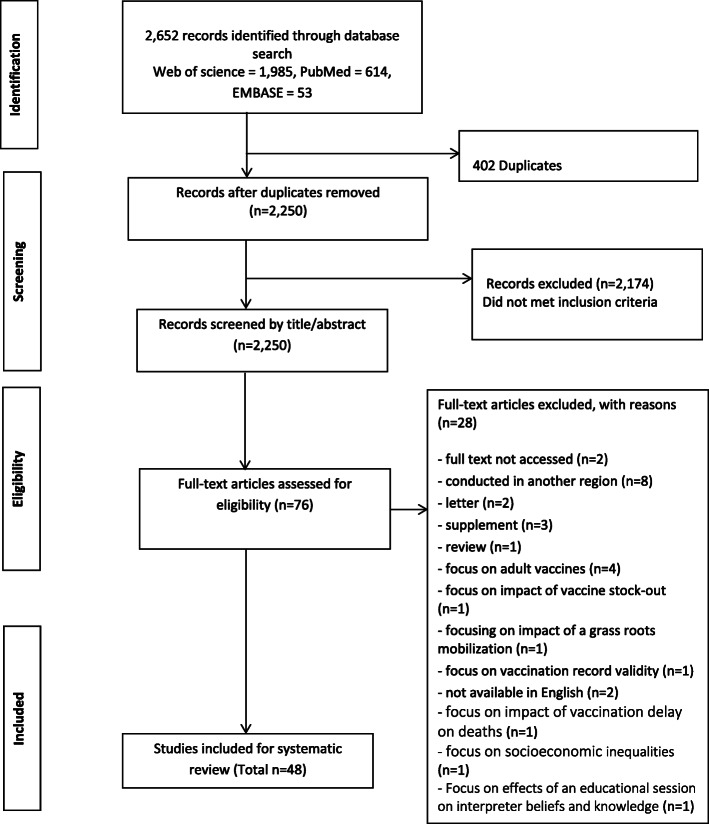
Background: Immunization to prevent infectious diseases is a core strategy to improve childhood health as well as survival. It remains a challenge for some African countries to attain the required childhood immunization coverage. We aim at identifying individual barriers confronting parents/caretakers, providers, and health systems that hinder childhood immunization coverage in Sub-Saharan Africa. Method: This systematic review searched PubMed/MEDLINE, Web of Science and EMBASE. We restricted to published articles in English that focused on childhood immunization barriers in sub-Saharan Africa from January 1988 to December 2019. We excluded studies if: focused on barriers to immunization for children in other regions of the world, studied adult immunization barriers; studies not available on the university library, they were editorial, reports, reviews, supplement, and bulletins. Study designs included were cross-sectional, second-hand data analysis; and case control. Results: Of the 2652 items identified, 48 met inclusion criteria. Parents/caretakers were the most common subjects. Nine articles were of moderate and 39 were of high methodological quality. Nine studies analyzed secondary data; 36 used cross-sectional designs and three employed case control method. Thirty studies reported national immunization coverage of key vaccines for children under one, eighteen did not. When reported, national immunization coverage of childhood vaccines is reported to be low. Parents/caretaker’ barriers included lack of knowledge of immunization, distance to access point, financial deprivation, lack of partners support, and distrust in vaccines and immunization programs. Other associated factors for low vaccine rates included the number of off-springs, lifestyle, migration, occupation and parent’s forgetfulness, inconvenient time and language barrier. Barriers at health system level cited by healthcare providers included limited human resources and inadequate infrastructures to maintain the cold chain and adequate supply of vaccines. Conclusion: In this review we identified more thoroughly the parents/caretakers’ barriers than those of providers and health systems. Factors that influenced decisions to get children vaccinated were mainly their gender, beliefs, socio-culture factors in the communities in which they live. Thus it is vital that immunization programs consider these barriers and address the people and societies in their communities across sub-Saharan Africa.
Overview
The claims and statistics of this paper haven’t been checked yet.
Free: it reads the open-access text and checks the first 5 claims that cite a source we can check. Create a free account to check every claim.
Integrity signals
Registry
Cites
Statistics
Figures
Verification
Claims the paper makes
The claims and statistics of this paper haven’t been checked yet.
Free: it reads the open-access text and checks the first 5 claims that cite a source we can check. Create a free account to check every claim.
Self-check
Percentages, sums and reported differences re-computed from the paper’s own numbers.
The self-check needs the paper’s full text.
Citations
Cites
Preferred Reporting Items for Systematic Reviews and Meta-Analyses: the PRISMA statement
Moher, D., Liberati, A., Tetzlaff, J., Altman, D. G., & for the PRISMA Group (2009) · BMJ · doi:10.1136/bmj.b2535 · Cited by 83,823
Preferred Reporting Items for Systematic Reviews and Meta-Analyses: The PRISMA Statement
Moher, D., Liberati, A., Tetzlaff, J., Altman, D. G., & The PRISMA Group (2009) · PLoS Medicine · doi:10.1371/journal.pmed.1000097 · Cited by 64,042
Preferred reporting items for systematic reviews and meta-analyses: the PRISMA Statement.
(2009) · PubMed Central · Cited by 44,859
Wang, G., Ma, R., Qiao, G., Wada, K., Aizawa, Y., & Satoh, T. (2015) · Integrative Medicine International · doi:10.1159/000368408 · Cited by 18,657
Naghavi, M., Abajobir, A. A., Abbafati, C., Abbas, K. M., Abd-Allah, F., Abera, S. F., Aboyans, V., Adetokunboh, O., Afshin, A., Agrawal, A., et al. (2017) · The Lancet · doi:10.1016/s0140-6736(17)32152-9 · Cited by 4,821
Schmid, P., Rauber, D., Betsch, C., Lidolt, G., & Denker, M.-L. (2017) · PLOS ONE · doi:10.1371/journal.pone.0170550 · Cited by 1,228 · cited 2×
“This is in line with previous review of Influenza Vaccine hesitancy, which pointed out that, a lack of confidence due to low perceived effectiveness of the vaccine was a hindrance to vaccine uptake [56].”
BackgroundResultRainey, J. J., Watkins, M., Ryman, T. K., Sandhu, P., Bo, A., & Banerjee, K. (2011) · Vaccine · doi:10.1016/j.vaccine.2011.08.096 · Cited by 426
Vaccine Hesitancy: Clarifying a Theoretical Framework for an Ambiguous Notion
Peretti-Watel, P., Ward, J. K., Schulz, W. S., Verger, P., & Larson, H. J. (2015) · PLoS Currents · doi:10.1371/currents.outbreaks.6844c80ff9f5b273f34c91f71b7fc289 · Cited by 343 · cited 1×
“A published article exploring vaccine hesitancy stated that various attitudes seems to result into specific categories; for instance, vaccine refusal attitude could be as a result of having little or no knowledge about vaccine, lack of trust on the vaccine or it could as well linked to financial limitations [64].”
BackgroundWiysonge, C. S., Uthman, O. A., Ndumbe, P. M., & Hussey, G. D. (2012) · PLoS ONE · doi:10.1371/journal.pone.0037905 · Cited by 251 · cited 3×
“This is mainly due to vaccinepreventable diseases [7].”
BackgroundEstimating teh costs of achieving the WHO-UNICEF Global Immunization Vision and Strategy, 2006-2015
Wolfson, L. (2008) · Bulletin of the World Health Organization · doi:10.2471/blt.07.045096 · Cited by 232
Risk factors for incomplete vaccination and missed opportunity for immunization in rural Mozambique
Jani, J. V., De Schacht, C., Jani, I. V., & Bjune, G. (2008) · BMC Public Health · doi:10.1186/1471-2458-8-161 · Cited by 231 · cited 6×
“Some caregivers were reported to believe in the efficacy of traditional medicines as an alternative to immunization and concomitant treatment by traditional healers [31, 35].”
BackgroundInfluentialAdedokun, S. T., Uthman, O. A., Adekanmbi, V. T., & Wiysonge, C. S. (2017) · BMC Public Health · doi:10.1186/s12889-017-4137-7 · Cited by 218 · cited 2×
“Delivery at health facility enhances full immunization [18, 20, 22, 27, 28, 40, 48].”
BackgroundFactors associated with incomplete or delayed vaccination across countries: A systematic review
Tauil, M. D. C., Sato, A. P. S., & Waldman, E. A. (2016) · Vaccine · doi:10.1016/j.vaccine.2016.04.016 · Cited by 196 · cited 1×
“These pose a challenge to immunization programs due to its complexity and require strategic interventions [63].”
BackgroundNegussie, A., Kassahun, W., Assegid, S., & Hagan, A. K. (2015) · BMC Public Health · doi:10.1186/s12889-015-2678-1 · Cited by 175 · cited 2×
“Migration was also cited as a hindrance to childhood immunization coverage [30, 35, 44, 48].”
BackgroundLegesse, E., & Dechasa, W. (2015) · BMC Pediatrics · doi:10.1186/s12887-015-0345-4 · Cited by 170 · cited 6×
“Financial limitation was a major barrier cited that hinder childhood immunization [7, 11, 13, 15, 17, 24, 27, 34, 36, 38, 40, 42, 45, 47, 50, 52].”
BackgroundInfluentialVaccine hesitancy – a potential threat to the achievements of vaccination programmes in Africa
Cooper, S., Betsch, C., Sambala, E. Z., Mchiza, N., & Wiysonge, C. S. (2018) · Human Vaccines & Immunotherapeutics · doi:10.1080/21645515.2018.1460987 · Cited by 166 · cited 1×
“Most African countries are unable to reach the most vulnerable children populations in remote and rural communities [5, 10].”
BackgroundBarriers to effective uptake and provision of immunization in a rural district in Uganda
Malande, O. O., Munube, D., Afaayo, R. N., Kisakye, A., Bodo, B., Bakainaga, A. N., Ayebare, E. O., Njunwamukama, S., Mworozi, E. A., & Musyoki, A. M. (2019) · PLoS ONE · doi:10.1371/journal.pone.0212270 · Cited by 162 · cited 8×
“It was noted that due to staff limitation, only one staff often conducted immunization sessions in the catchment population [2, 3, 11, 25].”
BackgroundInfluentialTadesse, H., Deribew, A., & Woldie, M. K. (2009) · BMC Public Health · doi:10.1186/1471-2458-9-150 · Cited by 135
Barriers to immunization among newcomers: A systematic review
Wilson, L. A., Rubens-Augustson, T., Murphy, M. S. Q., Jardine, C., Crowcroft, N. S., Hui, C. P., & Wilson, K. R. (2018) · Vaccine · doi:10.1016/j.vaccine.2018.01.025 · Cited by 126
van de Water, B. J., Esmaili, B. E., & Cunningham, C. K. (2017) · Global Health Action · doi:10.1080/16549716.2017.1290317 · Cited by 121 · cited 1×
“Poor arrangement and coordination of immunization seasons at healthcenter level was noted [16, 38, 43, 45] this findings reflect a review (conducted in sub-Saharan countries) focus on children and youth which noted that poorly organized services can cause delays and increase costs for beneficiaries [62].”
Exploring Factors Influencing Immunization Utilization in Nigeria—A Mixed Methods Study
Akwataghibe, N., Ogunsola, E. A., Broerse, J. E. W., Popoola, O. A., Agbo, A. I., & Dieleman, M. A. (2019) · Frontiers in Public Health · doi:10.3389/fpubh.2019.00392 · Cited by 121
Meleko, A., Geremew, M., & Birhanu, F. (2017) · International Journal of Pediatrics · doi:10.1155/2017/7976587 · Cited by 114 · cited 1×
“Delivery at health facility enhances full immunization [18, 20, 22, 27, 28, 40, 48].”
BackgroundZewdie, A., Letebo, M., & Mekonnen, T. (2016) · BMC Public Health · doi:10.1186/s12889-016-3904-1 · Cited by 105 · cited 5×
“But it was noted with strong emphasis that women were in charge of taking children for immunization and sometimes the husbands opposed immunization and stopped their wives from immunizing their children by denying them the social and financial support necessary [3, 16, 17, 22, 33, 38].”
BackgroundInfluentialBabirye, J. N., Rutebemberwa, E., Kiguli, J., Wamani, H., Nuwaha, F., & Engebretsen, I. M. (2011) · BMC Public Health · doi:10.1186/1471-2458-11-723 · Cited by 96 · cited 1×
“Babirye et al. (2011) further revealed that “poor mothers often felt stigmatized and bullied from other women and health workers if they did not show up in good clothing” [17] Being a single mother was also a cited barrier to childhood immunization in this review [37].”
BackgroundPredictors and Barriers to Full Vaccination among Children in Ethiopia
Abeje, Y., Wagner, A. L., Mekonen, E. B., Carlson, B. F., & Boulton, M. L. (2018) · Vaccines · doi:10.3390/vaccines6020022 · Cited by 96 · cited 11×
“It was noted that due to staff limitation, only one staff often conducted immunization sessions in the catchment population [2, 3, 11, 25].”
BackgroundInfluentialBarriers to timely administration of birth dose vaccines in The Gambia, West Africa
Miyahara, R., Jasseh, M., Gomez, P., Shimakawa, Y., Greenwood, B. M., Keita, K., Ceesay, S., D’Alessandro, U., & Roca, A. (2016) · Vaccine · doi:10.1016/j.vaccine.2016.05.017 · Cited by 90 · cited 8×
“Delivery at health facility enhances full immunization [18, 20, 22, 27, 28, 40, 48].”
BackgroundInfluentialMaternal reasons for non‐immunisation and partial immunisation in northern Nigeria
Babalola, S. (2011) · Journal of Paediatrics and Child Health · doi:10.1111/j.1440-1754.2010.01956.x · Cited by 82 · cited 6×
“Delivery at health facility enhances full immunization [18, 20, 22, 27, 28, 40, 48].”
BackgroundInfluentialMekonnen, A. G., Bayleyegn, A. D., & Tesfahun, E. (2019) · BMC Pediatrics · doi:10.1186/s12887-019-1575-7 · Cited by 79
Kiptoo, E. (2015) · International Journal of Vaccines & Vaccination · doi:10.15406/ijvv.2015.01.00012 · Cited by 76
Ekouévi, D. K., Gbeasor‐Komlanvi, F. A., Yaya, I., Zida-Compaore, W. I. C., Boko, A., Sewu, E. K., Lacle, A., Kebe, N. N. M. K., Toke, Y. T., & Landoh, D. E. (2018) · BMC Public Health · doi:10.1186/s12889-018-5881-z · Cited by 73
Kagoné, M., Yé, M., Nebie, E. I., Sié, A., Müller, O., & Beiersmann, C. (2018) · BMC Public Health · doi:10.1186/s12889-018-5244-9 · Cited by 72 · cited 5×
“The restricted vaccine opening policy (use of multi-dose vials and the limited time for their use) was noted as a barrier specifically for the BCG vaccine [18, 30, 43].”
BackgroundInfluentialPredictors of incomplete immunization coverage among one to five years old children in Togo
Landoh, D. E., Ouro-kavalah, F., Yaya, I., Kahn, A.-L., Wasswa, P., Lacle, A., Nassoury, D. I., Gitta, S. N., & Soura, A. (2016) · BMC Public Health · doi:10.1186/s12889-016-3625-5 · Cited by 66 · cited 3×
“The place of residence of the mother was reported as determinants of full immunization of a child [37, 39, 41].”
BackgroundNtenda, P. A. M. (2019) · Pediatrics & Neonatology · doi:10.1016/j.pedneo.2019.03.005 · Cited by 64
Yismaw, A. E., Assimamaw, N. T., Bayu, N. H., & Shumet, S. (2019) · BMC Research Notes · doi:10.1186/s13104-019-4276-2 · Cited by 61
Factors influencing attendance to immunization sessions for children in a rural district of Ghana
Bosu, W. K., Ahelegbe, D., Edum-Fotwe, E., BAINSON, K. A., & Turkson, P. K. (1997) · Acta Tropica · doi:10.1016/s0001-706x(97)00094-6 · Cited by 53
Barriers to the use of reminder/recall interventions for immunizations: a systematic review
the Public Health Agency of Canada/Canadian Institutes of Health Research Influenza Research Network (PCIRN) Vaccine Coverage Theme Group, Pereira, J. A., Quach, S., Heidebrecht, C. L., Quan, S. D., Kolbe, F., Finkelstein, M., & Kwong, J. C. (2012) · BMC Medical Informatics and Decision Making · doi:10.1186/1472-6947-12-145 · Cited by 50
Missed opportunities and caretaker constraints to childhood vaccination in rural areas of Uganda
Tugumisirize, F., Tumwine, J. K., & Mworoza, E. A. (2002) · East African Medical Journal · doi:10.4314/eamj.v79i7.8837 · Cited by 46
Why children are not vaccinated against measles: a cross-sectional study in two Nigerian States
Cockcroft, A., Usman, M. U., Nyamucherera, O. F., Emori, H., Duke, B., Umar, N. A., & Andersson, N. (2014) · Archives of Public Health · doi:10.1186/2049-3258-72-48 · Cited by 45
A Qualitative Analysis of Vaccine Safety Perceptions and Concerns Among Caretakers in Uganda
Braka, F., Asiimwe, D., Soud, F., Lewis, R. F., Makumbi, I., & Gust, D. A. (2011) · Maternal and Child Health Journal · doi:10.1007/s10995-011-0826-5 · Cited by 44 · cited 3×
“Other expressed a total distrust of immunization programs and vaccines [2, 17, 21, 22, 30, 32, 33, 35, 38, 45, 47, 48].”
BackgroundDienye, P. O., Itimi, K., & Ordinioha, B. (2012) · Nigerian Medical Journal · doi:10.4103/0300-1652.99826 · Cited by 40
Pertet, A. M., Kaseje, D., Otieno, C., Kirika, L., Wanjala, C., Ochieng, J., Jaoko, M., Otieno, W., & Odindo, D. (2018) · BMC Public Health · doi:10.1186/s12889-018-6309-5 · Cited by 39 · cited 1×
“Socio-cultural factors and religion were noted to have negatively impacted immunization uptake [12, 18, 19, 22, 23, 37, 48].”
BackgroundReasons for non-adherence to vaccination at mother and child care clinics (MCCs) in Lambaréné, Gabon
Schwarz, N. G., Gysels, M., Pell, C. L., Gabor, J. J., Schlie, M., Issifou, S., Lell, B., Kremsner, P. G., Grobusch, M. P., & Pool, R. (2009) · Vaccine · doi:10.1016/j.vaccine.2009.06.100 · Cited by 37 · cited 3×
“Financial limitation was a major barrier cited that hinder childhood immunization [7, 11, 13, 15, 17, 24, 27, 34, 36, 38, 40, 42, 45, 47, 50, 52].”
BackgroundThe Acceptability of Childhood Immunization to Togolese Mothers: A Sociobehavioral Perspective
Eng, E., Naimoli, J., Naimoli, G., Parker, K. A., & Lowenthal, N. (1991) · Health Education Quarterly · doi:10.1177/109019819101800110 · Cited by 37
Maternal sociodemographic factors that influence full child immunisation uptake in Nigeria
Chidiebere, O., Ekwochi, U., & Onah, K. S. (2014) · South African Journal of Child Health · doi:10.7196/sajch.661 · Cited by 36
Yenit, M. K., Gelaw, Y. A., & Shiferaw, A. M. (2018) · Archives of Public Health · doi:10.1186/s13690-018-0261-9 · Cited by 35 · cited 3×
“Two articles reported that delay on vaccine birth doses is associated with maternal education [18, 20].”
BackgroundAmbe, J. P., Omotara, B. A., & Baba, M. (2001) · Tropical Doctor · doi:10.1177/004947550103100211 · Cited by 34 · cited 3×
“But it was noted with strong emphasis that women were in charge of taking children for immunization and sometimes the husbands opposed immunization and stopped their wives from immunizing their children by denying them the social and financial support necessary [3, 16, 17, 22, 33, 38].”
BackgroundIsmail, I. T. A., El-Tayeb, E. M., Omer, M. D. F. A., Eltahir, Y. M., Elsayed, E. A., & Deribe, K. (2014) · Asian Journal of Medical Sciences · doi:10.19026/ajms.6.5348 · Cited by 33 · cited 4×
“It was revealed that children from large families have low vaccine uptakes, considering the burden of other children at home in taking up immunization services [11, 13, 25, 46, 50].”
BackgroundInfluentialNolna, S. K., Bonono, C.-R., Nsangou, M. M., Bindé, T., Nolna, D., & Ongolo‐Zogo, P. (2018) · Vaccine · doi:10.1016/j.vaccine.2018.10.048 · Cited by 32
Tadesse, T., Getachew, K., Assefa, T., Ababu, Y., Simireta, T., Birhanu, Z., & Hailemichael, Y. (2017) · Pan African Medical Journal · doi:10.11604/pamj.2017.28.290.14133 · Cited by 29 · cited 8×
“Inconvenient immunization time such as on weekend/public holidays was reported as a barrier [43, 54].”
BackgroundInfluentialOladokun, R., Adedokun, B., & Lawoyin, T. O. (2010) · PubMed · Cited by 28
Nadella, P., Smith, E. R., Muhihi, A. J., Noor, R. A., Masanja, H., Fawzi, W. W., & Sudfeld, C. R. (2019) · BMC Infectious Diseases · doi:10.1186/s12879-019-3828-3 · Cited by 27 · cited 2×
“Delivery at health facility enhances full immunization [18, 20, 22, 27, 28, 40, 48].”
BackgroundOkenwa, U. J., Dairo, M. D., Uba, B. V., & Ajumobi, O. O. (2019) · Vaccine · doi:10.1016/j.vaccine.2019.09.056 · Cited by 26
Sato, R. (2020) · Vaccine · doi:10.1016/j.vaccine.2019.09.097 · Cited by 26
Porth, J. M., Wagner, A. L., Teklie, H., Abeje, Y., Moges, B., & Boulton, M. L. (2019) · Vaccine · doi:10.1016/j.vaccine.2019.02.045 · Cited by 25
Wemakor, A., Helegbe, G. K., Abdul‐Mumin, A., Amedoe, S., Zoku, J. A., & Dufie, A. I. (2018) · Archives of Public Health · doi:10.1186/s13690-018-0315-z · Cited by 22
Mthiyane, N., Cohen, C., Norris, S. A., Walaza, S., Tempia, S., Cohen, A. L., von Gottberg, A., & von Mollendorf, C. (2019) · South African Medical Journal · doi:10.7196/samj.2019.v109i8.13244 · Cited by 21
Obasohan, P. E., Mustapha, M., Makada, A., & Obasohan, D. N. (2018) · African Journal of Reproductive Health · doi:10.29063/ajrh2018/v22i4.12 · Cited by 21
Tadesse, H., Deribew, A., & Woldie, M. K. (2009) · Archives of Medical Science · Cited by 20
Ibraheem, R. M., Abdulkadir, M. B., Akintola, M. A., & Adeboye, M. (2019) · Annals of Global Health · doi:10.5334/aogh.725 · Cited by 20
Tobin-West, C., & Alex-Hart, B. A. (2012) · International Quarterly of Community Health Education · doi:10.2190/iq.32.2.e · Cited by 18 · cited 2×
“Long waiting time at health facilities was frequently and consistency noted [11, 12, 31, 35, 36, 45].”
Backgrounddu Loû, A. D., & Pison, G. (1994) · Europe PMC (PubMed Central) · Cited by 17
Rees, H., Buch, E., Ferrinho, P. D. L. G. M., Ht, G., & NEETHLING, A. (1991) · PubMed · Cited by 7
Research works printed but not linked: 1
- WHO - Ministerial Conference on Immunization in Africa. Historical Commitment from Africa Heads of States to Advance Immunization in Africa. Available from: http://immunizationinafrica2016.org/releases/2017/1/31/historic-commitment-from-african-heads-of-state-to-advance-immunization-in-africa. Accessed 9 Apr 2019.
Cited by
A systematic literature review to clarify the concept of vaccine hesitancy
Bussink-Voorend, D., Hautvast, J. L. A., Vandeberg, L., Visser, O., & Hulscher, M. E. J. L. (2022) · Nature Human Behaviour · doi:10.1038/s41562-022-01431-6 · Cited by 260
Clinical translation of long-acting drug delivery formulations
Li, W., Tang, J., Lee, D., Tice, T. R., Schwendeman, S. P., & Prausnitz, M. R. (2022) · Nature Reviews Materials · doi:10.1038/s41578-021-00405-w · Cited by 223
Drivers of inappropriate antibiotic use in low- and middle-income countries
Otaigbe, I. I., & Elikwu, C. J. (2023) · JAC-Antimicrobial Resistance · doi:10.1093/jacamr/dlad062 · Cited by 186
Hu, H., Xu, J., Liu, M., & Lim, M. K. (2023) · Journal of Business Research · doi:10.1016/j.jbusres.2022.113480 · Cited by 172
“The public ’ s lack of knowledge about immunization in some developing countries leads to distrust of immunization programs (Bangura et al., 2020) and decreases global immunization coverage (Weintraub et al., 2021).”
BackgroundFactors influencing childhood immunisation uptake in Africa: a systematic review
Galadima, A. N., Zulkefli, N. A. M., Said, S. M., & Ahmad, N. (2021) · BMC Public Health · doi:10.1186/s12889-021-11466-5 · Cited by 213
Metadata
- Authors
- Bangura, J. B., Xiao, S., Qiu, D., Ouyang, F., & Chen, L.
- Affiliations
- Central South University (CN)
- Yale University (US)
- Venue
- BMC Public Health
- Published
- 2020-07-14
- Volume
- 20
- Issue
- 1
- Pages
- 1108-1108
- ISSN
- 1471-2458 (ISSN-L)
- PMC
- PMC7362649
- OpenAlex
- W3042680521
- Cited by
- 340
- References
- 62
- Citations by year
- 2026: 55 · 2025: 91 · 2024: 63 · 2023: 52 · 2022: 38 · 2021: 37 · 2020: 4
- FWCI
- 5.14
- Type
- journal article
- Language
- en
- Open access
- gold
- doi.org
- Licence
- cc-by
- creativecommons.org/licenses/by/4.0 (tdm)
- creativecommons.org/licenses/by/4.0 (vor)
- Locations
- BMC Public Health (publishedVersion, cc-by)
- Research Square (acceptedVersion, cc-by)
- PubMed Central (publishedVersion, cc-by)
- PubMed (publishedVersion)
- DOAJ (DOAJ: Directory of Open Access Journals) (submittedVersion, cc-by-sa)
- Funders
- China Medical Board ([CMB-14-188])
- Topics
- Social Sciences › Health › Vaccine Coverage and Hesitancy
- Health Sciences › Medicine › Pediatrics, Perinatology and Child Health › Global Maternal and Child Health
- Life Sciences › Immunology and Microbiology › Immunology › Immune responses and vaccinations
- Keywords
- childhood immunization, vaccine hesitancy, barriers to vaccination, vaccination coverage, sub-Saharan Africa, vaccine distrust, health system barriers, cold chain, vaccine supply, sociocultural factors
- MeSH terms
- Vaccination Coverage, Adolescent, Adult, Attitude to Health, Child, Child, Preschool, Cross-Sectional Studies, Female, Health Personnel, Humans, Infant, Infant, Newborn, Male, Middle Aged, Parents, Vaccination, Case-Control Studies, Caregivers, Immunization Programs, Africa South of the Sahara
About these checks
Registry, retraction, Cites and statistics results are computed, not judged, with one exception: a printed reference that no index lists is read once by a model before it counts as a citation error. Claims are extracted by a model and kept only when their quote appears verbatim in the text; each cited source is then checked, with a model’s help, for whether it says what the claim relies on. Those verdicts can be wrong — read the claim’s quote and the cited source before relying on one.
Statistics and arithmetic are recomputed, not judged.
Confidence bands are shown only for fields calibrated on our annotated test set. None is calibrated yet, so no band is shown.
What counts as a claim ›How we measure confidence ›How we check this ›
Are you an author, or do you see a problem with this page? Request a review
Data sources
Bibliographic data: Semantic Scholar, OpenAlex, Crossref.
Contains information from the Semantic Scholar Academic Graph Datasets, made available under the ODC Attribution License (ODC-BY 1.0).
Semantic Scholar’s data is described in: Kinney, R., et al. (2023). The Semantic Scholar Open Data Platform. arXiv:2301.10140.
