

Trend analysis of cardiovascular disease mortality, incidence, and mortality-to-incidence ratio: results from global burden of disease study 2017
Open accessThe DOI matches its Crossref record; 49 of the 49 references it cites were found in a registry or an index.
Abstract
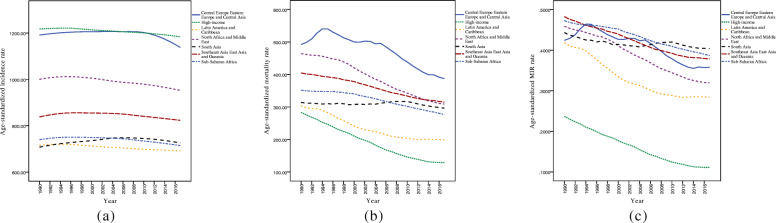
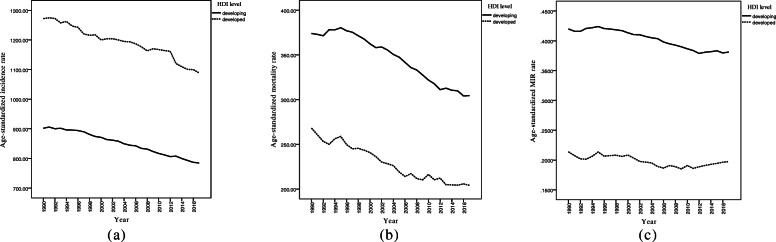
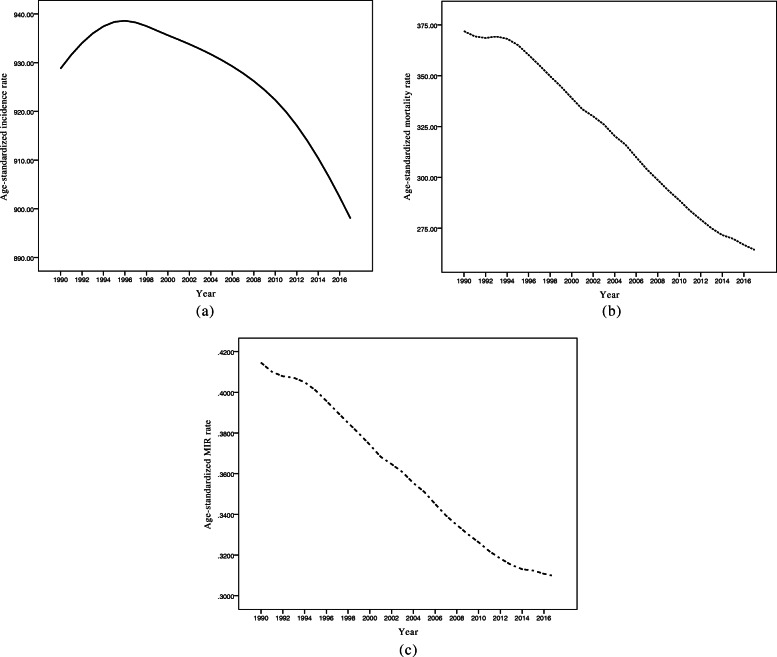
Background: Cardiovascular diseases (CVDs) are one of the global leading causes of concern due to the rising prevalence and consequence of mortality and disability with a heavy economic burden. The objective of the current study was to analyze the trend in CVD incidence, mortality, and mortality-to-incidence ratio (MIR) across the world over 28 years. Methods: The age-standardized CVD mortality and incidence rates were retrieved from the Global Burden of Disease (GBD) Study 2017 for both genders and different world super regions with available data every year during the period 1990–2017. Additionally, the Human Development Index was sourced from the United Nations Development Programme (UNDP) database for all countries at the same time interval. The marginal modeling approach was implemented to evaluate the mean trend of CVD incidence, mortality, and MIR for 195 countries and separately for developing and developed countries and also clarify the relationship between the indices and Human Development Index (HDI) from 1990 to 2017. Results: The obtained estimates identified that the global mean trend of CVD incidence had an ascending trend until 1996 followed by a descending trend after this year. Nearly all of the countries experienced a significant declining mortality trend from 1990 to 2017. Likewise, the global mean MIR rate had a significant trivial decrement trend with a gentle slope of 0.004 over the time interval. As such, the reduction in incidence and mortality rates for developed countries was significantly faster than developing counterparts in the period 1990–2017 (p < 0.05). Nevertheless, the developing nations had a more rather shallow decrease in MIR compared to developed ones. Conclusions: Generally, the findings of this study revealed that there was an overall downward trend in CVD incidence and mortality rates, while the survival rate of CVD patients was rather stable. These results send a satisfactory message that global effort for controlling the CVD burden was quite successful. Nonetheless, there is an urgent need for more efforts to improve the survival rate of patients and lower the burden of this disease in some areas with an increasing trend of either incidence or mortality.
Overview
The claims and statistics of this paper haven’t been checked yet.
Free: it reads the open-access text and checks the first 5 claims that cite a source we can check. Create a free account to check every claim.
Integrity signals
Registry
Cites
Statistics
Figures
Verification
Claims the paper makes
The claims and statistics of this paper haven’t been checked yet.
Free: it reads the open-access text and checks the first 5 claims that cite a source we can check. Create a free account to check every claim.
Claims other papers make about this one
Each is checked against this paper’s own text: does it say what the citing paper says it does?
In the citing paper
“Small reductions in depressive symptoms after psychological and educational interventions have been reported for primary care patients. 450”
From Time for united action on depression: a Lancet–World Psychiatric Association Commission (2022) · cites this paper as [450]
Self-check
Percentages, sums and reported differences re-computed from the paper’s own numbers.
The self-check needs the paper’s full text.
Citations
Cites
Lozano, R., Naghavi, M., Foreman, K., Lim, S., Shibuya, K., Aboyans, V., Abraham, J., Adair, T., Aggarwal, R., Ahn, S. Y., et al. (2012) · The Lancet · doi:10.1016/s0140-6736(12)61728-0 · Cited by 14,070
Roth, G. A., Abate, D., Abate, K. H., Abay, S. M., Abbafati, C., Abbasi, N., Abbastabar, H., Abd-Allah, F., Abdela, J., Abdelalim, A., et al. (2018) · The Lancet · doi:10.1016/s0140-6736(18)32203-7 · Cited by 8,600
Naghavi, M., Abajobir, A. A., Abbafati, C., Abbas, K. M., Abd-Allah, F., Abera, S. F., Aboyans, V., Adetokunboh, O., Afshin, A., Agrawal, A., et al. (2017) · The Lancet · doi:10.1016/s0140-6736(17)32152-9 · Cited by 4,821
Kyu, H. H., Abate, D., Abate, K. H., Abay, S. M., Abbafati, C., Abbasi, N., Abbastabar, H., Abd-Allah, F., Abdela, J., Abdelalim, A., et al. (2018) · The Lancet · doi:10.1016/s0140-6736(18)32335-3 · Cited by 4,081
Feigin, V. L., Forouzanfar, M. H., Krishnamurthi, R., Mensah, G. A., Connor, M., Bennett, D. A., Moran, A. E., Sacco, R. L., Anderson, L., Truelsen, T., et al. (2014) · The Lancet · doi:10.1016/s0140-6736(13)61953-4 · Cited by 3,899
Global, Regional, and National Burden of Cardiovascular Diseases for 10 Causes, 1990 to 2015
Roth, G. A., Johnson, C., Abajobir, A., Abd-Allah, F., Abera, S. F., Abyu, G., Ahmed, M., Aksut, B., Alam, T., Alam, K., et al. (2017) · Journal of the American College of Cardiology · doi:10.1016/j.jacc.2017.04.052 · Cited by 3,791
Johnson, C. O., Nguyen, M., Roth, G. A., Nichols, E., Alam, T., Abate, D., Abd-Allah, F., Abdelalim, A., Abraha, H. N., Abu-Rmeileh, N. M., et al. (2019) · The Lancet Neurology · doi:10.1016/s1474-4422(19)30034-1 · Cited by 3,264
The Global Burden of Cardiovascular Diseases and Risk Factors
Mensah, G. A., Roth, G. A., & Fuster, V. (2019) · Journal of the American College of Cardiology · doi:10.1016/j.jacc.2019.10.009 · Cited by 1,324
Global Epidemiology of Ischemic Heart Disease: Results from the Global Burden of Disease Study
Khan, M. A., Hashim, M. J., Mustafa, H., Baniyas, M. Y., Al Suwaidi, S. K. B. M., AlKatheeri, R., Alblooshi, F. M. K., Almatrooshi, M. E. A. H., Alzaabi, M. E. H., Al Darmaki, R. S., et al. (2020) · Cureus · doi:10.7759/cureus.9349 · Cited by 1,134
Lead Exposure and Cardiovascular Disease—A Systematic Review
Navas-Acien, A., Guallar, E., Silbergeld, E. K., & Rothenberg, S. J. (2007) · Environmental Health Perspectives · doi:10.1289/ehp.9785 · Cited by 1,112
Cited by
Items 401–500 of 693
Stäuber, A., Hoppe, M. W., Lapp, H., Richter, S. E., Ohlow, M., Dörr, M., Piper, C., Eckert, S., Barroso, M. T. C., Stäuber, F., et al. (2024) · PLoS ONE · doi:10.1371/journal.pone.0302793 · Cited by 3
Sun, A., Nasser, A., Chen, C., Zhao, Y. C., Zhao, H., Wang, Z., Cheng, W., Qian, P. C., & Ju, L. A. (2024) · Med-X · doi:10.1007/s44258-024-00025-3 · Cited by 3
“Cardiovascular diseases (CVDs) are the most significant cause of death globally, responsible for 32% of all deaths according to World Health Organization (WHO) statistics [4], with an anticipated increase to 23 million deaths by the year 2030 [5].”
Heart Segmentation on PA Chest X-Ray Images by Model-Based Deep Learning Approach
Tumay, Á., Hadházi, D., & Hullám, G. (2024) · IEEE International Symposium on Medical Measurements and Applications (MeMeA) · doi:10.1109/memea60663.2024.10596926 · Cited by 4
“The reduction of the mortality of CVD is likely the result of population screening tests, since the incidence was decreased only slightly in high-income countries [6]).”
BackgroundBatchelor, R., Dipnall, J. F., Read, D. J., Cameron, P. A., Fitzgerald, M., Stub, D. A., & Lefkovits, J. (2024) · Injury · doi:10.1016/j.injury.2024.111996 · Cited by 3
Comparative Analysis of Random Forest and Logistic Regression for Heart Attack Risk Prediction
Sooriyaperakasam, N., Emami, H., Entezam, P., & Ezekiel, C. (2024) · Journal of Computers Mechanical and Management · doi:10.57159/jcmm.3.5.24123 · Cited by 3
“Cardiovascular diseases, including heart attacks, represent a major public health concern throughout the world, contributing to substantial morbidity and mortality [1].”
Virtual Screening and Molecular Dynamics of Cytokine–Drug Complexes for Atherosclerosis Therapy
Rodríguez-Fernández, M. A., Tristán-Flores, F. E., Casique‐Aguirre, D., Negrete-Rodríguez, M. D. L. L. X., Cervantes‐Montelongo, J. A., Conde-Barajas, E., Acosta‐García, G., & Silva-Martínez, G. A. (2025) · International Journal of Molecular Sciences · doi:10.3390/ijms26072931 · Cited by 3
“Globally, ischemic heart disease, driven largely by atherosclerosis, remains the leading cause of mortality, responsible for approximately 9 million deaths annually [2,3].”
Global and regional cardiovascular risk and mortality: a right, but a long way to go
Shamia, D., Abramowitz, Y., & Tsaban, G. (2022) · European Journal of Preventive Cardiology · doi:10.1093/eurjpc/zwac313 · Cited by 3
Whole-Body Cryotherapy Alters Circulating MicroRNA Profile in Postmenopausal Women
Wiecek, M., Kusmierczyk, J., Szymura, J., Kreiner, G., & Szygula, Z. (2023) · Journal of Clinical Medicine · doi:10.3390/jcm12165265 · Cited by 2
“Although in a global study covering 195 countries it was concluded that the overall incidence and mortality due to CVD significantly decreased in the years 1990–2017, and the ratio of mortality to morbidity was stable, CVD mortality remains a global problem [4].”
BackgroundAdusu‐Donkor, L. X., Ofori, E. K., Kotey, F. C. N., Dogodzi, F. K., Wormenor, D., Buabeng, A., Bernard, S. K., Amponsah, S. K., & Asare‐Anane, H. (2023) · Health Science Reports · doi:10.1002/hsr2.1535 · Cited by 2
“6 million by the year 2030.(5) Aside from contributing to early mortality, CVDs are responsible for incapacitation to work, decreased family income, and diminished productivity.”
BackgroundShekha, G. A., Maulood, K. A., & Shekha, M. S. (2023) · Cellular and Molecular Biology · doi:10.14715/cmb/2023.69.13.28 · Cited by 2
“It is the leading cause of mortality and morbidity worldwide (4).”
BackgroundA Comprehensive Review of Emerging Therapies for Type 2 Diabetes and Their Cardiovascular Effects
G, A. J. A., Chitneni, E., Vidals, C. J. M., Modumudi, S., Hammad, S., Verma, A., Rajesh, R. Y., Khaliq, A., Adeyemi, O. T., Abid, F., et al. (2024) · Cureus · doi:10.7759/cureus.65707 · Cited by 4
“There is a high rate of mortality and morbidity linked to cardiovascular disease and diabetes, two of the top causes of death worldwide [8].”
BackgroundIon, A. P., Asztalos, A. I., Ciucanu, C. C., Russu, E., Mureșan, A. V., Arbănași, E. M., Chirilă, T. V., Strnad, G., & Arbănași, E. M. (2024) · Methods and Protocols · doi:10.3390/mps7060090 · Cited by 2
“Cardiovascular diseases represent the first cause of mortality worldwide, although recently, there has been a trend of decreasing incidence and morbidity [1,2].”
Cardiovascular morbidity, mortality and risk management in patients with abdominal aortic aneurysms
Kwan, J. Y., Davies, H., Stocco, F., Scott, D. J. A., Bailey, M., & Coughlin, P. A. (2024) · Journal of Vascular Societies Great Britain and Ireland · doi:10.54522/jvsgbi.2024.152 · Cited by 2
Vo, C. Q., Wilsgaard, T., Samuelsen, P., Mathiesen, E. B., Sommerseth, H. L., Eggen, A. E., & Wisløff, T. F. (2024) · BMJ Open · doi:10.1136/bmjopen-2024-089819 · Cited by 2
Hennessy, O., Noonan, S., Skerritt, C., & Broderick, J. M. (2025) · The Journal of Arthroplasty · doi:10.1016/j.arth.2025.02.029 · Cited by 2
Mohamed, A. R., Sayed, R. A., Shalaby, A., & Ibrahim, H. (2025) · Scientific Reports · doi:10.1038/s41598-024-83692-x · Cited by 2
Abadi, P. D., Zakerimoghadam, M., Dolatabadi, Z. A., Rahmanian, M., Riahi, S. M., & Khanipour-Kencha, A. (2025) · BMJ Open · doi:10.1136/bmjopen-2024-090256 · Cited by 2
You, W., Sevastidis, J., & Donnelly, F. (2025) · International Journal of Cardiology Cardiovascular Risk and Prevention · doi:10.1016/j.ijcrp.2025.200437 · Cited by 2
Zhang, Y., Wang, S., Lu, H., Liu, L., Chen, R., Li, B., Li, Y., Sun, J., & Gao, Q. (2025) · BMC Public Health · doi:10.1186/s12889-025-24041-z · Cited by 2
“Cardiovascular disease (CVD) has a global incidence of 898 per 100,000 person-years and a mortality of 264.3 per 100,000 person-years in 2017 [4].”
Influentialde Santana, A. C. C. S., Santos, E. S. R., Batista, J. F. C., Moura, A. R., Sardeiro, S. S. S., da Silva, B. E. B., & Lima, C. A. (2025) · Cancer Epidemiology · doi:10.1016/j.canep.2025.102931 · Cited by 2
Veeram, A., Sistla, R., & Andugulapati, S. B. (2025) · International Immunopharmacology · doi:10.1016/j.intimp.2025.115593 · Cited by 2
Alhilaly, A. K., & Al‐Jubouri, M. B. (2025) · International journal of body, mind and culture · doi:10.61838/ijbmc.v12i6.961 · Cited by 2
Qudah, T., Al-Damook, N., Hait, K. A., & AbuMweis, S. S. (2025) · Applied Physiology, Nutrition, and Metabolism · doi:10.1139/apnm-2025-0158 · Cited by 2
Modifiable factors associated with early vascular ageing in youth: a systematic review
Kodithuwakku, V., Evans, J. T., Breslin, M. C., Gall, S., & Climie, R. E. (2025) · Journal of Hypertension · doi:10.1097/hjh.0000000000004130 · Cited by 2
Yasmin, F., Moeed, A., Fahim, M. A. A., Rahman, H. A. U., Shaharyar, M., Salman, A., Asghar, M. S., & Alraies, M. C. (2025) · BMC Cardiovascular Disorders · doi:10.1186/s12872-025-05139-z · Cited by 2
“Cardiovascular diseases are referred to as a heterogeneous group of cardiac and circulatory system-related disorders leading to significant mortality and morbidity [1, 2].”
Mohandas, N. V., Krishnapillai, V., George, N. S., Dinesh, A., & Mohandas, V. (2025) · BMC Public Health · doi:10.1186/s12889-025-25571-2 · Cited by 2
“While developed nations have achieved declines in CAD mortality through robust health systems and preventive strategies, low-and middle-income countries, including India, are experiencing a rapidly rising CAD epidemic [7, 8].”
A role for long-lived nuclear envelope proteins in cardiac ageing
Shuen, M., Lamberts, R. R., Coffey, S., & Sheard, P. W. (2025) · Mechanisms of Ageing and Development · doi:10.1016/j.mad.2025.112145 · Cited by 3
Revisiting the Windkessel Function: Toward Accessible Assessment of Central Arterial Health
Sugawara, J. (2026) · Journal of Clinical Medicine · doi:10.3390/jcm15010342 · Cited by 2
“Cardiovascular disease (CVD) remains the leading cause of death worldwide, accounting for nearly one-third of global mortality [1,2].”
Surfactant-Triggered Signal Enhancement for Lateral Flow Immunoassay
PARK, J., Park, J., Kim, Y., Park, B., Jeong, J., Park, Y.-J., Kim, K., & Kim, M. Y. (2026) · ACS Sensors · doi:10.1021/acssensors.5c04338 · Cited by 2
Ramudu, M. J., Raju, K. N., & Mohan, A. K. (2026) · ICT Express · doi:10.1016/j.icte.2026.05.019 · Cited by 2
Association between sleep duration and cardiovascular disease specific mortality: A meta-analysis
Ye, F., Liu, J., Zhang, S., & Han, X. (2022) · Neurology Asia · doi:10.54029/2022yry · Cited by 2
“We used the following selection criteria: (1) We included case-control and cohort studies investigating the association between sleep duration and CVD specific mortality; (2) We excluded studies which did not provide sufficient information regarding hazard ratios (HRs) and 95% confidence intervals (CIs) regarding the…”
MethodMikhailov, I. А., Omelyanovsky, V. V., & Semenov, V. Y. (2023) · Complex Issues of Cardiovascular Diseases · doi:10.17802/2306-1278-2022-11-4s-105-115 · Cited by 2
Chanchaeva, E. A., Grjibovski, A. M., Kurilenko, T. K., & MALKOV, P. Y. (2023) · Hygiene and Sanitation · doi:10.47470/0016-9900-2023-102-1-40-49 · Cited by 2
“и причинам смерти в большинстве стран, а этиология не всегда изучается в полной мере [9, 32].”
Jones, I. C., & Dass, C. R. (2023) · Journal of Pharmacy and Pharmacology · doi:10.1093/jpp/rgad037 · Cited by 2
Spatial Error Model to Analyze Morbidity Rate in Indonesia
Yahya, I., Abapihi, B., Agusrawati, M., & Wibawa, G. N. A. (2023) · International Journal of Science Technology Engineering and Mathematics · doi:10.53378/352998 · Cited by 2
“Based on research conducted by health experts (Okoroiwu, 2020; Moise, 2018; Wunsch & Gourbin, 2018; Zylke & Bauchner, 2020; Amini et al., 2021; Chang et al., 2022), morbidity is caused by neonatal respiratory distress syndrome, tuberculosis and diarrhea.”
BackgroundLuan, H., Wang, Z., Zhang, Z., Hou, B., Liu, Z., Yang, L.-P., Yang, M., Ma, Y., & Zhang, B. (2023) · Fitoterapia · doi:10.1016/j.fitote.2023.105715 · Cited by 2
Curcumin as a pharmaceutical leader
Vahdat‐Lasemi, F., Kesharwani, P., & Sahebkar, A. (2024) · Elsevier eBooks · doi:10.1016/b978-0-443-15412-6.00001-5 · Cited by 3
Naderi, N., MozafaryBazargany, M., Maleki, M., & Kalayinia, S. (2024) · Journal of Cellular and Molecular Medicine · doi:10.1111/jcmm.18461 · Cited by 2
Cardiac Rehabilitation in Saudi Arabia: Current Status and Future Directions
Osailan, A. (2024) · Current Cardiology Reports · doi:10.1007/s11886-024-02105-7 · Cited by 2
Noncommunicable chronic diseases
Sharma, M., & Lakhan, R. (2024) · Elsevier eBooks · doi:10.1016/b978-0-443-29098-5.00008-4 · Cited by 2
Morgan, M., Yellapu, V., Short, D., & Ruggeri, C. E. (2024) · Cureus · doi:10.7759/cureus.70620 · Cited by 2
Ogawa, K., & Hirata, A. (2024) · Biosensors · doi:10.3390/bios14100513 · Cited by 2
“Heart diseases remain a leading cause of mortality worldwide, necessitating continual advancements in diagnostic and therapeutic techniques [1].”
BackgroundMethodInfluentialMadani, A. H., Bateni, B. H., Pourrajabi, A., Leyli, E. K., & Madani, M. H. (2024) · International Urology and Nephrology · doi:10.1007/s11255-024-04241-z · Cited by 2
Real-World Long-Term Effectiveness of Implantable Cardioverter-Defibrillators in Elderly Patients
Hagiwara, H., Nagai, N., Otsubo, K., Sasaki, S., Aoyagi, H., Chiba, Y., Komoriyama, H., Kato, Y., Takahashi, M., Tokuda, Y., et al. (2024) · Circulation Reports · doi:10.1253/circrep.cr-24-0131 · Cited by 2
Assessment of detraining through a six-minute walk test in patients with heart disease
da Silva, V. O., Cintra, V. M., da Silva, M. D. L., Meneguci, J., Silva, F. S., de Carvalho, E. E. V., Espíndula, A. P., & Silva, L. D. N. (2025) · Sao Paulo Medical Journal · doi:10.1590/1516-3180.2023.0334.r1.03072024 · Cited by 2
Hannan, S. A. (2025) · International Journal of Innovative Research in Information Security · doi:10.26562/ijiris.2025.v1101.11 · Cited by 3
Cardiac-specific troponin-I (cTnI) in a post-mortem setting
Sutton, E. D., Parsons, S. A., Pricone, M., & de Boer, H. H. (2025) · International Journal of Legal Medicine · doi:10.1007/s00414-025-03526-x · Cited by 3
Kumelachew, D. M. (2025) · Journal of Biomaterials Science Polymer Edition · doi:10.1080/09205063.2025.2537734 · Cited by 2
“An essential aspect of effective treatment for these diseases is the use of vascular grafts, particularly small-diameter vascular grafts (SDVGs), which are defined as having an inner diameter of 6 mm or less [4,5].”
The regulatory role of pioneer factors during cardiovascular lineage specification – A mini review
Sierra-Pagán, J. E., & Garry, D. J. (2022) · Frontiers in Cardiovascular Medicine · doi:10.3389/fcvm.2022.972591 · Cited by 2
Estimation of myocardial infarction death in Iran: artificial neural network
Jafarabadi, M. A., Gholipour, K., Zarnaq, R. K., Azmin, M., & Alizadeh, G. (2022) · BMC Cardiovascular Disorders · doi:10.1186/s12872-022-02871-8 · Cited by 3
“As predicted in Iran according to the report of the World Health Organization; The death rate from cardiovascular disease will reach 44.8% by 2030 [2, 10, 16, 17].”
InfluentialLin, C., Wang, C., Sung, F., & Su, T. (2023) · Nutrients · doi:10.3390/nu15214528 · Cited by 2
“Cardiovascular diseases (CVD) are the primary reason for human mortality, despite substantial advancements in treatment [5].”
BackgroundFerrand, M. C., Giordano, G., Mougenot, N., Laporte, P.-L., Vignier, N., Leclerc, A., Algalarrondo, V., Extramiana, F., Charpentier, F., & Neyroud, N. (2024) · Frontiers in Physiology · doi:10.3389/fphys.2024.1326663 · Cited by 2
“Sudden cardiac death (SCD) due to ventricular arrhythmias (VAs) is one of the first causes of global mortality and accounts for approximately 50% of all cardiovascular deaths (Amini et al., 2021).”
BackgroundWaaler, P. N., Bongo, L. A., Rolandsen, C., & Lorem, G. F. (2024) · Scientific Reports · doi:10.1038/s41598-024-53275-x · Cited by 2
Terapi Akupresur pada Pasien Paska CABG
Kurnia, P., Herawati, T., Maria, R., & Waluyo, A. D. (2024) · Journal of Telenursing (JOTING) · doi:10.31539/joting.v6i1.9077 · Cited by 2
“Penyakit Jantung Koroner adalah penyebab utama kematian dan kecacatan secara global di dunia (Amini et al., 2021) .”
BackgroundEditorial: Sedentary behaviour and cardiometabolic health
Azevedo, L. B., Cucato, G. G., & Morseth, B. (2024) · Frontiers in Cardiovascular Medicine · doi:10.3389/fcvm.2024.1498410 · Cited by 3
Mohseni, P., Khalili, D., Djalalinia, S., Farzadfar, F., & Mehrabi, Y. (2023) · International Journal of Preventive Medicine · doi:10.4103/ijpvm.ijpvm_464_21 · Cited by 1
Tubercular Tenosynovitis of the Wrist and Cardiac Correlation
Kapoor, P., Singh, A., & Sood, A. (2023) · Journal of Cardiac Critical Care TSS · doi:10.25259/jccc_41_2023 · Cited by 1
Stemming The Tide Of Hypertension In Women: Optimal Age For Obstetric Debut
Okeahialam, B. N. (2023) · Journal of Preventive Medicine And Care · doi:10.14302/issn.2474-3585.jpmc-23-4442 · Cited by 1
Kim, T. J., Lee, H. S., Kim, S.-E., Park, J., Kim, J. Y., Lee, J., Song, J. E., Hong, J. H., Lee, J., Chung, J., et al. (2024) · Osong Public Health and Research Perspectives · doi:10.24171/j.phrp.2023.0248 · Cited by 1
Franke, W. D., Lefferts, E. C., Lefferts, W. K., Keren, N., Flynn, M. H., Lutrick, L. D., Hinkhouse, J. J., Ramey, S. L., & Lang, J. A. (2024) · Journal of Occupational and Environmental Medicine · doi:10.1097/jom.0000000000003119 · Cited by 1
Mehra, P., Mehta, V., Yusuf, J., Safal, & Dabla, P. K. (2024) · doi:10.62772/apfcb-news.2024.1.1 · Cited by 1
Dihydrotanshinone I promotes LDL uptake by HepG2 cells through increasing LDLR level
Hu, D., Qi, L., Wang, L.-T., Jin, Y.-M., Yang, X.-X., Yin, H., Zhang, R., Huang, Y., Sheng, J., & Wang, X. (2024) · CyTA - Journal of Food · doi:10.1080/19476337.2024.2402842 · Cited by 1
“It is expected that the number of deaths due to CVD will increase to 23 million by 2030 which poses a serious hazard to human health (Amini et al., 2021; Tsao et al., 2022).”
Wahyudi, M., Trianda, D., Pujiastuti, L., & Solikhun, S. (2025) · JITK (Jurnal Ilmu Pengetahuan dan Teknologi Komputer) · doi:10.33480/jitk.v10i3.5637 · Cited by 1
Gantiya, L., & Pintaviooj, C. (2024) · Biomedical Engineering International Conference · doi:10.1109/bmeicon64021.2024.10896289 · Cited by 1
“One of the most common fatalities in patients across the world is caused from conditions or diseases where the symptoms are unpredictable and sudden such as Ischemic heart diseases, Strokes, and Chronic obstructive pulmonary diseases [1].”
Cheng, R., Cheng, X., Jiang, D., Xiong, J., Ding, Y., Liu, J., Zhao, H., Feng, H., Wu, D., & Zhang, W. (2025) · Food and Chemical Toxicology · doi:10.1016/j.fct.2025.115372 · Cited by 1
Valve Token Masked Autoencoder for Missing Recordings on Cardiac Abnormality Classification
Chang, A.-Y., Tzeng, J.-T., Chen, H., Huang, C.-H., Huang, E. P., & Lee, C.-C. (2025) · IEEE International Conference on Acoustics Speech and Signal Processing · doi:10.1109/icassp49660.2025.10889947 · Cited by 2
“Cardiovascular diseases (CVDs) are among the leading causes of morbidity and mortality globally, representing a significant public health challenge [1].”
Rabanal, K. S., Selmer, R. M., Igland, J., Ariansen, I., & Meyer, H. E. (2025) · Open Heart · doi:10.1136/openhrt-2024-003114 · Cited by 1
Xiong, L., Zhang, Y., Wang, X., He, B., Li, Z., & Zhu, J. (2025) · Physics in Medicine and Biology · doi:10.1088/1361-6560/add3b8 · Cited by 1
“Cardiovascular diseases are the leading underlying factors contributing to mortality worldwide (Amini et al 2021), so early risk assessment and effective prevention may help reduce the morbidity and mortality of related diseases.”
Onakomaiya, D. O., Bubu, O. M., & Schoenthaler, A. (2025) · Elsevier eBooks · doi:10.1016/b978-0-443-23750-8.00014-x · Cited by 1
Adam, L. N., & Al-Habib, O. A. M. (2025) · Tissue and Cell · doi:10.1016/j.tice.2025.103046 · Cited by 1
Vaping is associated with increased length of stay among cardiac inpatients
Heshmati, J., Mullen, K. A., Walker, K. L., & Mir, H. R. (2025) · Tobacco Induced Diseases · doi:10.18332/tid/207800 · Cited by 1
“Cardiovascular disease (CVD) is a leading cause of morbidity and mortality worldwide, imposing a significant burden on healthcare systems 11 .”
Verastegui, A., Gómez-Gutiérrez, O. A., Huerta, L. P., Castaneda, R., & Fabiani, M. A. (2025) · Scientometrics · doi:10.1007/s11192-025-05423-x · Cited by 1
“(Amini et al., 2021).”
Dietary acid load and its association with all-cause mortality, cardiovascular mortality, and events
Abdollahpour, N., Homayounfar, N., Samadi, N., Farsi, F., Kabourani, A., Hatamzadeh, H., Ferns, G. A., Seifi, N., & Ghayour‐Mobarhan, M. (2025) · Scientific Reports · doi:10.1038/s41598-025-29440-1 · Cited by 1
“It is estimated that by 2030, CVDs are responsible for more than 23 million deaths worldwide 6 .”
Ma, M., Lian, S., Kraft, P., Mayer, T., Sayour, A. A., Karck, M., Szabo, G. B., & Korkmaz‐Icöz, S. (2025) · Biochemical Pharmacology · doi:10.1016/j.bcp.2025.117601 · Cited by 1
Spatial distribution of mortality: evidence from DIMAMO HDSS, Limpopo Province, South Africa
Mothapo, K., Seakamela, K. P., Mashaba, R. G., Ntimana, C. B., & Tlouyamma, J. (2025) · BMC Public Health · doi:10.1186/s12889-025-25449-3 · Cited by 1
“Previous studies reported that, in developed countries, death rates have decreased due to better living conditions and medical improvements [2, 3].”
Epidemiological Investigations of Cardiovascular Risk Factors: Implications of ECG and HRV Analysis
Jain, S., Dwivedi, A., Bibyan, S., Jain, A., & Jat, D. (2025) · doi:10.61440/jcc.2025.v3.51 · Cited by 1
Bawa, E. M., Amoatika, D. A., Miller, M. C., Olatosi, B., Donelle, L., Levkoff, S. E., Hardin, J. W., Li, X., Bonilha, L., Friedman, D. B., et al. (2025) · PLoS ONE · doi:10.1371/journal.pone.0339785 · Cited by 1
“Because the MIR provides an avenue to identify regions with higher or lower mortalities, normalized to their incidences [23], extending this metric to ADRDs will aid in the identification of regions in need of timely and focused attention for the allocation of public health resources.”
Comanici, M., Das, A., Camangon, C., Kanchirassery, K., Singh, H., Lees, N. J., Gorog, D. A., Marczin, N., & Raja, S. G. (2026) · Journal of Cardiovascular Development and Disease · doi:10.3390/jcdd13010035 · Cited by 1
“Coronary artery disease remains one of the leading causes of morbidity and mortality worldwide, despite advancements in medical and interventional therapies [1].”
Murumkar, S. (2024) · International Journal of Artificial Intelligence Data Science and Machine Learning · doi:10.63282/3050-9262.ijaidsml-v5i4p119 · Cited by 1
Chen, Q., Li, S., & Jin, X. (2026) · Current Pharmaceutical Biotechnology · doi:10.2174/0113892010424194251027101646 · Cited by 1
Chong, M. S., & Wang, W. (2025) · European Journal of Cardiovascular Nursing · doi:10.1093/eurjcn/zvaf228 · Cited by 1
Crooijmans, J., van de Wiel, K. M., He, K., Keuken, M. C., Wottschel, V., Widrich, C., Zwinderman, A. H., & Pinto‐Sietsma, S. (2026) · Hearts · doi:10.3390/hearts7010009 · Cited by 1
“Amini et al. reported a steady decreasing trend of mortality of CVD for 1990–2017, stratified by age [4].”
D’Imperio, H., Gagliardi, J., Charask, A. A., Costa, Y. C., Macin, S. M., Zapata, G., & Quiroga, W. (2026) · Revista Argentina de Cardiología · doi:10.7775/rac.es.v94.i1.20967 · Cited by 1
Chen, Y., Chen, L., Li, H., & Yu, Z. (2026) · BMC Ophthalmology · doi:10.1186/s12886-026-04769-x · Cited by 1
“Acute coronary syndrome (ACS) represents a major health concern, contributing to morbidity and mortality globally [1] , and remains a persistent challenge within the healthcare sector [2, 3].”
Murali, P., & Meenatchi, S. (2026) · Engineering Reports · doi:10.1002/eng2.70687 · Cited by 3
“Approximately four out of five deaths from CVD are attributable to heart attacks and strokes [4].”
Su, S. C., Chen, Z., Xu, T., Wu, H., Ma, X., Peng, Z., Lin, M., Xu, X., Huang, R., Zhong, C. C., et al. (2026) · BMC Cardiovascular Disorders · doi:10.1186/s12872-026-05803-y · Cited by 1
“CVD, a leading cause of morbidity and mortality worldwide, represents a spectrum of cardiac and vascular conditions that disproportionately affect older adults [7, 8].”
Collins, B. E. G., Gordon, B. A., Wundersitz, D. W. T., Hunter, J. R., Hanson, L. C., & Kingsley, M. (2026) · Journal of Cardiopulmonary Rehabilitation and Prevention · doi:10.1097/hcr.0000000000001035 · Cited by 1
Su, S., Teng, Y., Liu, S., Wang, L., & Zhao, M. (2026) · Frontiers in Cardiovascular Medicine · doi:10.3389/fcvm.2026.1868328 · Cited by 1
Puri, R., Mehta, V., Sahoo, P. K., & Yusuf, J. (2026) · Journal of clinical lipidology · doi:10.1016/j.jacl.2026.09.010 · Cited by 1
RISK FACTORS FOR SUDDEN CARDIAC DEATH IN HOSPITAL PATIENTS
Shvedova, A. A., Газенкампф, А. А., & Kobanenko, V. O. (2026) · Complex Issues of Cardiovascular Diseases · doi:10.17802/2306-1278-2026-15-1-166-173 · Cited by 1
Azeez, T. A. (2021) · Hamdan Medical Journal · doi:10.4103/hmj.hmj_28_21 · Cited by 1
Li, R., Zou, X., Luan, P., Liu, X., Wang, N., Wang, Q., Guan, H., & Xu, Z. (2022) · Analytical Letters · doi:10.1080/00032719.2022.2053700 · Cited by 1
“Cardiovascular disease (CVD) degrades public health due to the high mortality rate (Amini, Zayeri, and Salehi 2021).”
BackgroundBalakrishna, D., Sowjanya, B., Prasad, M., & Viswakumar, R. (2022) · Indian Journal of Clinical Biochemistry · doi:10.1007/s12291-022-01073-5 · Cited by 1
Delirium in a patient with myocardial infarction
Panteleev, O. O., & Ryabov, V. V. (2022) · Сибирский журнал клинической и экспериментальной медицины · doi:10.29001/2073-8552-2022-37-3-49-55 · Cited by 1
Vascular smooth muscle cell aging: Insights from Hutchinson-Gilford progeria syndrome
Hamczyk, M. R., & Nevado, R. M. (2023) · Clínica e Investigación en Arteriosclerosis (English Edition) · doi:10.1016/j.artere.2023.02.005 · Cited by 1
Noise Removal-based Thresholding framework for Arrhythmia classification
Prajitha, C., Sridhar, K. P., & Baskar, S. (2023) · Journal of Intelligent & Fuzzy Systems · doi:10.3233/jifs-223719 · Cited by 1
“Because of the rising prevalence of cardiovascular diseases, the death rate has risen steadily over time [2, 3].”
Targeting cAMP signaling compartments in iPSC-derived models of cardiovascular disease
Liu, T., & Klußmann, E. (2023) · Current Opinion in Pharmacology · doi:10.1016/j.coph.2023.102392 · Cited by 1
Гріднева, О. В. (2023) · Medicine Today and Tomorrow · doi:10.35339/msz.2023.92.3.gri · Cited by 1
Kim, W., Ju, Y. J., & Lee, S. Y. (2024) · BMC Public Health · doi:10.1186/s12889-024-18130-8 · Cited by 2
“CVD is reported as one of the most serious health problems and the leading cause of mortality world-wide [4, 5].”
BackgroundPamporis, K., Karakasis, P., Simantiris, S., Sagris, Μ., Bougioukas, K. I., Fragakis, N., & Tousoulis, D. M. (2024) · Clínica e Investigación en Arteriosclerosis (English Edition) · doi:10.1016/j.artere.2024.02.003 · Cited by 2
Metadata
- Authors
- Amini, M., Zayeri, F., & Salehi, M.
- Affiliations
- Shahid Beheshti University (IR)
- Corresponding author
- Zayeri, Farid
- Venue
- BMC Public Health
- Published
- 2021-02-25
- Volume
- 21
- Issue
- 1
- Pages
- 401-401
- ISSN
- 1471-2458 (ISSN-L)
- PMC
- PMC7905904
- OpenAlex
- W3131704889
- Semantic Scholar
- 56a738374cbe3a199ecc242d2242438f16572859
- Cited by
- 636
- References
- 49
- Citations by year
- 2026: 56 · 2025: 132 · 2024: 176 · 2023: 154 · 2022: 93 · 2021: 25
- FWCI
- 81.06
- Type
- journal article
- Language
- en
- Open access
- gold
- doi.org
- Licence
- cc-by
- creativecommons.org/licenses/by/4.0/ (tdm)
- creativecommons.org/licenses/by/4.0/ (vor)
- Locations
- BMC Public Health (publishedVersion, cc-by)
- PubMed Central (publishedVersion, cc-by)
- PubMed (publishedVersion)
- DOAJ (DOAJ: Directory of Open Access Journals) (submittedVersion, cc-by-sa)
- Funders
- Shahid Beheshti University of Medical Sciences
- Topics
- Health Sciences › Medicine › Epidemiology › Healthcare Systems and Public Health
- Health Sciences › Medicine › Cardiology and Cardiovascular Medicine › Cardiovascular Health and Risk Factors
- Health Sciences › Medicine › Public Health, Environmental and Occupational Health › Global Health and Epidemiology
- Keywords
- cardiovascular disease, cardiovascular mortality, cardiovascular disease incidence, mortality-to-incidence ratio, temporal trends, Human Development Index, developed and developing countries, Global Burden of Disease 2017, disease burden
- MeSH terms
- Global Burden of Disease, Cardiovascular Diseases, Female, Humans, Male, Global Health, Incidence, Prevalence
About these checks
Registry, retraction, Cites and statistics results are computed, not judged, with one exception: a printed reference that no index lists is read once by a model before it counts as a citation error. Claims are extracted by a model and kept only when their quote appears verbatim in the text; each cited source is then checked, with a model’s help, for whether it says what the claim relies on. Those verdicts can be wrong — read the claim’s quote and the cited source before relying on one.
Statistics and arithmetic are recomputed, not judged.
Confidence bands are shown only for fields calibrated on our annotated test set. None is calibrated yet, so no band is shown.
What counts as a claim ›How we measure confidence ›How we check this ›
Are you an author, or do you see a problem with this page? Request a review
Data sources
Bibliographic data: Semantic Scholar, OpenAlex, Crossref.
Contains information from the Semantic Scholar Academic Graph Datasets, made available under the ODC Attribution License (ODC-BY 1.0).
Semantic Scholar’s data is described in: Kinney, R., et al. (2023). The Semantic Scholar Open Data Platform. arXiv:2301.10140.
