

Association between physical activity and longitudinal change in body mass index in middle-aged and older adults
Open accessThe DOI matches its Crossref record; 48 of the 48 references it cites were found in a registry or an index.
Abstract
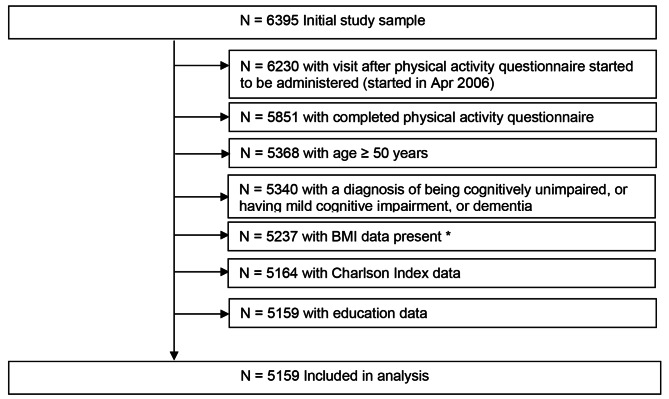
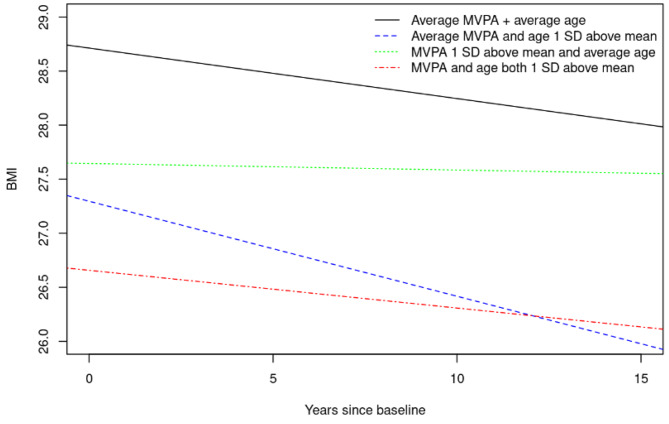
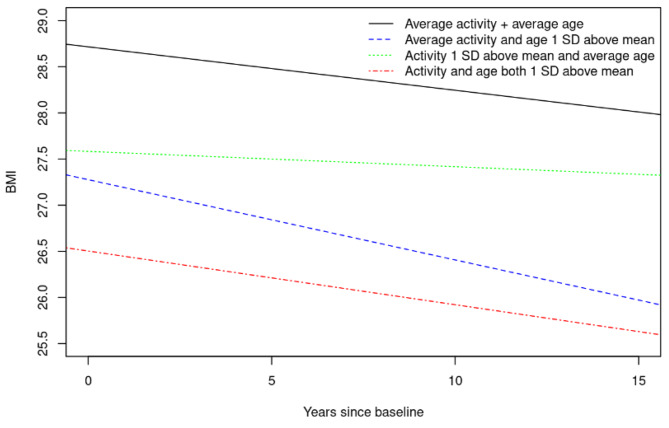
Background: In middle-aged and particularly older adults, body mass index (BMI) is associated with various health outcomes. We examined associations between physical activity (PA) and longitudinal BMI change in persons aged ≥ 50 years. Methods: The sample included 5159 community-dwelling individuals aged ≥ 50 years (50.5% males, mean (SD) age 73.0 (10.2) years at baseline) who were enrolled in the Mayo Clinic Study of Aging (MCSA). Participants had information on PA within one year of baseline assessment, BMI at baseline, and potential follow-up assessments (mean (SD) follow-up 4.6 (3.7) years). Linear mixed-effect models were used to calculate the association between PA (moderate-vigorous physical activity, MVPA; and all PA composite score) and the longitudinal change in BMI, adjusted for baseline age, sex, education and medical comorbidities. In addition to interactions between years since baseline and PA, we also included 2- and 3-way interactions with baseline age to further assess whether age modifies the trajectory of BMI over time. Results: We observed a decrease in BMI among participants engaging at a mean amount of PA (i.e., MVPA: 2.7; all PA: 6.8) and with a mean age (i.e., 73 years) at baseline (MVPA: estimate = -0.047, 95% CI -0.059, -0.034; all PA: estimate = -0.047, 95% CI -0.060, -0.035), and this decline is accelerated with increasing age. Participants with a mean age (i.e., 73 years) that engage at an increased amount of MVPA or all PA at baseline (i.e., one SD above the mean) do not decrease as fast with regard to BMI (MVPA: estimate = -0.006; all PA: estimate = -0.016), and higher levels of MVPA or all PA at baseline (i.e., two SD above the mean) were even associated with an increase in BMI (MVPA: estimate = 0.035; all PA: estimate = 0.015). Finally, MVPA but not all PA is beneficial at slowing BMI decline with increasing age. Conclusion: PA, particularly at moderate-vigorous intensity, is associated with slower decline in longitudinal BMI trajectories. This implies that engaging in PA may be beneficial for healthy body weight regulation in middle and late adulthood.
Overview
The claims and statistics of this paper haven’t been checked yet.
Free: it reads the open-access text and checks the first 5 claims that cite a source we can check. Create a free account to check every claim.
Integrity signals
Registry
Cites
Statistics
Figures
Verification
Claims the paper makes
The claims and statistics of this paper haven’t been checked yet.
Free: it reads the open-access text and checks the first 5 claims that cite a source we can check. Create a free account to check every claim.
Claims other papers make about this one
Each is checked against this paper’s own text: does it say what the citing paper says it does?
The cited source says what the claim attributes to it.
In the citing paper
“Moderate to vigorous physical activity is associated with a slower decline in BMI over time in middle-aged and older adults”
From Lifestyle Medicine for Obesity in the Era of Highly Effective Anti-Obesity Treatment (2025) · cites this paper as [274]
Self-check
Percentages, sums and reported differences re-computed from the paper’s own numbers.
The self-check needs the paper’s full text.
Citations
Cites
Charlson, M. E., Pompei, P., Ales, K. L., & MacKenzie, C. R. (1987) · Journal of Chronic Diseases · doi:10.1016/0021-9681(87)90171-8 · Cited by 49,742
(2000) · PubMed · Cited by 13,173
The metabolic phenotype in obesity: Fat mass, body fat distribution, and adipose tissue function
Goossens, G. H. (2017) · Obesity Facts · doi:10.1159/000471488 · Cited by 8,481
Health benefits of physical activity: the evidence
Warburton, D. E. R. (2006) · Canadian Medical Association Journal · doi:10.1503/cmaj.051351 · Cited by 8,007 · cited 1×
“, [5]), dementia [6, 7] as well as all-cause mortality [8].”
BackgroundDi Angelantonio, E., Bhupathiraju, S. N., Wormser, D., Gao, P., Kaptoge, S., de Gonzalez, A. B., Cairns, B. J., Huxley, R., Jackson, C. L., Joshy, G., et al. (2016) · The Lancet · doi:10.1016/s0140-6736(16)30175-1 · Cited by 2,821
Physical activity from childhood to adulthood
Telama, R., Yang, X., Viikari, J., Välimäki, I., Wanne, O., & Raitakari, O. (2005) · American Journal of Preventive Medicine · doi:10.1016/j.amepre.2004.12.003 · Cited by 1,585 · cited 1×
“stability of PA engagement over the lifespan [37, 38] as well as metabolic mechanisms related to PA (e.”
BackgroundRoberts, R. O., Geda, Y. E., Knopman, D. S., Cha, R. H., Pankratz, V. S., Boeve, B. F., Ivnik, R. J., Tangalos, E. G., Petersen, R. C., & Rocca, W. A. (2008) · Neuroepidemiology · doi:10.1159/000115751 · Cited by 793
Self-citationLongitudinal physical activity and sedentary behavior trends
Gordon-Larsen, P., Nelson, M. C., & Popkin, B. M. (2004) · American Journal of Preventive Medicine · doi:10.1016/j.amepre.2004.07.006 · Cited by 708 · cited 1×
“stability of PA engagement over the lifespan [37, 38] as well as metabolic mechanisms related to PA (e.”
BackgroundDoes physical activity prevent weight gain – a systematic review
Fogelholm, M., & Kukkonen‐Harjula, K. (2000) · Obesity Reviews · doi:10.1046/j.1467-789x.2000.00016.x · Cited by 598 · cited 1×
“Results from longitudinal studies on the association between baseline levels of PA and BMI changes over time focusing on older adults are scarce, while those on middle-aged adults are conflicting [29, 30].”
BackgroundCurrent Estimates from the National Health Interview Survey, United States, 1981.
(1984) · Annals of Internal Medicine · doi:10.7326/0003-4819-100-2-328_1 · Cited by 491
Body mass index and risk of dementia: analysis of individual-level data from 1·3 million individuals
Kivimäki, M., Luukkonen, R., Batty, G. D., Ferrie, J. E., Pentti, J., Nyberg, S. T., Shipley, M. J., Alfredsson, L., Fransson, E. I., Goldberg, M., et al. (2018) · Alzheimer's & Dementia · doi:10.1016/j.jalz.2017.09.016 · Cited by 440 · cited 1×
“, when BMI was assessed < 10 years before dementia diagnosis [11]).”
BackgroundPhysical Exercise, Aging, and Mild Cognitive Impairment: A Population-Based Study
Geda, Y. E., Roberts, R. O., Knopman, D. S., Christianson, T. J. H., Pankratz, V. S., Ivnik, R. J., Boeve, B. F., Tangalos, E. G., Petersen, R. C., & Rocca, W. A. (2010) · Archives of Neurology · doi:10.1001/archneurol.2009.297 · Cited by 371
Self-citationPhysical Activity and Weight Gain Prevention
Lee, I.-M. (2010) · JAMA · doi:10.1001/jama.2010.312 · Cited by 331
Body weight and weight change and their health implications for the elderly
Seidell, J., & Visscher, T. (2000) · European Journal of Clinical Nutrition · doi:10.1038/sj.ejcn.1601023 · Cited by 324 · cited 1×
“Furthermore, in adults, a high BMI is usually due to a high fat mass which is associated with negative effects on health and may lead to reduced quality of life due to functional impairment [41].”
BackgroundRecreational physical activity and ten-year weight change in a US national cohort.
Williamson, D. F., Madans, J. H., Anda, R. F., Kleinman, J. C., Kahn, H. S., & Byers, T. (1993) · PubMed · Cited by 323
Cleven, L., Krell-Roesch, J., Nigg, C. R., & Woll, A. (2020) · BMC Public Health · doi:10.1186/s12889-020-08715-4 · Cited by 277
Self-citationFOLSOM, A. R., CASPERSEN, C. J., TAYLOR, H. L., JACOBS, D. R., LUEPKER, R. V., GOMEZ-MARIN, O., GILLUM, R. F., & BLACKBURN, H. (1985) · American Journal of Epidemiology · doi:10.1093/oxfordjournals.aje.a114035 · Cited by 263
Reid, K. F., Pasha, E., Doros, G., Clark, D. J., Patten, C., Phillips, E. M., Frontera, W. R., & Fielding, R. A. (2014) · European Journal of Applied Physiology · doi:10.1007/s00421-013-2728-2 · Cited by 246 · cited 1×
“As the mean age of our sample was 73 years at baseline, a low BMI may actually indicate a reduced skeletal muscle mass, which in turn is related to a reduction of physical functioning and an increased risk of falls [43].”
BackgroundAllison, D., Zannolli, R., Faith, M., Heo, M., Pietrobelli, A., Vanltallie, T., Pi-Sunyer, F., & Heymsfield, S. (1999) · International Journal of Obesity · doi:10.1038/sj.ijo.0800875 · Cited by 236
Effect of intensity of physical activity on body fatness and fat distribution
Tremblay, A., Després, J., Leblanc, C., Craig, C., Ferris, B., Stephens, T., & Bouchard, C. (1990) · The American Journal of Clinical Nutrition · doi:10.1093/ajcn/51.2.153 · Cited by 219
Body Mass Index and Mortality Among Older People Living in the Community
Landi, F., Zuccala, G., Gambassi, G., Incalzi, R. A., Manigrasso, L., Pagano, F., Carbonin, P., & Bernabei, R. (1999) · Journal of the American Geriatrics Society · doi:10.1111/j.1532-5415.1999.tb05229.x · Cited by 218
Leisure‐time physical activity from mid‐ to late life, body mass index, and risk of dementia
Tolppanen, A., Solomon, A., Kulmala, J., Kåreholt, I., Ngandu, T., Rusanen, M., Laatikainen, T., Soininen, H., & Kivipelto, M. (2015) · Alzheimer's & Dementia · doi:10.1016/j.jalz.2014.01.008 · Cited by 214
Physical Activity and the Prevention of Weight Gain in Adults: A Systematic Review
JAKICIC, J. M., POWELL, K. E., CAMPBELL, W. W., DIPIETRO, L., PATE, R. R., PESCATELLO, L. S., COLLINS, K. A., BLOODGOOD, B., & PIERCY, K. L. (2019) · Medicine & Science in Sports & Exercise · doi:10.1249/mss.0000000000001938 · Cited by 213
BMI, Body Composition, and Physical Functioning in Older Adults
Woo, J., Leung, J., & Kwok, T. (2007) · Obesity · doi:10.1038/oby.2007.223 · Cited by 188
Obesity in older adults: epidemiology and implications for disability and disease
Samper-Ternent, R., & Al Snih, S. (2012) · Reviews in Clinical Gerontology · doi:10.1017/s0959259811000190 · Cited by 180
The Relationship Between Obesity, Physical Activity, and Physical Function in Older Adults
Riebe, D., Blissmer, B. J., Greaney, M. L., Ewing Garber, C., Lees, F. D., & Clark, P. G. (2009) · Journal of Aging and Health · doi:10.1177/0898264309350076 · Cited by 169
Decline in Weight and Incident Mild Cognitive Impairment: Mayo Clinic Study of Aging
Alhurani, R. E., Vassilaki, M., Aakre, J. A., Mielke, M. M., Kremers, W. K., Machulda, M. M., Geda, Y. E., Knopman, D. S., Petersen, R. C., & Roberts, R. O. (2016) · JAMA Neurology · doi:10.1001/jamaneurol.2015.4756 · Cited by 130
Self-citationBody mass index across midlife and cognitive change in late life
Dahl, A. K., Hassing, L. B., Fransson, E. I., Gatz, M., Reynolds, C. A., & Pedersen, N. L. (2013) · International Journal of Obesity · doi:10.1038/ijo.2012.37 · Cited by 118
Parker, D., Gonzalez, S., Derby, C., Gans, K. M., Lasater, T. M., & Carleton, R. (1997) · International Journal of Obesity · doi:10.1038/sj.ijo.0800373 · Cited by 97
Body Mass Index and Decline in Cognitive Function in Older Black and White Persons
Arvanitakis, Z., Capuano, A. W., Bennett, D. A., & Barnes, L. L. (2018) · The Journals of Gerontology: Series A · doi:10.1093/gerona/glx152 · Cited by 91
Lv, Y., Yuan, J.-Q., Mao, C., Gao, X., Yin, Z., Kraus, V. B., Luo, J., Chen, H.-S., Zeng, Y., Wang, W.-T., et al. (2018) · JAMA Network Open · doi:10.1001/jamanetworkopen.2018.1915 · Cited by 90
Tittlbach, S. A., Jekauc, D., Schmidt, S., Wöll, A., & Bös, K. (2017) · European Journal of Sport Science · doi:10.1080/17461391.2017.1347963 · Cited by 57
Driscoll, I. F., Espeland, M. A., Wassertheil-Smoller, S. W., Gaussoin, S. A., Ding, J., Granek, I. A., Ockene, J. K., Phillips, L. S., Yaffe, K. S., Resnick, S. M., et al. (2011) · Obesity · doi:10.1038/oby.2011.23 · Cited by 56
Leisure-time physical activity and the risk of incident dementia: the mayo clinic study of aging
Krell-Roesch, J., Feder, N. T., Roberts, R. O., Mielke, M. M., Christianson, T. J., Knopman, D. S., Petersen, R. C., & Geda, Y. E. (2018) · Journal of Alzheimer s Disease · doi:10.3233/jad-171141 · Cited by 50
Self-citationBody Weight and Health Status: Importance of Socioeconomic Position and Working Conditions
Laaksonen, M., Sarlio‐Lähteenkorva, S., Leino‐Arjas, P., Martikainen, P., & Lahelma, E. T. (2005) · Obesity Research · doi:10.1038/oby.2005.269 · Cited by 43
Imierska, M., Kurianiuk, A., & Błachnio-Zabielska, A. (2020) · Biomolecules · doi:10.3390/biom10121665 · Cited by 39
Hamer, M., Brunner, E. J., Bell, J., Batty, G. D., Shipley, M., Akbaraly, T., Singh‐Manoux, A., & Kivimaki, M. (2013) · Obesity · doi:10.1002/oby.20446 · Cited by 38
Physical Activity and Trajectory of Cognitive Change in Older Persons: Mayo Clinic Study of Aging
Krell‐Roesch, J., Syrjanen, J. A., Bezold, J., Trautwein, S., Barisch‐Fritz, B., Boes, K., Wöll, A., Forzani, E., Kremers, W. K., Machulda, M. M., et al. (2020) · Journal of Alzheimer s Disease · doi:10.3233/jad-200959 · Cited by 38
Self-citationBotoseneanu, A., & Liang, J. (2012) · The Journals of Gerontology Series A · doi:10.1093/gerona/gls073 · Cited by 35
Long-Term BMI Trajectories and Health in Older Adults: Hierarchical Clustering of Functional Curves
Zajacova, A., Huzurbazar, S. V., Greenwood, M., & Nguyen, T. T. H. (2015) · Journal of Aging and Health · doi:10.1177/0898264315584329 · Cited by 31
Physical Activity, Central Adiposity, and Functional Limitations in Community-Dwelling Older Adults
GERMAIN, C. M., Vásquez, E., & Batsis, J. A. (2015) · Journal of Geriatric Physical Therapy · doi:10.1519/jpt.0000000000000051 · Cited by 29
Aiken‐Morgan, A. T., Capuano, A. W., Arvanitakis, Z., & Barnes, L. L. (2020) · Journal of the American Geriatrics Society · doi:10.1111/jgs.16814 · Cited by 29
Bodyweight change and cognitive performance in the older population
Kronschnabl, J. M., Kneip, T., Weiss, L. M., & Bergmann, M. (2021) · PLoS ONE · doi:10.1371/journal.pone.0249651 · Cited by 27
Krell‐Roesch, J., Syrjanen, J. A., Vassilaki, M. E., Barisch‐Fritz, B., Trautwein, S., Boes, K., Wöll, A., Kremers, W. K., Machulda, M. M., Mielke, M. M., et al. (2019) · European Journal of Ageing · doi:10.1007/s10433-019-00513-1 · Cited by 14
Self-citationHuang, F., Zhang, M., Li, Y., Li, Z., Fang, J., & Guo, K. (2018) · PLoS ONE · doi:10.1371/journal.pone.0207845 · Cited by 8
Diet and Nutrition for Body Weight Management
Alfadda, A. A., Sallam, R. M., & Park, J. (2019) · Journal of Obesity · doi:10.1155/2019/6798096 · Cited by 8
BMI Trajectory In Relation to Cause-Specific Mortality In Taiwan’s Adult Population.Preprint
Chiu, P.-W., Yu, T., Kukreti, S., & Strong, C. (2021) · Research Square · doi:10.21203/rs.3.rs-271169/v1 · Cited by 1
Cited by
Lifestyle Medicine for Obesity in the Era of Highly Effective Anti-Obesity Treatment
Sannidhi, D., Abeles, R., Andrew, W., Bonnet, J. P., Vitale, K., Niranjan, V., Gulati, M., Pauly, K., Moran, R., Alexander, L., et al. (2025) · Nutrients · doi:10.3390/nu17142382 · Cited by 29
“Moderate to vigorous physical activity is associated with a slower decline in BMI over time in middle-aged and older adults, suggesting that maintaining and/or increasing physical activity levels can help manage body weight effectively as one ages [274].”
Impact of wearable-assisted walking on sarcopenia and body composition in older adults
Wu, C.-E. R., & Manga, Y. B. (2025) · BMC Geriatrics · doi:10.1186/s12877-025-06142-x · Cited by 20
Qian, C., Zhou, F., Lu, D., Huang, J., & Sun, M. (2024) · BMC Public Health · doi:10.1186/s12889-024-20498-6 · Cited by 7
Zhang, M., Guan, Q., Mai, J., Li, S., Liu, C., Zhou, L., Lin, L., & Teng, K. (2025) · Frontiers in Public Health · doi:10.3389/fpubh.2024.1514805 · Cited by 10
Association of adipose tissue inflammation and physical fitness in older adults
Tylutka, A., Morawin, B., Torz, N., Osmólska, J., Łuszczki, K., Jarmużek, P., & Zembroń-Łacny, A. (2024) · Immunity & Ageing · doi:10.1186/s12979-024-00468-7 · Cited by 7
“There are still few studies that have assessed the association between physical activity and BMI in older people [25].”
Background
Metadata
- Authors
- Cleven, L., Syrjanen, J. A., Geda, Y. E., Christenson, L. R., Petersen, R. C., Vassilaki, M., Woll, A., & Krell-Roesch, J.
- Affiliations
- Karlsruhe Institute of Technology (DE)
- Mayo Clinic (US)
- Barrow Neurological Institute (US)
- Corresponding author
- Cleven, Laura
- Venue
- BMC Public Health
- Published
- 2023-01-30
- Volume
- 23
- Issue
- 1
- Pages
- 202-202
- ISSN
- 1471-2458 (ISSN-L)
- PMC
- PMC9885704
- OpenAlex
- W4318478144
- Semantic Scholar
- a1ef9e83d42d743956ae77ded02280bb649251e3
- Cited by
- 16
- References
- 48
- Citations by year
- 2026: 2 · 2025: 7 · 2024: 6 · 2023: 1
- FWCI
- 2.83
- Type
- journal article
- Language
- en
- Open access
- gold
- doi.org
- Licence
- cc-by
- creativecommons.org/licenses/by/4.0 (tdm)
- creativecommons.org/licenses/by/4.0 (vor)
- Locations
- BMC Public Health (publishedVersion, cc-by)
- PubMed Central (publishedVersion, cc-by)
- PubMed (publishedVersion)
- Repository KITopen (Karlsruhe Institute of Technology) (submittedVersion, cc-by)
- DOAJ (DOAJ: Directory of Open Access Journals) (submittedVersion, cc-by-sa)
- KITopen (cc-by)
- Funders
- Karlsruher Institut für Technologie (KIT)
- Topics
- Health Sciences › Medicine › Public Health, Environmental and Occupational Health › Physical Activity and Health
- Health Sciences › Medicine › Public Health, Environmental and Occupational Health › Obesity, Physical Activity, Diet
- Health Sciences › Medicine › Physiology (medical) › Nutrition and Health in Aging
- Keywords
- physical activity, body mass index, BMI change, middle-aged and older adults, moderate-to-vigorous physical activity, aging, BMI trajectories, Mayo Clinic Study of Aging, weight gain
- MeSH terms
- Adult, Aged, Aging, Body Weight, Female, Humans, Longitudinal Studies, Male, Middle Aged, Exercise, Body Mass Index, Independent Living
About these checks
Registry, retraction, Cites and statistics results are computed, not judged, with one exception: a printed reference that no index lists is read once by a model before it counts as a citation error. Claims are extracted by a model and kept only when their quote appears verbatim in the text; each cited source is then checked, with a model’s help, for whether it says what the claim relies on. Those verdicts can be wrong — read the claim’s quote and the cited source before relying on one.
Statistics and arithmetic are recomputed, not judged.
Confidence bands are shown only for fields calibrated on our annotated test set. None is calibrated yet, so no band is shown.
What counts as a claim ›How we measure confidence ›How we check this ›
Are you an author, or do you see a problem with this page? Request a review
Data sources
Bibliographic data: Semantic Scholar, OpenAlex, Crossref.
Contains information from the Semantic Scholar Academic Graph Datasets, made available under the ODC Attribution License (ODC-BY 1.0).
Semantic Scholar’s data is described in: Kinney, R., et al. (2023). The Semantic Scholar Open Data Platform. arXiv:2301.10140.
