

Bidirectional and cross-lag relationship between social media use and psychological wellbeing: evidence from an Indian adolescent cohort study
Open accessPublished version of a preprint
The DOI matches its Crossref record; 41 of the 41 references it cites were found in a registry or an index.
Abstract
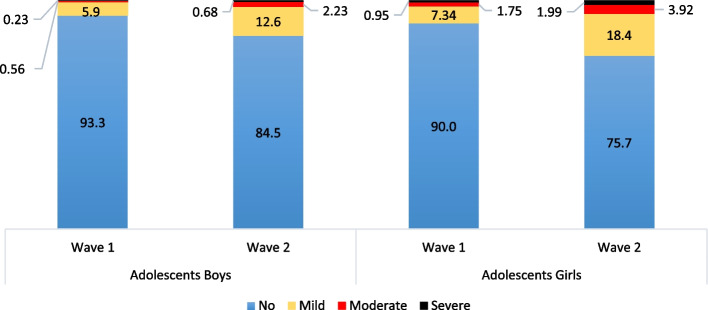
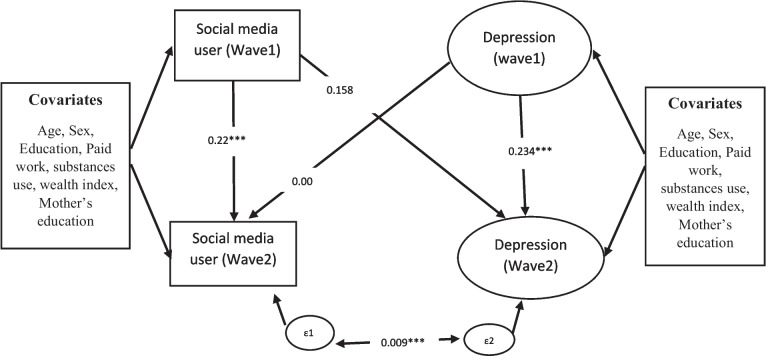
Introduction: In an online era like today, the relationship between social media and depression among adolescents and young adults is erratic and still continues to be a debatable subject. The study aims to examine the association and bi-directional relationship between social media usage and depressive symptoms among the adolescent boys and girls in India. Methods: The study uses data from two waves of Understanding the Lives of Adolescents and Young Adults (UDAYA) project survey conducted in two Indian states of Uttar Pradesh and Bihar. Depression was measured by a Patient Health Questionnaire. Logistic regression has been used for analyzing the data comprising the same time period, whereas the bidirectional relationship between two time periods has been evaluated by Cross-Lagged Path Model. Result: Findings suggest that the percentage of moderate depressive symptoms increased from 1.7% to 3.0% from Wave 1 to Wave 2. Depression among adolescent girls increased slightly from wave 1 to wave 2 whereas a slight decrement was noticed in the moderate form of depressive symptom among adolescent girls using social media for the two waves. Socioeconomic factors like education, age, gender played an important role in affecting depression among adolescents in both the Wave of the survey. The path relationship reveals that social media users in Wave 1 [β=0.22, p <0.001] were positively associated with social media users in Wave 2. Similar patterns were observed for depressive symptoms at both the waves of the survey. However, cross lagged relations between social media use and depression could not be established between the survey periods. Conclusion: A significant degree of association was found between social media use and depression among adolescent boys and girls in the study. The present study concludes that factors like age, gender and education showed significant relationships with social media use and depression.
Overview
The claims and statistics of this paper haven’t been checked yet.
Free: it reads the open-access text and checks the first 5 claims that cite a source we can check. Create a free account to check every claim.
Integrity signals
Registry
Cites
Statistics
Figures
Verification
Claims the paper makes
The claims and statistics of this paper haven’t been checked yet.
Free: it reads the open-access text and checks the first 5 claims that cite a source we can check. Create a free account to check every claim.
Claims other papers make about this one
Each is checked against this paper’s own text: does it say what the citing paper says it does?
The cited source doesn’t support the claim as written.
In the citing paper
“Third, recent longitudinal studies have provided emerging evidence of a bidirectional association between SMU and adolescent mental health [29, 82, 87, 88]—a key limitation of the present work is that bidirectionality could not be tested.”
From Adolescent social media use and psychiatric outcomes: a longitudinal mediation analysis via interpersonal distrust, sleep, and self-image. (2026) · cites this paper as [87]
Checked by a reasoning model — may be wrong.
Experimental — accuracy not yet measured
Self-check
Percentages, sums and reported differences re-computed from the paper’s own numbers.
The self-check needs the paper’s full text.
Citations
Cites
Internet paradox: A social technology that reduces social involvement and psychological well-being?
Kraut, R., Patterson, M., Lundmark, V., Kiesler, S., Mukophadhyay, T., & Scherlis, W. (1998) · American Psychologist · doi:10.1037/0003-066x.53.9.1017 · Cited by 4,793 · cited 1×
“This concern stems from several factors, including reduced in-person social interactions [43], addictive tendencies [44] , online bullying [45], heightened social pressure through constant comparisons [46], and the increased exposure to stories about suicide, which can have a harmful influence [47].”
BackgroundThe Impact of Social Media on Children, Adolescents, and Families
O'Keeffe, G. S., Clarke-Pearson, K., & Council on Communications and Media (2011) · Pediatrics · doi:10.1542/peds.2011-0054 · Cited by 2,943
Online Social Network Site Addiction: A Comprehensive Review
Andreassen, C. S. (2015) · Current Addiction Reports · doi:10.1007/s40429-015-0056-9 · Cited by 1,212 · cited 1×
“People can use for a variety of activities designed to satisfy basic social needs, including chatting with friends, sharing photos and videos, blogging, dating, meeting new people, entertainment, health promotion [8], and gambling [7, 9].”
BackgroundSocial media use and adolescent mental health: Findings from the UK Millennium Cohort Study
Kelly, Y., Zilanawala, A., Booker, C., & Sacker, A. (2018) · EClinicalMedicine · doi:10.1016/j.eclinm.2018.12.005 · Cited by 740 · cited 4×
“This finding falls in line with the previous study, which revealed that the association between social media use and depressive symptoms was larger for girls than for boys [14].”
BackgroundResultInfluentialAnderson, E. L., Steen, E., & Stavropoulos, V. (2017) · International Journal of Adolescence and Youth · doi:10.1080/02673843.2016.1227716 · Cited by 722 · cited 1×
“This concern stems from several factors, including reduced in-person social interactions [43], addictive tendencies [44] , online bullying [45], heightened social pressure through constant comparisons [46], and the increased exposure to stories about suicide, which can have a harmful influence [47].”
BackgroundDoes time spent using social media impact mental health?: An eight year longitudinal study
Coyne, S. M., Rogers, A. A., Zurcher, J. D., Stockdale, L., & Booth, M. (2020) · Computers in Human Behavior · doi:10.1016/j.chb.2019.106160 · Cited by 701 · cited 1×
“Social networking sites are now a normative part of adolescent development [17].”
BackgroundSmartphones, social media use and youth mental health
Abi-Jaoude, E., Naylor, K. T., & Pignatiello, A. (2020) · Canadian Medical Association Journal · doi:10.1503/cmaj.190434 · Cited by 627 · cited 2×
“According to a study conducted in North America, mental health has paralleled a steep rise in smartphones and social media use by children and adolescents [16].”
BackgroundInternet Use and Well‐Being in Adolescence
Gross, E. F., Juvonen, J., & Gable, S. L. (2002) · Journal of Social Issues · doi:10.1111/1540-4560.00249 · Cited by 580
Adolescents’ identity experiments on the internet
Valkenburg, P. M., Schouten, A. P., & Peter, J. (2005) · New Media & Society · doi:10.1177/1461444805052282 · Cited by 532 · cited 2×
“This bidirectional relationship between social media use and depressive symptoms can be explained through two primary theoretical approaches [3, 34, 35].”
BackgroundReiss, F., Meyrose, A.-K., Otto, C., Lampert, T., Klasen, F., & Ravens-Sieberer, U. (2019) · PLOS ONE · doi:10.1371/journal.pone.0213700 · Cited by 517 · cited 1×
“Adolescents from lower social group had higher chance to get mental health problems[29, 30].”
BackgroundSocial media use and mental health among young adults
Berryman, C., Ferguson, C. J., & Negy, C. (2018) · Psychiatric Quarterly · doi:10.1007/s11126-017-9535-6 · Cited by 484 · cited 1×
“…that increased time spent on social media was not associated with increased mental health issues across development when examined at the individual level [11, 41] whereas some of the studies have proposed that mental health problems are both cause and result of social media use problems [42].”
BackgroundNeiger, B. L., Thackeray, R., Van Wagenen, S. A., Hanson, C. L., West, J. H., Barnes, M. D., & Fagen, M. C. (2012) · Health Promotion Practice · doi:10.1177/1524839911433467 · Cited by 407
Socioeconomic status and adolescent mental disorders
McLaughlin, K. A., Costello, E. J., Leblanc, W., Sampson, N. A., & Kessler, R. C. (2012) · American Journal of Public Health · doi:10.2105/ajph.2011.300477 · Cited by 360 · cited 1×
“Adolescents from lower social group had higher chance to get mental health problems[29, 30].”
BackgroundBoer, M., Stevens, G. W. J. M., Finkenauer, C., de Looze, M. E., & van den Eijnden, R. J. J. M. (2021) · Computers in Human Behavior · doi:10.1016/j.chb.2020.106645 · Cited by 335 · cited 1×
“…that increased time spent on social media was not associated with increased mental health issues across development when examined at the individual level [11, 41] whereas some of the studies have proposed that mental health problems are both cause and result of social media use problems [42].”
BackgroundValkenburg, P. M., & Peter, J. (2008) · Communication Research · doi:10.1177/0093650207313164 · Cited by 306
Viner, R. M., Gireesh, A., Stiglic, N., Hudson, L. D., Goddings, A.-L., Ward, J. L., & Nicholls, D. E. (2019) · The Lancet Child & Adolescent Health · doi:10.1016/s2352-4642(19)30186-5 · Cited by 295 · cited 2×
“This complex interplay of factors underscores the urgent need for digital literacy and mental health awareness in India’s youth [14, 18].”
BackgroundMedia multitasking is associated with symptoms of depression and social anxiety
Becker, M. W., Alzahabi, R., & Hopwood, C. J. (2013) · Cyberpsychology, Behavior, and Social Networking · doi:10.1089/cyber.2012.0291 · Cited by 291 · cited 1×
“Increased media multitasking was associated with higher depression and social anxiety symptoms, even after controlling for general media use [19].”
BackgroundTang, S., Werner-Seidler, A., Torok, M., Mackinnon, A. J., & Christensen, H. (2021) · Clinical Psychology Review · doi:10.1016/j.cpr.2021.102021 · Cited by 284 · cited 1×
“Some studies show the bi-directional relationship between social media use and psychological wellbeing [32, 33].”
BackgroundHeffer, T., Good, M., Daly, O., MacDonell, E., & Willoughby, T. (2019) · Clinical Psychological Science · doi:10.1177/2167702618812727 · Cited by 278
Social Media Use and Access to Digital Technology in US Young Adults in 2016
Villanti, A. C., Johnson, A. L., Ilakkuvan, V., Jacobs, M. A., Graham, A. L., & Rath, J. M. (2017) · Journal of Medical Internet Research · doi:10.2196/jmir.7303 · Cited by 275 · cited 1×
“Almost 90 percent of young adults with internet access used social media [6].”
BackgroundBooker, C. L., Kelly, Y. J., & Sacker, A. (2018) · BMC Public Health · doi:10.1186/s12889-018-5220-4 · Cited by 268 · cited 2×
“Adolescents and young adults are the most active social media users, which have a predominantly high risk for developing mental health issues [13–15].”
BackgroundMaurya, C., Muhammad, T., Dhillon, P., & Maurya, P. (2022) · BMC Psychiatry · doi:10.1186/s12888-022-04238-x · Cited by 153 · cited 1×
“The scale of 27 points will then generated using the egen command in STATA 14 [37].”
MethodSelf-citationMental health problems among young people in substance abuse treatment in Sweden
Richert, T., Anderberg, M., & Dahlberg, M. (2020) · Substance Abuse Treatment Prevention and Policy · doi:10.1186/s13011-020-00282-6 · Cited by 144 · cited 1×
“Studies found that those who uses substance were at higher risk of having mental health problem than the non-users [26].”
BackgroundHardy, B. W., & Castonguay, J. S. (2018) · Computers in Human Behavior · doi:10.1016/j.chb.2018.04.005 · Cited by 135 · cited 1×
“It helps explain the changing role of social media in younger adolescents’ mental health compared to older adolescents [48].”
BackgroundMedia multitasking and well-being of university students
Xu, S., Wang, Z., & David, P. (2015) · Computers in Human Behavior · doi:10.1016/j.chb.2015.08.040 · Cited by 130 · cited 2×
“Media multitasking during entertainment activities was correlated with increased social success, normalcy, and self-control [22].”
BackgroundBenefits of maternal education for mental health trajectories across childhood and adolescence
Meyrose, A., Klasen, F., Otto, C., Gniewosz, G., Lampert, T., & Ravens‐Sieberer, U. (2018) · Social Science & Medicine · doi:10.1016/j.socscimed.2018.02.026 · Cited by 124
Kim, H. H.-S. (2017) · International Journal of Adolescence and Youth · doi:10.1080/02673843.2016.1197135 · Cited by 118 · cited 1×
“Social media use for chatting, emailing, participating in communities or clubs, and using bulletin boards negatively affects mental health and suicidal ideation [24].”
BackgroundClinical Report: The impact of social media on children, adolescents and families
Fernández, A. R. (2011) · Archivos de Pediatría del Uruguay · Cited by 111
Beeres, D. T., Andersson, F., Vossen, H. G. M., & Galanti, M. R. (2021) · Journal of Adolescent Health · doi:10.1016/j.jadohealth.2020.07.042 · Cited by 102 · cited 1×
“Many studies have looked upon that social media use is an essential indicator of the risk of mental health problems among adolescents [40].”
BackgroundNegative and positive impact of internet addiction on young adults: Empericial study in Malaysia
Alam, S. S., Hashim, N. M. H. N., Ahmad, M., Wel, C. A. C., Nor, S. M., & Omar, N. A. (2014) · Intangible Capital · doi:10.3926/ic.452 · Cited by 100 · cited 1×
“Asia has the highest number of Internet users globally, which is approximately 922.3 million, representing 44% share of the world’s Internet user population, as cited by Internet World Stats [4].”
BackgroundInfluentialEvaluating the model fit of diffusion models with the root mean square error of approximation
Schubert, A., Hagemann, D., Voß, A., & Bergmann, K. (2016) · Journal of Mathematical Psychology · doi:10.1016/j.jmp.2016.08.004 · Cited by 100 · cited 1×
“…root mean square error of approximation (RMSEA) values are 0.05 or less (0.6–0.8 indicates a mediocre model fit), Chi square difference testing and Akaike Information Criterion (AIC) were used to compare the best fit of competing models, whereby the lowest AIC indicated the best fitting model [39].”
MethodInfluentialSocial Media Use and Depressive Symptoms-A Longitudinal Study from Early to Late Adolescence
Puukko, K., Hietajärvi, L., Maksniemi, E., Alho, K., & Salmela-Aro, K. (2020) · International Journal of Environmental Research and Public Health · doi:10.3390/ijerph17165921 · Cited by 99 · cited 3×
“Hence, the frequency of social media use revealing the whole truth is unlikely [31].”
BackgroundInfluentialFakhrunnisak, D., & Patria, B. (2022) · BMC Public Health · doi:10.1186/s12889-022-13380-w · Cited by 93 · cited 1×
“Numerous research revealed that kids with higher levels of schooling have much less mental health issues [27, 28].”
Background(2017) · The SAGE Encyclopedia of Communication Research Methods · doi:10.4135/9781483381411.n117 · Cited by 61 · cited 1×
“Cross-lagged path models are estimated using longitudinal data where two or more variables are measured on two or more occasions to examine the causal influences between variables [38].”
MethodStraatmann, V. S., Oliveira, A. J., Rostila, M., & Lopes, C. S. (2016) · BMC Public Health · doi:10.1186/s12889-016-3606-8 · Cited by 50 · cited 1×
“In middle-income countries, the relationship between poor psychological wellbeing and screen time or social media use among girls is well documented in the literature [49].”
BackgroundHarmful or helpful? The role of the internet in self-harming and suicidal behaviour in young people
Bell, J. (2014) · Mental Health Review Journal · doi:10.1108/mhrj-05-2013-0019 · Cited by 46 · cited 1×
“This concern stems from several factors, including reduced in-person social interactions [43], addictive tendencies [44] , online bullying [45], heightened social pressure through constant comparisons [46], and the increased exposure to stories about suicide, which can have a harmful influence [47].”
BackgroundManthey, J., Lindemann, C., Kraus, L., Reimer, J., Verthein, U., Schulte, B., & Rehm, J. (2020) · Substance Abuse Treatment, Prevention, and Policy · doi:10.1186/s13011-019-0249-7 · Cited by 40
Hatchel, T. J., Negriff, S. L., & Subrahmanyam, K. (2017) · Computers in Human Behavior · doi:10.1016/j.chb.2017.12.012 · Cited by 31 · cited 1×
“There may be a convergence between the subjective belief of tech intensity and multitasking behavior [20].”
BackgroundGarbled in Translation: Getting Media Research to the Press and Public
Guernsey, L. (2014) · Journal of Children and Media · doi:10.1080/17482798.2014.863486 · Cited by 23 · cited 1×
“This concern stems from several factors, including reduced in-person social interactions [43], addictive tendencies [44] , online bullying [45], heightened social pressure through constant comparisons [46], and the increased exposure to stories about suicide, which can have a harmful influence [47].”
BackgroundGriffioen, N., Lichtwarck‐Aschoff, A., van Rooij, M. M. J. W., & Granic, I. (2021) · Frontiers in Psychology · doi:10.3389/fpsyg.2021.789302 · Cited by 20 · cited 1×
“Some studies show the bi-directional relationship between social media use and psychological wellbeing [32, 33].”
BackgroundMedia Multitasking and Mental Health
Cheever, N. A., Peviani, K., & Rosen, L. D. (2018) · Technology and Adolescent Mental Health · doi:10.1007/978-3-319-69638-6_8 · Cited by 10 · cited 1×
“Multitask-ing media with symptoms was reflected by changes in the functioning due to depressed mood or loss of interest and impaired work or social functioning [21].”
Background
Research works printed but not linked: 6
- Christopher A. Who are the internet users, Mobile Internet users, and mobile-mostly internet users? Demographic differences across internet-use subgroups in the U.S. Mobile Research methods: opportunities and challenges of mobile research methodologies. London: Ubiquity Press; 2015. pp. 99–117.
- Ruzgar N, A Research on the purpose of internet usage, and learning via internet. Vol. 4, The Turkish Online Journal of Educational Technology-TOJET. 2005.
- Coyne SM Rogers AA Zurcher JD Stockdale L Booth M Does time spent using social media impact mental health? An eight year longitudinal study Comput Hum Behav 2020 104 106160 10.1016/j.chb.2019.106160 · DOI · Paper page
- Singh M, Amiri M, Sabbarwal S. Social media usage: positive and negative effects on the Life Style of Indian Youth Peer review under responsibility of Iranian Journal of Social Sciences and Humanities Research. Vol. 5, Iranian Journal of Social Sciences and Humanities Research UCT. J Soc Scien Human Resear. 2017.
- Kraut R Patterson M Lundmark V Kiesler S Mukophadhyay T Internet paradox: a social technology that reduces social involvement and psychological well-being? Am Psychol 1998 53 1017 1031 10.1037/0003-066X.53.9.1017 9841579 · DOI · Paper page
- Kowalski RM Limber S Cyberbullying AP Bullying in the digital age 2012 2 Malden, MA In: Wiley-Blackwell
Cited by
Oleas, D., & López-Barranco, G. (2024) · European Public & Social Innovation Review · doi:10.31637/epsir-2024-1042 · Cited by 16
“…key to human communications through technological convergence, generic hybridisation, and aesthetic reinterpretation (Scolari, 2023), a close relationship has been generated between the use of social media (e.g. Facebook, Instagram, Tik Tok, X, etc.) and emotional well-being (Maurya et al., 2024).”
Is it time for India to set social media age limits for adolescents?
Prakash, O. (2025) · Indian Journal of Psychiatry · doi:10.4103/indianjpsychiatry.indianjpsychiatry_1012_24 · Cited by 12
“[28] In India, where academic pressures are intense, limiting young users’ social media exposure could alleviate mental health issues tied to negative self-comparisons and social pressures.”
Shen, C., Girela-Serrano, B. M., Di Simplicio, M., Spiers, A., Dumontheil, I., Thomas, M. S. C., Röösli, M., Elliott, P., Smith, R. B., & Toledano, M. B. (2026) · BMC Medicine · doi:10.1186/s12916-026-04667-5 · Cited by 6
“Our findings are in line with studies (sample size between 763 and 12,035) conducted in Norway, Canada, Iceland, Israel, and India, which showed that longer duration of SNS use predicts greater depressive or anxiety symptoms [17, 37–40].”
Tsomokos, D. I. (2026) · Social Psychiatry and Psychiatric Epidemiology · doi:10.1007/s00127-025-02999-w · Cited by 5
Impact of Social Media on Parenting Style and Child Behavior in India: A Systematic Scoping Review
Siva, N., Jena, S., Dhanya, V. J., Senapati, P., Praharaj, M., Das, S., Tripathy, P., & Dash, M. (2025) · Asian Journal of Social Health and Behavior · doi:10.4103/shb.shb_4_25 · Cited by 8
Metadata
- Authors
- Maurya, C., Dhillon, P., Sharma, H., & Kumar, P.
- Affiliations
- International Institute for Population Sciences (IN)
- Corresponding author
- Maurya, Chanda
- Venue
- BMC Public Health
- Published
- 2024-01-26
- Volume
- 24
- Issue
- 1
- Pages
- 303-303
- ISSN
- 1471-2458 (ISSN-L)
- PMC
- PMC10811814
- OpenAlex
- W4391260035
- Semantic Scholar
- e3c213abb14827ccf8df8ac207c0b8c52e95dd84
- Cited by
- 16
- References
- 41
- Citations by year
- 2026: 6 · 2025: 8 · 2024: 2
- FWCI
- 11.48
- Type
- journal article
- Language
- en
- Open access
- gold
- doi.org
- Licence
- cc-by
- creativecommons.org/licenses/by/4.0 (tdm)
- creativecommons.org/licenses/by/4.0 (vor)
- Locations
- BMC Public Health (publishedVersion, cc-by)
- Research Square (acceptedVersion, cc-by)
- PubMed Central (publishedVersion, cc-by)
- PubMed (publishedVersion)
- DOAJ (DOAJ: Directory of Open Access Journals) (submittedVersion, cc-by-sa)
- Topics
- Social Sciences › Sociology and Political Science › Impact of Technology on Adolescents
- Social Sciences › Psychology › Social Psychology › Mental Health via Writing
- Social Sciences › Psychology › Clinical Psychology › Child and Adolescent Psychosocial and Emotional Development
- Keywords
- social media use, depressive symptoms, adolescent mental health, bidirectional relationship, gender differences, socioeconomic factors
- MeSH terms
- Adolescent, Depression, Female, Humans, Longitudinal Studies, Male, Surveys and Questionnaires, Cohort Studies, Young Adult, Social Media
About these checks
Registry, retraction, Cites and statistics results are computed, not judged, with one exception: a printed reference that no index lists is read once by a model before it counts as a citation error. Claims are extracted by a model and kept only when their quote appears verbatim in the text; each cited source is then checked, with a model’s help, for whether it says what the claim relies on. Those verdicts can be wrong — read the claim’s quote and the cited source before relying on one.
Statistics and arithmetic are recomputed, not judged.
Confidence bands are shown only for fields calibrated on our annotated test set. None is calibrated yet, so no band is shown.
What counts as a claim ›How we measure confidence ›How we check this ›
Are you an author, or do you see a problem with this page? Request a review
Data sources
Bibliographic data: Semantic Scholar, OpenAlex, Crossref.
Contains information from the Semantic Scholar Academic Graph Datasets, made available under the ODC Attribution License (ODC-BY 1.0).
Semantic Scholar’s data is described in: Kinney, R., et al. (2023). The Semantic Scholar Open Data Platform. arXiv:2301.10140.
