

Parental expectation and psychological distress of Chinese youth: the chain mediating effects of core self-worth and perceived stress
Open accessThe DOI matches its Crossref record; 46 of the 48 references it cites were found in a registry or an index; 6 of the 18 sources its claims cite were checked for support.
Abstract
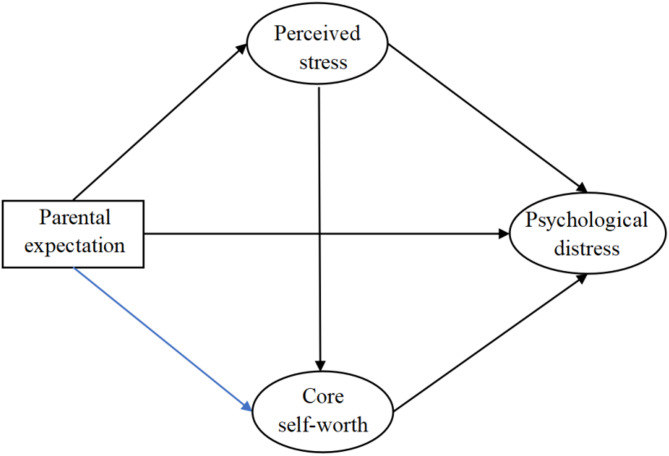
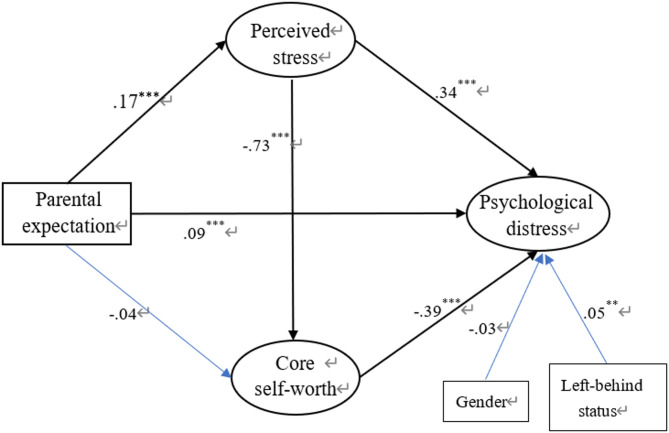
BACKGROUND: High parental expectations are increasingly recognized as a risk factor for youth mental health, yet the mechanisms underlying this association remain understudied, particularly in contexts like China where academic and familial pressures are pronounced. Existing literature highlights links between parental expectations and psychological distress but lacks clarity on mediating pathways. METHODS: This cross-sectional study analyzed data from 1,445 Chinese college students, using structural equation modeling (SEM). The model examined direct and indirect effects of parental expectations on psychological distress, with perceived stress and core self-worth as mediators, while controlling for co-variables. RESULTS: Parental expectations exhibited a substantial total effect on psychological distress (β = 0.216, p < 0.001). Direct effects accounted for 43% of this association (β = 0.093), while 57% operated indirectly through three pathways: (1) perceived stress alone (27.3% mediation, β = 0.059), (2) a sequential chain of heightened stress, reduced core self-worth, and exacerbated distress (22.7% mediation, β = 0.049), and (3) reduced core self-worth alone (7.0% mediation, β = 0.015). The dual-mediator model revealed how parental expectations trigger stress-driven erosion of self-worth and, independently, a direct erosion of self-worth, disproportionately affecting young adults. CONCLUSION: These findings underscore the dual nature of parental expectations as both direct and cascading stressors. The study advances stress-appraisal theories by elucidating mechanisms through which external pressures from parental expectation internalize as psychological harm. Culturally tailored interventions should target stress resilience and core self-worth reinforcement. By addressing conditional acceptance and fostering autonomy, strategies can mitigate mental health risks tied to excessive parental demands. This research calls for policy and educational reforms to balance parental aspirations with children's well-being, emphasizing systemic support for marginalized youth.
Overview
CoChat Summary
TL;DR
In a cross-sectional SEM study of 1,445 Chinese college students, parental expectations were positively associated with psychological distress, with 43% direct and 57% indirect effects. Indirect pathways involved perceived stress, core self-worth, and a sequential stress-to-lower-self-worth chain.
Key findings
- Parental expectations had a substantial total effect on psychological distress (β = 0.216, p < 0.001); the direct effect (β = 0.093) accounted for 43%, while indirect effects accounted for 57%.
- Three indirect pathways were found: perceived stress alone mediated 27.3% (β = 0.059, 95% CI [0.039–0.082]); core self-worth alone mediated 7.0% (β = 0.015, 95% CI [0.001–0.031]); and perceived stress → core self-worth → distress mediated 22.7% (β = 0.049, 95% CI [0.031–0.066]).
- Parental expectation correlated positively with psychological distress (r = 0.22) and perceived stress (r = 0.17), and negatively with core self-worth (r = −0.17); perceived stress correlated with higher distress (r = 0.64) and lower core self-worth (r = −0.74), while core self-worth inversely predicted distress (r = −0.66; all p < 0.01).
- Left-behind students reported significantly higher psychological distress than non-left-behind students (23.08 ± 7.1 vs. 20.86 ± 7.6; t = 4.71, p < 0.001).
Methods
- Cross-sectional survey of 1,445 students from two universities in Chengdu, China; mean age 18.30 years (SD = 0.74), 41.9% male and 58.1% female, 24.4% with left-behind experience, and 64.0% only children.
- Measures included parental expectations (5-item FMPS subscale, Cronbach’s α = 0.86), core self-worth (10-item Core Self-Evaluations Scale, α = 0.89), perceived stress (PSS-10, α = 0.71), and psychological distress (K10, α = 0.95); covariates were gender, age, left-behind status, only-child status, and major.
- Pearson correlations and structural equation modeling in Mplus 7.0 were used, with standardized estimates, 95% CIs, and control variables included.
Limitations
- The authors state the cross-sectional design prevents confirming causal relationships; longitudinal or experimental studies are needed. The text also makes evident that temporal ordering among mediators cannot be established from these data.
- The authors state reliance on self-reported data may introduce biases such as social desirability or inflated correlations.
- The authors state the sample was limited to Chinese college students, where Confucian cultural values may uniquely influence outcomes, limiting generalizability to other cultures or age groups.
Model-written summary. Check it against the paper before relying on it.
Integrity signals
Registry
Cites
Statistics
Figures
Verification
Claims the paper makes
3 Valid · 3 Not valid · 7 Not checked · 32 Own results and interpretations
The cited sources support only part of this claim — read each source’s verdict below.
In the paper
“Gender differences are significant, as research consistently shows that female adolescents report higher rates of mental health challenges, such as anxiety and depression, compared to their male counterparts [20, 21].”
§ Parental expectation and psychological distress of Chinese youth: the chain mediating effects of core self-worth and perceived stress > Introduction
What the sources say
- Partly supportedcites [20] Ma Z, Zhao J, Li Y, Chen D, Wang T, Zhang Z, Chen Z, Yu Q, Jiang J, Fan F. Mental health problems and correlates among 746 217 college students during the coronavirus disease 2019 outbreak in China. Epidemiol Psychiatric Sci. 2020;29:e181. PMC7681173 33185174 sourceExperimental — accuracy not yet measured
In Results, Table 2 (page not provided), female college students had higher odds of depressive symptoms than male students, but not higher odds of anxiety symptoms. The study surveyed Chinese college students during the COVID-19 outbreak, so it does not establish the broader claim about female adolescents. (LLM, conf=0.90)
- Not checked — no full text of the sourcecites [21] Tang W, Lu Y, Xu J. Post-traumatic stress disorder, anxiety and depression symptoms among adolescent earthquake victims: comorbidity and associated sleep-disturbing factors. Soc Psychiatry Psychiatr Epidemiol. 2018;53:1241–51. 30109368 source
boostedstates an association- Asserted: passes — The authors put it forward as true.
- Checkable: passes — It can be checked against evidence.
- Load-bearing: passes — The paper’s conclusions depend on it.
- Based: passes — The paper gives a reason why it holds.
- Partly supported
A result the paper reports from its own data — it cites no other source for it, so there is none to check. The quote shows it is in the paper.
In the paper
“Parental expectation showed positive correlations with psychological distress (r = 0.22) and perceived stress (r = 0.17), and a negative correlation with core self-worth (r = − 0.17; all p < 0.01).”
§ Parental expectation and psychological distress of Chinese youth: the chain mediating effects of core self-worth and perceived stress > Results > Correlation analysis
plainstates an associationn = 1,445 ·- Asserted: passes — The authors put it forward as true.
- Checkable: passes — It can be checked against evidence.
- Load-bearing: passes — The paper’s conclusions depend on it.
- Based: passes — The paper gives a reason why it holds.
A result the paper reports from its own data — it cites no other source for it, so there is none to check. The quote shows it is in the paper.
In the paper
“LBC reported significantly higher psychological distress (23.08 ± 7.1 vs. 20.86 ± 7.6, t = 4.71, p < 0.001) than non-LBC.”
§ Parental expectation and psychological distress of Chinese youth: the chain mediating effects of core self-worth and perceived stress > Results > Descriptive statistics
plainstates an associationn = 1,445 ·- Asserted: passes — The authors put it forward as true.
- Checkable: passes — It can be checked against evidence.
- Load-bearing: unclear — It is unclear whether the paper’s conclusions depend on it.
- Based: passes — The paper gives a reason why it holds.
A result the paper reports from its own data — it cites no other source for it, so there is none to check. The quote shows it is in the paper.
In the paper
“Our findings indicate that college students with a left-behind childhood experience significantly higher psychological distress, while gender does not appear to play a notable role.”
§ Parental expectation and psychological distress of Chinese youth: the chain mediating effects of core self-worth and perceived stress > Discussion
hedged- Asserted: passes — The authors put it forward as true.
- Checkable: passes — It can be checked against evidence.
- Load-bearing: unclear — It is unclear whether the paper’s conclusions depend on it.
- Based: passes — The paper gives a reason why it holds.
A result the paper reports from its own data — it cites no other source for it, so there is none to check. The quote shows it is in the paper.
In the paper
“Parental expectation showed positive correlations with psychological distress (r = 0.22) and perceived stress (r = 0.17), and a negative correlation with core self-worth (r = − 0.17; all p < 0.01).”
§ Parental expectation and psychological distress of Chinese youth: the chain mediating effects of core self-worth and perceived stress > Results > Correlation analysis
plainstates an associationn = 1,445 ·- Asserted: passes — The authors put it forward as true.
- Checkable: passes — It can be checked against evidence.
- Load-bearing: passes — The paper’s conclusions depend on it.
- Based: passes — The paper gives a reason why it holds.
17 more claims
Create a free account to see all 45 claims and every source verdict.
- It may state two separate claims as one. 9
- Probably not a substantial claim. 14
- The quote only partly states this claim. 2
Self-check
Percentages, sums and reported differences re-computed from the paper’s own numbers.
Rated minor: it would not touch a result — a value no result rests on, a p-value that stays on the same side of the significance level, or a conflict that is clerical, resolved elsewhere in the paper, or outside its own findings.
In the paper
“| Parental expectation → Perceived stress →PD | 0.097 | 5.39*** | 27.6% | 0.059 | 5.36*** | 27.3% | 0.039 | 0.082 |”
§ Parental expectation and psychological distress of Chinese youth: the chain mediating effects of core self-worth and perceived stress > Results > Chain mediation model between parental expectation and psychological distress
Reported 27.6 · recomputed 27.170868
Citations
Cites
The "what" and "why" of goal pursuits: Human needs and the self-determination of behavior
Deci, E. L., & Ryan, R. M. (2000) · Psychological Inquiry · doi:10.1207/s15327965pli1104_01 · Cited by 34,210 · cited 1×
“This result aligns with self-determination theory, which posits that excessive external pressure and conditional regard from parents may undermine individuals’ intrinsic sense of worth [47].”
A Global Measure of Perceived Stress
Cohen, S., Kamarck, T., & Mermelstein, R. (1983) · Journal of Health and Social Behavior · doi:10.2307/2136404 · Cited by 32,807 · cited 1×
“The study employed the PSS-10, a self-reported scale designed to assess the extent of perceived stress among individuals over the remainder of the month [38].”
Conservation of resources: A new attempt at conceptualizing stress
Hobfoll, S. E. (1989) · American Psychologist · doi:10.1037/0003-066x.44.3.513 · Cited by 18,187 · cited 2×
“When students internalize high parental expectations, poor academic performance or setbacks can feel like personal failures, undermining their core self-worth [26].”
KESSLER, R. C., ANDREWS, G., COLPE, L. J., HIRIPI, E., MROCZEK, D. K., NORMAND, S.-L. T., WALTERS, E. E., & ZASLAVSKY, A. M. (2002) · Psychological Medicine · doi:10.1017/s0033291702006074 · Cited by 10,327 · cited 1×
“The 10-item Kessler Scale (K10) was employed to assess the severity of psychological distress [40].”
Davis-Kean, P. E. (2005) · Journal of Family Psychology · doi:10.1037/0893-3200.19.2.294 · Cited by 2,466 · cited 1×
“High expectations can drive academic success, motivating students to excel [13, 14].”
THE CORE SELF‐EVALUATIONS SCALE: DEVELOPMENT OF A MEASURE
JUDGE, T. A., EREZ, A., BONO, J. E., & THORESEN, C. J. (2003) · Personnel Psychology · doi:10.1111/j.1744-6570.2003.tb00152.x · Cited by 2,010 · cited 1×
“To assess core self-worth, the study employed the Core self-evaluations scale, a 10-item psychometric scale crafted to evaluate an individual’s core belief in their capacity to navigate challenging situations and accomplish their goals [36].”
FURUKAWA, T. A., KESSLER, R. C., SLADE, T., & ANDREWS, G. (2003) · Psychological Medicine · doi:10.1017/s0033291702006700 · Cited by 1,570 · cited 1×
“This scale primarily evaluates an individual’s symptoms of depression and anxiety, providing insight into general mental health status [41] and validated in Chinese population [42].”
Systematic Review and Meta-Analysis: Adolescent Depression and Long-Term Psychosocial Outcomes
Clayborne, Z. M., Varin, M., & Colman, I. (2019) · Journal of the American Academy of Child & Adolescent Psychiatry · doi:10.1016/j.jaac.2018.07.896 · Cited by 787 · cited 1×
“These challenges demand urgent public health attention, given their profound ripple effects on psychosocial outcomes, including educational attainment, employment stability, income trajectories, and social relationships [6, 7].”
The Discipline Controversy Revisited
Baumrind, D. (1996) · Family Relations · doi:10.2307/585170 · Cited by 676 · cited 1×
“However, they also frequently lead to increased stress and anxiety, undermining well-being [15–18].”
Li, W., Zhao, Z., Chen, D., Peng, Y., & Lu, Z. (2022) · Journal of Child Psychology and Psychiatry · doi:10.1111/jcpp.13606 · Cited by 601 · cited 1×
“Recent studies report depression prevalence rates of 19.6–32.8% among Chinese college students [4], while another study reported pooled prevalence rates of 33.6% for depression and 39.0% for anxiety [5].”
InfluentialParental Expectations and Children's Academic Performance in Sociocultural Context
Yamamoto, Y., & Holloway, S. D. (2010) · Educational Psychology Review · doi:10.1007/s10648-010-9121-z · Cited by 575 · cited 1×
“This cultural framework profoundly shapes students’ academic and personal lives, creating a complex interplay between motivation and pressure [10, 11].”
Cultural Variation in the Self-Concept
Markus, H. R., & Kitayama, S. (1991) · The Self: Interdisciplinary Approaches · doi:10.1007/978-1-4684-8264-5_2 · Cited by 520 · cited 2×
“To explore the impact of parental expectations on the mental health of Chinese college students, we adopted an integrated theoretical framework combining the Conservation of Resources (COR) theory [26] and the Socio-cultural Self Model [27].”
Ma, Z., Zhao, J., Li, Y., Chen, D., Wang, T., Zhang, Z., Chen, Z., Yu, Q., Jiang, J., Fan, F., et al. (2020) · Epidemiology and Psychiatric Sciences · doi:10.1017/s2045796020000931 · Cited by 437 · cited 1×
“Gender differences are significant, as research consistently shows that female adolescents report higher rates of mental health challenges, such as anxiety and depression, compared to their male counter-parts [20, 21].”
A Model for Academic Success: The School and Home Environment of East Asian Students
SCHNEIDER, B., & LEE, Y. (1990) · Anthropology & Education Quarterly · doi:10.1525/aeq.1990.21.4.04x0596x · Cited by 374 · cited 1×
“In Chinese culture, where academic success is closely tied to family honor, these expectations can intensify stress, depleting students’ psychological resources and contributing to distress [30].”
Prevalence of depression among Chinese university students: a systematic review and meta-analysis
Gao, L., Xie, Y., Jia, C., & Wang, W. (2020) · Scientific Reports · doi:10.1038/s41598-020-72998-1 · Cited by 279 · cited 1×
“Recent studies report depression prevalence rates of 19.6–32.8% among Chinese college students [4], while another study reported pooled prevalence rates of 33.6% for depression and 39.0% for anxiety [5].”
InfluentialThe long-term effects of early parent involvement and parent expectation in the USA
Froiland, J. M., Peterson, A., & Davison, M. L. (2013) · School Psychology International · doi:10.1177/0143034312454361 · Cited by 277 · cited 1×
“This cultural framework profoundly shapes students’ academic and personal lives, creating a complex interplay between motivation and pressure [10, 11].”
Mojtabai, R., Stuart, E. A., Hwang, I., Eaton, W. W., Sampson, N., & Kessler, R. C. (2015) · Social Psychiatry and Psychiatric Epidemiology · doi:10.1007/s00127-015-1083-5 · Cited by 215 · cited 1×
“These challenges demand urgent public health attention, given their profound ripple effects on psychosocial outcomes, including educational attainment, employment stability, income trajectories, and social relationships [6, 7].”
Tang, W., Wang, G., Hu, T., Dai, Q., Xu, J., Yang, Y., & Xu, J. (2018) · Journal of Affective Disorders · doi:10.1016/j.jad.2018.08.017 · Cited by 200
Self-citationMa, Y., Siu, A., & Tse, W. S. (2018) · Journal of Family Issues · doi:10.1177/0192513x18755194 · Cited by 186 · cited 1×
“However, they also frequently lead to increased stress and anxiety, undermining well-being [15–18].”
Yatham, S., Sivathasan, S., Yoon, R., da Silva, T. L., & Ravindran, A. V. (2018) · Asian Journal of Psychiatry · doi:10.1016/j.ajp.2017.10.029 · Cited by 181 · cited 1×
“Psychological distress, encompassing symptoms of depression, anxiety, and stress, has emerged as a global priority [1], particularly in low-and middle-income countries [2].”
Lu, W., Bian, Q., Wang, W., Wu, X., Wang, Z., & Zhao, M. (2017) · PLOS ONE · doi:10.1371/journal.pone.0189543 · Cited by 175 · cited 1×
“This scale has been validated for use among young people in China [39].”
The Neglect of Left-Behind Children in China: A Meta-Analysis
Wen, Y., Hou, W., Zheng, W., Zhao, X., Wang, X., Bo, Q., Pao, C., Tang, Y., Tan, T. X., Li, X., et al. (2020) · Trauma Violence & Abuse · doi:10.1177/1524838020916837 · Cited by 148
Contingencies of Self–Worth and Depressive Symptoms in College Students
Sargent, J. T., Crocker, J., & Luhtanen, R. K. (2006) · Journal of Social and Clinical Psychology · doi:10.1521/jscp.2006.25.6.628 · Cited by 129 · cited 1×
“The COR theory suggests that stress arises when individuals lose or perceive a threat to their psychological resources, such as self-worth or emotional stability, due to external pressures like high parental expectations [28, 29].”
Wang, L.-F., & Heppner, P. P. (2002) · The Counseling Psychologist · doi:10.1177/00100002030004006 · Cited by 128
Purdon, C., Antony, M. M., & Swinson, R. P. (1999) · Journal of Clinical Psychology · doi:10.1002/(sici)1097-4679(199910)55:10<1271::aid-jclp8>3.0.co;2-a · Cited by 115
Mental Health among Left-Behind Children in Rural China in Relation to Parent-Child Communication
Wang, F., Lin, L. K., Xu, M., Li, L., Lu, J., & Zhou, X. (2019) · International Journal of Environmental Research and Public Health · doi:10.3390/ijerph16101855 · Cited by 111 · cited 1×
“This aligns with prior research suggesting that such separation can disrupt emotional bonds, weaken support systems, and introduce socioeconomic stressors, all of which contribute to lasting mental health vulnerabilities [44].”
Tang, W., Lu, Y., & Xu, J. (2018) · Social Psychiatry and Psychiatric Epidemiology · doi:10.1007/s00127-018-1576-0 · Cited by 96 · cited 1×
“Gender differences are significant, as research consistently shows that female adolescents report higher rates of mental health challenges, such as anxiety and depression, compared to their male counter-parts [20, 21].”
Self-citationCurran, T., & Hill, A. P. (2022) · Psychological Bulletin · doi:10.1037/bul0000347 · Cited by 96 · cited 1×
“This 5-item subscale measures individual perceptions of parental pressure through statements rated on a 5-point Likert scale (1 = Strongly Disagree to 5 = Strongly Agree) [34].”
The Mediating Role of Parental Expectations in Culture and Well‐Being
Oishi, S., & Sullivan, H. W. (2005) · Journal of Personality · doi:10.1111/j.1467-6494.2005.00349.x · Cited by 92
Left-behind children: the social price of China's economic boom
Ye, J. (2011) · The Journal of Peasant Studies · doi:10.1080/03066150.2011.582946 · Cited by 84 · cited 1×
“The left-behind child (LBC) experience, prevalent among students from rural China [22], also warrants careful consideration.”
Chen, X., & Hesketh, T. M. (2021) · International Journal of Environmental Research and Public Health · doi:10.3390/ijerph182111524 · Cited by 73 · cited 1×
“Research highlights a dual impact of parental expectations [12].”
Li, X., Coid, J. W., Tang, W., Lv, Q., Zhang, Y., Yu, H., Wang, Q., Deng, W., Zhao, L., Ma, X., et al. (2021) · European Child & Adolescent Psychiatry · doi:10.1007/s00787-020-01666-6 · Cited by 70 · cited 1×
“Approximately one in four Chinese college students has an LBC background, which studies suggest can heighten vulnerability to mental health issues [25].”
Self-citationParental Control and Adolescent Wellbeing in Chinese Adolescents in Hong Kong
Leung, J. T. Y., & Shek, D. T. L. (2020) · Child Indicators Research · doi:10.1007/s12187-019-09642-6 · Cited by 61 · cited 1×
“High expectations can drive academic success, motivating students to excel [13, 14].”
Leung, J. T. Y., & Shek, D. T. L. (2019) · Applied Research in Quality of Life · doi:10.1007/s11482-017-9540-9 · Cited by 58 · cited 1×
“This finding aligns with previous studies conducted on different samples in China, which identified parental expectations as a significant factor contributing to poorer well-being [17, 45].”
Liu, X., Li, Y., & Cao, X. (2024) · Humanities and Social Sciences Communications · doi:10.1057/s41599-024-02785-0 · Cited by 54 · cited 2×
“The Sociocultural Self Model complements this by emphasizing the interdependent nature of self-concept in Chinese society, where individuals define themselves through family expectations and social roles [31].”
Huang, J., Lin, K., Fan, L., Qiao, S., & Wang, Y. (2021) · Mindfulness · doi:10.1007/s12671-021-01614-8 · Cited by 52 · cited 1×
“Engaging both students and parents in these initiatives helps cultivate a healthier balance between parental expectations and academic performance, thereby enhancing student mental health and well-being [50, 51].”
Fu, Z., Zhou, S., Burger, H., Bockting, C. L. H., & Williams, A. D. (2020) · Journal of Affective Disorders · doi:10.1016/j.jad.2019.11.058 · Cited by 44 · cited 1×
“Empirical research supports their efficacy in alleviating distress and strengthening coping mechanisms among Chinese university students [49].”
Interventions in Chinese Undergraduate Students’ Mental Health: Systematic Review
Shan, Y., Ji, M., Xie, W., Li, R., Qian, X., Zhang, X., & Hao, T. (2022) · Interactive Journal of Medical Research · doi:10.2196/38249 · Cited by 44 · cited 1×
“Engaging both students and parents in these initiatives helps cultivate a healthier balance between parental expectations and academic performance, thereby enhancing student mental health and well-being [50, 51].”
Zhang, L. (2023) · Child Indicators Research · doi:10.1007/s12187-023-10094-2 · Cited by 30
Yan, X., Su, J., Zhu, X., & He, D. (2012) · Social Indicators Research · doi:10.1007/s11205-012-0172-z · Cited by 27 · cited 1×
“This scale has been proven to satisfy validation in Chinese college students [37].”
López, M. D., Iglesias, A. M. J., Paniagua, C. T., & García‐Moya, I. (2023) · Youth & Society · doi:10.1177/0044118x231205929 · Cited by 21
Zhang, J., Liu, Y., & Zhang, X. (2025) · Psychiatry Research · doi:10.1016/j.psychres.2025.116370 · Cited by 21
Parental expectations and adolescents’ happiness: the role of self-efficacy and connectedness
Zhang, F., & Yang, R. (2025) · BMC Psychology · doi:10.1186/s40359-025-02345-4 · Cited by 14 · cited 1×
“As Zhang and Yang (2025) noted, cultural norms make parental expectations part of the student’s identity and goals [16].”
Wang, Y., Zeng, Z., Huang, C., Ma, J., Ye, J., Li, J., Deng, X., & Zhang, L. (2025) · General Hospital Psychiatry · doi:10.1016/j.genhosppsych.2025.02.017 · Cited by 10 · cited 1×
“This scale primarily evaluates an individual’s symptoms of depression and anxiety, providing insight into general mental health status [41] and validated in Chinese population [42].”
Tang, W., Deng, Z., Sun, Z., Zhao, Q., Garcia‐Argibay, M., Anoop, K., Hu, T., Xue, S., Bozhilova, N. S., Conti, A. A., et al. (2025) · BMJ Mental Health · doi:10.1136/bmjment-2025-301761 · Cited by 10 · cited 1×
“In China, this issue is particularly pressing among college students (roughly 30–35% report clinically significant symptoms) [3], given cultural and structural factors that Magnify academic pressure.”
Self-citationLiu, Q., Yang, H., Peng, W., Liu, Z., Wang, J., Chu, J., Liu, J., Li, F., & Zhong, M. (2021) · Psychological Reports · doi:10.1177/00332941211018402 · Cited by 5 · cited 1×
“The validated instrument shows strong psychometric properties in Chinese youth samples [35] and includes items such as: “My parents set very high standards for me,” “My parents expected me to excel in all domains,” “My parents demanded exceptional achievements from me,” “My parents had higher…”
Self-citationDomestic violence and depression among Chinese adolescents: The role of self-evaluation
Fu, W., Zhang, S., Zhu, Y., & Liu, R. (2025) · International Journal of Social Psychiatry · doi:10.1177/00207640241288215 · Cited by 5 · cited 1×
“The COR theory suggests that stress arises when individuals lose or perceive a threat to their psychological resources, such as self-worth or emotional stability, due to external pressures like high parental expectations [28, 29].”
Research works printed but not linked: 4
- Agrahari SK, Kinra A. A comparative study on self-concept of adolescent boys and girls. Indian J Posit Psychol. 2017;8(4):519.
- Zi F, Zhou X. Reliability and validity of the Chinese version of the Frost multidimensional perfectionism scale. Chin J Clin Psychol. 2006;14(6):560–3.
- Muthén B, Muthén BO. Statistical analysis with latent variables. New York; NY:Wiley, 2009;123.
- Hobfoll SE. Conservation of resources. A new attempt at conceptualizing stress. Am Psychol. 1989;44(3):513–24. 2648906 · DOI · Paper page
Cited by
The relationship between perceived stress and mobile phone addiction in adolescents: a meta-analysis
Li, M., Han, X., & Li, J. (2025) · BMC Psychology · doi:10.1186/s40359-025-03702-z · Cited by 13
“Firstly, Chinese society places a strong emphasis on collective interests and familial responsibilities, which subjects adolescents to heightened academic stress, familial expectations, and pressures from social comparisons [83].”
Zhou, X., Wider, W., Wu, H., Xu, Y., Qin, M., & Borromeo, A. S. (2026) · Acta Psychologica · doi:10.1016/j.actpsy.2025.106168 · Cited by 4
Lu, H., Ren, Z., Meng, X., Sun, J., & Wu, Y. (2026) · Journal of Youth and Adolescence · doi:10.1007/s10964-026-02338-5 · Cited by 3
“In everyday terms, this pattern suggests that when girls perceive heightened pressure to meet others’ expectations, they are more likely to interpret this pressure as a reflection of their personal worth (Zhou et al., 2025).”
Sun, Y., Wang, M., Li, X., Zhu, Z., Wang, Y., Zhao, R., Sawada, Y., & Anme, T. (2026) · Frontiers in Psychology · doi:10.3389/fpsyg.2026.1867806 · Cited by 1
“This issue is particularly important in the Chinese educational context, where academic achievement is strongly emphasized from an early age and is often regarded as a pathway to future educational opportunities and upward social mobility (Zhou et al., 2025).”
Li, P., & Gao, X. (2026) · Frontiers in Psychology · doi:10.3389/fpsyg.2026.1824427 · Cited by 1
Metadata
- Authors
- Zhou, J., Tang, W., Sun, Z., Xue, S., Liu, Q., Wu, S., Dai, Q., & Xu, J.
- Affiliations
- Sichuan University (CN)
- King's College London (GB)
- Norwegian University of Science and Technology (NO)
- Charles Sturt University (AU)
- Sichuan Normal University (CN)
- Corresponding author
- Dai, Qian
- Xu, Jiuping
- Venue
- BMC Public Health
- Published
- 2025-10-10
- Volume
- 25
- Issue
- 1
- Pages
- 3457-3457
- ISSN
- 1471-2458 (ISSN-L)
- PMC
- PMC12512374
- OpenAlex
- W4415024400
- Cited by
- 24
- References
- 48
- Citations by year
- 2026: 23 · 2025: 1
- FWCI
- 20.52
- Type
- journal article
- Language
- en
- Open access
- gold
- doi.org
- Licence
- cc-by-nc-nd
- creativecommons.org/licenses/by-nc-nd/4.0 (tdm)
- creativecommons.org/licenses/by-nc-nd/4.0 (vor)
- Locations
- BMC Public Health (publishedVersion, cc-by-nc-nd)
- Europe PMC (PubMed Central) (publishedVersion, cc-by-nc-nd)
- PubMed (publishedVersion)
- Charles Sturt University Research Output (CRO) (submittedVersion, cc-by-nc-nd)
- DOAJ (DOAJ: Directory of Open Access Journals) (submittedVersion, cc-by-sa)
- Funders
- National Natural Science Foundation of China (82273745)
- Topics
- Social Sciences › Psychology › Developmental and Educational Psychology › Student Stress and Coping
- Social Sciences › Psychology › Clinical Psychology › Child and Adolescent Psychosocial and Emotional Development
- Social Sciences › Psychology › Developmental and Educational Psychology › Psychosocial Factors Impacting Youth
- Keywords
- parental expectations, psychological distress, perceived stress, Chinese university students, youth mental health, serial mediation, conditional acceptance, parental demands, academic stress
- MeSH terms
- Psychological Distress, Adolescent, Adult, China, Cross-Sectional Studies, Female, Humans, Male, Parent-Child Relations, Parents, Surveys and Questionnaires, Self Concept, Stress, Psychological, Students, Universities, Young Adult
About these checks
Registry, retraction, Cites and statistics results are computed, not judged, with one exception: a printed reference that no index lists is read once by a model before it counts as a citation error. Claims are extracted by a model and kept only when their quote appears verbatim in the text; each cited source is then checked, with a model’s help, for whether it says what the claim relies on. Those verdicts can be wrong — read the claim’s quote and the cited source before relying on one.
The claim verdicts this report counts are experimental: their accuracy is not yet measured.
A language model drew the claims from the paper on 2026-10-07, under version 3 of the claim definition (model deepseek-v4.1-flash, prompt extract-v3).
A second model labelled each claim on 2026-10-07 (model jev-1.13-20260917, definition revision gold-guideline-v0.2).
Cited sources are checked with a language model’s help (gpt-6-sol).
Statistics and arithmetic are recomputed, not judged.
Confidence bands are shown only for fields calibrated on our annotated test set. None is calibrated yet, so no band is shown.
What counts as a claim ›How we measure confidence ›How we check this ›
Are you an author, or do you see a problem with this page? Request a review
Data sources
Bibliographic data: Semantic Scholar, OpenAlex, Crossref.
Contains information from the Semantic Scholar Academic Graph Datasets, made available under the ODC Attribution License (ODC-BY 1.0).
Semantic Scholar’s data is described in: Kinney, R., et al. (2023). The Semantic Scholar Open Data Platform. arXiv:2301.10140.
