

Adolescent social media use and its association with mental health: a cross-sectional study in Bradford, England
Open accessThe DOI matches its Crossref record; 47 of the 47 references it cites were found in a registry or an index; none of the 80 sources its claims cite is checked for support yet.
Abstract
Background: Social media is a central part of the lives of adolescents in 2025. The recent rise of short-form content and gamification features has coincided with an increasing prevalence of mental health problems among this age group. Many policy makers are considering restrictions to the amount of time under-16s spend on social media. Despite this, there is limited contemporary evidence about the extent of their social media use, nor meaningful estimates of the effect a reduction may have on their mental health. Here, we estimate daily social media usage for adolescents in the culturally and ethnically diverse city of Bradford, England, plus its association with their mental health. Method: We did a cross-sectional analysis of data from Born in Bradford: Age of Wonder 2023-24, a school-based survey of students aged 12–15 ( n = 8,466). We weighted the sample to be representative of the city-wide population of 12–15-year-olds and report the median daily screen time spent on social media apps by age, sex, and ethnicity. We used a log-linear model to estimate the effect of daily social media screen time on anxiety and depression symptoms (RCADS-25), adjusting for age, sex, ethnicity, free school meal eligibility, special educational needs, deprivation, and season of survey completion. Predictions from this model were used to estimate the change in prevalence of clinical threshold symptomatology associated with a range of daily screen time limits. Results: The median time spent using social media apps was 3.36 h per day (IQR 1.88–5.44). Longer durations of social media use were associated with greater mental health symptoms after adjustment for potential confounders. In a scenario where this association is causal, capping social media use at a maximum of 3 h per day would lead to a 1.25ppt (95% CI 0.74ppt – 1.76ppt) decrease in the prevalence of clinical threshold symptomatology (a reduction from 10.7% to 9.5%), equivalent to 13 fewer cases in a typical school of 1000 pupils. Conclusions: All groups of adolescents spend a large of amount of time using social media apps each day. We observed a significant association between social media use and symptoms of anxiety and depression. Assuming a causal relationship, daily time limits placed on social media may yield meaningful reductions in anxiety and depression symptomatology. Nevertheless, we cannot demonstrate strong evidence of a causal relationship, and robust methods such as controlled trials or natural experiments are needed to precisely determine the benefits and harms of policies restricting access for under-16s.
Overview
CoChat Summary
TL;DR
In a cross-sectional, population-weighted survey of 8,466 adolescents aged 12–15 in Bradford, England, median daily social media use was 3.36 hours and greater use was associated with more anxiety/depression symptoms. Assuming causality, a 3-hour daily cap was estimated to reduce clinical-threshold anxiety/depression prevalence by 1.25 percentage points (from 10.7% to 9.5%), but the authors caution that causal evidence remains weak.
Key findings
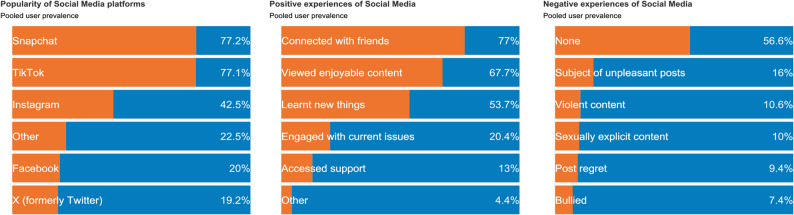
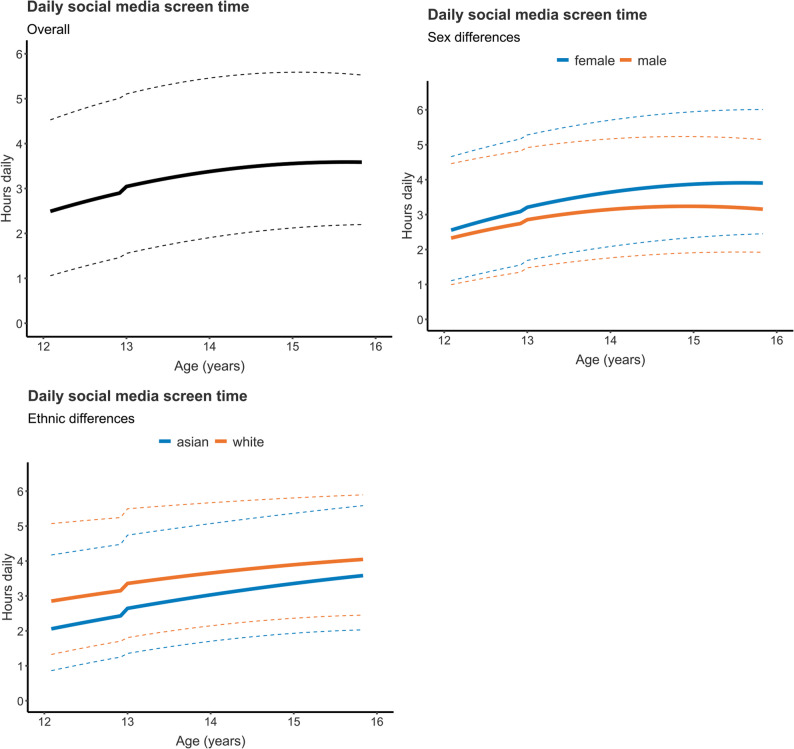
- Median daily social media use was 3.36 h (IQR 1.88–5.44); the most popular platforms were Snapchat (77.2%, 95% CI 76.8–77.6) and TikTok (77.1%, 95% CI 76.7–77.5). Use rose with age: 12-year-olds reported a median of 2.64 h/day (IQR 1.27–4.79) with 81.3% using at least one app, while 15-year-olds reported 3.38 h/day (IQR 2.00–5.14) with 93.0% using at least one app.
- Clinical-threshold anxiety/depression prevalence was 10.7% (95% CI 10.3–11.1). After adjustment, each hour of social media screen time was associated with a 1.21% (95% CI 0.84–1.58) increase in RCADS-25 score.
- A maximum 3 h/day threshold was associated with estimated prevalence of 9.45% (95% CI 8.94–9.96), a 1.25 percentage-point reduction (95% CI 0.74–1.76), equivalent to 13 fewer cases in a typical 1,000-pupil school. Table 3 also reports estimated reductions of 0.50 ppt for a 5 h cap, 0.77 ppt for 4 h, 1.71 ppt for 2 h, and 2.25 ppt for 1 h.
- Positive experiences included connecting with friends (77.0%), viewing enjoyable content (67.7%), and learning new things (53.7%); negative experiences included being the subject of unpleasant posts (16.0%), encountering violent content (10.6%), and encountering sexually explicit content (9.4%), while 56.6% reported no negative experiences.
Methods
- Cross-sectional analysis of Born in Bradford: Age of Wonder 2023–24, a school-based self-report survey of students in years 8–10 (ages 12–15); 25 of 36 contacted mainstream secondary schools participated, yielding n = 8,466. RCADS-25 analysis was restricted to 5,399 participants in years 8 and 10.
- Inverse probability weights were applied to Bradford school census data by academic year, sex, ethnicity, free school meal eligibility, and special educational needs. Daily social media use was derived by weighting weekday and weekend usage over a normal school week; quantile regression estimated medians by age, sex, and ethnicity.
- A log-linear model estimated the association between daily social media screen time and RCADS-25, adjusting for age, sex, ethnicity, free school meal eligibility, special educational needs, deprivation, and season of survey completion. Multiple imputation with chained equations handled missing data, and model predictions estimated changes in clinical-threshold prevalence under maximum usage thresholds.
Limitations
- Stated: selection bias is possible; non-participants may differ, non-participation is associated with school absence (which is associated with poorer mental health), and experiences of individuals with learning disabilities or other support needs precluding survey participation were not captured.
- Stated: self-reported social media use only modestly correlates with objective use measures and may be overestimated by as much as 150–160%; time spent also does not distinguish between types of content or activities.
- Stated: unmeasured confounding and reverse causation make the effect estimates approximate and uncertain. Evident from the text: the cross-sectional design cannot demonstrate causality, and RCADS-25 was completed only by years 8 and 10, so mental health analyses used 5,399 of the 8,466 participants.
Model-written summary. Check it against the paper before relying on it.
Integrity signals
Registry
Cites
Statistics
Figures
Verification
Claims the paper makes
0 Valid · 1 Not valid · 32 Not checked · 53 Own results and interpretations
A result the paper reports from its own data — it cites no other source for it, so there is none to check. The quote shows it is in the paper.
In the paper
“The median time spent using social media apps was 3.36 h per day (IQR 1.88–5.44).”
- Also stated in: § Social media usage · plain
“Participants reported spending a median of 3.36 (IQR 1.88–5.44) hours on social media each day on a normal school week.”
- Also stated in: § Discussion · plain
“Secondary school students in Bradford report using social media for an average of 3 h and 20 min each day.”
§ Adolescent social media use and its association with mental health: a cross-sectional study in Bradford, England > Abstract > Results
plain- Asserted: passes — The authors put it forward as true.
- Checkable: passes — It can be checked against evidence.
- Load-bearing: unclear — It is unclear whether the paper’s conclusions depend on it.
- Based: passes — The paper gives a reason why it holds.
- Also stated in: § Social media usage · plain
A result the paper reports from its own data — it cites no other source for it, so there is none to check. The quote shows it is in the paper.
In the paper
“The descriptive statistics show a disparity in social media usage between Asian (predominantly British Pakistani) and White (predominantly White British) ethnicities.”
§ Adolescent social media use and its association with mental health: a cross-sectional study in Bradford, England > Discussion
plainstates an association- Asserted: passes — The authors put it forward as true.
- Checkable: passes — It can be checked against evidence.
- Load-bearing: unclear — It is unclear whether the paper’s conclusions depend on it.
- Based: passes — The paper gives a reason why it holds.
A result the paper reports from its own data — it cites no other source for it, so there is none to check. The quote shows it is in the paper.
In the paper
“The most popular social media platforms were Snapchat (77.2% of participants; 95% CI 76.8–77.6) and TikTok (77.1%; 95% CI 76.7–77.5) (see Fig. 1).”
§ Adolescent social media use and its association with mental health: a cross-sectional study in Bradford, England > Results > Social media usage
plain- Asserted: passes — The authors put it forward as true.
- Checkable: passes — It can be checked against evidence.
- Load-bearing: unclear — It is unclear whether the paper’s conclusions depend on it.
- Based: passes — The paper gives a reason why it holds.
A result the paper reports from its own data — it cites no other source for it, so there is none to check. The quote shows it is in the paper.
In the paper
“Nevertheless, the majority reported no negative experiences (56.6%; 95% CI 56.1–57.1).”
§ Adolescent social media use and its association with mental health: a cross-sectional study in Bradford, England > Results > Social media usage
plain- Asserted: passes — The authors put it forward as true.
- Checkable: passes — It can be checked against evidence.
- Load-bearing: unclear — It is unclear whether the paper’s conclusions depend on it.
- Based: passes — The paper gives a reason why it holds.
A result the paper reports from its own data — it cites no other source for it, so there is none to check. The quote shows it is in the paper.
In the paper
“Although signing up for an account is illegal for children under 13, 12-year-olds in Bradford reported spending an average of 2 h and 38 min each day on social media.”
§ Adolescent social media use and its association with mental health: a cross-sectional study in Bradford, England > Discussion
plain- Asserted: passes — The authors put it forward as true.
- Checkable: passes — It can be checked against evidence.
- Load-bearing: passes — The paper’s conclusions depend on it.
- Based: passes — The paper gives a reason why it holds.
25 more claims
Create a free account to see all 86 claims and to verify the 80 references still open.
- The quote only partly states this claim. 1
- It may state two separate claims as one. 32
- Probably not a substantial claim. 37
Self-check
Percentages, sums and reported differences re-computed from the paper’s own numbers.
Each contradiction between two passages listed here was confirmed by an independent check.
Rated minor: it would not touch a result — a value no result rests on, a p-value that stays on the same side of the significance level, or a conflict that is clerical, resolved elsewhere in the paper, or outside its own findings.
In the paper
§ Adolescent social media use and its association with mental health: a cross-sectional study in Bradford, England > Methods > Variables
“if their overall scaled score exceeded 70”
§ Adolescent social media use and its association with mental health: a cross-sectional study in Bradford, England > Results > Association between reported social media use and anxiety and depression symptomatology
“The prevalence of ‘clinical’ threshold anxiety and depression symptomatology (≥ 70 on RCADS-25)”
Rated minor: it would not touch a result — a value no result rests on, a p-value that stays on the same side of the significance level, or a conflict that is clerical, resolved elsewhere in the paper, or outside its own findings.
In the paper
§ Adolescent social media use and its association with mental health: a cross-sectional study in Bradford, England > Results > Social media usage
“For 12-year-olds, median reported daily use was 2.64 h (IQR 1.27–4.79)”
§ Adolescent social media use and its association with mental health: a cross-sectional study in Bradford, England > Results > Social media usage
“| Age | 12 | 0.10 | 1.29 | 2.64 | 4.53 | 7.91 |”
Citations
Cites
Harris, P. A., Taylor, R., Thielke, R., Payne, J., Gonzalez, N., & Conde, J. G. (2009) · Journal of Biomedical Informatics · doi:10.1016/j.jbi.2008.08.010 · Cited by 51,384
Multiple Imputation for Nonresponse in Surveys
Rubin, D. B. (1987) · Wiley Series in Probability and Statistics · doi:10.1002/9780470316696 · Cited by 20,701
mice: Multivariate Imputation by Chained Equations in R
Buuren, S. V., & Groothuis-Oudshoorn, K. (2011) · Journal of Statistical Software · doi:10.18637/jss.v045.i03 · Cited by 13,870
Deep Neural Networks for YouTube Recommendations
Covington, P., Adams, J., & Sargin, E. (2016) · Proceedings of the 10th ACM Conference on Recommender Systems · doi:10.1145/2959100.2959190 · Cited by 3,539
Twenge, J. M., Cooper, A. B., Joiner, T. E., Duffy, M. E., & Binau, S. G. (2019) · Journal of Abnormal Psychology · doi:10.1037/abn0000410 · Cited by 1,469
The welfare effects of social media
Allcott, H., Braghieri, L., Eichmeyer, S., & Gentzkow, M. (2020) · American Economic Review · doi:10.1257/aer.20190658 · Cited by 857
Parry, D. A., Davidson, B. I., Sewall, C. J. R., Fisher, J. T., Mieczkowski, H., & Quintana, D. S. (2021) · Nature Human Behaviour · doi:10.1038/s41562-021-01117-5 · Cited by 793
Social media use and its impact on adolescent mental health: An umbrella review of the evidence.
Valkenburg, P. M., Meier, A., & Beyens, I. (2022) · Current opinion in psychology · doi:10.1016/j.copsyc.2021.08.017 · Cited by 767 · cited 1×
“The pooled evidence shows that greater social media use is associated with more mental health problems, though a minority of studies find the opposite, or no association (e.g., [49, 51, 52]).”
Meier, A., & Reinecke, L. (2021) · Communication Research · doi:10.1177/0093650220958224 · Cited by 534 · cited 2×
“Still, understanding when and how they use social media permits far greater mechanistic insight [56] and will guide policy makers towards targets for intervention with more precision.”
Meier, A., & Reinecke, L. (2020) · doi:10.31234/osf.io/573ph · Cited by 533
Research works printed but not linked: 2
- Sunstein CR. Is social media good or bad for democracy? Sur Int J Hum Rights. 2018;15:83–90.
- Meta MRTQ. 2024 Results. 2024. Accessed online: https://investor.atmeta.com/investor-news/press-release-details/2024/Meta-Reports-Third-Quarter-2024-Results/default.aspx (26th January 2026).
Cited by
Joy, R. B. (2026) · International Journal of Education Pedagogy and Psychology · doi:10.64823/ijepp.2601011
Metadata
- Authors
- Pickavance, J., O’Nions, E., Hammad, M., Jackson, L., Lightfoot, K., McEachan, R. R. C., Orben, A., Ryan, D., Shire, K., Wood, M. L., Wright, J., & Lewer, D.
- Affiliations
- Bradford Teaching Hospitals NHS Foundation Trust (GB)
- MRC Cognition and Brain Sciences Unit (GB)
- Corresponding author
- Pickavance, John
- ORCID
- Venue
- BMC Public Health
- Published
- 2026-05-07
- Volume
- 26
- Issue
- 1
- Pages
- 2212
- ISSN
- 1471-2458 (ISSN-L)
- PMC
- PMC13393615
- OpenAlex
- W7160960775
- Semantic Scholar
- 0dbcf7efef082435feda69d9154c2c3a81146ae2
- Cited by
- 1
- References
- 44
- Citations by year
- 2026: 1
- FWCI
- 3.71
- Type
- journal article
- Language
- en
- Open access
- gold
- doi.org
- Licence
- cc-by
- creativecommons.org/licenses/by/4.0 (tdm)
- creativecommons.org/licenses/by/4.0 (vor, 77 d)
- Locations
- BMC Public Health (publishedVersion, cc-by)
- PubMed Central (publishedVersion, cc-by)
- PubMed (publishedVersion)
- Apollo (University of Cambridge) (submittedVersion, cc-by)
- DOAJ (DOAJ: Directory of Open Access Journals) (submittedVersion)
- Apollo (cc-by)
- Funders
- National Institute for Health and Care Research (NIHR205448)
- Wellcome Trust (223601)
- NIHR Applied Research Collaboration for Yorkshire and Humber (NIHR200166)
- Topics
- Social Sciences › Sociology and Political Science › Impact of Technology on Adolescents
- Social Sciences › Education › Child Development and Digital Technology
- Social Sciences › Psychology › Clinical Psychology › Child and Adolescent Psychosocial and Emotional Development
- Keywords
- adolescent social media use, screen time, mental health, anxiety symptoms, depressive symptoms, short-form content, gamification, ethnic and cultural diversity, Bradford, school-based survey, deprivation, special educational needs, free school meals, causal inference, public health policy, children and young people
- MeSH terms
- Media Exposure, Digital Media, Adolescent, Anxiety, Child, Cross-Sectional Studies, Depression, England, Female, Humans, Male, Mental Health, Social Media
About these checks
Registry, retraction, Cites and statistics results are computed, not judged, with one exception: a printed reference that no index lists is read once by a model before it counts as a citation error. Claims are extracted by a model and kept only when their quote appears verbatim in the text; each cited source is then checked, with a model’s help, for whether it says what the claim relies on. Those verdicts can be wrong — read the claim’s quote and the cited source before relying on one.
A language model drew the claims from the paper on 2026-11-28, under version 3 of the claim definition (model deepseek-v4.1-flash, prompt extract-v3).
A second model labelled each claim on 2026-11-28 (model jev-1.13-20260917, definition revision gold-guideline-v0.2).
Statistics and arithmetic are recomputed, not judged.
Confidence bands are shown only for fields calibrated on our annotated test set. None is calibrated yet, so no band is shown.
What counts as a claim ›How we measure confidence ›How we check this ›
Are you an author, or do you see a problem with this page? Request a review
Data sources
Bibliographic data: Semantic Scholar, OpenAlex, Crossref.
Contains information from the Semantic Scholar Academic Graph Datasets, made available under the ODC Attribution License (ODC-BY 1.0).
Semantic Scholar’s data is described in: Kinney, R., et al. (2023). The Semantic Scholar Open Data Platform. arXiv:2301.10140.
