

Caregiver burden among family caregivers of incurable cancer patients in two eastern Mediterranean countries
Open accessThe DOI matches its Crossref record; 27 of the 27 references it cites were found in a registry or an index; 18 of the 32 sources its claims cite were checked for support.
Abstract
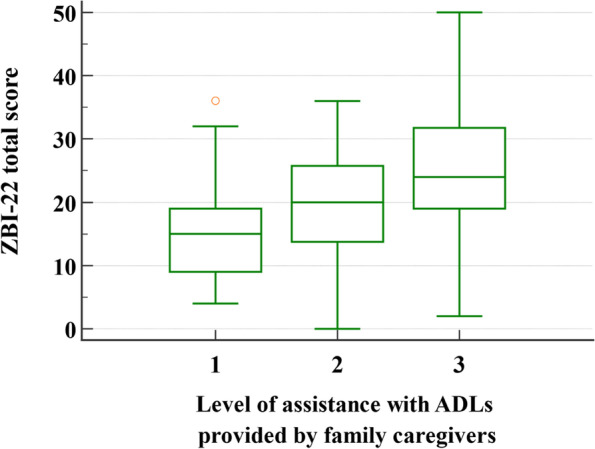
Background: Although family caregivers (FCs) play an important role in the care provided to incurable cancer patients in our region, little is known about the burden they experience. This study was conducted to determine the prevalence of caregiver burden (CB) among FCs of incurable cancer patients in two Eastern Mediterranean countries and to identify factors that may be associated with significant CB. Methods: The study included 218 FCs, 165 from Egypt and 53 from Saudi Arabia. The 22-item Zarit Burden Interview (ZBI-22) was used to assess caregiver burden CB. Significant CB was defined as a ZBI-22 score ≥ 21. The assistance with basic ADLs was classified into 3 levels according to FCs’ assistance with early/middle/late-loss basic ADLs. The relationship between CB and the assistance with ADLs and other factors was studied. Results: The mean (SD) ZBI-22 score among FCs was 23.4 (9.3) and the majority (128/218, 59%) had significant CB. Eighty-nine percent of FCs assisted with at least one basic ADL. Assistance with late-loss basic ADLs, best supportive care treatment plan and poorer performance status were associated with higher CB ( p < 0.0001, =0.018 and = 0.005). However, in logistic regression analysis, only assistance with late-loss ADLs was independently associated with significant CB (OR = 3.4 [95%CI:1.2–9.7], p = 0.024). Conclusion: A substantial proportion of FCs of incurable cancer patients in our region experience significant CB. Family caregivers assisting with late-loss basic ADLs are at risk of significant CB and should be routinely screened for CB.
Overview
CoChat Summary
TL;DR
Among 218 family caregivers of incurable cancer patients in Egypt and Saudi Arabia, 128/218 (58.7%) had significant caregiver burden on the ZBI-22. Only assistance with late-loss basic ADLs was independently associated with significant burden.
Key findings
- Mean (SD) ZBI-22 score was 23.4 (9.3); median (IQR) was 23 (16–31), and 128/218 (58.7%) had significant burden using the cutoff score ≥ 21.
- 194/218 (89%) caregivers assisted with at least one basic ADL; 167/218 (76.6%) provided level 3 assistance, defined as assistance with late-loss ADLs ± early/middle-loss ADLs.
- In univariate analysis, higher burden was associated with level of ADL assistance, best supportive care treatment plan, and poorer ECOG performance status (p < 0.0001, p = 0.018, and p = 0.005, respectively).
- In logistic regression, only level 3 assistance with basic ADLs was independently associated with significant burden (OR = 3.4 [95% CI: 1.2–9.7], p = 0.024).
Methods
- Observational cross-sectional study conducted November 2019 to January 2021 at oncology services in Cairo, Egypt and Riyadh, Saudi Arabia; 244 family caregivers were recruited, and 218 were analyzed (165 from Egypt, 53 from Saudi Arabia).
- Participants were Arabic-speaking adult informal family caregivers of adult patients with incurable cancer; one caregiver per patient was included, and non-family informal caregivers were excluded.
- Caregiver burden was assessed with the 22-item Zarit Burden Interview (ZBI-22), with significant burden defined as score ≥ 21; assistance with basic ADLs was graded into early-, middle-, and late-loss levels, and associations were examined with univariate tests and logistic regression.
Limitations
- The authors state they did not study all factors previously found to contribute to caregiver burden, such as caregivers’ social network index and activity restriction.
- The authors state the purposive-convenience sampling method was a limitation.
- Evident from the text: the cross-sectional design cannot establish causality, and the sample was drawn from two centers in two countries, with most caregivers recruited from Egypt (75.7%), which may limit generalizability.
Model-written summary. Check it against the paper before relying on it.
Integrity signals
Registry
Cites
Statistics
Figures
Verification
Claims the paper makes
12 Valid · 1 Not valid · 3 Not checked · 21 Own results and interpretations
The sources with a verdict support this claim; the rest weren’t checked yet, have no full text we could read, or their verdicts aren’t rated yet.
In the paper
“The important roles performed by informal caregivers and their unmet needs are associated with significant caregiver burden (CB) [9–12].”
§ Caregiver burden among family caregivers of incurable cancer patients in two eastern Mediterranean countries > Background
What the sources say
- Not checked — no full text of the sourcecites [9] Lukhmana S Bhasin SK Chhabra P Bhatia MS Family caregivers' burden: a hospital based study in 2010 among cancer patients from Delhi Indian J Cancer 2015 52 1 146 151 10.4103/0019-509X.175584 26838005 source
- Supportedcites [10] Mirsoleymani SR Rohani C Matbouei M Nasiri M Vasli P Predictors of caregiver burden in Iranian family caregivers of cancer patients J Educ Health Promot 2017 6 91 10.4103/jehp.jehp_137_16 29114558 PMC5651650 source
The Introduction says family caregivers perform important, complex care roles with little preparation or support, and that demands exceeding their resources lead to greater caregiver burden. The Conclusion reports that the Iranian family caregivers studied experienced a high level of burden. (LLM, conf=0.88)
- Not checked — no full text of the sourcecites [11] Seo YJ Park H Factors influencing caregiver burden in families of hospitalized patients with lung Cancer J Clin Nurs 2019 28 9–10 1979 1989 10.1111/jocn.14812 30697851 source
- Not checked — no full text of the sourcecites [12] Tang Y Caregiver burden and bereavement among family caregivers who lost terminally ill cancer patients Palliat Support Care 2019 17 5 515 522 10.1017/S1478951518001025 30702057 source
plainstates an association- Asserted: passes — The authors put it forward as true.
- Checkable: passes — It can be checked against evidence.
- Load-bearing: passes — The paper’s conclusions depend on it.
- Based: passes — The paper gives a reason why it holds.
The cited sources support only part of this claim — read each source’s verdict below.
In the paper
“The prevalence of CB among FCs of cancer patients in general using the ZBI-22 cutoff point of 21 ranged widely from 37 to 82% in other studies [9, 20–25].”
§ Caregiver burden among family caregivers of incurable cancer patients in two eastern Mediterranean countries > Discussion
What the sources say
- Not checked — no full text of the sourcecites [9] Lukhmana S Bhasin SK Chhabra P Bhatia MS Family caregivers' burden: a hospital based study in 2010 among cancer patients from Delhi Indian J Cancer 2015 52 1 146 151 10.4103/0019-509X.175584 26838005 source
- Not checked — no full text of the sourcecites [20] Bayen E Laigle-Donadey F Prouté M Hoang-Xuan K Joël ME Delattre JY The multidimensional burden of informal caregivers in primary malignant brain tumor Support Care Cancer 2017 25 1 245 253 10.1007/s00520-016-3397-6 27624465 source
- Not checked — no full text of the sourcecites [21] Germain V Dabakuyo-Yonli TS Marilier S Putot A Bengrine-Lefevre L Arveux P Management of elderly patients suffering from cancer: assessment of perceived burden and of quality of life of primary caregivers J Geriatr Oncol 2017 8 3 220 228 10.1016/j.jgo.2016.12.001 27974265 source
- Partly supportedcites [22] Wood R Taylor-Stokes G Smith F Chaib C The humanistic burden of advanced non-small cell lung cancer (NSCLC) in Europe: a real-world survey linking patient clinical factors to patient and caregiver burden Qual Life Res 2019 28 7 1849 1861 10.1007/s11136-019-02152-6 30825160 PMC6571083 sourceExperimental — accuracy not yet measured
The Methods (Data collection; page unavailable) confirm that the paper used the 22-item ZBI to assess caregiver burden, and the Results (Humanistic burden on caregivers; page unavailable) report percentages for caregivers of patients with advanced NSCLC. But the paper uses a cutoff of ≥24 to identify risk of depression, not 21 to define caregiver burden, and does not report a 37–82% prevalence range for family caregivers of cancer patients generally. (LLM, conf=0.82)
- Partly supportedcites [23] Akpan-Idiok PA Ehiemere IO Asuquo EF Chabo JAU Osuchukwu EC Assessment of burden and coping strategies among caregivers of cancer patients in sub-Saharan Africa World J Clin Oncol 2020 11 12 1045 1063 10.5306/wjco.v11.i12.1045 33437666 PMC7769710 sourceExperimental — accuracy not yet measured
The Results section (page unavailable) uses a 22-item Zarit scale and places scores of 21 or higher in burden categories. Its reported counts imply 173 of 210 caregivers (82.4%) met that threshold. The paper does not report a 37% prevalence or establish a 37–82% range across studies. (LLM, conf=0.88)
- Supportedcites [24] Onyeneho CA Ilesanmi RE Burden of care and perceived psycho-social outcomes among family caregivers of patients living with Cancer Asia Pac J Oncol Nurs 2021 8 3 330 336 10.4103/2347-5625.308678 33850967 PMC8030593 source
The Methods specify a 22-item ZBI and classify scores of 21 or above as burden. In Results, Table 2 reports 35.7% with no burden, so 64.3% had burden—a prevalence within the cited 37–82% range. This paper supports one value in the range cited across multiple studies, not the range’s endpoints. (LLM, conf=0.88)
- Partly supportedcites [25] Chindaprasirt J Limpawattana P Pakkaratho P Wirasorn K Sookprasert A Kongbunkiat K Burdens among caregivers of older adults with advanced cancer and risk factors Asian Pac J Cancer Prev 2014 15 4 1643 1648 10.7314/apjcp.2014.15.4.1643 24641382 sourceExperimental — accuracy not yet measured
The Caregiver burden scales section reports that 63% of this paper’s caregivers had no burden, implying 37% had some burden; the Discussion uses a ZBI threshold of 21. But 37% is this study’s result, not a figure from other studies, and the paper does not report an 82% prevalence or establish that the comparison studies used the same cutoff. Page numbers are unavailable in our copy. (LLM, conf=0.84)
plain- Asserted: passes — The authors put it forward as true.
- Checkable: passes — It can be checked against evidence.
- Load-bearing: unclear — It is unclear whether the paper’s conclusions depend on it.
- Based: passes — The paper gives a reason why it holds.
Every source the paper cites for this claim was checked and supports it.
In the paper
“In a study from another country in the EMRO region (Iran), no enough income for living expenses was significantly associated with CB [14].”
§ Caregiver burden among family caregivers of incurable cancer patients in two eastern Mediterranean countries > Discussion
What the sources say
- Supportedcites [14] Vahidi M Mahdavi N Asghari E Ebrahimi H Eivazi Ziaei J Hosseinzadeh M Other side of breast Cancer: factors associated with caregiver burden Asian Nurs Res (Korean Soc Nurs Sci) 2016 10 3 201 206 10.1016/j.anr.2016.06.002 27692249 source
Table 2 reports higher caregiver-burden scores among those without enough income for living expenses than among those with enough income (37.45 versus 21.04; p < .001). The Results also identify perceived income inadequacy as a determinant of caregiver burden in the Iranian study. (LLM, conf=0.95)
plainstates an association- Asserted: passes — The authors put it forward as true.
- Checkable: passes — It can be checked against evidence.
- Load-bearing: unclear — It is unclear whether the paper’s conclusions depend on it.
- Based: passes — The paper gives a reason why it holds.
- Supported
The cited sources support only part of this claim — read each source’s verdict below.
In the paper
“Using the 10 outcome events per predictor variable (EPV) rule and considering a 70% prevalence of CB using the ZBI-22 cutoff score of 21 [20–24], at least 214 participants were needed for logistic regression analysis including 15 predictor variables.”
§ Caregiver burden among family caregivers of incurable cancer patients in two eastern Mediterranean countries > Methods > Sample size
What the sources say
- Not checked — no full text of the sourcecites [20] Bayen E Laigle-Donadey F Prouté M Hoang-Xuan K Joël ME Delattre JY The multidimensional burden of informal caregivers in primary malignant brain tumor Support Care Cancer 2017 25 1 245 253 10.1007/s00520-016-3397-6 27624465 source
- Not checked — no full text of the sourcecites [21] Germain V Dabakuyo-Yonli TS Marilier S Putot A Bengrine-Lefevre L Arveux P Management of elderly patients suffering from cancer: assessment of perceived burden and of quality of life of primary caregivers J Geriatr Oncol 2017 8 3 220 228 10.1016/j.jgo.2016.12.001 27974265 source
- Partly supportedcites [22] Wood R Taylor-Stokes G Smith F Chaib C The humanistic burden of advanced non-small cell lung cancer (NSCLC) in Europe: a real-world survey linking patient clinical factors to patient and caregiver burden Qual Life Res 2019 28 7 1849 1861 10.1007/s11136-019-02152-6 30825160 PMC6571083 sourceExperimental — accuracy not yet measured
The Methods (Data collection; page unavailable) identify the ZBI as a 22-item caregiver-burden scale, and the Results (Humanistic burden on caregivers; page unavailable) report proportions near 70% in some patient-functionality subgroups. But the paper uses a ZBI score of ≥24 to identify risk of depression, not a cutoff of 21 for caregiver burden. It does not give the 214-person sample-size calculation or a 10-events-per-predictor rule. (LLM, conf=0.86)
- Partly supportedcites [23] Akpan-Idiok PA Ehiemere IO Asuquo EF Chabo JAU Osuchukwu EC Assessment of burden and coping strategies among caregivers of cancer patients in sub-Saharan Africa World J Clin Oncol 2020 11 12 1045 1063 10.5306/wjco.v11.i12.1045 33437666 PMC7769710 sourceExperimental — accuracy not yet measured
The Instruments used for data collection section (page unavailable) defines ZBI-22 scores of 0–20 as little or no burden and 21–30 as mild burden, supporting a cutoff of 21. The Results section (page unavailable) reports 46.2% with severe and 36.2% with moderate burden—82.4% combined, not 70%. The paper does not provide the citing authors’ 214-participant logistic-regression calculation. (LLM, conf=0.88)
- Partly supportedcites [24] Onyeneho CA Ilesanmi RE Burden of care and perceived psycho-social outcomes among family caregivers of patients living with Cancer Asia Pac J Oncol Nurs 2021 8 3 330 336 10.4103/2347-5625.308678 33850967 PMC8030593 sourceExperimental — accuracy not yet measured
The Methods define a ZBI-22 score of 21 as the start of mild caregiver burden. Table 2 in the Results reports 35.7% with no burden, implying 64.3% scored 21 or higher—not the stated 70%. The 70% figure is therefore an approximate planning assumption rather than this paper’s reported prevalence; the EPV calculation and 214-participant requirement are the citing authors’ own calculation. (LLM, conf=0.86)
plainn = 214- Asserted: passes — The authors put it forward as true.
- Checkable: passes — It can be checked against evidence.
- Load-bearing: passes — The paper’s conclusions depend on it.
- Based: passes — The paper gives a reason why it holds.
Every source the paper cites for this claim was checked and supports it.
In the paper
“In a Thai study, the mean ZBI-22 score of 19 among 150 informal caregivers of elderly advanced cancer patients [25].”
§ Caregiver burden among family caregivers of incurable cancer patients in two eastern Mediterranean countries > Discussion
What the sources say
- Supportedcites [25] Chindaprasirt J Limpawattana P Pakkaratho P Wirasorn K Sookprasert A Kongbunkiat K Burdens among caregivers of older adults with advanced cancer and risk factors Asian Pac J Cancer Prev 2014 15 4 1643 1648 10.7314/apjcp.2014.15.4.1643 24641382 source
The Abstract reports 150 caregivers of older patients with advanced cancer and a mean ZBI score of 19.2. The Caregiver burden scales section specifies that the study used the Thai 22-item ZBI and gives the more precise mean of 19.15, consistent with the claim's rounded score of 19. (LLM, conf=0.94)
plain- Asserted: passes — The authors put it forward as true.
- Checkable: passes — It can be checked against evidence.
- Load-bearing: unclear — It is unclear whether the paper’s conclusions depend on it.
- Based: passes — The paper gives a reason why it holds.
- Supported
19 more claims
Create a free account to see all 37 claims and every source verdict.
- Probably not a substantial claim. 9
- It may state two separate claims as one. 3
- The quote only partly states this claim. 1
Claims other papers make about this one
Each is checked against this paper’s own text: does it say what the citing paper says it does?
The source backs part of the claim, not all of it — or backs it for a different population, condition or comparison.
In the citing paper
“Consistent with prior studies in the Eastern Mediterranean region using ZBA-I 22, the burden was dichotomized at a cutoff of 21 to indicate clinically meaningful caregiver burden. This cutoff has been commonly applied to reflect moderate burden in community-based and clinical caregiving studies allowing for meaningful comparison across similar populations [22].”
From Caregiver burden and mental health among informal caregivers of older adults in Lebanon (2026) · cites this paper as [22]
Experimental — accuracy not yet measured
Self-check
Percentages, sums and reported differences re-computed from the paper’s own numbers.
Rated minor: it would not touch a result — a value no result rests on, a p-value that stays on the same side of the significance level, or a conflict that is clerical, resolved elsewhere in the paper, or outside its own findings.
In the paper
“From 244 participating FCs, 218 (89.3%) were included in the analysis, 23 (9.4%) were excluded and 3 (1.2%) withdrew from the study. The causes of exclusion were missing patient’s data (11), repeated patient (5), > 6 missing ZBI items (2), no incurable cancer (2), no confirmed cancer diagnosis (1), < 18 years of age (1) and being a friend (1). 165 (75.7%) FCs were recruited from Egypt and 53 (24.3%)”
§ Caregiver burden among family caregivers of incurable cancer patients in two eastern Mediterranean countries > Results
Reported 218 · recomputed 264
Citations
Cites
International Agency for Research on Cancer
National Cancer Institute (2020) · Definitions · doi:10.32388/pfg7jq · Cited by 9,435
Morris, J. N., Fries, B. E., & Morris, S. A. (1999) · The Journals of Gerontology Series A: Biological Sciences and Medical Sciences · doi:10.1093/gerona/54.11.m546 · Cited by 1,408 · cited 1×
“[19] into early loss (dressing and personal hygiene), middle loss (toilet use, transfer and locomotion) and late loss (bed mobility and eating).”
BackgroundNational Cancer Control Programmes, Policies and Managerial Guidelines
Ezzat, A. (1996) · Annals of Saudi Medicine · doi:10.5144/0256-4947.1996.358b · Cited by 1,271
(1985) · Medical Entomology and Zoology · Cited by 781
Unmet care needs of advanced cancer patients and their informal caregivers: a systematic review
Wang, T., Molassiotis, A., Chung, B. P. M., & Tan, J.-Y. (2018) · BMC Palliative Care · doi:10.1186/s12904-018-0346-9 · Cited by 672
Sklenarova, H., Krümpelmann, A., Haun, M. W., Friederich, H., Huber, J., Thomas, M., Winkler, E. C., Herzog, W., & Hartmann, M. (2015) · Cancer · doi:10.1002/cncr.29223 · Cited by 438
The emerging role and needs of family caregivers in cancer care.
Glajchen, M. (2004) · PubMed · Cited by 344
The unmet needs of partners and caregivers of adults diagnosed with cancer: a systematic review
Lambert, S. D., Harrison, J. D., Smith, E., Bonevski, B., Carey, M., Lawsin, C., Paul, C., & Girgis, A. (2012) · BMJ Supportive & Palliative Care · doi:10.1136/bmjspcare-2012-000226 · Cited by 254
Factors Associated with Caregiver Burden among Caregivers of Terminally Ill Patients with Cancer
Goldstein, N. E., Concato, J., Fried, T. R., Kasl, S. V., Johnson-Hurzeler, R., & Bradley, E. H. (2004) · Journal of Palliative Care · doi:10.1177/082585970402000108 · Cited by 190 · cited 2×
“included in their study caregivers of patients with terminal cancer and found no significant association between the number of ADLs the caregivers assist with and higher CB [28].”
BackgroundAhmad Zubaidi, Z. S., Ariffin, F., Oun, C. T. C., & Katiman, D. (2020) · BMC Palliative Care · doi:10.1186/s12904-020-00691-1 · Cited by 121 · cited 1×
“Similarly, the mean ZBI-22 score was 23 in a study from a palliative care unit in Malaysia that included 249 informal caregivers of patients with life-limiting illnesses of whom 74% had malignancy [27].”
Background
Research works printed but not linked: 1
- Al Wakeel JS Bayoumi MM Caregiver burden among peritoneal dialysis and hemodialysis family in Saudi Arabia Kuwait Med J 2016 48 3 197 201
Cited by
Karimi Moghaddam, Z., Rostami, M., Zeraatchi, A., Mohammadi Bytamar, J., Saed, O., & Zenozian, S. (2023) · Frontiers in Psychology · doi:10.3389/fpsyg.2023.1059605 · Cited by 139
“7% prevalence for significant caregiving burden (Alsirafy et al., 2021).”
The assessment of care burden and influencing factors on family caregivers for cancer patients
Parvizi, M., & Ay, S. (2024) · Journal of Clinical Nursing · doi:10.1111/jocn.17408 · Cited by 42
Mental Health Care Utilization Among Parents of Children With Cancer
Hu, X. Y., Grosse, S. D., Han, X., Marchak, J. G., & Ji, X. (2024) · JAMA Network Open · doi:10.1001/jamanetworkopen.2024.4531 · Cited by 35
Gambe, R. G., Clark, J., Meddick-Dyson, S., Ukoha-Kalu, B. O., Nyaaba, G. N., & Murtagh, F. E. (2023) · PLOS Global Public Health · doi:10.1371/journal.pgph.0001785 · Cited by 28
Prevalence of Anxiety and Depression among Parents of Children with Cancer—A Preliminary Study
Lewandowska, A., Lewandowski, T., Bartosiewicz, A., Papp, K., Zrubcová, D., Šupínová, M., Stryjkowska-Góra, A., Laskowska, B. J., Joniec, G., & Apay, S. E. (2024) · Children · doi:10.3390/children11101227 · Cited by 27
Metadata
- Authors
- Alsirafy, S. A., Nagy, R., Hassan, A. D., Fawzy, R., Abdelhafeez, A. A. M., Husein, M. O., Almashiakhi, M. A., Alabdullateef, S. H., Alghamdi, S. A., & Elyamany, A. M.
- Affiliations
- Cairo University (EG)
- King Saud Medical City (SA)
- Corresponding author
- Alsirafy, Samy A.
- Venue
- BMC Palliative Care
- Published
- 2021-10-18
- Volume
- 20
- Issue
- 1
- Pages
- 163-163
- ISSN
- 1472-684X (ISSN-L)
- PMC
- PMC8522156
- OpenAlex
- W3205961734
- Cited by
- 30
- References
- 27
- Citations by year
- 2026: 8 · 2025: 5 · 2024: 8 · 2023: 6 · 2022: 3
- FWCI
- 6.62
- Type
- journal article
- Language
- en
- Open access
- gold
- doi.org
- Licence
- cc-by
- creativecommons.org/licenses/by/4.0 (tdm)
- creativecommons.org/licenses/by/4.0 (vor)
- Locations
- BMC Palliative Care (publishedVersion, cc-by)
- PubMed Central (publishedVersion, cc-by)
- PubMed (publishedVersion)
- DOAJ (DOAJ: Directory of Open Access Journals) (submittedVersion, cc-by-sa)
- Greater South Information System
- Topics
- Health Sciences › Nursing › Research and Theory › Nursing care and research
- Health Sciences › Medicine › Public Health, Environmental and Occupational Health › Palliative Care and End-of-Life Issues
- Health Sciences › Medicine › Oncology › Cancer survivorship and care
- Keywords
- caregiver burden, family caregivers, incurable cancer, advanced cancer, activities of daily living, Zarit Burden Interview, supportive care, performance status, Egypt, Saudi Arabia, Eastern Mediterranean
- MeSH terms
- Caregiver Burden, Activities of Daily Living, Humans, Neoplasms, Saudi Arabia, Caregivers
About these checks
Registry, retraction, Cites and statistics results are computed, not judged, with one exception: a printed reference that no index lists is read once by a model before it counts as a citation error. Claims are extracted by a model and kept only when their quote appears verbatim in the text; each cited source is then checked, with a model’s help, for whether it says what the claim relies on. Those verdicts can be wrong — read the claim’s quote and the cited source before relying on one.
The claim verdicts this report counts are experimental: their accuracy is not yet measured.
A language model drew the claims from the paper on 2026-10-14, under version 3 of the claim definition (model deepseek-v4.1-flash, prompt extract-v3).
A second model labelled each claim on 2026-10-14 (model jev-1.13-20260917, definition revision gold-guideline-v0.2).
Cited sources are checked with a language model’s help (gpt-6-sol).
Statistics and arithmetic are recomputed, not judged.
Confidence bands are shown only for fields calibrated on our annotated test set. None is calibrated yet, so no band is shown.
What counts as a claim ›How we measure confidence ›How we check this ›
Are you an author, or do you see a problem with this page? Request a review
How to cite
Cite CoChat for the checks on this page, and the paper for its own findings.
- This page
- CoChat. (2026). Citation check: Caregiver burden among family caregivers of incurable cancer patients in two eastern Mediterranean countries. https://app.cochat.ai/papers/10.1186/s12904-021-00857-5
- The paper
- Alsirafy, S. A., Nagy, R., Hassan, A. D., Fawzy, R., Abdelhafeez, A. A. M., Husein, M. O., Almashiakhi, M. A., Alabdullateef, S. H., Alghamdi, S. A., & Elyamany, A. M. (2021). Caregiver burden among family caregivers of incurable cancer patients in two eastern Mediterranean countries. BMC Palliative Care. https://doi.org/10.1186/s12904-021-00857-5
Data sources
Bibliographic data: Semantic Scholar, OpenAlex, Crossref.
Contains information from the Semantic Scholar Academic Graph Datasets, made available under the ODC Attribution License (ODC-BY 1.0).
Semantic Scholar’s data is described in: Kinney, R., et al. (2023). The Semantic Scholar Open Data Platform. arXiv:2301.10140.
