

Virtual reality reduces pain in palliative care–A feasibility trial
Open accessThe DOI matches its Crossref record; 44 of the 44 references it cites were found in a registry or an index.
Abstract
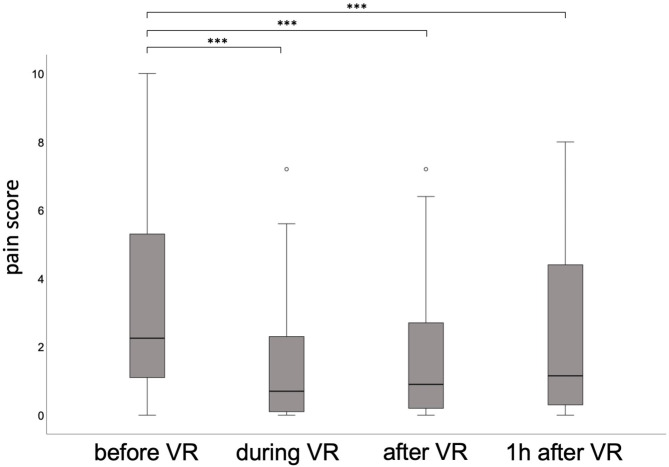
Background: Effective symptom control is a stated goal of palliative care (PC) to improve quality of life for terminally ill patients. Virtual reality (VR) provides temporary escapes from pharmacologically resistant pain and allows for experiences and journeys patients may not access in any other way. Enabling wishes through virtual worlds may also offer additional benefits such as controlling psychological and physical symptoms. Aims: We investigated the feasibility of a single VR experience as a viable, satisfying, and effective tool for end-of-life pain relief for inpatients presenting palliative needs. Design: This is an observational, single-arm and national single-center feasibility trial. Methods: A one-time VR experience with a selection of several videos and games was offered to 45 inpatients receiving PC at Muenster University Hospital. Patients with brain tumors, brain metastases, seizures, motion sickness, claustrophobia, vertigo, hearing or visual impairment, or unable to consent were excluded. Primary outcome measured patient reported pain on a visual analogue scale (VAS). We also measured Karnofsky performance status, health-related quality of life (HRQOL) using the EQ-5D-5 L questionnaire, and the Pain Out Questionnaire for postoperative pain. Results: We analyzed data from 21 women (52.5%) and 19 men (47.5%) at an average age of 51.9 (SD: 15.81) years. The mean Karnofsky score among the sample was 45.5 (SD: 14.97) and the HRQOL was 41.9 (SD: 23.08). While no serious side effects were reported during the intervention, three patients experienced nausea (7%), two headaches (5%), and three reported dry eyes (7%) afterwards. Significant pain reduction (baseline VAS 2.25 (SD: 0.4399)) was demonstrated during (VAS 0.7 (SD: 0.2983, p < 0.0001)), immediately after (VAS 0.9 (SD: 0.3354, p = 0.0001)) and one hour after the intervention (VAS 1.15 (SD: 0.4163, p = 0.0004)). More than 80% rated the VR experience as very good or good (85%, n = 34) and intended to make use of the device again (82.5%, n = 33). However, two participants (5%) also expressed sadness by becoming aware of old memories and previous opportunities that are gone. Discussion: The present pilot study suggests that VR seems to be a feasible and effective tool for pain relief in PC. Its use encompasses the approach of a total pain and symptom therapy and enhances patients’ dignity and autonomy. Future research ought to include if and to what extent VR could reduce the necessity of pharmacological pain relief.
Overview
The claims and statistics of this paper haven’t been checked yet.
Free: it reads the open-access text and checks the first 5 claims that cite a source we can check. Create a free account to check every claim.
Integrity signals
Registry
Cites
Statistics
Figures
Verification
Claims the paper makes
The claims and statistics of this paper haven’t been checked yet.
Free: it reads the open-access text and checks the first 5 claims that cite a source we can check. Create a free account to check every claim.
Claims other papers make about this one
Each is checked against this paper’s own text: does it say what the citing paper says it does?
The cited source doesn’t support the claim as written.
In the citing paper
“The more immersive the VR, the greater the analgesic effect.25,27,29,43,44”
From A Pilot Study of Virtual Reality in Hemodialysis for Mitigating Pain and Anxiety: User Experiences and Perceptions (2025) · cites this paper as [44]
Checked by a reasoning model — may be wrong.
Experimental — accuracy not yet measured
Self-check
Percentages, sums and reported differences re-computed from the paper’s own numbers.
The self-check needs the paper’s full text.
Citations
Cites
Development and preliminary testing of the new five-level version of EQ-5D (EQ-5D-5L)
Herdman, M., Gudex, C., Lloyd, A., Janssen, M., Kind, P., Parkin, D., Bonsel, G., & Badia, X. (2011) · Quality of Life Research · doi:10.1007/s11136-011-9903-x · Cited by 9,795 · cited 1×
“For the assessment of health-related quality of life (HRQOL), patients completed EQ-5D-5 L health questionnaire [31].”
MethodEarly Palliative Care for Patients with Metastatic Non–Small-Cell Lung Cancer
Temel, J. S., Greer, J. A., Muzikansky, A., Gallagher, E. R., Admane, S., Jackson, V. A., Dahlin, C. M., Blinderman, C. D., Jacobsen, J., Pirl, W. F., et al. (2010) · New England Journal of Medicine · doi:10.1056/nejmoa1000678 · Cited by 7,482
Symptom Prevalence in Patients with Incurable Cancer: A Systematic Review
Teunissen, S. C. C. M., Wesker, W., Kruitwagen, C., de Haes, H. C. J. M., Voest, E. E., & de Graeff, A. (2007) · Journal of Pain and Symptom Management · doi:10.1016/j.jpainsymman.2006.10.015 · Cited by 990 · cited 2×
“Observational research confirms that many patients suffering from cancer experience moderate or severe pain yet do not receive appropriate treatment [13, 16].”
BackgroundThe validity of pain intensity measures: what do the NRS, VAS, VRS, and FPS-R measure?
Thong, I. S. K., Jensen, M. P., Miró, J., & Tan, G. (2018) · Scandinavian Journal of Pain · doi:10.1515/sjpain-2018-0012 · Cited by 652 · cited 1×
“Also, the “VAS questionnaire” was self-constructed and is not standardized, although visual analog scales are proven and validated instruments for the measurement of individual pain over several years [44].”
BackgroundVirtual Reality and Pain Management: Current Trends and Future Directions
Li, A., Montaño, Z., Chen, V. J., & Gold, J. I. (2011) · Pain Management · doi:10.2217/pmt.10.15 · Cited by 536
Evidence on the cost and cost-effectiveness of palliative care: A literature review
Smith, S., Brick, A., O’Hara, S., & Normand, C. (2014) · Palliative Medicine · doi:10.1177/0269216313493466 · Cited by 502
Mallari, B., Spaeth, E. K., Goh, H., & Boyd, B. S. (2019) · Journal of Pain Research · doi:10.2147/jpr.s200498 · Cited by 374 · cited 1×
“It was concluded that VR is an effective treatment for acute pain, although lacking any long-term benefit addressing chronic pain [25].”
BackgroundGupta, A., Scott, K., & Dukewich, M. (2018) · Pain Medicine · doi:10.1093/pm/pnx109 · Cited by 340 · cited 2×
“It is considered that experiencing virtual worlds and environments necessitates sufficient mental capacity for distracting pain [19, 20].”
BackgroundVirtual reality for management of pain in hospitalized patients: results of a controlled trial
Tashjian, V. C., Mosadeghi, S., Howard, A. R., Lopez, M., Dupuy, T., Reid, M., Martinez, B., Ahmed, S., Dailey, F., Robbins, K., et al. (2017) · JMIR Mental Health · doi:10.2196/mental.7387 · Cited by 332
Virtual Reality as a Clinical Tool for Pain Management
Pourmand, A., Davis, S., Marchak, A., Whiteside, T., & Sikka, N. (2018) · Current Pain and Headache Reports · doi:10.1007/s11916-018-0708-2 · Cited by 326 · cited 2×
“It is considered that experiencing virtual worlds and environments necessitates sufficient mental capacity for distracting pain [19, 20].”
Background
Cited by
A scoping review of digital technology applications in palliative care
Tan, Y., Liang, X., Wei, M., Xing, H., Wang, Y., & Gao, Y. (2024) · BMC Palliative Care · doi:10.1186/s12904-024-01626-w · Cited by 42
“Guenther et al. [7] employed immersive 360° VR interventions for palliative care patients, including videos for travel, relaxation, and meditation, which resulted in significant pain reduction.”
InfluentialQin, W., Sun, R., Liang, Y., & Chen, D. (2024) · BMC Nursing · doi:10.1186/s12912-024-02184-5 · Cited by 24
“VR technology enables children to maintain a sense of pleasure, achieve a state of physical and mental relaxation, and eliminate anxiety through visual images and auditory stimulation [48–50].”
BackgroundVirtual reality use and patient outcomes in palliative care: A scoping review
Moloney, M., Doody, O., O’Reilly, M., Lucey, M. R., Callinan, J., Exton, C., Colreavy‐Donnelly, S., O’Mahony, F., Meskell, P., & Coffey, A. (2023) · Digital Health · doi:10.1177/20552076231207574 · Cited by 25
A Rapid Review of the Role of Virtual Reality in Care Delivery of Palliative Care and Hospice
Moutogiannis, P. P., Thrift, J. R., Pope, J. K., Browning, M. H. E. M., McAnirlin, O., & Fasolino, T. K. (2023) · Journal of Hospice and Palliative Nursing · doi:10.1097/njh.0000000000000983 · Cited by 16
A Systematic Review of Virtual Reality’s Impact on Anxiety During Palliative Care
Găină, A.-M., Ștefănescu, C., Szalontay, A.-S., Găină, M.-A., Poroch, V., Mosoiu, D. V., Ştefănescu, B., Axinte, M., Bostan, C. M., & Magurianu, L. A. (2024) · Healthcare · doi:10.3390/healthcare12242517 · Cited by 12
“…so they were very easily integrated into the routines of palliative care [62] VR was complementary to conventional palliative care protocols, being perceived as desirable by patients and providers alike as a treatment alternative that did not conflict with existing treatment or medication [62].”
Influential
Metadata
- Authors
- Guenther, M., Görlich, D., Bernhardt, F., Pogatzki-Zahn, E., Dasch, B., Krueger, J., & Lenz, P.
- Affiliations
- University Hospital Münster (DE)
- University of Münster (DE)
- Corresponding author
- Lenz, Philipp
- Venue
- BMC Palliative Care
- Published
- 2022-10-05
- Volume
- 21
- Issue
- 1
- Pages
- 169-169
- ISSN
- 1472-684X (ISSN-L)
- PMC
- PMC9533542
- OpenAlex
- W4301372145
- Cited by
- 34
- References
- 44
- Citations by year
- 2026: 5 · 2025: 12 · 2024: 9 · 2023: 8
- FWCI
- 6.40
- Type
- journal article
- Language
- en
- Open access
- gold
- doi.org
- Licence
- cc-by
- creativecommons.org/licenses/by/4.0 (tdm)
- creativecommons.org/licenses/by/4.0 (vor)
- Locations
- BMC Palliative Care (publishedVersion, cc-by)
- PubMed Central (publishedVersion, cc-by)
- PubMed (publishedVersion)
- DOAJ (DOAJ: Directory of Open Access Journals) (submittedVersion, cc-by-sa)
- Funders
- Westfälische Wilhelms-Universität Münster
- Topics
- Health Sciences › Medicine › Public Health, Environmental and Occupational Health › Palliative Care and End-of-Life Issues
- Physical Sciences › Computer Science › Human-Computer Interaction › Virtual Reality Applications and Impacts
- Health Sciences › Medicine › Anesthesiology and Pain Medicine › Pain Management and Opioid Use
- Keywords
- virtual reality, palliative care, analgesia, symptom management, health-related quality of life, Karnofsky performance status, virtual reality games, feasibility, hospitalized patients, adverse effects, patient satisfaction, dying patients, visual analogue scale, EQ-5D-5L, distraction therapy
- MeSH terms
- Virtual Reality, Feasibility Studies, Female, Humans, Male, Middle Aged, Pain, Palliative Care, Pilot Projects, Quality of Life
About these checks
Registry, retraction, Cites and statistics results are computed, not judged, with one exception: a printed reference that no index lists is read once by a model before it counts as a citation error. Claims are extracted by a model and kept only when their quote appears verbatim in the text; each cited source is then checked, with a model’s help, for whether it says what the claim relies on. Those verdicts can be wrong — read the claim’s quote and the cited source before relying on one.
Statistics and arithmetic are recomputed, not judged.
Confidence bands are shown only for fields calibrated on our annotated test set. None is calibrated yet, so no band is shown.
What counts as a claim ›How we measure confidence ›How we check this ›
Are you an author, or do you see a problem with this page? Request a review
How to cite
Cite CoChat for the checks on this page, and the paper for its own findings.
- This page
- CoChat. (2026). Citation check: Virtual reality reduces pain in palliative care–A feasibility trial. https://app.cochat.ai/papers/10.1186/s12904-022-01058-4
- The paper
- Guenther, M., Görlich, D., Bernhardt, F., Pogatzki-Zahn, E., Dasch, B., Krueger, J., & Lenz, P. (2022). Virtual reality reduces pain in palliative care–A feasibility trial. BMC Palliative Care. https://doi.org/10.1186/s12904-022-01058-4
Data sources
Bibliographic data: Semantic Scholar, OpenAlex, Crossref.
Contains information from the Semantic Scholar Academic Graph Datasets, made available under the ODC Attribution License (ODC-BY 1.0).
Semantic Scholar’s data is described in: Kinney, R., et al. (2023). The Semantic Scholar Open Data Platform. arXiv:2301.10140.
