

Analysis of the effect of an artificial intelligence chatbot educational program on non-face-to-face classes: a quasi-experimental study
Open accessThe DOI matches its Crossref record; 22 of the 24 references it cites were found in a registry or an index; 2 of the 11 sources its claims cite were checked for support.
Abstract
Background: Education and training are needed for nursing students using artificial intelligence-based educational programs. However, few studies have assessed the effect of using chatbots in nursing education. Objectives: This study aimed to develop and examine the effect of an artificial intelligence chatbot educational program for promoting nursing skills related to electronic fetal monitoring in nursing college students during non-face-to-face classes during the COVID-19 pandemic. Design: This quasi-experimental study used a nonequivalent control group non-synchronized pretest–posttest design. Methods: The participants were 61 junior students from a nursing college located in G province of South Korea. Data were collected between November 3 and 16, 2021, and analyzed using independent t-tests. Results: The experimental group—in which the artificial intelligence chatbot program was applied—did not show statistically significant differences in knowledge (t = -0.58, p = .567), clinical reasoning competency (t = 0.75, p = .455), confidence (t = 1.13, p = .264), and feedback satisfaction (t = 1.72, p = .090), compared with the control group; however, its participants’ interest in education (t = 2.38, p = .020) and self-directed learning (t = 2.72, p = .006) were significantly higher than those in the control group. Conclusion: The findings of our study highlighted the potential of artificial intelligence chatbot programs as an educational assistance tool to promote nursing college students’ interest in education and self-directed learning. Moreover, such programs can be effective in enhancing nursing students’ skills in non-face-to face-situations caused by the ongoing COVID-19 pandemic.
Overview
CoChat Summary
TL;DR
This quasi-experimental study developed and tested an AI chatbot educational program for electronic fetal monitoring (EFM) in non-face-to-face nursing classes during COVID-19. The chatbot did not significantly improve knowledge, clinical reasoning competency, confidence, or feedback satisfaction, but it did significantly increase interest in education and self-directed learning.
Key findings
- No statistically significant differences were found between experimental and control groups for EFM knowledge (t = -0.58, p = .567), clinical reasoning competency (t = 0.75, p = .455), confidence in fetal health assessment (t = 1.13, p = .264), or feedback satisfaction (t = 1.72, p = .090).
- The experimental group had significantly higher interest in education than the control group (t = 2.38, p = .020), with mean differences from pre- to post-test of 2.17 ± 2.60 vs. 0.09 ± 1.37.
- The experimental group also had significantly higher self-directed learning than the control group (t = 2.72, p = .006), with mean differences of 2.20 ± 2.43 vs. 0.81 ± 1.47.
- Both groups improved in knowledge from pre- to post-test, but the between-group difference was not significant.
Methods
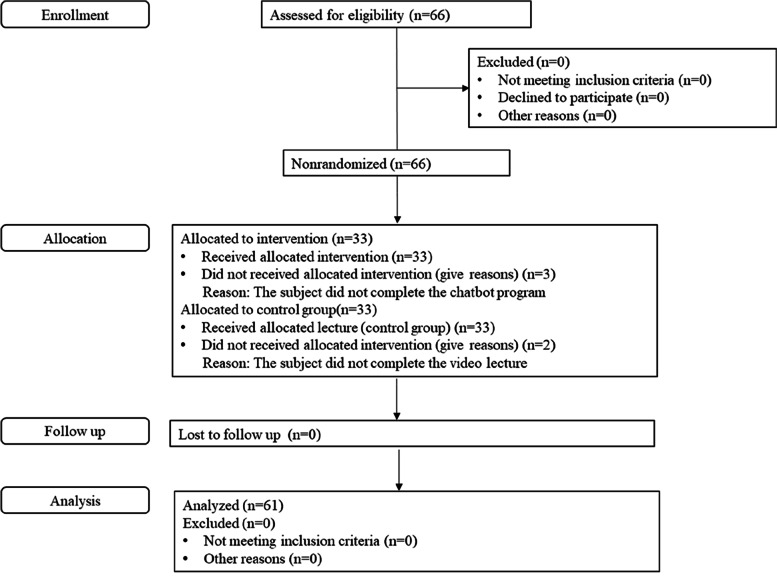
- Quasi-experimental nonequivalent control group pretest–posttest design; participants were 61 junior nursing students from a nursing college in G province, South Korea, with final groups of 31 control and 30 experimental participants.
- Data were collected November 3–16, 2021; the experimental group attended video lectures plus the AI chatbot program, while the control group attended video lectures only.
- Analysis used SPSS/WIN 23, with independent t-tests for outcome comparisons and chi-squared tests, Fisher’s exact tests, and t-tests for homogeneity testing.
Limitations
- Stated: the study evaluated participants from only one college and used a nonequivalent study design; the authors propose future longitudinal studies to assess medium- or long-term effects.
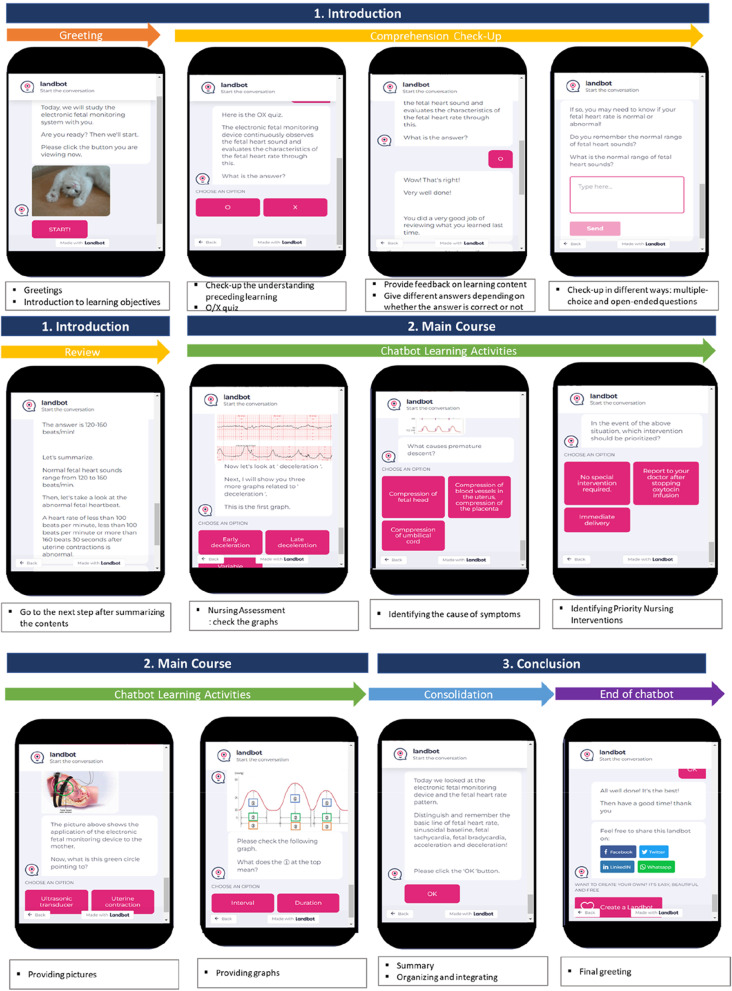
- Stated: the chatbot was a transaction-type chatbot that provided feedback based on predicted responses but did not address specific student questions, which may have limited feedback satisfaction.
- Evident from the text: the sample was small (N = 61) and data collection occurred over a short two-week period, limiting generalizability and long-term inference.
Model-written summary. Check it against the paper before relying on it.
Integrity signals
Registry
Cites
Statistics
Figures
Verification
Claims the paper makes
2 Valid · 0 Not valid · 5 Not checked · 21 Own results and interpretations
A result the paper reports from its own data — it cites no other source for it, so there is none to check. The quote shows it is in the paper.
In the paper
“The experimental group, in which, the AI chatbot educational program for EFM was applied, did not show statistically significant differences in knowledge (t = -0.58, p = 0.567), Clinical reasoning competency (t = 0.75, p = 0.455), confidence in fetal health assessment (t = 1.13, p = 0.264), and feedback satisfaction (t = 1.72, p = 0.090), compared with the control group.”
§ Analysis of the effect of an artificial intelligence chatbot educational program on non-face-to-face classes: a quasi-experimental study > Results > Hypothesis testing
plain- Asserted: passes — The authors put it forward as true.
- Checkable: passes — It can be checked against evidence.
- Load-bearing: passes — The paper’s conclusions depend on it.
- Based: passes — The paper gives a reason why it holds.
A result the paper reports from its own data — it cites no other source for it, so there is none to check. The quote shows it is in the paper.
In the paper
“However, participants in the experimental group showed significantly higher interest in education (t = 2.38, p = 0.020) and self-directed learning (t = 2.72, p = 0.006) than those in the control group.”
- Also stated in: § Conclusions · plain
“The chatbot program developed in our study had positive effects on the nursing college students’ interest in education and self-directed learning.”
§ Analysis of the effect of an artificial intelligence chatbot educational program on non-face-to-face classes: a quasi-experimental study > Results > Hypothesis testing
plainstates a cause- Asserted: passes — The authors put it forward as true.
- Checkable: passes — It can be checked against evidence.
- Load-bearing: passes — The paper’s conclusions depend on it.
- Based: passes — The paper gives a reason why it holds.
- Also stated in: § Conclusions · plain
A result the paper reports from its own data — it cites no other source for it, so there is none to check. The quote shows it is in the paper.
In the paper
“The experimental group, in which, the AI chatbot educational program for EFM was applied, did not show statistically significant differences in knowledge (t = -0.58, p = 0.567), Clinical reasoning competency (t = 0.75, p = 0.455), confidence in fetal health assessment (t = 1.13, p = 0.264), and feedback satisfaction (t = 1.72, p = 0.090), compared with the control group.”
§ Analysis of the effect of an artificial intelligence chatbot educational program on non-face-to-face classes: a quasi-experimental study > Results > Hypothesis testing
plain- Asserted: passes — The authors put it forward as true.
- Checkable: passes — It can be checked against evidence.
- Load-bearing: passes — The paper’s conclusions depend on it.
- Based: passes — The paper gives a reason why it holds.
9 more claims
Create a free account to see all 28 claims and to verify the 1 reference still open.
- It may state two separate claims as one. 13
- The quote only partly states this claim. 1
- Probably not a substantial claim. 1
Claims other papers make about this one
Each is checked against this paper’s own text: does it say what the citing paper says it does?
The cited source doesn’t support the claim as written.
In the citing paper
“Positive changes in affective learning gains include learning interest (16), self-efficacy (18), satisfaction (25), enjoyment (19), and motivation (11).”
From Digital affordances of AI chatbots in nursing education: a systematic review of learning gains and gaps in the evidence (2026) · cites this paper as [16]
Checked by a reasoning model — may be wrong.
Experimental — accuracy not yet measuredThe source backs part of the claim, not all of it — or backs it for a different population, condition or comparison.
In the citing paper
“and can also be used as a tool of assessment to assess clinical skills (Han et al., 2022)”
From ChatGPT in medicine: an overview of its applications, advantages, limitations, future prospects, and ethical considerations (2023) · cites this paper as Han et al., 2022
Experimental — accuracy not yet measuredThe source backs part of the claim, not all of it — or backs it for a different population, condition or comparison.
In the citing paper
“Chatbots, free from time and space constraints, can complement the limitations of simulation education, enabling learners to engage in SDL by facilitating conversations anytime and anywhere [16].”
From Development and effects of a chatbot education program for self-directed learning in nursing students (2025) · cites this paper as [16]
Experimental — accuracy not yet measuredThe source backs part of the claim, not all of it — or backs it for a different population, condition or comparison.
In the citing paper
“However, fewer studies (16) have reported significant changes in students’ affective learning gains (e.g., confidence and satisfaction) or cognitive learning gains (e.g., knowledge and clinical reasoning competency).”
From Digital affordances of AI chatbots in nursing education: a systematic review of learning gains and gaps in the evidence (2026) · cites this paper as [16]
Experimental — accuracy not yet measuredThe source backs part of the claim, not all of it — or backs it for a different population, condition or comparison.
In the citing paper
“In nursing education, AI-enabled tools are increasingly employed to facilitate simulation, knowledge retrieval, feedback provision and self-directed learning, with some reports suggesting enhanced engagement and perceived performance [1,12-15].”
From Artificial Intelligence–Enabled Educational Tools and Clinical Reasoning in Undergraduate Nursing Education: A Systematic Review (2026) · cites this paper as [12]
Experimental — accuracy not yet measured
20 more claims about this paper
Create a free account to see every claim other papers make about this one.
Self-check
Percentages, sums and reported differences re-computed from the paper’s own numbers.
Rated major: it would touch a result — a value a result rests on, reported and recomputed p-values on opposite sides of the significance level, two passages that conflict with no sign which is right, or a cited work retracted before this paper was published.
In the paper
“| Interest in education | Exp | 6.07 ± 2.23 | 8.40 ± 1.43 | 2.17 ± 2.60 | 2.38 | .020 |”
§ Analysis of the effect of an artificial intelligence chatbot educational program on non-face-to-face classes: a quasi-experimental study > Results > Hypothesis testing
Reported 2.17 · recomputed 2.33
Rated major: it would touch a result — a value a result rests on, reported and recomputed p-values on opposite sides of the significance level, two passages that conflict with no sign which is right, or a cited work retracted before this paper was published.
In the paper
“| Interest in education | Con | 6.87 ± 2.08 | 7.77 ± 1.77 | 0.09 ± 1.37 | 2.38 | .020 |”
§ Analysis of the effect of an artificial intelligence chatbot educational program on non-face-to-face classes: a quasi-experimental study > Results > Hypothesis testing
Reported 0.09 · recomputed 0.9
Rated minor: it would not touch a result — a value no result rests on, a p-value that stays on the same side of the significance level, or a conflict that is clerical, resolved elsewhere in the paper, or outside its own findings.
In the paper
“The participants’ knowledge of EFM was assessed using 13 questions as follows: three questions on understanding and explaining the purpose and method of EFM, seven questions on examining the results of EFM, and three questions on knowledge of nursing interventions based on the EFM results. With one point for every correct answer, the total scores ranged from 0‒20”
§ Analysis of the effect of an artificial intelligence chatbot educational program on non-face-to-face classes: a quasi-experimental study > Methods > Study instruments
Reported 20 · recomputed 13
Citations
Cites
Faul, F., Erdfelder, E., Lang, A.-G., & Buchner, A. (2007) · Behavior Research Methods · doi:10.3758/bf03193146 · Cited by 65,971 · cited 1×
“The sample size was calculated using G*Power version 3.1.9.2 [19].”
MethodInfluentialPredicted Influences of Artificial Intelligence on Nursing Education: Scoping Review
Buchanan, C., Howitt, M. L., Wilson, R., Booth, R. G., Risling, T., & Bamford, M. (2021) · JMIR Nursing · doi:10.2196/23933 · Cited by 326
Shorey, S., Ang, E., Yap, J., Ng, E. D., Lau, S. T., & Chui, C. K. (2019) · Journal of Medical Internet Research · doi:10.2196/14658 · Cited by 238
Chatbot application in a 5th grade science course
Deveci Topal, A., Dilek Eren, C., & Kolburan Geçer, A. (2021) · Education and Information Technologies · doi:10.1007/s10639-021-10627-8 · Cited by 182
Optimizing Students’ Mental Health and Academic Performance: AI-Enhanced Life Crafting
Dekker, I., De Jong, E. M., Schippers, M. C., De Bruijn-Smolders, M., Alexiou, A., & Giesbers, B. (2020) · Frontiers in Psychology · doi:10.3389/fpsyg.2020.01063 · Cited by 176
Liou, S., Liu, H., Tsai, H., Tsai, Y., Lin, Y., Chang, C., & Cheng, C. (2016) · Journal of Advanced Nursing · doi:10.1111/jan.12831 · Cited by 104 · cited 1×
“[22], using a 5-point Likert scale, and translated and validated by Joung and Han [23].”
MethodLeveraging chatbots to improve self-guided learning through conversational quizzes
Pereira, J. (2016) · Proceedings of the Fourth International Conference on Technological Ecosystems for Enhancing Multiculturality · doi:10.1145/3012430.3012625 · Cited by 82 · cited 2×
“This is similar to the result of a previous study, that used a 15-week chatbot program for students majoring in computer science, which reported that it assisted in self-directed learning since 72% of the students showed improved participation in subjects [24].”
BackgroundResultFryer, L. K., Thompson, A., Nakao, K., Howarth, M., & Gallacher, A. (2020) · Learning and Individual Differences · doi:10.1016/j.lindif.2020.101850 · Cited by 71 · cited 2×
“Since previous studies that assessed the effect of using chatbot in college students’ education had an effect size larger than 0.8 [7, 20], the effect size in this study was set at 0.8, which corresponds to a large effect size, as presented by Cohen [21].”
BackgroundMethodInfluentialQualitative exploration of digital chatbot use in medical education: A pilot study
Kaur, A., Singh, S., Chandan, J. S., Robbins, T., & Patel, V. (2021) · DIGITAL HEALTH · doi:10.1177/20552076211038151 · Cited by 67 · cited 2×
“A chatbot also has various applications in the education field, as people can use it to learn without time and space restrictions [4].”
BackgroundAbbasi, S., & Kazi, H. (2014) · Asian Journal of Applied Science and Engineering · doi:10.15590/ajase/2014/v3i7/53576 · Cited by 67 · cited 1×
“8 [7, 20], the effect size in this study was set at 0.”
Background
Research works printed but not linked: 1
- Cohen J Statistical power analysis for the Behavioral Science 1988 Hillsdale Erlbaum
Cited by
Items 101–184 of 184
Dicheva, N. K., Rehman, I. U., Husamaldin, L., & Aleshaiker, S. (2023) · IEEE International Smart Cities Conference (ISC2) · doi:10.1109/isc257844.2023.10293413 · Cited by 12
“An AI-enabled chatbot called ”LandBot.io”, promoting nursing education for Electronic Fetal Monitoring (EFM), was proposed [53].”
BackgroundMethodUser Experience on a Virtual Patient Chatbot for Physiotherapy Student Training
Lee, C.-C., Low, M. Y. H., Lu, L., Lee, H. H., & Soon, B. T. C. (2023) · IEEE International Conference on Teaching, Assessment, and Learning for Engineering · doi:10.1109/tale56641.2023.10398237 · Cited by 4
Self-citationHerbawani, L. O., Susanti, A. I., & Adnani, Q. E. S. (2025) · Advances in Medical Education and Practice · doi:10.2147/amep.s543098 · Cited by 7
“23,66 This approach employs multimodal learning analytics to enhance collaborative learning by analyzing students’ digital interactions encompassing text, audio, and visual elements.”
InfluentialAn Evaluation on the Potential of Large Language Models for Use in Trauma Triage
Le, K., Chen, J., Mai, D., & Le, K. D. R. (2024) · Emergency Care and Medicine · doi:10.3390/ecm1040035 · Cited by 6
Sobowale, F. M., Mohammed, I. A., Ali, F., Samson, B. M., & Sadiku, A. (2024) · Discover Education · doi:10.1007/s44217-024-00352-y · Cited by 4
Modiba, M. T., & Shekgola, M. M. (2025) · Journal of Infrastructure Policy and Development · doi:10.24294/jipd11334 · Cited by 2
Mohamed, A. M. A., Alanezi, N. A., Darrag, Y., Alrwuaili, N. S., Alshamrani, R. A. H., & Berdida, D. J. E. (2025) · Teaching and learning in nursing · doi:10.1016/j.teln.2025.08.007 · Cited by 15
Chatbot de IA para prevenir el abandono de la educación superior: una revisión de la literatura
Segovia-García, N., & García, L. S. (2024) · Education in the Knowledge Society (EKS) · doi:10.14201/eks.31416 · Cited by 16
Self-Directed Learning Curriculum implementation, praxis and scholarship in context
Wirth, K. R., du Toit-Brits, C., Vos, E., Blignaut, J. H., Olivier, J., Mahlaba, S., Westhuizen, C. P. V. D., van Deventer, N., Imhof, C., Comsa, I.-S., et al. (2024) · NWU self-directed learning series · doi:10.4102/aosis.2024.bk492 · Cited by 6
Jelloul, H., Arhouh, S., Rmili, M., & Nafidi, Y. (2026) · Journal of Pioneering Medical Sciences · doi:10.47310/jpms2026150226 · Cited by 3
TAY, Y. N., NEO, N. W. S., & SIAH, C. J. R. (2026) · Nurse Education Today · doi:10.1016/j.nedt.2026.107322 · Cited by 4
Wei, S., Wei, W., & Zou, G. (2026) · Frontiers in Medicine · doi:10.3389/fmed.2026.1832598 · Cited by 2
Development of a chatbot for mental health support using ai-intelligent
Dulloyeva, I. S., Рауфов, Ф. М., Bakhadirova, M., Nasirova, N., Pekhanova, Y., Mamarasulova, I., Pulatova, B. J., & Khakimova, M. (2024) · Health Leadership and Quality of Life · doi:10.56294/hl2024.178 · Cited by 2
Early detection and personalized academic support using a predictive chatbot for student success
Arévalo-Cordovilla, F. E., & Pe, M. (2026) · PeerJ Computer Science · doi:10.7717/peerj-cs.3656 · Cited by 2
Aksoy, M., & Doğan, N. (2026) · CIN Computers Informatics Nursing · doi:10.1097/cin.0000000000001510 · Cited by 3
Generative AI in higher education: a meta-analysis of intellectual and social–emotional outcomes
Liu, C., Xie, L., & Xu, G. (2026) · Frontiers in Psychology · doi:10.3389/fpsyg.2026.1848745 · Cited by 10
“…Vázquez-Cano et al., 2021; Mirzababaei and Pammer-Schindler, 2022; Kim and Lee, 2023; Kuo and Chen, 2023; Lee et al., 2022; Essel et al., 2022; Han et al., 2022; Escalante et al., 2023; Yilmaz and Yilmaz, 2023; Al Al Kahf et al., 2023; Li, 2023; Liu et al., 2024; Zhang R. et al., 2024; Hakiki…”
Implementation of a Virtual Patient Chatbot for Physiotherapy Students Training
Low, M. Y. H., Yeo, Y. H., Lee, C.-C., Lu, L., Lee, H. H., Soon, B. T. C., & Patel, N. S. (2023) · IEEE International Conference on Industrial Engineering and Engineering Management (IEEM) · doi:10.1109/ieem58616.2023.10407018 · Cited by 2
“The use of chatbots for training also promotes self-directed learning as students can practice their skills repeatedly and receive immediate user feedback from the chatbot in a safe, low-stress environment without harming any real patients [7].”
BackgroundSelf-citationAltun, E., & Seferoğlu, S. S. (2024) · İnönü Üniversitesi Eğitim Fakültesi Dergisi · doi:10.17679/inuefd.1397735 · Cited by 2
(2024) · NWU self-directed learning series · doi:10.4102/aosis.2024.bk492.07 · Cited by 1
(2024) · NWU self-directed learning series · doi:10.4102/aosis.2024.bk492.06 · Cited by 1
(2024) · NWU self-directed learning series · doi:10.4102/aosis.2024.bk492.01 · Cited by 1
Nursing Students’ Perceptions of Using ChatGPT in a Written Assignment
Newton, L. J., Wignall, A., & Fullerton, C. (2025) · Quality Advancement in Nursing Education - Avancées en formation infirmière · doi:10.17483/qc1kc694 · Cited by 2
Al-Natsheh, B., & Imam, A. (2025) · International Journal of Environmental Research and Public Health · doi:10.3390/ijerph23010014 · Cited by 3
“The sample size was calculated using G*Power version 3.1.9.2 [36,37].”
InfluentialTaylor, J. R., & Frost, J. S. (2025) · International Journal of Human-Computer Interaction · doi:10.1080/10447318.2025.2596862 · Cited by 1
“Previous work has reported improvements to learning outcomes for students in terms of their knowledge acquisition, conceptual understanding and clinical preparedness (Gunawan et al., 2024; Han et al., 2022; Tam et al., 2023).”
The impact of neuroscience and artificial intelligence on feedback: a systematic review
Adıgüzel, O. C., Potvin, P., & Esen, E. (2026) · Educational Technology Research and Development · doi:10.1007/s11423-026-10589-z · Cited by 3
Artificial Intelligence and Nursing Education: Enhancing Teaching, Learning, and Critical Thinking
Nacer, N., Chouikh, J., & Nacer, K. (2026) · Advances in computational intelligence and robotics book series · doi:10.4018/979-8-3373-3436-3.ch005 · Cited by 1
Kumar, A., & Mans, K. B. (2026) · Korean journal of medical education · doi:10.3946/kjme.2025.104 · Cited by 1
“While numerous publications about generative AI technology in medical education have come out both before [1-6] and after [7-12] the release of ChatGPT, few tools to prepare medical educators for the generative AI era exist.”
‘OrthoQA’ semantic search and question-answering tool for orthodontic education
Arqub, S. A., Zhao, Q., Akolkar, P., Al‐Moghrabi, D., Kuo, C.-L., Zhong, K., Alomair, D., Adel, M., & Zhang, Y. (2026) · Journal of Dentistry · doi:10.1016/j.jdent.2026.106590 · Cited by 1
Chang, W., Lin, C., Lee, H., Juan, Y., Xu, H. G., Chen, L., & Han, C.-Y. S. (2026) · Nurse Education in Practice · doi:10.1016/j.nepr.2026.104787 · Cited by 4
Self-citationMa, X., Liu, X., & Sun, H. (2026) · Frontiers in Public Health · doi:10.3389/fpubh.2026.1813108 · Cited by 3
Dai, Z., Huang, F., Xiong, J., Yang, Y., Zhang, Q., & Peng, X. (2026) · International Journal of STEM Education · doi:10.1186/s40594-026-00631-0 · Cited by 8
“However, the findings of this study are not fully consistent with some previous studies, which did not demonstrate that chatbots had significant advantages in improving students’ learning achievement (Deveci Topal et al., 2021; Han et al., 2022; Huang & Chen, 2025; Yin et al., 2021).”
Applications Areas, Possibilities, and Limitations of ChatGPT
Qamar, R., & Zardari, B. A. (2024) · Advances in computational intelligence and robotics book series · doi:10.4018/979-8-3693-6824-4.ch004 · Cited by 1
The Impact of Generative AI on Self-Efficacy: Evidence From a Meta-Analysis
Heshmati, H., Li, A., & Tullis, J. G. (2026) · Journal of Educational Computing Research · doi:10.1177/07356331261483943 · Cited by 1
Krüger, L., Krotsetis, S., & Nydahl, P. (2024) · PRO CARE · doi:10.1007/s00735-024-1792-7
PENGEMBANGAN MULTIMEDIA CHATBOT UNTUK MEREMEDIASI MISKONSEPSI PESERTA DIDIK
Novitasari, A., Fauza, R. A., & Solviana, M. D. (2024) · DIDAKTIKA BIOLOGI Jurnal Penelitian Pendidikan Biologi · doi:10.32502/didaktikabiologi.v8i1.78
Sobowale, F. M., Mohammed, I. A., Samson, B. M., et al. (2024) · Research Square · doi:10.21203/rs.3.rs-5071560/v1
Strayhorn, T. L., & Johnson, J. (2025) · CABI eBooks · doi:10.1079/9781800626607.0010
(2024) · NWU self-directed learning series · doi:10.4102/aosis.2024.bk492.05
TONDER, D. V., & van Deventer, N. (2024) · NWU self-directed learning series · doi:10.4102/aosis.2024.bk492.04
(2024) · NWU self-directed learning series · doi:10.4102/aosis.2024.bk492.03
(2024) · NWU self-directed learning series · doi:10.4102/aosis.2024.bk492.09
(2024) · NWU self-directed learning series · doi:10.4102/aosis.2024.bk492.02
(2024) · NWU self-directed learning series · doi:10.4102/aosis.2024.bk492.08
(2024) · NWU self-directed learning series · doi:10.4102/aosis.2024.bk492.10
(2024) · NWU self-directed learning series · doi:10.4102/aosis.2024.bk492.00
(2024) · NWU self-directed learning series · doi:10.4102/aosis.2024.bk492.0i
Wang, Y., & Li, H. (2025) · SSRN Electronic Journal · doi:10.2139/ssrn.5274267
Why the Future of AIED is Causal: Arguments for Creating a Tradition Based on Causal Thinking
Cohausz, L. (2025) · Communications in computer and information science · doi:10.1007/978-3-031-99261-2_2
Dahake, P. S., Dahake, N. S., & Santos, V. (2025) · Advances in computational intelligence and robotics book series · doi:10.4018/979-8-3373-5097-4.ch018
Lajane, H., allioui, W., Gouifrane, R., Arai, M., Idrissi, W. E. M. E., Lamiri, A., Abidi, O., Chemsi, G., & Radid, M. (2025) · doi:10.2196/preprints.82466
Effects of AI on Nursing Education: Protocol for a Systematic Review and Meta-Analysis
Yang, T., Chen, B., & Qin, H. (2026) · JMIR Research Protocols · doi:10.2196/89455
“While some studies report knowledge enhancement [13], others demonstrate nonsignificant improvements [14,15].”
Sezer, H., & Yağcan, H. (2025) · Journal of Medical Education and Family Medicine · doi:10.62425/jmefm.1735129 · Cited by 2
Artificial Intelligence Experiences of Nurse Educators: A Phenomenological Study
Aydoğan, S., Ergezen, F. D., & Bozkurt, S. A. (2026) · CIN Computers Informatics Nursing · doi:10.1097/cin.0000000000001457 · Cited by 1
Patel, I. S., Awad, A. N., Shihadeh, H., Sura, A., Dwivedi, D., Vangal, P., Kpodzo, D. S., & Bray, S. M. C. (2026) · Annals of Plastic Surgery · doi:10.1097/sap.0000000000004652
Retrieval-Augmented Deep Learning Framework for Intelligent Drug Efficacy Prediction
Totiny, T. Z., Biswas, U., Rakin, S. S., Anjuman, S., Jahan, I., & Islam, S. M. S. (2025) · IEEE International Conference on Computing, Applications and Systems (COMPAS) · doi:10.1109/compas67506.2025.11381859
“The adoption of AI-driven tools such as chatbots will also go a long way to providing readily available health solutions in various environments [4][5].”
Gurler, N., Şengül, T., Bülbül, S. H., Akyaz, D. Y., Güler, Ö., Yantaç, A. E., Aydın, E. B., & Kirkland‐Kyhn, H. (2026) · Nurse Education in Practice · doi:10.1016/j.nepr.2026.104789 · Cited by 4
Suazo-Galdamés, I. C., & Chaple-Gil, A. M. (2026) · Lecture notes in networks and systems · doi:10.1007/978-3-032-09077-5_24
Does AI-assisted Learning Improve Students' Learning Outcomes? Evidence From A Meta-analysis
Liu, C., Meng, H., Zhu, H., & Rong, C. (2026) · The Asia-Pacific Education Researcher · doi:10.1007/s40299-026-01104-2 · Cited by 3
“AI chatbots provide instant feedback and personalized sup - port (Han et al., 2022 ), while AI-assisted digital storytell - ing reduces anxiety and enhances emotional engagement (Chang et al., 2023 ).”
Hong, E., Shin, S., Lee, M., & Lee, M. (2025) · Research Square · doi:10.21203/rs.3.rs-6187585/v1 · Cited by 1
Wei, S., & Wei, W. (2026) · Lecture notes in educational technology · doi:10.1007/978-981-95-8824-4_1
Narasimhan, S., El‐Kishawi, M., Al Kawas, S., Mohammed, M. M. A., Kamath, V. B., & Shetty, S. R. (2026) · Dubai Medical Journal · doi:10.18502/dmj.v9is1.21025
Adaptive Intelligence: Reshaping Education Through AI in Ed-Tech
Mohan, R., Kidiya, G. H. S., Daniel, R. A., Rithana, S. K., & Arjun, A. S. (2026) · Studies in systems, decision and control · doi:10.1007/978-3-032-04378-8_56 · Cited by 4
Li, J., Pang, X., Song, Y., Liu, Y., Ye, J., & Fan, X. (2026) · International Conference on AI in Education Technology and Applications (AIETA) · doi:10.1109/aieta69357.2026.11508953
Importance of AI Chatbot in Nursing Education: A Systematic Review
Ghaffar, T., Balakrishnan, R., & Javaid, M. A. A. (2026) · Biological and Clinical Sciences Research Journal · doi:10.54112/bcsrj.v7i4.2271
Zakir, H., Ebrahimi, H., Khan, A., Ullah, I., & Ullah, B. (2026) · BMC Medical Education · doi:10.1186/s12909-026-09229-0
“Previous literature suggests that real-time engagement with AI tools supports self-regulated learning and enhances students’ learning experiences, particularly in technology-assisted educational environments [11].”
Sindhvananda, K., Ruengwattanachot, K., Leksuwankun, S., Pongpitakmetha, T., Hiransuthikul, A., Surawattanawong, T., Anukoolwittaya, P., & Panjasriprakarn, P. (2026) · BMC Medical Education · doi:10.1186/s12909-026-09511-1 · Cited by 3
“Prior studies suggest that chatbot-based training with structured feedback can improve history-taking skills and clinical reasoning [23], and that chatbot-based environments can support self-directed practice in health professions education [24, 25].”
(2024) · NWU self-directed learning series · doi:10.4102/aosis.2024.bk492.0e
Conceptual analysis of Chatbots in nursing education applications
Li, L., Chen, X., Ma, S., Yang, Z., & Wang, Y. (2026) · Nurse Education Today · doi:10.1016/j.nedt.2026.107188
Using chatbot in education – A systematic review and research agenda
Wut, T. M., Low, M. P., & Tam, K.-W. (2026) · Social Sciences & Humanities Open · doi:10.1016/j.ssaho.2026.102956 · Cited by 1
Surveying Artificial Intelligence (AI) Attitudes, Use, and Competencies Among Nursing Faculty
Turchioe, M. R., Moore, S., Shamnath, A., Hickey, M., & Ferrara, S. A. (2026) · CIN Computers Informatics Nursing · doi:10.1097/cin.0000000000001586
Kaya, F. C. I. (2026) · IEEE Global Engineering Education Conference (EDUCON) · doi:10.1109/educon67543.2026.11574170
“Reviews of educational chatbots and virtual assistants document increasing use across STEM and engineering for content questions, after-class review, micro-learning, language practice, and blended learning, with mixed effects on achievement and study behaviour [12]–[14], [19]–[24], [55], [56].”
Shen, Y., Chen, Y., Li, M., Gu, X., & Zhuang, A. (2026) · Frontiers in Medicine · doi:10.3389/fmed.2026.1885204
Avidov‐Ungar, O., & Friebroon‐Yesharim, M. (2026) · Education Sciences · doi:10.3390/educsci16071165
Gençdal, G., & Çoğaltay, N. (2026) · Studies In Educational Evaluation · doi:10.1016/j.stueduc.2026.101651 · Cited by 2
AI and student motivation: A scoping review
Li, J., King, R. B., Chai, C. S., Lee, V. W. Y., & Li, R. (2026) · Journal of Research on Technology in Education · doi:10.1080/15391523.2026.2672515 · Cited by 1
Düzgün, N., & Annak, İ. M. (2026) · Nurse Education Today · doi:10.1016/j.nedt.2026.107321
Erkayıran, O. (2026) · Bandırma Onyedi Eylül Üniversitesi Sağlık Bilimleri ve Araştırmaları Dergisi · doi:10.46413/boneyusbad.1755590 · Cited by 1
Potel, J. T., & Kumashiro, M. (2026) · Behavioral Sciences · doi:10.3390/bs16081431 · Cited by 1
“…avenues for future research, multiple studies on AI-human interaction emphasize the need for methodologies to include longitudinal designs to distinguish sustained change from plateauing or declining engagement as the novelty effect fades (Abdi et al., 2022; Han et al., 2022; Jasin et al., 2023).”
Adoption of AI in Romanian PR and communication education: A TAM-informed survey study
Fitzek, S., Bârgăoanu, A., & Sultănescu, D. (2026) · Heliyon · doi:10.1016/j.heliyon.2026.e45352
Hung, H.-C., & Pawitra, M. A. S. (2026) · Journal of Educational Computing Research · doi:10.1177/07356331261483883
Kahyaoğlu, M., & Kenanoğlu, R. (2026) · Fen Bilimleri Öğretimi Dergisi · doi:10.56423/fbod.1841698
Artificial Intelligence in Nursing Practice Education: A Systematic Review and Meta‐Analysis
Wang, J., Kuang, M., Chen, J., Yan, Y., & Li, Z. (2026) · Journal of Nursing Management · doi:10.1155/jonm/6626865 · Cited by 3
Artificial intelligence (AI) in nursing education: An evolutionary concept analysis
Araújo, A. A. C., Gardim, L., Pramila‐Savukoski, S., Mendes, I. A. C., & Mikkonen, K. (2026) · Nurse Education Today · doi:10.1016/j.nedt.2026.107425 · Cited by 4
ENHANCING ASSESSMENT LITERACY: A SYSTEMATIC REVIEW OF AI TOOLS IN EDUCATION
Pongkendek, J. J., Rochintaniawati, D., Nahadi, N., Nugroho, E. P., Suana, W., Suparman, A., Saefullah, A., Dewi, W. S., Uliyandari, M., & Lestari, A. K. (2026) · F1000Research · doi:10.12688/f1000research.188623.1
Metadata
- Authors
- Han, J.-W., Park, J., & Lee, H.
- Affiliations
- Kyung Hee University (KR)
- Gangneung–Wonju National University (KR)
- Corresponding author
- Lee, Hanna
- Venue
- BMC Medical Education
- Published
- 2022-12-01
- Volume
- 22
- Issue
- 1
- Pages
- 830-830
- ISSN
- 1472-6920 (ISSN-L)
- PMC
- PMC9713176
- OpenAlex
- W4310494163
- Cited by
- 187
- References
- 24
- Citations by year
- 2026: 52 · 2025: 51 · 2024: 60 · 2023: 24
- FWCI
- 10.18
- Type
- journal article
- Language
- en
- Open access
- gold
- doi.org
- Licence
- cc-by
- creativecommons.org/licenses/by/4.0 (tdm)
- creativecommons.org/licenses/by/4.0 (vor)
- Locations
- BMC Medical Education (publishedVersion, cc-by)
- PubMed Central (publishedVersion, cc-by)
- PubMed (publishedVersion)
- DOAJ (DOAJ: Directory of Open Access Journals) (submittedVersion, cc-by-sa)
- Funders
- National Research Foundation of Kore (2022R1I1A3072862)
- Topics
- Health Sciences › Medicine › Health Informatics › Artificial Intelligence in Healthcare and Education
- Social Sciences › Education › Artificial Intelligence in Education
- Physical Sciences › Computer Science › Artificial Intelligence › Intelligent Tutoring Systems and Adaptive Learning
- Keywords
- chatbots, artificial intelligence in education, nursing education, fetal heart rate monitoring, non-face-to-face teaching, COVID-19 pandemic, clinical reasoning, self-directed learning, student self-confidence, nursing students
- MeSH terms
- COVID-19, Artificial Intelligence, Humans, Learning, Students, Nursing, Pandemics
About these checks
Registry, retraction, Cites and statistics results are computed, not judged, with one exception: a printed reference that no index lists is read once by a model before it counts as a citation error. Claims are extracted by a model and kept only when their quote appears verbatim in the text; each cited source is then checked, with a model’s help, for whether it says what the claim relies on. Those verdicts can be wrong — read the claim’s quote and the cited source before relying on one.
The claim verdicts this report counts are experimental: their accuracy is not yet measured.
A language model drew the claims from the paper on 2026-10-10, under version 3 of the claim definition (model deepseek-v4.1-flash, prompt extract-v3).
A second model labelled each claim on 2026-10-10 (model jev-1.13-20260917, definition revision gold-guideline-v0.2).
Statistics and arithmetic are recomputed, not judged.
Confidence bands are shown only for fields calibrated on our annotated test set. None is calibrated yet, so no band is shown.
What counts as a claim ›How we measure confidence ›How we check this ›
Are you an author, or do you see a problem with this page? Request a review
Data sources
Bibliographic data: Semantic Scholar, OpenAlex, Crossref.
Contains information from the Semantic Scholar Academic Graph Datasets, made available under the ODC Attribution License (ODC-BY 1.0).
Semantic Scholar’s data is described in: Kinney, R., et al. (2023). The Semantic Scholar Open Data Platform. arXiv:2301.10140.
