

Analysis of the effect of an artificial intelligence chatbot educational program on non-face-to-face classes: a quasi-experimental study
Open accessThe DOI matches its Crossref record; 22 of the 24 references it cites were found in a registry or an index; 2 of the 11 sources its claims cite were checked for support.
Abstract
Background: Education and training are needed for nursing students using artificial intelligence-based educational programs. However, few studies have assessed the effect of using chatbots in nursing education. Objectives: This study aimed to develop and examine the effect of an artificial intelligence chatbot educational program for promoting nursing skills related to electronic fetal monitoring in nursing college students during non-face-to-face classes during the COVID-19 pandemic. Design: This quasi-experimental study used a nonequivalent control group non-synchronized pretest–posttest design. Methods: The participants were 61 junior students from a nursing college located in G province of South Korea. Data were collected between November 3 and 16, 2021, and analyzed using independent t-tests. Results: The experimental group—in which the artificial intelligence chatbot program was applied—did not show statistically significant differences in knowledge (t = -0.58, p = .567), clinical reasoning competency (t = 0.75, p = .455), confidence (t = 1.13, p = .264), and feedback satisfaction (t = 1.72, p = .090), compared with the control group; however, its participants’ interest in education (t = 2.38, p = .020) and self-directed learning (t = 2.72, p = .006) were significantly higher than those in the control group. Conclusion: The findings of our study highlighted the potential of artificial intelligence chatbot programs as an educational assistance tool to promote nursing college students’ interest in education and self-directed learning. Moreover, such programs can be effective in enhancing nursing students’ skills in non-face-to face-situations caused by the ongoing COVID-19 pandemic.
Overview
CoChat Summary
TL;DR
This quasi-experimental study developed and tested an AI chatbot educational program for electronic fetal monitoring (EFM) in non-face-to-face nursing classes during COVID-19. The chatbot did not significantly improve knowledge, clinical reasoning competency, confidence, or feedback satisfaction, but it did significantly increase interest in education and self-directed learning.
Key findings
- No statistically significant differences were found between experimental and control groups for EFM knowledge (t = -0.58, p = .567), clinical reasoning competency (t = 0.75, p = .455), confidence in fetal health assessment (t = 1.13, p = .264), or feedback satisfaction (t = 1.72, p = .090).
- The experimental group had significantly higher interest in education than the control group (t = 2.38, p = .020), with mean differences from pre- to post-test of 2.17 ± 2.60 vs. 0.09 ± 1.37.
- The experimental group also had significantly higher self-directed learning than the control group (t = 2.72, p = .006), with mean differences of 2.20 ± 2.43 vs. 0.81 ± 1.47.
- Both groups improved in knowledge from pre- to post-test, but the between-group difference was not significant.
Methods
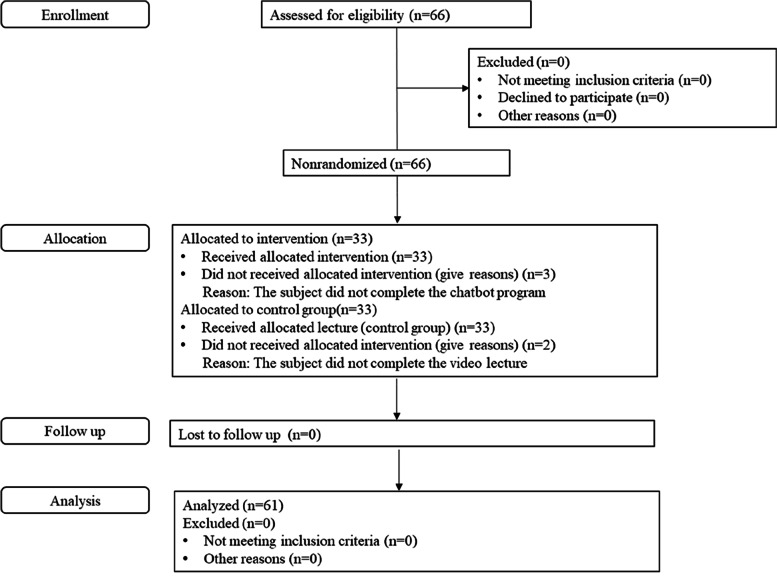
- Quasi-experimental nonequivalent control group pretest–posttest design; participants were 61 junior nursing students from a nursing college in G province, South Korea, with final groups of 31 control and 30 experimental participants.
- Data were collected November 3–16, 2021; the experimental group attended video lectures plus the AI chatbot program, while the control group attended video lectures only.
- Analysis used SPSS/WIN 23, with independent t-tests for outcome comparisons and chi-squared tests, Fisher’s exact tests, and t-tests for homogeneity testing.
Limitations
- Stated: the study evaluated participants from only one college and used a nonequivalent study design; the authors propose future longitudinal studies to assess medium- or long-term effects.
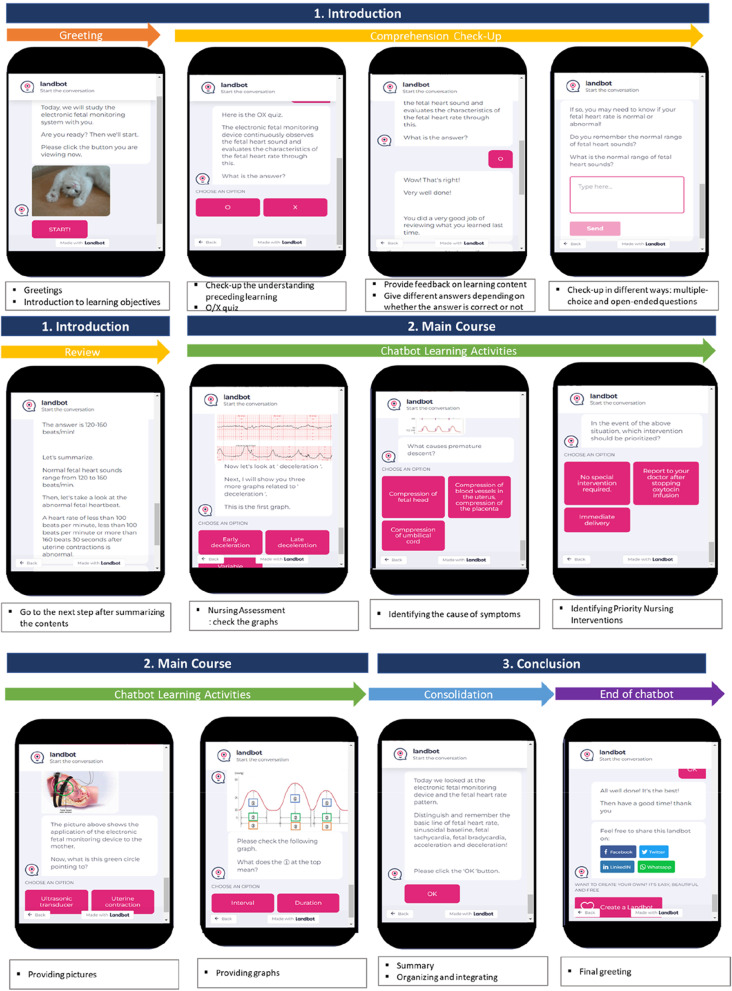
- Stated: the chatbot was a transaction-type chatbot that provided feedback based on predicted responses but did not address specific student questions, which may have limited feedback satisfaction.
- Evident from the text: the sample was small (N = 61) and data collection occurred over a short two-week period, limiting generalizability and long-term inference.
Model-written summary. Check it against the paper before relying on it.
Integrity signals
Registry
Cites
Statistics
Figures
Verification
Claims the paper makes
2 Valid · 0 Not valid · 5 Not checked · 21 Own results and interpretations
A result the paper reports from its own data — it cites no other source for it, so there is none to check. The quote shows it is in the paper.
In the paper
“The experimental group, in which, the AI chatbot educational program for EFM was applied, did not show statistically significant differences in knowledge (t = -0.58, p = 0.567), Clinical reasoning competency (t = 0.75, p = 0.455), confidence in fetal health assessment (t = 1.13, p = 0.264), and feedback satisfaction (t = 1.72, p = 0.090), compared with the control group.”
§ Analysis of the effect of an artificial intelligence chatbot educational program on non-face-to-face classes: a quasi-experimental study > Results > Hypothesis testing
plain- Asserted: passes — The authors put it forward as true.
- Checkable: passes — It can be checked against evidence.
- Load-bearing: passes — The paper’s conclusions depend on it.
- Based: passes — The paper gives a reason why it holds.
A result the paper reports from its own data — it cites no other source for it, so there is none to check. The quote shows it is in the paper.
In the paper
“However, participants in the experimental group showed significantly higher interest in education (t = 2.38, p = 0.020) and self-directed learning (t = 2.72, p = 0.006) than those in the control group.”
- Also stated in: § Conclusions · plain
“The chatbot program developed in our study had positive effects on the nursing college students’ interest in education and self-directed learning.”
§ Analysis of the effect of an artificial intelligence chatbot educational program on non-face-to-face classes: a quasi-experimental study > Results > Hypothesis testing
plainstates a cause- Asserted: passes — The authors put it forward as true.
- Checkable: passes — It can be checked against evidence.
- Load-bearing: passes — The paper’s conclusions depend on it.
- Based: passes — The paper gives a reason why it holds.
- Also stated in: § Conclusions · plain
A result the paper reports from its own data — it cites no other source for it, so there is none to check. The quote shows it is in the paper.
In the paper
“The experimental group, in which, the AI chatbot educational program for EFM was applied, did not show statistically significant differences in knowledge (t = -0.58, p = 0.567), Clinical reasoning competency (t = 0.75, p = 0.455), confidence in fetal health assessment (t = 1.13, p = 0.264), and feedback satisfaction (t = 1.72, p = 0.090), compared with the control group.”
§ Analysis of the effect of an artificial intelligence chatbot educational program on non-face-to-face classes: a quasi-experimental study > Results > Hypothesis testing
plain- Asserted: passes — The authors put it forward as true.
- Checkable: passes — It can be checked against evidence.
- Load-bearing: passes — The paper’s conclusions depend on it.
- Based: passes — The paper gives a reason why it holds.
9 more claims
Create a free account to see all 28 claims and to verify the 1 reference still open.
- It may state two separate claims as one. 13
- The quote only partly states this claim. 1
- Probably not a substantial claim. 1
Claims other papers make about this one
Each is checked against this paper’s own text: does it say what the citing paper says it does?
The cited source doesn’t support the claim as written.
In the citing paper
“Positive changes in affective learning gains include learning interest (16), self-efficacy (18), satisfaction (25), enjoyment (19), and motivation (11).”
From Digital affordances of AI chatbots in nursing education: a systematic review of learning gains and gaps in the evidence (2026) · cites this paper as [16]
Checked by a reasoning model — may be wrong.
Experimental — accuracy not yet measuredThe source backs part of the claim, not all of it — or backs it for a different population, condition or comparison.
In the citing paper
“and can also be used as a tool of assessment to assess clinical skills (Han et al., 2022)”
From ChatGPT in medicine: an overview of its applications, advantages, limitations, future prospects, and ethical considerations (2023) · cites this paper as Han et al., 2022
Experimental — accuracy not yet measuredThe source backs part of the claim, not all of it — or backs it for a different population, condition or comparison.
In the citing paper
“Chatbots, free from time and space constraints, can complement the limitations of simulation education, enabling learners to engage in SDL by facilitating conversations anytime and anywhere [16].”
From Development and effects of a chatbot education program for self-directed learning in nursing students (2025) · cites this paper as [16]
Experimental — accuracy not yet measuredThe source backs part of the claim, not all of it — or backs it for a different population, condition or comparison.
In the citing paper
“However, fewer studies (16) have reported significant changes in students’ affective learning gains (e.g., confidence and satisfaction) or cognitive learning gains (e.g., knowledge and clinical reasoning competency).”
From Digital affordances of AI chatbots in nursing education: a systematic review of learning gains and gaps in the evidence (2026) · cites this paper as [16]
Experimental — accuracy not yet measuredThe source backs part of the claim, not all of it — or backs it for a different population, condition or comparison.
In the citing paper
“In nursing education, AI-enabled tools are increasingly employed to facilitate simulation, knowledge retrieval, feedback provision and self-directed learning, with some reports suggesting enhanced engagement and perceived performance [1,12-15].”
From Artificial Intelligence–Enabled Educational Tools and Clinical Reasoning in Undergraduate Nursing Education: A Systematic Review (2026) · cites this paper as [12]
Experimental — accuracy not yet measured
20 more claims about this paper
Create a free account to see every claim other papers make about this one.
Self-check
Percentages, sums and reported differences re-computed from the paper’s own numbers.
Rated major: it would touch a result — a value a result rests on, reported and recomputed p-values on opposite sides of the significance level, two passages that conflict with no sign which is right, or a cited work retracted before this paper was published.
In the paper
“| Interest in education | Exp | 6.07 ± 2.23 | 8.40 ± 1.43 | 2.17 ± 2.60 | 2.38 | .020 |”
§ Analysis of the effect of an artificial intelligence chatbot educational program on non-face-to-face classes: a quasi-experimental study > Results > Hypothesis testing
Reported 2.17 · recomputed 2.33
Rated major: it would touch a result — a value a result rests on, reported and recomputed p-values on opposite sides of the significance level, two passages that conflict with no sign which is right, or a cited work retracted before this paper was published.
In the paper
“| Interest in education | Con | 6.87 ± 2.08 | 7.77 ± 1.77 | 0.09 ± 1.37 | 2.38 | .020 |”
§ Analysis of the effect of an artificial intelligence chatbot educational program on non-face-to-face classes: a quasi-experimental study > Results > Hypothesis testing
Reported 0.09 · recomputed 0.9
Rated minor: it would not touch a result — a value no result rests on, a p-value that stays on the same side of the significance level, or a conflict that is clerical, resolved elsewhere in the paper, or outside its own findings.
In the paper
“The participants’ knowledge of EFM was assessed using 13 questions as follows: three questions on understanding and explaining the purpose and method of EFM, seven questions on examining the results of EFM, and three questions on knowledge of nursing interventions based on the EFM results. With one point for every correct answer, the total scores ranged from 0‒20”
§ Analysis of the effect of an artificial intelligence chatbot educational program on non-face-to-face classes: a quasi-experimental study > Methods > Study instruments
Reported 20 · recomputed 13
Citations
Cites
Faul, F., Erdfelder, E., Lang, A.-G., & Buchner, A. (2007) · Behavior Research Methods · doi:10.3758/bf03193146 · Cited by 65,971 · cited 1×
“The sample size was calculated using G*Power version 3.1.9.2 [19].”
MethodInfluentialPredicted Influences of Artificial Intelligence on Nursing Education: Scoping Review
Buchanan, C., Howitt, M. L., Wilson, R., Booth, R. G., Risling, T., & Bamford, M. (2021) · JMIR Nursing · doi:10.2196/23933 · Cited by 326
Shorey, S., Ang, E., Yap, J., Ng, E. D., Lau, S. T., & Chui, C. K. (2019) · Journal of Medical Internet Research · doi:10.2196/14658 · Cited by 238
Chatbot application in a 5th grade science course
Deveci Topal, A., Dilek Eren, C., & Kolburan Geçer, A. (2021) · Education and Information Technologies · doi:10.1007/s10639-021-10627-8 · Cited by 182
Optimizing Students’ Mental Health and Academic Performance: AI-Enhanced Life Crafting
Dekker, I., De Jong, E. M., Schippers, M. C., De Bruijn-Smolders, M., Alexiou, A., & Giesbers, B. (2020) · Frontiers in Psychology · doi:10.3389/fpsyg.2020.01063 · Cited by 176
Liou, S., Liu, H., Tsai, H., Tsai, Y., Lin, Y., Chang, C., & Cheng, C. (2016) · Journal of Advanced Nursing · doi:10.1111/jan.12831 · Cited by 104 · cited 1×
“[22], using a 5-point Likert scale, and translated and validated by Joung and Han [23].”
MethodLeveraging chatbots to improve self-guided learning through conversational quizzes
Pereira, J. (2016) · Proceedings of the Fourth International Conference on Technological Ecosystems for Enhancing Multiculturality · doi:10.1145/3012430.3012625 · Cited by 82 · cited 2×
“This is similar to the result of a previous study, that used a 15-week chatbot program for students majoring in computer science, which reported that it assisted in self-directed learning since 72% of the students showed improved participation in subjects [24].”
BackgroundResultFryer, L. K., Thompson, A., Nakao, K., Howarth, M., & Gallacher, A. (2020) · Learning and Individual Differences · doi:10.1016/j.lindif.2020.101850 · Cited by 71 · cited 2×
“Since previous studies that assessed the effect of using chatbot in college students’ education had an effect size larger than 0.8 [7, 20], the effect size in this study was set at 0.8, which corresponds to a large effect size, as presented by Cohen [21].”
BackgroundMethodInfluentialQualitative exploration of digital chatbot use in medical education: A pilot study
Kaur, A., Singh, S., Chandan, J. S., Robbins, T., & Patel, V. (2021) · DIGITAL HEALTH · doi:10.1177/20552076211038151 · Cited by 67 · cited 2×
“A chatbot also has various applications in the education field, as people can use it to learn without time and space restrictions [4].”
BackgroundAbbasi, S., & Kazi, H. (2014) · Asian Journal of Applied Science and Engineering · doi:10.15590/ajase/2014/v3i7/53576 · Cited by 67 · cited 1×
“8 [7, 20], the effect size in this study was set at 0.”
Background
Research works printed but not linked: 1
- Cohen J Statistical power analysis for the Behavioral Science 1988 Hillsdale Erlbaum
Cited by
Dave, T., Athaluri, S. A., & Singh, S. (2023) · Frontiers in Artificial Intelligence · doi:10.3389/frai.2023.1169595 · Cited by 1,204
“…medical students, doctors, nurses, and all members of the healthcare fraternity alike to know about updates and new developments in their respective fields, and can also be used as a tool of assessment to assess clinical skills (Han et al., 2022) thus playing a pivotal role in medical education.”
MethodDo AI chatbots improve students learning outcomes? Evidence from a meta‐analysis
Wu, R., & Yu, Z. (2024) · British Journal of Educational Technology · doi:10.1111/bjet.13334 · Cited by 576
Roles, Users, Benefits, and Limitations of Chatbots in Health Care: Rapid Review
Laymouna, M., Ma, Y., Lessard, D., Schuster, T., Engler, K., & Lebouché, B. (2024) · Journal of Medical Internet Research · doi:10.2196/56930 · Cited by 305
Roles, Users, Benefits, and Limitations of Chatbots in Health Care: Rapid Review (Preprint)
Laymouna, M., Ma, Y., Lessard, D., Schuster, T., Engler, K., & Lebouché, B. (2024) · doi:10.2196/preprints.56930 · Cited by 302
Deng, X., & Yu, Z. (2023) · Sustainability · doi:10.3390/su15042940 · Cited by 298
“With chatbot technology, students experienced more learning interest than those without it, supporting previous studies [10,43,46].”
BackgroundResultEnhancing Student Engagement: Harnessing “AIED”’s Power in Hybrid Education—A Review Analysis
Almusaed, A., Almssad, A., Yitmen, I., & Homod, R. Z. (2023) · Education Sciences · doi:10.3390/educsci13070632 · Cited by 242
“In addition, it allows users to contribute real-time feedback through dialogues while learning and provides individualized information in response to user input [75].”
BackgroundThe impact of educational chatbot on student learning experience
Ait Baha, T., El Hajji, M., Es-Saady, Y., & Fadili, H. (2024) · Education and Information Technologies · doi:10.1007/s10639-023-12166-w · Cited by 206
“This alignment is mirrored in the study by (Han et al., 2022), reinforcing our own investigation by high-lighting how students progressively cultivate autonomy and enhanced self-directed learning practices.”
Design and assessment of AI-based learning tools in higher education: a systematic review
Luo, J., Zheng, C., Yin, J., & Teo, H. (2025) · International Journal of Educational Technology in Higher Education · doi:10.1186/s41239-025-00540-2 · Cited by 352
“Conversely, two studies reported limited benefits from AI tools (Han et al., 2022; Huang et al., 2023).”
InfluentialAssessing the Effectiveness of ChatGPT in Delivering Mental Health Support: A Qualitative Study
Alanezi, F. (2024) · Journal of Multidisciplinary Healthcare · doi:10.2147/jmdh.s447368 · Cited by 139
Sun, L., & Zhou, L. (2024) · Journal of Educational Computing Research · doi:10.1177/07356331241277937 · Cited by 129
“…students (Koç, 2024; Kuhail et al., 2022; Qureshi, 2023), foster critical thinking (Essien et al., 2024), and stimulate interest in learning (Han et al., 2022), enhancing motivation (Yilmaz & Yilmaz, 2023), learning engagement (Ouyang et al., 2022), learning satisfaction (Li, 2023), and…”
Gökçearslan, Ş., Tosun, C., & Erdemir, Z. G. (2024) · International Journal of Technology in Education · doi:10.46328/ijte.600 · Cited by 112
Are Lesson Plans Created by ChatGPT More Effective? An Experimental Study
Karaman, M. R., & Göksu, İ. (2024) · International Journal of Technology in Education · doi:10.46328/ijte.607 · Cited by 96
Rony, M. K. K., Numan, S. M., Akter, K., Tushar, H., Debnath, M., Johra, F. T., Akter, F., Mondal, S., Das, M., Uddin, M. J., et al. (2024) · Heliyon · doi:10.1016/j.heliyon.2024.e36702 · Cited by 93
“A study by Han et al. (2022) underscored the significance of patient engagement and shared decision-making in AI-enabled care delivery [58].”
BackgroundBa, S., Yang, L., Yan, Z., Looi, C. K., & Gašević, D. (2025) · Computers and Education Open · doi:10.1016/j.caeo.2025.100284 · Cited by 91
Liu, X., Guo, B., He, W., & Hu, X. (2025) · Journal of Educational Computing Research · doi:10.1177/07356331251329185 · Cited by 89
Hamid, H., Zulkifli, K., Naimat, F., Che Yaacob, N. L., & Ng, K. W. (2023) · Currents in Pharmacy Teaching and Learning · doi:10.1016/j.cptl.2023.10.001 · Cited by 87
The role of artificial intelligence in shaping nursing education: A comprehensive systematic review
Ma, J., Wen, J., Qiu, Y., Wang, Y., Xiao, Q., Liu, T., Zhang, D., Zhao, Y., Lu, Z., & Sun, Z. (2025) · Nurse Education in Practice · doi:10.1016/j.nepr.2025.104345 · Cited by 73
Moskovich, L., & Rozani, V. (2025) · BMC Medical Education · doi:10.1186/s12909-025-06702-0 · Cited by 73
Jing, Y., Wang, H., Chen, X., & Wang, C. (2024) · Humanities and Social Sciences Communications · doi:10.1057/s41599-024-02751-w · Cited by 73
“…conversational chatbots similar to ChatGPT have also found multiple applications in education (Wu and Yu, 2023; Okonkwo and Ade-Ibijola, 2021; Han et al., 2022), including writing exercises (K ı l ı çkaya, 2020), mathematics teaching (Lee and Yeo, 2022), and language instruction (Kohnke,…”
Zhu, Y., Liu, Q., & Zhao, L. (2025) · Education and Information Technologies · doi:10.1007/s10639-025-13420-z · Cited by 143
Debets, T., Banihashem, S. K., Brinke, D. J.-T., Vos, T. E. J., Wenniger, G. M. D. B., & Camp, G. (2025) · Computers & Education · doi:10.1016/j.compedu.2025.105323 · Cited by 162
Talyshinskii, A., Naik, N., Hameed, B. M. Z., Juliebø-Jones, P., & Somani, B. K. (2024) · Current Urology Reports · doi:10.1007/s11934-023-01184-3 · Cited by 70
“So, Han et al. [31] developed an AI chatbot educational program to promote nursing skills and found that the experimental group showed significantly higher interest in education and self-directed learning compared to the control group.”
ResultTao, W., Yang, J., & Qu, X. (2024) · JMIR Medical Education · doi:10.2196/57132 · Cited by 71
“While research on AI chatbot applications in medical students has emerged [7-10], the utilization of, perceptions on, and intention to use AI chatbots among Chinese medical students are still unknown.”
BackgroundBaskara, F. R. (2023) · IJORER : International Journal of Recent Educational Research · doi:10.46245/ijorer.v4i2.331 · Cited by 66
Yin, J., Goh, T.-T., & Hu, Y. (2024) · IEEE Transactions on Learning Technologies · doi:10.1109/tlt.2024.3364015 · Cited by 64
Bozkurt, S. A., Aydoğan, S., Dursun Ergezen, F., & Türkoğlu, A. (2025) · International Nursing Review · doi:10.1111/inr.70018 · Cited by 63
“In four articles, AI was used to increase or assess nursing students’ knowledge (Farghaly Abdelaliem et al., 2022; Han et al., 2022; Kwak et al., 2022a; Chang et al., 2022).”
InfluentialArtificial intelligence tools utilized in nursing education: incidence and associated factors
Jallad, S. T., Alsaqer, K., Albadareen, B. I., & Al-maghaireh, D. (2024) · Nurse Education Today · doi:10.1016/j.nedt.2024.106355 · Cited by 58
Artificial Intelligence in Nursing: New Opportunities and Challenges
Ramírez‐Baraldes, E., García‐Gutiérrez, D., & García‐Salido, C. (2025) · European Journal of Education · doi:10.1111/ejed.70033 · Cited by 56
Akutay, S., Yüceler Kaçmaz, H., & Kahraman, H. (2024) · Nurse Education in Practice · doi:10.1016/j.nepr.2024.104142 · Cited by 54
Impact of ChatGPT usage on nursing students education: A cross-sectional study
Gonzalez-Garcia, A., Bermejo-Martinez, D., Lopez-Alonso, A. I., Trevisson-Redondo, B., Martín-Vázquez, C., & Perez-Gonzalez, S. (2025) · Heliyon · doi:10.1016/j.heliyon.2024.e41559 · Cited by 54
Here's to the future: Conversational agents in higher education- a scoping review
Pereira, D. S. M., Falcão, F., Costa, L., Lunn, B. S., Pêgo, J. M., & Costa, P. (2023) · International Journal of Educational Research · doi:10.1016/j.ijer.2023.102233 · Cited by 97
Tiago, R. D. S., & Mitchell, A. (2024) · Digital Transformation in Higher Education, Part B · doi:10.1108/978-1-83608-424-220241004 · Cited by 51
Labrague, L. J., & Sabei, S. A. (2025) · Teaching and Learning in Nursing · doi:10.1016/j.teln.2024.11.010 · Cited by 48
Artificial intelligence in nursing education: A review of AI-based teaching pedagogies
Labrague, L. J., Sabei, S. D. A., & Yahyaei, A. A. (2025) · Teaching and learning in nursing · doi:10.1016/j.teln.2025.01.019 · Cited by 83
Shin, H., De Gagne, J. C., Kim, S. S., & Hong, M. (2024) · CIN: Computers, Informatics, Nursing · doi:10.1097/cin.0000000000001177 · Cited by 47
Xia, Q., Li, W., Yang, Y., Weng, X., & Chiu, T. K. F. (2025) · Computers and Education: Artificial Intelligence · doi:10.1016/j.caeai.2025.100455 · Cited by 45
Chatbots and student motivation: a scoping review
Huang, W., Jiang, J., King, R. B., & Fryer, L. K. (2025) · International Journal of Educational Technology in Higher Education · doi:10.1186/s41239-025-00524-2 · Cited by 107
“Moreover, 22 of the 43 included articles were quantitative research (e.g., Han et al., 2022) and 21 used mixed methods (e.g., Hobert et al., 2023).”
InfluentialMakhlouf, E., Alenezi, A., & Shokr, E. A. (2024) · Nurse Education Today · doi:10.1016/j.nedt.2024.106159 · Cited by 39
The future of education: a systematic literature review of self-directed learning with AI
Navas Bonilla, C. D. R., Viñan Carrasco, L. M., Gaibor Pupiales, J. C., & Murillo Noriega, D. E. (2025) · Future Internet · doi:10.3390/fi17080366 · Cited by 41
Dicheva, N. K., Rehman, I. U., Anwar, A., Nasralla, M. M., Husamaldin, L., & Aleshaiker, S. (2023) · IEEE Access · doi:10.1109/access.2023.3337669 · Cited by 55
“Similarly, no significant differences in knowledge and clinical reasoning were reported by [64], who examined an AI-enabled chatbot.”
BackgroundMethodInfluentialHardie, P., Darley, A., Derwin, R., Eustace-Cook, J., Kearns, S., Brien, B. M., Siddiquee, A., Zheng, D., & Mooney, M. (2026) · BMC Nursing · doi:10.1186/s12912-025-04253-9 · Cited by 57
“Personalised learning has been enhanced using AI Teaching Assistant Systems (AI-TAS) and chatbots that provide tailored support and address clinical questions, thereby promoting individualised learning experiences [83, 90, 94].”
Labrague, L. J., & Alharrasi, M. (2025) · Teaching and learning in nursing · doi:10.1016/j.teln.2025.02.032 · Cited by 53
Emerging Artificial Intelligence-Based Pedagogies in Didactic Nursing Education: A Scoping Review
Gerdes, M., Bayne, A., Henry, K., Ludwig, B., Stephenson, L., Vance, A., Wessol, J., & Winston, S. (2025) · Nurse Educator · doi:10.1097/nne.0000000000001746 · Cited by 31
“28 , 29 , 37 , 38 Most of the literature using chatbots.”
Designing a Chatbot for Contemporary Education: A Systematic Literature Review
Ramandanis, D., & Xinogalos, S. (2023) · Information · doi:10.3390/info14090503 · Cited by 51
Han, J.-W., Park, J., & Lee, H. (2025) · BMC Medical Education · doi:10.1186/s12909-025-07316-2 · Cited by 41
“Chatbots, free from time and space constraints, can complement the limitations of simulation education, enabling learners to engage in SDL by facilitating conversations anytime and anywhere [16].”
InfluentialSelf-citationachuthan, K. (2025) · Frontiers in Education · doi:10.3389/feduc.2025.1738751 · Cited by 92
Suleiman, A., von Wedel, D., Munoz-Acuna, R., Redaelli, S., Santarisi, A., Seibold, E.-L., Ratajczak, N., Kato, S., Said, N., Sundar, E., et al. (2024) · Computer Methods and Programs in Biomedicine · doi:10.1016/j.cmpb.2024.108313 · Cited by 33
Evaluating self-directed learning competencies in digital learning environments: A meta-analysis
Lee, D., & Chang, C. (2024) · Education and Information Technologies · doi:10.1007/s10639-024-13083-2 · Cited by 55
“Methods involving a blend of online and offline learning (Noh & Kim, 2019), flipped classrooms (Fan et al., 2020), chatbots (Han et al., 2022), and online SDL programs (Ke et al., 2023) also did not show significant improvements in learning outcomes over traditional teaching methods.”
Evolution of Chatbots in Nursing Education: Narrative Review
Zhang, F., Liu, X., Wu, W., & Zhu, S. (2024) · JMIR Medical Education · doi:10.2196/54987 · Cited by 38
“South Korea secured the third position, representing 10% (4/40) of the articles [41,47,48,63].”
BackgroundClinical reasoning using ChatGPT: Is it beyond credibility for physiotherapists use?
Bilika, P., Stefanouli, V., Στριμπάκος, Ν., & Kapreli, E. (2023) · Physiotherapy Theory and Practice · doi:10.1080/09593985.2023.2291656 · Cited by 32
“Lastly, ChatGPT 3.5 could serve as a valuable learning tool for healthcare professionals (Dave, Athaluri, and Singh, 2023; Han, Park, and Lee, 2022).”
InfluentialKang, S. R., Kim, S.-J., & Kang, K.-A. (2023) · Child Health Nursing Research · doi:10.4094/chnr.2023.29.4.290 · Cited by 23
“The use of chatbots facilitates easy access to learning content via the internet and mobile devices [23,24].”
BackgroundInfluentialChatGPT in forensic sciences: a new Pandora’s box with advantages and challenges to pay attention
Dinis‐Oliveira, R. J., & Azevedo, R. M. S. (2023) · Forensic Sciences Research · doi:10.1093/fsr/owad039 · Cited by 34
“In a different perspective, it was found that there is a potential for using ChatGPT as an educational assistance tool to promote interest in education and self-directed learning, particularly in non-face-to-face situations as COVID-19 pandemic [13].”
BackgroundChatbots in higher education: a systematic review
Lambebo, E. A., & Chen, H. (2024) · Interactive Learning Environments · doi:10.1080/10494820.2024.2436931 · Cited by 37
“Instances of negative findings include Ilieva et al. (2023), who noted instructors ’ lukewarm assessment of chatbots as a teaching tool, and Han and Lee (2022), who discovered students ’ reluctance to use FAQ chatbots due to unfamiliarity compared to FAQ websites.”
InfluentialMohammed, I. A., Bello, A., & Ayuba, B. (2025) · Education and Information Technologies · doi:10.1007/s10639-024-13293-8 · Cited by 33
“Han et al. (2022) developed a chatbot system to teach nursing students and their findings revealed that the experimental group taught with an artificial intelligence chatbot program did not show any significant differences in performance.”
InfluentialRevolution of AAV in Drug Discovery: From Delivery System to Clinical Application
Yin, L., He, H., Zhang, H., Shang, Y., Fu, C., Wu, S., & Jin, T. (2025) · Journal of Medical Virology · doi:10.1002/jmv.70447 · Cited by 27
Huang, W., & Hew, K. F. (2024) · IEEE Transactions on Learning Technologies · doi:10.1109/tlt.2024.3523199 · Cited by 34
Fitzek, S., & Choi, K.-E. A. (2024) · BMC Medical Education · doi:10.1186/s12909-024-05826-z · Cited by 18
Patient Engagement and Satisfaction in Ai-Enhanced Healthcare Management
Rathore, Y. K., Chaturvedi, V. M., Madhukar, K. S., Karwande, V. S., Rokade, A. H., & Nagargoje, Y. (2023) · International Conference on Artificial Intelligence for Innovations in Healthcare Industries (ICAIIHI) · doi:10.1109/icaiihi57871.2023.10489712 · Cited by 18
The Use of Artificial Intelligence in Nursing Education: A Scoping Review
Doston, T., Fontenot, J., Morris, D. L., & Hebert, M. (2025) · Journal of Nursing Education · doi:10.3928/01484834-20250313-03 · Cited by 33
Huang, S.-K., & Chen, C. (2025) · Journal of Computer Assisted Learning · doi:10.1111/jcal.70094 · Cited by 36
Based on Medicine, The Now and Future of Large Language Models
Su, Z., Tang, G., Huang, R., Yang, Q. W., Zhang, Z., & Dai, X. (2024) · Cellular and Molecular Bioengineering · doi:10.1007/s12195-024-00820-3 · Cited by 20
“Additionally, ChatGPT can serve as a tool for evaluating students' clinical skills [28].”
Rücker, C. R., & Becker, S. (2025) · Computers and Education Open · doi:10.1016/j.caeo.2025.100315 · Cited by 30
Park, S.-A., & Kim, H. Y. (2025) · Women s Health Nursing · doi:10.4069/whn.2025.06.18 · Cited by 14
“Generation Z learners, who are naturally attuned to digital environments, further support the adoption of AI-enhanced strategies [15], which can improve knowledge, critical thinking, clinical competency, and digital literacy [9-11 , 16 ].”
Enhancing patient information texts in orthopaedics: How OpenAI's ‘ChatGPT’ can help
Yüce, A., Yerli, M., Mısır, A., & Çakar, M. (2024) · Journal of Experimental Orthopaedics · doi:10.1002/jeo2.70019 · Cited by 17
Generative AI in Self-Directed Learning: a thematic scoping review
Roe, J., & Perkins, M. (2025) · Interactive Learning Environments · doi:10.1080/10494820.2025.2603431 · Cited by 68
Molu, B. (2024) · Journal of Evaluation in Clinical Practice · doi:10.1111/jep.14286 · Cited by 16
Tseng, L., Lu, Y.-C., Tseng, L.-C., Chen, Y., & Chen, H. (2025) · JMIR Medical Education · doi:10.2196/58897 · Cited by 17
“Recognized for its foundational medical knowledge and conversational capabilities, ChatGPT is considered a valuable tool in medical education, aiding in the understanding and application of medical knowledge [7], thereby facilitating student learning [8].”
Posner, K. M., Bakus, C., Basralian, G., Chester, G., Zeiman, M., O’Malley, G. R., & Klein, G. R. (2024) · Cureus · doi:10.7759/cureus.55945 · Cited by 18
Saifullah, S., Yawan, H., Syafitri, N., & Nurhaliza, S. (2024) · Dharmas Education Journal (DE_Journal) · doi:10.56667/dejournal.v5i2.1605 · Cited by 27
Quantum leap in medical mentorship: exploring ChatGPT’s transition from textbooks to terabytes
Chokkakula, S., Chong, S., Yang, B., Jiang, H., Yu, J., Han, R., Attitalla, I. H., Yin, C., & Zhang, S. (2025) · Frontiers in Medicine · doi:10.3389/fmed.2025.1517981 · Cited by 12
Chen, J., Liu, L., Ruan, S., Li, M., & Yin, C. (2023) · Journal of Multidisciplinary Healthcare · doi:10.2147/jmdh.s441790 · Cited by 14
OPPORTUNITIES AND CHALLENGES OF USING ChatGPT IN THE ELT SCENARIO OF UTAS, NIZWA, OMAN
Govindarajan, R., & Christuraj, G. (2024) · Journal of Teaching English for Specific and Academic Purposes · doi:10.22190/jtesap230529046g · Cited by 27
“Similarly, Han et al. (2022) noted that chatbot programs have a positive influence on nursing college students’ interest in education and their ability to engage in self-directed learning.”
BackgroundEnhancing Dental Students' History‐Taking Skills With a Generative Artificial Intelligence Chatbot
Or, A. J., Sukumar, S., Ma, A., Ang, D., Liu, M., Ritchie, H. E., & Sarrafpour, B. (2025) · Journal of Dental Education · doi:10.1002/jdd.13952 · Cited by 14
Kuo, N. I.-H., Perez‐Concha, O., Hanly, M., Mnatzaganian, E., Hao, B., Sipio, M. D., Yu, G., Vanjara, J., Valerie, I. C., Costa, J. D. O., et al. (2024) · JMIR Medical Education · doi:10.2196/51388 · Cited by 23
“AI chatbots, with their personalized and interactive responses using large language models, can significantly incite interest and foster self-directed learning in medical students [92].”
ChatGPT: Fluch oder Segen in der Pflege?
Krüger, L., Krotsetis, S., Model, O. G. P. T. 3. (.-3., & Nydahl, P. (2023) · Medizinische Klinik - Intensivmedizin und Notfallmedizin · doi:10.1007/s00063-023-01038-3 · Cited by 17
Artificial intelligence in nursing practice – A Delphi study with ChatGPT
Bohn, B., & Anselmann, V. (2024) · Applied Nursing Research · doi:10.1016/j.apnr.2024.151867 · Cited by 13
Ji, Z., An, P., & Zhao, J. (2025) · Designing Interactive Systems Conference · doi:10.1145/3715336.3735762 · Cited by 14
Reyes-Moreno, E. R., Londoño-Gallego, J. A., Andrade-Martelo, I. C., Villar-Vega, H. F., & Maldonado, J. J. C. (2023) · Aibi revista de investigación administración e ingeniería · doi:10.15649/2346030x.3245 · Cited by 25
Conversational AI in Higher Education: Opportunities, Challenges, and Ethical Considerations
Venter, I. M., Cranfield, D. J., Blignaut, R. J., Achi, S. E., & Tick, A. (2024) · IEEE International Conference on Intelligent Engineering Systems (INES) · doi:10.1109/ines63318.2024.10629104 · Cited by 18
“This has impacted”
ChatGPT Review: A Sophisticated Chatbot Models in Medical & Health-related Teaching and Learning
Razak, N. I. A., Yusoff, M. F. M., & Rahmat, R. W. O. K. (2023) · Malaysian Journal of Medicine and Health Sciences · doi:10.47836/mjmhs.19.s12.12 · Cited by 18
“The exploration of chatbots or other conversational agents in the realm of medical education and training is a path that is currently being traversed with great interest and curiosity [21].”
Kamu Hizmetlerinin Sunumunda Yapay Zeka Kullanımı
Aydin, M. S. (2024) · Uluslararası sosyal, siyasal ve mali araştırmalar dergisi. · doi:10.70101/ussmad.1520892 · Cited by 9
AI versus tradition: shaping the future of higher education
Venter, I. M., Blignaut, R. J., Cranfield, D. J., Tick, A., & Achi, S. E. (2025) · Journal of Applied Research in Higher Education · doi:10.1108/jarhe-12-2024-0702 · Cited by 12
Assessing DeepSeek-R1 for Clinical Decision Support in Multidisciplinary Laboratory Medicine
Li, Q., Zhan, L., & Cai, X. (2025) · Journal of Multidisciplinary Healthcare · doi:10.2147/jmdh.s538253 · Cited by 9
Shi, J. C., Li, X., Ning, Y., Kong, W., Guo, W., Ma, T., Yang, N., Lu, J., Guo, Y., Liu, L., et al. (2025) · BMC Medical Education · doi:10.1186/s12909-025-08324-y · Cited by 11
“…educational program into non-face-to-face training programs related to electronic fetal monitoring during the COVID-19 pandemic, with the findings high-lighting the potential of such programs as an educational tool to promote nursing students’ interest in education and self-directed learning [11].”
Revolutionizing healthcare through Chat GPT: AI is accelerating medical diagnosis
Kharat, P. B., Dash, K. S., Rajpurohit, L., Tripathy, S., & Mehta, V. (2024) · Oral Oncology Reports · doi:10.1016/j.oor.2024.100222 · Cited by 11
Ha, P. N. T., Van, H. T., Thai, P. L., Phuong, T. T. T., & Tran, T. (2024) · New Review of Information Networking · doi:10.1080/13614576.2025.2499748 · Cited by 13
Can GPT-4 revolutionize otolaryngology? Navigating opportunities and ethical considerations
Edalati, S., Vasan, V., Cheng, C., Patel, Z. M., Govindaraj, S., & Iloreta, A. M. (2024) · American Journal of Otolaryngology · doi:10.1016/j.amjoto.2024.104303 · Cited by 9
Alshwiah, A. A. (2024) · Qualitative Research Journal · doi:10.1108/qrj-06-2024-0117 · Cited by 13
Shokr, E. A. (2025) · BMC Nursing · doi:10.1186/s12912-025-03883-3 · Cited by 8
“This tool was adopted by Han, Park, and Lee [10].”
Liang, C., Shi, H., Wu, Y., & Li, F. (2025) · Journal of Educational Computing Research · doi:10.1177/07356331251400540 · Cited by 9
“Nevertheless, the expert-centric unidirectional output model might potentially sti fl e innovative thinking among younger learners (Han et al., 2022).”
Nasirun, H., Mulyono, S., Hapsari, A. W. D., Wiradinata, H. H., & Ratu, M. (2026) · Nurse Education in Practice · doi:10.1016/j.nepr.2026.104847 · Cited by 25
Okyar, H. (2023) · RumeliDE Dil ve Edebiyat Araştırmaları Dergisi :/RumeliDe Dil ve Edebiyat Araştırmaları Dergisi · doi:10.29000/rumelide.1369170 · Cited by 11
“, 2022); arousing and maintaining motivation and interest for learning in students (Deng & Yu, 2023; Fryer & Carpenter 2006; Han, 2020; Han et al., 2022); leading to success in (language) learning (Deng & Yu, 2023; Lee & Hwang, 2022); improving speaking skill (Han, 2020); encouraging shy learners by providing the oppo…”
BackgroundExploring the effect of GenAI on learning outcomes in higher education: a three-level meta-analysis
Fan, C., Ke, L., Chen, Z., & Lv, P. (2026) · Frontiers in Psychology · doi:10.3389/fpsyg.2026.1758670 · Cited by 9
Generative AI: A Case Study of ChatGPT’s Impact on University Students’ Learning PracticesPreprint
Alnaim, N. M. (2024) · Research Square · doi:10.21203/rs.3.rs-4515034/v1 · Cited by 8
Application of generative AI chatbot in nursing education and care: A literature review
Ahmat, R., & Tang, F. W. K. (2025) · Science Talks · doi:10.1016/j.sctalk.2025.100454 · Cited by 5
Effects of Artificial Intelligence on Educational Functioning: A Review and Meta-Analysis
Yeo, G., & Lansford, J. E. (2025) · Educational Psychology Review · doi:10.1007/s10648-025-10085-5 · Cited by 19
“The limited existing research primarily focused on attrition rates (e.g., Copur-Gencturk et al., 2024; Han et al., 2022 ).”
Abdelwahab, A. M. T., Aboraiah, M. I. H., & El-Sayed, H. M. (2025) · BMC Medical Education · doi:10.1186/s12909-025-08391-1 · Cited by 8
“Similarly, another investigation in Korea reported that the introduction of a chatbot-based educational intervention among nursing students did not lead to a statistically significant improvement in clinical reasoning compared with the control group [11].”
InfluentialThe effectiveness of AI-based conversational agents in nursing education: A systematic review
Ko, J., & Lee, Y. (2026) · Nurse Education in Practice · doi:10.1016/j.nepr.2026.104728 · Cited by 8
Artificial Intelligence in Nursing Education: A Bibliometric Analysis
Yu, X., Wu, W., Ni, J., & Lin, Z. (2026) · Nursing Research and Practice · doi:10.1155/nrp/1538554 · Cited by 5
Costa-Dookhan, K. A., Adirim, Z. L., Maslej, M. M., Donner, K., Rodak, T., Soklaridis, S., Sockalingam, S., & Thakur, A. (2025) · Academic Medicine · doi:10.1097/acm.0000000000005983 · Cited by 6
Metadata
- Authors
- Han, J.-W., Park, J., & Lee, H.
- Affiliations
- Kyung Hee University (KR)
- Gangneung–Wonju National University (KR)
- Corresponding author
- Lee, Hanna
- Venue
- BMC Medical Education
- Published
- 2022-12-01
- Volume
- 22
- Issue
- 1
- Pages
- 830-830
- ISSN
- 1472-6920 (ISSN-L)
- PMC
- PMC9713176
- OpenAlex
- W4310494163
- Cited by
- 187
- References
- 24
- Citations by year
- 2026: 52 · 2025: 51 · 2024: 60 · 2023: 24
- FWCI
- 10.18
- Type
- journal article
- Language
- en
- Open access
- gold
- doi.org
- Licence
- cc-by
- creativecommons.org/licenses/by/4.0 (tdm)
- creativecommons.org/licenses/by/4.0 (vor)
- Locations
- BMC Medical Education (publishedVersion, cc-by)
- PubMed Central (publishedVersion, cc-by)
- PubMed (publishedVersion)
- DOAJ (DOAJ: Directory of Open Access Journals) (submittedVersion, cc-by-sa)
- Funders
- National Research Foundation of Kore (2022R1I1A3072862)
- Topics
- Health Sciences › Medicine › Health Informatics › Artificial Intelligence in Healthcare and Education
- Social Sciences › Education › Artificial Intelligence in Education
- Physical Sciences › Computer Science › Artificial Intelligence › Intelligent Tutoring Systems and Adaptive Learning
- Keywords
- chatbots, artificial intelligence in education, nursing education, fetal heart rate monitoring, non-face-to-face teaching, COVID-19 pandemic, clinical reasoning, self-directed learning, student self-confidence, nursing students
- MeSH terms
- COVID-19, Artificial Intelligence, Humans, Learning, Students, Nursing, Pandemics
About these checks
Registry, retraction, Cites and statistics results are computed, not judged, with one exception: a printed reference that no index lists is read once by a model before it counts as a citation error. Claims are extracted by a model and kept only when their quote appears verbatim in the text; each cited source is then checked, with a model’s help, for whether it says what the claim relies on. Those verdicts can be wrong — read the claim’s quote and the cited source before relying on one.
The claim verdicts this report counts are experimental: their accuracy is not yet measured.
A language model drew the claims from the paper on 2026-10-10, under version 3 of the claim definition (model deepseek-v4.1-flash, prompt extract-v3).
A second model labelled each claim on 2026-10-10 (model jev-1.13-20260917, definition revision gold-guideline-v0.2).
Statistics and arithmetic are recomputed, not judged.
Confidence bands are shown only for fields calibrated on our annotated test set. None is calibrated yet, so no band is shown.
What counts as a claim ›How we measure confidence ›How we check this ›
Are you an author, or do you see a problem with this page? Request a review
Data sources
Bibliographic data: Semantic Scholar, OpenAlex, Crossref.
Contains information from the Semantic Scholar Academic Graph Datasets, made available under the ODC Attribution License (ODC-BY 1.0).
Semantic Scholar’s data is described in: Kinney, R., et al. (2023). The Semantic Scholar Open Data Platform. arXiv:2301.10140.
