

The DOI matches its Crossref record; 34 of the 35 references it cites were found in a registry or an index.
Combining structured and unstructured data for predictive models: a deep learning approach
Open accessPublished version of a preprint
Abstract
BACKGROUND: The broad adoption of electronic health records (EHRs) provides great opportunities to conduct health care research and solve various clinical problems in medicine. With recent advances and success, methods based on machine learning and deep learning have become increasingly popular in medical informatics. However, while many research studies utilize temporal structured data on predictive modeling, they typically neglect potentially valuable information in unstructured clinical notes. Integrating heterogeneous data types across EHRs through deep learning techniques may help improve the performance of prediction models. METHODS: In this research, we proposed 2 general-purpose multi-modal neural network architectures to enhance patient representation learning by combining sequential unstructured notes with structured data. The proposed fusion models leverage document embeddings for the representation of long clinical note documents and either convolutional neural network or long short-term memory networks to model the sequential clinical notes and temporal signals, and one-hot encoding for static information representation. The concatenated representation is the final patient representation which is used to make predictions. RESULTS: We evaluate the performance of proposed models on 3 risk prediction tasks (i.e. in-hospital mortality, 30-day hospital readmission, and long length of stay prediction) using derived data from the publicly available Medical Information Mart for Intensive Care III dataset. Our results show that by combining unstructured clinical notes with structured data, the proposed models outperform other models that utilize either unstructured notes or structured data only. CONCLUSIONS: The proposed fusion models learn better patient representation by combining structured and unstructured data. Integrating heterogeneous data types across EHRs helps improve the performance of prediction models and reduce errors.
Overview
The claims and statistics of this paper haven’t been checked yet.
Run the check — free, no account needed. It reads the open-access text and checks the sources it cites.
Integrity signals
Registry
Cites
Statistics
Figures
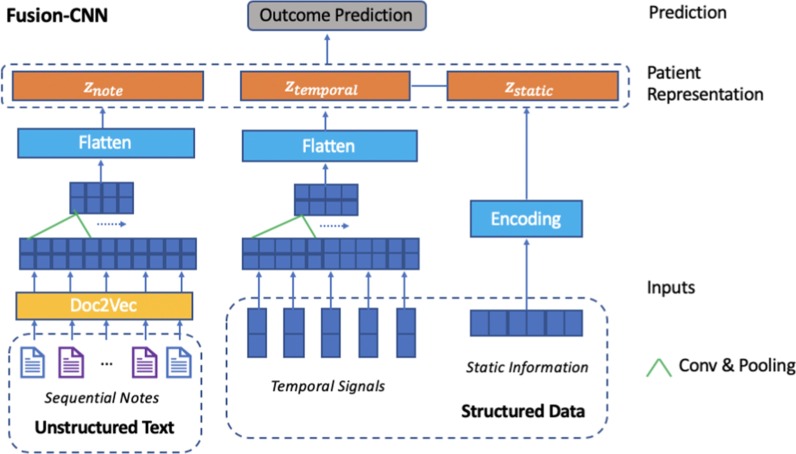
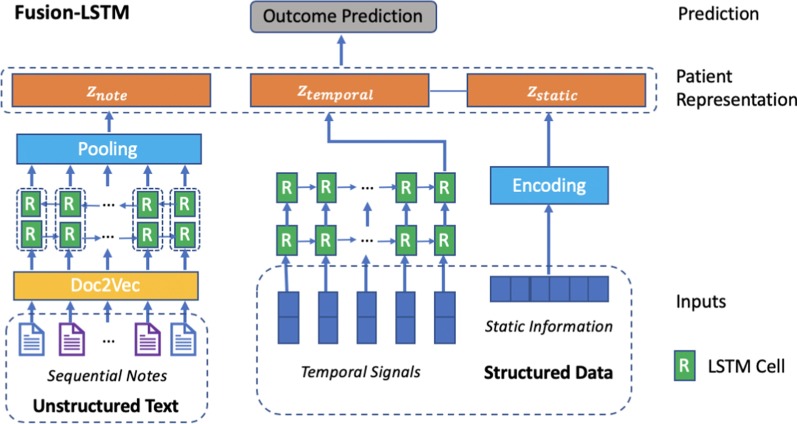
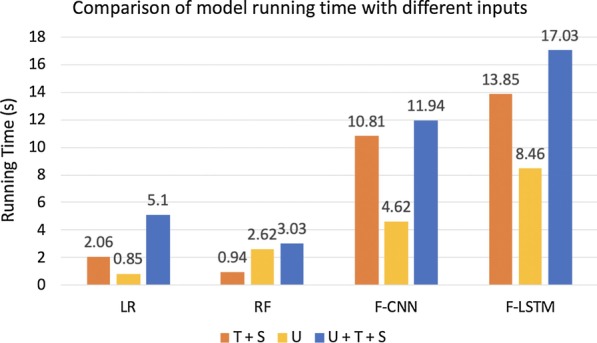
Verification
Claims the paper makes
The claims and statistics of this paper haven’t been checked yet.
Run the check — free, no account needed. It reads the open-access text and checks the sources it cites.
Claims other papers make about this one
Each is checked against this paper’s own text: does it say what the citing paper says it does?
The cited source doesn’t support the claim as written.
In the citing paper
“For evaluation, we use a 0.70-0.15-0.15 train-validation-test split following the previous work [13]. However, we equalized the size of the validation set and the test set to get a better estimation of test performance on the validation set. We split the dataset according to patient ID and admission ID so that there's no overlap between training, validation, and test sets.”
From Multimodal risk prediction with physiological signals, medical images and clinical notes (2024) · cites this paper as [13]
Checked by a reasoning model — may be wrong.
Experimental — accuracy not yet measuredThe cited source says what the claim attributes to it.
In the citing paper
“They hold great promise in deriving meaningful insights from EHR, which can aid in accurately predicting clinical outcomes, such as mortality [13] and readmission [13], [14].”
From Multimodal risk prediction with physiological signals, medical images and clinical notes (2024) · cites this paper as [13]
Self-check
Percentages, sums and reported differences re-computed from the paper’s own numbers.
The self-check needs the paper’s full text.
Citations
Cites
LeCun, Y., Bengio, Y., & Hinton, G. (2015) · Nature · doi:10.1038/nature14539 · Cited by 84,126
Scikit-learn: Machine Learning in Python
Pedregosa, F., Varoquaux, G., Gramfort, A., Michel, V., Thirion, B., Grisel, O., Blondel, M., Müller, A., Nothman, J., Louppe, G., et al. (2012) · arXiv · doi:10.48550/arxiv.1201.0490 · Cited by 71,016 · cited 1×
“, logistic regression and random forest) with scikit-learn [32].”
BackgroundPyTorch: An Imperative Style, High-Performance Deep Learning Library
Paszke, A., Gross, S., Massa, F., Lerer, A., Bradbury, J., Chanan, G., Killeen, T., Lin, Z., Gimelshein, N., Antiga, L., et al. (2019) · arXiv · doi:10.48550/arxiv.1912.01703 · Cited by 31,473 · cited 1×
“Deep learning models are implemented using PyTorch [33].”
MethodSantos, A. G., da Rocha, G. O., & de Andrade, J. B. (2019) · Scientific Reports · doi:10.1038/s41598-018-37186-2 · Cited by 8,495
MIMIC-III, a freely accessible critical care database
Johnson, A. E. W., Pollard, T. J., Shen, L., Lehman, L.-W. H., Feng, M., Ghassemi, M., Moody, B., Szolovits, P., Anthony Celi, L., & Mark, R. G. (2016) · Scientific Data · doi:10.1038/sdata.2016.35 · Cited by 8,141
Distributed Representations of Sentences and DocumentsPreprint
Le, Q. V., & Mikolov, T. (2014) · arXiv (Cornell University) · doi:10.48550/arxiv.1405.4053 · Cited by 7,905 · cited 1×
“Doc2Vec) [30] to learn the embedding of each clinical note.”
BackgroundA unified architecture for natural language processing: deep neural networks with multitask learning
Collobert, R., & Weston, J. (2008) · Proceedings of the 25th international conference on Machine learning - ICML '08 · doi:10.1145/1390156.1390177 · Cited by 5,058
Software Framework for Topic Modelling with Large Corpora
Rek, R. R. U., & Sojka, P. (2010) · doi:10.13140/2.1.2393.1847 · Cited by 3,789
Scalable and accurate deep learning with electronic health records
Rajkomar, A., Oren, E., Chen, K., Dai, A. M., Hajaj, N., Hardt, M., Liu, P. J., Liu, X., Marcus, J., Sun, M., et al. (2018) · npj Digital Medicine · doi:10.1038/s41746-018-0029-1 · Cited by 2,648
Scalable and accurate deep learning with electronic health records.
Rajkomar, A., Oren, E., Chen, K., Dai, A. M., Hajaj, N., Hardt, M., Liu, P. J., Liu, X., Marcus, J., Sun, M., et al. (2018) · eScholarship (California Digital Library) · Cited by 2,242
Research works printed but not linked: 3
- Henry J, Pylypchuk Y, Searcy T, Patel V. Adoption of electronic health record systems among US non-federal acute care hospitals: 2008–2015. ONC Data Brief. 2016;35:1–9.
- Ghassemi M, Naumann T, Joshi R, Rumshisky A. Topic models for mortality modeling in intensive care units. In: ICML machine learning for clinical data analysis workshop; 2012. p. 1–4.
- Hackbarth G, Reischauer R, Miller M. Report to the congress: promoting greater efficiency in medicare. Washington, DC: MedPAC; 2007.
Cited by
Sorted by citations
Items 201–268 of 268
DataWords: Getting Contrarian with Text, Structured Data and Explanations
Gallant, S. I., & Hossain, M. N. (2022) · Lecture notes in networks and systems · doi:10.1007/978-3-031-16075-2_50
Huang, Y., Zheng, Z., Ma, M., Xin, X., Liu, H., Fei, X., Lan, W., & Chen, H. (2022) · doi:10.2196/preprints.37486
Ostropolets, A., Hripcsak, G. M., Husain, S. A., Richter, L., Spotnitz, M., Elhussein, A., & Ryan, P. B. (2022) · medRxiv · doi:10.1101/2022.12.27.22283944
Boukhers, Z., Goswami, P., & Jürjens, J. (2023) · Research Square · doi:10.21203/rs.3.rs-1873701/v2
Understanding Deep Learning for LoS prediction via Latent space visualizationPreprint
Momo, L. N. W., Scheltjens, V., Rademakers, F. E., Verbeke, W., & Moor, B. D. (2023) · doi:10.36227/techrxiv.24278491
Understanding Deep Learning for LoS prediction via Latent space visualizationPreprint
Momo, L. N. W., Scheltjens, V., Rademakers, F. E., Verbeke, W., & Moor, B. D. (2023) · doi:10.36227/techrxiv.24278491.v1
Calcote, M. J., Mann, J. R., Adcock, K. G., Duckworth, S., & Donald, M. C. (2023) · Nurse Educator · doi:10.1097/nne.0000000000001571
“35 Structured data are generally characterized as quantitative data and are standardized, organized, and formatted in such a way as to be easily searched.”
Machine Learning for Software Developers: An Introductory Guide
Thatikonda, V. K. (2022) · Journal of Artificial Intelligence & Cloud Computing · doi:10.47363/jaicc/2022(1)143
Jiang, Y., Wang, S., Li, Q., & Zhang, W. (2023) · Hawaii International Conference on System Sciences (HICSS) · doi:10.24251/hicss.2023.460
Ingwersen, E. W. (2024) · doi:10.5463/thesis.749
Analysis of Various Smart Healthcare Systems for Heart Disease Prediction
Arora, R. K., Gupta, M. K., & Singh, S. P. (2024) · Lecture notes in electrical engineering · doi:10.1007/978-981-97-5231-7_32
Learning Sustainable Mobility Behaviour in Post-Pandemic Vienna
Brașoveanu, A., Nixon, L. J. B., & Arno Scharl, A. (2024) · Advances in transdisciplinary engineering · doi:10.3233/atde241198
An Attention-Based Model for Clinical Time Series Prediction: Enhancing ICU Readmission Prediction
Madinei, H. S., Keyvanpour, M. R., & Shojaedini, S. V. (2024) · International Conference on Computer and Knowledge Engineering · doi:10.1109/iccke65377.2024.10874795
“As an example, it is possible to evaluate the risk of hospital readmission with the HOSPITAL Score and the LACE Index [7].”
Application Value and Progress of Unstructured Data in Early Prediction of Pediatric Sepsis
宋, 婉. (2025) · Advances in Clinical Medicine · doi:10.12677/acm.2025.153769
Vagliano, I., Rios, M., Abukmeil, M., Schut, M. C., Luik, T. T., van Asselt, K. M., van Weert, H. C. P. M., & Abu–Hanna, A. (2025) · Cancers · doi:10.3390/cancers17071151 · Cited by 1
“Contextual embeddings are emerging [34–36].”
ICU Outcome Predictions Using Real-Time Signals with Wavelet-Transform-based Deep Learning Method
Jiang, Y., Wang, S., Li, Q., & Zhang, W. (2025) · ACM Transactions on Management Information Systems · doi:10.1145/3727624 · Cited by 1
“Research has shown that oxygen levels and supplementation are highly related to in-hospital mortality for sepsis patients [39].”
Hummel, L. M., Lorenz-Artz, K., Bierbooms, J. J. P. A., & Bongers, I. M. B. (2025) · doi:10.2196/preprints.74240
Gas Station of the Future: A Perspective on AI/ML and IoT in Retail Downstream
Talukdar, W. (2021) · European Journal of Technology · doi:10.47672/ejt.2676
Sekar, T., Kushal, K., Shankar, S., Mohammed, S., & Fiaidhi, J. (2025) · doi:10.36227/techrxiv.174494685.55828887/v1
Theocharopoulos, P. C., Bersimis, S., Georgakopoulos, S. V., Plagianakos, V. P., & Tasoulis, S. K. (2025) · doi:10.1109/cihm64979.2025.10969489
“Despite this, RNNs are useful for identifying short-term trends and fluctuations in patient health data, making them suitable for short-term predictive tasks [21].”
Lee, H., Kim, Y. J., Hwang, Y. S., Park, Y., & Jo, H. S. (2025) · JMIR Medical Informatics · doi:10.2196/65127
“This information is continuously accumulated as unstructured data on various websites, and there is a growing trend of analyzing these posts to study patients’ emotional states and experiences [18].”
Computational medicine and patient avatars in cardio-oncology
Evbayekha, E. O., Moore, S., Cullinane, R. R., Duffy, Q., Rickards, J., Sun, L. Y., & Brown, S.-A. N. (2025) · Elsevier eBooks · doi:10.1016/b978-0-443-29829-5.00011-6
Generative Adversarial Networks for Longitudinal Data Imputation and Classification
Pingi, S. T. (2025) · Queensland University of Technology · doi:10.5204/thesis.eprints.258292
The Role of Deep Learning Techniques in Financial Reporting Challenges and Opportunities
Meteab, H. L., Jameel, S. Z. M., & Ramo, R. M. (2025) · IEEE International Conference on Soft Computing and Measurements (SCM) · doi:10.1109/scm66446.2025.11060413
The Digital Power Plant: AI-Driven Solutions for Energy Efficiency
Gupta, S. T., Hải, V. N., & Das, S. (2025) · Springer eBooks · doi:10.1007/978-981-96-8015-3_6
Machine Learning and Word Representation Techniques in Medical Transcription Data Analysis
Danties, A., Banu, P. K. N., Azar, A. T., Kamal, N. A., Tounsi, M., & Njima, C. B. (2025) · International Conference on Control, Automation and Diagnosis (ICCAD) · doi:10.1109/iccad64771.2025.11099201
“Recent advancements in ML and deep learning have become popular in medical data analysis [25].”
A model-agnostic ordinal regression pipeline for length of stay prediction
Huang, X., He, K., Hou, C., Zhou, M., & Zheng, D. (2025) · The Journal of Supercomputing · doi:10.1007/s11227-025-07681-1
“Zhang et al. [27] suggested improving the learning of patient representations through the integration of sequential and non-structured clinical notes along-side structured data using a multi-modal network architecture.”
A Study of Patient Data Management Systems Using Blockchain Technology
Abdlhasan, Z. A., & Aljabery, M. A. (2025) · Lecture notes in networks and systems · doi:10.1007/978-3-032-04725-0_5
Turki, H., Pasha, N. A., Altammami, A., & Alzahrani, A. (2025) · Research Square · doi:10.21203/rs.3.rs-7660197/v1 · Cited by 1
Stahl-Toyota, S., Dönnhoff, I., Nagy, E., Hochlehnert, A., Unger, I., Szendrödi, J., Frey, N., Michl, P., Müller‐Tidow, C., Jäger, D., et al. (2025) · BMC Medical Informatics and Decision Making · doi:10.1186/s12911-025-03290-3
Zhang, C., Yuan-Lu, Tang, F.-Q., Zhang, S.-Q., & Cai, H.-P. (2025) · Biomedical Signal Processing and Control · doi:10.1016/j.bspc.2025.108436
Comparative Evaluation of Class Balancing Strategies for Depression Detection in Reddit Posts
Fontenele, T. G. M. C., & de Souza, B. F. (2025) · doi:10.5753/eniac.2025.13879
“Uma base de dados é uma coleção de informações organizadas de maneira es-truturada ou não estruturada, sendo um recurso essencial para treinar algoritmos de AM [Zhang et al. 2020].”
Smart recommendations in E-commerce using convolutional neural networks and collaborative filtering
Li, X. (2025) · Australian Journal of Electrical & Electronics Engineering · doi:10.1080/1448837x.2025.2605390
Öneri Karar Destek Sistemlerinin Karar Süreçlerindeki Etkisinin Değerlendirilmesi
Yıldırım, M., Tunçer, E., & Henkoğlu, T. (2025) · İzmir Yönetim Dergisi · doi:10.56203/iyd.1770321
Haldar, P., Mandal, D. K., & Gupta, U. (2025) · Sustainable finance · doi:10.1007/978-3-032-01677-5_15
A Hybrid Approach Using BERT and Machine Learning Model for Startup Valuation
Chong, D. S., Junn, K. Y., Medi, I., Yee, A. S. V., & Maheshwari, V. (2026) · Lecture notes in networks and systems · doi:10.1007/978-3-032-08240-4_6
Ramprasanth, H., & Rahul, M. (2025) · International Conference on Mobile Networks and Wireless Communications (ICMNWC) · doi:10.1109/icmnwc66779.2025.11354446
“Daily interactions, social media, sensor-generated digital photographs, movies, audio files, and clickstreams with contributions from people and organizations are a few examples of both data sources Zhang, Dongdong, et al.(2020) [1].”
Siddiqi, K. A., Canidate, S. S., Liu, Y., Kriegel, L. S., Monjur, S., Cook, C. L., & Cook, R. L. (2026) · PLoS ONE · doi:10.1371/journal.pone.0319139
“However, CDS tools have the ability to analyze large volumes of structured and/or unstructured data within minutes and can predict the likelihood of HIV acquisition [39–41].”
Near-instantaneous Cardiovascular Event Prediction Using Multimodal Deep Learning
Al-Hasooni, M., Abdzaid, A., Hadi, N., & Fakhruldeen, H. (2026) · Electronics ETF · doi:10.53314/els2630003a
Cross-Silo Prediction of Hospital Readmissions using a Federated Learning Framework
Ayyadurai, M., Anand, M., & Eniyan, P. (2025) · International Conference on Evolutionary Computing and Mobile Sustainable Networks (ICECMSN) · doi:10.1109/icecmsn68058.2025.11383090
“Some previous work has shown applying [7] Likewise, [8] developed deep learning architecture to predict readmissions by utilizing both structured and unstructured clinical notes.”
Identifying pertinent cohorts and addressing imbalance for robust intensive care survival analysis
Ahmed, A., Zeng, X., Xi, R., Hou, M., Afzal, M., & Shah, S. A. (2026) · Engineering Applications of Artificial Intelligence · doi:10.1016/j.engappai.2026.114267 · Cited by 1
Sharma, Y., Thompson, C. H., Mangoni, A. A., Horwood, C., & Woodman, R. J. (2026) · Computers · doi:10.3390/computers15030138
Baughman, D. J., Qassem, L., Sulieman, L. M., Matheny, M. E., Nelson, S. D., Anselm, E., Tindle, H. A., Fabbri, D., & Embí, P. J. (2026) · JAMIA Open · doi:10.1093/jamiaopen/ooag026
“These findings are consistent with the literature, supporting a hybrid training approach 29,30 that marries authentic clinical documentation with structured guideline-conformant language to capture both language variability and billing specificity.”
Singh, P. K., Kumar, V., Parihar, A., Goyal, G., Singh, S., & Bhatt, P. (2026) · Journal of Pharmaceutical Innovation · doi:10.1007/s12247-026-10539-5
“Strong correlations between experimental and predicted values in both training and validation datasets further mitigated concerns regarding overfitting [ 32, 33].”
Artificial intelligence in precision medicine: enhancing predictive analytics
Priyadarsini, S., & Karmakar, P. (2026) · Elsevier eBooks · doi:10.1016/b978-0-443-40483-2.00049-2
Multimodal learning to predict breast cancer prognosis
Mbaye, N. M. (2024) · theses.fr (ABES) · doi:10.70675/cdccc54az52f7z4e20za5a4z3ec09cd3a564
Targeted use of large language models for EHR-based computable phenotyping
Owens, D., Cao, J., Gupta, M., Nguyen, D., Peterson, E. D., & Navar, A. M. (2026) · Journal of the American Medical Informatics Association · doi:10.1093/jamia/ocag051 · Cited by 1
Multimodal Late Fusion for Obstructive Sleep Apnea Phenotyping and Risk Stratification
Ayo-Durojaiye, I., Dong, A., Ferrer, S. I. P., Crivelli, S. N., Coblentz, D., & Cheng, Q. (2026) · IEEE International Conference on Semantic Computing (ICSC) · doi:10.1109/icsc67292.2026.00028
Deep Phenotyping of Obstructive Sleep Apnea Using Multimodal Representation Learning
Coblentz, D., Dong, A., Crivelli, S. N., Zamora‐Resendiz, R., Ayo-Durojaiye, I., & Qian, C. (2026) · IEEE International Conference on Semantic Computing (ICSC) · doi:10.1109/icsc67292.2026.00064
“Zhang et al. combined structured variables and clinical notes derived from the MIMIC database [12] for in-hospital mortality and readmission prediction [10].”
Credit Score Prediction Using Multi-modal Deep Learning with Intermediate Fusion
Kumar, P., Kohli, V., Khan, A., Mathur, A., & Thoday, V. (2026) · Lecture notes in networks and systems · doi:10.1007/978-3-032-19185-4_16
Explainable ICD coding via MediThoth: A multimodal clinical decision support system
Elbehery, M. M., Mohamed, M. S., & Elshafey, M. A. (2026) · Array · doi:10.1016/j.array.2026.100875
Sinha, D. N., & Roy, S. (2026) · International Conference on Intelligent Computing and Automation for Sustainable Solutions (ICASS) · doi:10.1109/icass69550.2026.11547510
Li, J., Ni, J. F., Zhan, Y., Tao, D., Qi, C., Luo, J., & Jin, H. (2026) · Expert Systems with Applications · doi:10.1016/j.eswa.2026.133223
Zuo, Q., Zhao, L., & Tao, G. (2026) · Research Square · doi:10.21203/rs.3.rs-9693461/v1
Naik, M. D., Deepika, G., Jawalkar, A. P., Rajesh, M., Munigala, M., Srinivas, B., & Kumari, R. K. (2026) · AIP conference proceedings · doi:10.1063/5.0342272
Priyadharshini, U., & Vijayan, R. (2026) · Frontiers in Artificial Intelligence · doi:10.3389/frai.2026.1844707
“Zhang et al. (2020) combined structured clinical variables with unstructured text to improve healthcare prediction accuracy.”
Dipto, S. M., Banerjee, S., Roy, S., Musawi, A. F. A., Ghosh, P., Shetty, S. S., & Rana, P. (2026) · ACM International Conference on Bioinformatics, Computational Biology, and Health Informatics (ACM-BCB) · doi:10.1145/3807503.3819489
“This EHR has been widely used to predict LoS using centralized machine learning settings [3, 10, 23, 38].”
Niu, X., Zhang, S., Li, Y., Yan, L., Li, D., Lin, H., & Song, Y. (2026) · Communications in computer and information science · doi:10.1007/978-981-95-8447-5_9
AI-based multimodal integration of genomics and electronic health records
Venkatesh, R., & Ritchie, M. D. (2026) · Nature Reviews Genetics · doi:10.1038/s41576-026-00992-w
“Advances in structured and semi-structured modelling of clinical data have enabled more scalable phenotyping and event prediction 58 .”
InfluentialData and Knowledge Dual-Driven Text Embedding Approaches: A Survey
Chen, X., 詹佳青, Lin, J., Liu, H., Zhang, Q., Chen, J., & Chen, H. (2026) · IEEE Transactions on Knowledge and Data Engineering · doi:10.1109/tkde.2026.3721883
Enhancement of Machine Learning Algorithms through Boosting for Multimodal Disease Analysis
Nasution, F. A., Defit, S., & Arlis, S. (2026) · International Conference on Advancement in Data Science, E-learning and Information System (ICADEIS) · doi:10.1109/icadeis71120.2026.11644513
“[4] proposed multi-modal neural network architectures that combine structured clinical variables with unstructured clinical notes for predictive modeling, showing that heterogeneous EHR data can be jointly learned within a unified framework.”
Machine Learning for Early Detection and Prevention of Disease Using Electronic Health Records
Huo, Z., & Wu, J. (2026) · Methods in molecular biology · doi:10.1007/978-1-0716-5408-8_5
Cheng, P., Lyu, M., Chen, Z., & Wu, Y. (2026) · Journal of the American Medical Informatics Association · doi:10.1093/jamia/ocag146
Üstündağ, H., & Doğanay, S. (2026) · Purinergic Signalling · doi:10.1007/s11302-026-10185-z
“…neural networks, long short-term memory (LSTM) networks and Transformer models have been applied to capture temporal patterns in sepsis progression [24–27], but these models operate as “black boxes” that neither incorporate prior biological knowledge nor provide mechanistic interpretability.”
Residual Transformer–Decision Forest Hybrid Learning for Accurate Hospital Length-of-Stay Prediction
Neshat, M. (2026) · International Conference on Intelligent Systems, Metaheuristics & Swarm Intelligence (ISMSI) · doi:10.1145/3820820.3820830
Torres, A., & Fernandez, M. (2024) · Journal of Health Informatics and Digital Systems · doi:10.68159/j256166969
Shruthi, S., & Naidu, D. H. R. (2026) · Awareness Journals · doi:10.67277/awj01-2026-000010
Haq, Q. A. U., QADRI, S., Iqbal, N., & Hashim, S. (2026) · doi:10.2196/preprints.114794
Metadata
- Authors
- Zhang, D., Yin, C., Zeng, J., Yuan, X., & Zhang, P.
- Affiliations
- Wuhan University of Technology (CN)
- The Ohio State University (US)
- Corresponding author
- Zhang, Ping
- Venue
- BMC Medical Informatics and Decision Making
- Published
- 2020-10-29
- Volume
- 20
- Issue
- 1
- Pages
- 280-280
- ISSN
- 1472-6947 (ISSN-L)
- PMC
- PMC7596962
- OpenAlex
- W3095791468
- Cited by
- 269
- References
- 35
- Citations by year
- 2026: 41 · 2025: 72 · 2024: 52 · 2023: 52 · 2022: 34 · 2021: 18
- FWCI
- 10.13
- Type
- journal article
- Language
- en
- Open access
- gold
- doi.org
- Locations
- BMC Medical Informatics and Decision Making (publishedVersion, cc-by)
- medRxiv (acceptedVersion, cc-by-nc-nd)
- PubMed Central (publishedVersion, cc-by)
- PubMed (publishedVersion)
- DOAJ (DOAJ: Directory of Open Access Journals) (submittedVersion, cc-by-sa)
- Topics
- Physical Sciences › Computer Science › Artificial Intelligence › Machine Learning in Healthcare
- Health Sciences › Nursing › Research and Theory › Nursing Diagnosis and Documentation
- Health Sciences › Health Professions › Health Information Management › Electronic Health Records Systems
- Keywords
- electronic health records, unstructured clinical notes, multimodal neural networks, patient representation learning, in-hospital mortality prediction, hospital readmission prediction, length of stay prediction, MIMIC-III, clinical risk prediction
- MeSH terms
- Machine Learning, Deep Learning, Humans, Patient Readmission, Neural Networks, Computer, Electronic Health Records
About these checks
Registry, retraction, Cites and statistics results are computed, not judged, with one exception: a printed reference that no index lists is read once by a model before it counts as a citation error. Claims are extracted by a model and kept only when their quote appears verbatim in the text; each cited source is then checked, with a model’s help, for whether it says what the claim relies on. Those verdicts can be wrong — read the claim’s quote and the cited source before relying on one.
Statistics and arithmetic are recomputed, not judged.
Confidence bands are shown only for fields calibrated on our annotated test set. None is calibrated yet, so no band is shown.
What counts as a claim ›How we measure confidence ›How we check this ›
Are you an author, or do you see a problem with this page? Request a review
