

Follow-Up Support for Effective type 1 Diabetes self-management (The FUSED Model): A systematic review and meta-ethnography of the barriers, facilitators and recommendations for sustaining self-management skills after attending a structured education programme
Open accessThe DOI matches its Crossref record; 63 of the 64 references it cites were found in a registry or an index.
Abstract
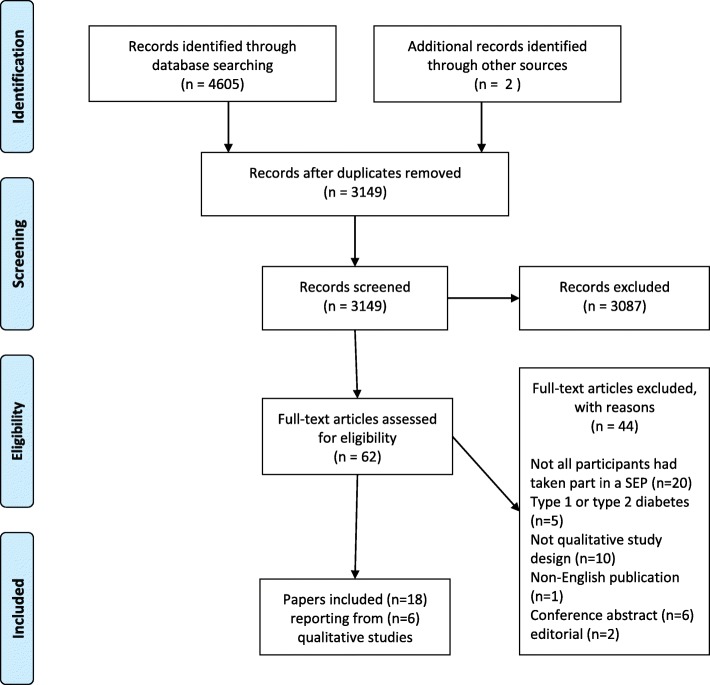
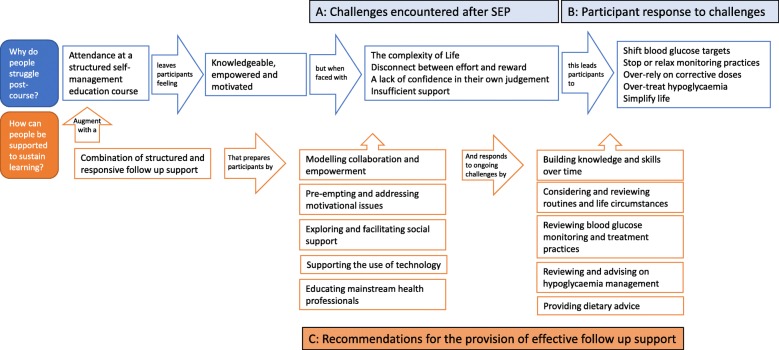
BACKGROUND: People with type 1 diabetes who attend structured education training in self-management using flexible intensive therapy achieve improved blood glucose control and experience fewer episodes of severe hypoglycaemia. However, many struggle to sustain these improvements over time. To inform the design of more effective follow-up support we undertook a review of qualitative studies which have identified factors that influence and inform participants' self-management behaviours after attending structured education and their need for support to sustain improvements in glycaemic control. METHODS: We undertook a meta-ethnography of relevant qualitative studies, identified using systematic search methods. Studies were included which focused on participants' experiences of self-managing type 1 diabetes after attending structured education which incorporated training in flexible intensive insulin therapy. A line of argument approach was used to synthesise the findings. RESULTS: The search identified 18 papers from six studies. The studies included were judged to be of high methodological quality. The line of argument synthesis developed the Follow-Up Support for Effective type 1 Diabetes self-management (FUSED) model. This model outlines the challenges participants encounter in maintaining diabetes self-management practices after attending structured education, and describes how participants try to address these barriers by adapting, simplifying or personalising the self-management approaches they have learned. To help participants maintain the skills taught during courses, the FUSED model presents ten recommendations abstracted from the included papers to provide a logic model for a programme of individualised and responsive follow-up support. CONCLUSIONS: This meta-ethnography highlights how providing skills training using structured education to people with type 1 diabetes does not necessarily result in participants adopting and sustaining recommended changes in behaviour. To help people sustain diabetes self-management skills after attending structured education, it is recommended that support be provided over the longer-term by appropriately trained healthcare professionals which is responsive to individuals' needs. Although developed to inform support for people with type 1 diabetes, the FUSED model provides a framework that could also be applied to support individuals with other long term conditions which require complex self-management skills to be learned and sustained over time. TRIAL REGISTRATION: PROSPERO registration: CRD42017067961 .
Overview
The claims and statistics of this paper haven’t been checked yet.
Free: it reads the open-access text and checks the first 5 claims that cite a source we can check. Create a free account to check every claim.
Integrity signals
Registry
Cites
Statistics
Figures
Verification
Claims the paper makes
The claims and statistics of this paper haven’t been checked yet.
Free: it reads the open-access text and checks the first 5 claims that cite a source we can check. Create a free account to check every claim.
Claims other papers make about this one
Each is checked against this paper’s own text: does it say what the citing paper says it does?
The source backs part of the claim, not all of it — or backs it for a different population, condition or comparison.
In the citing paper
“Internet-based DSMES services and telemedicine approaches for DM prevention and the management of T2D management have also been shown to be effective.1481–1484”
From American Association of Clinical Endocrinology Clinical Practice Guideline: Developing a Diabetes Mellitus Comprehensive Care Plan-2022 Update. (2022) · cites this paper as [1483]
Experimental — accuracy not yet measured
Self-check
Percentages, sums and reported differences re-computed from the paper’s own numbers.
The self-check needs the paper’s full text.
Citations
Cites
Diagnosis and Classification of Diabetes Mellitus
American Diabetes Association (2011) · Diabetes Care · doi:10.2337/dc11-s062 · Cited by 13,988
Noblit, G., & Hare, R. (1988) · doi:10.4135/9781412985000 · Cited by 2,723
Beyond PICO: The SPIDER Tool for Qualitative Evidence Synthesis
Cooke, A., Smith, D., & Booth, A. (2012) · Qualitative Health Research · doi:10.1177/1049732312452938 · Cited by 2,608
Meta-Ethnography: Synthesizing Qualitative Studies
Noblit, G. W., & Hare, R. D. (1988) · Medical Entomology and Zoology · Cited by 2,191
Self-Management Education for Adults With Type 2 Diabetes
Norris, S. L., Lau, J., Smith, S. J., Schmid, C. H., & Engelgau, M. M. (2002) · Diabetes Care · doi:10.2337/diacare.25.7.1159 · Cited by 1,750
Diagnosis and Classification of Diabetes Mellitus
American Diabetes Association (2004) · Diabetes Care · doi:10.2337/diacare.27.2007.s5 · Cited by 1,666
National Standards for Diabetes Self-Management Education
Funnell, M. M., Brown, T. L., Childs, B. P., Haas, L. B., Hosey, G. M., Jensen, B., Maryniuk, M., Peyrot, M., Piette, J. D., Reader, D., et al. (2009) · Diabetes Care · doi:10.2337/dc09-s087 · Cited by 1,350
Using meta ethnography to synthesise qualitative research: a worked example
Britten, N., Campbell, R., Pope, C., Donovan, J., Morgan, M., & Pill, R. (2002) · Journal of Health Services Research & Policy · doi:10.1258/135581902320432732 · Cited by 1,110
Conducting a meta-ethnography of qualitative literature: Lessons learnt
Atkins, S., Lewin, S., Smith, H., Engel, M., Fretheim, A., & Volmink, J. (2008) · BMC Medical Research Methodology · doi:10.1186/1471-2288-8-21 · Cited by 981
Campbell, R., Pound, P., Pope, C., Britten, N., Pill, R., Morgan, M., & Donovan, J. (2003) · Social Science & Medicine · doi:10.1016/s0277-9536(02)00064-3 · Cited by 921
Research works printed but not linked: 4
- National Clinical Guideline, C., National Institute for Health and Care Excellence Clinical Guidelines, in Type 1 Diabetes in Adults: Diagnosis and Management 2015 London National Institute for Health and Care Excellence (UK
- Heller, S.L., Lawton J; Amiel S; Cooke D., Mansell P., Brennan A., Elliott J., Boote J., Emery C., Baird W., Basarir H., Beveridge S., Bond R., Campbell M., Chater T., Choudhary P., Clark M., de Zoysa N., Dixon S., Gianfrancesco C., Hopkins D., Hacques R., Kruger J., Moore S., Oliver L., Peasgood T., Rankin D., Roberts S., Rogers H., Taylor C., Thokala P., Thompson G., Ward C., Improving management of type 1 diabetes in teh UK: the Dose Adjustment For Normal Eating (DAFNE) programme as a research test-bed. A mixed metod analysis of the barriers to and facilitators of successful diabetes self-management, a health conomic analysis, a cluster randomised controlled trial of different models of delivery of an educational intervention and the pottential of insulin pubmps and additiaonal educator input to improve outcomes. NIHR PGfAR (ref: RP-PG-0514-20013). Programme Grants Appl Res, 2014. 2(5). 25642502
- NICE Methods for the development of NICE public health guidance 2012 third 27905711
- Corben S Rosen R Self-management for long-term conditions 2005 London King’s Fund
Cited by
Blonde, L., Umpierrez, G. E., Reddy, S. S., McGill, J. B., Berga, S. L., Bush, M., Chandrasekaran, S., DeFronzo, R. A., Einhorn, D., Galindo, R. J., et al. (2022) · Endocrine Practice · doi:10.1016/j.eprac.2022.08.002 · Cited by 507
ISPAD Clinical Practice Consensus Guidelines 2022: Diabetes education in children and adolescents
Olinder, A. L., Deabreu, M., Greene, S. A., Haugstvedt, A., Lange, K., Majaliwa, E., Pais, V., Pélicand, J., Town, M., & Mahmud, F. H. (2022) · Pediatric Diabetes · doi:10.1111/pedi.13418 · Cited by 168
“term by appropriately trained health care professionals in response to individuals' needs.(6,27,45) A study of structured education during the pedi-”
BackgroundSustained type 1 diabetes self‐management: Specifying the behaviours involved and their influences
Hamilton, K., Fay, S. H., Chadwick, P., Lorencatto, F., de Zoysa, N., Gianfrancesco, C., Taylor, C., Coates, E. J., Breckenridge, J. P., Cooke, D. D., et al. (2020) · Diabetic Medicine · doi:10.1111/dme.14430 · Cited by 71
“facilitators for sustaining self-management skills after attending a type 1 diabetes structured education programme.(19) This introduces a source of potential bias, in that the original data had already undergone a degree interpretation and synthesis by the review authors.”
BackgroundSelf-citationCrespo-González, C., Benrimoj, S. I., Scerri, M., & García‐Cárdenas, V. (2020) · Research in Social and Administrative Pharmacy · doi:10.1016/j.sapharm.2020.01.015 · Cited by 63
Patel, R., Kaur, K., & Singh, S. (2021) · Inflammopharmacology · doi:10.1007/s10787-021-00843-6 · Cited by 43
Blood Glucose Level Time Series Forecasting: Nested Deep Ensemble Learning Lag Fusion
Khadem, H., Nemat, H., Elliott, D., & Benaissa, M. (2023) · Bioengineering · doi:10.3390/bioengineering10040487 · Cited by 45
Heller, S. R., Gianfrancesco, C., Taylor, C., & Elliott, J. (2020) · Diabetic Medicine · doi:10.1111/dme.14268 · Cited by 41
Self-citationStanton‐Fay, S. H., Hamilton, K., Chadwick, P. M., Lorencatto, F., Gianfrancesco, C., de Zoysa, N., Coates, E., Cooke, D., McBain, H., Heller, S. R., et al. (2021) · Diabetic Medicine · doi:10.1111/dme.14548 · Cited by 33
“17,30,38 By revising an existing intervention that has proved beneficial, we aimed to retain successful elements of the original while addressing limitations associated with maintenance of outcomes or with implementation.”
BackgroundSelf-citationO’Shea, A., Drennan, J., Littlewood, C., Slater, H., Sim, J., & McVeigh, J. G. (2022) · Clinical Rehabilitation · doi:10.1177/02692155221108553 · Cited by 26
“Similar to our review, Campbell et al.(53) highlighted that follow-up support for effective type 1 diabetes self-management should be a combination of both structured and responsive individualized follow-up support.”
BackgroundResultJensen, A. L., Schougaard, L. M. V., Laurberg, T., Hansen, T. K., & Lomborg, K. E. (2023) · Scandinavian Journal of Caring Sciences · doi:10.1111/scs.13154 · Cited by 21
Xie, Y., Liu, F., Huang, F., Lan, C., Guo, J., He, J., Li, L., Li, X., & Zhou, Z. (2020) · BMC Endocrine Disorders · doi:10.1186/s12902-020-0514-9 · Cited by 22
Carvalho, M., Dunne, P., Kwaśnicka, D., Byrne, M., Panel, S. T. P. A., & McSharry, J. (2023) · Health Psychology Review · doi:10.1080/17437199.2023.2268731 · Cited by 21
“…and habits, supporting prior studies and emphasising the key role of sustained motivation and habit formation in maintaining health-related behaviours (Campbell et al., 2018; Greaves et al., 2017; Kwas-nicka et al., 2019; Robinson et al., 2018; Sainsbury et al., 2018; van Stralen et al., 2009).”
InfluentialTzivian, L., Sokolovska, J., Grike, A. E., Kalcenaua, A., Seidmann, A. A., Benis, A., Mednis, M., Danovska, I., Berzins, U., Bogdanovs, A., et al. (2022) · Health and Quality of Life Outcomes · doi:10.1186/s12955-022-02029-2 · Cited by 23
“However, people were often tired and encountered difficulties in managing their everyday lives according to guidelines even during these educational trainings, which made additional follow-up by the physician essential [7].”
BackgroundCoates, E. J., Amiel, S. A., Baird, W. O., Benaissa, M., Brennan, A., Campbell, M. J., Chadwick, P., Chater, T., Choudhary, P., Cooke, D. D., et al. (2021) · BMJ Open · doi:10.1136/bmjopen-2020-040438 · Cited by 18
“21 The development of the DAFNE plus programme (described in 22) was informed by expert consensus, integrating data on participant-generated and clinician-generated barriers and facilitators to sustaining DAFNE with the findings from a synthesis of qualitative evidence about post-DAFNE challenges.”
MethodSelf-citationReidy, C., Foster, C. L., & Rogers, A. E. (2020) · Journal of Medical Internet Research · doi:10.2196/13980 · Cited by 17
“Treatment of T1D comprises demanding SM requirements, including insulin therapy (multiple daily injections [MDI] or insulin pumps); self-monitoring of blood glucose; and comprehensive understanding of nutritional, hormonal, and physical impacts on glycemia [6,7].”
Moldestad, M., Stryczek, K. C., Haverhals, L. M., Kenney, R. R., Lee, M., Ball, S. L., Au, D. H., Kirsh, S. R., Sayre, G. G., & Young, J. P. (2020) · Military Medicine · doi:10.1093/milmed/usaa520 · Cited by 16
Zhang, J., Xu, F., Zhuang, P., Xu, X., Zou, Z., & Qing, W. (2025) · Scientific Reports · doi:10.1038/s41598-025-01152-6 · Cited by 14
Rimmele, D. L., Schrage, T., Brettschneider, C., Engels, A., Gerloff, C. P., Härter, M. C., Rosenkranz, M., Schmidt, H., Kriston, L., & Thomalla, G. (2021) · Neurological Research and Practice · doi:10.1186/s42466-021-00107-2 · Cited by 10
Xie, L. F., Roy‐Fleming, A., Haag, S. C., Costa, D. D., & Brazeau, A. (2023) · Digital Health · doi:10.1177/20552076231152760 · Cited by 10
Type 1 Diabetes Patient Experiences Before and After Transfer from a Paediatric to an Adult Hospital
Flor, M. V., Jansà, M., Yoldi-Vergara, C., Cardona‐Hernandez, R., Giménez, M., Conget, I., & Pera, P. I. (2022) · Patient Preference and Adherence · doi:10.2147/ppa.s363081 · Cited by 10
“The results related to the fear adolescents have of hypoglycaemia and the emotional and social repercussions that it generates coincide with those of other studies that have described that some adolescents prefer to eat more and maintain their blood glucose levels above the recommended levels than to suffer a hypoglyc…”
ResultGupta, L., Lal, P. R., Gupta, Y., Goyal, A., Khanna, A., & Tandon, N. (2021) · Diabetes & Metabolic Syndrome Clinical Research & Reviews · doi:10.1016/j.dsx.2021.05.023 · Cited by 8
Flaks‐Manov, N., Shadmi, E., Yahalom, R., Perry‐Mezre, H., Balicer, R. D., & Srulovici, E. (2021) · Journal of Nursing Management · doi:10.1111/jonm.13495 · Cited by 8
Daniel, M., Liang, B., & Luo, M. (2021) · Vaccine · doi:10.1016/j.vaccine.2021.03.068 · Cited by 7
Lawton, J., Rankin, D., Scott, E., Lorencatto, F., Gericke, C., Heller, S. R., de Zoysa, N., & the DAFNEplus Study Group (2024) · Diabetic Medicine · doi:10.1111/dme.15375 · Cited by 6
Self-citationManagement of Type 1 Diabetes Mellitus in Adults
Yun, H. R. (2020) · Journal of Korean Diabetes · doi:10.4093/jkd.2020.21.3.156 · Cited by 5
“2) 추후 교육 당뇨병 자가관리 교육 프로그램은 초기에는 효과적인 경 우가 많지만 시간이 지남에 따라 이러한 기술과 능력을 유 지하는데 어려움을 겪게 되며 실제 프로그램이 종료된 후 6 개월에서 1년 후 이러한 효과는 약화될 수 있어 이는 추후 교육의 제공을 통해 해결할 수 있다[20].”
Luo, X., Pan, J., Lu, H., & Li, X. (2021) · Nursing Open · doi:10.1002/nop2.971 · Cited by 5
Challenges of Achieving an Optimum Glycemic Control in Children with Type 1 Diabetes in India
Seth, A. (2020) · The Indian Journal of Pediatrics · doi:10.1007/s12098-020-03336-6 · Cited by 5
“Development of a structured diabetes education program and its stepwise delivery to the children with T1DM and their caregivers is feasible and is being successfully carried out at many Centres [8, 9].”
BackgroundCarvalho, M., Morrissey, E. C., Dunne, P., Drury, A., Byrne, M., & McSharry, J. (2025) · Diabetic Medicine · doi:10.1111/dme.70032 · Cited by 4
“These findings align with previous research on support needs for diabetes self-management 18,19,39,46 and suggest that better support of behaviour change maintenance may require education of families and significant others about people's support needs; education and training of health professionals…”
Mattsson, S., Adolfsson, P., JENDLE, J. H., Bengtsson, V., & Sparud‐Lundin, C. (2021) · Frontiers in Clinical Diabetes and Healthcare · doi:10.3389/fcdhc.2021.655238 · Cited by 5
Lawton, J., Chadwick, P., de Zoysa, N., Fay, S. H., Heller, S. R., Rankin, D., & the DAFNEplus Study Group (2024) · Diabetic Medicine · doi:10.1111/dme.15309 · Cited by 4
“Findings from this and re-lated studies, 1,5–14 together with inputs from behaviour change 15–17 and technology experts 18–21 led to the development of the DAFNE plus program.”
Self-citationStern, C., Valenzuela, C., Whitehorn, A., Pollock, D., Minooee, S., Gohil, D. A., Zhu, Z., Kirkpatrick, P., Loureiro, R. L., Davies, E., et al. (2026) · JBI Evidence Synthesis · doi:10.11124/jbies-25-00265 · Cited by 6
Hart, R. I., Rankin, D., Chadwick, P., de Zoysa, N., Heller, S. R., Cooke, D. D., Elliott, J., Lawton, J., & the DAFNEplus study group (2024) · Diabetic Medicine · doi:10.1111/dme.15371 · Cited by 3
“In particular, notwithstanding participants' positive feedback on the group aspect of the DAFNE plus course, 15 the one- to-one format, as previously recommended, 7,19 seems to have been important.”
Self-citationEffect of Mothers’ Care Adherence on Control of type 1 Diabetes Mellitus Among their Children
Nassar, S., Elbahnasawy, H. T., Elnagar, S., & Elfeshawy, R. (2022) · Menoufia Nursing Journal · doi:10.21608/menj.2022.276315 · Cited by 2
Łazicka, P., Tarnowska, J., & Jakubowska, E. (2024) · Journal of Education Health and Sport · doi:10.12775/jehs.2024.76.56529 · Cited by 2
Breckenridge, J. P., Gossage-Worrall, R., Chadwick, P., de Zoysa, N., Elliott, J., Gianfrancesco, C., Hamilton, K., Heller, S. R., Lawton, J., Rankin, D., et al. (2024) · Pilot and Feasibility Studies · doi:10.1186/s40814-024-01576-3 · Cited by 2
Self-citationCarvalho, M., Dunne, P., Kwaśnicka, D., Byrne, M., & McSharry, J. (2021) · HRB Open Research · doi:10.12688/hrbopenres.13466.1 · Cited by 2
Nofal, A., Jabeh, R. A. H. A., Alrafayia, D., Hyasat, T. B., Suboh, L. T., Jabiri, R. A., AlRyalat, S. A., Alhawari, H. H., & Jaber, R. M. (2023) · Jordan Medical Journal · doi:10.35516/jmj.v57i1.1101 · Cited by 1
“This includes those with optimal glycemic control who have access to good social support and report confidence in their knowledge and skills [11].”
BackgroundHanding control to the patient - structured education in diabetes
Heller, S. R. (2022) · British Journal of Diabetes · doi:10.15277/bjd.2022.363 · Cited by 1
Self-citationJustesen, T. F., Freyberg, J., & Schultz, A. N. Ø. (2020) · Research Square · doi:10.21203/rs.3.rs-104619/v1 · Cited by 1
Egenmestring av diabetes type 1
Hunt, E. S. (2019) · NORA - Norwegian Open Research Archives
West, S., Ramis, M., Burgess, L., & Kynoch, K. (2020) · JBI Evidence Synthesis · doi:10.11124/jbisrir-d-19-00283
Flor, M. V. (2020) · Tesis Doctorals en Xarxa (Consorci de Serveis Universitaris de Catalunya) · doi:10.6035/14103.2020.474385
Gityamwi, N., van Even, S., Younes, Y. R., Armes, J., & Field, B. C. T. (2025) · Diabetic Medicine · doi:10.1111/dme.70138
“Follow-up support is known to help build sustainable changes and adherence to diabetes management protocols, 24 promote better glycaemic control and reduce the risk of developing diabetes-related complications.”
Xie, Y., Liu, F., Huang, F., Lan, C., Guo, J., He, J., Li, L., Li, X., & Zhou, Z. (2020) · Figshare · doi:10.6084/m9.figshare.11960181
Tzivian, L., Sokolovska, J., Grike, A. E., Kalcenaua, A., Seidmann, A. A., Benis, A., Mednis, M., Danovska, I., Berzins, U., Bogdanovs, A., et al. (2022) · Figshare · doi:10.6084/m9.figshare.20416464
Xie, Y., Liu, F., Huang, F., Lan, C., Guo, J., He, J., Li, L., Li, X., & Zhou, Z. (2020) · Figshare · doi:10.6084/m9.figshare.11960190
Xie, Y., Liu, F., Huang, F., Lan, C., Guo, J., He, J., Li, L., Li, X., & Zhou, Z. (2020) · Figshare · doi:10.6084/m9.figshare.11960193
Xie, Y., Liu, F., Huang, F., Lan, C., Guo, J., He, J., Li, L., Li, X., & Zhou, Z. (2020) · Figshare · doi:10.6084/m9.figshare.11960172
Xie, Y., Liu, F., Huang, F., Lan, C., Guo, J., He, J., Li, L., Li, X., & Zhou, Z. (2020) · Figshare · doi:10.6084/m9.figshare.11960184
Innes, E. (2024) · Worcester Research and Publications (University of Worcester)
DigiCare Model : Digitalized Healthcare and Coaching of Patients in an Asian Context
(2023) · Theseus (Ammattikorkeakoulujen) · Cited by 3
Patients' experiences of self-care in diabetes type 1 : A literature-based study
Alyassin, I., & Wahlström, V. (2023) · University Library of Skövde (University of Skövde)
Agboomaname, O. J., & Ristell, R. V. (2025) · Journal of Diabetes & Metabolic Disorders · doi:10.1007/s40200-025-01794-3
“Overcoming these systemic barriers requires a shared vision, collaboration, empower - ment, addressing motivational issues, social support, the use of technology, and ongoing education and support for mainstream health professionals [39 ].”
Cheng, Q., Qiu, J., Han, M., Wan, X., Zhang, Q., Xu, Z., Zheng, Q., Shi, B., & Zhang, Y. (2026) · Journal of Clinical Nursing · doi:10.1111/jocn.70336
Heller, S. R., Scott, E., Elliott, J., Herbert, E., Rombach, I., Cooper, C. L., Brennan, A., Pollard, D. J., Lawton, J., Rankin, D., et al. (2026) · Programme Grants for Applied Research · doi:10.3310/gjsh0917 · Cited by 1
Self-citation
Metadata
- Authors
- Campbell, F., Lawton, J., Rankin, D., Clowes, M., Coates, E., Heller, S., de Zoysa, N., Elliott, J., & Breckenridge, J. P.
- Affiliations
- University of Sheffield (GB)
- University of Edinburgh (GB)
- University of Dundee (GB)
- Corresponding author
- Campbell, Fiona
- ORCID
- Venue
- BMC Health Services Research
- Published
- 2018-11-27
- Volume
- 18
- Issue
- 1
- Pages
- 898-898
- ISSN
- 1472-6963 (ISSN-L)
- PMC
- PMC6258400
- OpenAlex
- W2901674116
- Semantic Scholar
- 9b92ff7e5af44fb420e6466e594fe739f3468afe
- Cited by
- 53
- References
- 64
- Citations by year
- 2026: 1 · 2025: 5 · 2024: 6 · 2023: 5 · 2022: 10 · 2021: 10 · 2020: 15 · 2019: 1
- FWCI
- 1.00
- Type
- journal article
- Language
- en
- Open access
- gold
- doi.org
- Licence
- cc-by
- creativecommons.org/licenses/by/4.0/ (tdm)
- Locations
- BMC Health Services Research (publishedVersion, cc-by)
- Europe PMC (PubMed Central) (publishedVersion, other-oa)
- PubMed Central (publishedVersion, cc-by)
- PubMed (publishedVersion)
- Discovery Research Portal (University of Dundee) (publishedVersion, cc-by)
- White Rose Research Online (University of Leeds, The University of Sheffield, University of York) (acceptedVersion)
- DOAJ (DOAJ: Directory of Open Access Journals) (submittedVersion, cc-by-sa)
- Edinburgh Research Explorer (University of Edinburgh) (submittedVersion, cc-by)
- Funders
- National Institute for Health Research Programme Grants for Applied Research (RP-PG-0514-20013)
- Topics
- Health Sciences › Medicine › Endocrinology, Diabetes and Metabolism › Diabetes Management and Education
- Health Sciences › Medicine › Endocrinology, Diabetes and Metabolism › Diabetes Management and Research
- Health Sciences › Medicine › Endocrinology, Diabetes and Metabolism › Diabetes Treatment and Management
- Keywords
- type 1 diabetes, diabetes self-management, structured education, follow-up support, glycemic control, behavior change, barriers and facilitators, chronic disease, patient experience
- MeSH terms
- Self-Management, Adult, Anthropology, Cultural, Blood Glucose, Diabetes Mellitus, Type 1, Female, Follow-Up Studies, Health Personnel, Humans, Hypoglycemia, Hypoglycemic Agents, Insulin, Male, Patient Education as Topic, Qualitative Research
About these checks
Registry, retraction, Cites and statistics results are computed, not judged, with one exception: a printed reference that no index lists is read once by a model before it counts as a citation error. Claims are extracted by a model and kept only when their quote appears verbatim in the text; each cited source is then checked, with a model’s help, for whether it says what the claim relies on. Those verdicts can be wrong — read the claim’s quote and the cited source before relying on one.
Statistics and arithmetic are recomputed, not judged.
Confidence bands are shown only for fields calibrated on our annotated test set. None is calibrated yet, so no band is shown.
What counts as a claim ›How we measure confidence ›How we check this ›
Are you an author, or do you see a problem with this page? Request a review
Data sources
Bibliographic data: Semantic Scholar, OpenAlex, Crossref.
Contains information from the Semantic Scholar Academic Graph Datasets, made available under the ODC Attribution License (ODC-BY 1.0).
Semantic Scholar’s data is described in: Kinney, R., et al. (2023). The Semantic Scholar Open Data Platform. arXiv:2301.10140.
