

Follow-Up Support for Effective type 1 Diabetes self-management (The FUSED Model): A systematic review and meta-ethnography of the barriers, facilitators and recommendations for sustaining self-management skills after attending a structured education programme
Open accessThe DOI matches its Crossref record; 63 of the 64 references it cites were found in a registry or an index.
Abstract
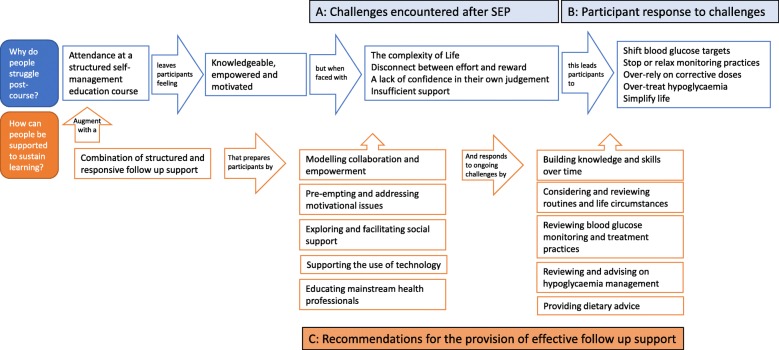
BACKGROUND: People with type 1 diabetes who attend structured education training in self-management using flexible intensive therapy achieve improved blood glucose control and experience fewer episodes of severe hypoglycaemia. However, many struggle to sustain these improvements over time. To inform the design of more effective follow-up support we undertook a review of qualitative studies which have identified factors that influence and inform participants' self-management behaviours after attending structured education and their need for support to sustain improvements in glycaemic control. METHODS: We undertook a meta-ethnography of relevant qualitative studies, identified using systematic search methods. Studies were included which focused on participants' experiences of self-managing type 1 diabetes after attending structured education which incorporated training in flexible intensive insulin therapy. A line of argument approach was used to synthesise the findings. RESULTS: The search identified 18 papers from six studies. The studies included were judged to be of high methodological quality. The line of argument synthesis developed the Follow-Up Support for Effective type 1 Diabetes self-management (FUSED) model. This model outlines the challenges participants encounter in maintaining diabetes self-management practices after attending structured education, and describes how participants try to address these barriers by adapting, simplifying or personalising the self-management approaches they have learned. To help participants maintain the skills taught during courses, the FUSED model presents ten recommendations abstracted from the included papers to provide a logic model for a programme of individualised and responsive follow-up support. CONCLUSIONS: This meta-ethnography highlights how providing skills training using structured education to people with type 1 diabetes does not necessarily result in participants adopting and sustaining recommended changes in behaviour. To help people sustain diabetes self-management skills after attending structured education, it is recommended that support be provided over the longer-term by appropriately trained healthcare professionals which is responsive to individuals' needs. Although developed to inform support for people with type 1 diabetes, the FUSED model provides a framework that could also be applied to support individuals with other long term conditions which require complex self-management skills to be learned and sustained over time. TRIAL REGISTRATION: PROSPERO registration: CRD42017067961 .
Overview
The claims and statistics of this paper haven’t been checked yet.
Free: it reads the open-access text and checks the first 5 claims that cite a source we can check. Create a free account to check every claim.
Integrity signals
Registry
Cites
Statistics
Figures
Verification
Claims the paper makes
The claims and statistics of this paper haven’t been checked yet.
Free: it reads the open-access text and checks the first 5 claims that cite a source we can check. Create a free account to check every claim.
Claims other papers make about this one
Each is checked against this paper’s own text: does it say what the citing paper says it does?
The source backs part of the claim, not all of it — or backs it for a different population, condition or comparison.
In the citing paper
“Internet-based DSMES services and telemedicine approaches for DM prevention and the management of T2D management have also been shown to be effective.1481–1484”
From American Association of Clinical Endocrinology Clinical Practice Guideline: Developing a Diabetes Mellitus Comprehensive Care Plan-2022 Update. (2022) · cites this paper as [1483]
Experimental — accuracy not yet measured
Self-check
Percentages, sums and reported differences re-computed from the paper’s own numbers.
The self-check needs the paper’s full text.
Citations
Cites
Diagnosis and Classification of Diabetes Mellitus
American Diabetes Association (2011) · Diabetes Care · doi:10.2337/dc11-s062 · Cited by 13,988
Noblit, G., & Hare, R. (1988) · doi:10.4135/9781412985000 · Cited by 2,723
Beyond PICO: The SPIDER Tool for Qualitative Evidence Synthesis
Cooke, A., Smith, D., & Booth, A. (2012) · Qualitative Health Research · doi:10.1177/1049732312452938 · Cited by 2,608
Meta-Ethnography: Synthesizing Qualitative Studies
Noblit, G. W., & Hare, R. D. (1988) · Medical Entomology and Zoology · Cited by 2,191
Self-Management Education for Adults With Type 2 Diabetes
Norris, S. L., Lau, J., Smith, S. J., Schmid, C. H., & Engelgau, M. M. (2002) · Diabetes Care · doi:10.2337/diacare.25.7.1159 · Cited by 1,750
Diagnosis and Classification of Diabetes Mellitus
American Diabetes Association (2004) · Diabetes Care · doi:10.2337/diacare.27.2007.s5 · Cited by 1,666
National Standards for Diabetes Self-Management Education
Funnell, M. M., Brown, T. L., Childs, B. P., Haas, L. B., Hosey, G. M., Jensen, B., Maryniuk, M., Peyrot, M., Piette, J. D., Reader, D., et al. (2009) · Diabetes Care · doi:10.2337/dc09-s087 · Cited by 1,350
Using meta ethnography to synthesise qualitative research: a worked example
Britten, N., Campbell, R., Pope, C., Donovan, J., Morgan, M., & Pill, R. (2002) · Journal of Health Services Research & Policy · doi:10.1258/135581902320432732 · Cited by 1,110
Conducting a meta-ethnography of qualitative literature: Lessons learnt
Atkins, S., Lewin, S., Smith, H., Engel, M., Fretheim, A., & Volmink, J. (2008) · BMC Medical Research Methodology · doi:10.1186/1471-2288-8-21 · Cited by 981
Campbell, R., Pound, P., Pope, C., Britten, N., Pill, R., Morgan, M., & Donovan, J. (2003) · Social Science & Medicine · doi:10.1016/s0277-9536(02)00064-3 · Cited by 921
Daneman, D. (2006) · The Lancet · doi:10.1016/s0140-6736(06)68341-4 · Cited by 921
Amiel, S. A., Beveridge, S., Bradley, C., Gianfrancesco, C., Heller, S. R., James, P., McKeown, N., Newton, D. F., Newton, L. D., Oliver, L., et al. (2002) · Deakin Research Online (Deakin University) · Cited by 723
Self-citationNational Standards for Diabetes Self-Management Education and Support
Haas, L., Maryniuk, M., Beck, J., Cox, C. E., Duker, P., Edwards, L., Fisher, E. B., Hanson, L., Kent, D., Kolb, L., et al. (2012) · Diabetes Care · doi:10.2337/dc12-1707 · Cited by 663 · cited 1×
“As a result, many people struggle to achieve optimal glycaemic control; hence, diabetes self-management education/training is now considered a critical element of care [6].”
BackgroundTricco, A. C., Ivers, N. M., Grimshaw, J. M., Moher, D., Turner, L., Galipeau, J., Halperin, I., Vachon, B., Ramsay, T., Manns, B., et al. (2012) · The Lancet · doi:10.1016/s0140-6736(12)60480-2 · Cited by 652
Evaluating meta-ethnography: systematic analysis and synthesis of qualitative research
Campbell, R., Pound, P., Morgan, M., Daker-White, G., Britten, N., Pill, R., Yardley, L., Pope, C., & Donovan, J. (2011) · Health Technology Assessment · doi:10.3310/hta15430 · Cited by 619 · cited 2×
“Appraising the included studies ensured careful and systematic reading of the included studies [27] and yielded descriptive information on aspects of the quality of the included papers which provided context for the meta-ethnographic synthesis.”
BackgroundMethodGreenwood, D. A., Gee, P. M., Fatkin, K. J., & Peeples, M. (2017) · Journal of Diabetes Science and Technology · doi:10.1177/1932296817713506 · Cited by 526
National Standards for Diabetes Self-Management Education
Funnell, M. M., Brown, T. L., Childs, B. P., Haas, L. B., Hosey, G. M., Jensen, B., Maryniuk, M., Peyrot, M., Piette, J. D., Reader, D., et al. (2008) · Diabetes Care · doi:10.2337/dc08-s097 · Cited by 497
Patterson, C. C., Gyürüs, E., Rosenbauer, J., Cinek, O., Neu, A., Schober, E., Parslow, R. C., Joner, G., Svensson, J., Castell, C., et al. (2012) · Diabetologia · doi:10.1007/s00125-012-2571-8 · Cited by 470
Malpass, A., Shaw, A., Sharp, D., Walter, F., Feder, G., Ridd, M., & Kessler, D. (2009) · Social Science & Medicine · doi:10.1016/j.socscimed.2008.09.068 · Cited by 368
Secrest, A. M., Becker, D. J., Kelsey, S. F., LaPorte, R. E., & Orchard, T. J. (2010) · Diabetes · doi:10.2337/db10-0862 · Cited by 358
Pavey, T., Anokye, N., Taylor, A., Trueman, P., Moxham, T., Fox, K., Hillsdon, M., Green, C., Campbell, J., Foster, C., et al. (2011) · Health Technology Assessment · doi:10.3310/hta15440 · Cited by 351
Toye, F., Seers, K., Allcock, N., Briggs, M., Carr, E., & Barker, K. (2014) · BMC Medical Research Methodology · doi:10.1186/1471-2288-14-80 · Cited by 322
M�hlhauser, I., J�rgens, V., Berger, M., Graninger, W., G�rtler, W., Hornke, L., Kunz, A., Schernthaner, G., Scholz, V., & Voss, H. E. (1983) · Diabetologia · doi:10.1007/bf00284453 · Cited by 269
Hopkins, D., Lawrence, I., Mansell, P., Thompson, G., Amiel, S., Campbell, M., & Heller, S. (2012) · Diabetes Care · doi:10.2337/dc11-1579 · Cited by 265
Self-citationMühlhauser, I., Bruckner, I., Berger, M., Cheţa, D., Jörgens, V., Ionescu-Tîrgovişte, C., Scholz, V., & Mincu, I. (1987) · Diabetologia · doi:10.1007/bf00296989 · Cited by 262
Soedamah-Muthu, S. S., Fuller, J. H., Mulnier, H. E., Raleigh, V. S., Lawrenson, R. A., & Colhoun, H. M. (2006) · Diabetologia · doi:10.1007/s00125-005-0120-4 · Cited by 240
Intensified insulin therapy and the risk of severe hypoglycaemia
Bott, S., Bott, U., Berger, M., & Mühlhauser, I. (1997) · Diabetologia · doi:10.1007/s001250050769 · Cited by 180
Secrest, A. M., Becker, D. J., Kelsey, S. F., LaPorte, R. E., & Orchard, T. J. (2010) · Diabetes Care · doi:10.2337/dc10-1170 · Cited by 176
Evaluation of a Structured Outpatient Group Education Program for Intensive Insulin Therapy
Pieber, T. R., Brunner, G. A., Schnedl, W. J., Schattenberg, S., Kaufmann, P., & Krejs, G. J. (1995) · Diabetes Care · doi:10.2337/diacare.18.5.625 · Cited by 160
Speight, J., Amiel, S. A., Bradley, C., Heller, S., Oliver, L., Roberts, S., Rogers, H., Taylor, C., & Thompson, G. (2010) · Diabetes Research and Clinical Practice · doi:10.1016/j.diabres.2010.03.017 · Cited by 160
Self-citationNational Standards for Diabetes Self-Management Education and Support
Haas, L., Maryniuk, M., Beck, J., Cox, C. E., Duker, P., Edwards, L., Fisher, E., Hanson, L., Kent, D., Kolb, L., et al. (2012) · The Diabetes Educator · doi:10.1177/0145721712455997 · Cited by 154
Handbook of obesity—clinical applications
Levine, A. S. (2004) · American Journal of Clinical Nutrition · doi:10.1093/ajcn/80.3.794a · Cited by 150
Plank, J., K�hler, G., Rakovac, I., Semlitsch, B., Horvath, K., Bock, G., Kraly, B., & Pieber, T. R. (2004) · Diabetologia · doi:10.1007/s00125-004-1456-x · Cited by 123
Snow, R., Humphrey, C., & Sandall, J. (2013) · BMJ Open · doi:10.1136/bmjopen-2013-003583 · Cited by 103
Lowe, J., Linjawi, S., Mensch, M., James, K., & Attia, J. (2008) · Diabetes Research and Clinical Practice · doi:10.1016/j.diabres.2008.02.003 · Cited by 92
Handbook of Self-Help Therapies
(2007) · doi:10.4324/9780203935439 · Cited by 77
Heller, S., White, D., Lee, E., Lawton, J., Pollard, D., Waugh, N., Amiel, S., Barnard, K., Beckwith, A., Brennan, A., et al. (2017) · Health Technology Assessment · doi:10.3310/hta21200 · Cited by 73
Self-citationLawton, J., Rankin, D., Cooke, D. D., Clark, M., Elliot, J., & Heller, S. R. (2010) · Diabetes Research and Clinical Practice · doi:10.1016/j.diabres.2010.11.007 · Cited by 71
Self-citationLawton, J., & Rankin, D. (2010) · Social Science & Medicine · doi:10.1016/j.socscimed.2010.04.030 · Cited by 71
Self-citationMurphy, K., Casey, D., Dinneen, S. F., Lawton, J., & Brown, F. J. (2011) · Journal of Clinical Nursing · doi:10.1111/j.1365-2702.2010.03564.x · Cited by 71
Self-citationFrost, J., Garside, R., Cooper, C., & Britten, N. (2014) · BMC Health Services Research · doi:10.1186/1472-6963-14-348 · Cited by 70
the UK NIHR DAFNE Study Group, Rankin, D., Cooke, D. D., Elliott, J., Heller, S. R., & Lawton, J. (2012) · BMC Public Health · doi:10.1186/1471-2458-12-652 · Cited by 63
Self-citationDose adjustment for normal eating (DAFNE)—an audit of outcomes in Australia
McIntyre, H. D., Knight, B. A., Harvey, D. M., Noud, M. N., Hagger, V. L., & Gilshenan, K. S. (2010) · Medical Journal of Australia · doi:10.5694/j.1326-5377.2010.tb03662.x · Cited by 61
Gunn, D., & Mansell, P. (2012) · Diabetic Medicine · doi:10.1111/j.1464-5491.2011.03525.x · Cited by 57
Lawton, J., Rankin, D., Cooke, D. D., Elliott, J., Amiel, S., Heller, S., & for the UK NIHR DAFNE Study Group (2013) · Diabetic Medicine · doi:10.1111/dme.12007 · Cited by 54
Self-citationFranc, S., Dardari, D., Boucherie, B., Riveline, J. P., Biedzinski, M., Petit, C., Requeda, E., Leurent, P., Varroud-Vial, M., Hochberg, G., et al. (2009) · Diabetes & Metabolism · doi:10.1016/j.diabet.2009.05.006 · Cited by 54
Heller, S., Lawton, J., Amiel, S., Cooke, D., Mansell, P., Brennan, A., Elliott, J., Boote, J., Emery, C., Baird, W., et al. (2014) · Programme Grants for Applied Research · doi:10.3310/pgfar02050 · Cited by 53
Self-citationLawton, J., Rankin, D., Cooke, D. D., Elliott, J., Amiel, S. A., & Heller, S. R. (2012) · Diabetes Research and Clinical Practice · doi:10.1016/j.diabres.2012.09.024 · Cited by 47
Self-citationRankin, D., Cooke, D. D., Clark, M., Heller, S., Elliott, J., Lawton, J., & for the UK NIHR DAFNE Study Group (2011) · Diabetic Medicine · doi:10.1111/j.1464-5491.2011.03243.x · Cited by 45
Self-citationMcIntyre, D. H. (2006) · The Medical Journal of Australia · doi:10.5694/j.1326-5377.2006.tb00261.x · Cited by 42
Knight, B. A., McIntyre, D. H., Hickman, I. J., & Noud, M. (2016) · BMC Medical Informatics and Decision Making · doi:10.1186/s12911-016-0356-6 · Cited by 42
Rankin, D., Cooke, D. D., Heller, S. R., Elliott, D., Amiel, S. A., & Lawton, J. (2012) · Diabetic Medicine · doi:10.1111/j.1464-5491.2012.03670.x · Cited by 40
Self-citationRankin, D., Barnard, K. D., Elliott, D., Cooke, D. D., Heller, S. R., Gianfrancesco, C., Taylor, C., Lawton, J., & the UK NIHR DAFNE Study Group (2014) · Journal of Clinical Nursing · doi:10.1111/jocn.12539 · Cited by 39
Self-citationCasey, D., Murphy, K., Lawton, J., White, F. F., & Dineen, S. (2011) · BMC Public Health · doi:10.1186/1471-2458-11-672 · Cited by 37
Self-citationLawton, J., Kirkham, J., Rankin, D., Barnard, K., Cooper, C. L., Taylor, C., Heller, S., & Elliott, J. (2014) · Diabetes Research and Clinical Practice · doi:10.1016/j.diabres.2014.09.011 · Cited by 30
Self-citationPreventing Weight Regain After Weight Loss
Perri, M. G., Foreyt, J. P., & Anton, S. A. (2008) · CRC Press eBooks · doi:10.3109/9781420051452-16 · Cited by 27 · cited 1×
“This is a pattern frequently shown in evaluations of self-management programmes, where benefits can be short-lived, and may attenuate substantially six months to a year after a programme ends [54, 55].”
BackgroundSnow, R., Sandall, J., & Humphrey, C. (2014) · Diabetic Medicine · doi:10.1111/dme.12401 · Cited by 21
Structured education in type 1 diabetes
Heller, S. R. (2009) · The British Journal of Diabetes · doi:10.1177/1474651409351646 · Cited by 21
Self-citationShuttlewood, E., de Zoysa, N., Rankin, D., & Amiel, S. A. (2015) · Diabetes Research and Clinical Practice · doi:10.1016/j.diabres.2015.05.034 · Cited by 18
Self-citationCasey, D., O’Hara, M. C., Meehan, B., Byrne, M., Dinneen, S. F., & Murphy, K. (2014) · Journal of Mixed Methods Research · doi:10.1177/1558689814547579 · Cited by 16
An Ecological Perspective on Self-Help
Fisher, E. B., Glasgow, R. E., & Gabriele, J. M. (2007) · doi:10.4324/9780203935439.ch15 · Cited by 1 · cited 2×
“2016 [54] To obtain user feedback on the usability of the RapidCalc app in adults with T1DM already experienced in flexible MDI to inform further development of the app and identify user preferences.”
BackgroundMethod(2004) · PubMed
Research works printed but not linked: 4
- National Clinical Guideline, C., National Institute for Health and Care Excellence Clinical Guidelines, in Type 1 Diabetes in Adults: Diagnosis and Management 2015 London National Institute for Health and Care Excellence (UK
- Heller, S.L., Lawton J; Amiel S; Cooke D., Mansell P., Brennan A., Elliott J., Boote J., Emery C., Baird W., Basarir H., Beveridge S., Bond R., Campbell M., Chater T., Choudhary P., Clark M., de Zoysa N., Dixon S., Gianfrancesco C., Hopkins D., Hacques R., Kruger J., Moore S., Oliver L., Peasgood T., Rankin D., Roberts S., Rogers H., Taylor C., Thokala P., Thompson G., Ward C., Improving management of type 1 diabetes in teh UK: the Dose Adjustment For Normal Eating (DAFNE) programme as a research test-bed. A mixed metod analysis of the barriers to and facilitators of successful diabetes self-management, a health conomic analysis, a cluster randomised controlled trial of different models of delivery of an educational intervention and the pottential of insulin pubmps and additiaonal educator input to improve outcomes. NIHR PGfAR (ref: RP-PG-0514-20013). Programme Grants Appl Res, 2014. 2(5). 25642502
- NICE Methods for the development of NICE public health guidance 2012 third 27905711
- Corben S Rosen R Self-management for long-term conditions 2005 London King’s Fund
Cited by
Blonde, L., Umpierrez, G. E., Reddy, S. S., McGill, J. B., Berga, S. L., Bush, M., Chandrasekaran, S., DeFronzo, R. A., Einhorn, D., Galindo, R. J., et al. (2022) · Endocrine Practice · doi:10.1016/j.eprac.2022.08.002 · Cited by 507
ISPAD Clinical Practice Consensus Guidelines 2022: Diabetes education in children and adolescents
Olinder, A. L., Deabreu, M., Greene, S. A., Haugstvedt, A., Lange, K., Majaliwa, E., Pais, V., Pélicand, J., Town, M., & Mahmud, F. H. (2022) · Pediatric Diabetes · doi:10.1111/pedi.13418 · Cited by 168
“term by appropriately trained health care professionals in response to individuals' needs.(6,27,45) A study of structured education during the pedi-”
BackgroundSustained type 1 diabetes self‐management: Specifying the behaviours involved and their influences
Hamilton, K., Fay, S. H., Chadwick, P., Lorencatto, F., de Zoysa, N., Gianfrancesco, C., Taylor, C., Coates, E. J., Breckenridge, J. P., Cooke, D. D., et al. (2020) · Diabetic Medicine · doi:10.1111/dme.14430 · Cited by 71
“facilitators for sustaining self-management skills after attending a type 1 diabetes structured education programme.(19) This introduces a source of potential bias, in that the original data had already undergone a degree interpretation and synthesis by the review authors.”
BackgroundSelf-citationCrespo-González, C., Benrimoj, S. I., Scerri, M., & García‐Cárdenas, V. (2020) · Research in Social and Administrative Pharmacy · doi:10.1016/j.sapharm.2020.01.015 · Cited by 63
Patel, R., Kaur, K., & Singh, S. (2021) · Inflammopharmacology · doi:10.1007/s10787-021-00843-6 · Cited by 43
Metadata
- Authors
- Campbell, F., Lawton, J., Rankin, D., Clowes, M., Coates, E., Heller, S., de Zoysa, N., Elliott, J., & Breckenridge, J. P.
- Affiliations
- University of Sheffield (GB)
- University of Edinburgh (GB)
- University of Dundee (GB)
- Corresponding author
- Campbell, Fiona
- ORCID
- Venue
- BMC Health Services Research
- Published
- 2018-11-27
- Volume
- 18
- Issue
- 1
- Pages
- 898-898
- ISSN
- 1472-6963 (ISSN-L)
- PMC
- PMC6258400
- OpenAlex
- W2901674116
- Cited by
- 53
- References
- 64
- Citations by year
- 2026: 1 · 2025: 5 · 2024: 6 · 2023: 5 · 2022: 10 · 2021: 10 · 2020: 15 · 2019: 1
- FWCI
- 1.00
- Type
- journal article
- Language
- en
- Open access
- gold
- doi.org
- Licence
- cc-by
- creativecommons.org/licenses/by/4.0/ (tdm)
- Locations
- BMC Health Services Research (publishedVersion, cc-by)
- Europe PMC (PubMed Central) (publishedVersion, other-oa)
- PubMed Central (publishedVersion, cc-by)
- PubMed (publishedVersion)
- Discovery Research Portal (University of Dundee) (publishedVersion, cc-by)
- White Rose Research Online (University of Leeds, The University of Sheffield, University of York) (acceptedVersion)
- DOAJ (DOAJ: Directory of Open Access Journals) (submittedVersion, cc-by-sa)
- Edinburgh Research Explorer (University of Edinburgh) (submittedVersion, cc-by)
- Funders
- National Institute for Health Research Programme Grants for Applied Research (RP-PG-0514-20013)
- Topics
- Health Sciences › Medicine › Endocrinology, Diabetes and Metabolism › Diabetes Management and Education
- Health Sciences › Medicine › Endocrinology, Diabetes and Metabolism › Diabetes Management and Research
- Health Sciences › Medicine › Endocrinology, Diabetes and Metabolism › Diabetes Treatment and Management
- Keywords
- type 1 diabetes, diabetes self-management, structured education, follow-up support, glycemic control, behavior change, barriers and facilitators, chronic disease, patient experience
- MeSH terms
- Self-Management, Adult, Anthropology, Cultural, Blood Glucose, Diabetes Mellitus, Type 1, Female, Follow-Up Studies, Health Personnel, Humans, Hypoglycemia, Hypoglycemic Agents, Insulin, Male, Patient Education as Topic, Qualitative Research
About these checks
Registry, retraction, Cites and statistics results are computed, not judged, with one exception: a printed reference that no index lists is read once by a model before it counts as a citation error. Claims are extracted by a model and kept only when their quote appears verbatim in the text; each cited source is then checked, with a model’s help, for whether it says what the claim relies on. Those verdicts can be wrong — read the claim’s quote and the cited source before relying on one.
Statistics and arithmetic are recomputed, not judged.
Confidence bands are shown only for fields calibrated on our annotated test set. None is calibrated yet, so no band is shown.
What counts as a claim ›How we measure confidence ›How we check this ›
Are you an author, or do you see a problem with this page? Request a review
Data sources
Bibliographic data: Semantic Scholar, OpenAlex, Crossref.
Contains information from the Semantic Scholar Academic Graph Datasets, made available under the ODC Attribution License (ODC-BY 1.0).
Semantic Scholar’s data is described in: Kinney, R., et al. (2023). The Semantic Scholar Open Data Platform. arXiv:2301.10140.
