

The effectiveness of prescription drug monitoring programs at reducing opioid-related harms and consequences: a systematic review
Open accessThe DOI matches its Crossref record; 52 of the 53 references it cites were found in a registry or an index.
Abstract
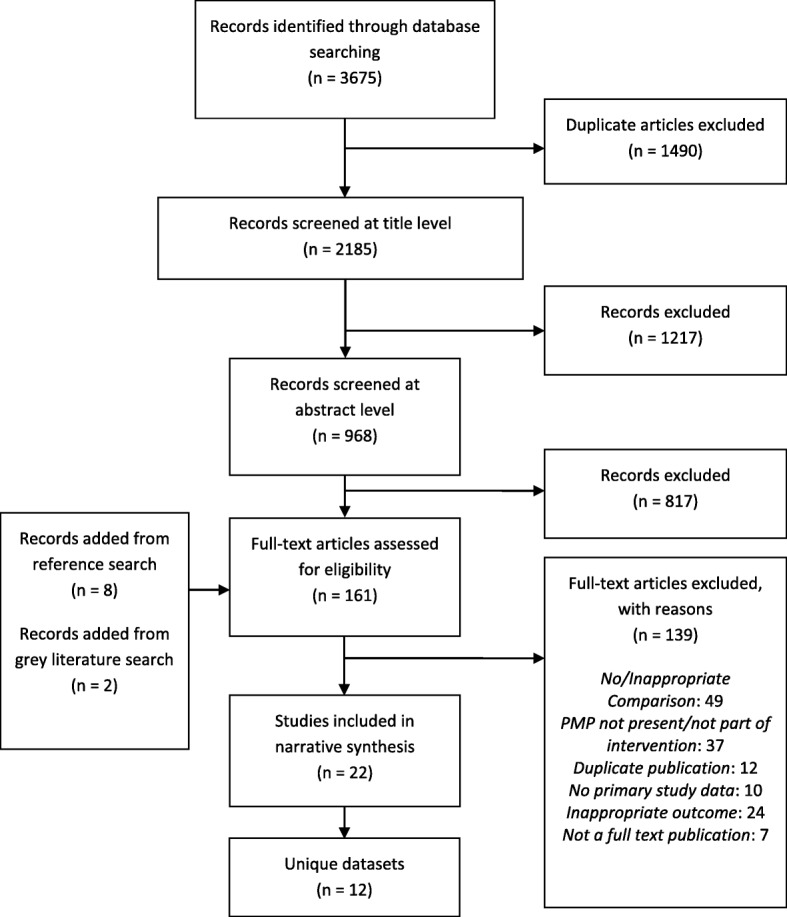
Background: In order to address the opioid crisis in North America, many regions have adopted preventative strategies, such as prescription drug monitoring programs (PDMPs). PDMPs aim to increase patient safety by certifying that opioids are prescribed in appropriate quantities. We aimed to synthesize the literature on changes in opioid-related harms and consequences, an important measure of PDMP effectiveness. Methods: We completed a systematic review. We conducted a narrative synthesis of opioid-related harms and consequences from PDMP implementation. Outcomes were grouped into categories by theme: opioid dependence, opioid-related care outcomes, opioid-related adverse events, and opioid-related legal and crime outcomes. Results: We included a total of 22 studies (49 PDMPs) in our review. Two studies reported on illicit and problematic use but found no significant associations with PDMP status. Eight studies examined the association between PDMP status and opioid-related care outcomes, of which two found that treatment admissions for prescriptions opioids were lower in states with PDMP programs (p < 0.05). Of the thirteen studies that reported on opioid-related adverse events, two found significant (p < 0.001 and p < 0.05) but conflicting results with one finding a decrease in opioid-related overdose deaths after PDMP implementation and the other an increase. Lastly, two studies found no statistically significant association between PDMP status and opioid-related legal and crime outcomes (crime rates, identification of potential dealers, and diversion). Conclusion: Our study found limited evidence to support overall associations between PDMPs and reductions in opioid-related consequences. However, this should not detract from the value of PDMPs’ larger role of improving opioid prescribing.
Overview
The claims and statistics of this paper haven’t been checked yet.
Free: it reads the open-access text and checks the first 5 claims that cite a source we can check. Create a free account to check every claim.
Integrity signals
Registry
Cites
Statistics
Figures
Verification
Claims the paper makes
The claims and statistics of this paper haven’t been checked yet.
Free: it reads the open-access text and checks the first 5 claims that cite a source we can check. Create a free account to check every claim.
Claims other papers make about this one
Each is checked against this paper’s own text: does it say what the citing paper says it does?
The check wasn’t confident either way, so it gives no verdict — never disputed.
In the citing paper
“Evidence is mixed regarding the effect of CM on prenatal care participation; studies have found either increased rates of attendance or no significant effect, with two low-quality studies showing a slight increase in attendance.201”
From The ASAM/AAAP Clinical Practice Guideline on the Management of Stimulant Use Disorder (2024) · cites this paper as [201]
Experimental — accuracy not yet measured
Self-check
Percentages, sums and reported differences re-computed from the paper’s own numbers.
The self-check needs the paper’s full text.
Citations
Cites
Cochrane Handbook for Systematic Reviews of Interventions: Cochrane Book Series
(2008) · doi:10.1002/9780470712184 · Cited by 25,048
Assessing Bias in Studies of Prognostic Factors
Hayden, J. A., van der Windt, D. A., Cartwright, J. L., Côté, P., & Bombardier, C. (2013) · Annals of Internal Medicine · doi:10.7326/0003-4819-158-4-201302190-00009 · Cited by 3,287 · cited 1×
“The QUIPS tool assesses risk of bias across six domains: study participation, study attrition, prognostic factor measurement, outcome measurement, study confounding, statistical analysis and reporting [36].”
MethodSelf-citationAssociation Between Opioid Prescribing Patterns and Opioid Overdose-Related Deaths
Bohnert, A. S. B. (2011) · JAMA · doi:10.1001/jama.2011.370 · Cited by 1,509
National and state treatment need and capacity for opioid agonist medication-assisted treatment
Jones, C. M., Campopiano, M., Baldwin, G., & McCance-Katz, E. (2015) · American Journal of Public Health · doi:10.2105/ajph.2015.302664 · Cited by 668 · cited 4×
“Background: In order to address the opioid crisis in North America, many regions have adopted preventative strategies, such as prescription drug monitoring programs (PDMPs).”
BackgroundInfluentialBrat, G. A., Agniel, D., Beam, A., Yorkgitis, B., Bicket, M., Homer, M., Fox, K. P., Knecht, D. B., McMahill-Walraven, C. N., Palmer, N., et al. (2018) · BMJ · doi:10.1136/bmj.j5790 · Cited by 591
Prescription Drug Monitoring Programs and Death Rates from Drug Overdose
Paulozzi, L. J., Kilbourne, E. M., & Desai, H. A. (2011) · Pain Medicine · doi:10.1111/j.1526-4637.2011.01062.x · Cited by 372 · cited 1×
“No significant association between PDMP status and fatal prescription opioid overdose deaths was observed in adjusted models in any of these studies [40, 45, 46, 53].”
ResultIedema, R., Allen, S., Britton, K., Piper, D., Baker, A., Grbich, C., Allan, A., Jones, L., Tuckett, A., Williams, A., et al. (2011) · BMJ · doi:10.1136/bmj.d4423 · Cited by 306
Patrick, S. W., Fry, C. E., Jones, T. F., & Buntin, M. B. (2016) · Health Affairs · doi:10.1377/hlthaff.2015.1496 · Cited by 299
State Legal Restrictions and Prescription-Opioid Use among Disabled Adults
Meara, E., Horwitz, J. R., Powell, W., McClelland, L., Zhou, W., O'Malley, A. J., & Morden, N. E. (2016) · New England Journal of Medicine · doi:10.1056/nejmsa1514387 · Cited by 251 · cited 2×
“A study examining cohorts of Medicare beneficiaries for each year from 2006 to 2012 in 45 states found no association between PDMP status and the proportion of insurance beneficiaries experiencing non-fatal prescription opioid overdoses in adjusted models [48].”
BackgroundDo Prescription Monitoring Programs Impact State Trends in Opioid Abuse/Misuse?
Reifler, L. M., Droz, D., Bailey, J. E., Schnoll, S. H., Fant, R., Dart, R. C., & Bucher Bartelson, B. (2012) · Pain Medicine · doi:10.1111/j.1526-4637.2012.01327.x · Cited by 243
Fink, D. S., Schleimer, J. P., Sarvet, A., Grover, K. K., Delcher, C., Castillo-Carniglia, A., Kim, J. H., Rivera-Aguirre, A. E., Henry, S. G., Martins, S. S., et al. (2018) · Annals of Internal Medicine · doi:10.7326/m17-3074 · Cited by 213 · cited 2×
“This review found uncertainty in the evidence around an increase or decrease in fatal and nonfatal overdoes after the implementation of PDMPs [23].”
BackgroundFacing up to the prescription opioid crisis
Dhalla, I. A., Persaud, N., & Juurlink, D. N. (2011) · BMJ · doi:10.1136/bmj.d5142 · Cited by 187 · cited 1×
“The crisis has been perpetuated, in part, by the over and inappropriate prescribing of opioids by health professionals, brought on by improvements in the treatment of chronic pain and pharmaceutical companies’ push to use opioids as a first line therapy [2, 3].”
BackgroundEconomic Costs of Nonmedical Use of Prescription Opioids
Hansen, R. N., Oster, G., Edelsberg, J., Woody, G. E., & Sullivan, S. D. (2011) · The Clinical Journal of Pain · doi:10.1097/ajp.0b013e3181ff04ca · Cited by 183
Mandatory Access Prescription Drug Monitoring Programs and Prescription Drug Abuse
Grecu, A. C., Dave, D., & Saffer, H. (2018) · Journal of Policy Analysis and Management · doi:10.1002/pam.22098 · Cited by 176
How good intentions contributed to bad outcomes: the opioid crisis
Rummans, T. A., Burton, M. C., & Dawson, N. L. (2018) · Mayo Clinic Proceedings · doi:10.1016/j.mayocp.2017.12.020 · Cited by 174 · cited 1×
“The crisis has been perpetuated, in part, by the over and inappropriate prescribing of opioids by health professionals, brought on by improvements in the treatment of chronic pain and pharmaceutical companies’ push to use opioids as a first line therapy [2, 3].”
BackgroundAli, M. M., Dowd, W. N., Classen, T., Mutter, R., & Novak, S. P. (2017) · Addictive Behaviors · doi:10.1016/j.addbeh.2017.01.011 · Cited by 153
Evaluating the impact of prescription drug monitoring program implementation: a scoping review
Finley, E. P., Garcia, A., Rosen, K., McGeary, D., Pugh, M. J., & Potter, J. S. (2017) · BMC Health Services Research · doi:10.1186/s12913-017-2354-5 · Cited by 152 · cited 1×
“An important measure of PDMP effectiveness is a reduction in opioid-related harms and consequences [22].”
BackgroundDelcher, C., Wagenaar, A. C., Goldberger, B. A., Cook, R. L., & Maldonado‐Molina, M. M. (2015) · Drug and Alcohol Dependence · doi:10.1016/j.drugalcdep.2015.02.010 · Cited by 126 · cited 4×
“0079), but not in nonoxycodone related overdoses [50].”
BackgroundMethodInfluentialReductions in prescription opioid diversion following recent legislative interventions in Florida
Surratt, H. L., O'Grady, C., Kurtz, S. P., Stivers, Y., Cicero, T. J., Dart, R. C., & Chen, M. (2014) · Pharmacoepidemiology and Drug Safety · doi:10.1002/pds.3553 · Cited by 113 · cited 2×
“As for diversion, an interrupted time series study from 2009 to 2012 found significant reductions in rates of diversion of oxycodone, methadone, and morphine in over time in Florida postPDMP implementation [26].”
BackgroundMeinhofer, A. (2017) · American Journal of Health Economics · doi:10.1162/ajhe_a_00101 · Cited by 101 · cited 2×
“No significant association between PDMP status and fatal prescription opioid overdose deaths was observed in adjusted models in any of these studies [40, 45, 46, 53].”
BackgroundReisman, R. M., Shenoy, P. J., Atherly, A. J., & Flowers, C. R. (2009) · Substance Abuse: Research and Treatment · doi:10.4137/sart.s2345 · Cited by 93 · cited 1×
“Broadly, PDMPs aim to restrict drug diversion and reduce opioid misuse-related harms [18, 19].”
BackgroundPrescription drug monitoring and drug overdose mortality
Li, G., Brady, J. E., Lang, B. H., Giglio, J. F., Wunsch, H., & DiMaggio, C. J. (2014) · Injury Epidemiology · doi:10.1186/2197-1714-1-9 · Cited by 86
Differences between men and women in self-reported body mass index and its relation to drug use
Vera-Villarroel, P., Piqueras, J. A., Walter Kühne, C., Cuijpers, P. J., & van Straten, A. (2014) · Substance Abuse Treatment Prevention and Policy · doi:10.1186/1747-597x-9-1 · Cited by 84
The Effect of Prescription Drug Monitoring Programs on Opioid Prescriptions and Heroin Crime RatesPreprint
Mallatt, J. (2017) · SSRN Electronic Journal · doi:10.2139/ssrn.3050692 · Cited by 79 · cited 2×
“Employing standardized, adjusted difference in difference models, no association was found between PDMP status and opioid-related crime rates or the identification of potential opioid dealers [55].”
BackgroundMethodState prescription drug monitoring programs and fatal drug overdoses.
Nam, Y. H., Shea, D. G., Shi, Y., & Moran, J. R. (2017) · PubMed · Cited by 77
An Evaluation of Prescription Drug Monitoring Programs: (597562007-001)
Simeone, R., & Holland, L. (2006) · PsycEXTRA Dataset · doi:10.1037/e597562007-001 · Cited by 74
Physician attitudes and experiences with Maryland's prescription drug monitoring program (PDMP)
Lin, D. H., Lucas, E., Murimi, I. B., Jackson, K., Baier, M., Frattaroli, S., Gielen, A. C., Moyo, P., Simoni‐Wastila, L., & Alexander, G. C. (2017) · Addiction · doi:10.1111/add.13620 · Cited by 70
Egan, J. E., Casadonte, P., Gartenmann, T., Martin, J., McCance-Katz, E. F., Netherland, J., Renner, J. A., Weiss, L., Saxon, A. J., & Fiellin, D. A. (2010) · Journal of General Internal Medicine · doi:10.1007/s11606-010-1377-y · Cited by 68
Pauly, N. J., Slavova, S., Delcher, C., Freeman, P. R., & Talbert, J. (2018) · Drug and Alcohol Dependence · doi:10.1016/j.drugalcdep.2017.12.002 · Cited by 63 · cited 1×
“Two unique studies examined the association between non-fatal overdose and PDMPs [48, 49].”
BackgroundFriends and family test should no longer be mandatory
Robert, G., Cornwell, J., & Black, N. A. (2018) · BMJ · doi:10.1136/bmj.k367 · Cited by 59
Rotter, T., Plishka, C., Hansia, M. R., Goodridge, D. M., Penz, E. D., Kinsman, L., Lawal, A. K., O’Quinn, S., Buchan, N., Comfort, P., et al. (2017) · BMC Health Services Research · doi:10.1186/s12913-017-2750-x · Cited by 58
Gabapentin Toxicity in Renal Failure: The Importance of Dose Adjustment
Miller, A., & Price, G. (2008) · Pain Medicine · doi:10.1111/j.1526-4637.2008.00492.x · Cited by 54
Lodahl, M., Treister, R., & Oaklander, A. L. (2018) · PAIN Reports · doi:10.1097/pr9.0000000000000633 · Cited by 52
Harms of prescription opioid use in the United States
Imtiaz, S., Shield, K. D., Fischer, B., & Rehm, J. (2014) · Substance Abuse Treatment, Prevention, and Policy · doi:10.1186/1747-597x-9-43 · Cited by 45 · cited 1×
“We also included outcomes related to illicit opioids such as heroin, as the literature suggests that there is the potential for PDMPs to push people who use prescription opioids to illicit sources [6].”
BackgroundOverdose and prescribed opioids: Associations among chronic non-cancer pain patients
Dunn, K. M., Saunders, K. W., Rutter, C. M., Banta‐Green, C. J., Merrill, J. O., Sullivan, M. D., Weisner, C. M., Silverberg, M. J., Campbell, C. I., Psaty, B. M., et al. (2010) · PubMed Central · doi:10.1059/0003-4819-152-2-201001190-00006 · Cited by 44
Li, G., & DiMaggio, C. J. (2014) · Injury Epidemiology · doi:10.1186/2197-1714-1-1 · Cited by 42
Devonshire, E., & Nicholas, M. K. (2018) · PAIN Reports · doi:10.1097/pr9.0000000000000688 · Cited by 36
Deaths related to the use of prescription opioids
Fischer, B., & Rehm, J. T. (2009) · Canadian Medical Association Journal · doi:10.1503/cmaj.091791 · Cited by 34
Prescription monitoring programs and emergency department visits involving opioids, 2004–2011
Maughan, B. C., Bachhuber, M. A., Mitra, N., & Starrels, J. L. (2015) · Drug and Alcohol Dependence · doi:10.1016/j.drugalcdep.2015.09.024 · Cited by 33 · cited 1×
“That same study, along with an interrupted time series study on nine states from 2004 to 2011 using the DAWN data set, found no statistically significant associations when examining emergency department visits for all prescription opioids, Schedule II opioids, and heroin over time when comparing PDMP jurisdictions to…”
ResultOverview of Four Prescription Monitoring/Review Programs in Canada
Furlan, A. D., MacDougall, P., Pellerin, D., Shaw, K., Spitzig, D., Wilson, G., & Wright, J. (2014) · Pain Research and Management · doi:10.1155/2014/634171 · Cited by 32
Prescription Drug Monitoring Programs and Opioid Overdoses: Exploring Sources of Heterogeneity
Castillo‐Carniglia, Á., Ponicki, W. R., Gaidus, A. J., Gruenewald, P. J., Marshall, B. D. L., Fink, D. S., Martins, S. S., Rivera‐Aguirre, A., Wintemute, G. J., & Cerdá, M. (2018) · Epidemiology · doi:10.1097/ede.0000000000000950 · Cited by 32
Mandatory Access Prescription Drug Monitoring Programs and Prescription Drug Abuse
Dave, D., Grecu, A. C., & Saffer, H. (2017) · National Bureau of Economic Research · doi:10.3386/w23537 · Cited by 30
Borwein, A., Kephart, G. C., Whelan, E., & Asbridge, M. (2013) · Journal of Pain · doi:10.1016/j.jpain.2013.08.012 · Cited by 29
Self-citationThe Mitigating Role of Prescription Drug Monitoring Programs in the Abuse of Prescription DrugsPreprint
Birk, E., & Waddell, G. R. (2017) · SSRN Electronic Journal · doi:10.2139/ssrn.3037875 · Cited by 21 · cited 2×
“Included studies varied in how they measured Table 2 Detailed risk of bias and quality assessment using the QUIPs tool Study Study participation Study attrition PMP measurement Outcome measurement Study confounding Statistical analysis and reporting Ali 2017 [24] moderate low moderate moderate low low Birk 2017 [43] l…”
BackgroundMethodBranham, D. K. (2017) · Substance Use & Misuse · doi:10.1080/10826084.2017.1363232 · Cited by 17 · cited 4×
“found no association between PDMP status and prescription opioid treatment admissions [27, 42].”
BackgroundMethodInfluentialRobinson, A., Wilson, M. N., Hayden, J. A., Rhodes, E., Campbell, S., MacDougall, P., & Asbridge, M. (2020) · Pain Medicine · doi:10.1093/pm/pnaa412 · Cited by 15
Self-citationPrescription monitoring programs: Best practice and Canadian program review
Sproule, B. A. (2015) · Drug and Alcohol Dependence · doi:10.1016/j.drugalcdep.2015.07.565 · Cited by 14
The evolution of prescription drug monitoring programs
Ashburn, M. A. (2016) · Pharmacoepidemiology and Drug Safety · doi:10.1002/pds.4036 · Cited by 11 · cited 1×
“Broadly, PDMPs aim to restrict drug diversion and reduce opioid misuse-related harms [18, 19].”
BackgroundTake-home naloxone kits preventing overdose deaths
Eggertson, L. (2013) · Canadian Medical Association Journal · doi:10.1503/cmaj.109-4663 · Cited by 8
PMH65 EFFECT OF PRESCRIPTION MONITORING PROGRAMS (PMP'S) ON OPIOID OVERDOSE ADMISSION
Painter, J. T. (2011) · Value in Health · doi:10.1016/j.jval.2011.02.1089 · Cited by 1
Fleming, M., Barner, J., & Bamgbade, B. (2010) · Value in Health · doi:10.1016/s1098-3015(10)72444-x · Cited by 1
202EMF Do State Prescription Drug Monitoring Programs Reduce Opioid Consumption?
Menchine, M. D., Georgis, M., Lam, C. N., & Seabury, S. A. (2016) · Annals of Emergency Medicine · doi:10.1016/j.annemergmed.2016.08.216 · Cited by 1
Research works printed but not linked: 7
- Brandeis University Technical assistance guide: history of Prescription drug monitoring programs [internet] 2018
- McLaughlin S Empirical Essays to inform marijuana legalization and Prescription opioid Abuse policy [internet] 2016
- Veritas Health Innovation Covidence Systematic Review Software 2017
- PRISMA PRISMA: Transparent Reporting of Systematic Reviews and Meta-Analyses [Internet] 2015
- Microsoft Excel 2016
- StataCorp Stata 15 2017
- Asbridge M Hayden J Campbell S Wilson M Macdougall P Utilization and effectiveness of Prescription monitoring programs: a systematic review (CIHR Report) 2018 Halifax In Press PMC8311582 33484144
Cited by
Strang, J., Volkow, N. D., Degenhardt, L., Hickman, M., Johnson, K., Koob, G. F., Marshall, B. D. L., Tyndall, M., & Walsh, S. L. (2020) · Nature Reviews Disease Primers · doi:10.1038/s41572-019-0137-5 · Cited by 639
The Opioid Epidemic: A Review of the Contributing Factors, Negative Consequences, and Best Practices
Judd, D., King, C. R., & Galke, C. L. (2023) · Cureus · doi:10.7759/cureus.41621 · Cited by 107
“Buprenorphine is an opioid-based medication primarily used for treating opioid use disorder (OUD), acute pain, and chronic pain.”
BackgroundInfluentialThe ASAM/AAAP Clinical Practice Guideline on the Management of Stimulant Use Disorder
(2024) · Journal of Addiction Medicine · doi:10.1097/adm.0000000000001299 · Cited by 78
Bardwell, G., Small, W., Lavalley, J., McNeil, R., & Kerr, T. H. (2021) · Social Science & Medicine · doi:10.1016/j.socscimed.2021.113986 · Cited by 75
Picco, L., Lam, T., Haines, S., & Nielsen, S. (2021) · Drug and Alcohol Dependence · doi:10.1016/j.drugalcdep.2021.109090 · Cited by 45
Metadata
- Authors
- Rhodes, E., Wilson, M., Robinson, A., Hayden, J. A., & Asbridge, M.
- Affiliations
- Dalhousie University (CA)
- Corresponding author
- Asbridge, Mark
- Venue
- BMC Health Services Research
- Published
- 2019-11-01
- Volume
- 19
- Issue
- 1
- Pages
- 784-784
- ISSN
- 1472-6963 (ISSN-L)
- PMC
- PMC6825333
- OpenAlex
- W2988262664
- Cited by
- 103
- References
- 53
- Citations by year
- 2026: 6 · 2025: 9 · 2024: 10 · 2023: 26 · 2022: 20 · 2021: 26 · 2020: 6
- FWCI
- 2.13
- Type
- journal article
- Language
- en
- Open access
- gold
- doi.org
- Licence
- cc-by
- creativecommons.org/licenses/by/4.0/ (tdm)
- creativecommons.org/licenses/by/4.0/ (vor)
- Locations
- BMC Health Services Research (publishedVersion, cc-by)
- PubMed Central (publishedVersion, cc-by)
- PubMed (publishedVersion)
- uO Research (University of Ottawa) (submittedVersion, public-domain)
- DOAJ (DOAJ: Directory of Open Access Journals) (submittedVersion, cc-by-sa)
- Funders
- Canadian Institutes of Health Research (397982)
- Topics
- Health Sciences › Medicine › Public Health, Environmental and Occupational Health › Opioid Use Disorder Treatment
- Health Sciences › Medicine › Epidemiology › Substance Abuse Treatment and Outcomes
- Health Sciences › Medicine › Anesthesiology and Pain Medicine › Pain Management and Opioid Use
- Keywords
- prescription drug monitoring programs, opioid epidemic, opioid-related harms, opioid prescribing, opioid use disorder, opioid overdose deaths, opioid side effects, illicit opioid use, drug diversion
- MeSH terms
- Prescription Drug Monitoring Programs, Humans, Opioid-Related Disorders, Program Evaluation, Randomized Controlled Trials as Topic
About these checks
Registry, retraction, Cites and statistics results are computed, not judged, with one exception: a printed reference that no index lists is read once by a model before it counts as a citation error. Claims are extracted by a model and kept only when their quote appears verbatim in the text; each cited source is then checked, with a model’s help, for whether it says what the claim relies on. Those verdicts can be wrong — read the claim’s quote and the cited source before relying on one.
Statistics and arithmetic are recomputed, not judged.
Confidence bands are shown only for fields calibrated on our annotated test set. None is calibrated yet, so no band is shown.
What counts as a claim ›How we measure confidence ›How we check this ›
Are you an author, or do you see a problem with this page? Request a review
Data sources
Bibliographic data: Semantic Scholar, OpenAlex, Crossref.
Contains information from the Semantic Scholar Academic Graph Datasets, made available under the ODC Attribution License (ODC-BY 1.0).
Semantic Scholar’s data is described in: Kinney, R., et al. (2023). The Semantic Scholar Open Data Platform. arXiv:2301.10140.
