

Unpacking organizational readiness for change: an updated systematic review and content analysis of assessments
Open accessThe DOI matches its Crossref record; 46 of the 47 references it cites were found in a registry or an index.
Abstract
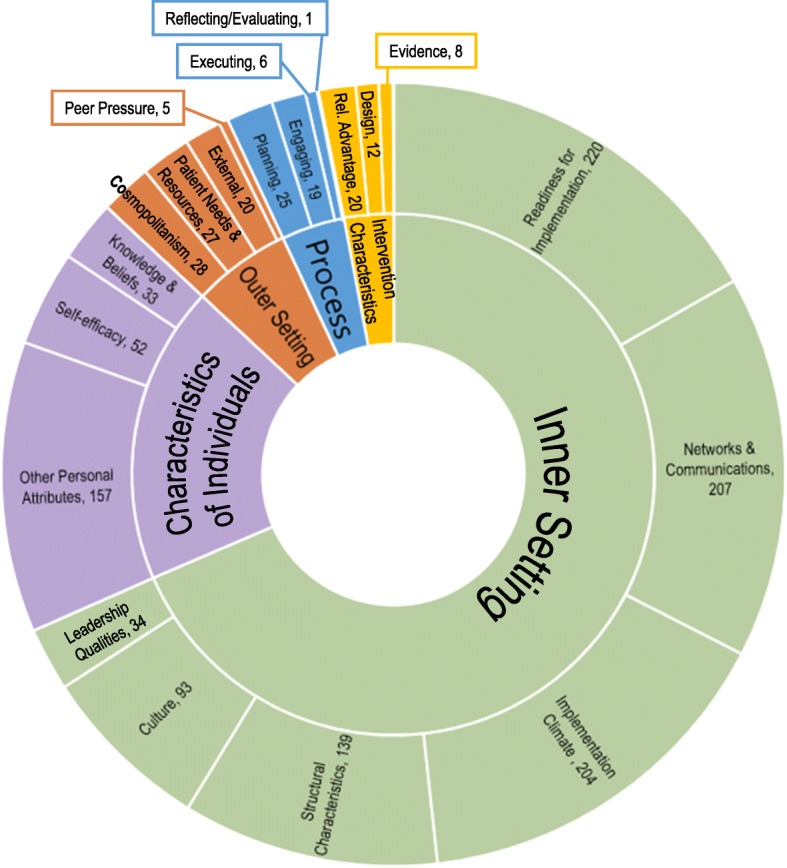
Background: Organizational readiness assessments have a history of being developed as important support tools for successful implementation. However, it remains unclear how best to operationalize readiness across varied projects or settings. We conducted a synthesis and content analysis of published readiness instruments to compare how investigators have operationalized the concept of organizational readiness for change. Methods: We identified readiness assessments using a systematic review and update search. We mapped individual assessment items to the Consolidated Framework for Implementation Research (CFIR), which identifies five domains affecting implementation (outer setting, inner setting, intervention characteristics, characteristics of individuals, and implementation process) and multiple constructs within each domain. Results: Of 1370 survey items, 897 (68%) mapped to the CFIR domain of inner setting, most commonly related to constructs of readiness for implementation (n = 220); networks and communication (n = 207); implementation climate (n = 204); structural characteristics (n = 139); and culture (n = 93). Two hundred forty-two items (18%) mapped to characteristics of individuals (mainly other personal attributes [n = 157] and self-efficacy [n = 52]); 80 (6%) mapped to outer setting; 51 (4%) mapped to implementation process; 40 (3%) mapped to intervention characteristics; and 60 (4%) did not map to CFIR constructs. Instruments were typically tailored to specific interventions or contexts. Discussion: Available readiness instruments predominantly focus on contextual factors within the organization and characteristics of individuals, but the specificity of most assessment items suggests a need to tailor items to the specific scenario in which an assessment is fielded. Readiness assessments must bridge the gap between measuring a theoretical construct and factors of importance to a particular implementation.
Overview
The claims and statistics of this paper haven’t been checked yet.
Free: it reads the open-access text and checks the first 5 claims that cite a source we can check. Create a free account to check every claim.
Integrity signals
Registry
Cites
Statistics
Figures
Verification
Claims the paper makes
The claims and statistics of this paper haven’t been checked yet.
Free: it reads the open-access text and checks the first 5 claims that cite a source we can check. Create a free account to check every claim.
Claims other papers make about this one
Each is checked against this paper’s own text: does it say what the citing paper says it does?
The cited source says what the claim attributes to it.
In the citing paper
“Some users recommended dividing the Inner Setting into multiple levels [52] to account for teams or units [53, 54].”
From The updated consolidated framework for implementation research based on user feedback (2022) · cites this paper as [53]
Self-check
Percentages, sums and reported differences re-computed from the paper’s own numbers.
The self-check needs the paper’s full text.
Citations
Cites
Three Approaches to Qualitative Content Analysis
Hsieh, H.-F., & Shannon, S. E. (2005) · Qualitative Health Research · doi:10.1177/1049732305276687 · Cited by 44,601
PRISMA-P Group, Moher, D., Shamseer, L., Clarke, M., Ghersi, D., Liberati, A., Petticrew, M., Shekelle, P., & Stewart, L. A. (2015) · Systematic Reviews · doi:10.1186/2046-4053-4-1 · Cited by 26,223
Damschroder, L. J., Aron, D. C., Keith, R. E., Kirsh, S. R., Alexander, J. A., & Lowery, J. C. (2009) · Implementation Science · doi:10.1186/1748-5908-4-50 · Cited by 14,496 · cited 6×
“values, and basic assumptions of a given organization” [13] contained 93 items that were never specific to a particular”
BackgroundMethodInfluentialDiffusion of Innovations in Service Organizations: Systematic Review and Recommendations
GREENHALGH, T., ROBERT, G., MACFARLANE, F., BATE, P., & KYRIAKIDOU, O. (2004) · The Milbank Quarterly · doi:10.1111/j.0887-378x.2004.00325.x · Cited by 7,448 · cited 1×
“Background The rapid growth of multi-disciplinary fields, including implementation science, brings along with it the propagation of more terminology [1, 2].”
BackgroundAdvancing a Conceptual Model of Evidence-Based Practice Implementation in Public Service Sectors
Aarons, G. A., Hurlburt, M., & Horwitz, S. M. (2011) · Administration and Policy in Mental Health and Mental Health Services Research · doi:10.1007/s10488-010-0327-7 · Cited by 3,240 · cited 1×
“And while the definition of organizational readiness for change can be either intervention-specific or more general, [7, 14, 44, 45] in developing measures authors chose to be intervention-specific for 23 of the 29 assessment uses we identified.”
BackgroundA theory of organizational readiness for change
Weiner, B. J. (2009) · Implementation Science · doi:10.1186/1748-5908-4-67 · Cited by 2,268
Wandersman, A., Duffy, J., Flaspohler, P., Noonan, R., Lubell, K., Stillman, L., Blachman, M., Dunville, R., & Saul, J. (2008) · American Journal of Community Psychology · doi:10.1007/s10464-008-9174-z · Cited by 1,339 · cited 1×
“And while the definition of organizational readiness for change can be either intervention-specific or more general, [7, 14, 44, 45] in developing measures authors chose to be intervention-specific for 23 of the 29 assessment uses we identified.”
BackgroundAarons, G. A. (2004) · Mental Health Services Research · doi:10.1023/b:mhsr.0000024351.12294.65 · Cited by 1,272
Readiness for Organizational Change: The Systematic Development of a Scale
Holt, D. T., Armenakis, A. A., Feild, H. S., & Harris, S. G. (2007) · The Journal of Applied Behavioral Science · doi:10.1177/0021886306295295 · Cited by 1,243
Interpretation of Educational Measurements
Freeman, F. S., & Kelley, T. L. (1928) · The American Journal of Psychology · doi:10.2307/1414476 · Cited by 877
Research works printed but not linked: 1
- Helfrich CD, Hannon PA, Harris JR, Kohn MJ, Hammerback K, Parrish AT, et al. Does readiness-to-change change readiness to implement wellness practices among work sites participating in a site-randomized implementation trial? Poster presentation at the 10th annual conference on the science of dissemination and implementation in health. Arlington; 2017.
Cited by
Items 101–169 of 169
Purvis, R., Taylor, N., Young, M., James, P. A., & Forrest, L. E. (2025) · Journal of Genetic Counseling · doi:10.1002/jgc4.70084 · Cited by 2
Liang, J., Tan, X., Li, Y., Yang, X., Miao, J., Xu, Y., & Li, W. (2025) · Journal of Multidisciplinary Healthcare · doi:10.2147/jmdh.s565297 · Cited by 2
“17,18 A review by Kirk et al further reported that many published studies either applied CFIR superficially or encountered methodological challenges during its use.”
Hilminata, A. N., & Alamsjah, F. (2025) · International Conference on Information Technology and Digital Applications (ICITDA) · doi:10.1109/icitda68167.2025.11332422 · Cited by 1
Are We Really Studying Organizational Change? Next Steps in Moving Forward
Holten, A., Schwarz, G. M., & Bouckenooghe, D. (2026) · The Journal of Applied Behavioral Science · doi:10.1177/00218863251398617 · Cited by 2
“A large amount of change studies use data derived from narratives, observations, interviews, and surveys eliciting attitudes, perceptions, and impressions of change (Caci et al., 2025; Miake-Lye et al., 2020; Oreg et al., 2011).”
Ivert, A., Freyland, S., Stephansson, O., Viirman, F., & Edqvist, M. (2026) · BMC Health Services Research · doi:10.1186/s12913-026-14187-w · Cited by 2
“…Inner Setting in CFIR, including structural characteristics, resources, adequate staffing, and implementation climate (i.e., readiness for change) [29], may shape patient safety culture by enabling its development when these conditions are sufficient, or hindering it when they are lacking [13,…”
Organizational change readiness for team science: a pathway framework for team science success
Lotrecchiano, G. R., DiazGranados, D., Vitale, A., & Huntt, M. B. (2026) · Frontiers in Psychology · doi:10.3389/fpsyg.2026.1761789 · Cited by 2
Analyzing the critical factors of digital readiness for construction enterprises
Chen, B., Luo, M., Yu, H., & Zhang, N. (2026) · Engineering Construction & Architectural Management · doi:10.1108/ecam-07-2025-1093 · Cited by 2
Kelly, P., Hegarty, J. M., Dyer, K. R., & Donovan, A. O. (2022) · Journal of Addictions Nursing · doi:10.1097/jan.0000000000000471 · Cited by 2
Lwin, K., Fallon, B., Houston, E. A. L., Wilson, R., Fluke, J., Jud, A., & Trocmé, N. (2023) · Journal of Public Child Welfare · doi:10.1080/15548732.2023.2182398 · Cited by 3
Kesiapan Dosen dalam Menghadapi Perubahan
Nashiruddin, M. F., Nuraini, S., & Wibowo, D. S. (2023) · Jurnal Psikologi · doi:10.47134/pjp.v1i3.2006 · Cited by 1
“Tugas utama dosen adalah untuk mentransformasikan, mengembangkan, dan menyebarkan pengetahuan, teknologi, dan seni melalui kegiatan pendidikan, penelitian, dan pengabdian kepada masyarakat (Miake-Lye, 2020).”
BackgroundPerceptual drivers for individual readiness for change in question
Saïd, K., & Kherrazi, S. (2024) · Management & Prospective · doi:10.3917/g2000.402.0089 · Cited by 2
Unlocking the sources of individual readiness for change: exploring the role of nationality
Saïd, K., Kherrazi, S., & Gottschling-Knudsen, L. (2024) · Journal of Management Development · doi:10.1108/jmd-11-2023-0329 · Cited by 5
Aljendi, S., Mrklas, K., & Kamal, N. R. (2024) · Healthcare · doi:10.3390/healthcare12181801 · Cited by 3
“This observation aligns with the findings from [39], where organizational readiness was linked to stakeholder engagement.”
ResultMudzi, P. Y., & Bruce, J. C. (2024) · International Journal of Africa Nursing Sciences · doi:10.1016/j.ijans.2024.100794 · Cited by 1
Implementation considerations for delivering inpatient COVID rehabilitation: A qualitative study
Sheppard, C. L., Szigeti, Z., Simpson, R., Minezes, J., Hitzig, S. L., Mayo, A. L., Robinson, L. R., Lung, M., & Wasilewski, M. B. (2022) · Journal of Evaluation in Clinical Practice · doi:10.1111/jep.13757
Determinant of SMEs Readiness for The Implementation of International Financial Reporting Standards
Tanimu, I. M., Musa, A., & Haruna, M. (2023) · The European Proceedings of Social & Behavioural Sciences · doi:10.15405/epsbs.2023.11.02.16
Madrigal, L., Manders, O. C., Kegler, M. C., Haardörfer, R., Piper, S., Blais, L. M., Weber, M. B., & Escoffery, C. (2022) · Research Square · doi:10.21203/rs.3.rs-1665651/v1
McPhee, J., Huett, B., Brogan, L. A., McCurdy, E., NeMoyer, A., Kreimer, R., DeYoung, L., & Goldstein, N. E. S. (2023) · Journal of Applied Juvenile Justice Services · doi:10.52935/23.13316.05 · Cited by 1
“Individual and organizational readiness for change has been widely studied across several diverse settings (Miake-Lye et al., 2020), including healthcare (Alexander & Hearld, 2012; Vaishnavi et al., 2019), community mental health clinics (Stanhope et al., 2019), child welfare agencies (Mersky et…”
BackgroundYahya, S., & Tanimu, I. M. (2023) · International Journal of Advanced Research in Economics and Finance · doi:10.55057/ijaref.2023.5.3.2
Perceptual drivers for individual readiness for change in question
Saïd, K., & Kherrazi, S. (2024) · Management & Prospective · doi:10.3917/g2000.402.0075 · Cited by 1
Kong, I., Janssen, M., & Bharosa, N. (2024) · Lecture notes in computer science · doi:10.1007/978-3-031-70274-7_27 · Cited by 2
Hurlocker, M. C., Carlon, H. A., & Hernandez‐Vallant, A. (2024) · Journal of Substance Use and Addiction Treatment · doi:10.1016/j.josat.2024.209546
Meyer, S., Söling, S., Dymek, N. G., Britz, H., May, S., Dumröse, A., & Köberlein–Neu, J. (2024) · Prävention und Gesundheitsförderung · doi:10.1007/s11553-024-01172-6
Commentary: Sustaining and scaling a clinic-based approach to address health-related social needs
Kim, B. (2025) · Frontiers in Health Services · doi:10.3389/frhs.2025.1571843 · Cited by 1
Melby, L. M. H., Anthun, K. S., & Toussaint, P. J. (2025) · Health Informatics Journal · doi:10.1177/14604582251344839
“6,7 However, at the same time, many felt that they existed in a state of uncertainty and chaos.”
InfluentialBa, N. S., Usman, A., Gasasira, A. N., Kabore, P., Achu, B., Kulausa, H., Chanda, E., Olu, O. O., Cabore, J. W., & Moeti, M. R. (2025) · Frontiers in Public Health · doi:10.3389/fpubh.2025.1560361 · Cited by 2
Meyer, C., Schnitker, L., Appannah, A., Laver, K., O’Keefe, F., & Lowthian, J. A. (2025) · Dementia · doi:10.1177/14713012251356007
“Organisational readiness was explored to some extent through context mapping, but next steps would bene fi t from more formal tools that can tailor implementation strategies to what is important and relevant (Miake-Lye et al., 2020).”
National assessment of health center readiness to train health profession students
Zlateva, I., Schiessl, A., Oo, M., Angers, M., & Flinter, M. (2025) · BMC Health Services Research · doi:10.1186/s12913-025-13046-4 · Cited by 1
“This definition was intended to be more general and in line with the main constructs of the Organizational Readiness to Change (ORC) theory (change commitment and change efficacy) [48], mainly because there is no consensus around a definition of organizational readiness for change [49].”
The Learning Loop: Mastering and Enabling AI in Organizations
Aires, T., & Schatten, J. (2025) · Advances in computational intelligence and robotics book series · doi:10.4018/979-8-3373-0159-4.ch001 · Cited by 1
Mohiuddin, M., Mamun, M. N. H., & Zamil, M. H. (2025) · SSRN Electronic Journal · doi:10.2139/ssrn.5386522 · Cited by 1
trauma-Informed PRACTICES in SCHOOLS: DISTRICT LEVEL CHANGE EFFORTS and IMPLEMENTATION OUTCOMES
Hales, T. W., Koury, S. P., Green, S. A., & Way, I. F. (2025) · Journal of Evidence-Based Social Work · doi:10.1080/26408066.2025.2547221 · Cited by 3
‘On Your Mark’: Operationalizing a Readiness for Change Module in the SHIFT InterventionPreprint
Ginsburg, L. R., Berta, W. B., Hoben, M., Jacobsen, F. F., Kehler, L. R., Pietracci, J., Rose, L., Saj, D., Veldhorst, G., Wagg, A., et al. (2025) · medRxiv · doi:10.1101/2025.10.09.25337684
Measuring system readiness for equity in sepsis care: Survey development and psychometrics
Toraman, S., Cherlin, E. J., Boatright, D. B., Curry, L. A., & Linnander, E. L. (2025) · Journal of Hospital Medicine · doi:10.1002/jhm.70231
Duncan, E., Osei, E. O., & Arthur-Nyarko, E. (2025) · Research Square · doi:10.21203/rs.3.rs-8182290/v1
Menon, D. R., & Patri, R. (2025) · International journal of organizational analysis · doi:10.1108/ijoa-04-2025-5430 · Cited by 1
Additional file 2 of Development and validation of the Readiness to Train Assessment Tool (RTAT)
Zlateva, I., Schiessl, A., Khalid, N., Bamrick, K., & Flinter, M. (2021) · Figshare · doi:10.6084/m9.figshare.14509533
Moss, J. L., Stoltzfus, K. C., Popalis, M. L., Calo, W. A., & Kraschnewski, J. L. (2024) · Figshare · doi:10.6084/m9.figshare.26562379
Soloe, C. S., Arena, L. C., Schlueter, D., Melillo, S. N., DeGroff, A. S., Tangka, F. K. L., Hoover, S., & Subramanian, S. (2022) · Figshare · doi:10.6084/m9.figshare.21285508
Finley, E. P., Chrystal, J. G., Gable, A. R., Fletcher, E. H., Palma, A., Canelo, I. A., Oberman, R. S., Jackson, L. S. S., Lesser, R., Moin, T., et al. (2024) · Figshare · doi:10.6084/m9.figshare.26082592
Self-citationMadrigal, L., Manders, O. C., Kegler, M. C., Haardörfer, R., Piper, S., Blais, L. M., Weber, M. B., & Escoffery, C. (2022) · Figshare · doi:10.6084/m9.figshare.21258276
Additional file 1 of Development and validation of the Readiness to Train Assessment Tool (RTAT)
Zlateva, I., Schiessl, A., Khalid, N., Bamrick, K., & Flinter, M. (2021) · Figshare · doi:10.6084/m9.figshare.14509530
Kononowech, J., Hagedorn, H., Hall, C., Helfrich, C. D., Lambert‐Kerzner, A., Miller, S. C., Sales, A. E., & Damschroder, L. J. (2021) · Figshare · doi:10.6084/m9.figshare.14006147
Additional file 1 of Exploring the intersection of hermeneutics and implementation: a scoping review
MacLeod, M., McCaffrey, G., Wilson, E., Zimmer, L. V., Snadden, D., Zimmer, P., Jónatansdóttir, S., Fyfe, T., Koopmans, E., Ulrich, C., et al. (2024) · Figshare · doi:10.6084/m9.figshare.26572378
Faris, M. M., Shepherd, H. L., Butow, P. N., Kelly, P., He, S., Rankin, N., Masya, L. M., & Shaw, J. (2024) · Figshare · doi:10.6084/m9.figshare.26610525
Soloe, C. S., Arena, L. C., Schlueter, D., Melillo, S. N., DeGroff, A. S., Tangka, F. K. L., Hoover, S., & Subramanian, S. (2022) · Figshare · doi:10.6084/m9.figshare.21285505
Soloe, C. S., Arena, L. C., Schlueter, D., Melillo, S. N., DeGroff, A. S., Tangka, F. K. L., Hoover, S., & Subramanian, S. (2022) · Figshare · doi:10.6084/m9.figshare.21285511
Faris, M. M., Shepherd, H. L., Butow, P. N., Kelly, P., He, S., Rankin, N., Masya, L. M., & Shaw, J. (2024) · Figshare · doi:10.6084/m9.figshare.26610528
Motswakae, T., & Diedericks, M. (2025) · Administratio publica. · doi:10.61967/adminpub.2025.33.2.6
Challenges and Solutions for Organizational Change in the Software Industry: A Tertiary Study
Lima, R. R., Oran, A. C., Marques, L., & França, C. (2025) · Journal of Software Engineering Research and Development · doi:10.5753/jserd.2025.6116
Sawyer, K., & Corr, P. G. (2025) · Occupational Therapy In Health Care · doi:10.1080/07380577.2025.2604698
Giroux, C. M., Bush, P. L., AlKhaldi, M., Talla, P. K., Couturier, Y., Thomas, A., Bussières, A., Wong, S. T., Poitras, M.-È., & Ahmed, S. (2025) · BMC Health Services Research · doi:10.1186/s12913-025-13636-2
“Finally, existing tools accounted for resources and implementation complexity, recognizing that sustainability depends on the availability of time, staff, funding, and scalable infrastructure [23, 54].”
Ntalakos, A., & Soklis, G. (2026) · IGI Global eBooks · doi:10.4018/979-8-3373-3526-1.ch007
Ly, N. T., Huong, N. T., Hoa, N. T., Nhat, N. T., & HUE, N. T. (2026) · WSEAS TRANSACTIONS ON BUSINESS AND ECONOMICS · doi:10.37394/23207.2026.23.10 · Cited by 1
Peng, Y., Zhao, Q., He, X., Yang, Y., Wang, L., Ma, L., Lu, R., Xie, C., & Wang, Y. (2026) · BMC Nursing · doi:10.1186/s12912-026-04547-6
“Previous studies have also shown that during healthcare reform, employees with stronger self-efficacy are more proactive and less resistant to change [59].”
Robertson, M. M., Parker, T. R., Henning, R. A., Nobrega, S., Gilmer, D. O., Morocho, C., Calvo, A. J., Cavallari, J. M., & Brennan, M. (2026) · Work · doi:10.1177/10519815261433950 · Cited by 1
“7 Yet, a recent systematic review by Miake-Lye and colleagues 8 noted that there is not yet a gold standard for organizational readiness instruments and that readiness assessments must still be tailored to the particular implementation at hand.”
The hedonic expectancy gap: a framework for understanding intention failure in precontemplation
Burge, J. (2026) · Frontiers in Psychology · doi:10.3389/fpsyg.2026.1789958
Rodríguez-Calero, M. Á., Hernández-Belmonte, R. M., & Díaz‐Cortés, M. D. M. (2026) · Enfermería Clínica · doi:10.1016/j.enfcli.2026.502508
Bradley, F., Howells, K., Gasteiger, N., Sanders, C., Blakeman, T., & Dowding, D. (2026) · BMJ Open · doi:10.1136/bmjopen-2025-111868
Haifete, A. N., & Brysiewicz, P. (2026) · Health Science Reports · doi:10.1002/hsr2.72825
Haryandi, Sudiarno, A., & Khindi, B. A. (2026) · Procedia Computer Science · doi:10.1016/j.procs.2026.07.024
Hilts, K. E., Gutta, J., McDaniel, A., Williamson, C., Rivich, N., Rupp, K., Spitznagle, M. H., & Yeager, V. A. (2026) · Frontiers in Health Services · doi:10.3389/frhs.2026.1749305
Purnamasari, N., Adliah, F., Rapley, T., Pennington, L., & Basu, A. P. (2026) · Developmental Medicine & Child Neurology · doi:10.1111/dmcn.70436
Dixon-Ibarra, A. M., Lincoln, A. E., Krahn, G. L., Hanley, J. P., Smith, A. L., Murray, H. A., & Rosanoff, M. (2026) · American Journal on Intellectual and Developmental Disabilities · doi:10.1080/19447515.2026.2694337
Standal, B., Kenter, R. M. F., Gullslett, M. K., Nordgreen, T., & Teig, I. L. (2026) · Frontiers in Digital Health · doi:10.3389/fdgth.2026.1955151
Carvalho, M., Amoako, E. F., Salifu, N., Tagoe, L. G., Bediako, Y., Hermiston, M. L., & Segbefia, C. I. (2026) · Pediatric Blood & Cancer · doi:10.1002/1545-5017.70670
U.S. Primary Care Clinic Staff Attitudes Toward Providing Medication Abortion
Srinivasulu, S., Manze, M. G., Tito, R., & Jones, H. E. (2026) · Women s Health Issues · doi:10.1016/j.whi.2026.08.005
Rodríguez-Calero, M. Á., Hernández-Belmonte, R. M., & Cortés, M. M. D. (2026) · Enfermería Clínica (English Edition) · doi:10.1016/j.enfcle.2026.502508
Thủy, T. T. T., & Tuyet, T. T. A. (2026) · World Development Sustainability · doi:10.1016/j.wds.2026.100383
Metadata
- Authors
- Miake-Lye, I. M., Delevan, D. M., Ganz, D. A., Mittman, B. S., & Finley, E. P.
- Affiliations
- University of California, Los Angeles (US)
- VA Greater Los Angeles Healthcare System (US)
- Kaiser Permanente (US)
- The University of Texas at San Antonio Health Science Center (US)
- Corresponding author
- Miake-Lye, Isomi M.
- Venue
- BMC Health Services Research
- Published
- 2020-02-11
- Volume
- 20
- Issue
- 1
- Pages
- 106-106
- ISSN
- 1472-6963 (ISSN-L)
- PMC
- PMC7014613
- OpenAlex
- W3008480173
- Semantic Scholar
- 7a4d19b5d33628b6c6ca988aea7e279110db3d84
- Cited by
- 170
- References
- 47
- Citations by year
- 2026: 23 · 2025: 33 · 2024: 31 · 2023: 21 · 2022: 40 · 2021: 15 · 2020: 7
- FWCI
- 3.94
- Type
- journal article
- Language
- en
- Open access
- gold
- doi.org
- Licence
- cc-by
- creativecommons.org/licenses/by/4.0/ (tdm)
- creativecommons.org/licenses/by/4.0/ (vor)
- Locations
- BMC Health Services Research (publishedVersion, cc-by)
- Europe PMC (PubMed Central) (publishedVersion, cc-by)
- PubMed Central (publishedVersion, cc-by)
- PubMed (publishedVersion)
- DOAJ (DOAJ: Directory of Open Access Journals) (submittedVersion, cc-by-sa)
- eScholarship (California Digital Library) (submittedVersion)
- eScholarship (California Digital Library) (submittedVersion, cc-by)
- Funders
- VA Quality Enhancement Research Initiative (QUE 15-276)
- Topics
- Health Sciences › Health Professions › General Health Professions › Health Policy Implementation Science
- Social Sciences › Business, Management and Accounting › Organizational Behavior and Human Resource Management › Organizational Change and Leadership
- Health Sciences › Health Professions › General Health Professions › Health Sciences Research and Education
- Keywords
- organizational preparedness, readiness assessment, Consolidated Framework for Implementation Research, inner setting, implementation climate, self-efficacy, organizational culture, implementation process, intervention characteristics, construct operationalization
- MeSH terms
- Humans, Organizational Innovation, Organizations, Surveys and Questionnaires, Randomized Controlled Trials as Topic
About these checks
Registry, retraction, Cites and statistics results are computed, not judged, with one exception: a printed reference that no index lists is read once by a model before it counts as a citation error. Claims are extracted by a model and kept only when their quote appears verbatim in the text; each cited source is then checked, with a model’s help, for whether it says what the claim relies on. Those verdicts can be wrong — read the claim’s quote and the cited source before relying on one.
Statistics and arithmetic are recomputed, not judged.
Confidence bands are shown only for fields calibrated on our annotated test set. None is calibrated yet, so no band is shown.
What counts as a claim ›How we measure confidence ›How we check this ›
Are you an author, or do you see a problem with this page? Request a review
Data sources
Bibliographic data: Semantic Scholar, OpenAlex, Crossref.
Contains information from the Semantic Scholar Academic Graph Datasets, made available under the ODC Attribution License (ODC-BY 1.0).
Semantic Scholar’s data is described in: Kinney, R., et al. (2023). The Semantic Scholar Open Data Platform. arXiv:2301.10140.
