

Empower Veterans Program (EVP): a chronic pain management program demonstrates positive outcomes among veterans
Open accessThe DOI matches its Crossref record; 49 of the 49 references it cites were found in a registry or an index; none of the 1 sources its claims cite is checked for support yet.
Abstract
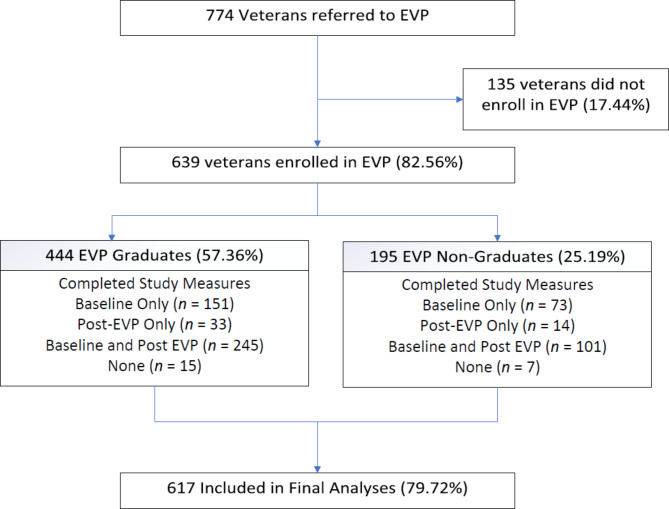
Background: Chronic pain is a highly prevalent health condition among veterans. Traditional pharmacological interventions present unique challenges for chronic pain management including prescription opioid addiction and overdose. In alignment with the 2016 Comprehensive Addiction and Recovery Act and VA’s Stepped Care Model to meet veterans’ pain management needs, the Offices of Rural Health and Pain Management, Opioid Safety, and Prescription Drug Monitoring Program (PMOP) funded an enterprise-wide initiative to implement a Step 3 integrated tele-pain program: Empower Veterans Program (EVP). EVP provides veterans with chronic pain self-care skills using a whole health driven approach to pain management. Objectives: The Comprehensive Addiction and Recovery Act prompted the strategic approach to offer non-pharmacological options to meet veterans’ pain management needs. EVP, a 10-week interdisciplinary group medical appointment, leverages Acceptance and Commitment Therapy, Mindful Movement, and Whole Health to provide veterans with chronic pain self-care skills. This evaluation was conducted to describe participant characteristics, graduation, and satisfaction rates; and assess pre-post patient-reported outcomes (PRO) associated with EVP participation. Methods: A sample of 639 veterans enrolled in EVP between May, 2015 and December, 2017 provided data to conduct descriptive analyses to assess participant demographics, graduation, and satisfaction rates. PRO data were analyzed using a within-participants pre-post design, and linear mixed-effects models were used to examine pre-post changes in PRO. Results: Of 639 participants, 444 (69.48%) graduated EVP. Participant median program satisfaction rating was 8.41 (Interquartile Range: 8.20–9.20). Results indicate pre-post EVP improvements (Bonferroni-adjusted p < .003) in the three primary pain outcomes (intensity, interference, catastrophizing), and 12 of 17 secondary outcomes, including physical, psychological, health-related quality of life (HRQoL), acceptance, and mindfulness measures. Discussion: Data suggest that EVP has significant positive outcomes in pain, psychological, physical, HRQoL, acceptance, and mindfulness measures for veterans with chronic pain through non-pharmacological means. Future evaluations of intervention dosing effect and long-term effectiveness of the program is needed.
Overview
CoChat Summary
## TL;DR
Empower Veterans Program (EVP) is a 10-week interdisciplinary tele-pain group for veterans with chronic pain, and this evaluation found significant pre-post improvements in several pain and well-being outcomes. Of 639 participants, 444 (69.48%) graduated, median satisfaction was 8.41/10, and 12 of 17 secondary outcomes improved.
## Key findings
- Of 639 participants, 444 (69.48%) graduated EVP; program satisfaction had a median of 8.41 (IQR 8.20–9.20), with scores ranging from 3.20 to 9.80.
- In adjusted pre-post models, all three primary pain outcomes improved from baseline to post-EVP: pain intensity (SMD = −0.199), interference (SMD = −0.448), and catastrophizing (SMD = −0.392), all at p < .001.
- Secondary outcomes improved in 12 of 17 measures, including fatigue (SMD = −0.300), anxiety (SMD = −0.233), depression (SMD = −0.430), sleep disturbance (SMD = −0.218), and HRQoL domains such as physical (SMD = 0.417) and psychological (SMD = 0.279).
- Acceptance and mindfulness also improved, with a large effect for activity engagement (SMD = 0.779) and small effects for mindfulness domains such as non-reactivity (SMD = 0.178) and observing experiences (SMD = 0.173).
## Methods
- Quality management evaluation of EVP, a 10-week interdisciplinary group medical appointment using Acceptance and Commitment Therapy, Mindful Movement, and Whole Health, with weekly in-person sessions and chaplain follow-up calls.
- Data came from a VA medical center in the southeastern United States; 774 veterans were referred, 639 enrolled, and 617 completed PRO measures for at least one time point and were included in final analyses.
- Used a within-participants pre-post design with baseline and week-10 PROs; descriptive statistics, logistic regression for graduation predictors, Mann-Whitney U tests for satisfaction, and linear mixed-effects models for pre-post outcome changes with Bonferroni correction (0.05/20 = 0.0025).
## Limitations
- The paper states the sample was from a single VA facility in an urban setting in the southeast, limiting generalizability; it also notes the recent move to remote TelePain-EVP may affect rural engagement.
- As a clinical quality management effort, participants were referred pragmatically rather than randomized, creating potential self-selection and referral bias; the authors also note that an adequate control group is difficult and sometimes unethical for this population.
- The text makes evident additional limits: dosing of EVP components (ACT, MM, WH) was not recorded, confounding from concurrent services was not fully addressed, and outcomes relied on self-report PRO measures.
Model-written summary. Check it against the paper before relying on it.
Integrity signals
Registry
Cites
Statistics
Figures
Verification
Claims the paper makes
0 Valid · 0 Not valid · 1 Not checked · 9 Own results and interpretations
A result the paper reports from its own data — it cites no other source for it, so there is none to check. The quote shows it is in the paper.
In the paper
“White participants were 43.4% less likely to graduate from EVP than non-white participants, OR = 0.566, 95% CI (0.372, 0.862)”
§ Empower Veterans Program (EVP): a chronic pain management program demonstrates positive outcomes among veterans > Results > Primary analyses
plainstates an associationn = 444- Asserted: passes — The authors put it forward as true.
- Checkable: passes — It can be checked against evidence.
- Load-bearing: unclear — It is unclear whether the paper’s conclusions depend on it.
- Based: passes — The paper gives a reason why it holds.
A result the paper reports from its own data — it cites no other source for it, so there is none to check. The quote shows it is in the paper.
In the paper
“Participant median program satisfaction rating was 8.41 (Interquartile Range: 8.20–9.20).”
§ Empower Veterans Program (EVP): a chronic pain management program demonstrates positive outcomes among veterans > Abstract > Results
plainn = 639- Asserted: passes — The authors put it forward as true.
- Checkable: passes — It can be checked against evidence.
- Load-bearing: unclear — It is unclear whether the paper’s conclusions depend on it.
- Based: passes — The paper gives a reason why it holds.
A result the paper reports from its own data — it cites no other source for it, so there is none to check. The quote shows it is in the paper.
In the paper
“Each one-year increase in age was associated with a 3.1% increase in the odds of being an EVP graduate versus a non-graduate, OR = 1.031, 95% confidence interval (CI; 1.014, 1.049).”
§ Empower Veterans Program (EVP): a chronic pain management program demonstrates positive outcomes among veterans > Results > Primary analyses
plainstates an associationn = 444- Asserted: passes — The authors put it forward as true.
- Checkable: passes — It can be checked against evidence.
- Load-bearing: unclear — It is unclear whether the paper’s conclusions depend on it.
- Based: passes — The paper gives a reason why it holds.
A result the paper reports from its own data — it cites no other source for it, so there is none to check. The quote shows it is in the paper.
In the paper
“Of 639 participants, 444 (69.48%) graduated EVP.”
§ Empower Veterans Program (EVP): a chronic pain management program demonstrates positive outcomes among veterans > Abstract > Results
plainn = 639- Asserted: passes — The authors put it forward as true.
- Checkable: passes — It can be checked against evidence.
- Load-bearing: unclear — It is unclear whether the paper’s conclusions depend on it.
- Based: passes — The paper gives a reason why it holds.
A result the paper reports from its own data — it cites no other source for it, so there is none to check. The quote shows it is in the paper.
In the paper
“Contrary to expectations, there were no significant graduation effects in these in any of the LMMs after the Bonferroni-correction was applied (p = .032-0.998).”
§ Empower Veterans Program (EVP): a chronic pain management program demonstrates positive outcomes among veterans > Results > Primary analyses
plain- Asserted: passes — The authors put it forward as true.
- Checkable: passes — It can be checked against evidence.
- Load-bearing: unclear — It is unclear whether the paper’s conclusions depend on it.
- Based: passes — The paper gives a reason why it holds.
1 reference still to check
A free account verifies the references that are still open.
- It may state two separate claims as one. 4
- Probably not a substantial claim. 2
Claims other papers make about this one
Each is checked against this paper’s own text: does it say what the citing paper says it does?
The source backs part of the claim, not all of it — or backs it for a different population, condition or comparison.
In the citing paper
“For in-person EVP the effect size for pre-post improvements in depression was medium, but this may be attributed to differences in outcome surveys between evaluations (PHQ-2 vs. PHQ-9) increasing variability of participants' responses [36].”
From Benchmark findings from a veteran electronic patient-reported outcomes evaluation from a chronic pain management telehealth program (2024) · cites this paper as [36]
Experimental — accuracy not yet measuredThe source backs part of the claim, not all of it — or backs it for a different population, condition or comparison.
In the citing paper
“The effectiveness of integrated interdisciplinary chronic pain programs on improving multi-dimensional pain outcomes is well-established in VA settings [32–36].”
From Benchmark findings from a veteran electronic patient-reported outcomes evaluation from a chronic pain management telehealth program (2024) · cites this paper as [36]
Experimental — accuracy not yet measuredThe source backs part of the claim, not all of it — or backs it for a different population, condition or comparison.
In the citing paper
“The non-significant trend for improved pain willingness demonstrated a small effect size and is in the same direction of previous work (medium effect size improvement) supporting improved pain willingness pre-post EVP [36].”
From Benchmark findings from a veteran electronic patient-reported outcomes evaluation from a chronic pain management telehealth program (2024) · cites this paper as [36]
Experimental — accuracy not yet measuredThe cited source says what the claim attributes to it.
In the citing paper
“Unlike previous work, sleep disturbance did not improve at any time point compared to the small effect size observed during in-person EVP [36].”
From Benchmark findings from a veteran electronic patient-reported outcomes evaluation from a chronic pain management telehealth program (2024) · cites this paper as [36]
The cited source says what the claim attributes to it.
In the citing paper
“The Empower Veterans Program (EVP) is a non-pharmacological interdisciplinary chronic pain rehabilitation program that integrates ACT, its core behavioral therapy, with mindful movement (MM), and whole health (WH) [36].”
From Benchmark findings from a veteran electronic patient-reported outcomes evaluation from a chronic pain management telehealth program (2024) · cites this paper as [36]
10 more claims about this paper
Create a free account to see every claim other papers make about this one.
Statistics recomputed
Every reported test result, recomputed from its test statistic and degrees of freedom. A result shows as not adding up only once an independent check has confirmed it.
- Consistentχ²(8) = 5.041reported p = .753 · recomputed p = .753
“χ2(8) = 5.041, p = .753”
Self-check
Percentages, sums and reported differences re-computed from the paper’s own numbers.
Self-check results appear here once an independent check has confirmed them.
Citations
Cites
Depression and quality of life in older persons: A review
Sivertsen, H., Bjørkløf, G. H., Engedal, K., Selbæk, G., & Helvik, A.-S. (2015) · Dementia and Geriatric Cognitive Disorders · doi:10.1159/000437299 · Cited by 14,152
Lakens, D. (2013) · Frontiers in Psychology · doi:10.3389/fpsyg.2013.00863 · Cited by 10,303 · cited 2×
“[47] Effect sizes for Cohen’s d and Hedges g were adopted from a recent meta-analysis of chronic pain interventions that aim to enhance positive affect rather than reduce Scale Construct Description Items Scale”
MethodThe Pain Catastrophizing Scale: Development and validation.
Sullivan, M. J. L., Bishop, S. R., & Pivik, J. (1995) · Psychological Assessment · doi:10.1037//1040-3590.7.4.524 · Cited by 8,227 · cited 2×
“Pain Catastrophizing Scale (PCS) [35] Pain”
InfluentialDevelopment of the World Health Organization WHOQOL-BREF Quality of Life Assessment
THE WHOQOL GROUP (1998) · Psychological Medicine · doi:10.1017/s0033291798006667 · Cited by 7,933 · cited 1×
“World Health Organization Quality of Life Scale Brief Version (WHOQoL-BREF) [37] Physical HRQoL Mobility, daily activities, functional capacity, energy, pain, and sleep.”
MethodUsing Self-Report Assessment Methods to Explore Facets of Mindfulness
Baer, R. A., Smith, G. T., Hopkins, J., Krietemeyer, J., & Toney, L. (2006) · Assessment · doi:10.1177/1073191105283504 · Cited by 7,511 · cited 1×
“[39] Acting Acting with awareness in the moment.”
BackgroundThe PHQ-9: A New Depression Diagnostic and Severity Measure
Kroenke, K., & Spitzer, R. L. (2002) · Psychiatric Annals · doi:10.3928/0048-5713-20020901-06 · Cited by 5,898 · cited 3×
“Patient Health Questionnaire-9 (PHQ-9) [36] Depression Depression symptom severity.”
BackgroundInfluentialCella, D., Riley, W., Stone, A., Rothrock, N., Reeve, B., Yount, S., Amtmann, D., Bode, R., Buysse, D., Choi, S., et al. (2010) · Journal of Clinical Epidemiology · doi:10.1016/j.jclinepi.2010.04.011 · Cited by 5,128 · cited 5×
“PROMIS-29 – Social subscale [34] Social Health Social roles (e.”
BackgroundInfluentialPrevalence of Chronic Pain and High-Impact Chronic Pain Among Adults — United States, 2016
Dahlhamer, J., Lucas, J., Zelaya, Nahin, R., Mackey, S., DeBar, L., Kerns, R., Von Korff, M., Porter, L., & Helmick, C. (2018) · MMWR. Morbidity and Mortality Weekly Report · doi:10.15585/mmwr.mm6736a2 · Cited by 2,598
Flexible Imputation of Missing Data, Second Edition
van Buuren, S. (2018) · doi:10.1201/9780429492259 · Cited by 2,273
RELIEVING PAIN IN AMERICA: A BLUEPRINT FOR TRANSFORMING PREVENTION, CARE, EDUCATION, AND RESEARCH
Simon, L. S. (2012) · Journal of Pain & Palliative Care Pharmacotherapy · doi:10.3109/15360288.2012.678473 · Cited by 2,183
Association Between Opioid Prescribing Patterns and Opioid Overdose-Related Deaths
Bohnert, A. S. B. (2011) · JAMA · doi:10.1001/jama.2011.370 · Cited by 1,509
(1979) · PubMed · Cited by 1,355
Acceptance of chronic pain: component analysis and a revised assessment method
McCracken, L. M., Vowles, K. E., & Eccleston, C. (2004) · Pain · doi:10.1016/j.pain.2003.10.012 · Cited by 1,101
Kamper, S. J., Apeldoorn, A. T., Chiarotto, A., Smeets, R. J. E. M., Ostelo, R. W. J. G., Guzman, J., & van Tulder, M. W. (2015) · BMJ · doi:10.1136/bmj.h444 · Cited by 1,092
Krebs, E. E., Gravely, A., Nugent, S., Jensen, A. C., DeRonne, B., Goldsmith, E. S., Kroenke, K., Bair, M. J., & Noorbaloochi, S. (2018) · JAMA · doi:10.1001/jama.2018.0899 · Cited by 983
Krebs, E. E., Lorenz, K. A., Bair, M. J., Damush, T. M., Wu, J., Sutherland, J. M., Asch, S. M., & Kroenke, K. (2009) · Journal of General Internal Medicine · doi:10.1007/s11606-009-0981-1 · Cited by 782 · cited 1×
“[33] Pain Intensity Pain intensity and interference with life enjoyment and”
BackgroundLew, H. L., Otis, J. D., Tun, C., Kerns, R. D., Clark, M. E., & Cifu, D. X. (2009) · The Journal of Rehabilitation Research and Development · doi:10.1682/jrrd.2009.01.0006 · Cited by 655 · cited 1×
“[7] The veteran chronic pain disparity is particularly problematic because mental health (e.”
BackgroundAcceptance and commitment therapy and mindfulness for chronic pain: Model, process, and progress.
McCracken, L. M., & Vowles, K. E. (2014) · American Psychologist · doi:10.1037/a0035623 · Cited by 627 · cited 2×
“[25, 26] The importance of increasing veteran access to nonpharmacological, integrated chronic pain programs is well-established.”
BackgroundAcceptance and Commitment Therapy (ACT) for Chronic Pain: A Systematic Review and Meta-Analyses
Hughes, L. S., Clark, J., Colclough, J. A., Dale, E., & McMillan, D. (2017) · The Clinical Journal of Pain · doi:10.1097/ajp.0000000000000425 · Cited by 611 · cited 1×
“[49] The current study examined acceptance as two CPAQ sub-scales rather than as a total score.”
MethodSeal, K. H., Shi, Y., Cohen, G., Cohen, B. E., Maguen, S., Krebs, E. E., & Neylan, T. C. (2012) · JAMA · doi:10.1001/jama.2012.234 · Cited by 515
Wetherell, J. L., Afari, N., Rutledge, T., Sorrell, J. T., Stoddard, J. A., Petkus, A. J., Solomon, B. C., Lehman, D. H., Liu, L., Lang, A. J., et al. (2011) · PAIN · doi:10.1016/j.pain.2011.05.016 · Cited by 508 · cited 1×
“[11, 22, 23] Through the ACT model an individual explores willingness to live a high quality of life, irrespective of chronic pain discomfort, through valuedriven actions (e.”
BackgroundPrevalence and Profile of High-Impact Chronic Pain in the United States
Pitcher, M. H., Von Korff, M., Bushnell, M. C., & Porter, L. (2019) · The Journal of Pain · doi:10.1016/j.jpain.2018.07.006 · Cited by 470 · cited 1×
“[1, 5] Compared to the general population, veterans are disproportionately impacted by chronic pain and associated impairments, with higher prevalence of overall (29.”
BackgroundSevere pain in veterans: the effect of age and sex, and comparisons with the general population
Nahin, R. L. (2017) · The Journal of Pain · doi:10.1016/j.jpain.2016.10.021 · Cited by 293
The difference between acute and chronic pain.
Grichnik, K. P., & Ferrante, F. M. (1991) · PubMed · Cited by 246
Multiple Imputation of Missing Data for Multilevel Models: Simulations and Recommendations
Grund, S., Lüdtke, O., & Robitzsch, A. (2018) · Organizational Research Methods · doi:10.1177/1094428117703686 · Cited by 224
Beyond nociception: the imprecision hypothesis of chronic pain
Moseley, G. L., & Vlaeyen, J. W. S. (2015) · Pain · doi:10.1016/j.pain.0000000000000014 · Cited by 192
Psychological Interventions for the Treatment of Chronic Pain in Adults
Driscoll, M. A., Edwards, R. R., Becker, W. C., Kaptchuk, T. J., & Kerns, R. D. (2021) · Psychological Science in the Public Interest · doi:10.1177/15291006211008157 · Cited by 176 · cited 1×
“[11, 22, 23] Through the ACT model an individual explores willingness to live a high quality of life, irrespective of chronic pain discomfort, through valuedriven actions (e.”
BackgroundConnolly, S. L., Stolzmann, K. L., Heyworth, L., Weaver, K. R., Bauer, M. S., & Miller, C. J. (2021) · Telemedicine and e-Health · doi:10.1089/tmj.2020.0233 · Cited by 171 · cited 1×
“[52, 53] As such, the potential impact of the recent implementation of TelePain-EVP as a remotely delivered telehealth program is currently being evaluated.”
BackgroundHiggins, D. M., Kerns, R. D., Brandt, C. A., Haskell, S. G., Bathulapalli, H., Gilliam, W., & Goulet, J. L. (2014) · Pain Medicine · doi:10.1111/pme.12388 · Cited by 168 · cited 1×
“[8, 9] Moreover, Ilgen and colleagues observed a dose-response relationship between pain severity and completed suicide among veterans even when controlling for demographic and psychiatric characteristics.”
BackgroundDevelopment and validation of the Pain Outcomes Questionnaire-VA
Clark, M. E., Gironda, R. J., & Young, R. W. (2003) · The Journal of Rehabilitation Research and Development · doi:10.1682/jrrd.2003.09.0381 · Cited by 131 · cited 3×
“Affairs (POQ-VA) [40] EVP Satisfaction Satisfaction with the EVP administered at week 10”
MethodInfluentialSevere Pain Predicts Greater Likelihood of Subsequent Suicide
Ilgen, M. A., Zivin, K., Austin, K. L., Bohnert, A. S. B., Czyz, E. K., Valenstein, M., & Kilbourne, A. M. (2010) · Suicide and Life-Threatening Behavior · doi:10.1521/suli.2010.40.6.597 · Cited by 125 · cited 1×
“[10] Consequently, chronic pain has been designated a high priority area within the Department of Veterans Affairs (VA) system.”
BackgroundGender Differences in Health Care Utilization Among Veterans with Chronic Pain
Kaur, S., Stechuchak, K. M., Coffman, C. J., Allen, K. D., & Bastian, L. A. (2007) · Journal of General Internal Medicine · doi:10.1007/s11606-006-0048-5 · Cited by 93 · cited 1×
“[43, 46] For analyses that examined race as a predictor variable, missing race cases were excluded from analyses (n = 6).”
MethodAcceptance and Commitment Therapy and Traditional Cognitive Behavior Therapy Approaches to Pain
Hayes, S. C., & Duckworth, M. P. (2006) · Cognitive and Behavioral Practice · doi:10.1016/j.cbpra.2006.04.002 · Cited by 93 · cited 1×
“[24, 25] ACT has shown promising results when other interventions focused on pain reduction achieve limited success.”
BackgroundChanging Trends in Opioid Overdose Deaths and Prescription Opioid Receipt Among Veterans
Lin, L. (., Peltzman, T., McCarthy, J. F., Oliva, E. M., Trafton, J. A., & Bohnert, A. S. B. (2019) · American Journal of Preventive Medicine · doi:10.1016/j.amepre.2019.01.016 · Cited by 90
Chua, K.-P., Brummett, C. M., Conti, R. M., & Bohnert, A. (2020) · JAMA Pediatrics · doi:10.1001/jamapediatrics.2019.4878 · Cited by 90
The Association Between Chronic Pain and Prescription Drug Abuse in Veterans
Becker, W. C., Fiellin, D. A., Gallagher, R. M., Barth, K. S., Ross, J. T., & Oslin, D. W. (2009) · Pain Medicine · doi:10.1111/j.1526-4637.2009.00584.x · Cited by 82 · cited 1×
“[8, 9] Moreover, Ilgen and colleagues observed a dose-response relationship between pain severity and completed suicide among veterans even when controlling for demographic and psychiatric characteristics.”
BackgroundOpioid Cessation and Multidimensional Outcomes After Interdisciplinary Chronic Pain Treatment
Murphy, J. L., Clark, M. E., & Banou, E. (2013) · The Clinical Journal of Pain · doi:10.1097/ajp.0b013e3182579935 · Cited by 81 · cited 2×
“[27, 31] Early EVP results indicate this program as a viable option to provide veterans with accessible and sustainable integrated non-pharmacological rehabilitation for chronic pain.”
BackgroundAbbey, H. (2015) · International journal of osteopathic medicine · doi:10.1016/j.ijosm.2015.07.008 · Cited by 81
Positive affect and chronic pain: a preregistered systematic review and meta-analysis
Ong, A. D., Thoemmes, F. J., Ratner, K., Ghezzi‐Kopel, K., & Reid, M. C. (2020) · Pain · doi:10.1097/j.pain.0000000000001828 · Cited by 65
Becker, W. C., DeBar, L. L., Heapy, A. A., Higgins, D., Krein, S. L., Lisi, A., Makris, U. E., & Allen, K. D. (2018) · Journal of General Internal Medicine · doi:10.1007/s11606-018-4345-6 · Cited by 59
Murphy, J. L., Cordova, M. J., & Dedert, E. A. (2022) · Psychological Services · doi:10.1037/ser0000506 · Cited by 57 · cited 1×
“Murphy and colleagues [50] found large within-participant improvements for depression and physical HRQoL as well as medium effects for psychological, social, and environmental HRQoL from pre-post CBT for chronic pain.”
BackgroundVowles, K. E., Fink, B. C., & Cohen, L. L. (2014) · Journal of Contextual Behavioral Science · doi:10.1016/j.jcbs.2014.04.003 · Cited by 55 · cited 1×
“[25, 26] The importance of increasing veteran access to nonpharmacological, integrated chronic pain programs is well-established.”
BackgroundMurphy, J. L., Palyo, S. A., Schmidt, Z. S., Hollrah, L. N., Banou, E., Van Keuren, C. P., & Strigo, I. A. (2021) · Pain Medicine · doi:10.1093/pm/pnaa417 · Cited by 54 · cited 3×
“[27] A separate study examining the VA inpatient chronic pain rehabilitation program found a similar pattern of significant effects with these primary outcomes, but effect sizes were not reported for comparison.”
BackgroundResultBhimani, R., Cross, L. J. S., Taylor, B. C., Meis, L. A., Fu, S. S., Allen, K. D., Krein, S. L., Do, T., Kerns, R. D., & Burgess, D. J. (2017) · BMC Musculoskeletal Disorders · doi:10.1186/s12891-016-1363-6 · Cited by 47 · cited 2×
“[43, 46] For analyses that examined race as a predictor variable, missing race cases were excluded from analyses (n = 6).”
BackgroundMethodBringing chronic-pain care to rural veterans: A telehealth pilot program description.
Glynn, L. H., Chen, J. A., Dawson, T. C., Gelman, H., & Zeliadt, S. B. (2021) · Psychological Services · doi:10.1037/ser0000408 · Cited by 40
Penney, L. S., & Haro, E. (2019) · Journal of Pain Research · doi:10.2147/jpr.s185652 · Cited by 32 · cited 1×
“[30, 32] This paper follows a cohort of Veterans who completed EVP at a large VA Medical Center in the southeast who were unresponsive to and/or declining medications, procedures, and sequential monotherapies such as Cognitive-Behavioral Therapy (CBT) and Physical Therapy.”
BackgroundTelehealth and Rural-Urban Differences in Receipt of Pain Care in the Veterans Health Administration
Chen, J. A., DeFaccio, R. J., Gelman, H., Thomas, E. R., Indresano, J. A., Dawson, T. C., Glynn, L. H., Sandbrink, F., & Zeliadt, S. B. (2022) · Pain Medicine · doi:10.1093/pm/pnab194 · Cited by 28
Ward, R., Rauch, S. A. M., Axon, R. N., & Saenger, M. S. (2023) · Health Services Research · doi:10.1111/1475-6773.14062 · Cited by 9 · cited 1×
“[51] Thus, identifying an adequate control group for this unique population is very difficult and under certain circumstances unethical (e.”
BackgroundSelf-citationEvaluation of the Empower Veterans Program for Military Veterans With Chronic Pain
Uche (2022) · Journal of Clinical Outcomes Management · doi:10.12788/jcom.0089 · Cited by 8 · cited 3×
“[30, 32] This paper follows a cohort of Veterans who completed EVP at a large VA Medical Center in the southeast who were unresponsive to and/or declining medications, procedures, and sequential monotherapies such as Cognitive-Behavioral Therapy (CBT) and Physical Therapy.”
BackgroundResult
Cited by
Guiding Principles for the Practice of Integrative Physical Therapy
Justice, C., Sullivan, M. B., Demark, C. B. V., Davis, C. M., & Erb, M. (2023) · Physical Therapy · doi:10.1093/ptj/pzad138 · Cited by 19
“One example could be found in the field of pelvic health, where the sensitivity required to facilitate healing in the intimate areas of the pelvis and genitals aligns with elements of IPT care, such as trauma informed care, therapeutic partnership, and WPH. Physical therapists who work with people who experience chron…”
InfluentialSullivan, M. B., Hill, K., Ballengee, L. A., Knoblach, D., Fowler, C., Haun, J., & Saenger, M. (2023) · Global Advances in Integrative Medicine and Health · doi:10.1177/27536130231209751 · Cited by 10
“25,27 EVP is a weekly 30 hour remotely delivered program (3 hours a week, on one particular day of the week, for 10 weeks) for veterans with high impact chronic pain.”
BackgroundSelf-citationQualitative Evaluation Informs the Implementation of a Telehealth Program to Manage Chronic Pain
McHugh, M., Fowler, C. A., Philbin, S. E., Schneider, T., Ballistrea, L. M., Klanchar, S. A., Smith, B., Benzinger, R. C., French, D. D., Saenger, M. S., et al. (2024) · Journal of Pain · doi:10.1016/j.jpain.2024.02.007 · Cited by 12
Self-citationMeasuring Whole Person Health: A Scoping Review
DiGuiseppi, G., Rodriguez, A., Qureshi, N., Zeng, C., Coulter, I. D., Hays, R. D., Herman, P. M., & Edelen, M. O. (2025) · Journal of Integrative and Complementary Medicine · doi:10.1089/jicm.2024.0817 · Cited by 13
“31,65,66 However, the development of a single measure for use in this context would offer a standardized approach to intervention evaluation and contribute signi fi cantly to advances in whole person care.”
Whitehead, A. M., MULLUR, R. S., Sullivan, M. B., & Nicosia, F. M. (2024) · Global Advances in Integrative Medicine and Health · doi:10.1177/27536130241235908 · Cited by 7
Metadata
- Authors
- Haun, J. N., Fowler, C. A., Venkatachalam, H. H., Saenger, M. S., Alman, A. C., Smith, B. M., Schneider, T., Benzinger, R., Stroupe, K., & French, D. D.
- Affiliations
- University of Utah (US)
- University of South Florida (US)
- James A. Haley Veterans' Hospital (US)
- Emory University (US)
- Edward Hines, Jr. VA Hospital (US)
- Northwestern University (US)
- Corresponding author
- Fowler, Christopher A.
- ORCID
- Venue
- BMC Health Services Research
- Published
- 2023-05-03
- Volume
- 23
- Issue
- 1
- Pages
- 431-431
- ISSN
- 1472-6963 (ISSN-L)
- PMC
- PMC10155644
- OpenAlex
- W4368359562
- Cited by
- 12
- References
- 49
- Citations by year
- 2025: 3 · 2024: 6 · 2023: 3
- FWCI
- 1.87
- Type
- journal article
- Language
- en
- Open access
- gold
- doi.org
- Licence
- cc-by
- creativecommons.org/licenses/by/4.0 (tdm)
- creativecommons.org/licenses/by/4.0 (vor)
- Locations
- BMC Health Services Research (publishedVersion, cc-by)
- PubMed Central (publishedVersion, cc-by)
- PubMed (publishedVersion)
- DOAJ (DOAJ: Directory of Open Access Journals) (submittedVersion, cc-by-sa)
- Funders
- U.S. Department of Veterans Affairs (OMAT ID# 16403,16404, 16405, 16489, 16490)
- Topics
- Health Sciences › Health Professions › Physical Therapy, Sports Therapy and Rehabilitation › Musculoskeletal pain and rehabilitation
- Health Sciences › Medicine › Public Health, Environmental and Occupational Health › Opioid Use Disorder Treatment
- Health Sciences › Medicine › Anesthesiology and Pain Medicine › Pain Management and Opioid Use
- Keywords
- chronic pain management, veterans, telemedicine, non-pharmacological pain management, acceptance and commitment therapy, mindful movement, whole health, stepped care, health-related quality of life, pain catastrophizing, program satisfaction
- MeSH terms
- Humans, Quality of Life, Veterans, Chronic Pain, Pain Management, Acceptance and Commitment Therapy
About these checks
Registry, retraction, Cites and statistics results are computed, not judged, with one exception: a printed reference that no index lists is read once by a model before it counts as a citation error. Claims are extracted by a model and kept only when their quote appears verbatim in the text; each cited source is then checked, with a model’s help, for whether it says what the claim relies on. Those verdicts can be wrong — read the claim’s quote and the cited source before relying on one.
A language model drew the claims from the paper on 2026-10-11, under version 3 of the claim definition (model deepseek-v4.1-flash, prompt extract-v3).
A second model labelled each claim on 2026-10-11 (model jev-1.13-20260917, definition revision gold-guideline-v0.2).
Statistics and arithmetic are recomputed, not judged.
Confidence bands are shown only for fields calibrated on our annotated test set. None is calibrated yet, so no band is shown.
What counts as a claim ›How we measure confidence ›How we check this ›
Are you an author, or do you see a problem with this page? Request a review
Data sources
Bibliographic data: Semantic Scholar, OpenAlex, Crossref.
Contains information from the Semantic Scholar Academic Graph Datasets, made available under the ODC Attribution License (ODC-BY 1.0).
Semantic Scholar’s data is described in: Kinney, R., et al. (2023). The Semantic Scholar Open Data Platform. arXiv:2301.10140.
