

Effect of leadership styles on turnover intention among staff nurses in private hospitals: the moderating effect of perceived organizational support
Open accessThe DOI matches its Crossref record; 65 of the 65 references it cites were found in a registry or an index.
Abstract
Leadership styles have often been proven to support employees in performing their duties better and with more efficiency while enabling them to have extended organizational tenures. Staff nurses are an essential resource of hospitals to ensure proper administration and quality patient health care. The study aims to determine how transformational and authentic leadership styles affect the staff nurses’ turnover intention in private hospitals. In addition, it also finds the moderating effect of perceived organizational support. An explanatory quantitative research design with a cross-sectional investigation and a stratified sampling strategy was used for the study. Data from 296 nurses from the eight chosen private hospitals in the Kingdom of Bahrain were gathered using a questionnaire with 24 items. Smart-PLS was employed to conduct PLS-SEM (partial least squares structural equation modeling) to measure direct and indirect effects. The result indicates that transformational, authentic leadership styles and perceived organizational support significantly negatively affect nurses’ turnover intention. The study confirms the negative moderating effect of perceived organizational support between transformational leadership and turnover intention and the positive moderating effect of perceived organizational support between authentic leadership and turnover intention. Managers should concentrate on the leadership style to avoid its impact on turnover intention. By considering human resource practices such as communication and training strategies to cope with the negative effect of turnover intention, organizations can enhance employee engagement, improve job satisfaction, and foster a more stable and productive work environment. The present research revealed the adverse impact of turnover intention within hospitals by examining its association with leadership styles. The research made a significant contribution to the existing literature by delving into the impact of leadership styles on turnover intention, focusing on the moderating effect of perceived organizational support. The study’s findings shed light on the intricate relationship between leadership practices and employee turnover, providing valuable insights for both scholars and practitioners in the field. The study used a cross-sectional design to collect data and ensured the absence of standard method variance. The research enhanced the social dominance theory (SDT) by examining how perceived organizational support moderates the relationship between leadership styles and turnover intention.
Overview
The claims and statistics of this paper haven’t been checked yet.
Free: it reads the open-access text and checks the first 5 claims that cite a source we can check. Create a free account to check every claim.
Integrity signals
Registry
Cites
Statistics
Figures
Verification
Claims the paper makes
The claims and statistics of this paper haven’t been checked yet.
Free: it reads the open-access text and checks the first 5 claims that cite a source we can check. Create a free account to check every claim.
Self-check
Percentages, sums and reported differences re-computed from the paper’s own numbers.
The self-check needs the paper’s full text.
Citations
Cites
1 retracted
Srivastava, S., & Agrawal, S. (2020) · Journal of Organizational Change Management · doi:10.1108/jocm-02-2020-0063 · Cited by 212
RetractedEvaluating Structural Equation Models with Unobservable Variables and Measurement Error
Fornell, C., & Larcker, D. F. (1981) · Journal of Marketing Research · doi:10.2307/3151312 · Cited by 109,314
Evaluating structural equation models with unobservable variables and measurement error
Fornell, C., & Larcker, D. F. (1981) · Journal of Marketing Research · doi:10.1177/002224378101800104 · Cited by 109,190
A new criterion for assessing discriminant validity in variance-based structural equation modeling
Henseler, J., Ringle, C. M., & Sarstedt, M. (2015) · Journal of the Academy of Marketing Science · doi:10.1007/s11747-014-0403-8 · Cited by 38,459
When to Use and How to Report the Results of PLS-SEM
Hair, J. F., Risher, J. J., Sarstedt, M., & Ringle, C. M. (2019) · European Business Review · doi:10.1108/ebr-11-2018-0203 · Cited by 27,541
Multivariate data analysis : a global perspective
Hair, J. F. (2010) · Cited by 19,929
Determining sample size for research activities
Krejcie, R. V., & Morgan, D. W. (1970) · Educational and Psychological Measurement · doi:10.1177/001316447003000308 · Cited by 18,930
Using pls path modeling in new technology research: updated guidelines
Henseler, J., Hubona, G., & Ray, P. A. (2016) · Industrial Management & Data Systems · doi:10.1108/imds-09-2015-0382 · Cited by 7,173 · cited 1×
“An approximate model fit needs to be utilized to evaluate the model fit [74, 75].”
MethodAuthentic leadership development: Getting to the root of positive forms of leadership
Avolio, B. J., & Gardner, W. L. (2005) · The Leadership Quarterly · doi:10.1016/j.leaqua.2005.03.001 · Cited by 5,478
Structural Equation Modeling With AMOS: Basic Concepts, Applications, and Programming, Third Edition
Byrne, B. M. (2016) · doi:10.4324/9781315757421 · Cited by 4,653
An updated and expanded assessment of PLS-SEM in information systems research
Hair, J., Hollingsworth, C. L., Randolph, A. B., & Chong, A. Y. L. (2017) · Industrial Management & Data Systems · doi:10.1108/imds-04-2016-0130 · Cited by 4,043 · cited 2×
“As per Hair et al. (2017) [76], the calculated d_ULS and d_G values should be < 95% to be a good fit.”
BackgroundInfluentialImproving Organizational Effectiveness through Transformational Leadership
Bass, B. M., & Avolio, B. J. (1993) · Medical Entomology and Zoology · Cited by 3,340
How to Specify, Estimate, and Validate Higher-Order Constructs in PLS-SEM
Sarstedt, M., Hair, J. F., Cheah, J.-H., Becker, J.-M., & Ringle, C. M. (2019) · Australasian Marketing Journal · doi:10.1016/j.ausmj.2019.05.003 · Cited by 3,210
Consistent Partial Least Squares Path Modeling1
Dijkstra, T. K., & Henseler, J. (2015) · MIS Quarterly · doi:10.25300/misq/2015/39.2.02 · Cited by 2,898 · cited 2×
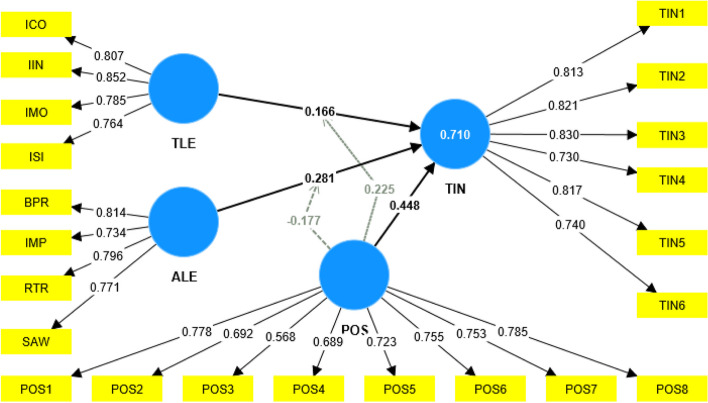
“Table 3 reveals that the standardized root means square residual (SRMR) is 0.078; as suggested by Dijk-stra & Henseler (2015) [75], the calculated SRMR value should be less than 0.1 to be a good fit.”
MethodInfluentialPerceived organizational support: a meta-analytic evaluation of organizational support theory.
Kurtessis, J. N., Eisenberger, R., Ford, M. T., Buffardi, L. C., Stewart, K. A., & Adis, C. S. (2017) · Journal of Management · doi:10.1177/0149206315575554 · Cited by 2,354 · cited 2×
“Perceived organizational support questions were adopted from the study by Kurtessis et al. (2017) [9].”
BackgroundMethodTARGET ARTICLE: Toward a Conceptualization of Optimal Self-Esteem
Kernis, M. H. (2003) · Psychological Inquiry · doi:10.1207/s15327965pli1401_01 · Cited by 1,683 · cited 1×
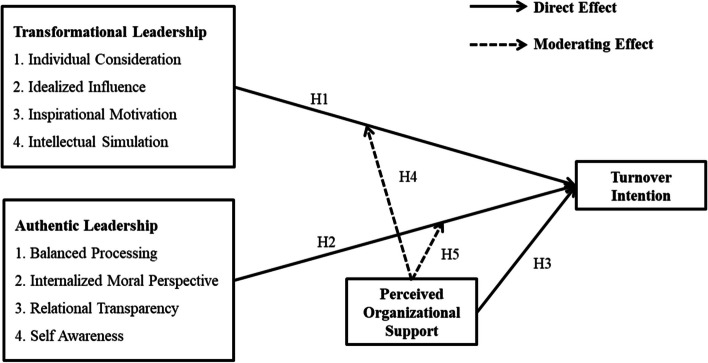
“…(ISI)) [25] and ALE (balanced processing (BPR), internalized moral perspective (IMP), relational transparency (RTR), and self-awareness (SAW)) [26, 27], which in turn influences staff nurses’ intention to leave private hospitals and the moderating effect of perceived organizational support.”
BackgroundTransformational Leadership and Job Behaviors: The Mediating Role of Core Job Characteristics
Piccolo, R. F., & Colquitt, J. A. (2006) · Academy of Management Journal · doi:10.5465/amj.2006.20786079 · Cited by 1,613
Leadership, creativity, and innovation: A critical review and practical recommendations
Hughes, D. J., Lee, A., Tian, A. W., Newman, A., & Legood, A. (2018) · The Leadership Quarterly · doi:10.1016/j.leaqua.2018.03.001 · Cited by 1,080
Budhwar, P., Malik, A., De Silva, M. T. T., & Thevisuthan, P. (2022) · The International Journal of Human Resource Management · doi:10.1080/09585192.2022.2035161 · Cited by 723
The validation of the turnover intention scale
Bothma, C. F. C., & Roodt, G. (2013) · SA Journal of Human Resource Management · doi:10.4102/sajhrm.v11i1.507 · Cited by 570
Digital transformation: Five recommendations for the digitally conscious firm
Saarikko, T., Westergren, U. H., & Blomquist, T. (2020) · Business Horizons · doi:10.1016/j.bushor.2020.07.005 · Cited by 557
Farahnak, L. R., Ehrhart, M. G., Torres, E. M., & Aarons, G. A. (2020) · Journal of Leadership & Organizational Studies · doi:10.1177/1548051818824529 · Cited by 261
Perceived Organizational Support: A Literature Review
Sun, L. (2019) · International Journal of Human Resource Studies · doi:10.5296/ijhrs.v9i3.15102 · Cited by 247
Grošelj, M., Černe, M., Penger, S., & Grah, B. (2021) · European Journal of Innovation Management · doi:10.1108/ejim-10-2019-0294 · Cited by 241
Gemeda, H. K., & Lee, J. (2020) · Heliyon · doi:10.1016/j.heliyon.2020.e03699 · Cited by 235
Duarte, A. P., Ribeiro, N. M. P., Semedo, A. S., & Gomes, D. R. (2021) · Frontiers in Psychology · doi:10.3389/fpsyg.2021.675749 · Cited by 200
Giao, H. N. K., Vuong, B. N., Huan, D. D., Tushar, H., & Quan, T. N. (2020) · Sustainability · doi:10.3390/su12051857 · Cited by 198
The effects of authentic leadership and organizational commitment on turnover intention
Ausar, K., Kang, H. J. A., & Kim, J. S. (2016) · Leadership & Organization Development Journal · doi:10.1108/lodj-05-2014-0090 · Cited by 190
Employee Turnover: Causes, Importance and Retention Strategies
Al-Suraihi, W. A., Samikon, S. A., Al-Suraihi, A.-H. A., & Ibrahim, I. (2021) · European Journal of Business and Management Research · doi:10.24018/ejbmr.2021.6.3.893 · Cited by 190
Khaola, P. P., & Rambe, P. (2020) · Management Research Review · doi:10.1108/mrr-07-2019-0323 · Cited by 173
Tian, H., Iqbal, S., Akhtar, S., Qalati, S. A., Anwar, F., & Khan, M. A. S. (2020) · Frontiers in Psychology · doi:10.3389/fpsyg.2020.00314 · Cited by 164
Steinmann, B., Klug, H. J. P., & Maier, G. W. (2018) · Frontiers in Psychology · doi:10.3389/fpsyg.2018.02338 · Cited by 163
Reducing turnover intention: perceived organizational support for frontline employees
Wang, Q., & Wang, C. (2020) · Frontiers of Business Research in China · doi:10.1186/s11782-020-00074-6 · Cited by 155
Meyers, M. C., Adams, B. G., Sekaja, L., Buzea, C., Cazan, A., Gotea, M., Ștefenel, D., & van Woerkom, M. (2018) · Journal of Happiness Studies · doi:10.1007/s10902-018-0026-8 · Cited by 122
Puhakka, I., Nokelainen, P., & Pylväs, L. (2021) · Vocations and Learning · doi:10.1007/s12186-021-09275-3 · Cited by 118
Metcalfe, R. J. A., & Alimo‐Metcalfe, B. (2000) · Leadership & Organization Development Journal · doi:10.1108/01437730010343077 · Cited by 106
Łaguna, M., Wałachowska, K., Gorgievski, M. J., & Moriano, J. A. (2019) · International Journal of Environmental Research and Public Health · doi:10.3390/ijerph16214201 · Cited by 95
Authentic leadership and turnover intention: does organizational size matter?
Oh, J., & Oh, S.-M. (2017) · Leadership & Organization Development Journal · doi:10.1108/lodj-08-2016-0209 · Cited by 89
Yusliza, M. Y., Faezah, J. N., Ali, N., Noor, N. M. M., Ramayah, T., Tanveer, M. I., & Fawehinmi, O. O. (2020) · Industrial and Commercial Training · doi:10.1108/ict-12-2019-0111 · Cited by 87
Leadership Styles of Nurse Managers and Turnover Intention
Magbity, J. B., Ofei, A. M. A., & Wilson, D. (2020) · Hospital Topics · doi:10.1080/00185868.2020.1750324 · Cited by 82
Impacts of Nursing Work Environment on Turnover Intentions: The Mediating Role of Burnout in Ghana
Poku, C. A., Donkor, E. S., & Naab, F. (2022) · Nursing Research and Practice · doi:10.1155/2022/1310508 · Cited by 80
Bridging the Gap between Authentic Leadership and Employees Communal Relationships through Trust
Iqbal, S., Farid, T., Khan, M. K., Zhang, Q., Khattak, A. N., & Ma, J. (2019) · International Journal of Environmental Research and Public Health · doi:10.3390/ijerph17010250 · Cited by 77
Seo, J. H., Kim, S. J., Lee, M., & Kang, J. I. (2021) · Journal of Affective Disorders · doi:10.1016/j.jad.2021.04.070 · Cited by 66
The Relationship Between Perceived Leadership Style and Perceived Stress on Hospital Employees
Baysak, B., & Yener, M. I. (2015) · Procedia - Social and Behavioral Sciences · doi:10.1016/j.sbspro.2015.10.159 · Cited by 64
Authentic Leadership and Job Satisfaction: A Fuzzy-Set Qualitative Comparative Analysis (fsQCA)
Baquero, A., Delgado, B., Escortell, R., & Sapena, J. (2019) · Sustainability · doi:10.3390/su11082412 · Cited by 64
Nursing turnover intentions: The role of leader emotional intelligence and team culture
Majeed, N., & Jamshed, S. (2021) · Journal of Nursing Management · doi:10.1111/jonm.13144 · Cited by 62
Choi, Y., Yoon, D. J., & Kim, D. (2020) · International Journal of Environmental Research and Public Health · doi:10.3390/ijerph17124303 · Cited by 58
Authentic Leadership Questionnaire: invariance between samples of Brazilian and Portuguese employees
Cervo, C. S., Mónico, L. D. S. M., dos Santos, N. R., Hutz, C. S., & Pais, L. (2016) · Psicologia Reflexão e Crítica · doi:10.1186/s41155-016-0046-4 · Cited by 50
Zhao, Y., Russell, D., Guthridge, S. L., Ramjan, M., Jones, M. P., Humphreys, J. S., & Wakerman, J. (2019) · BMJ Open · doi:10.1136/bmjopen-2018-023906 · Cited by 50
Developing nurse leaders: Toward a theory of authentic leadership empowerment
Doherty, D. P., & Revell, S. M. H. (2020) · Nursing Forum · doi:10.1111/nuf.12446 · Cited by 44
Yusuf, Y., & Irwan, A. M. (2021) · British Journal of Healthcare Management · doi:10.12968/bjhc.2020.0083 · Cited by 42
Alhamwan, M., Mat, N. B., & Muala, I. A. (2015) · Journal of Management and Sustainability · doi:10.5539/jms.v5n2p154 · Cited by 41
The Effects of Emergency Room Violence toward Nurse′s Intention to Leave—Resilience as a Mediator
Li, J.-H., Chen, T.-W., Lee, H.-F., & Shih, W.-M. J. (2021) · Healthcare · doi:10.3390/healthcare9050507 · Cited by 41
Authentic leadership and follower trust in the leader: The effect of precariousness
Kleynhans, D. J., Heyns, M. M., & Stander, M. W. (2021) · SA Journal of Industrial Psychology · doi:10.4102/sajip.v47i0.1904 · Cited by 36
Nicol, A. A. M., Rounding, K. D., & MacIntyre, A. (2011) · Personality and Individual Differences · doi:10.1016/j.paid.2011.07.009 · Cited by 32
Schippers, M. C., & Jaarsveld, G. M. V. (2020) · Frontiers in Psychology · doi:10.2139/ssrn.3599939 · Cited by 28
Matande, M., Thoyib, A., & Kurniawati, D. T. (2022) · International Journal of Research in Business and Social Science (2147-4478) · doi:10.20525/ijrbs.v11i6.1922 · Cited by 28
Leaders’ Individualized Consideration and Employees’ Job Satisfaction
KHALIL, D. S. H., & SAHIBZADAH, S. (2021) · Journal of Business & Tourism · doi:10.34260/jbt.v3i2.81 · Cited by 24
Education and inspirational intuition - Drivers of innovation
Müller, J. (2021) · Heliyon · doi:10.1016/j.heliyon.2021.e07923 · Cited by 23
Kasa, M. D., Shamsuddin, M. F., Yaakob, M. F. M., Yusof, M. R., & Sofian, F. N. R. M. (2020) · Journal of Education and e-Learning Research · doi:10.20448/journal.509.2020.73.323.333 · Cited by 21
Tesi, A., Aiello, A., & Pratto, F. (2022) · Current Psychology · doi:10.1007/s12144-022-03627-5 · Cited by 17
SharifHeravi, M. G., Shahidi, S. E., & Mahmood, N. H. N. (2010) · ACM SIGCPR Conference on Computer Personnel Research (SIGCPR) · doi:10.1145/1796900.1796923 · Cited by 9
Development and the Sacred: An Account of Reef Resource Management in the Maldives
Mohamed, M., Gombay, N., & Pirker, J. (2019) · International Journal of Social Research and Innovation · doi:10.55712/ijsri.v3i1.18 · Cited by 9
Kim, B., & Kim, B.-G. (2018) · Journal of Distribution Science · doi:10.15722/jds.16.9.201809.13 · Cited by 3
The application of Industry 4.0 in continuous professional development (CPD)
Sainidis, E., & Brown, G. (2021) · Elsevier eBooks · doi:10.1016/b978-0-12-821442-8.00014-8 · Cited by 3
Research works printed but not linked: 5
- Eisenberger R, Malone GP, Presson WD. Optimizing perceived organi- zational support to enhance employee engagement. Soc Hum Resour Manag Soc Ind Organ Psychol. 2016;2:1-22.
- Puni AA. Leadership styles, employee turnover intentions and counter- productive work behaviours. Int J Innov Res Dev. 2016;5:1-7.
- Alzoubi RHM, Jaaffar AH. Leadership styles, Crisis Management, and Hotel performance: a conceptual perspective of the Jordanian hotel. J Crit Rev. 2020;7:556-62.
- Kline RB. Principles and practices of structural equation modelling, 4th Editio. New York: The Guilford Press; 2015.
- Baykal E. Mediator effect of perceived organizational support in the rela- tionship between authentic leadership and organizational commitment. Manas J Soc Stud. 2020;9:1674-88.
Cited by
Prevalence of turnover intention among emergency nurses worldwide: a meta-analysis
Ren, H., Xue, Y., Li, P., Yin, X., Xin, W., & Li, H. (2024) · BMC Nursing · doi:10.1186/s12912-024-02284-2 · Cited by 46
Singh, B., Malviya, R., & Kaunert, C. (2024) · Advances in human resources management and organizational development book series · doi:10.4018/979-8-3693-3470-6.ch014 · Cited by 26
Terry, D. R., Jacobs, S., Moloney, W., East, L., Ryan, L., Elliott, J., Tulleners, T., Masamba, H., & Peck, B. (2025) · Journal of Advanced Nursing · doi:10.1111/jan.16817 · Cited by 24
Artificial Intelligence and Employee Well-Being: Projecting Psychological and Physical Healthcare
Singh, B., Kaunert, C., & Ravesangar, K. (2024) · Advances in human resources management and organizational development book series · doi:10.4018/979-8-3693-6412-3.ch005 · Cited by 16
Workplace Gaslighting Is Associated with Nurses’ Job Burnout and Turnover Intention in Greece
Moisoglou, I., Katsiroumpa, A., Konstantakopoulou, O., Papathanasiou, I. V., Katsapi, A., Prasini, I., Chatzi, M., & Galanis, P. (2025) · Healthcare · doi:10.3390/healthcare13131574 · Cited by 22
Metadata
- Authors
- Pattali, S., Sankar, J. P., Al Qahtani, H., Menon, N., & Faizal, S.
- Affiliations
- University of Technology Bahrain (BH)
- Venue
- BMC Health Services Research
- Published
- 2024-02-14
- Volume
- 24
- Issue
- 1
- Pages
- 199-199
- ISSN
- 1472-6963 (ISSN-L)
- PMC
- PMC10865721
- OpenAlex
- W4391818081
- Cited by
- 76
- References
- 64
- Citations by year
- 2026: 31 · 2025: 34 · 2024: 11
- FWCI
- 34.63
- Type
- journal article
- Language
- en
- Open access
- gold
- doi.org
- Licence
- cc-by
- creativecommons.org/licenses/by/4.0 (tdm)
- creativecommons.org/licenses/by/4.0 (vor)
- Locations
- BMC Health Services Research (publishedVersion, cc-by)
- PubMed Central (publishedVersion, cc-by)
- PubMed (publishedVersion)
- DOAJ (DOAJ: Directory of Open Access Journals) (submittedVersion, cc-by-sa)
- Topics
- Health Sciences › Nursing › Research and Theory › Nursing education and management
- Health Sciences › Nursing › Leadership and Management › Healthcare Education and Workforce Issues
- Social Sciences › Business, Management and Accounting › Organizational Behavior and Human Resource Management › Job Satisfaction and Organizational Behavior
- Keywords
- leadership styles, turnover intention, transformational leadership, authentic leadership, perceived organizational support, staff nurses, private hospitals, moderating effect, social dominance theory, nurse retention
- MeSH terms
- Cross-Sectional Studies, Humans, Job Satisfaction, Leadership, Nursing Staff, Hospital, Personnel Turnover, Surveys and Questionnaires, Hospitals, Private, Intention
About these checks
Registry, retraction, Cites and statistics results are computed, not judged, with one exception: a printed reference that no index lists is read once by a model before it counts as a citation error. Claims are extracted by a model and kept only when their quote appears verbatim in the text; each cited source is then checked, with a model’s help, for whether it says what the claim relies on. Those verdicts can be wrong — read the claim’s quote and the cited source before relying on one.
Statistics and arithmetic are recomputed, not judged.
Confidence bands are shown only for fields calibrated on our annotated test set. None is calibrated yet, so no band is shown.
What counts as a claim ›How we measure confidence ›How we check this ›
Are you an author, or do you see a problem with this page? Request a review
Data sources
Bibliographic data: Semantic Scholar, OpenAlex, Crossref.
Contains information from the Semantic Scholar Academic Graph Datasets, made available under the ODC Attribution License (ODC-BY 1.0).
Semantic Scholar’s data is described in: Kinney, R., et al. (2023). The Semantic Scholar Open Data Platform. arXiv:2301.10140.
