

Comparison of registered and published outcomes in randomized controlled trials: a systematic review
Open accessThe DOI matches its Crossref record; 43 of the 44 references it cites were found in a registry or an index.
Abstract
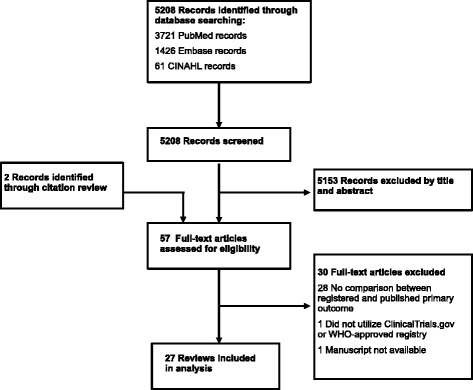
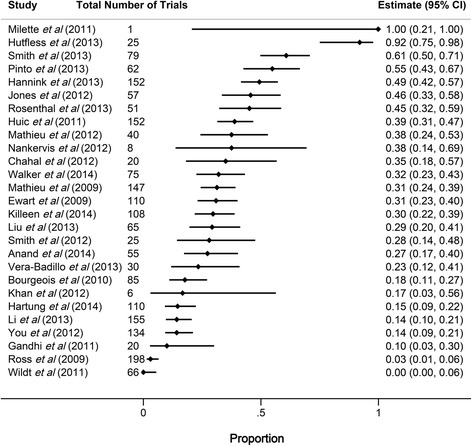
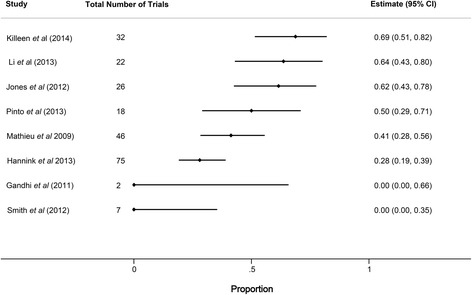
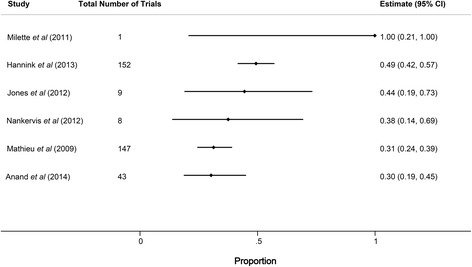
BACKGROUND: Clinical trial registries can improve the validity of trial results by facilitating comparisons between prospectively planned and reported outcomes. Previous reports on the frequency of planned and reported outcome inconsistencies have reported widely discrepant results. It is unknown whether these discrepancies are due to differences between the included trials, or to methodological differences between studies. We aimed to systematically review the prevalence and nature of discrepancies between registered and published outcomes among clinical trials. METHODS: We searched MEDLINE via PubMed, EMBASE, and CINAHL, and checked references of included publications to identify studies that compared trial outcomes as documented in a publicly accessible clinical trials registry with published trial outcomes. Two authors independently selected eligible studies and performed data extraction. We present summary data rather than pooled analyses owing to methodological heterogeneity among the included studies. RESULTS: Twenty-seven studies were eligible for inclusion. The overall risk of bias among included studies was moderate to high. These studies assessed outcome agreement for a median of 65 individual trials (interquartile range [IQR] 25-110). The median proportion of trials with an identified discrepancy between the registered and published primary outcome was 31%; substantial variability in the prevalence of these primary outcome discrepancies was observed among the included studies (range 0% (0/66) to 100% (1/1), IQR 17-45%). We found less variability within the subset of studies that assessed the agreement between prospectively registered outcomes and published outcomes, among which the median observed discrepancy rate was 41% (range 30% (13/43) to 100% (1/1), IQR 33-48%). The nature of observed primary outcome discrepancies also varied substantially between included studies. Among the studies providing detailed descriptions of these outcome discrepancies, a median of 13 % of trials introduced a new, unregistered outcome in the published manuscript (IQR 5-16%). CONCLUSIONS: Discrepancies between registered and published outcomes of clinical trials are common regardless of funding mechanism or the journals in which they are published. Consistent reporting of prospectively defined outcomes and consistent utilization of registry data during the peer review process may improve the validity of clinical trial publications.
Overview
The claims and statistics of this paper haven’t been checked yet.
Free: it reads the open-access text and checks the first 5 claims that cite a source we can check. Create a free account to check every claim.
Integrity signals
Registry
Cites
Statistics
Figures
Verification
Claims the paper makes
The claims and statistics of this paper haven’t been checked yet.
Free: it reads the open-access text and checks the first 5 claims that cite a source we can check. Create a free account to check every claim.
Claims other papers make about this one
Each is checked against this paper’s own text: does it say what the citing paper says it does?
The source backs part of the claim, not all of it — or backs it for a different population, condition or comparison.
In the citing paper
“Eight studies also assessed the impact of outcome switching on the statistical significance of the published outcome and found that outcome switching favoured the reporting of significant outcomes in half the trials.”
From COMPare: a prospective cohort study correcting and monitoring 58 misreported trials in real time (2019) · cites this paper as [1]
Experimental — accuracy not yet measuredThe source backs part of the claim, not all of it — or backs it for a different population, condition or comparison.
In the citing paper
“However, owing to lack of access to all measured outcomes, this biased reporting could not be assessed in many cases and therefore the reviewers concluded that this figure was likely to be an underestimate.”
From COMPare: a prospective cohort study correcting and monitoring 58 misreported trials in real time (2019) · cites this paper as [1]
Experimental — accuracy not yet measuredThe source backs part of the claim, not all of it — or backs it for a different population, condition or comparison.
In the citing paper
“However, despite near universal recognition of the importance of this issue and extensive public commitments to address the problem, trial reports in academic journals routinely fail to report pre-specified outcomes, and add in non-pre-specified outcomes, without disclosing that this has occurred.”
From COMPare: a prospective cohort study correcting and monitoring 58 misreported trials in real time (2019) · cites this paper as [1]
Experimental — accuracy not yet measuredThe source backs part of the claim, not all of it — or backs it for a different population, condition or comparison.
In the citing paper
“Several studies have compared journal article reports of studies with their corresponding protocols 23,24 , trials register entries 25,26 , or documents submitted to regulators 27 , and identified frequent nonreporting of results for outcomes that were prespecified.”
From Investigating and dealing with publication bias and other reporting biases in meta-analyses of health research: a review (2021) · cites this paper as [25]
Experimental — accuracy not yet measuredThe source backs part of the claim, not all of it — or backs it for a different population, condition or comparison.
In the citing paper
“Even when a study report is available, results for some outcomes that were assessed may be missing or incompletely reported because of the P value, or the magnitude or direction of the results (selective nonreporting bias or outcome reporting bias).”
From Investigating and dealing with publication bias and other reporting biases in meta-analyses of health research: a review (2021) · cites this paper as [25]
Experimental — accuracy not yet measured
5 more claims about this paper
Create a free account to see every claim other papers make about this one.
Self-check
Percentages, sums and reported differences re-computed from the paper’s own numbers.
The self-check needs the paper’s full text.
Citations
Cites
Preferred Reporting Items for Systematic Reviews and Meta-Analyses: the PRISMA statement
Moher, D., Liberati, A., Tetzlaff, J., Altman, D. G., & for the PRISMA Group (2009) · BMJ · doi:10.1136/bmj.b2535 · Cited by 83,823
Preferred reporting items for systematic reviews and meta-analyses: the PRISMA Statement.
(2009) · PubMed Central · Cited by 44,859
Preferred Reporting Items for Systematic Reviews and Meta-Analyses: The PRISMA Statement
Moher, D., Liberati, A., Tetzlaff, J., & Altman, D. G. (2009) · Journal of Clinical Epidemiology · doi:10.1016/j.jclinepi.2009.06.005 · Cited by 19,575
(2014) · Medical Entomology and Zoology · Cited by 17,633
CONSORT 2010 Statement: updated guidelines for reporting parallel group randomised trials
the CONSORT Group, Schulz, K. F., Altman, D. G., & Moher, D. (2010) · BMC Medicine · doi:10.1186/1741-7015-8-18 · Cited by 13,371
Moher, D., Hopewell, S., Schulz, K. F., Montori, V., Gotzsche, P. C., Devereaux, P. J., Elbourne, D., Egger, M., & Altman, D. G. (2010) · BMJ · doi:10.1136/bmj.c869 · Cited by 8,883
Two-sided confidence intervals for the single proportion: comparison of seven methods
Newcombe, R. G. (1998) · Statistics in Medicine · doi:10.1002/(sici)1097-0258(19980430)17:8<857::aid-sim777>3.0.co;2-e · Cited by 5,107 · cited 1×
“correction to calculate 95 % confidence intervals [14].”
BackgroundChan, A.-W., Hróbjartsson, A., Haahr, M. T., Gøtzsche, P. C., & Altman, D. G. (2004) · JAMA · doi:10.1001/jama.291.20.2457 · Cited by 1,845 · cited 2×
“were common [10]: for five studies the most common discrepancy was omission of”
BackgroundClinical Trial Registration: A Statement from the International Committee of Medical Journal Editors
De Angelis, C., Drazen, J. M., Frizelle, F. A., Haug, C., Hoey, J., Horton, R., Kotzin, S., Laine, C., Marusic, A., Overbeke, A. J. P. M., et al. (2004) · New England Journal of Medicine · doi:10.1056/nejme048225 · Cited by 1,241
The ClinicalTrials.gov Results Database — Update and Key Issues
Zarin, D. A., Tse, T., Williams, R. J., Califf, R. M., & Ide, N. C. (2011) · New England Journal of Medicine · doi:10.1056/nejmsa1012065 · Cited by 838 · cited 1×
“While utilization of the results database on the part of investigators has been mixed, improved compliance with this feature has the potential to streamline comparisons between planned and completed outcome analyses [41].”
BackgroundComparison of Registered and Published Primary Outcomes in Randomized Controlled Trials
Mathieu, S. (2009) · JAMA · doi:10.1001/jama.2009.1242 · Cited by 730 · cited 8×
“However, in as many as half of the included trials, the impact of outcome changes on the favorability of the published results could not be assessed [7].”
BackgroundResultInfluentialClinical Trial Registration: A Statement From the International Committee of Medical Journal Editors
DeAngelis, C. D., Drazen, J. M., Frizelle, F. A., Haug, C., Hoey, J., Horton, R., Kotzin, S., Laine, C., Marusic, A., Overbeke, A. J. P. M., et al. (2004) · JAMA · doi:10.1001/jama.292.11.1363 · Cited by 579
Characteristics of Clinical Trials Registered in ClinicalTrials.gov, 2007-2010
Califf, R. M. (2012) · JAMA · doi:10.1001/jama.2012.3424 · Cited by 516
Trial Publication after Registration in ClinicalTrials.Gov: A Cross-Sectional Analysis
Ross, J. S., Mulvey, G. K., Hines, E. M., Nissen, S. E., & Krumholz, H. M. (2009) · PLoS Medicine · doi:10.1371/journal.pmed.1000144 · Cited by 401
Outcome Reporting Among Drug Trials Registered in ClinicalTrials.gov
Bourgeois, F. T., Murthy, S., & Mandl, K. D. (2010) · Annals of Internal Medicine · doi:10.7326/0003-4819-153-3-201008030-00006 · Cited by 332 · cited 1×
“sistencies than were trials with other funding sources [17].”
ResultComparison of protocols and registry entries to published reports for randomised controlled trials
Dwan, K., Altman, D. G., Cresswell, L., Blundell, M., Gamble, C. L., & Williamson, P. R. (2011) · Cochrane Database of Systematic Reviews · doi:10.1002/14651858.mr000031.pub2 · Cited by 243 · cited 1×
“cols with published trial manuscripts [42].”
Hartung, D. M., Zarin, D. A., Guise, J.-M., McDonagh, M., Paynter, R., & Helfand, M. (2014) · Annals of Internal Medicine · doi:10.7326/m13-0480 · Cited by 239 · cited 3×
“Nine studies began with a group of registered trials and searched for corresponding publications [8, 9, 17– 19, 21, 28, 34, 37], and one study did not specify which method was used [23].”
BackgroundVera-Badillo, F. E., Shapiro, R., Ocana, A., Amir, E., & Tannock, I. F. (2013) · Annals of Oncology · doi:10.1093/annonc/mds636 · Cited by 117 · cited 2×
“1) [7–9, 15–38].”
Huić, M., Marušić, M., & Marušić, A. (2011) · PLoS ONE · doi:10.1371/journal.pone.0025258 · Cited by 114 · cited 6×
“Eight of the included studies examined the history of changes made to each registry record in order to compare published outcomes with the primary outcome as stated in the registry at either the time of study initiation or prior to completion of enrollment [7, 16, 20, 22, 24, 30, 31, 36].”
BackgroundResultInfluentialHannink, G., Gooszen, H. G., & Rovers, M. M. (2013) · Annals of Surgery · doi:10.1097/sla.0b013e3182864fa3 · Cited by 102 · cited 5×
“Eight of the included studies examined the history of changes made to each registry record in order to compare published outcomes with the primary outcome as stated in the registry at either the time of study initiation or prior to completion of enrollment [7, 16, 20, 22, 24, 30, 31, 36].”
BackgroundResultInfluentialKilleen, S., Sourallous, P., Hunter, I. A., Hartley, J. E., & Grady, H. L. O. (2014) · Annals of Surgery · doi:10.1097/sla.0b013e318299d00b · Cited by 90 · cited 2×
“, 2014 [26] 108 9 (8) 9 (8) 6 (6) 6 (6) 7 (6)”
ResultYou, B., Gan, H. K., Pond, G., & Chen, E. X. (2012) · Journal of Clinical Oncology · doi:10.1200/jco.2011.37.0890 · Cited by 74 · cited 2×
“1) [7–9, 15–38].”
Milette, K., Roseman, M., & Thombs, B. D. (2010) · Journal of Psychosomatic Research · doi:10.1016/j.jpsychores.2010.09.015 · Cited by 72 · cited 6×
“Eight of the included studies examined the history of changes made to each registry record in order to compare published outcomes with the primary outcome as stated in the registry at either the time of study initiation or prior to completion of enrollment [7, 16, 20, 22, 24, 30, 31, 36].”
BackgroundResultInfluentialUse of Trial Register Information during the Peer Review Process
Mathieu, S., Chan, A.-W., & Ravaud, P. (2013) · PLoS ONE · doi:10.1371/journal.pone.0059910 · Cited by 71 · cited 1×
“trial manuscripts [39].”
Chauvin, A., Ravaud, P., Baron, G., Barnes, C., & Boutron, I. (2015) · BMC Medicine · doi:10.1186/s12916-015-0395-3 · Cited by 62 · cited 1×
“Unfortunately, very few journals currently prioritize the assessment of registry entries during the peer review process [40].”
BackgroundNankervis, H., Baibergenova, A., Williams, H. C., & Thomas, K. S. (2012) · Journal of Investigative Dermatology · doi:10.1038/jid.2012.231 · Cited by 60 · cited 2×
“a registered primary outcome [15, 19, 20, 30, 34]; for four studies the most common discrepancy was publication of an unregistered primary outcome [7, 22, 31, 36]; one study reported equal numbers of these two types of discrepancies [26]; for three studies the most commonly observed discrepancy was reporting the regis…”
ResultKhan, N. A., Lombeida, J. I., Singh, M., Spencer, H. J., & Torralba, K. D. (2012) · Arthritis & Rheumatism · doi:10.1002/art.34393 · Cited by 56 · cited 2×
“1) [7–9, 15–38].”
Quality of Registration for Clinical Trials Published in Emergency Medicine Journals
Jones, C. W., & Platts‐Mills, T. F. (2012) · Annals of Emergency Medicine · doi:10.1016/j.annemergmed.2012.02.005 · Cited by 51 · cited 7×
“Eight of the included studies examined the history of changes made to each registry record in order to compare published outcomes with the primary outcome as stated in the registry at either the time of study initiation or prior to completion of enrollment [7, 16, 20, 22, 24, 30, 31, 36].”
BackgroundResultInfluentialSelf-citationPinto, R. Z., Elkins, M. R., Moseley, A. M., Sherrington, C., Herbert, R. D., Maher, C. G., Ferreira, P. H., & Ferreira, M. L. (2013) · Physical Therapy · doi:10.2522/ptj.20120206 · Cited by 51 · cited 3×
“a registered primary outcome [15, 19, 20, 30, 34]; for four studies the most common discrepancy was publication of an unregistered primary outcome [7, 22, 31, 36]; one study reported equal numbers of these two types of discrepancies [26]; for three studies the most commonly observed discrepancy was reporting the regis…”
BackgroundResultRosenthal, R., & Dwan, K. (2013) · Annals of Surgery · doi:10.1097/sla.0b013e318283cf7f · Cited by 50 · cited 3×
“, 2013 [33] 51 10 (20) 9 (18) 11 (22) 7 (14) 12 (24)”
BackgroundResultUndisclosed Changes in Outcomes in Randomized Controlled Trials: An Observational Study
Ewart, R., Lausen, H., & Millian, N. (2009) · The Annals of Family Medicine · doi:10.1370/afm.1017 · Cited by 50 · cited 2×
“a registered primary outcome [15, 19, 20, 30, 34]; for four studies the most common discrepancy was publication of an unregistered primary outcome [7, 22, 31, 36]; one study reported equal numbers of these two types of discrepancies [26]; for three studies the most commonly observed discrepancy was reporting the regis…”
ResultComparison of published orthopaedic trauma trials following registration in Clinicaltrials.gov
Gandhi, R., Jan, M., Smith, H. N., Mahomed, N. N., & Bhandari, M. (2011) · BMC Musculoskeletal Disorders · doi:10.1186/1471-2474-12-278 · Cited by 47 · cited 2×
“a registered primary outcome [15, 19, 20, 30, 34]; for four studies the most common discrepancy was publication of an unregistered primary outcome [7, 22, 31, 36]; one study reported equal numbers of these two types of discrepancies [26]; for three studies the most commonly observed discrepancy was reporting the regis…”
ResultLiu, J.-P., Han, M., Li, X.-X., Mu, Y.-J., Lewith, G., Wang, Y.-Y., Witt, C. M., Yang, G.-Y., Manheimer, E., Snellingen, T., et al. (2013) · BMJ Open · doi:10.1136/bmjopen-2013-002968 · Cited by 46 · cited 3×
“Nine studies began with a group of registered trials and searched for corresponding publications [8, 9, 17– 19, 21, 28, 34, 37], and one study did not specify which method was used [23].”
BackgroundWalker, K. F., Stevenson, G., & Thornton, J. G. (2014) · JRSM Open · doi:10.1177/2042533313517688 · Cited by 45 · cited 3×
“, 2014 [36] 75 10 (13) 2 (3) 2 (3) 1 (1) 5 (7)”
ResultAnand, V., Scales, D. C., Parshuram, C. S., & Kavanagh, B. P. (2014) · Intensive Care Medicine · doi:10.1007/s00134-014-3250-7 · Cited by 40 · cited 14×
“by the ICMJE [16], and none limited inclusion to trials completed after the 2007 U.”
BackgroundMethodResultInfluentialPublication of Sports Medicine–Related Randomized Controlled Trials Registered in ClinicalTrials.gov
Chahal, J., Tomescu, S. S., Ravi, B., Bach, B. R., Ogilvie-Harris, D., Mohamed, N. N., & Gandhi, R. (2012) · The American Journal of Sports Medicine · doi:10.1177/0363546512448363 · Cited by 38 · cited 1×
“a registered primary outcome [15, 19, 20, 30, 34]; for four studies the most common discrepancy was publication of an unregistered primary outcome [7, 22, 31, 36]; one study reported equal numbers of these two types of discrepancies [26]; for three studies the most commonly observed discrepancy was reporting the regis…”
ResultMathieu, S., Giraudeau, B., Soubrier, M., & Ravaud, P. (2012) · Joint Bone Spine · doi:10.1016/j.jbspin.2011.05.008 · Cited by 37 · cited 2×
“[29] Joint Bone Spine.”
Comparison of Arthroplasty Trial Publications After Registration in ClinicalTrials.gov
Smith, H. N., Bhandari, M., Mahomed, N. N., Jan, M., & Gandhi, R. (2012) · The Journal of Arthroplasty · doi:10.1016/j.arth.2011.11.005 · Cited by 34 · cited 1×
“a registered primary outcome [15, 19, 20, 30, 34]; for four studies the most common discrepancy was publication of an unregistered primary outcome [7, 22, 31, 36]; one study reported equal numbers of these two types of discrepancies [26]; for three studies the most commonly observed discrepancy was reporting the regis…”
ResultSmith, S. M., Wang, A. T., Pereira, A., Chang, D. R., McKeown, A., Greene, K., Rowbotham, M. C., Burke, L. B., Coplan, P., Gilron, I., et al. (2013) · Pain · doi:10.1016/j.pain.2013.08.011 · Cited by 33 · cited 2×
“a registered primary outcome [15, 19, 20, 30, 34]; for four studies the most common discrepancy was publication of an unregistered primary outcome [7, 22, 31, 36]; one study reported equal numbers of these two types of discrepancies [26]; for three studies the most commonly observed discrepancy was reporting the regis…”
ResultLi, X.-Q., Yang, G.-L., Tao, K.-M., Zhang, H.-Q., Zhou, Q.-H., & Ling, C.-Q. (2013) · Scandinavian Journal of Gastroenterology · doi:10.3109/00365521.2013.845909 · Cited by 25 · cited 4×
“, 2013 [27] 155 7 (5) 5 (3) 9 (6) 6 (4) 6 (4)”
BackgroundResultInfluentialWildt, S., Krag, A., & Gluud, L. (2011) · BMJ Open · doi:10.1136/bmjopen-2011-000309 · Cited by 15 · cited 1×
“, 2011 [37] 66 0 (0) 0 (0) 0 (0) 0 (0) 0 (0)”
Treatment of Acute Otitis Media in Children
Principi, N., Esposito, S., & Marchisio, P. (2011) · New England Journal of Medicine · doi:10.1056/nejmc1102207 · Cited by 6
Sa1215 Poor Reporting of Crohn's Disease Trials in Clinicaltrials.Gov
Hutfless, S. M., Blair, R., Berger, Z., Wilson, L. M., Bass, E. B., & Lazarev, M. G. (2013) · Gastroenterology · doi:10.1016/s0016-5085(13)60821-5 · Cited by 1
Cited by
Guidelines for Reporting Outcomes in Trial Reports: The CONSORT-Outcomes 2022 Extension
Butcher, N. J., Monsour, A., Mew, E. J., Chan, A.-W., Moher, D., Mayo-Wilson, E., Terwee, C. B., Chee-A-Tow, A., Baba, A., Gavin, F., et al. (2022) · JAMA · doi:10.1001/jama.2022.21022 · Cited by 719
Mead, E., Brown, T., Rees, K., Azevedo, L. B., Whittaker, V., Jones, D., Olajide, J., Mainardi, G. M., Corpeleijn, E., O'Malley, C., et al. (2017) · Cochrane Database of Systematic Reviews · doi:10.1002/14651858.cd012651 · Cited by 518
Neil-Sztramko, S. E., Caldwell, H., & Dobbins, M. (2021) · Cochrane Database of Systematic Reviews · doi:10.1002/14651858.cd007651.pub3 · Cited by 449
Page, M. J., Sterne, J. A. C., Higgins, J. P. T., & Egger, M. (2021) · Research Synthesis Methods · doi:10.1002/jrsm.1468 · Cited by 294
Page, M. J., McKenzie, J. E., & Higgins, J. P. T. (2018) · BMJ Open · doi:10.1136/bmjopen-2017-019703 · Cited by 278
“Specifically, on average, half of all trials are not published,(1) 5 trials with statistically significant results are twice as likely to be published(5) and a third of trials have outcomes that are omitted, added or modified between protocol and publication.(6) Audits of systematic review conduct suggest that most sy…”
Background
Metadata
- Authors
- Jones, C. W., Keil, L. G., Holland, W. C., Caughey, M. C., & Platts-Mills, T. F.
- Affiliations
- Cooper Medical School of Rowan University (US)
- University of North Carolina at Chapel Hill (US)
- Corresponding author
- Jones, Christopher W.
- Venue
- BMC Medicine
- Published
- 2015-11-18
- Volume
- 13
- Issue
- 1
- Pages
- 282-282
- ISSN
- 1741-7015 (ISSN-L)
- PMC
- PMC4650202
- OpenAlex
- W2180048566
- Cited by
- 237
- References
- 44
- Citations by year
- 2026: 11 · 2025: 7 · 2024: 20 · 2023: 17 · 2022: 15 · 2021: 30 · 2020: 30 · 2019: 30 · 2018: 32 · 2017: 27 · 2016: 17
- FWCI
- 4.17
- Type
- journal article
- Language
- en
- Open access
- gold
- doi.org
- Licence
- cc-by
- Locations
- BMC Medicine (publishedVersion, cc-by)
- PubMed Central (publishedVersion, cc-by)
- PubMed (publishedVersion)
- Carolina Digital Repository (University of North Carolina at Chapel Hill) (submittedVersion)
- Funders
- National Institute on Aging (K23AG038548)
- Topics
- Social Sciences › Decision Sciences › Statistics, Probability and Uncertainty › Meta-analysis and systematic reviews
- Physical Sciences › Mathematics › Statistics and Probability › Statistical Methods in Clinical Trials
- Health Sciences › Nursing › Issues, ethics and legal aspects › Pharmaceutical industry and healthcare
- Keywords
- clinical trial registries, clinical trial registration, reporting bias, peer review, trial validity
- MeSH terms
- Humans, Peer Review, Publications, Registries, Bias, Randomized Controlled Trials as Topic, Treatment Outcome
About these checks
Registry, retraction, Cites and statistics results are computed, not judged, with one exception: a printed reference that no index lists is read once by a model before it counts as a citation error. Claims are extracted by a model and kept only when their quote appears verbatim in the text; each cited source is then checked, with a model’s help, for whether it says what the claim relies on. Those verdicts can be wrong — read the claim’s quote and the cited source before relying on one.
Statistics and arithmetic are recomputed, not judged.
Confidence bands are shown only for fields calibrated on our annotated test set. None is calibrated yet, so no band is shown.
What counts as a claim ›How we measure confidence ›How we check this ›
Are you an author, or do you see a problem with this page? Request a review
Data sources
Bibliographic data: Semantic Scholar, OpenAlex, Crossref.
Contains information from the Semantic Scholar Academic Graph Datasets, made available under the ODC Attribution License (ODC-BY 1.0).
Semantic Scholar’s data is described in: Kinney, R., et al. (2023). The Semantic Scholar Open Data Platform. arXiv:2301.10140.
