

Reconsidering the prognosis of major depressive disorder across diagnostic boundaries: full recovery is the exception rather than the rule
Open accessThe DOI matches its Crossref record; 29 of the 30 references it cites were found in a registry or an index.
Abstract
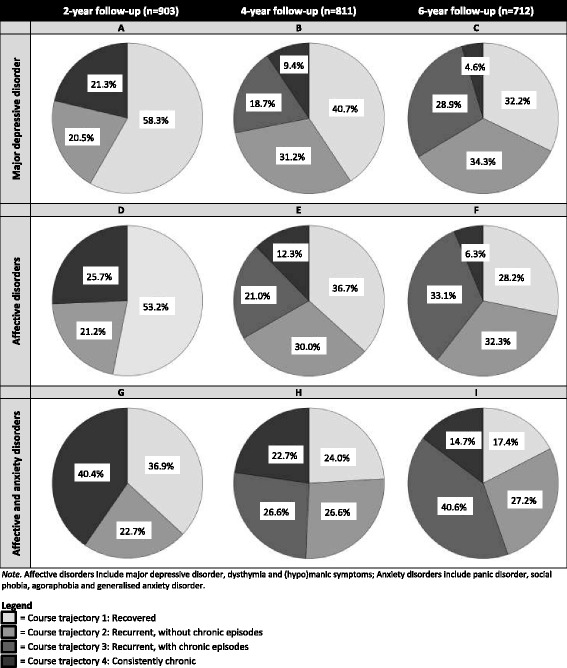
BACKGROUND: Major depressive disorder (MDD) is often handled as an episodic and isolated disorder, resulting in an optimistic view about its prognosis. Herein, we test the idea that the prognosis of MDD changes if we vary the perspective in terms of (1) a longer time frame and (2) a broader diagnostic conceptualisation including dysthymia, (hypo)mania and anxiety disorders as relevant outcomes. METHODS: Patients with current MDD at baseline (n = 903) and available 2-, 4-, and/or 6-year follow-up assessments were selected from the Netherlands Study of Depression and Anxiety, a psychiatric cohort study. Combining psychiatric DSM-IV-based diagnoses and life-chart data, patient course trajectories were classified as (1) recovered (no diagnoses at 2-year follow-up or thereafter), (2) recurrent without chronic episodes, (3) recurrent with chronic episodes or (4) consistently chronic since baseline. A chronic episode was defined as having a current diagnosis at the follow-up assessment and consistent symptoms over 2 years. Proportions of course trajectories were provided moving from a short, narrow perspective (2-year follow-up, considering only MDD diagnosis) to a long, broad perspective (6-year follow-up, including MDD, dysthymia, (hypo)mania and anxiety diagnoses). RESULTS: With the short, narrow perspective, the recovery rate was 58% and 21% had a chronic episode. However, in the long, broad perspective the recovery rate was reduced to 17%, while 55% of the patients experienced chronic episodes. CONCLUSIONS: Results from a long and rigorous follow-up in a large cohort suggests that most MDD patients have an unfavourable prognosis. Longer follow-up and broader diagnostic conceptualisation show that the majority of patients have a disabling and chronic disorder. Conceptualising and handling MDD as a narrowly defined and episodic disorder may underestimate the prognosis of the majority of depressed patients and, consequently, the type of care that is appropriate.
Overview
The claims and statistics of this paper haven’t been checked yet.
Free: it reads the open-access text and checks the first 5 claims that cite a source we can check. Create a free account to check every claim.
Integrity signals
Registry
Cites
Statistics
Figures
Verification
Claims the paper makes
The claims and statistics of this paper haven’t been checked yet.
Free: it reads the open-access text and checks the first 5 claims that cite a source we can check. Create a free account to check every claim.
Claims other papers make about this one
Each is checked against this paper’s own text: does it say what the citing paper says it does?
The source backs part of the claim, not all of it — or backs it for a different population, condition or comparison.
In the citing paper
“However, relapse is common in these patients [12, 13], even for those who have adequately responded to treatment in the acute phase.”
From Psychological interventions to prevent relapse in anxiety and depression: A systematic review and meta-analysis (2022) · cites this paper as [13]
Experimental — accuracy not yet measuredThe check wasn’t confident either way, so it gives no verdict — never disputed.
In the citing paper
“The idiom 'thinking too much' denotes a broader mental health syndrome, with manifestations such as sadness, lack of motivation, poor concentration, sleep difficulties and irritability, perhaps similar to the construct of 'common mental disorders'. 112-117”
From Time for united action on depression: a Lancet–World Psychiatric Association Commission (2022) · cites this paper as [113]
Experimental — accuracy not yet measuredIn the citing paper
“Major Depressive Disorder (MDD) is prevalent, often chronic, and requires ongoing monitoring of symptoms to track response to treatment and identify early indicators of relapse.”
Self-check
Percentages, sums and reported differences re-computed from the paper’s own numbers.
The self-check needs the paper’s full text.
Citations
Cites
Diagnostic and Statistical Manual of Mental Disorders
American Psychiatric Association (2013) · doi:10.1176/appi.books.9780890425596 · Cited by 116,369
An inventory for measuring clinical anxiety: Psychometric properties.
Beck, A. T., Epstein, N., Brown, G., & Steer, R. A. (1988) · Journal of Consulting and Clinical Psychology · doi:10.1037/0022-006x.56.6.893 · Cited by 14,407 · cited 2×
“Self Report [21], respectively.”
MethodRush, A. J., Trivedi, M. H., Ibrahim, H. M., Carmody, T. J., Arnow, B., Klein, D. N., Markowitz, J. C., Ninan, P. T., Kornstein, S., Manber, R., et al. (2003) · Biological Psychiatry · doi:10.1016/s0006-3223(02)01866-8 · Cited by 3,829 · cited 1×
“0), 67% was female, and both the average scores on depressive and anxiety symptoms were indicative of moderate severity [27].”
BackgroundWittchen, H.-U. (1994) · Journal of Psychiatric Research · doi:10.1016/0022-3956(94)90036-1 · Cited by 2,348 · cited 11×
“At baseline, a diagnosis of MDD was assessed with the DSM-IV Composite International Diagnostic Interview (CIDI) version 2.1 [19].”
MethodInfluentialGenetic relationship between five psychiatric disorders estimated from genome-wide SNPs
Cross-Disorder Group of the Psychiatric Genomics Consortium (2013) · Nature Genetics · doi:10.1038/ng.2711 · Cited by 2,263
The Inventory of Depressive Symptomatology (IDS): Psychometric properties
Rush, A. J., Gullion, C. M., Basco, M. R., Jarrett, R. B., & Trivedi, M. H. (1996) · Psychological Medicine · doi:10.1017/s0033291700035558 · Cited by 2,177 · cited 1×
“Depressive symptoms in the week prior to assessment were measured with the Inventory of Depressive Symptomatology (IDS) selfreport and were considered clinically relevant if the score was more than 13 [20].”
MethodThe Netherlands Study of Depression and Anxiety (NESDA): rationale, objectives and methods
Penninx, B. W. J. H., Beekman, A. T. F., Smit, J. H., Zitman, F. G., Nolen, W. A., Spinhoven, P., Cuijpers, P., De Jong, P. J., Van Marwijk, H. W. J., Assendelft, W. J. J., et al. (2008) · International Journal of Methods in Psychiatric Research · doi:10.1002/mpr.256 · Cited by 927 · cited 12×
“Availability of data and materials The datasets used and/or analysed during the current study are available on www.nesda.nl after access permission is given by the principal investigator of NESDA, Prof Dr B Penninx.”
BackgroundMethodInfluentialSelf-citationLamers, F., van Oppen, P., Comijs, H. C., Smit, J. H., Spinhoven, P., van Balkom, A. J. L. M., Nolen, W. A., Zitman, F. G., Beekman, A. T. F., & Penninx, B. W. J. H. (2011) · The Journal of Clinical Psychiatry · doi:10.4088/jcp.10m06176blu · Cited by 913 · cited 2×
“The high levels of co-occurrence [13, 33], overlapping etiologies [10, 12] and similar treatments that are effective for depression and anxiety further support this.”
BackgroundSelf-citationPrevalence and clinical course of depression: a review
Richards, D. (2011) · Clinical Psychology Review · doi:10.1016/j.cpr.2011.07.004 · Cited by 623 · cited 1×
“suggests that, ultimately, only a limited proportion follows a chronic course [6, 7].”
BackgroundSpijker, J., De Graaf, R., Bijl, R. V., Beekman, A. T. F., Ormel, J., & Nolen, W. A. (2002) · British Journal of Psychiatry · doi:10.1192/bjp.181.3.208 · Cited by 514
Self-citation
Research works printed but not linked: 5
- Emil K Psychiatry: A Textbook for Students and Physicians - Vol 2: Clinical Psychiatry (Resources in medical history) 1990 Sagamore Beach, MA Science History Publications
- WHO Collaborating Centre for Drug Statistics Methodology Anatomical Therapeutic Chemical (ATC) Classification System 2007 Oslo WHO Collaborating Centre for Drug Statistics Methodology
- Roijen L Handleiding Trimbos/iMTA questionnaire for Costs associated with Psychiatric Illness (TiC-P) 2002 Rotterdam Institute for Medical Technology Assessment, Erasmus University
- Lyketsos C Nestadt G Cwi J Heithoff K Eaton W The life-chart method to describe the course of psychopathology Int J Methods Psychiatr Res. 1994 4 143 55
- Corporation IBM IBM SPSS Statistics for Windows, Version 22.0 2013 Newark IBM Corp
Cited by
Items 101–123 of 123
White, K. M., Dawe‐Lane, E., Siddi, S., Lamers, F., Simblett, S. K., Alacid, G. R., Ivan, A., Myin‐Germeys, I., Haro, J. M., Oetzmann, C., et al. (2022) · Research Square · doi:10.21203/rs.3.rs-1622706/v1 · Cited by 1
Research Status of Related Influencing Factors of Depressive Disorder
孟, 繁. (2022) · Advances in Clinical Medicine · doi:10.12677/acm.2022.125615
Sandra, S., Ramayanti, N. P. N., Larasati, M. S. P., Semadi, I. M. S., Ruma, I. M. W., & Sumardika, I. W. (2021) · Essential Essence of Scientific Medical Journal · doi:10.24843/estl.2020.v18.i02.p03 · Cited by 1
Ibáñez, D., Condominas, E., Haro, J. M., Giné-Vázquez, I., RADAR-MDD-Spain, Bailón, R., Pagès, E. G., Kontaxis, S., Peñarrubia‐María, M. T., Arranz, B., et al. (2024) · Frontiers in Psychology · doi:10.3389/fpsyg.2024.1436611 · Cited by 1
Self-citationKoivisto, H., Smolander, H., Honkalampi, K. M., Pakarinen, M., Ruusunen, A. A., & Valkonen‐Korhonen, M. (2025) · Psykologia · doi:10.62443/psykologia.v58i1.112900 · Cited by 3
Diagnosis and Epidemiology of Depression
Murrough, J. W. (2025) · Oxford University Press eBooks · doi:10.1093/med/9780197640654.003.0027
Lai, Y., & Zhou, J. (2025) · Transactions on Materials Biotechnology and Life Sciences · doi:10.62051/ygt4nv07
“55% of patients have experienced chronic attacks, and most MDD patients have a poor prognosis [2].”
Linsen, F., Broeder, C. E., Sep, M. S. C., Verhoeven, J. E., Bet, P. M., Penninx, B. W. J. H., Meijer, O. C., & Vinkers, C. H. (2024) · Figshare · doi:10.6084/m9.figshare.26588757
Self-citationGathier, A. W., Verhoeven, J., van Oppen, P., Penninx, B. W. J. H., Merkx, M. J. M., Dingemanse, P., Stehouwer, K. M. K. S., van den Bulck, C. M. M., & Vinkers, C. H. (2023) · Figshare · doi:10.6084/m9.figshare.22599298
Self-citationSteffen, A., Nübel, J., Jacobi, F., Bätzing, J., & Holstiege, J. (2020) · Figshare · doi:10.6084/m9.figshare.12050313
Wang, W., Wang, Y., Wang, F., Chen, H., Qin, X., Yang, L., Yang, X., & Yang, L. (2024) · Figshare · doi:10.6084/m9.figshare.26036395
Solis, E. C., Carlier, I. V. E., Kamminga, N. G. A., Giltay, E. J., & van Hemert, A. M. (2024) · Figshare · doi:10.6084/m9.figshare.25405990
Self-citationSteffen, A., Nübel, J., Jacobi, F., Bätzing, J., & Holstiege, J. (2020) · Figshare · doi:10.6084/m9.figshare.12050316
Co-traveling of smoking in people with remitted, recurrent and repeated depression
ter Meulen, W. G., Draisma, S., Hoogendoorn, A. W., Kupka, R., Beekman, A. T. F., & Penninx, B. W. J. H. (2026) · Journal of Affective Disorders · doi:10.1016/j.jad.2026.121851 · Cited by 1
Self-citationCarniel, B. P., Alexandrino, G. B., Burin, L. M., & da Rocha, N. S. (2026) · Psychoneuroendocrinology · doi:10.1016/j.psyneuen.2026.107865
Depression and accuracy of judgment: A meta-analysis
Yeung, J. C., Lam, H., & Chan, D. K. ‐. (2026) · Clinical Psychology Review · doi:10.1016/j.cpr.2026.102752
Willey, J., McGhee, M., Patterson, D. A., & Ridner, S. (2026) · Clinical Social Work Journal · doi:10.1007/s10615-026-01035-x
Linsen, F., Broeder, C., Hoogendoorn, A. W., Sep, M. S. C., Verhoeven, J. E., Bet, P. M., Penninx, B. W. J. H., Meijer, O. C., & Vinkers, C. H. (2026) · Psychiatry Research · doi:10.1016/j.psychres.2026.117354 · Cited by 1
Self-citationSix-year clinical course of depressive and anxiety disorders: analysis by age
Triolo, F., Han, L. K. M., Jeuring, H. W., Giltay, E. J., & Penninx, B. W. J. H. (2026) · BMJ Mental Health · doi:10.1136/bmjment-2026-302895
Self-citationSchulz, R., Post, W. J., Huisman, M., Waldorp, L., & de Jong, P. J. (2026) · Clinical Psychological Science · doi:10.1177/21677026261485974
Smith-Apeldoorn, S. Y., Veraart, J. K. E., Spijker, J., van der Meij, A., Kamphuis, J., & Schoevers, R. A. (2026) · Depression and Anxiety · doi:10.1155/da/8320239
“This may be related to the fact that patients with TRD have a higher risk of relapse and to the general decline in depression recovery rates over time [5, 47].”
Self-citation
Metadata
- Authors
- Verduijn, J., Verhoeven, J. E., Milaneschi, Y., Schoevers, R. A., van Hemert, A. M., Beekman, A. T. F., & Penninx, B. W. J. H.
- Affiliations
- Amsterdam Public Health (NL)
- University Medical Center Groningen (NL)
- Corresponding author
- Verhoeven, Josine E.
- ORCID
- Venue
- BMC Medicine
- Published
- 2017-12
- Volume
- 15
- Issue
- 1
- Pages
- 215-215
- ISSN
- 1741-7015 (ISSN-L)
- PMC
- PMC5725897
- OpenAlex
- W2774368682
- Semantic Scholar
- 90e4f45e4e32b6a69396205447b34eb8f7d5e3f3
- Cited by
- 122
- References
- 30
- Citations by year
- 2026: 14 · 2025: 10 · 2024: 20 · 2023: 16 · 2022: 15 · 2021: 23 · 2020: 12 · 2019: 10 · 2018: 2
- FWCI
- 4.58
- Type
- journal article
- Language
- en
- Open access
- gold
- doi.org
- Licence
- cc-by
- Locations
- BMC Medicine (publishedVersion, cc-by)
- PubMed Central (publishedVersion, cc-by)
- PubMed (publishedVersion)
- Pure Amsterdam UMC (publishedVersion, other-oa)
- Amsterdam UMC (VU Amsterdam) - Institutional Repository (publishedVersion)
- University of Groningen research database (University of Groningen / Centre for Information Technology) (publishedVersion, cc-by)
- Data Archiving and Networked Services (DANS) (submittedVersion)
- Leiden Repository (Leiden University) (submittedVersion)
- DOAJ (DOAJ: Directory of Open Access Journals) (submittedVersion, cc-by-sa)
- University of Groningen research database (University of Groningen / Centre for Information Technology) (submittedVersion, cc-by)
- Funders
- Geestkracht program of the Netherlands Organisation for Health Research and Development (10-000-1002)
- Topics
- Health Sciences › Medicine › Pharmacology (medical) › Treatment of Major Depression
- Health Sciences › Medicine › Psychiatry and Mental health › Mental Health Treatment and Access
- Health Sciences › Medicine › Psychiatry and Mental health › Bipolar Disorder and Treatment
- Keywords
- major depressive disorder, prognosis, chronic depression, recovery, dysthymia, hypomania, mania, anxiety disorders, long-term follow-up
- MeSH terms
- Adolescent, Adult, Aged, Anxiety Disorders, Bipolar Disorder, Chronic Disease, Major Depressive Disorder, Depressive Disorder, Major, Female, Follow-Up Studies, Humans, Male, Middle Aged, Netherlands, Prognosis, Comorbidity, Diagnostic and Statistical Manual of Mental Disorders, Young Adult
About these checks
Registry, retraction, Cites and statistics results are computed, not judged, with one exception: a printed reference that no index lists is read once by a model before it counts as a citation error. Claims are extracted by a model and kept only when their quote appears verbatim in the text; each cited source is then checked, with a model’s help, for whether it says what the claim relies on. Those verdicts can be wrong — read the claim’s quote and the cited source before relying on one.
Statistics and arithmetic are recomputed, not judged.
Confidence bands are shown only for fields calibrated on our annotated test set. None is calibrated yet, so no band is shown.
What counts as a claim ›How we measure confidence ›How we check this ›
Are you an author, or do you see a problem with this page? Request a review
Data sources
Bibliographic data: Semantic Scholar, OpenAlex, Crossref.
Contains information from the Semantic Scholar Academic Graph Datasets, made available under the ODC Attribution License (ODC-BY 1.0).
Semantic Scholar’s data is described in: Kinney, R., et al. (2023). The Semantic Scholar Open Data Platform. arXiv:2301.10140.
