

Reconsidering the prognosis of major depressive disorder across diagnostic boundaries: full recovery is the exception rather than the rule
Open accessThe DOI matches its Crossref record; 29 of the 30 references it cites were found in a registry or an index.
Abstract
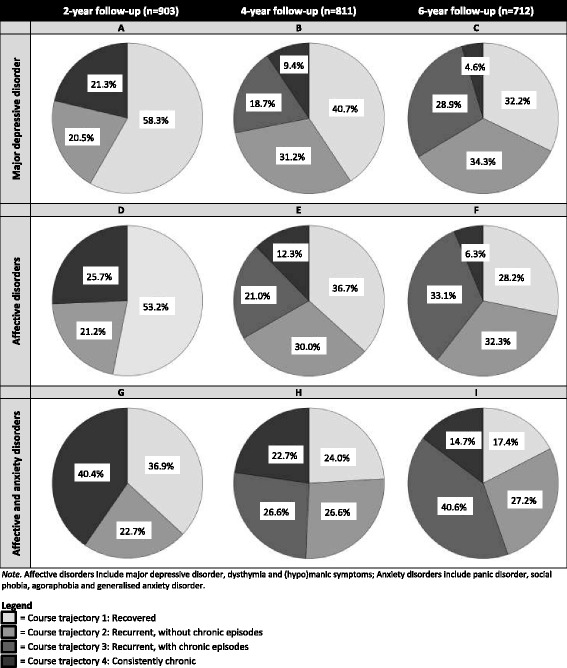
BACKGROUND: Major depressive disorder (MDD) is often handled as an episodic and isolated disorder, resulting in an optimistic view about its prognosis. Herein, we test the idea that the prognosis of MDD changes if we vary the perspective in terms of (1) a longer time frame and (2) a broader diagnostic conceptualisation including dysthymia, (hypo)mania and anxiety disorders as relevant outcomes. METHODS: Patients with current MDD at baseline (n = 903) and available 2-, 4-, and/or 6-year follow-up assessments were selected from the Netherlands Study of Depression and Anxiety, a psychiatric cohort study. Combining psychiatric DSM-IV-based diagnoses and life-chart data, patient course trajectories were classified as (1) recovered (no diagnoses at 2-year follow-up or thereafter), (2) recurrent without chronic episodes, (3) recurrent with chronic episodes or (4) consistently chronic since baseline. A chronic episode was defined as having a current diagnosis at the follow-up assessment and consistent symptoms over 2 years. Proportions of course trajectories were provided moving from a short, narrow perspective (2-year follow-up, considering only MDD diagnosis) to a long, broad perspective (6-year follow-up, including MDD, dysthymia, (hypo)mania and anxiety diagnoses). RESULTS: With the short, narrow perspective, the recovery rate was 58% and 21% had a chronic episode. However, in the long, broad perspective the recovery rate was reduced to 17%, while 55% of the patients experienced chronic episodes. CONCLUSIONS: Results from a long and rigorous follow-up in a large cohort suggests that most MDD patients have an unfavourable prognosis. Longer follow-up and broader diagnostic conceptualisation show that the majority of patients have a disabling and chronic disorder. Conceptualising and handling MDD as a narrowly defined and episodic disorder may underestimate the prognosis of the majority of depressed patients and, consequently, the type of care that is appropriate.
Overview
The claims and statistics of this paper haven’t been checked yet.
Free: it reads the open-access text and checks the first 5 claims that cite a source we can check. Create a free account to check every claim.
Integrity signals
Registry
Cites
Statistics
Figures
Verification
Claims the paper makes
The claims and statistics of this paper haven’t been checked yet.
Free: it reads the open-access text and checks the first 5 claims that cite a source we can check. Create a free account to check every claim.
Claims other papers make about this one
Each is checked against this paper’s own text: does it say what the citing paper says it does?
The source backs part of the claim, not all of it — or backs it for a different population, condition or comparison.
In the citing paper
“However, relapse is common in these patients [12, 13], even for those who have adequately responded to treatment in the acute phase.”
From Psychological interventions to prevent relapse in anxiety and depression: A systematic review and meta-analysis (2022) · cites this paper as [13]
Experimental — accuracy not yet measuredThe check wasn’t confident either way, so it gives no verdict — never disputed.
In the citing paper
“The idiom 'thinking too much' denotes a broader mental health syndrome, with manifestations such as sadness, lack of motivation, poor concentration, sleep difficulties and irritability, perhaps similar to the construct of 'common mental disorders'. 112-117”
From Time for united action on depression: a Lancet–World Psychiatric Association Commission (2022) · cites this paper as [113]
Experimental — accuracy not yet measuredIn the citing paper
“Major Depressive Disorder (MDD) is prevalent, often chronic, and requires ongoing monitoring of symptoms to track response to treatment and identify early indicators of relapse.”
Self-check
Percentages, sums and reported differences re-computed from the paper’s own numbers.
The self-check needs the paper’s full text.
Citations
Cites
Diagnostic and Statistical Manual of Mental Disorders
American Psychiatric Association (2013) · doi:10.1176/appi.books.9780890425596 · Cited by 116,369
An inventory for measuring clinical anxiety: Psychometric properties.
Beck, A. T., Epstein, N., Brown, G., & Steer, R. A. (1988) · Journal of Consulting and Clinical Psychology · doi:10.1037/0022-006x.56.6.893 · Cited by 14,407 · cited 2×
“Self Report [21], respectively.”
MethodRush, A. J., Trivedi, M. H., Ibrahim, H. M., Carmody, T. J., Arnow, B., Klein, D. N., Markowitz, J. C., Ninan, P. T., Kornstein, S., Manber, R., et al. (2003) · Biological Psychiatry · doi:10.1016/s0006-3223(02)01866-8 · Cited by 3,829 · cited 1×
“0), 67% was female, and both the average scores on depressive and anxiety symptoms were indicative of moderate severity [27].”
BackgroundWittchen, H.-U. (1994) · Journal of Psychiatric Research · doi:10.1016/0022-3956(94)90036-1 · Cited by 2,348 · cited 11×
“At baseline, a diagnosis of MDD was assessed with the DSM-IV Composite International Diagnostic Interview (CIDI) version 2.1 [19].”
MethodInfluentialGenetic relationship between five psychiatric disorders estimated from genome-wide SNPs
Cross-Disorder Group of the Psychiatric Genomics Consortium (2013) · Nature Genetics · doi:10.1038/ng.2711 · Cited by 2,263
The Inventory of Depressive Symptomatology (IDS): Psychometric properties
Rush, A. J., Gullion, C. M., Basco, M. R., Jarrett, R. B., & Trivedi, M. H. (1996) · Psychological Medicine · doi:10.1017/s0033291700035558 · Cited by 2,177 · cited 1×
“Depressive symptoms in the week prior to assessment were measured with the Inventory of Depressive Symptomatology (IDS) selfreport and were considered clinically relevant if the score was more than 13 [20].”
MethodThe Netherlands Study of Depression and Anxiety (NESDA): rationale, objectives and methods
Penninx, B. W. J. H., Beekman, A. T. F., Smit, J. H., Zitman, F. G., Nolen, W. A., Spinhoven, P., Cuijpers, P., De Jong, P. J., Van Marwijk, H. W. J., Assendelft, W. J. J., et al. (2008) · International Journal of Methods in Psychiatric Research · doi:10.1002/mpr.256 · Cited by 927 · cited 12×
“Availability of data and materials The datasets used and/or analysed during the current study are available on www.nesda.nl after access permission is given by the principal investigator of NESDA, Prof Dr B Penninx.”
BackgroundMethodInfluentialSelf-citationLamers, F., van Oppen, P., Comijs, H. C., Smit, J. H., Spinhoven, P., van Balkom, A. J. L. M., Nolen, W. A., Zitman, F. G., Beekman, A. T. F., & Penninx, B. W. J. H. (2011) · The Journal of Clinical Psychiatry · doi:10.4088/jcp.10m06176blu · Cited by 913 · cited 2×
“The high levels of co-occurrence [13, 33], overlapping etiologies [10, 12] and similar treatments that are effective for depression and anxiety further support this.”
BackgroundSelf-citationPrevalence and clinical course of depression: a review
Richards, D. (2011) · Clinical Psychology Review · doi:10.1016/j.cpr.2011.07.004 · Cited by 623 · cited 1×
“suggests that, ultimately, only a limited proportion follows a chronic course [6, 7].”
BackgroundSpijker, J., De Graaf, R., Bijl, R. V., Beekman, A. T. F., Ormel, J., & Nolen, W. A. (2002) · British Journal of Psychiatry · doi:10.1192/bjp.181.3.208 · Cited by 514
Self-citationThe Clinical Course of Unipolar Major Depressive Disorders
Judd, L. L. (1997) · Archives of General Psychiatry · doi:10.1001/archpsyc.1997.01830230015002 · Cited by 460 · cited 1×
“[9] have shown that most patients move in and out of more or less severe levels of symptoms over time.”
BackgroundSpinhoven, P., Elzinga, B. M., Hovens, J. G. F. M., Roelofs, K., Zitman, F. G., van Oppen, P., & Penninx, B. W. J. H. (2010) · Journal of Affective Disorders · doi:10.1016/j.jad.2010.02.132 · Cited by 324
Self-citationDisability in depression and back pain
Chwastiak, L. A., & Von Korff, M. (2003) · Journal of Clinical Epidemiology · doi:10.1016/s0895-4356(03)00051-9 · Cited by 280 · cited 4×
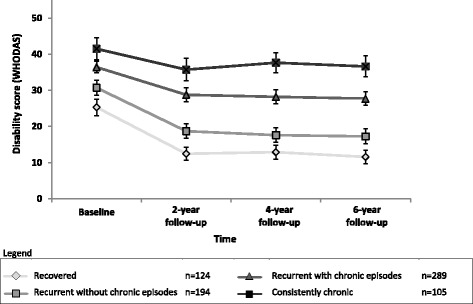
“As a clinical validation of the course trajectories, the longitudinal association between disability scores (WHODAS-II) and the four course trajectories according to the long, broad perspective (6-year follow-up, all affective and anxiety disorders; n = 712; observations = 2661) was estimated using a linear generalise…”
MethodInfluentialThe Phenomenology of Major Depression and the Representativeness and Nature of DSM Criteria.
Kendler, K. S. (2016) · American Journal of Psychiatry · doi:10.1176/appi.ajp.2016.15121509 · Cited by 255 · cited 1×
“However, in a recent review paper [32], Kendler showed that the large majority of descriptions of major depression up until the 1960s included anxiety as a symptom of depression.”
BackgroundWisniewski, S. R., Rush, A. J., Nierenberg, A. A., Gaynes, B. N., Warden, D., Luther, J. F., McGrath, P. J., Lavori, P. W., Thase, M. E., Fava, M., et al. (2009) · American Journal of Psychiatry · doi:10.1176/appi.ajp.2008.08071027 · Cited by 223 · cited 2×
“Moreover, clinical trials should aim to include a representative and ecologically valid study sample [8].”
BackgroundKlein, D. N., Shankman, S. A., & Rose, S. (2006) · American Journal of Psychiatry · doi:10.1176/ajp.2006.163.5.872 · Cited by 194 · cited 1×
“The high levels of co-occurrence [13, 33], overlapping etiologies [10, 12] and similar treatments that are effective for depression and anxiety further support this.”
BackgroundSteinert, C., Hofmann, M., Kruse, J., & Leichsenring, F. (2013) · Journal of Affective Disorders · doi:10.1016/j.jad.2013.10.017 · Cited by 178 · cited 2×
“Additionally, several studies on the prospective longterm course of depression in the general population and primary care describe high rates of stable recovery from depressive symptoms (35–60%) [15].”
BackgroundDysthymia and cyclothymia in psychiatric practice a century after Kraepelin
Akiskal, H. S. (2001) · Journal of Affective Disorders · doi:10.1016/s0165-0327(00)00347-5 · Cited by 136 · cited 3×
“This was further elaborated by Kraepelin [28, 29], who advocated more emphasis on prognosis, functional consequences or aetiology.”
BackgroundFichter, M. M., Quadflieg, N., Fischer, U. C., & Kohlboeck, G. (2010) · Acta Psychiatrica Scandinavica · doi:10.1111/j.1600-0447.2009.01512.x · Cited by 135 · cited 1×
“Finally, the three diagnostic constructs overlap in treatment outcomes and prognosis [14, 15].”
BackgroundThe 7-year course of depression and anxiety in the general population
Rhebergen, D., Batelaan, N. M., de Graaf, R., Nolen, W. A., Spijker, J., Beekman, A. T. F., & Penninx, B. W. J. H. (2011) · Acta Psychiatrica Scandinavica · doi:10.1111/j.1600-0447.2011.01677.x · Cited by 116 · cited 1×
“suggests that, ultimately, only a limited proportion follows a chronic course [6, 7].”
BackgroundSelf-citationThe Naturalistic Course of Unipolar Major Depression in the Absence of Somatic Therapy
Posternak, M. A., Solomon, D. A., Leon, A. C., Mueller, T. I., Shea, M. T., Endicott, J., & Keller, M. B. (2006) · The Journal of Nervous and Mental Disease · doi:10.1097/01.nmd.0000217820.33841.53 · Cited by 113
Emil Kraepelin: A pioneer of scientific understanding of psychiatry and psychopharmacology
Bar, K.-J., & Ebert, A. (2010) · Indian Journal of Psychiatry · doi:10.4103/0019-5545.64591 · Cited by 69 · cited 1×
“depression’, which he described as episodic [1, 2].”
Course of depression in a 10–year prospective study: Evidence for qualitatively distinct subgroups.
Klein, D. N., & Kotov, R. (2016) · Journal of Abnormal Psychology · doi:10.1037/abn0000147 · Cited by 62 · cited 1×
“Consequently, studies on the longitudinal course of MDD that do not take comorbidity into account might incline towards outcomes that are actually unrealistically favourable [16, 17].”
BackgroundFive-year outcome of major depressive disorder in primary health care
Riihimäki, K. A., Vuorilehto, M. S., Melartin, T. K., & Isometsä, E. T. (2014) · Psychological Medicine · doi:10.1017/s0033291711002303 · Cited by 56 · cited 1×
“Consequently, studies on the longitudinal course of MDD that do not take comorbidity into account might incline towards outcomes that are actually unrealistically favourable [16, 17].”
BackgroundThe transformation of American psychiatric nosology at the dawn of the twentieth century
Kendler, K. S. (2015) · Molecular Psychiatry · doi:10.1038/mp.2015.188 · Cited by 23 · cited 4×
“This was further elaborated by Kraepelin [28, 29], who advocated more emphasis on prognosis, functional consequences or aetiology.”
BackgroundInfluentialMental Health Analysis Profiles (MhAPs): Netherlands
Forti, A., Nas, C., van Geldrop, A., Franx, G. C., Petrea, I., van Strien, Y., & Jeurissen, P. (2014) · OECD health working papers · doi:10.1787/5jz158z60dzn-en · Cited by 22 · cited 1×
“Netherlands is accessible, affordable and of good quality [34], outcomes are generally unfavourable.”
BackgroundMaintenance treatment of recurrent unipolar depression: pharmacology and psychotherapy.
Frank, E., & Dj, K. (1985) · PubMed · Cited by 21
Thibodeau, P. H., Fein, M., Goodbody, E. S., & Flusberg, S. J. (2015) · Frontiers in Psychology · doi:10.3389/fpsyg.2015.01728 · Cited by 18 · cited 1×
“Moreover, lay people tend to view depression as an incident in response to life stress rather than a disorder that is often chronic [31].”
BackgroundDepression and anxiety: their insidious dance
Penninx, B. W. J. H. (2015) · The Lancet Psychiatry · doi:10.1016/s2215-0366(15)00118-2 · Cited by 17 · cited 2×
“childhood trauma and negative life events [11]) and similar physiological dysregulations [12].”
BackgroundSelf-citation
Research works printed but not linked: 5
- Emil K Psychiatry: A Textbook for Students and Physicians - Vol 2: Clinical Psychiatry (Resources in medical history) 1990 Sagamore Beach, MA Science History Publications
- WHO Collaborating Centre for Drug Statistics Methodology Anatomical Therapeutic Chemical (ATC) Classification System 2007 Oslo WHO Collaborating Centre for Drug Statistics Methodology
- Roijen L Handleiding Trimbos/iMTA questionnaire for Costs associated with Psychiatric Illness (TiC-P) 2002 Rotterdam Institute for Medical Technology Assessment, Erasmus University
- Lyketsos C Nestadt G Cwi J Heithoff K Eaton W The life-chart method to describe the course of psychopathology Int J Methods Psychiatr Res. 1994 4 143 55
- Corporation IBM IBM SPSS Statistics for Windows, Version 22.0 2013 Newark IBM Corp
Cited by
Malhi, G. S., & Mann, J. J. (2018) · The Lancet · doi:10.1016/s0140-6736(18)31948-2 · Cited by 4,099
Major depressive disorder: hypothesis, mechanism, prevention and treatment
Cui, L., Li, S., Wang, S., Wu, X., Liu, Y., Yu, W., Wang, Y., Tang, Y., Xia, M., & Li, B. (2024) · Signal Transduction and Targeted Therapy · doi:10.1038/s41392-024-01738-y · Cited by 1,244
“MDD is a disease with a high prevalence worldwide, 279 and preventing its occurrence and recurrence is crucial.”
BackgroundTime for united action on depression: a Lancet–World Psychiatric Association Commission
Herrman, H., Patel, V., Kieling, C., Berk, M., Buchweitz, C., Cuijpers, P., Furukawa, T. A., Kessler, R. C., Kohrt, B. A., Maj, M., et al. (2022) · The Lancet · doi:10.1016/s0140-6736(21)02141-3 · Cited by 1,104
Self-citationSteffen, A., Nübel, J., Jacobi, F., Bätzing, J., & Holstiege, J. (2020) · BMC Psychiatry · doi:10.1186/s12888-020-02546-8 · Cited by 212
ter Meulen, W. G., Draisma, S., van Hemert, A. M., Schoevers, R. A., Kupka, R. W., Beekman, A. T. F., & Penninx, B. W. J. H. (2021) · Journal of Affective Disorders · doi:10.1016/j.jad.2021.02.004 · Cited by 170
Self-citation
Metadata
- Authors
- Verduijn, J., Verhoeven, J. E., Milaneschi, Y., Schoevers, R. A., van Hemert, A. M., Beekman, A. T. F., & Penninx, B. W. J. H.
- Affiliations
- Amsterdam Public Health (NL)
- University Medical Center Groningen (NL)
- Corresponding author
- Verhoeven, Josine E.
- ORCID
- Venue
- BMC Medicine
- Published
- 2017-12
- Volume
- 15
- Issue
- 1
- Pages
- 215-215
- ISSN
- 1741-7015 (ISSN-L)
- PMC
- PMC5725897
- OpenAlex
- W2774368682
- Cited by
- 122
- References
- 30
- Citations by year
- 2026: 14 · 2025: 10 · 2024: 20 · 2023: 16 · 2022: 15 · 2021: 23 · 2020: 12 · 2019: 10 · 2018: 2
- FWCI
- 4.58
- Type
- journal article
- Language
- en
- Open access
- gold
- doi.org
- Licence
- cc-by
- Locations
- BMC Medicine (publishedVersion, cc-by)
- PubMed Central (publishedVersion, cc-by)
- PubMed (publishedVersion)
- Pure Amsterdam UMC (publishedVersion, other-oa)
- Amsterdam UMC (VU Amsterdam) - Institutional Repository (publishedVersion)
- University of Groningen research database (University of Groningen / Centre for Information Technology) (publishedVersion, cc-by)
- Data Archiving and Networked Services (DANS) (submittedVersion)
- Leiden Repository (Leiden University) (submittedVersion)
- DOAJ (DOAJ: Directory of Open Access Journals) (submittedVersion, cc-by-sa)
- University of Groningen research database (University of Groningen / Centre for Information Technology) (submittedVersion, cc-by)
- Funders
- Geestkracht program of the Netherlands Organisation for Health Research and Development (10-000-1002)
- Topics
- Health Sciences › Medicine › Pharmacology (medical) › Treatment of Major Depression
- Health Sciences › Medicine › Psychiatry and Mental health › Mental Health Treatment and Access
- Health Sciences › Medicine › Psychiatry and Mental health › Bipolar Disorder and Treatment
- Keywords
- major depressive disorder, prognosis, chronic depression, recovery, dysthymia, hypomania, mania, anxiety disorders, long-term follow-up
- MeSH terms
- Adolescent, Adult, Aged, Anxiety Disorders, Bipolar Disorder, Chronic Disease, Major Depressive Disorder, Depressive Disorder, Major, Female, Follow-Up Studies, Humans, Male, Middle Aged, Netherlands, Prognosis, Comorbidity, Diagnostic and Statistical Manual of Mental Disorders, Young Adult
About these checks
Registry, retraction, Cites and statistics results are computed, not judged, with one exception: a printed reference that no index lists is read once by a model before it counts as a citation error. Claims are extracted by a model and kept only when their quote appears verbatim in the text; each cited source is then checked, with a model’s help, for whether it says what the claim relies on. Those verdicts can be wrong — read the claim’s quote and the cited source before relying on one.
Statistics and arithmetic are recomputed, not judged.
Confidence bands are shown only for fields calibrated on our annotated test set. None is calibrated yet, so no band is shown.
What counts as a claim ›How we measure confidence ›How we check this ›
Are you an author, or do you see a problem with this page? Request a review
Data sources
Bibliographic data: Semantic Scholar, OpenAlex, Crossref.
Contains information from the Semantic Scholar Academic Graph Datasets, made available under the ODC Attribution License (ODC-BY 1.0).
Semantic Scholar’s data is described in: Kinney, R., et al. (2023). The Semantic Scholar Open Data Platform. arXiv:2301.10140.
