

Reconsidering the prognosis of major depressive disorder across diagnostic boundaries: full recovery is the exception rather than the rule
Open accessThe DOI matches its Crossref record; 29 of the 30 references it cites were found in a registry or an index.
Abstract
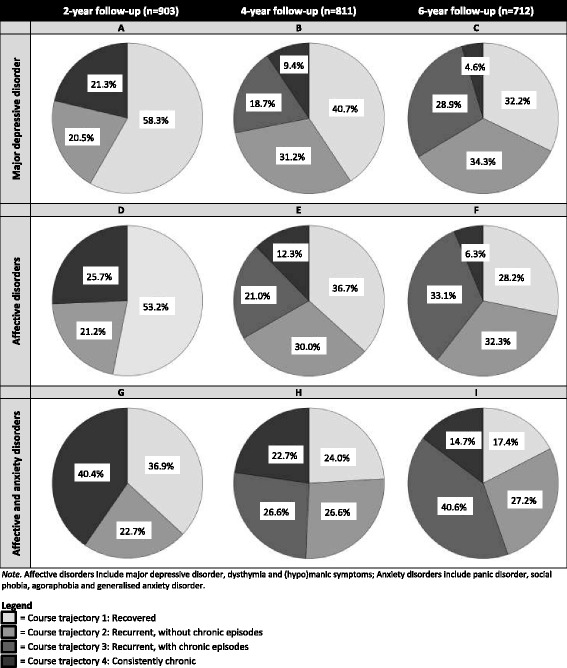
BACKGROUND: Major depressive disorder (MDD) is often handled as an episodic and isolated disorder, resulting in an optimistic view about its prognosis. Herein, we test the idea that the prognosis of MDD changes if we vary the perspective in terms of (1) a longer time frame and (2) a broader diagnostic conceptualisation including dysthymia, (hypo)mania and anxiety disorders as relevant outcomes. METHODS: Patients with current MDD at baseline (n = 903) and available 2-, 4-, and/or 6-year follow-up assessments were selected from the Netherlands Study of Depression and Anxiety, a psychiatric cohort study. Combining psychiatric DSM-IV-based diagnoses and life-chart data, patient course trajectories were classified as (1) recovered (no diagnoses at 2-year follow-up or thereafter), (2) recurrent without chronic episodes, (3) recurrent with chronic episodes or (4) consistently chronic since baseline. A chronic episode was defined as having a current diagnosis at the follow-up assessment and consistent symptoms over 2 years. Proportions of course trajectories were provided moving from a short, narrow perspective (2-year follow-up, considering only MDD diagnosis) to a long, broad perspective (6-year follow-up, including MDD, dysthymia, (hypo)mania and anxiety diagnoses). RESULTS: With the short, narrow perspective, the recovery rate was 58% and 21% had a chronic episode. However, in the long, broad perspective the recovery rate was reduced to 17%, while 55% of the patients experienced chronic episodes. CONCLUSIONS: Results from a long and rigorous follow-up in a large cohort suggests that most MDD patients have an unfavourable prognosis. Longer follow-up and broader diagnostic conceptualisation show that the majority of patients have a disabling and chronic disorder. Conceptualising and handling MDD as a narrowly defined and episodic disorder may underestimate the prognosis of the majority of depressed patients and, consequently, the type of care that is appropriate.
Overview
The claims and statistics of this paper haven’t been checked yet.
Free: it reads the open-access text and checks the first 5 claims that cite a source we can check. Create a free account to check every claim.
Integrity signals
Registry
Cites
Statistics
Figures
Verification
Claims the paper makes
The claims and statistics of this paper haven’t been checked yet.
Free: it reads the open-access text and checks the first 5 claims that cite a source we can check. Create a free account to check every claim.
Claims other papers make about this one
Each is checked against this paper’s own text: does it say what the citing paper says it does?
The source backs part of the claim, not all of it — or backs it for a different population, condition or comparison.
In the citing paper
“However, relapse is common in these patients [12, 13], even for those who have adequately responded to treatment in the acute phase.”
From Psychological interventions to prevent relapse in anxiety and depression: A systematic review and meta-analysis (2022) · cites this paper as [13]
Experimental — accuracy not yet measuredThe check wasn’t confident either way, so it gives no verdict — never disputed.
In the citing paper
“The idiom 'thinking too much' denotes a broader mental health syndrome, with manifestations such as sadness, lack of motivation, poor concentration, sleep difficulties and irritability, perhaps similar to the construct of 'common mental disorders'. 112-117”
From Time for united action on depression: a Lancet–World Psychiatric Association Commission (2022) · cites this paper as [113]
Experimental — accuracy not yet measuredIn the citing paper
“Major Depressive Disorder (MDD) is prevalent, often chronic, and requires ongoing monitoring of symptoms to track response to treatment and identify early indicators of relapse.”
Self-check
Percentages, sums and reported differences re-computed from the paper’s own numbers.
The self-check needs the paper’s full text.
Citations
Cites
Diagnostic and Statistical Manual of Mental Disorders
American Psychiatric Association (2013) · doi:10.1176/appi.books.9780890425596 · Cited by 116,369
An inventory for measuring clinical anxiety: Psychometric properties.
Beck, A. T., Epstein, N., Brown, G., & Steer, R. A. (1988) · Journal of Consulting and Clinical Psychology · doi:10.1037/0022-006x.56.6.893 · Cited by 14,407 · cited 2×
“Self Report [21], respectively.”
MethodRush, A. J., Trivedi, M. H., Ibrahim, H. M., Carmody, T. J., Arnow, B., Klein, D. N., Markowitz, J. C., Ninan, P. T., Kornstein, S., Manber, R., et al. (2003) · Biological Psychiatry · doi:10.1016/s0006-3223(02)01866-8 · Cited by 3,829 · cited 1×
“0), 67% was female, and both the average scores on depressive and anxiety symptoms were indicative of moderate severity [27].”
BackgroundWittchen, H.-U. (1994) · Journal of Psychiatric Research · doi:10.1016/0022-3956(94)90036-1 · Cited by 2,348 · cited 11×
“At baseline, a diagnosis of MDD was assessed with the DSM-IV Composite International Diagnostic Interview (CIDI) version 2.1 [19].”
MethodInfluentialGenetic relationship between five psychiatric disorders estimated from genome-wide SNPs
Cross-Disorder Group of the Psychiatric Genomics Consortium (2013) · Nature Genetics · doi:10.1038/ng.2711 · Cited by 2,263
The Inventory of Depressive Symptomatology (IDS): Psychometric properties
Rush, A. J., Gullion, C. M., Basco, M. R., Jarrett, R. B., & Trivedi, M. H. (1996) · Psychological Medicine · doi:10.1017/s0033291700035558 · Cited by 2,177 · cited 1×
“Depressive symptoms in the week prior to assessment were measured with the Inventory of Depressive Symptomatology (IDS) selfreport and were considered clinically relevant if the score was more than 13 [20].”
MethodThe Netherlands Study of Depression and Anxiety (NESDA): rationale, objectives and methods
Penninx, B. W. J. H., Beekman, A. T. F., Smit, J. H., Zitman, F. G., Nolen, W. A., Spinhoven, P., Cuijpers, P., De Jong, P. J., Van Marwijk, H. W. J., Assendelft, W. J. J., et al. (2008) · International Journal of Methods in Psychiatric Research · doi:10.1002/mpr.256 · Cited by 927 · cited 12×
“Availability of data and materials The datasets used and/or analysed during the current study are available on www.nesda.nl after access permission is given by the principal investigator of NESDA, Prof Dr B Penninx.”
BackgroundMethodInfluentialSelf-citationLamers, F., van Oppen, P., Comijs, H. C., Smit, J. H., Spinhoven, P., van Balkom, A. J. L. M., Nolen, W. A., Zitman, F. G., Beekman, A. T. F., & Penninx, B. W. J. H. (2011) · The Journal of Clinical Psychiatry · doi:10.4088/jcp.10m06176blu · Cited by 913 · cited 2×
“The high levels of co-occurrence [13, 33], overlapping etiologies [10, 12] and similar treatments that are effective for depression and anxiety further support this.”
BackgroundSelf-citationPrevalence and clinical course of depression: a review
Richards, D. (2011) · Clinical Psychology Review · doi:10.1016/j.cpr.2011.07.004 · Cited by 623 · cited 1×
“suggests that, ultimately, only a limited proportion follows a chronic course [6, 7].”
BackgroundSpijker, J., De Graaf, R., Bijl, R. V., Beekman, A. T. F., Ormel, J., & Nolen, W. A. (2002) · British Journal of Psychiatry · doi:10.1192/bjp.181.3.208 · Cited by 514
Self-citation
Research works printed but not linked: 5
- Emil K Psychiatry: A Textbook for Students and Physicians - Vol 2: Clinical Psychiatry (Resources in medical history) 1990 Sagamore Beach, MA Science History Publications
- WHO Collaborating Centre for Drug Statistics Methodology Anatomical Therapeutic Chemical (ATC) Classification System 2007 Oslo WHO Collaborating Centre for Drug Statistics Methodology
- Roijen L Handleiding Trimbos/iMTA questionnaire for Costs associated with Psychiatric Illness (TiC-P) 2002 Rotterdam Institute for Medical Technology Assessment, Erasmus University
- Lyketsos C Nestadt G Cwi J Heithoff K Eaton W The life-chart method to describe the course of psychopathology Int J Methods Psychiatr Res. 1994 4 143 55
- Corporation IBM IBM SPSS Statistics for Windows, Version 22.0 2013 Newark IBM Corp
Cited by
Malhi, G. S., & Mann, J. J. (2018) · The Lancet · doi:10.1016/s0140-6736(18)31948-2 · Cited by 4,099
Major depressive disorder: hypothesis, mechanism, prevention and treatment
Cui, L., Li, S., Wang, S., Wu, X., Liu, Y., Yu, W., Wang, Y., Tang, Y., Xia, M., & Li, B. (2024) · Signal Transduction and Targeted Therapy · doi:10.1038/s41392-024-01738-y · Cited by 1,244
“MDD is a disease with a high prevalence worldwide, 279 and preventing its occurrence and recurrence is crucial.”
BackgroundTime for united action on depression: a Lancet–World Psychiatric Association Commission
Herrman, H., Patel, V., Kieling, C., Berk, M., Buchweitz, C., Cuijpers, P., Furukawa, T. A., Kessler, R. C., Kohrt, B. A., Maj, M., et al. (2022) · The Lancet · doi:10.1016/s0140-6736(21)02141-3 · Cited by 1,104
Self-citationSteffen, A., Nübel, J., Jacobi, F., Bätzing, J., & Holstiege, J. (2020) · BMC Psychiatry · doi:10.1186/s12888-020-02546-8 · Cited by 212
ter Meulen, W. G., Draisma, S., van Hemert, A. M., Schoevers, R. A., Kupka, R. W., Beekman, A. T. F., & Penninx, B. W. J. H. (2021) · Journal of Affective Disorders · doi:10.1016/j.jad.2021.02.004 · Cited by 170
Self-citationon behalf of the RADAR-CNS consortium, Matcham, F., Barattieri di San Pietro, C., Bulgari, V., de Girolamo, G., Dobson, R., Eriksson, H., Folarin, A. A., Haro, J. M., Kerz, M., et al. (2019) · BMC Psychiatry · doi:10.1186/s12888-019-2049-z · Cited by 152
“wide range of negative outcomes including: premature mortality [2]; reduced quality-of-life [3]; loss of occupational function [4]; and is often experienced alongside physical comorbidity [5] and approximately 55% will go on to develop chronic depression, characterised by periods of recovery and relapse [6, 7].”
BackgroundSelf-citationSchoevers, R. A., van Borkulo, C. D., Lamers, F., Servaas, M. N., Bastiaansen, J. A., Beekman, A. T. F., van Hemert, A. M., Smit, J. H., Penninx, B. W. J. H., & Riese, H. (2021) · Psychological Medicine · doi:10.1017/s0033291720000689 · Cited by 149
“Depressive and anxiety disorders as they are currently classified (DSM diagnosis) are heterogeneous in terms of symptomatology (Fried, 2017), underlying pathophysiological mechanisms, and clinical course (Jentsch et al., 2015; Verduijn et al., 2017).”
BackgroundSelf-citationMatcham, F., Leightley, D., Siddi, S., Lamers, F., White, K. M., Annas, P., de Girolamo, G., Difrancesco, S., Haro, J. M., Horsfall, M., et al. (2022) · BMC Psychiatry · doi:10.1186/s12888-022-03753-1 · Cited by 110
“Whilst some may experience a single lifetime episode of MDD, it is becoming more widely recognised as a chronic condition, characterised by periods of relapse and recovery [6, 7].”
Self-citationOrmel (2019) · doi:10.1097/yco.0000000000000505 · Cited by 102
Penninx, B. W. J. H., Eikelenboom, M., Giltay, E. J., van Hemert, A. M., Riese, H., Schoevers, R. A., & Beekman, A. T. F. (2021) · Journal of Affective Disorders · doi:10.1016/j.jad.2021.03.026 · Cited by 117
Self-citationWang, H., Jin, M., Xie, M., Yang, Y., Xue, F., Li, W., Zhang, M., Li, Z., Li, X., Jia, N., et al. (2022) · Journal of Affective Disorders · doi:10.1016/j.jad.2022.11.072 · Cited by 101
de Kovel, C. G. F., Aftanas, L. I., Aleman, A., Alexander‐Bloch, A. F., Baune, B. T., Brack, I., Bülow, R., Busatto, G. F., Carballedo, A., Connolly, C. G., et al. (2019) · American Journal of Psychiatry · doi:10.1176/appi.ajp.2019.18101144 · Cited by 76
Hebel, T., Göllnitz, A., Schoisswohl, S., Weber, F. C., Abdelnaim, M., Wetter, T. C., Rupprecht, R., Langguth, B., & Schecklmann, M. (2021) · Brain Stimulation · doi:10.1016/j.brs.2021.01.013 · Cited by 59
“Despite an extensive array of pharmacological, psychotherapeutic and complimentary interventions, this disorder still runs a chronic and disabling course in many of the affected patients [2], highlighting the need for further innovations in treatment.”
BackgroundYang, Z., Jian, L., Qiu, H., Zhang, C., Cheng, S., Ji, J., Li, T., Wang, Y., Li, J., & Li, K. (2021) · Translational Psychiatry · doi:10.1038/s41398-021-01646-7 · Cited by 60
Leerssen, J., Lakbila-Kamal, O., Dekkers, L. M. S., Ikelaar, S. L. C., Albers, A. C. W., Blanken, T. F., Lancee, J., van der Lande, G. J. M., Maksimovic, T., Mastenbroek, S. E., et al. (2022) · Psychotherapy and Psychosomatics · doi:10.1159/000520282 · Cited by 54
Lever-van Milligen, B. A., Verhoeven, J. E., Schmaal, L., van Velzen, L. S., Révész, D., Black, C. N., Han, L. K. M., Horsfall, M., Batelaan, N. M., van Balkom, A. J. L. M., et al. (2019) · BMC Psychiatry · doi:10.1186/s12888-019-2404-0 · Cited by 51
Self-citationThe 9-year clinical course of depressive and anxiety disorders: New NESDA findings
Solis, E. C., van Hemert, A. M., Carlier, I. V. E., Wardenaar, K. J., Schoevers, R. A., Beekman, A. T. F., Penninx, B. W. J. H., & Giltay, E. J. (2021) · Journal of Affective Disorders · doi:10.1016/j.jad.2021.08.108 · Cited by 50
Self-citationMultidimensional sleep health is associated with mental well‐being in Australian adults
Appleton, S., Melaku, Y. A., Reynolds, A. C., Gill, T. K., de Batlle, J., & Adams, R. (2021) · Journal of Sleep Research · doi:10.1111/jsr.13477 · Cited by 51
“Therefore, it is important to identify modifiable factors, including sleep, that may protect mental well- being for promotion across the population, given mental health disorders may become chronic or recurrent (Verduijn et al., 2017).”
BackgroundKan, K., Jörg, F., Buskens, E., Schoevers, R. A., & Alma, M. (2020) · BJPsych Open · doi:10.1192/bjo.2020.27 · Cited by 46
Self-citationSun, S., Folarin, A., Zhang, Y., Cummins, N., Garcia‐Dias, R., Stewart, C., Ranjan, Y., Rashid, Z., Conde, P., Laiou, P., et al. (2023) · Journal of Medical Internet Research · doi:10.2196/45233 · Cited by 54
“Another main reason is that the symptom course is often not known to clinicians, and variability in the symptom course adds noise to the study of treatment [10].”
BackgroundSelf-citationStruijs, S. Y., Lamers, F., Verdam, M. G. E., van Ballegooijen, W., Spinhoven, P., van der Does, W. A. J., & Penninx, B. W. J. H. (2019) · Journal of Affective Disorders · doi:10.1016/j.jad.2019.08.090 · Cited by 48
Self-citationMicale, V., Bartolomeo, M. D., Martino, S. D., Štark, T., Dell’Osso, B. M., Drago, F., & D’Addario, C. (2022) · Pharmacology & Therapeutics · doi:10.1016/j.pharmthera.2022.108279 · Cited by 41
Bokma, W. A., Zhutovsky, P., Giltay, E. J., Schoevers, R. A., Penninx, B. W. J. H., van Balkom, A. J. L. M., Batelaan, N. M., & van Wingen, G. A. (2020) · Psychological Medicine · doi:10.1017/s0033291720001658 · Cited by 45
“CMDs include anxiety disorders, but also depressive disorders and substance use disorders as these disorders often co-occur, show diagnostic instability over time (Hovenkamp-Hermelink et al., 2016; Lamers et al., 2011; Scholten et al., 2016; Verduijn et al., 2017), and recovery from one but not the other does not inde…”
Self-citationDifrancesco, S., Penninx, B. W. J. H., Riese, H., Giltay, E. J., & Lamers, F. (2021) · Psychological Medicine · doi:10.1017/s0033291720004870 · Cited by 35
“It often has a chronic course (Verduijn et al., 2017) and a third of the patients experience poor treatment outcomes (Gaynes et al., 2009).”
BackgroundSelf-citationMosqueiro, B. P., Caldieraro, M. A., Messinger, M. F., da Costa, F. B. P., Peteet, J. R., & Fleck, M. P. D. A. (2020) · Journal of Affective Disorders · doi:10.1016/j.jad.2020.10.028 · Cited by 38
Habets, P. C., Thomas, R. M., Milaneschi, Y., Jansen, R., Pool, R., Peyrot, W. J., Penninx, B. W. J. H., Meijer, O. C., van Wingen, G. A., & Vinkers, C. H. (2023) · Biological Psychiatry · doi:10.1016/j.biopsych.2023.05.024 · Cited by 38
Self-citationThe Individual and Societal Burden of Treatment-Resistant Depression
Baig-Ward, K. M., Jha, M. K., & Trivedi, M. H. (2023) · Psychiatric Clinics of North America · doi:10.1016/j.psc.2023.02.001 · Cited by 47
Krijnen-de Bruin, E., Scholten, W., Muntingh, A., Maarsingh, O., van Meijel, B., van Straten, A., & Batelaan, N. (2022) · PLOS ONE · doi:10.1371/journal.pone.0272200 · Cited by 23
“However, relapse is common in these patients [12, 13], even for those who have adequately responded to treatment in the acute phase.”
BackgroundWardenaar, K. J., Riese, H., Giltay, E. J., Eikelenboom, M., van Hemert, A. M., Beekman, A. T. F., Penninx, B. W. J. H., & Schoevers, R. A. (2021) · Journal of Affective Disorders · doi:10.1016/j.jad.2021.06.029 · Cited by 26
Self-citationThe antidepressant standoff: Why it continues and how to resolve it
Ormel, J., Spinhoven, P., de Vries, Y. A., Cramer, A. O. J., Siegle, G. J., Bockting, C. L. H., & Hollon, S. D. (2020) · Psychological Medicine · doi:10.1017/s0033291719003295 · Cited by 22
“Recent naturalistic long-term outcome studies comparing ADM-treated and untreated individuals with diagnosed depression consistently corroborate the findings of Hughes and Cohen’s review (Bockting, Hollon, Jarrett, Kuyken, & Dobson, 2015; Hengartner, Angst, & Roessler, 2018; Nuijen, ten Have, Tuithof, van Dorsselaer,…”
Zeeck, A., von Wietersheim, J., Weiß, H., Hermann, S., Endorf, K., Lau, I., & Hartmann, A. (2020) · Frontiers in Psychiatry · doi:10.3389/fpsyt.2020.00147 · Cited by 26
“Major depressive disorder (MDD) shows a broad variability in symptom courses, with a considerable percentage of patients experiencing relapses or recurrences after symptom free periods (1, 2).”
BackgroundTan, X. W., Lee, E. S., Toh, M. P. H. S., Lum, A., Seah, E.-J. D., Leong, K. P., Chan, C. Y. W., Fung, D. S. S., & Tor, P. C. (2021) · Journal of Psychiatric Research · doi:10.1016/j.jpsychires.2021.07.039 · Cited by 27
Hebel, T., Grözinger, M., Landgrebe, M., Padberg, F., Schecklmann, M., Schlaepfer, T. E., Schönfeldt‐Lecuona, C., Ullrich, H., Zwanzger, P., Langguth, B., et al. (2021) · The World Journal of Biological Psychiatry · doi:10.1080/15622975.2021.1995810 · Cited by 21
“While a considerable number of patients benefit well from pharmacotherapy and psychotherapy, the overall state of antidepressive treatment remains nonsatisfactory (Verduijn et al. 2017).”
BackgroundWhite, K. M., Dawe‐Lane, E., Siddi, S., Lamers, F., Simblett, S. K., Alacid, G. R., Ivan, A., Myin‐Germeys, I., Haro, J. M., Oetzmann, C., et al. (2023) · JMIR Human Factors · doi:10.2196/39479 · Cited by 19
“Major depressive disorder (MDD) is characterized by a longitudinal trajectory of relapse and remission [2].”
BackgroundOchi, T., Vyalova, N. M., Losenkov, I. S., Levchuk, L. A., Paderina, D. Z., Викторовна, М. Е., LOONEN, A. J. M., Bosker, F. J., Simutkin, G. G., Bokhan, N. A., et al. (2019) · Journal of Affective Disorders · doi:10.1016/j.jad.2019.08.058 · Cited by 22
The relationship between wearable-derived sleep features and relapse in Major Depressive Disorder
Matcham, F., Carr, E., Meyer, N., White, K. M., Oetzmann, C., Leightley, D., Lamers, F., Siddi, S., Cummins, N., Annas, P., et al. (2024) · Journal of Affective Disorders · doi:10.1016/j.jad.2024.07.136 · Cited by 33
“MDD follows a persistent, relapsing-remitting course in 55 % of patients and is a heterogeneous, complex condition with multiple associated bio-psychosocial factors (Verduijn et al., 2017).”
Self-citationCorponi, F., Li, B. M., Anmella, G., Mas, A., Pacchiarotti, I., Valentí, M., Grande, I., Benabarre, A., Garriga, M., Vieta, E., et al. (2024) · Translational Psychiatry · doi:10.1038/s41398-024-02876-1 · Cited by 20
“…poor generalization [29] (see Section 3.4.2). c4 : learning with imbalanced classes, as patients on an acute episode usually receive intensive treatment and acute states therefore tend to be relatively short periods in the overall disease course [30, 31] thereby tilting items towards lower ranks.”
Influentialten Have, M., Tuithof, M., van Dorsselaer, S., Beurs, D. P. D., de Graaf, R., Batelaan, N. M., & Penninx, B. W. J. H. (2022) · Journal of Affective Disorders · doi:10.1016/j.jad.2022.08.083 · Cited by 24
Self-citationHebel, T., Abdelnaim, M. A., Deppe, M., Kreuzer, P. M., Mohonko, A., Poeppl, T. B., Rupprecht, R., Langguth, B., & Schecklmann, M. (2021) · European Archives of Psychiatry and Clinical Neuroscience · doi:10.1007/s00406-021-01287-3 · Cited by 19
“The necessity of adding innovative treatment strategies for the treatment of Major Depressive Disorder arises from the unsatisfactory state of purely pharmacological and psychotherapeutic treatment, which leaves a significant number of patients failing to reach remission [35].”
BackgroundCommon and differential neural mechanisms underlying mood disorders
Rai, S., Griffiths, K. R., Breukelaar, I. A., Barreiros, A. R., Boyce, P. M., Hazell, P., Foster, S., Malhi, G. S., Harris, A. W. F., & Korgaonkar, M. S. (2022) · Bipolar Disorders · doi:10.1111/bdi.13248 · Cited by 15
Marchetti, L., Lauria, M., Caberlotto, L., Musazzi, L., Popoli, M., Mathé, A. A., Domenici, E., & Carboni, L. (2019) · European Neuropsychopharmacology · doi:10.1016/j.euroneuro.2019.11.004 · Cited by 19
Malhi, G. S., Bell, E., Stavdal, A., Wu, C., Naylor, A., & Kumari, V. (2026) · The Lancet · doi:10.1016/s0140-6736(26)00201-1 · Cited by 23
Targeting Gap Junctions: New Insights into the Treatment of Major Depressive Disorder
Sarrouilhe, D., Mesnil, M., & Dejean, C. (2018) · Current Medicinal Chemistry · doi:10.2174/0929867325666180327103530 · Cited by 16
van Sprang, E. D., Maciejewski, D. F., Milaneschi, Y., Kullberg, M. J., Hu, M. X., Elzinga, B. M., van Hemert, A. M., Hartman, C. A., & Penninx, B. W. J. H. (2021) · Journal of Affective Disorders · doi:10.1016/j.jad.2021.06.072 · Cited by 18
Self-citationMatcham, F., Carr, E., White, K. M., Leightley, D., Lamers, F., Siddi, S., Annas, P., de Girolamo, G., Haro, J. M., Horsfall, M., et al. (2022) · Journal of Affective Disorders · doi:10.1016/j.jad.2022.05.005 · Cited by 15
“Major depressive disorder (MDD) is a severe form of depression, widely experienced as a chronic condition characterised by periods of recovery and relapse (Verduijn et al., 2017).”
Self-citationWang, W., Wang, Y., Wang, F., Chen, H., Qin, X., Yang, L., Yang, X., & Yang, L. (2024) · BMC Public Health · doi:10.1186/s12889-024-18943-7 · Cited by 18
Schiele, M. A., Crespo Salvador, O., Lipovsek, J., Schwarte, K., Schlosser, P., Zwanzger, P., Arolt, V., Baune, B. T., Köttgen, A., & Domschke, K. (2024) · International Journal of Neuropsychopharmacology · doi:10.1093/ijnp/pyae045 · Cited by 13
Piccin, J., Viduani, A. C., Buchweitz, C., Pereira, R. B., Zimerman, A., Amando, G. R., Cosenza, V., Ferreira, L. Z., McMahon, N. A. G., de Melo, R. F., et al. (2023) · JAACAP Open · doi:10.1016/j.jaacop.2023.11.002 · Cited by 16
“…characteristics of depression — an (often) episodic nature, with remittance and recurrence of depressive episodes across the life course, 7,8 and a heterogeneous presentation, 9 with individual variations in terms of which and how different signs and symptoms manifest — make the…”
Kabotyanski, K. E., Najera, R. A., Banks, G. P., Sharma, H., Provenza, N. R., Hayden, B. Y., Mathew, S. J., & Sheth, S. A. (2024) · Translational Psychiatry · doi:10.1038/s41398-024-02951-7 · Cited by 13
Kan, K., Lokkerbol, J., Jörg, F., Visser, E., Schoevers, R. A., & Feenstra, T. (2021) · PharmacoEconomics · doi:10.1007/s40273-021-01012-x · Cited by 16
“Conceptualizing and treating MDD as an isolated disorder may underestimate the prognosis of the majority of patients and the type of care that is appropriate [45].”
BackgroundSelf-citationde Vries, Y. A., Bos, E. H., Roest, A. M., & de Jonge, P. (2023) · Springer eBooks · doi:10.1007/978-3-030-42825-9_89-1 · Cited by 12
A prospective cohort study of depression (PROUD) in China: rationale and design
Zhou, J., Xu, J., Liu, R., Qi, H., Yang, J., Guo, T., Zhou, J. L., Zhu, X., Zhang, L., Chen, X., et al. (2023) · Current Medicine · doi:10.1007/s44194-022-00018-7 · Cited by 12
“…remission rate was only 67% in the STAR*D study (Rush et al., 2006) and rates of recurrence remain high at 77.1% over the 6-year follow-up (Verduijn et al., 2017), partly because objective evaluations of long-term efficacy are lacking and treatments are often based on practical…”
BackgroundInfluentialWoodhead, E. L., Cronkite, R. C., Finlay, A. K., Wong, J. J., Haverfield, M. C., & Timko, C. (2020) · Journal of Mental Health · doi:10.1080/09638237.2020.1793127 · Cited by 11
“There is a need to identify specific and modifiable intervention targets for chronic, long-term depression, particularly since many individuals who are diagnosed with major depressive disorder go on to experience a chronic course (Verduijn et al., 2017).”
BackgroundMurphy, M. L. M., Sichko, S., Bui, T. Q., Libowitz, M. R., Shields, G. S., & Slavich, G. M. (2022) · Journal of Clinical Psychology · doi:10.1002/jclp.23417 · Cited by 11
“Compounding these risks, many individuals with depression do not achieve long‐lasting remission from currently available treatments (Berlim & Turecki, 2007; Malhi & Mann, 2018; Verduijn et al., 2017).”
BackgroundLinsen, F., Broeder, C. E., Sep, M. S. C., Verhoeven, J. E., Bet, P. M., Penninx, B. W. J. H., Meijer, O. C., & Vinkers, C. H. (2023) · BMC Psychiatry · doi:10.1186/s12888-023-04830-9 · Cited by 11
“It is increasingly clear that MDD is a heterogeneous disorder with varying clinical phenotypes [5, 6].”
BackgroundSelf-citationOne-year actigraphy study of sleep and rest-activity rhythms as markers of relapse in depression
Tonon, A. C., Nexha, A., Cunningham, J. E. A., d’Eon, J., Chakrabarty, T., Farzan, F., Foster, J. A., Harkness, K. L., Hassel, S., Ho, K., et al. (2026) · JAMA Psychiatry · doi:10.1001/jamapsychiatry.2025.4453 · Cited by 9
Kashiwagi, Y., Tokuda, T., Takahara, Y., Masaki, Y., Sakai, Y., Yoshimoto, J., Yamashita, A., Yoshioka, T., Ogawa, K., Okada, G., et al. (2025) · Molecular Psychiatry · doi:10.1038/s41380-025-03224-5 · Cited by 13
“Because treatment modalities may not be tailored to the pathophysiological factors of individual patients, treatment responses are also highly variable [3], and remission takes 2 – 4 years for ~60% of patients with MDD [4 – 6].”
Spinhoven, P., Elzinga, B. M., Penninx, B. W. J. H., & Giltay, E. J. (2021) · BMC Psychiatry · doi:10.1186/s12888-021-03346-4 · Cited by 12
“of affective disorders revealing that chronicity is more the rule than the exception [35].”
BackgroundSelf-citationTan, X. W., Chan, C. Y. W., Lum, A., Lee, E. S., Mok, Y. M., Fung, D. S. S., & Tor, P. C. (2022) · BMC Psychiatry · doi:10.1186/s12888-022-03704-w · Cited by 9
Tesfaye, E., Kassaw, C., & Agenagnew, L. (2021) · Patient Related Outcome Measures · doi:10.2147/prom.s295680 · Cited by 10
Liu, Q., Cole, D. A., Tran, T., Quinn, M. E., McCauley, E., Diamond, G. S., & Garber, J. (2023) · Development and Psychopathology · doi:10.1017/s0954579423000500 · Cited by 17
“For example, a depressed state with a high inertia may result in chronicity and recurrence of depression, which is associated with comorbid internalizing (e.g., Melton et al., 2016; Verduijn et al., 2017) and externalizing symptoms (e.g., Powell et al., 2021).”
Resting‐State Brain Dynamics Unique to Anxiety in Major Depressive Disorder
Du, Y., Luo, Q., Zou, Y., Nie, H., Li, Y., Xiaohui, L., Shang, H., & Peng, H. (2024) · Depression and Anxiety · doi:10.1155/2024/4636291 · Cited by 7
“In addition to coexisting, depression and anxiety symptoms can alternate and transform, making diagnosis and treatment complicated [10, 11].”
White, K. M., Matcham, F., Leightley, D., Carr, E., Conde, P., Dawe‐Lane, E., Ranjan, Y., Simblett, S. K., Henderson, C., & Hotopf, M. H. (2021) · JMIR Research Protocols · doi:10.2196/32653 · Cited by 8
“Major depressive disorder (MDD) is a mental health disorder characterized by persistent low mood and anhedonia, often following a trajectory of remission and relapse over time [5].”
BackgroundMatcham, F., Leightley, D., Siddi, S., Lamers, F., White, K. M., Annas, P., de Girolamo, G., Difrancesco, S., Haro, J. M., Horsfall, M., et al. (2021) · Research Square · doi:10.21203/rs.3.rs-612374/v1 · Cited by 7
Self-citationFamilial risk for depression and anxiety: What can we learn from siblings?
van Sprang, E. D. (2023) · doi:10.5463/thesis.124 · Cited by 11
Gathier, A. W., Verhoeven, J. E., van Oppen, P., Penninx, B. W. J. H., Merkx, M. J. M., Dingemanse, P., Stehouwer, K. M. K. S., van den Bulck, C. M. M., & Vinkers, C. H. (2023) · BMC Psychiatry · doi:10.1186/s12888-023-04518-0 · Cited by 8
Self-citationWhite, K. M., Carr, E., Leightley, D., Matcham, F., Conde, P., Ranjan, Y., Simblett, S. K., Dawe‐Lane, E., Williams, L., Henderson, C., et al. (2024) · JMIR mhealth and uhealth · doi:10.2196/44214 · Cited by 9
Getting under the skin: Does biology help predict chronicity of depression?
Verhoeven, J. E., Verduijn, J., van Oppen, P., van Schaik, A., Vinkers, C. H., & Penninx, B. W. J. H. (2020) · Journal of Affective Disorders · doi:10.1016/j.jad.2020.05.098 · Cited by 7
Self-citationBruin, E. K.-D., Muntingh, A., Hoogendoorn, A. W., van Straten, A., Batelaan, N. M., Maarsingh, O. R., van Balkom, A. J. L. M., & van Meijel, B. (2019) · BMC Psychiatry · doi:10.1186/s12888-019-2034-6 · Cited by 7
“Background The course of anxiety and depressive disorders is often unfavourable, with chronic [1, 2] or intermittent episodes of anxiety and/or depression [3] and a high risk of relapse.”
BackgroundScarth, M., Vonk, J. M. J., Gerritsen, L., & GGeerlings, M. I. (2021) · Journal of Affective Disorders · doi:10.1016/j.jad.2021.12.036 · Cited by 6
Kloppe, T., Pohontsch, N. J., & Scherer, M. (2020) · Frontiers in Psychiatry · doi:10.3389/fpsyt.2020.565929 · Cited by 4
“Even with the best adjustments to the GermanIMPACT intervention, it will be impossible to achieve remission for all patients (62).”
MethodRamos‐Quiroga, J. A., Mora, F., Arostegui, S., Cardoner, N., Etxeandia-Pradera, J.-I., Gómez-Juanes, R., Gómez‐Revuelta, M., Montes, J. M. G., & Vieta, E. (2025) · The European Journal of Psychiatry · doi:10.1016/j.ejpsy.2025.100313 · Cited by 4
Reich, H., Schreynemackers, S., Amin, R., Ludwig, S., Zippelius, J., Leimhofer, J., Dunker, T., Schriewer, E., Carell, A., Weber, Y. G., et al. (2025) · Contemporary Clinical Trials Communications · doi:10.1016/j.conctc.2025.101492 · Cited by 4
“patients with depressive disorders have an unfavorable prognosis and the majority experiences a disabling and chronic disorder [2], characterized by premature mortality [3], reduced quality of life [4], and loss of occupational functioning [5].”
Haram, M., Jangmo, A., Jaholkowski, P. P., Pasman, J. A., Meijsen, J. J., Shorter, J. R., Corfield, E. C., Frei, O., Reichborn‐Kjennerud, T., Buil, A., et al. (2025) · Molecular Psychiatry · doi:10.1038/s41380-025-03243-2 · Cited by 4
“Although many individuals experience no more than one depressive episode, persistent symptoms and recurrence of MDD is common and present in up to 77% of individuals with MDD [3].”
Kachel, M., Dola, A., Kubiak, M., Majewska, W., Nowakowska, J., Langwiński, W., Hryhorowicz, S., & Szczepankiewicz, A. (2024) · Journal of Molecular Neuroscience · doi:10.1007/s12031-024-02298-0 · Cited by 5
“However, in the case of long-term depression, only 60% of subjects recover after 2 years, 40% after 4 years, and only 30% after 6 years (Verduijn et al. 2017), and each depressive episode increases the risk of recurrence up to 80%.”
Psychological and behavioral moderators of physical health among caregivers and non-caregivers
Ashare, R. L., Brewer, B. C., Patterson, F., Hubbard, A., & Longacre, M. L. (2021) · Geriatric Nursing · doi:10.1016/j.gerinurse.2021.11.004 · Cited by 6
Singh, S., Cunningham, J. E. A., Uher, R., Becker, S., & Nunes, A. (2026) · Neuroscience & Biobehavioral Reviews · doi:10.1016/j.neubiorev.2026.106652 · Cited by 3
Guillén, J. M. B. (2023) · American Journal of Psychiatry and Neuroscience · doi:10.11648/j.ajpn.20231101.12 · Cited by 5
Solis, E. C., Carlier, I. V. E., Kamminga, N. G. A., Giltay, E. J., & van Hemert, A. M. (2024) · Trials · doi:10.1186/s13063-024-08033-9 · Cited by 3
“More intensive prolonged care (i.e., higher number of attempted psychotherapeutic or pharmacotherapeutic treatments) does not always mean better outcomes for patients with PDD: often they remain symptomatic for a longer time or experience more frequent recurrence of chronic episodes [4, 9, 12– 15].”
BackgroundMiller, B. R., Gonzaga-Jauregui, C. G., Brigatti, K. W., de Jong, J., Breese, R., Ko, S. Y., Puffenberger, E. G., Hout, C. V. V., Young, M., Luna, V. M., et al. (2025) · Proceedings of the National Academy of Sciences · doi:10.1073/pnas.2404754122 · Cited by 3
Pan, T., Zhang, C., Liang, J., Wang, X., Di, X., Zhou, Y., Bai, P., & Yuan, H. (2024) · Scientific Reports · doi:10.1038/s41598-024-69777-7 · Cited by 4
Yang, H., Wu, M., Huang, W., Yu, H., Teng, C., Yang, H., Liang, H., Zhang, Y., Wei, Z., Tang, Z., et al. (2024) · Journal of Affective Disorders · doi:10.1016/j.jad.2024.08.210 · Cited by 6
Spulber, S. D., Ceccatelli, S., & Forsell, Y. (2025) · Journal of Affective Disorders · doi:10.1016/j.jad.2025.01.097 · Cited by 3
The 11-year functional outcome of bipolar and major depressive disorders in Butajira, Ethiopia
Kebede, D., Fekadu, A., Kelkile, T. S., Medhin, G., Hanlon, C., Mayston, R., & Alem, A. (2019) · Neurology Psychiatry and Brain Research · doi:10.1016/j.npbr.2019.04.003 · Cited by 3
de Vries, Y. A., Bos, E. H., Roest, A. M., & de Jonge, P. (2024) · Springer eBooks · doi:10.1007/978-3-030-51366-5_89 · Cited by 3
Perez, T. M., Glue, P., Adhia, D. B., Smith, M. J., Ridder, D. D., Zeng, J., Dillingham, P. W., & Niazi, I. K. (2021) · Research Square · doi:10.21203/rs.3.rs-173667/v1 · Cited by 3
Editorial: AI-Based Computer-Aided Diagnosis and Prognosis for Psychiatric Disorders
Shim, M., Kim, D.-W., Lee, S., & Hwang, H. (2022) · Frontiers in Human Neuroscience · doi:10.3389/fnhum.2022.901525 · Cited by 3
“For example, a recovery rate is ∼ 60% when patients with major depressive disorders are treated in an optimal time, but if not, the recovery rate decreases to about 17% (Verduijn et al., 2017).”
BackgroundWearable-derived sleep features predict relapse in Major Depressive Disorder.Preprint
Matcham, F., Carr, E., Meyer, N., White, K. M., Oetzmann, C., Leightley, D., Lamers, F., Siddi, S., Cummins, N., Annas, P., et al. (2023) · doi:10.31234/osf.io/epftv · Cited by 3
Self-citationEfficacy of iTBS in adolescent depression: effects on anhedonia and exploratory moderation analyses
Qin, Q., Li, J., Guo, Y., & He, K. (2026) · Journal of Affective Disorders · doi:10.1016/j.jad.2026.121398 · Cited by 3
Sun, K., Qin, T., & Kang, Z. (2026) · Gene · doi:10.1016/j.gene.2026.150095 · Cited by 2
Effect of Antidepressants on Non-alcoholic Fatty Liver Disease and their Underlying Mechanism
Peng, H., Qing, Y., Han, L., Fu, S., Li, J., Wang, S., Liu, D., Liu, L., & Tan, Y. (2024) · Current Medicinal Chemistry · doi:10.2174/0109298673317281240828170031 · Cited by 2
ten Have, M., Tuithof, M., van Dorsselaer, S., Batelaan, N. M., Penninx, B. W. J. H., Luik, A. I., & Vermunt, J. K. (2024) · Psychological Medicine · doi:10.1017/s0033291724001740 · Cited by 2
“Verduijn et al. (2017) showed that the percentage of patients with MDD with a consistently chronic course since baseline (i.e. experiencing a 2-year chronic episode at three successive follow-up assessments) more than tripled at 6-year follow-up, from 4.6% to 14.7%, when a broader definition of…”
InfluentialSelf-citationBammel, A. C., Johnson, K., Peters, R. H., & Nunez, N. L. (2024) · The Journal of Early Adolescence · doi:10.1177/02724316241265460 · Cited by 1
“It is possible the two disorders occurred at different times and were not actually co-occurring, though unlikely considering the chronic nature of major depression and substance use disorders (Saitz et al., 2008; Verduijn et al., 2017).”
Prognosis of unipolar depression
Boberg, M., & Videbech, P. (2024) · Ugeskrift for Læger · doi:10.61409/v02240120 · Cited by 1
Persistent suicidality: A systematic scoping review of the literature
Palm, M. M., Elzinga, E., Middelkoop, L., Kok, A. A. L., Kõlves, K., Beekman, A. T. F., & van Veen, S. M. P. (2025) · Journal of Affective Disorders Reports · doi:10.1016/j.jadr.2025.100996 · Cited by 5
Self-citationClinical staging and profiling of affective disorders
Beekman, A. T. F., Kupka, R., & van Exel, E. R. (2026) · Neuropsychopharmacology · doi:10.1038/s41386-026-02325-1 · Cited by 3
Self-citationGkitakou, A., ten Have, M., Batelaan, N. M., Luik, A. I., & Penninx, B. W. J. H. (2026) · Psychological Medicine · doi:10.1017/s0033291726105467 · Cited by 1
“Longitudinal research consistently shows that common mental disorders often follow a recurrent and/or persistent course (Penninx et al., 2011; Scholten et al., 2021; Ten Have et al., 2022a; Verduijn et al., 2017).”
InfluentialSelf-citationWicke, F. S., Schmidt, P. S., Petersen, J., Ernst, M., Krakau, L., Brähler, E., Tibubos, A. N., Otten, D., Reiner, I., Michal, M., et al. (2022) · Social Science & Medicine · doi:10.1016/j.socscimed.2022.115395 · Cited by 4
Aufsuchende, integrative und peergestützte Behandlungsansätze bei Therapieresistenz
Schwarz, J., & Weinmann, S. (2022) · Springer eBooks · doi:10.1007/978-3-662-65734-8_31 · Cited by 1
Bruijniks, S. J. E., Frank, U., Tuschen‐Caffier, B., Werthmann, J., & Renner, F. (2023) · Clinical Psychology in Europe · doi:10.32872/cpe.8475 · Cited by 2
“Response to psychological treatments is limited and relapse rates are high (Steinert et al., 2014; Verduijn et al., 2017; Vittengl et al., 2007).”
Background
Metadata
- Authors
- Verduijn, J., Verhoeven, J. E., Milaneschi, Y., Schoevers, R. A., van Hemert, A. M., Beekman, A. T. F., & Penninx, B. W. J. H.
- Affiliations
- Amsterdam Public Health (NL)
- University Medical Center Groningen (NL)
- Corresponding author
- Verhoeven, Josine E.
- ORCID
- Venue
- BMC Medicine
- Published
- 2017-12
- Volume
- 15
- Issue
- 1
- Pages
- 215-215
- ISSN
- 1741-7015 (ISSN-L)
- PMC
- PMC5725897
- OpenAlex
- W2774368682
- Cited by
- 122
- References
- 30
- Citations by year
- 2026: 14 · 2025: 10 · 2024: 20 · 2023: 16 · 2022: 15 · 2021: 23 · 2020: 12 · 2019: 10 · 2018: 2
- FWCI
- 4.58
- Type
- journal article
- Language
- en
- Open access
- gold
- doi.org
- Licence
- cc-by
- Locations
- BMC Medicine (publishedVersion, cc-by)
- PubMed Central (publishedVersion, cc-by)
- PubMed (publishedVersion)
- Pure Amsterdam UMC (publishedVersion, other-oa)
- Amsterdam UMC (VU Amsterdam) - Institutional Repository (publishedVersion)
- University of Groningen research database (University of Groningen / Centre for Information Technology) (publishedVersion, cc-by)
- Data Archiving and Networked Services (DANS) (submittedVersion)
- Leiden Repository (Leiden University) (submittedVersion)
- DOAJ (DOAJ: Directory of Open Access Journals) (submittedVersion, cc-by-sa)
- University of Groningen research database (University of Groningen / Centre for Information Technology) (submittedVersion, cc-by)
- Funders
- Geestkracht program of the Netherlands Organisation for Health Research and Development (10-000-1002)
- Topics
- Health Sciences › Medicine › Pharmacology (medical) › Treatment of Major Depression
- Health Sciences › Medicine › Psychiatry and Mental health › Mental Health Treatment and Access
- Health Sciences › Medicine › Psychiatry and Mental health › Bipolar Disorder and Treatment
- Keywords
- major depressive disorder, prognosis, chronic depression, recovery, dysthymia, hypomania, mania, anxiety disorders, long-term follow-up
- MeSH terms
- Adolescent, Adult, Aged, Anxiety Disorders, Bipolar Disorder, Chronic Disease, Major Depressive Disorder, Depressive Disorder, Major, Female, Follow-Up Studies, Humans, Male, Middle Aged, Netherlands, Prognosis, Comorbidity, Diagnostic and Statistical Manual of Mental Disorders, Young Adult
About these checks
Registry, retraction, Cites and statistics results are computed, not judged, with one exception: a printed reference that no index lists is read once by a model before it counts as a citation error. Claims are extracted by a model and kept only when their quote appears verbatim in the text; each cited source is then checked, with a model’s help, for whether it says what the claim relies on. Those verdicts can be wrong — read the claim’s quote and the cited source before relying on one.
Statistics and arithmetic are recomputed, not judged.
Confidence bands are shown only for fields calibrated on our annotated test set. None is calibrated yet, so no band is shown.
What counts as a claim ›How we measure confidence ›How we check this ›
Are you an author, or do you see a problem with this page? Request a review
Data sources
Bibliographic data: Semantic Scholar, OpenAlex, Crossref.
Contains information from the Semantic Scholar Academic Graph Datasets, made available under the ODC Attribution License (ODC-BY 1.0).
Semantic Scholar’s data is described in: Kinney, R., et al. (2023). The Semantic Scholar Open Data Platform. arXiv:2301.10140.
