

Different hypertension thresholds and cognitive decline: a pooled analysis of three ageing cohorts
Open accessThe DOI matches its Crossref record; 43 of the 43 references it cites were found in a registry or an index.
Abstract
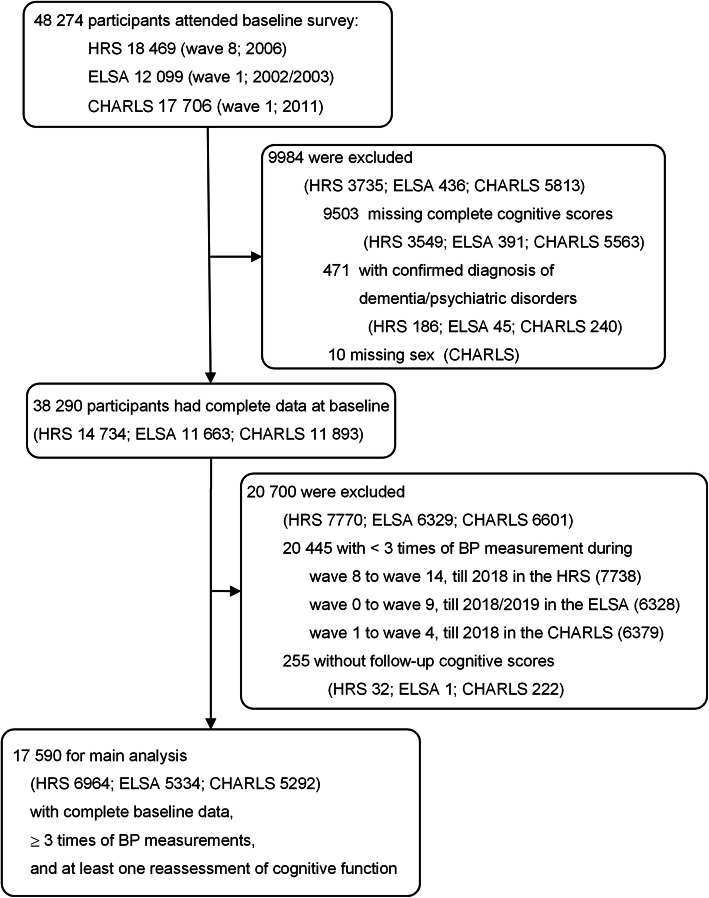
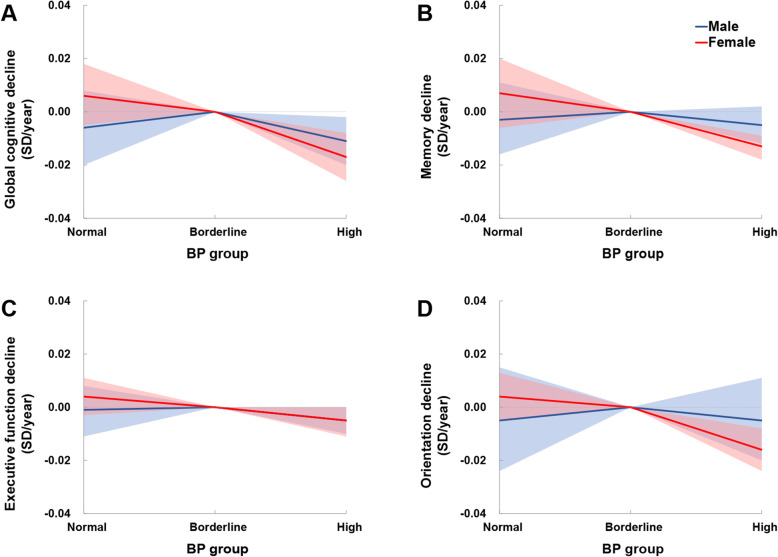
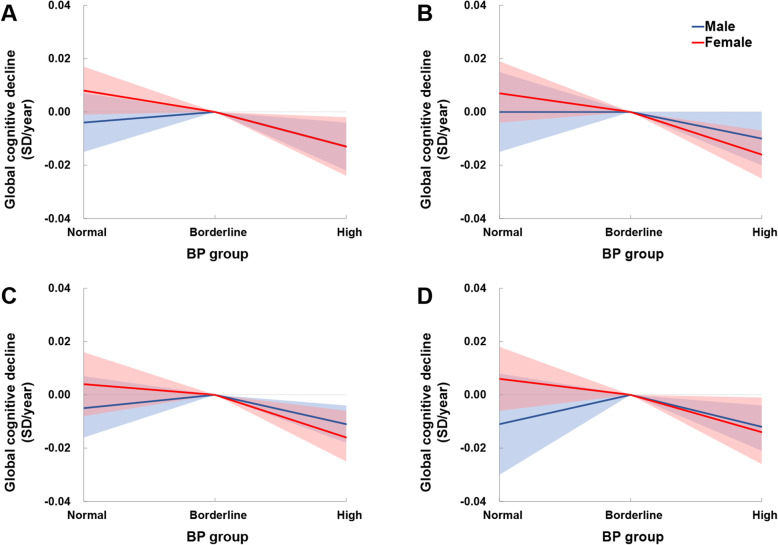
Background: The 2017 American College of Cardiology (ACC)/American Heart Association (AHA) guidelines for high blood pressure (BP) in adults came up with a new definition of hypertension with a threshold BP level of 130/80 mmHg. But the 2018 European Society of Cardiology (ESC)/European Society of Hypertension (ESH) guidelines adhered to a conventional hypertension definition as BP ≥ 140/90 mmHg. We aimed to compare the trajectories of cognitive decline between participants with BP < 130/80 mmHg in all BP measurement waves and others with all BP < 140/90 mmHg. Methods: This pooled analysis involved middle-aged and older participants from three nationally representative ageing cohorts, including the Health and Retirement Study (HRS), the English Longitudinal Study of Ageing (ELSA), and the China Health Retirement Longitudinal Study (CHARLS). Participants were divided into the Normal (BP < 130/80 mmHg on all occasions throughout the study), the Borderline (BP < 140/90 mmHg on all occasions throughout the study but not in the Normal group), and the High (the rest of participants) BP groups. Global cognitive Z score was calculated from tests on memory, executive function, and orientation. Results: A total of 17,590 participants (HRS 6964, median follow-ups 12 years; ELSA 5334, median follow-ups 16 years; CHARLS 5292, median follow-ups 7 years) were included. No significant difference in global cognitive decline rate was detected between the Normal and the borderline groups (men, pooled β = − 0.006 standard deviation [SD]/year; 95% confidence interval [CI], − 0.020 to 0.008; P = 0.377; women, pooled β = 0.006 SD/year; 95% CI − 0.005 to 0.018; P = 0.269). Participants in the High group had a significantly faster cognitive decline (men, pooled β = − 0.011 SD/year; 95% CI − 0.020 to − 0.002; P = 0.013; women, pooled β = − 0.017 SD/year; 95% CI − 0.026 to − 0.008; P < 0.001) than that in the Borderline group. Conclusions: Individuals in the Borderline group did not experience significantly faster cognitive decline compared with those in the Normal group. It might not be necessary for individuals with borderline BP (between 130/80 and 140/90 mmHg) to initiate antihypertension therapy in consideration of cognitive decline.
Overview
The claims and statistics of this paper haven’t been checked yet.
Free: it reads the open-access text and checks the first 5 claims that cite a source we can check. Create a free account to check every claim.
Integrity signals
Registry
Cites
Statistics
Figures
Verification
Claims the paper makes
The claims and statistics of this paper haven’t been checked yet.
Free: it reads the open-access text and checks the first 5 claims that cite a source we can check. Create a free account to check every claim.
Claims other papers make about this one
Each is checked against this paper’s own text: does it say what the citing paper says it does?
The cited source says what the claim attributes to it.
In the citing paper
“These tests have been shown to have high validity and reliability in the studies of others [16–18].”
From Digital exclusion and cognitive impairment in older people: findings from five longitudinal studies (2024) · cites this paper as [18]
Self-check
Percentages, sums and reported differences re-computed from the paper’s own numbers.
The self-check needs the paper’s full text.
Citations
Cites
1 retracted
Dementia prevention, intervention, and care: 2020 report of the Lancet Commission
Livingston, G., Huntley, J., Sommerlad, A., Ames, D., Ballard, C., Banerjee, S., Brayne, C., Burns, A., Cohen-Mansfield, J., Cooper, C., et al. (2020) · The Lancet · doi:10.1016/s0140-6736(20)30367-6 · Cited by 10,430 · cited 1×
“Dementia cannot be cured but can be prevented or delayed during its long period of the preclinical phase [4].”
BackgroundRetracted(2013) · European Heart Journal · doi:10.1093/eurheartj/eht151 · Cited by 13,655
Whelton, P. K., Carey, R. M., Aronow, W. S., Casey, D. E., Collins, K. J., Dennison Himmelfarb, C., DePalma, S. M., Gidding, S., Jamerson, K. A., Jones, D. W., et al. (2018) · Hypertension · doi:10.1161/hyp.0000000000000065 · Cited by 7,391
Cumpston, M., Li, T., Page, M. J., Chandler, J., Welch, V. A., Higgins, J. P., & Thomas, J. (2019) · Cochrane Database of Systematic Reviews · doi:10.1002/14651858.ed000142 · Cited by 7,218
Cohort Profile: The China Health and Retirement Longitudinal Study (CHARLS)
Zhao, Y., Hu, Y., Smith, J. P., Strauss, J., & Yang, G. (2014) · International Journal of Epidemiology · doi:10.1093/ije/dys203 · Cited by 5,266 · cited 1×
“The CHARLS randomly selected Chinese residents aged 45 years or older via multistage probability sampling since 2011 [12].”
MethodNorman, G. R., Sloan, J. A., & Wyrwich, K. W. (2003) · Medical Care · doi:10.1097/01.mlr.0000062554.74615.4c · Cited by 4,700
Williams, B., Mancia, G., Spiering, W., Agabiti Rosei, E., Azizi, M., Burnier, M., Clement, D. L., Coca, A., de Simone, G., Dominiczak, A., et al. (2018) · Journal of Hypertension · doi:10.1097/hjh.0000000000001940 · Cited by 2,885
Cohort Profile: the Health and Retirement Study (HRS)
Sonnega, A., Faul, J. D., Ofstedal, M. B., Langa, K. M., Phillips, J. W., & Weir, D. R. (2014) · International Journal of Epidemiology · doi:10.1093/ije/dyu067 · Cited by 2,318
Cohort profile: The English longitudinal study of ageing
Steptoe, A., Breeze, E., Banks, J., & Nazroo, J. (2013) · International Journal of Epidemiology · doi:10.1093/ije/dys168 · Cited by 1,779
O’Rourke, M. F., & Safar, M. E. (2005) · Hypertension · doi:10.1161/01.hyp.0000168052.00426.65 · Cited by 1,279 · cited 2×
“And arterial stiffening that was caused by long-standing hypertension might lead to small vessel ischemic disease in the brain [35].”
BackgroundThe age-dependent relation of blood pressure to cognitive function and dementia
Qiu, C., Winblad, B., & Fratiglioni, L. (2005) · The Lancet Neurology · doi:10.1016/s1474-4422(05)70141-1 · Cited by 1,138 · cited 1×
“Large epidemiological studies have demonstrated that midlife hypertension was significantly associated with an increased rate of cognitive decline and higher dementia risk in later life [5, 6].”
BackgroundLauner, L. J. (1995) · JAMA · doi:10.1001/jama.1995.03530230032026 · Cited by 908 · cited 1×
“A grouping approach using multiple BP measurements employed has also been adopted in a few studies, which was similar to but distinct from what we used [30, 44].”
MethodMidlife vascular risk factors and late-life mild cognitive impairment: A population-based study
Kivipelto, M., Helkala, E.-L., Hänninen, T., Laakso, M. P., Hallikainen, M., Alhainen, K., Soininen, H., Tuomilehto, J., & Nissinen, A. (2001) · Neurology · doi:10.1212/wnl.56.12.1683 · Cited by 717
Association between sleep duration and cognitive decline
Ma, Y., Liang, L., Zheng, F., Shi, L., Zhong, B., & Xie, W. (2020) · JAMA Network Open · doi:10.1001/jamanetworkopen.2020.13573 · Cited by 535
Self-citationTrajectory of Cognitive Decline After Incident Stroke
Levine, D. A., Galecki, A. T., Langa, K. M., Unverzagt, F. W., Kabeto, M. U., Giordani, B., & Wadley, V. G. (2015) · JAMA · doi:10.1001/jama.2015.6968 · Cited by 497
Gottesman, R. F., Schneider, A. L. C., Albert, M., Alonso, A., Bandeen-Roche, K., Coker, L., Coresh, J., Knopman, D., Power, M. C., Rawlings, A., et al. (2014) · JAMA Neurology · doi:10.1001/jamaneurol.2014.1646 · Cited by 474 · cited 1×
“reported that midlife hypertension at baseline was associated with faster global cognitive decline in a 20-year cohort [29].”
BackgroundHughes, D., Judge, C., Murphy, R., Loughlin, E., Costello, M., Whiteley, W., Bosch, J., O’Donnell, M. J., & Canavan, M. (2020) · JAMA · doi:10.1001/jama.2020.4249 · Cited by 472 · cited 3×
“No significant association between BP lowering and change in cognitive scores was detected in the metaanalysis of eight trials [28].”
BackgroundLiao, D., Cooper, L., Cai, J., Toole, J. F., Bryan, N. R., Hutchinson, R. G., & Tyroler, H. A. (1996) · Stroke · doi:10.1161/01.str.27.12.2262 · Cited by 450 · cited 2×
“Cortical white matter lesions and microvascular damage in the brain have been widely accepted as the mediating factors between hypertension and cognition [1, 34, 35].”
BackgroundNavarese, E. P., Kołodziejczak, M., Schulze, V., Gurbel, P. A., Tantry, U., Lin, Y., Brockmeyer, M., Kandzari, D. E., Kubica, J. M., D'Agostino, R. B., et al. (2015) · Annals of Internal Medicine · doi:10.7326/m14-2957 · Cited by 404
Ou, Y.-N., Tan, C.-C., Shen, X.-N., Xu, W., Hou, X.-H., Dong, Q., Tan, L., & Yu, J.-T. (2020) · Hypertension · doi:10.1161/hypertensionaha.120.14993 · Cited by 402
Cohort Profile: The Health Survey for England
Mindell, J., Biddulph, J. P., Hirani, V., Stamatakis, E., Craig, R., Nunn, S., & Shelton, N. (2012) · International Journal of Epidemiology · doi:10.1093/ije/dyr199 · Cited by 312 · cited 2×
“The ELSA sample was from the Health Survey for England (HSE), which randomly recruited individuals aged 50 years or older living in England using postcode [10, 14].”
MethodHbA1c, diabetes and cognitive decline: the English Longitudinal Study of Ageing
Zheng, F., Yan, L., Yang, Z., Zhong, B., & Xie, W. (2018) · Diabetologia · doi:10.1007/s00125-017-4541-7 · Cited by 280
Self-citationCognitive Decline Before and After Incident Coronary Events
Xie, W., Zheng, F., Yan, L., & Zhong, B. (2019) · Journal of the American College of Cardiology · doi:10.1016/j.jacc.2019.04.019 · Cited by 279
Self-citationMossello, E., Pieraccioli, M., Nesti, N., Bulgaresi, M., Lorenzi, C., Caleri, V., Tonon, E., Cavallini, M. C., Baroncini, C., Di Bari, M., et al. (2015) · JAMA Internal Medicine · doi:10.1001/jamainternmed.2014.8164 · Cited by 247 · cited 2×
“Remarkably, there have been studies reporting the association between low BP and poorer cognition [6, 33].”
BackgroundDregan, A., Stewart, R., & Gulliford, M. C. (2013) · Age and Ageing · doi:10.1093/ageing/afs166 · Cited by 195
Blood pressure levels and brain volume reduction: a systematic review and meta-analysis
Beauchet, O., Celle, S., Roche, F., Bartha, R., Montero-Odasso, M., Allali, G., & Annweiler, C. (2013) · Journal of Hypertension · doi:10.1097/hjh.0b013e32836184b5 · Cited by 180 · cited 1×
“Brain volume reduction has also been indicated as another manifestation of brain damage caused by hypertension in a systematic review [36].”
BackgroundDeterminants of vascular dementia in the Cardiovascular Health Cognition Study
Kuller, L. H., Lopez, O. L., Jagust, W. J., Becker, J. T., DeKosky, S. T., Lyketsos, C., Kawas, C., Breitner, J. C. S., Fitzpatrick, A., & Dulberg, C. (2005) · Neurology · doi:10.1212/01.wnl.0000160115.55756.de · Cited by 179
Blood Pressure-Related Cognitive Decline: Does Age Make a Difference?
Elias, P. K., Elias, M. F., Robbins, M. A., & Budge, M. M. (2004) · Hypertension · doi:10.1161/01.hyp.0000145858.07252.99 · Cited by 179
Total and High-density Lipoprotein Cholesterol in Adults: United States, 2015-2016.
Carroll, M. D., Fryar, C. D., & Nguyen, D. T. (2017) · PubMed · Cited by 146
Li, G., Rhew, I. C., Shofer, J. B., Kukull, W. A., Breitner, J. C. S., Peskind, E., Bowen, J. D., McCormick, W., Teri, L., Crane, P. K., et al. (2007) · Journal of the American Geriatrics Society · doi:10.1111/j.1532-5415.2007.01233.x · Cited by 137
High Blood Pressure and Cognitive Decline in Mild Cognitive Impairment
Goldstein, F. C., Levey, A. I., & Steenland, N. K. (2013) · Journal of the American Geriatrics Society · doi:10.1111/jgs.12067 · Cited by 119 · cited 3×
“grouped participants using an approach that was partly similar to what we used [30].”
BackgroundMethodEmdin, C. A., Rothwell, P. M., Salimi-Khorshidi, G., Kiran, A., Conrad, N., Callender, T., Mehta, Z., Pendlebury, S. T., Anderson, S. G., Mohseni, H., et al. (2016) · Stroke · doi:10.1161/strokeaha.116.012658 · Cited by 111
Persistent depressive symptoms and cognitive decline in older adults
Zheng, F., Zhong, B., Song, X., & Xie, W. (2018) · The British Journal of Psychiatry · doi:10.1192/bjp.2018.155 · Cited by 106 · cited 1×
“Participants with a score of ≥ 4 in the CESD-8 or ≥ 12 in the CESD10 were regarded as having depressive symptoms [21, 22].”
Self-citationEarly life exposure to China’s 1959–61 famine and midlife cognition
Xu, H., Zhang, Z., Li, L., & Liu, J. (2018) · International Journal of Epidemiology · doi:10.1093/ije/dyx222 · Cited by 103
Li, C., Miles, T., Shen, L., Shen, Y., Liu, T., Zhang, M., Li, S., & Huang, C. (2018) · The British Journal of Psychiatry · doi:10.1192/bjp.2018.116 · Cited by 88 · cited 1×
“Participants with a score of ≥ 4 in the CESD-8 or ≥ 12 in the CESD10 were regarded as having depressive symptoms [21, 22].”
Low levels of low-density lipoprotein cholesterol and cognitive decline
Hua, R., Ma, Y., Li, C., Zhong, B., & Xie, W. (2021) · Science Bulletin · doi:10.1016/j.scib.2021.02.018 · Cited by 87
Self-citationVisit‐to‐visit variability in blood pressure and Alzheimer's disease
Lattanzi, S., Brigo, F., Vernieri, F., & Silvestrini, M. (2018) · The Journal of Clinical Hypertension · doi:10.1111/jch.13290 · Cited by 72 · cited 1×
“On the one hand, the association between visit-to-visit variability in BP and cognitive decline has been demonstrated [45, 46].”
BackgroundYu, Z., Zhu, Y., Li, D., Wu, M., Tang, M., Wang, J., & Chen, K. (2019) · Diabetologia · doi:10.1007/s00125-019-04986-8 · Cited by 64
Visit-to-Visit Variability in Blood Pressure Is Related to Late-Life Cognitive Decline
Qin, B., Viera, A. J., Muntner, P., Plassman, B. L., Edwards, L. J., Adair, L. S., Popkin, B. M., & Mendez, M. A. (2016) · Hypertension · doi:10.1161/hypertensionaha.116.07494 · Cited by 63
Systolic Blood Pressure and Cognitive Decline in Older Adults With Hypertension
Streit, S., Poortvliet, R. K. E., den Elzen, W. P. J., Blom, J. W., & Gussekloo, J. (2019) · The Annals of Family Medicine · doi:10.1370/afm.2367 · Cited by 54
Total and high-density lipoprotein cholesterol in adults : United States, 2015–2018
Carroll, M. D., & Fryar, C. D. (2020) · Cited by 44
Taylor, C., Tillin, T., Chaturvedi, N., Dewey, M., Ferri, C. P., Hughes, A., Prince, M., Richards, M., Shah, A., & Stewart, R. (2013) · Journal of the American Geriatrics Society · doi:10.1111/jgs.12416 · Cited by 43
Cognitive Decline and Low Blood Pressure: The Other Side of the Coin
Maule, S. V., Caserta, M., Bertello, C., Verhovez, A., Naso, D., BISBOCCI, D., & Veglio, F. (2008) · Clinical and Experimental Hypertension · doi:10.1080/10641960802573344 · Cited by 29 · cited 1×
“What is more, a review suggested that low BP might cause cerebral hypoperfusion and then accelerate cognitive decline [37].”
Background
Research works printed but not linked: 2
- Higgins J Thomas J Chandler J Cumpston M Li T Page M Cochrane Handbook for Systematic Reviews of Interventions (Version 6.2) 2021
- Holden G Statistical Power Analysis for the Behavioral-Sciences, 2nd Edition - Cohen J Soc Work Health Care 1993 18 2 131 132
Cited by
Gross, A. L., Li, C., Briceño, E. M., Rentería, M. A., Jones, R. N., Langa, K. M., Manly, J. J., Nichols, E., Weir, D. R., Wong, R., et al. (2023) · The Lancet Healthy Longevity · doi:10.1016/s2666-7568(23)00170-8 · Cited by 115
Ohya, Y., Arakawa, K., Arata, N., Arima, S., Arima, H., Asayama, K., Dohi, Y., Fukami, A., Furuhashi, M., Goto, K., et al. (2026) · Hypertension Research · doi:10.1038/s41440-025-02462-y · Cited by 107
Digital exclusion and cognitive impairment in older people: findings from five longitudinal studies
Wang, Y., Wu, Z., Duan, L., Liu, S., Chen, R., Sun, T., Wang, J., Zhou, J., Wang, H., & Huang, P. (2024) · BMC Geriatrics · doi:10.1186/s12877-024-05026-w · Cited by 55
“These tests have been shown to have high validity and reliability in the studies of others [16–18].”
BackgroundZhang, J., Sun, Z., Li, Y., Yang, Y., Liu, W., Huang, M.-W., & Yao, K. (2025) · Cardiovascular Diabetology · doi:10.1186/s12933-025-02575-1 · Cited by 50
“The pooled estimates were calculated using random-effect meta ‐ analyses as previously used [38–40].”
Ding, L., Zhu, X., Xiong, Z., Yang, F., & Zhang, X. (2022) · Journal of General Internal Medicine · doi:10.1007/s11606-022-07951-1 · Cited by 45
“Detailed information on the study was previously published.(18,19) All participants signed an informed consent.”
Background
Metadata
- Authors
- Ma, Y., Hua, R., Yang, Z., Zhong, B., Yan, L., & Xie, W.
- Affiliations
- Peking University (CN)
- Imperial College London (GB)
- Corresponding author
- Yan, Li
- Xie, Wuxiang
- Venue
- BMC Medicine
- Published
- 2021-11-01
- Volume
- 19
- Issue
- 1
- Pages
- 287-287
- ISSN
- 1741-7015 (ISSN-L)
- PMC
- PMC8561998
- OpenAlex
- W3209608509
- Cited by
- 64
- References
- 43
- Citations by year
- 2026: 17 · 2025: 18 · 2024: 12 · 2023: 14 · 2022: 3
- FWCI
- 5.20
- Type
- journal article
- Language
- en
- Open access
- gold
- doi.org
- Licence
- cc-by
- creativecommons.org/licenses/by/4.0 (tdm)
- creativecommons.org/licenses/by/4.0 (vor)
- Locations
- BMC Medicine (publishedVersion, cc-by)
- Europe PMC (PubMed Central) (publishedVersion, other-oa)
- PubMed Central (publishedVersion, cc-by)
- PubMed (publishedVersion)
- DOAJ (DOAJ: Directory of Open Access Journals) (submittedVersion, cc-by-sa)
- Funders
- national natural science foundation of china (81974490)
- 2019 Irma and Paul Milstein Program for Senior Health Research Project Award
- Topics
- Health Sciences › Medicine › Psychiatry and Mental health › Dementia and Cognitive Impairment Research
- Health Sciences › Medicine › Cardiology and Cardiovascular Medicine › Blood Pressure and Hypertension Studies
- Health Sciences › Medicine › Cardiology and Cardiovascular Medicine › Cardiovascular Health and Disease Prevention
- Keywords
- hypertension threshold, cognitive decline, borderline hypertension, older adults, middle-aged adults, global cognitive function, sex differences, aging cohort, Health and Retirement Study, English Longitudinal Study of Ageing, memory, executive function, orientation, blood pressure
- MeSH terms
- Adult, Aged, Aging, Blood Pressure, Blood Pressure Determination, Female, Humans, Hypertension, Longitudinal Studies, Male, Middle Aged, United States, Cognitive Dysfunction
About these checks
Registry, retraction, Cites and statistics results are computed, not judged, with one exception: a printed reference that no index lists is read once by a model before it counts as a citation error. Claims are extracted by a model and kept only when their quote appears verbatim in the text; each cited source is then checked, with a model’s help, for whether it says what the claim relies on. Those verdicts can be wrong — read the claim’s quote and the cited source before relying on one.
Statistics and arithmetic are recomputed, not judged.
Confidence bands are shown only for fields calibrated on our annotated test set. None is calibrated yet, so no band is shown.
What counts as a claim ›How we measure confidence ›How we check this ›
Are you an author, or do you see a problem with this page? Request a review
Data sources
Bibliographic data: Semantic Scholar, OpenAlex, Crossref.
Contains information from the Semantic Scholar Academic Graph Datasets, made available under the ODC Attribution License (ODC-BY 1.0).
Semantic Scholar’s data is described in: Kinney, R., et al. (2023). The Semantic Scholar Open Data Platform. arXiv:2301.10140.
