

The DOI matches its Crossref record; 44 of the 44 references it cites were found in a registry or an index.
Mediterranean diet adherence is associated with lower dementia risk, independent of genetic predisposition: findings from the UK Biobank prospective cohort study
Open accessAbstract
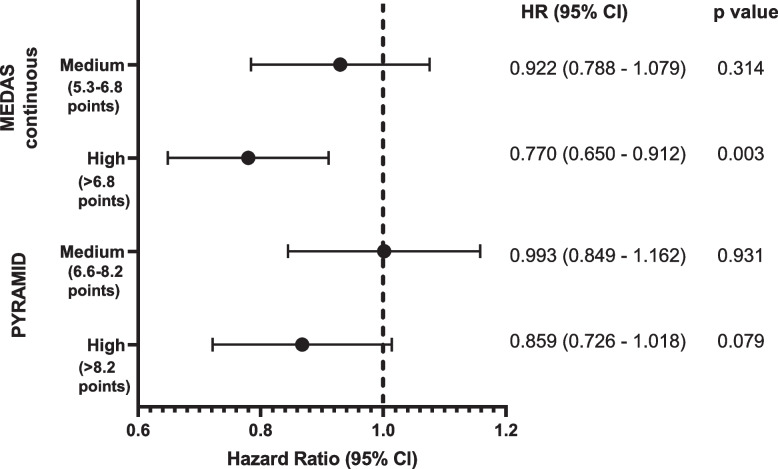
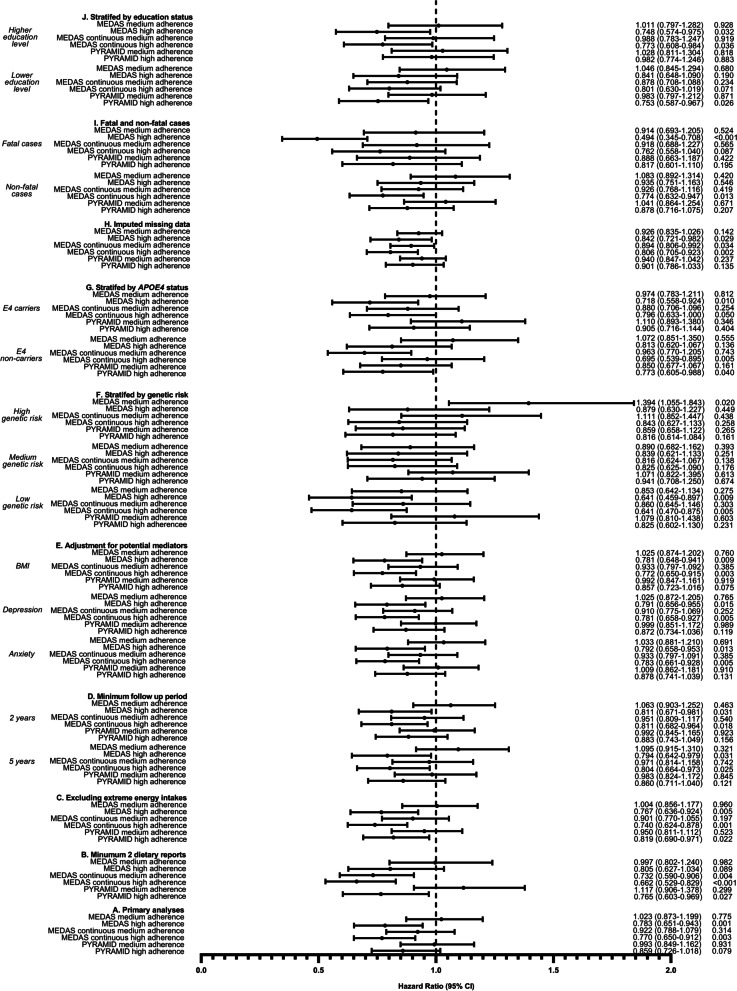
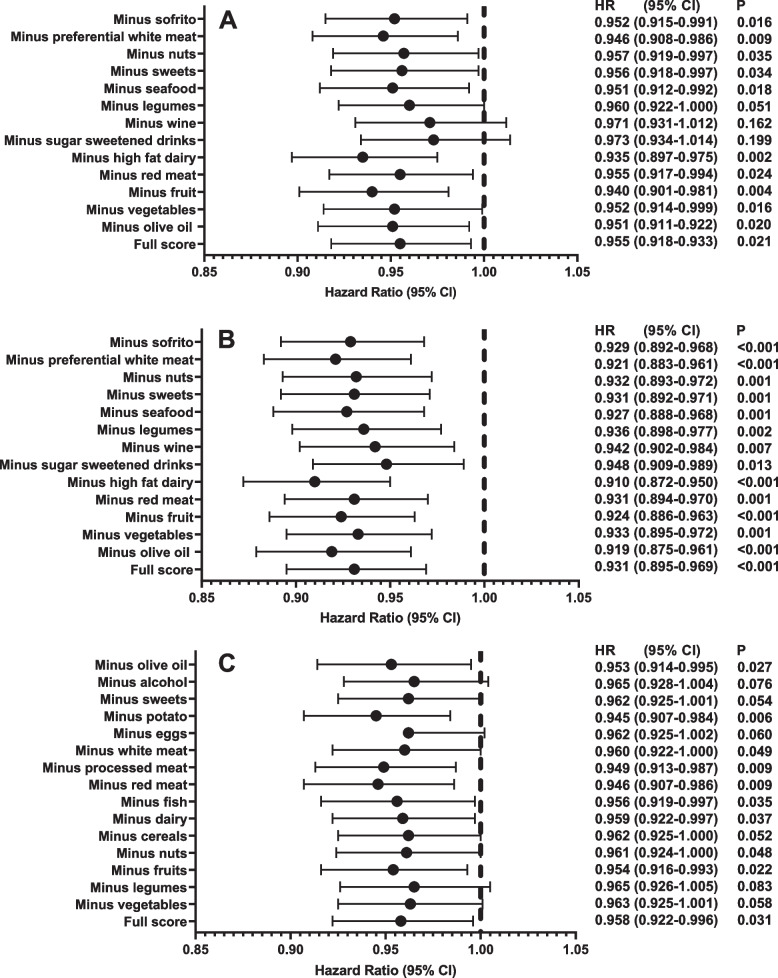
Background: The identification of effective dementia prevention strategies is a major public health priority, due to the enormous and growing societal cost of this condition. Consumption of a Mediterranean diet (MedDiet) has been proposed to reduce dementia risk. However, current evidence is inconclusive and is typically derived from small cohorts with limited dementia cases. Additionally, few studies have explored the interaction between diet and genetic risk of dementia. Methods: We used Cox proportional hazard regression models to explore the associations between MedDiet adherence, defined using two different scores (Mediterranean Diet Adherence Screener [MEDAS] continuous and Mediterranean diet Pyramid [PYRAMID] scores), and incident all-cause dementia risk in 60,298 participants from UK Biobank, followed for an average 9.1 years. The interaction between diet and polygenic risk for dementia was also tested. Results: Higher MedDiet adherence was associated with lower dementia risk (MEDAS continuous: HR = 0.77, 95% CI = 0.65–0.91; PYRAMID: HR = 0.86, 95% CI = 0.73–1.02 for highest versus lowest tertiles). There was no significant interaction between MedDiet adherence defined by the MEDAS continuous and PYRAMID scores and polygenic risk for dementia. Conclusions: Higher adherence to a MedDiet was associated with lower dementia risk, independent of genetic risk, underlining the importance of diet in dementia prevention interventions.
Overview
The claims and statistics of this paper haven’t been checked yet.
Run the check — free, no account needed. It reads the open-access text and checks the sources it cites.
Integrity signals
Registry
Cites
Statistics
Figures
Verification
Claims the paper makes
The claims and statistics of this paper haven’t been checked yet.
Run the check — free, no account needed. It reads the open-access text and checks the sources it cites.
Claims other papers make about this one
Each is checked against this paper’s own text: does it say what the citing paper says it does?
The cited source says what the claim attributes to it.
In the citing paper
“In contrast, a UKB study (n=60,298, mean age at baseline 63.8, mean follow up 9.1 years) reported adherence to the Mediterranean diet was associated with lower dementia risk independent of APOE status. (327)”
From Dementia prevention, intervention, and care: 2024 report of the Lancet standing Commission (2024) · cites this paper as [327]
Self-check
Percentages, sums and reported differences re-computed from the paper’s own numbers.
The self-check needs the paper’s full text.
Citations
Cites
Sudlow, C., Gallacher, J., Allen, N., Beral, V., Burton, P., Danesh, J., Downey, P., Elliott, P., Green, J., Landray, M., et al. (2015) · PLOS Medicine · doi:10.1371/journal.pmed.1001779 · Cited by 12,728
Multiple imputation using chained equations: Issues and guidance for practice
White, I. R., Royston, P., & Wood, A. M. (2011) · Statistics in Medicine · doi:10.1002/sim.4067 · Cited by 9,792
Dementia prevention, intervention, and care
Livingston, G., Sommerlad, A., Orgeta, V., Costafreda, S. G., Huntley, J., Ames, D., Ballard, C., Banerjee, S., Burns, A., Cohen-Mansfield, J., et al. (2017) · The Lancet · doi:10.1016/s0140-6736(17)31363-6 · Cited by 6,072
Nichols, E., Steinmetz, J. D., Vollset, S. E., Fukutaki, K., Chalek, J., Abd-Allah, F., Abdoli, A., Abualhasan, A., Abu-Gharbieh, E., Akram, T. T., et al. (2022) · The Lancet Public Health · doi:10.1016/s2468-2667(21)00249-8 · Cited by 5,575
Jack, C. R., Knopman, D. S., Jagust, W. J., Petersen, R. C., Weiner, M. W., Aisen, P. S., Shaw, L. M., Vemuri, P., Wiste, H. J., Weigand, S. D., et al. (2013) · The Lancet Neurology · doi:10.1016/s1474-4422(12)70291-0 · Cited by 4,396
Meta-Analysis of 74,046 Individuals Identifies 11 New Susceptibility Loci for Alzheimer’s Disease
(EADI), E. A. D. I., Lambert, J.-C., (GERAD), G. A. E. R. I. A. D., Alzheimer's Disease Genetic Consortium (ADGC), (CHARGE), C. F. H. A. A. R. I. G. E., Ibrahim-Verbaas, C. A., Harold, D., Naj, A. C., Sims, R., Bellenguez, C., et al. (2013) · Nature Genetics · doi:10.1038/ng.2802 · Cited by 4,336
Fry, A., Littlejohns, T. J., Sudlow, C., Doherty, N., Adamska, L., Sprosen, T., Collins, R., & Allen, N. E. (2017) · American Journal of Epidemiology · doi:10.1093/aje/kwx246 · Cited by 3,979
Adjustment for total energy intake in epidemiologic studies
Willett, W. C., Howe, G., & Kushi, L. H. (1997) · American Journal of Clinical Nutrition · doi:10.1093/ajcn/65.4.1220s · Cited by 3,805
MIND diet associated with reduced incidence of Alzheimer's disease
Morris, M. C., Tangney, C. C., Wang, Y., Sacks, F. M., Bennett, D. A., & Aggarwal, N. T. (2015) · Alzheimer's & Dementia · doi:10.1016/j.jalz.2014.11.009 · Cited by 1,162
Mediterranean Diet and Age-Related Cognitive Decline: A Randomized Clinical Trial
Valls-Pedret, C., Sala-Vila, A., Serra-Mir, M., Corella, D., de la Torre, R., Martínez-González, M. Á., Martínez-Lapiscina, E. H., Fitó, M., Pérez-Heras, A., Salas-Salvadó, J., et al. (2015) · JAMA Internal Medicine · doi:10.1001/jamainternmed.2015.1668 · Cited by 952
Association of Lifestyle and Genetic Risk With Incidence of Dementia
Lourida, I., Hannon, E., Littlejohns, T. J., Langa, K. M., Hyppönen, E., Kuzma, E., & Llewellyn, D. J. (2019) · JAMA · doi:10.1001/jama.2019.9879 · Cited by 881
Self-citationAdherence to a Mediterranean Diet, Cognitive Decline, and Risk of Dementia
Féart, C. (2009) · JAMA · doi:10.1001/jama.2009.1146 · Cited by 757
Mediterranean diet improves cognition: the PREDIMED-NAVARRA randomised trial
Martínez-Lapiscina, E. H., Clavero, P., Toledo, E., Estruch, R., Salas-Salvadó, J., San Julián, B., Sanchez-Tainta, A., Ros, E., Valls-Pedret, C., & Martinez-Gonzalez, M. Á. (2013) · Journal of Neurology, Neurosurgery & Psychiatry · doi:10.1136/jnnp-2012-304792 · Cited by 747
Cohort Profile: Design and methods of the PREDIMED study
Martinez-Gonzalez, M. A., Corella, D., Salas-Salvado, J., Ros, E., Covas, M. I., Fiol, M., Warnberg, J., Aros, F., Ruiz-Gutierrez, V., Lamuela-Raventos, R. M., et al. (2012) · International Journal of Epidemiology · doi:10.1093/ije/dyq250 · Cited by 671
Nutrition and prevention of cognitive impairment
Scarmeas, N., Anastasiou, C. A., & Yannakoulia, M. (2018) · The Lancet Neurology · doi:10.1016/s1474-4422(18)30338-7 · Cited by 612
Liu, B. C., Young, H., Crowe, F. L., Benson, V. S., Spencer, E. A., Key, T. J., Appleby, P. N., & Beral, V. (2011) · Public Health Nutrition · doi:10.1017/s1368980011000942 · Cited by 576
Biobank, O. B. O. D. P. U. A. U., Wilkinson, T., Schnier, C., Bush, K., Rannikmäe, K., Henshall, D. E., Lerpiniere, C., Allen, N. E., Flaig, R., Russ, T. C., et al. (2019) · European Journal of Epidemiology · doi:10.1007/s10654-019-00499-1 · Cited by 452
Bradbury, K. E., Young, H. J., Guo, W., & Key, T. J. (2018) · Journal of Nutritional Science · doi:10.1017/jns.2017.66 · Cited by 356
Validation of the Oxford WebQ Online 24-Hour Dietary Questionnaire Using Biomarkers
Greenwood, D. C., Hardie, L. J., Frost, G. S., Alwan, N. A., Bradbury, K. E., Carter, M. C., Elliott, P., Evans, C., Ford, H. E., Hancock, N., et al. (2019) · American Journal of Epidemiology · doi:10.1093/aje/kwz165 · Cited by 335
Perez‐Cornago, A., Pollard, Z., Young, H., van Uden, M., Andrews, C. D., Piernas, C., Key, T. J., Mulligan, A. A., & Lentjes, M. A. H. (2021) · European Journal of Nutrition · doi:10.1007/s00394-021-02558-4 · Cited by 306
Self-citationUK Biobank: From Concept to Reality
Ollier, W., Sprosen, T., & Peakman, T. (2005) · Pharmacogenomics · doi:10.2217/14622416.6.6.639 · Cited by 278
Licher, S., Ahmad, S., Karamujić‐Čomić, H., Voortman, T., Leening, M. J. G., Ikram, M. A., & Ikram, M. K. (2019) · Nature Medicine · doi:10.1038/s41591-019-0547-7 · Cited by 242
Hosking, D. E., Eramudugolla, R., Cherbuin, N., & Anstey, K. J. (2019) · Alzheimer s & Dementia · doi:10.1016/j.jalz.2018.12.011 · Cited by 230
Tong, T. Y. N., Wareham, N. J., Khaw, K., Imamura, F., & Forouhi, N. G. (2016) · BMC Medicine · doi:10.1186/s12916-016-0677-4 · Cited by 209
Nutrition and risk of dementia: overview and methodological issues
Morris, M. C. (2016) · Annals of the New York Academy of Sciences · doi:10.1111/nyas.13047 · Cited by 206
Papadaki, A., Johnson, L., Toumpakari, Z., England, C. Y., Rai, M., Toms, S., Penfold, C. M., Zazpe, I., Martínez‐González, M. Á., & Feder, G. S. (2018) · Nutrients · doi:10.3390/nu10020138 · Cited by 174
Vegetables, Unsaturated Fats, Moderate Alcohol Intake, and Mild Cognitive Impairment
Roberts, R. O., Geda, Y. E., Cerhan, J. R., Knopman, D. S., Cha, R. H., Christianson, T. J. H., Pankratz, V. S., Ivnik, R. J., Boeve, B. F., O’Connor, H. M., et al. (2010) · Dementia and Geriatric Cognitive Disorders · doi:10.1159/000305099 · Cited by 155
Sommerlad, A., Perera, G., Singh‐Manoux, A., Lewis, G., Stewart, R. J., & Livingston, G. (2018) · Alzheimer s & Dementia · doi:10.1016/j.jalz.2018.02.012 · Cited by 155
Shannon, O. M., Stephan, B. C. M., Granic, A., Lentjes, M. A. H., Hayat, S. A., Mulligan, A. A., Brayne, C., Khaw, K., Bundy, R., Aldred, S., et al. (2019) · American Journal of Clinical Nutrition · doi:10.1093/ajcn/nqz114 · Cited by 127
Self-citationAssociation of midlife diet with subsequent risk for dementia
Akbaraly, T. N., Singh-Manoux, A., Dugravot, A., Brunner, E. J., Kivimäki, M., & Sabia, S. (2019) · JAMA · doi:10.1001/jama.2019.1432 · Cited by 121
Haring, B., Wu, C., Mossavar‐Rahmani, Y., Snetselaar, L. G., Brunner, R. L., Wallace, R. B., Neuhouser, M. L., & Wassertheil-Smoller, S. W. (2016) · Journal of the Academy of Nutrition and Dietetics · doi:10.1016/j.jand.2015.12.017 · Cited by 119
Vadiveloo, M., Lichtenstein, A. H., Anderson, C., Aspry, K., Foraker, R., Griggs, S., Hayman, L. L., Johnston, E., Stone, N. J., Thorndike, A. N., et al. (2020) · Circulation: Cardiovascular Quality and Outcomes · doi:10.1161/hcq.0000000000000094 · Cited by 112
Andreu-Reinón, M. E., Chirlaque, M. D., Gavrila, D., Amiano, P., Mar, J., Tainta, M., Ardanáz, E., Larumbe, R., Colorado-Yohar, S. M., Navarro‐Mateu, F., et al. (2021) · Nutrients · doi:10.3390/nu13020700 · Cited by 101
Dietary Patterns and Cognitive Dysfunction in a 12-Year Follow-up Study of 70 Year Old Men
Olsson, E., Karlström, B., Kilander, L., Byberg, L., Cederholm, T., & Sjögren, P. (2014) · Journal of Alzheimer s Disease · doi:10.3233/jad-140867 · Cited by 94
Mediterranean diet and cognitive function: From methodology to mechanisms of action
Siervo, M., Shannon, O. M., Llewellyn, D. J., Stephan, B. C. M., & Fontana, L. (2021) · Free Radical Biology and Medicine · doi:10.1016/j.freeradbiomed.2021.09.018 · Cited by 91
Self-citationMinimizing random error in dietary intakes assessed by 24-h recall, in overweight and obese adults
Jackson, K., Byrne, N. M., Magarey, A., & Hills, A. P. (2007) · European Journal of Clinical Nutrition · doi:10.1038/sj.ejcn.1602740 · Cited by 88
Validation of a polygenic risk score for dementia in black and white individuals
Marden, J. R., Walter, S., Tchetgen, E. J. T., Kawachi, I. I., & Glymour, M. M. (2014) · Brain and Behavior · doi:10.1002/brb3.248 · Cited by 72
Barbaresko, J., Lellmann, A. W., Schmidt, A., Lehmann, A. C., Amini, A. M., Egert, S., Schlesinger, S., & Nöthlings, U. (2020) · Advances in Nutrition · doi:10.1093/advances/nmaa053 · Cited by 68
The role of lifestyle factors and sleep duration for late-onset dementia: a cohort study
Larsson, S. C., & Wolk, A. (2018) · Journal of Alzheimer's Disease · doi:10.3233/jad-180529 · Cited by 62
Limongi, F., Siviero, P., Bozanic, A., Noale, M., Veronese, N., & Maggi, S. (2020) · Journal of the American Medical Directors Association · doi:10.1016/j.jamda.2020.08.020 · Cited by 53
Samuelsson, J., Najar, J., Wallengren, O., Kern, S., Wetterberg, H., Fässberg, M. M., Zetterberg, H., Blennow, K., Lissner, L., Rothenberg, E. M., et al. (2021) · European Journal of Nutrition · doi:10.1007/s00394-021-02688-9 · Cited by 38
Wagner, M., Dartigues, J., Samieri, C., & Proust‐Lima, C. (2017) · American Journal of Epidemiology · doi:10.1093/aje/kwx293 · Cited by 28
Gregory, S., Ritchie, C. W., Ritchie, K. A., Shannon, O. M., Stevenson, E., & Terrera, G. M. (2022) · Frontiers in Aging · doi:10.3389/fragi.2022.1012598 · Cited by 17
Self-citationNuBrain: UK consortium for optimal nutrition for healthy brain ageing
Stevenson, E., Shannon, O. M., Minihane, A. M., Adamson, A., Burns, A. S., Hill, T. R., Sniehotta, F. F., Terrera, G. M., & Ritchie, C. W. (2020) · Nutrition Bulletin · doi:10.1111/nbu.12429 · Cited by 14
Self-citation
Research works printed but not linked: 1
- World Health Organization. Risk Reduction of Cognitive Decline and Dementia. Geneva: World Health Organization; 2019.
Cited by
Sorted by citations
Dementia prevention, intervention, and care: 2024 report of the Lancet standing Commission
Livingston, G., Huntley, J., Liu, K. Y., Costafreda, S. G., Selbæk, G., Alladi, S., Ames, D., Banerjee, S., Burns, A., Brayne, C., et al. (2024) · The Lancet · doi:10.1016/s0140-6736(24)01296-0 · Cited by 3,860
Fekete, M., Varga, P., Ungvari, Z. I., Fekete, J. T., Buda, A., Szappanos, Á., Lehoczki, A., Mózes, N., Grosso, G., Godos, J., et al. (2025) · GeroScience · doi:10.1007/s11357-024-01488-3 · Cited by 162
Bicknell, B. T., Liebert, A. D., Borody, T. J., Herkes, G., McLachlan, C. S., & Kiat, H. (2023) · International Journal of Molecular Sciences · doi:10.3390/ijms24119577 · Cited by 135
Warren, A., Nyavor, Y., Zarabian, N., Mahoney, A., & Frame, L. A. (2024) · Frontiers in Immunology · doi:10.3389/fimmu.2024.1365673 · Cited by 64
Diets to promote healthy brain ageing
Charisis, S., Yannakoulia, M., & Scarmeas, N. (2024) · Nature Reviews Neurology · doi:10.1038/s41582-024-01036-9 · Cited by 66
Metadata
- Authors
- Shannon, O. M., Ranson, J. M., Gregory, S., Macpherson, H., Milte, C., Lentjes, M., Mulligan, A., McEvoy, C., Griffiths, A., Matu, J., Hill, T. R., Adamson, A., Siervo, M., Minihane, A. M., Muniz-Tererra, G., Ritchie, C., Mathers, J. C., Llewellyn, D. J., & Stevenson, E.
- Affiliations
- Newcastle University (GB)
- University of Exeter (GB)
- University of Edinburgh (GB)
- Deakin University (AU)
- Örebro University (SE)
- University of Cambridge (GB)
- Queen's University Belfast (GB)
- Leeds Beckett University (GB)
- University of Nottingham (GB)
- University of East Anglia (GB)
- Corresponding author
- Mathers, John C.
- ORCID
- Venue
- BMC Medicine
- Published
- 2023-03-14
- Volume
- 21
- Issue
- 1
- Pages
- 81-81
- ISSN
- 1741-7015 (ISSN-L)
- PMC
- PMC10012551
- OpenAlex
- W4324029343
- Cited by
- 167
- References
- 44
- Citations by year
- 2026: 43 · 2025: 49 · 2024: 62 · 2023: 13
- FWCI
- 42.75
- Type
- journal article
- Language
- en
- Open access
- gold
- doi.org
- Locations
- BMC Medicine (publishedVersion, cc-by)
- PubMed Central (publishedVersion, cc-by)
- PubMed (publishedVersion)
- Research Portal (Queen's University Belfast) (publishedVersion, cc-by)
- Leeds Beckett Repository (Leeds Beckett University) (acceptedVersion, other-oa)
- UEA Digital Repository (University of East Anglia) (acceptedVersion, other-oa)
- DOAJ (DOAJ: Directory of Open Access Journals) (submittedVersion, cc-by-sa)
- Figshare (submittedVersion, cc-by)
- Open Research Exeter (University of Exeter) (submittedVersion, cc-by)
- Apollo (University of Cambridge) (submittedVersion, cc-by)
- Apollo
- Funders
- Medical Research Council (MR/T001852/1)
- Topics
- Health Sciences › Medicine › Public Health, Environmental and Occupational Health › Nutritional Studies and Diet
- Health Sciences › Medicine › Psychiatry and Mental health › Dementia and Cognitive Impairment Research
- Health Sciences › Nursing › Nutrition and Dietetics › Fatty Acid Research and Health
- Keywords
- Mediterranean diet, dietary adherence, dementia risk, dementia prevention, polygenic risk, genetic susceptibility, Mediterranean Diet Adherence Screener, Mediterranean diet pyramid, UK Biobank
- MeSH terms
- Dementia, United Kingdom, Humans, Prospective Studies, Biological Specimen Banks, Genetic Predisposition to Disease, Diet, Mediterranean
About these checks
Registry, retraction, Cites and statistics results are computed, not judged, with one exception: a printed reference that no index lists is read once by a model before it counts as a citation error. Claims are extracted by a model and kept only when their quote appears verbatim in the text; each cited source is then checked, with a model’s help, for whether it says what the claim relies on. Those verdicts can be wrong — read the claim’s quote and the cited source before relying on one.
Statistics and arithmetic are recomputed, not judged.
Confidence bands are shown only for fields calibrated on our annotated test set. None is calibrated yet, so no band is shown.
What counts as a claim ›How we measure confidence ›How we check this ›
Are you an author, or do you see a problem with this page? Request a review
