

Improved trends in cardiovascular complications among subjects with type 2 diabetes in Korea: a nationwide study (2006–2013)
Open accessThe DOI matches its Crossref record; 42 of the 42 references it cites were found in a registry or an index.
Abstract
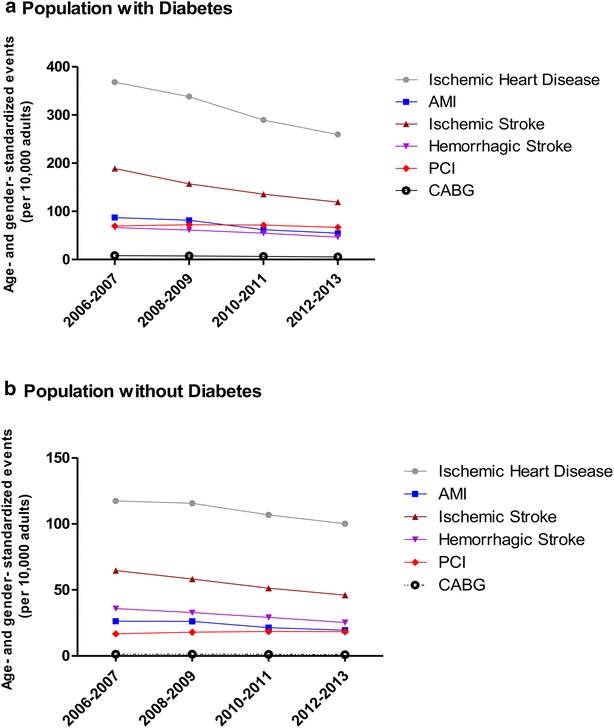
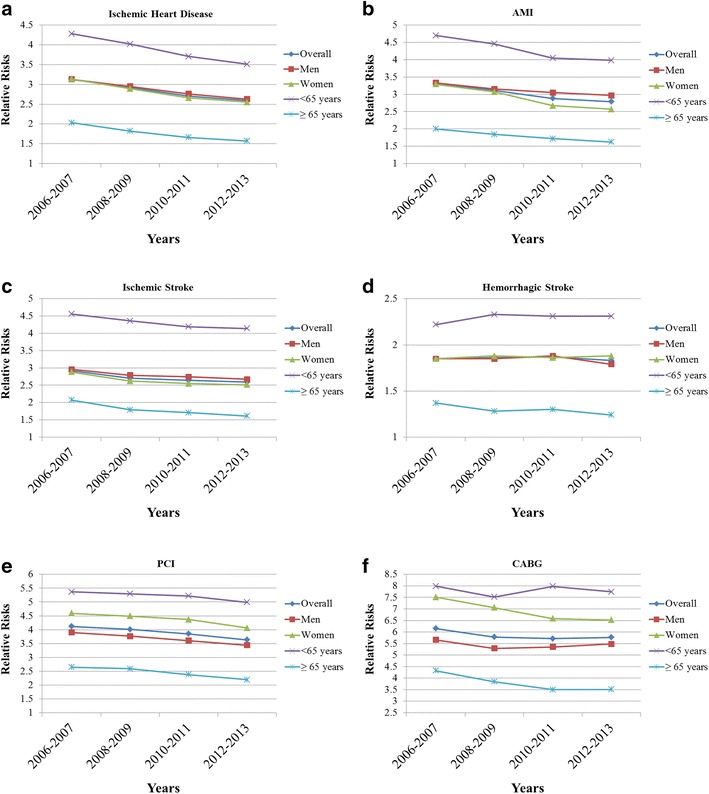
BACKGROUND: Representative data on the secular trends in cardiovascular disease (CVD) are limited in Asian populations with diabetes. We aimed to estimate the temporal trends in cardiovascular complications using Korean nationwide whole population-based claims data in subjects with and without diabetes. METHODS: Type 2 diabetes was defined as a current medication history of anti-diabetic drugs and the presence of International Classification of Diseases (ICD)-10 codes (E11-E14) as diagnosis. We compared the 8-year rates of six cardiovascular complications [i.e., ischemic heart disease, acute myocardial infarction (AMI), ischemic stroke, hemorrhagic stroke, percutaneous coronary intervention (PCI), and coronary artery bypass graft (CABG)] in Korean adults aged 30 years and older using data from four consecutive nationwide databases (2006-2007, 2008-2009, 2010-2011, and 2012-2013) of Korean national health insurance service. RESULTS: A total of 1,645,348, 1,971,559, 2,291,247, and 2,562,612 subjects with type 2 diabetes were found in the year of 2006-2007, 2008-2009, 2010-2011, and 2012-2013, respectively. Age and gender standardized rates of the six predefined cardiovascular complications decreased in Korean adults with type 2 diabetes during the study period. The greatest relative reductions were observed for hospitalization due to AMI (-37.28%), followed by hospitalizations due to ischemic stroke (-36.98%). In the overall population without type 2 diabetes, the greatest relative reductions were observed for hospitalization for hemorrhagic stroke (-29.47%), followed by hospitalization due to ischemic stroke (-28.92%). Relative decreases in all six predefined cardiovascular complications were generally more profound in adults with diabetes than in those without diabetes, which led to significant decrease in the relative risks of all six cardiovascular complications in subjects with diabetes over the past 8 years. However, people with diabetes still had a two- to sixfold higher risk of hospitalization for major CVD events and interventions than people without diabetes. CONCLUSIONS: Our findings suggest a significant reduction in the rate of people affected by CVD within the diabetic population. However, as the number of people with diabetes rises, the absolute burden of CVD will still be high in Korea.
Overview
The claims and statistics of this paper haven’t been checked yet.
Free: it reads the open-access text and checks the first 5 claims that cite a source we can check. Create a free account to check every claim.
Integrity signals
Registry
Cites
Statistics
Figures
Verification
Claims the paper makes
The claims and statistics of this paper haven’t been checked yet.
Free: it reads the open-access text and checks the first 5 claims that cite a source we can check. Create a free account to check every claim.
Claims other papers make about this one
Each is checked against this paper’s own text: does it say what the citing paper says it does?
The source backs part of the claim, not all of it — or backs it for a different population, condition or comparison.
In the citing paper
“The results show a significant reduction in CVD risk among people with T2DM brought on by improvements in the care and management of patients.”
From Prevalence of cardiovascular disease in type 2 diabetes: a systematic literature review of scientific evidence from across the world in 2007–2017 (2018) · cites this paper as [73]
Experimental — accuracy not yet measuredThe source backs part of the claim, not all of it — or backs it for a different population, condition or comparison.
In the citing paper
“This trend has also been observed in people with T2DM in some countries.”
From Prevalence of cardiovascular disease in type 2 diabetes: a systematic literature review of scientific evidence from across the world in 2007–2017 (2018) · cites this paper as [73]
Experimental — accuracy not yet measured
Self-check
Percentages, sums and reported differences re-computed from the paper’s own numbers.
The self-check needs the paper’s full text.
Citations
Cites
Standards of Medical Care in Diabetes
Power, D. (2006) · Diabetes Care · doi:10.2337/diacare.29.02.06.dc05-1593 · Cited by 8,673
10-year follow-up of intensive glucose control in type 2 diabetes
Holman, R. R., Paul, S. K., Bethel, M. A., Matthews, D. R., & Neil, H. A. W. (2008) · New England Journal of Medicine · doi:10.1056/nejmoa0806470 · Cited by 7,751 · cited 1×
“Fortunately, intensive glycemic control implemented in the early stage of diabetes as well as multifactorial risk management that includes better control of high blood pressure and dyslipidemia show beneficial effects on macrovascular complications and related mortality in subjects with diabetes [6, 7].”
BackgroundGlobal estimates of diabetes prevalence for 2013 and projections for 2035
Guariguata, L., Whiting, D. R., Hambleton, I., Beagley, J., Linnenkamp, U., & Shaw, J. E. (2014) · Diabetes Research and Clinical Practice · doi:10.1016/j.diabres.2013.11.002 · Cited by 4,642 · cited 2×
“However, there are considerable variations in the burden of diabetes across regions, with developing countries disproportionately affected [1].”
BackgroundStandards of medical care in diabetes—2014
American Diabetes Association (2014) · Diabetes Care · doi:10.2337/dc14-s014 · Cited by 4,572
Effect of a multifactorial intervention on mortality in type 2 diabetes
Gæde, P., Lund-Andersen, H., Parving, H.-H., & Pedersen, O. (2008) · New England Journal of Medicine · doi:10.1056/nejmoa0706245 · Cited by 3,465
Explaining the decrease in U.S. deaths from coronary disease, 1980–2000
Ford, E. S., Ajani, U. A., Croft, J. B., Critchley, J. A., Labarthe, D. R., Kottke, T. E., Giles, W. H., & Capewell, S. (2007) · New England Journal of Medicine · doi:10.1056/nejmsa053935 · Cited by 2,757
Changes in diabetes-related complications in the United States, 1990-2010
Gregg, E. W., Li, Y., Wang, J., Rios Burrows, N., Ali, M. K., Rolka, D., Williams, D. E., & Geiss, L. (2014) · New England Journal of Medicine · doi:10.1056/nejmoa1310799 · Cited by 1,749 · cited 2×
“Our findings of improved cardiovascular complications in the diabetic population support the findings of recent national survey- and registry-based studies in the US [11], as well as a nationwide study in England [26].”
BackgroundResultDiabetes and Glucose Tolerance as Risk Factors for Cardiovascular Disease: The Framingham Study
Kannel, W. B., & McGee, D. L. (1979) · Diabetes Care · doi:10.2337/diacare.2.2.120 · Cited by 1,203
Projection of Diabetes Burden Through 2050
Boyle, J. P., Honeycutt, A. A., Narayan, K. M. V., Hoerger, T. J., Geiss, L. S., Chen, H., & Thompson, T. J. (2001) · Diabetes Care · doi:10.2337/diacare.24.11.1936 · Cited by 1,004 · cited 1×
“It has been estimated that the number of people in the United States with diagnosed diabetes will increase by 165% from 2000 to 2050, from 11 million to 29 million [2].”
BackgroundAchievement of Goals in U.S. Diabetes Care, 1999–2010
Ali, M. K., Bullard, K. M., Saaddine, J. B., Cowie, C. C., Imperatore, G., & Gregg, E. W. (2013) · New England Journal of Medicine · doi:10.1056/nejmsa1213829 · Cited by 979
Cited by
Einarson, T. R., Acs, A., Ludwig, C., & Panton, U. H. (2018) · Cardiovascular Diabetology · doi:10.1186/s12933-018-0728-6 · Cited by 2,312
“[73] estimated trends in CVD in people with and without T2DM in South Korea using data from the national health insurance system.”
MethodGlobal trends in diabetes complications: a review of current evidence
Harding, J. L., Pavkov, M. E., Magliano, D. J., Shaw, J. E., & Gregg, E. W. (2019) · Diabetologia · doi:10.1007/s00125-018-4711-2 · Cited by 1,650
“Korea [5] 2006–2013 AMI 871 546 −37 ICD-10 I21–I23”
Yun, J.-S., & Ko, S.-H. (2021) · Metabolism · doi:10.1016/j.metabol.2021.154838 · Cited by 292
Self-citationMortality and Cardiovascular Disease in Type 1 and Type 2 Diabetes
Htay, T., Soe, K. K., Lopez-Perez, A., Doan, A. H., Romagosa, M. A., & Aung, K. (2019) · Current Cardiology Reports · doi:10.1007/s11886-019-1133-9 · Cited by 174
Ko, S.-H., Han, K., Lee, Y.-H., Noh, J., Park, C.-Y., Kim, D.-J., Jung, C. H., Lee, K.-U., Ko, K.-S., & on Behalf of the TaskForce Team for the Diabetes Fact Sheet of the Korean Diabetes Association (2018) · Diabetes & Metabolism Journal · doi:10.4093/dmj.2018.42.2.93 · Cited by 114
Self-citationSmoking cessation, but not reduction, reduces cardiovascular disease incidence
Jeong, S., Jeon, K. H., Shin, D. W., Han, K., Kim, D., Park, S. H., Cho, M. H., Lee, C. M., Nam, K., & Lee, S. (2021) · European Heart Journal · doi:10.1093/eurheartj/ehab578 · Cited by 107
Self-citationLeal, J. M., Galliano, L. M., & Del Vecchio, F. B. (2020) · Current Hypertension Reports · doi:10.1007/s11906-020-1030-z · Cited by 105
Zhou, M., Liu, J., Hao, Y., Liu, J., Huo, Y., Smith, S. C., Ge, J., Ma, C., Han, Y., Fonarow, G. C., et al. (2018) · Cardiovascular Diabetology · doi:10.1186/s12933-018-0793-x · Cited by 103
“Although studies have reported that the cardiovascular outcomes of diabetes have been improved in recent years, number of people with diabetes still rises, the absolute burden of CVD will still be high [39].”
Backgroundvon Jeinsen, B., Vasan, R. S., McManus, D. D., Mitchell, G. F., Cheng, S. C., & Xanthakis, V. (2020) · PLoS ONE · doi:10.1371/journal.pone.0243199 · Cited by 87
Bryk, A. H., Prior, S. M., Plens, K., Konieczyńska, M., Hohendorff, J., Malecki, M. T., Butenas, S., & Undas, A. (2019) · Cardiovascular Diabetology · doi:10.1186/s12933-019-0850-0 · Cited by 80
Sharma, P., Hajam, Y. A., Kumar, R., & Rai, S. (2021) · Phytomedicine Plus · doi:10.1016/j.phyplu.2021.100188 · Cited by 79
Nam, K., Kwon, H., & Lee, Y.-S. (2021) · Scientific Reports · doi:10.1038/s41598-021-94631-5 · Cited by 75
Ko, S.-H., Park, Y.-M., Yun, J.-S., Cha, S.-A., Choi, E.-K., Han, K., Han, E., Lee, Y.-H., & Ahn, Y.-B. (2018) · Journal of Diabetes and its Complications · doi:10.1016/j.jdiacomp.2017.09.009 · Cited by 62
Self-citationTrends in Cardiovascular Complications and Mortality among Patients with Diabetes in South Korea
Park, J. H., Ha, K. H., Kim, B. Y., Lee, J. H., & Kim, D. J. (2021) · Diabetes & Metabolism Journal · doi:10.4093/dmj.2020.0175 · Cited by 61
“These findings are consistent with previous study in Korea [4].”
ResultSelf-citationLee, J., Park, Y., Yun, J., Ahn, Y., Lee, K., Kim, D. B., Lee, J. M., Han, K., & Ko, S. (2020) · PLoS ONE · doi:10.1371/journal.pone.0226351 · Cited by 62
Self-citationEndothelial Dysfunction in Patients with Rheumatoid Arthritis: the Role of Hypertension
Anyfanti, P., Gavriilaki, E., Δούμα, Σ., & Gkaliagkousi, Ε. (2020) · Current Hypertension Reports · doi:10.1007/s11906-020-01064-y · Cited by 59
The interplay of inflammation, exosomes and Ca2+ dynamics in diabetic cardiomyopathy
Sanganalmath, S. K., Dubey, S., Veeranki, S., Narisetty, K. K., & Krishnamurthy, P. (2023) · Cardiovascular Diabetology · doi:10.1186/s12933-023-01755-1 · Cited by 58
Association Between Cardiorespiratory Fitness and Risk of Type 2 Diabetes: A Meta‐Analysis
Qiu, S., Cai, X., Yang, B., Du, Z., Cai, M., Sun, Z., Zügel, M., Michael Steinacker, J., & Schumann, U. (2019) · Obesity · doi:10.1002/oby.22368 · Cited by 53
“We included studies published in English that met the following criteria: (1) had cohort designs, (2) reported the association of CRF with the risk of type 2 diabetes as the major outcome, (3) determined CRF using an exercise stress test, and (4) provided hazard ratios (HRs) with 95% CIs or had sufficient data to calc…”
BackgroundMethodInfluentialTrends in diabetes-related complications in Hong Kong, 2001–2016: a retrospective cohort study
Wu, H., Lau, E. S. H., Yang, A., Ronald, C. W., Kong, A. P. S., Chow, E., So, W., Chan, J. C. N., & Luk, A. O. Y. (2020) · Cardiovascular Diabetology · doi:10.1186/s12933-020-01039-y · Cited by 55
Zhang, L., Xu, C., Liu, J., Bai, X., Li, R., Wang, L., Zhou, J., Wu, Y., & Yuan, Z. (2019) · Cardiovascular Diabetology · doi:10.1186/s12933-019-0858-5 · Cited by 43
Lara-Rojas, C. M., Perez-Belmonte, L. M., Lopez-Carmona, M. D., Guijarro, R., Bernal-López, M. R., & Gómez‐Huelgas, R. (2018) · European Journal of Internal Medicine · doi:10.1016/j.ejim.2018.04.005 · Cited by 42
Lee, S. W., Lee, N. R., Son, S. K., Kim, J., Sul, A.-R., Kim, Y., Park, J. T., Lee, J. P., & Ryu, D. (2019) · Scientific Reports · doi:10.1038/s41598-019-42508-z · Cited by 39
Self-citationGyldenkerne, C., Knudsen, J. S., Olesen, K. K. W., Sørensen, H. T., Bøtker, H. E., Thomsen, R. W., & Mæng, M. (2021) · Diabetes Care · doi:10.2337/dc21-0383 · Cited by 36
Lyu, Y. S., Oh, S. K., Kim, J. H., Kim, S. Y., & Jeong, M. H. (2023) · Cardiovascular Diabetology · doi:10.1186/s12933-023-01914-4 · Cited by 37
Yoo, J. E., Han, K., Jung, J., Hur, Y., Kim, Y., Kim, E. S., Son, J. W., Rhee, E., Lee, W., & Nam, G. E. (2022) · Journal of Cachexia Sarcopenia and Muscle · doi:10.1002/jcsm.13138 · Cited by 34
Self-citationKiss, Z., Rokszin, G., Abonyi‐Tóth, Z., Jermendy, G., Kempler, P., Aradi, D., & Wittmann, I. (2018) · Cardiovascular Diabetology · doi:10.1186/s12933-018-0751-7 · Cited by 33
Larsen, E. L., Weimann, A., & Poulsen, H. E. (2019) · Free Radical Biology and Medicine · doi:10.1016/j.freeradbiomed.2019.09.030 · Cited by 32
Potential molecular mechanism underlying cardiac fibrosis in diabetes mellitus: a narrative review
Ridwan, M. Q., Dimiati, H., Syukri, M., & Lesmana, R. (2023) · The Egyptian Heart Journal · doi:10.1186/s43044-023-00376-z · Cited by 32
Kitazawa, M., Fujihara, K., OSAWA, T., Yamamoto, M., Yamada, M. H., Kaneko, M., Matsubayashi, Y., Yamada, T., YAMANAKA, N., Seida, H., et al. (2019) · Metabolism · doi:10.1016/j.metabol.2019.153991 · Cited by 28
Yarmohammadi, F., Hayes, A. W., & Karimi, G. (2021) · Naunyn-Schmiedeberg s Archives of Pharmacology · doi:10.1007/s00210-021-02115-0 · Cited by 28
Korean National Burden of Disease: The Importance of Diabetes Management
Kim, C.-N., Jung, Y.-S., Kim, Y.-E., Ock, M., & Yoon, S. (2024) · Diabetes & Metabolism Journal · doi:10.4093/dmj.2024.0087 · Cited by 27
“DM causes microvascular complications, including retinopathy [94], neuropathy [95], and macrovascular complications, such as cardiovascular diseases [96].”
BackgroundStöckl, D., Rückert‐Eheberg, I., Heier, M., Peters, A., Schipf, S., Krabbe, C., Völzke, H., Tamayo, T., Rathmann, W., & Meisinger, C. (2016) · PLoS ONE · doi:10.1371/journal.pone.0156736 · Cited by 30
Anson, M., Henney, A. E., Edwards, H., Ibarburu, G. H., Mordi, I. R., Jaffar, S. S., Garrib, A. V., Lip, G. Y. H., Wang, D., Nabrdalik, K., et al. (2025) · Diabetes Research and Clinical Practice · doi:10.1016/j.diabres.2025.112431 · Cited by 26
“Most report that hospitalisation for myocardial infarction has consistently fallen in individuals with diabetes [15,19,20].”
InfluentialGyldenkerne, C., Kahlert, J. A., Olesen, K. K. W., Thrane, P. G., Sørensen, H. T., Thomsen, R. W., & Mæng, M. (2022) · Diabetes Care · doi:10.2337/dc22-0440 · Cited by 23
Ida, S., Kaneko, R., & Murata, K. (2018) · Cardiovascular Diabetology · doi:10.1186/s12933-018-0773-1 · Cited by 22
Taheri, E., Pourhoseingholi, M. A., Moslem, A., Hassani, A. H., Jarrahi, S. A. M., Aghdaei, H. A., Zali, M. R., & Hatami, B. (2022) · Journal of Diabetes & Metabolic Disorders · doi:10.1007/s40200-021-00941-w · Cited by 22
Park, S., Jeong, S., Park, S. J., Song, J., Kim, S. M., Chang, J., Choi, S., Cho, Y., Oh, Y. H., Kim, J. S., et al. (2024) · Scientific Reports · doi:10.1038/s41598-024-53161-6 · Cited by 21
Cui, K., Lyu, S., Liu, H., Song, X., Yuan, F., Xu, F., Zhang, M., Wang, W., Zhang, M., Zhang, D., et al. (2019) · Cardiovascular Diabetology · doi:10.1186/s12933-019-0923-0 · Cited by 20
Ulambayar, B., Ghanem, A. S., Kovács, N., Trefán, L., Móré, M., & Nagy, A. C. (2023) · Frontiers in Endocrinology · doi:10.3389/fendo.2023.1263365 · Cited by 19
Morieri, M. L., Longato, E., Mazzucato, M., Camillo, B. D., Cocchiglia, A., Gubian, L., Sparacino, G., Avogaro, A., Fadini, G. P., & de Kreutzenberg, S. V. (2019) · Cardiovascular Diabetology · doi:10.1186/s12933-019-0922-1 · Cited by 19
Vaspin attenuates steatosis-induced fibrosis via GRP78 receptor by targeting AMPK signaling pathway
Abdolahi, A., Vahabzadeh, Z., Izadpanah, E., & Moloudi, M. R. (2022) · Journal of Physiology and Biochemistry · doi:10.1007/s13105-021-00852-7 · Cited by 18
Shahid, M., Zarif, H. M. A., Farid, M. S., Abid, M. S., Akhtar, B., & Khan, M. R. (2020) · Cureus · doi:10.7759/cureus.7024 · Cited by 15
Effects of exercise training and sex on dynamic responses of O2 uptake in type 2 diabetes
Green, S., Kiely, C., O’Connor, E., Gildea, N., O'Shea, D. B., & Egaña, M. (2020) · Applied Physiology, Nutrition, and Metabolism · doi:10.1139/apnm-2019-0636 · Cited by 14
Cardiovascular Disease & Diabetes Statistics in Korea: Nationwide Data 2010 to 2019
Kim, J. H., Lee, J., Han, K., Kim, J., & Kwon, H. (2024) · Diabetes & Metabolism Journal · doi:10.4093/dmj.2024.0275 · Cited by 13
“Jung et al. [5] observed a 29.47% reduction in hospital admission rates for IHD and a 36.98% decrease in ischemic stroke rates among individuals with T2DM between 2006 and 2013, as reported in the Korean NHIS database.”
InfluentialSelf-citationChanging landscape of diabetes in Asia – What are the unmet needs?
Luk, A. O. Y. (2024) · Journal of Diabetes Investigation · doi:10.1111/jdi.14150 · Cited by 13
“A population-based study in Korea reported reduction in age-and sex-standardized incidence rates of acute myocardial infarction by 37%, ischemic stroke by 37%, and hemorrhagic stroke by 30%, from 2006 to 2013 23 .”
BackgroundSGLT2 inhibitors for delaying diabetic retinopathy: a systematic review and meta-analysis
Goodarzi, S., Abhari, F. S., Azarinoush, G., Rafiei, M. A., Yousefian, H., Heidari, E., Ekramipour, E., Mirzaei, A., Namakin, K., & Shafiee, A. (2025) · International Ophthalmology · doi:10.1007/s10792-025-03768-z · Cited by 12
Trends in Cardiovascular Complications and Mortality among Patients with Diabetes in South Korea
Park, J. H., Ha, K. H., Kim, B., Lee, J. H., & Kim, D. J. (2021) · Diabetes & Metabolism Journal · doi:10.4093/dmj.2021.0026 · Cited by 10
Self-citationChen, C., Huang, Y., Zeng, Y., Lu, X., & Dong, G. (2019) · BMC Cardiovascular Disorders · doi:10.1186/s12872-019-01275-5 · Cited by 10
The association between myocardial infarction and intravitreal bevacizumab injection
Kwon, J. W., Jee, D., & La, T. Y. (2018) · Medicine · doi:10.1097/md.0000000000010198 · Cited by 10
Top, W. M. C., Lehert, P., Schalkwijk, C. G., Stehouwer, C. D. A., & Kooy, A. (2021) · PLoS ONE · doi:10.1371/journal.pone.0247939 · Cited by 9
Jeon, J., & Kim, J. (2022) · Journal of Personalized Medicine · doi:10.3390/jpm12010078 · Cited by 8
“As a marker of severity and disability, length of hospital stays at index MI was classified into two groups (≤6 days, >6 days) according to median length of hospital stays following index MI. Hypertension (I10–15) [19], diabetes mellitus (E11–14) [20], heart failure (I50) [21], stroke (I60–64) [22] and chronic obstruc…”
BackgroundFayed, A. A., Alzeidan, R. A., Elkouny, R., Tawfik, M., & Naguib, R. (2023) · International Journal of General Medicine · doi:10.2147/ijgm.s404054 · Cited by 8
Ou, S., Chen, H., Fang, N., Yin, C.-H., Chen, C., & Chen, J. (2021) · Cardiovascular Diabetology · doi:10.1186/s12933-021-01364-w · Cited by 8
Giuffrida, F. M. A., Rai, S. K., Tang, Y., Mendonça, C., Frodsham, S. G., Shah, H., Pezzolesi, M. G., Sun, Q., & Doria, A. (2024) · Cardiovascular Diabetology · doi:10.1186/s12933-024-02442-5 · Cited by 6
“In recent years, a global declining trend has been observed in the prevalence [2, 3] of CAD and associated mortality [4].”
Prenatal irisin is inversely related to the term placental telomere length
Kasrineh, F. A., Esmaeili, O. S., Tavakoli, T., Khalili, P., Rajabi, Z., Vatankhah, H., Hajizadeh, M. R., Mahmoodi, M., Hakimi, H., & Jalali, Z. (2025) · BMC Research Notes · doi:10.1186/s13104-025-07118-1 · Cited by 5
Kim, Y. H., Her, A., Choi, B. G., Choi, S. Y., Byun, J. K., Park, Y., Baek, M. J., Ryu, Y. G., Mashaly, A., Jang, W. Y., et al. (2018) · Diabetes Research and Clinical Practice · doi:10.1016/j.diabres.2018.02.007 · Cited by 5
Sarabhai, T., & Kostev, K. (2025) · Journal of Diabetes · doi:10.1111/1753-0407.70099 · Cited by 4
Ahmed, R. M., Rakha, N. K., Yousry, A., & Soliman, A. R. (2024) · The Egyptian Journal of Internal Medicine · doi:10.1186/s43162-024-00352-2 · Cited by 4
Harding, J. L., Benoit, S. R., HORA, I. A., Sridharan, L., Ali, M. K., Jagannathan, R., Patzer, R. E., & Narayan, K. M. V. (2021) · BMJ Open Diabetes Research & Care · doi:10.1136/bmjdrc-2021-002377 · Cited by 4
Metabolic stress in exudative age-related macular degeneration: potential role of lipid ındex
Çalışkan, B. (2025) · International Ophthalmology · doi:10.1007/s10792-025-03665-5 · Cited by 3
Chung, S. M., Lee, K., Han, E., Seo, H.-A., Jeon, E. J., Kim, H. S., & Yoon, J. S. (2022) · Endocrinology and Metabolism · doi:10.3803/enm.2022.1515 · Cited by 3
Kim, H. Y., Ji, E., & Kim, J. (2026) · Diabetes Research and Clinical Practice · doi:10.1016/j.diabres.2026.113285 · Cited by 2
Larsen, E. L., Kjær, L. K., Lundby‐Christensen, L., Boesgaard, T. W., Breum, L., Gluud, C. N., Hedetoft, C., Krarup, T., Lund, S. S., Mathiesen, E. R., et al. (2021) · Free Radical Biology and Medicine · doi:10.1016/j.freeradbiomed.2021.11.028 · Cited by 2
Jung, J. H., Lee, J. H., Jang, H. M., Na, Y., Choi, H. S., Lee, Y. H., Kang, Y. G., Kim, N. R., Lee, J. R., Song, B. R., et al. (2022) · Journal of Korean Diabetes · doi:10.4093/jkd.2022.23.1.64 · Cited by 2
Kiss, Z., Rokszin, G., Abonyi‐Tóth, Z., Jermendy, G., Kempler, P., Aradi, D., & Wittmann, I. (2019) · Diabetologia Hungarica · doi:10.24121/dh.2019.2 · Cited by 2
“Ugyancsak a kockázat pozitív változását publikálták egy koreai vizsgálatban, ahol a 2006–2013-as időszakban a cukorbetegeknél jelentősen csökkent a kardiovaszkuláris szövődmények kockázata.(24) A tanulmányok egy része a kardiovaszkuláris kockázat további csökkenését várja az intenzívebb antidiabetikus kezeléstől,(18)…”
Mitrea, A., Vladu, I. M., Rosu, M. M., Clenciu, D., Moța, E., & Moța, M. (2023) · IntechOpen eBooks · doi:10.5772/intechopen.1002510 · Cited by 2
Ishizuka, T., Tokuyama, Y., Horie, A., & Kanatsuka, A. (2020) · Diabetology International · doi:10.1007/s13340-020-00448-4 · Cited by 1
Nundy, S., Kakar, A., & Bhutta, Z. A. (2021) · Springer eBooks · doi:10.1007/978-981-16-5248-6_16 · Cited by 1
Lourenço, M. C. C. A. (2020) · Portuguese National Funding Agency for Science, Research and Technology (RCAAP Project by FCT)
Fu, X., Jia, Y., Liu, J., Lei, Q., Li, L., Li, N., Hu, Y., Wang, S., Liu, H., & Yan, S. (2021) · Journal of Diabetes Research · doi:10.1155/2021/3552080
Yen, F., Wei, J. C., Hsu, T.-J., Shih, Y., Yeh, Y., Hsu, C., & Hwu, C. (2023) · medRxiv · doi:10.1101/2023.12.21.23300417
“5,6,20,22 However, from 2000 to 2018, the decline in stroke incidence rate increased in people with diabetes under 60 compared to those without diabetes.”
BackgroundMAAZ, Batool, A., FAROOQ, M., BHATTY, E., Mehtab, M. U., ASIM, F., Sarfraz, M., & AHMAD, W. (2024) · Biological and Clinical Sciences Research Journal · doi:10.54112/bcsrj.v2024i1.1013
Hernandez, I., Gobinath, C., Padilla, A. E., Loyola, C. D., & Joddar, B. (2025) · Discover Applied Sciences · doi:10.1007/s42452-025-07442-y
Ou, S.-H., Chen, H.-Y., Fang, N.-W., Yin, C.-H., Chen, C.-L., & Chen, J.-S. (2021) · Figshare · doi:10.6084/m9.figshare.16590915
Wu, H., Lau, E. S. H., Yang, A., Ronald, C. W., Kong, A. P. S., Chow, E., So, W.-Y., Chan, J. C. N., & Luk, A. O. Y. (2020) · Figshare · doi:10.6084/m9.figshare.12291593
Shukla, M., & Yaduwanshi, P. S. (2026) · International Journal of Drug Delivery Technology · doi:10.25258/ijddt.16.53s.57
Gowsami, D., & Yaduwanshi, P. S. (2026) · International Journal of Drug Delivery Technology · doi:10.25258/ijddt.16.53s.56
Gowsami, D., Yaduwanshi, P. S., & Shukla, M. (2026) · International Journal of Drug Delivery Technology · doi:10.25258/ijddt.16.63s.71
“Persistent elevation of blood glucose levels causes oxidative stress and generation of reactive oxygen species, leading to pancreatic β-cell dysfunction and various diabetic complications [1].”
Ko, F., Yen, F., Wei, J. C.-C., Yeh, Y., Hsu, T.-J., Shih, Y., Hsu, C.-C., & Hwu, C. (2026) · Journal of Stroke and Cerebrovascular Diseases · doi:10.1016/j.jstrokecerebrovasdis.2026.108774
Metadata
- Authors
- on Behalf of the Taskforce Team of Diabetes Fact Sheet of the Korean Diabetes Association, Jung, C. H., Chung, J. O., Han, K., Ko, S.-H., Ko, K. S., & Park, J.-Y.
- Affiliations
- Asan Medical Center (KR)
- Chonnam National University (KR)
- Catholic University of Korea (KR)
- The Catholic University of Korea St. Vincent's Hospital (KR)
- Inje University Sanggye Paik Hospital (KR)
- Corresponding author
- Ko, Kyung Soo
- Park, Joong-Yeol
- Venue
- Cardiovascular Diabetology
- Published
- 2017-01-06
- Volume
- 16
- Issue
- 1
- Pages
- 1-1
- ISSN
- 1475-2840 (ISSN-L)
- PMC
- PMC5216535
- OpenAlex
- W2569372355
- Cited by
- 74
- References
- 42
- Citations by year
- 2026: 2 · 2025: 5 · 2024: 7 · 2023: 7 · 2022: 7 · 2021: 14 · 2020: 10 · 2019: 11 · 2018: 9 · 2017: 1
- FWCI
- 6.70
- Type
- journal article
- Language
- en
- Open access
- gold
- doi.org
- Licence
- cc-by
- Locations
- Cardiovascular Diabetology (publishedVersion, cc-by)
- PubMed Central (publishedVersion, cc-by)
- PubMed (publishedVersion)
- Funders
- University of Ulsan
- National Health Insurance Service
- Topics
- Health Sciences › Medicine › Endocrinology, Diabetes and Metabolism › Diabetes, Cardiovascular Risks, and Lipoproteins
- Health Sciences › Medicine › Endocrinology, Diabetes and Metabolism › Diabetes Treatment and Management
- Health Sciences › Medicine › Endocrinology, Diabetes and Metabolism › Diabetes Management and Research
- Keywords
- type 2 diabetes, cardiovascular complications, secular trends, acute myocardial infarction, ischemic stroke, hemorrhagic stroke, ischemic heart disease, percutaneous coronary intervention, coronary artery bypass grafting, hospitalization rates, Korean adults, health insurance claims data
- MeSH terms
- Adult, Aged, Aged, 80 and over, Cardiovascular Diseases, Diabetes Mellitus, Type 2, Female, Hospitalization, Humans, Male, Middle Aged, Population Surveillance, Retrospective Studies, Republic of Korea
About these checks
Registry, retraction, Cites and statistics results are computed, not judged, with one exception: a printed reference that no index lists is read once by a model before it counts as a citation error. Claims are extracted by a model and kept only when their quote appears verbatim in the text; each cited source is then checked, with a model’s help, for whether it says what the claim relies on. Those verdicts can be wrong — read the claim’s quote and the cited source before relying on one.
Statistics and arithmetic are recomputed, not judged.
Confidence bands are shown only for fields calibrated on our annotated test set. None is calibrated yet, so no band is shown.
What counts as a claim ›How we measure confidence ›How we check this ›
Are you an author, or do you see a problem with this page? Request a review
Data sources
Bibliographic data: Semantic Scholar, OpenAlex, Crossref.
Contains information from the Semantic Scholar Academic Graph Datasets, made available under the ODC Attribution License (ODC-BY 1.0).
Semantic Scholar’s data is described in: Kinney, R., et al. (2023). The Semantic Scholar Open Data Platform. arXiv:2301.10140.
