

The DOI matches its Crossref record; 52 of the 52 references it cites were found in a registry or an index.
Clinical outcomes and glycaemic responses to different aerobic exercise training intensities in type II diabetes: a systematic review and meta-analysis
Open accessAbstract
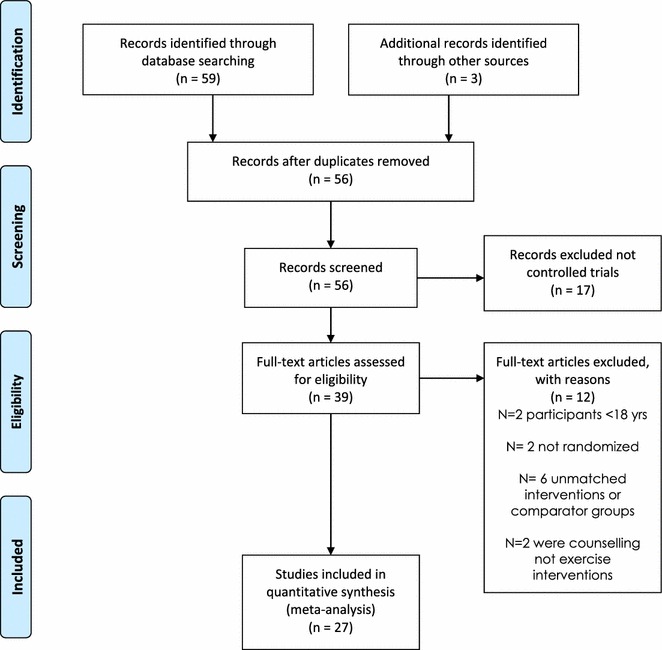
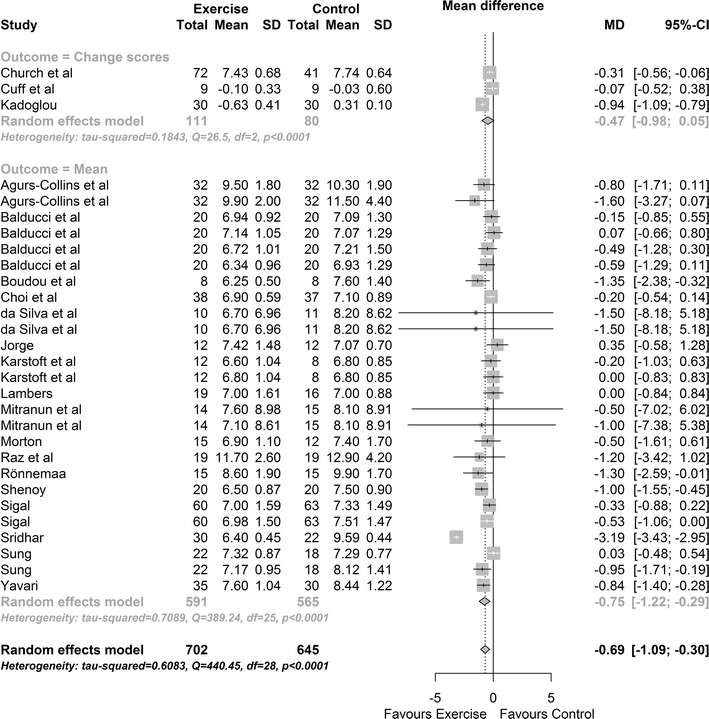
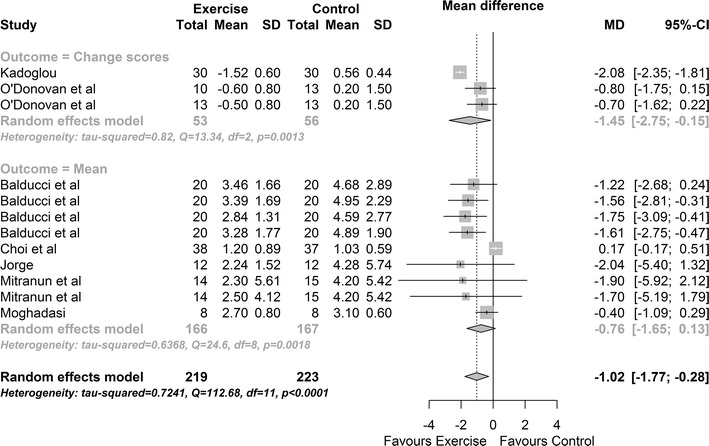
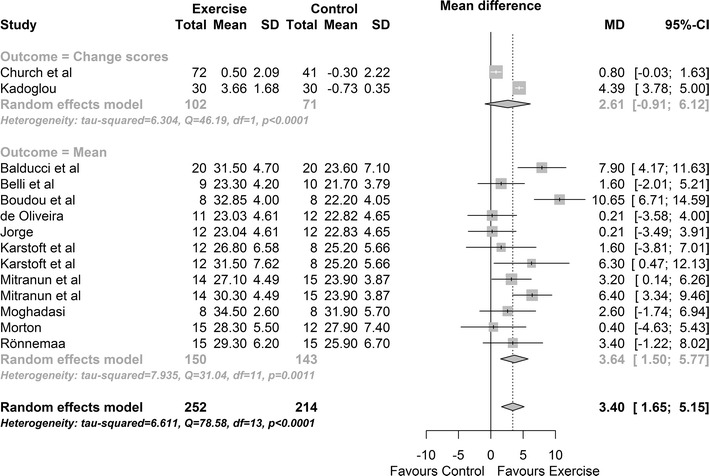
To establish if aerobic exercise training is associated with beneficial effects on clinical outcomes and glycaemic profile in people with type II diabetes. A systematic search was conducted to identify studies through a search of MEDLINE (1985 to Sept 1, 2016, Cochrane Controlled Trials Registry (1966 to Sept 1, 2016), CINAHL, SPORTDiscus and Science Citation Index. The search strategy included a mix of MeSH and free text terms for related key concepts. Searches were limited to prospective randomized or controlled trials of aerobic exercise training in humans with type II diabetes, aged >18 years, lasting >2 weeks. Our analysis included 27 studies (38 intervention groups) totalling 1372 participants, 737 exercise and 635 from control groups. The studies contain data from 39,435 patient-hours of exercise training. Our analyses showed improvements with exercise in glycosylated haemoglobin (HbA1C%) MD: −0.71%, 95% CI −1.11, −0.31; p value = 0.0005. There were significant moderator effects; for every additional week of exercise HbA1C% reduces between 0.009 and 0.04%, p = 0.002. For those exercising at vigorous intensity peak oxygen consumption (peak VO 2 ) increased a further 0.64 and 5.98 ml/kg/min compared to those doing low or moderate intensity activity. Homeostatic model assessment of insulin resistance (HOMA-IR) was also improved with exercise MD: −1.02, 95% CI −1.77, −0.28; p value = 0.007; as was fasting serum glucose MD: −12.53 mmol/l, 95% CI −18.94, −6.23; p value <0.0001; and serum MD: −10.39 IU, 95% CI −17.25, −3.53; p value = 0.003. Our analysis support existing guidelines that for those who can tolerate it, exercise at higher intensity may offer superior fitness benefits and longer program duration will optimize reductions in HbA1C%.
Overview
The claims and statistics of this paper haven’t been checked yet.
Run the check — free, no account needed. It reads the open-access text and checks the sources it cites.
Integrity signals
Registry
Cites
Statistics
Figures
Verification
Claims the paper makes
The claims and statistics of this paper haven’t been checked yet.
Run the check — free, no account needed. It reads the open-access text and checks the sources it cites.
Claims other papers make about this one
Each is checked against this paper’s own text: does it say what the citing paper says it does?
The check wasn’t confident either way, so it gives no verdict — never disputed.
In the citing paper
“none found the optimal type or dose of physical activity to verify the validity and reliability of these recommendations”
From Optimal Dose and Type of Physical Activity to Improve Glycemic Control in People Diagnosed With Type 2 Diabetes: A Systematic Review and Meta-analysis (2024) · cites this paper as [12]
Experimental — accuracy not yet measured
Self-check
Percentages, sums and reported differences re-computed from the paper’s own numbers.
The self-check needs the paper’s full text.
Citations
Cites
Bias in meta-analysis detected by a simple, graphical test
Egger, M., Smith, G. D., Schneider, M., & Minder, C. (1997) · BMJ · doi:10.1136/bmj.315.7109.629 · Cited by 56,722
Conducting Meta-Analyses in R with the metafor Package
Viechtbauer, W. (2010) · Journal of Statistical Software · doi:10.18637/jss.v036.i03 · Cited by 20,464
Exercise Training for Blood Pressure: A Systematic Review and Meta‐analysis
Cornelissen, V. A., & Smart, N. A. (2013) · Journal of the American Heart Association · doi:10.1161/jaha.112.004473 · Cited by 1,683 · cited 1×
“It is therefore perhaps surprising that studies comparing shorter and longer exercise program durations have produced non-uniform effects on peak VO2 [7, 8, 46].”
Self-citationChurch, T. S., Blair, S. N., Cocreham, S., Johannsen, N., Johnson, W., Kramer, K., Mikus, C. R., Myers, V., Nauta, M., Rodarte, R. Q., et al. (2010) · JAMA · doi:10.1001/jama.2010.1710 · Cited by 944
Snowling, N. J., & Hopkins, W. G. (2006) · Diabetes Care · doi:10.2337/dc06-1317 · Cited by 813
Position statement on physical activity and exercise intensity terminology.
Norton, K., Norton, L., & Sadgrove, D. (2010) · Journal of Science and Medicine in Sport · doi:10.1016/j.jsams.2009.09.008 · Cited by 804
Short, K. R., Vittone, J. L., Bigelow, M. L., Proctor, D. N., Rizza, R. A., Coenen-Schimke, J. M., & Nair, K. S. (2003) · Diabetes · doi:10.2337/diabetes.52.8.1888 · Cited by 631
Haddad, E., Wells, G. A., Sigal, R. J., Boul�, N. G., & Kenny, G. P. (2003) · Diabetologia · doi:10.1007/s00125-003-1160-2 · Cited by 601
Jelleyman, C., Yates, T., O'Donovan, G., Gray, L. J., King, J. A., Khunti, K., & Davies, M. J. (2015) · Obesity Reviews · doi:10.1111/obr.12317 · Cited by 588
Effective exercise modality to reduce insulin resistance in women with type 2 diabetes
Cuff, D. J., Meneilly, G. S., Martin, A., Ignaszewski, A., Tildesley, H. D., & Frohlich, J. J. (2003) · Diabetes Care · doi:10.2337/diacare.26.11.2977 · Cited by 545
Cited by
Sorted by citations
Items 101–173 of 173
Metabolic Syndrome, Hormones, and Exercise
Δίπλα, Κ., Zafeiridis, A., & Tordjman, K. M. (2020) · Contemporary Endocrinology · doi:10.1007/978-3-030-33376-8_29 · Cited by 3
Witusik, A., Kaczmarek, S., Kosmalski, M., & Pietras, T. (2023) · Polski Merkuriusz Lekarski · doi:10.36740/merkur202301109 · Cited by 3
Passing on the exercise baton: What can endocrine patients learn from elite athletes?
McCarthy, O. M., Pitt, J. P., Keay, N., Vestergaard, E. T., Tan, A. S. Y., Churm, R., Rees, D. A., & Bracken, R. M. (2022) · Clinical Endocrinology · doi:10.1111/cen.14683 · Cited by 3
Lagas, I. F., Nijst, B. K. J. F., Hartgens, F., de Bie, R. A., Vis, M., Verhaar, J. A. N., & de Vos, R.-J. (2024) · Muscles Ligaments and Tendons Journal · doi:10.32098/mltj.01.2024.10 · Cited by 2
Moharamzadeh, S., Kashef, M., Salehpour, M., Torabi, M., Vesali, S., Samsonchi, Z., & Hajizadeh‐Saffar, E. (2025) · Diabetology & Metabolic Syndrome · doi:10.1186/s13098-024-01541-3 · Cited by 2
Chen, K., Ma, H., Wang, Y., Li, D., Li, J., Huang, Y. L., & Huang, M. (2025) · BMC Sports Science Medicine and Rehabilitation · doi:10.1186/s13102-025-01402-0 · Cited by 2
azhir, S., Alijani, E., Martínez-Huenchullán, S., Amni, H., Baker, J., & Farhani, F. (2022) · Retos · doi:10.47197/retos.v44i0.91770 · Cited by 2
Exercise in Metabolic Syndrome and Diabetes: A Central Role for Insulin Sensitivity
Schauer, I. E., Regensteiner, J. G., & Reusch, J. E. B. (2019) · Contemporary Endocrinology · doi:10.1007/978-3-030-25057-7_18 · Cited by 4
Sukendro, S., Kurniawati, Y., Dinafi, Y., Irawan, T. A., Anjanika, Y., & Lestari, P. A. (2022) · Kinestetik Jurnal Ilmiah Pendidikan Jasmani · doi:10.33369/jk.v6i3.24013 · Cited by 2
Effect of Endurance Training with Different Intensities on HBA1C in Type 2 Diabetes
Ghafari, M., Faramarzi, M., & Farsani, Z. H. (2020) · Armaghane Danesh · doi:10.52547/armaghanj.25.4.503 · Cited by 2
Shen, Y., Yu, L., Hua, Z., Jia, N., Zhou, Y., Dong, X., & Ding, M. (2021) · Medicine · doi:10.1097/md.0000000000023963 · Cited by 2
Shahnavazi, A., Sedaghat, M., & Sabet, M. (2022) · doi:10.61838/kman.aftj.3.5.7 · Cited by 1
Shojaa, M., Knaub, K., Schmitz, N., Niess, A. M., Munz, B., Rau, S., Feit, V., Mphepö, W., Dingler, R., & KEMMLER, W. K. (2025) · JMIR Research Protocols · doi:10.2196/68761 · Cited by 1
Zhou, L., Li, Y., Zhang, S., Zhang, H., Ji, X., Yu, Y., & Xie, H. (2025) · Frontiers in Nutrition · doi:10.3389/fnut.2025.1694982 · Cited by 2
Ekechukwu, N. I., Anwara, S. U., Mgbeojedo, U. G., Chijioke, U. O., Onwukwe, O. S., Ezugwu, U. A., Ekechukwu, E. N. D., & Okoronkwo, I. (2020) · International Journal of Medicine and Health Development · doi:10.4103/ijmh.ijmh_23_20 · Cited by 1
Relationships Between Physical Activity Metrics of Intensity and Diabetes
Moxley, E., Habtezgi, D., Subramanian, V., Hwang, S., Yalla, S. V., & Attewell, L. (2022) · The Journal of Cardiovascular Nursing · doi:10.1097/jcn.0000000000000947 · Cited by 1
Abordagens em medicina: avanços científicos, tecnológicos e sociais
Gemelli, I. F. B., Farias, E. D. S., Teixeira, T. G., & Moreira, K. F. A. (2023) · Amplla Editora eBooks · doi:10.51859/amplla.ama3315-0 · Cited by 1
Chaeroni, A., Ramdani, H. T., Orhan, B. E., Khishe, M., Govindasamy, K., Mario, D. T., Ilham, I., Talib, K., & Lani, M. N. (2024) · Retos · doi:10.47197/retos.v59.107824 · Cited by 2
EFFECTIVENESS OF WALKING EXERCISE ON HBA1C AND BMI OF DIABETES MELLITUS TYPE 2: A SYSTEMATIC REVIEW
Fitri, N., Dewi, Y. S., Suarilah, I., Efendi, C., & Yazid, S. A. (2024) · Nurse and Health Jurnal Keperawatan · doi:10.36720/nhjk.v13i2.672 · Cited by 2
Mundia, E., Goundar, R., & Marfoh, K. (2025) · Journal of Primary Health Care · doi:10.1071/hc25096 · Cited by 1
Rajabi, A., Akbarnejad, A., Siahkouhian, M., & Yari, M. (2019) · DOAJ (DOAJ: Directory of Open Access Journals) · Cited by 1
Kitic, C. M., Selig, S., Davison, K., Best, T., Parmenter, B. J., Pumpa, K. L., Furzer, B. J., Rice, V., Hardcastle, S., Cheney, M., et al. (2019) · BMJ Open · doi:10.1136/bmjopen-2018-027610 · Cited by 1
Diabetes as a Metabolic Disease and Translational Exercise Medicine Informatics
Bao, T., & Shen, B. (2022) · Springer eBooks · doi:10.1007/978-981-16-9162-1_10 · Cited by 1
Maximizing lifestyle changes to manage type 2 diabetes
McMullan (2022) · The Journal of Family Practice · doi:10.12788/jfp.0482 · Cited by 2
Mylytsya, К., Lavryk, O., & Lavryk, A. (2017) · EUREKA Health Sciences · doi:10.21303/2504-5679.2017.00343
Ranasinghe, D. C. (2018) · Queensland University of Technology · doi:10.5204/thesis.eprints.115457
Diabetic Skeletal Health and Potential Benefits of Exercise
O’Neill, E. (2019) · Journal of Clinical Exercise Physiology · doi:10.31189/2165-6193-8.3.108
The effect of exercise timing on glycaemic control in individuals with Type 2 diabetes mellitus
Teo, S. Y. M. (2019) · Murdoch University Research Portal
Jabardo-Camprubí, G., Bort‐Roig, J., Roca, R. D., Martín-Horcajo, M., Puig-Ribera, A. M., & McKenna, J. (2021) · Research Square · doi:10.21203/rs.3.rs-154801/v1
Glucose control, cardiorespiratory fitness, and dietary composition in healthy men.
Moller, J. C. (2020) · SUNScholar (Stellenbosch University)
Abidha, C. A., Amoako, Y. A., Nyamekye, R. K., Bedu‐Addo, G., Grziwotz, F., Mockenhaupt, F. P., Telschow, A., & Danquah, I. (2021) · Research Square · doi:10.21203/rs.3.rs-965079/v1
Going the distance with our patients
Barry, H. C. (2022) · The Journal of Family Practice · doi:10.12788/jfp.0490
Evaluation of Non-Pharmacological Remedies Adopted By The Patients with Diabetes Mellitus Type 2
Hasan, I., Batool, S. R., Dars, J. A., Batool, R., Ahmad, S. M., & Afridi, M. I. (2022) · Pakistan Armed Forces Medical Journal · doi:10.51253/pafmj.v72i1.4700
Effectiveness of Medical Music Therapy in Lifestyle Metabolic Treatment
Sivakumar, M., Rajampudi, N., Uthanthi, T. U., Ar, V., & Deepa, N. (2023) · Journal of Humanities Music and Dance · doi:10.55529/jhmd.35.27.33
DOENÇA DE HIRSCHSPRUNG: NOVOS AVANÇOS E REVISÃO DA LITERATURA
Salazar, G. C., Alves, I. J. D. S., Alvares, L. E. M. D. B., Colpo, J. A. D., Mendanha, V. C., de Brito, M. A. M., & Arruda, J. T. (2023) · Amplla Editora eBooks · doi:10.51859/amplla.ama3315-20
TESTES FARMACOGENÉTICOS PARA A OTIMIZAÇÃO DO TRATAMENTO FARMACOLÓGICO DA DOENÇA DE PARKINSON
Rebêlo, E. C., Rebêlo, R. C., Bachur, T. P. R., de Andrade, M. D. F. C., & Carvalho, E. D. F. (2023) · Amplla Editora eBooks · doi:10.51859/amplla.ama3315-2
ANÁLISE DA VIABILIDADE DO USO DE ÍONS NIÓBIO NO CONTROLE DE CONTAMINAÇÃO BACTERIANA
de Lima, O. J., Marangoni, A. C., & Marangoni, R. J. (2023) · Amplla Editora eBooks · doi:10.51859/amplla.ama3315-7
IMPACTOS DO EXERCÍCIO FÍSICO SOBRE OS PARÂMETROS GLICÊMICOS E CARDIOVASCULARES NO DIABETES TIPO 2
da Franca, R., Santana, A. P., Evangelista, A. D. S., & Caria, A. C. I. (2023) · Amplla Editora eBooks · doi:10.51859/amplla.ama3315-10
ASPECTOS TOXICOLÓGICOS DO USO DO ECSTASY NO SISTEMA NERVOSO CENTRAL: REVISÃO DA LITERATURA
da Cruz, F. D. N., Santiago, K. L. L., de Vilhena, V. H., Rivera, J. G. B., & Quemel, G. K. C. (2023) · Amplla Editora eBooks · doi:10.51859/amplla.ama3315-11
de Medeiros, E. M. B., Bezerra, T. R. P., Silva, G. F. D. O., Araújo, L. O. D. S., & de Mendonça, L. P. (2023) · Amplla Editora eBooks · doi:10.51859/amplla.ama3315-17
REPLAME E A PRESENÇA DE HORTOS DE PLANTAS MEDICINAIS NOS POSTOS DE SAÚDE DE FORTALEZA
de Pinho, L. L., Filho, E. P. D. C., Oliveira, S. D. S., Lopes, G. A. F., Silva, F. W. L., & Nunes, R. D. M. (2023) · Amplla Editora eBooks · doi:10.51859/amplla.ama3315-6
Valetim, J. N. D. M., de Pinho, L. L., Hadad, E. V., Rabelo, M. W. F., Silva, F. W. L., & Nunes, R. D. M. (2023) · Amplla Editora eBooks · doi:10.51859/amplla.ama3315-22
A CANNABIS SATIVA E SEU USO NO TRATAMENTO DE ALZHEIMER E DE EPILEPSIA: UMA REVISÃO DA LITERATURA
de Miranda, A. I. M., Santos, N. C. D. S., Braga, R. D. F. M., Rivera, J. G. B., & Quemel, G. K. C. (2023) · Amplla Editora eBooks · doi:10.51859/amplla.ama3315-15
ORIENTAÇÃO FARMACÊUTICA ÀS GESTANTES HIPERTENSAS
Rocha, M. A. D. A., de Pinho, L. L., de Melo, A. T., Filho, J. D. D. S., Silva, F. W. L., & Nunes, R. D. M. (2023) · Amplla Editora eBooks · doi:10.51859/amplla.ama3315-13
A INFLUÊNCIA DO CONTEXTO FAMILIAR NOS PROCESSOS DE ADOECIMENTO MENTAL DE ADOLESCENTES
de Moraes, S. G., de Oliveira, E., Neto, I. F. D. S., Gregório, M. J. L., Ferreira, R. A., & da Silva, M. S. M. P. (2023) · Amplla Editora eBooks · doi:10.51859/amplla.ama3315-18
Raiol, R. S. L. R., da Cruz, M. Z. R., Queiroz, S. A., Rivera, J. G. B., Moreira, D. R., & Quemel, G. K. C. (2023) · Amplla Editora eBooks · doi:10.51859/amplla.ama3315-9
FATOR NEUROTRÓFICO DERIVADO DO CÉREBRO E A RESPOSTA ANTIDEPRESSIVA À CETAMINA
Beanes, G., Sousa, R. A. L. D., & Caria, A. C. I. (2023) · Amplla Editora eBooks · doi:10.51859/amplla.ama3315-1
COMO OS BENZODIAZEPÍNICOS ESTÃO TRANSFORMANDO O TRATAMENTO DA DEPENDÊNCIA DO ÁLCOOL
Marques, A. C., Marinho, M. R. M., de Pinho, L. L., Filho, J. D. D. S., Silva, F. W. L., & Nunes, R. D. M. (2023) · Amplla Editora eBooks · doi:10.51859/amplla.ama3315-5
USO DE MEDICAMENTOS ISENTOS DE PRESCRIÇÃO E OS RISCOS À SAÚDE: REVISÃO DE LITERATURA
Nogueira, J. F., de Pinho, L. L., de Melo, A. T., Filho, J. D. D. S., Silva, F. W. L., & Nunes, R. D. M. (2023) · Amplla Editora eBooks · doi:10.51859/amplla.ama3315-12
Miranda, J. B., Souza, L. A., Buriti, L. P., Mota, R. D. S., Rivera, J. G. B., & Quemel, G. K. C. (2023) · Amplla Editora eBooks · doi:10.51859/amplla.ama3315-19
TREINAMENTO DE FORÇA E QUALIDADE DE VIDA EM IDOSOS
Santana, T. D., Torres, T., & Caria, A. C. I. (2023) · Amplla Editora eBooks · doi:10.51859/amplla.ama3315-14
A OBESIDADE E A IMPORTÂNCIA DO TREINAMENTO FÍSICO PARA O EMAGRECIMENTO
de Deus, L. B. D. C., Júnior, G. F. D. S., & Caria, A. C. I. (2023) · Amplla Editora eBooks · doi:10.51859/amplla.ama3315-16
The role of the nervous system in patients with frozen shoulder
Mertens, M. G., & Meeus, M. (2024) · Elsevier eBooks · doi:10.1016/b978-0-443-15995-4.00003-9
The Impact of Exercises on Metabolic Diseases
Liu, T. (2025) · MedScien · doi:10.61173/s6xy4j94
SMART CARE FOR DIABETES: INTEGRATING TECHNOLOGY AND LIFESTYLE FOR BETTER OUTCOMES
Maciejczyk, A., Krupa, K., Głowacz, W., & Świeczkowski-Feiz, J. (2025) · International Journal of Innovative Technologies in Social Science · doi:10.31435/ijitss.3(47).2025.3519
THE ROLE OF LIFESTYLE MEDICINE IN TYPE 2 DIABETES: A COMPREHENSIVE REVIEW
Gąska, W., Głowacka, J., Spitaleri, M., Kieloch, F., Sewruk, D., Sienkiel, O., Fitas, A., Gąska, W., Kanon, K., & Dębek-Kalinowska, K. (2025) · International Journal of Innovative Technologies in Social Science · doi:10.31435/ijitss.3(47).2025.3801
Lazić, A., Jevtović−Stoimenov, T., & Trajković, N. (2025) · AFMN Biomedicine · doi:10.5937/afmnai42-55083
Dong, C., Liu, R., Huang, Z., Yang, Y., Sun, S., & Li, R. (2024) · Figshare · doi:10.6084/m9.figshare.26639551
Bourne, J. E., Leary, S., Page, A., Searle, A., England, C. Y., Thompson, D., Andrews, R. C., Foster, C., & Cooper, A. R. (2023) · Figshare · doi:10.6084/m9.figshare.22655448
Al-Mhanna, S. B., Rocha‐Rodrigues, S., Mohamed, M., Batrakoulis, A., Aldhahi, M. I., Afolabi, H. A., Yagin, F. H., Alhussain, M. H., Gülü, M., Abubakar, B. D., et al. (2024) · Figshare · doi:10.6084/m9.figshare.26649351
Bourne, J. E., Leary, S., Page, A., Searle, A., England, C. Y., Thompson, D., Andrews, R. C., Foster, C., & Cooper, A. R. (2023) · Figshare · doi:10.6084/m9.figshare.22655445
Dong, C., Liu, R., Huang, Z., Yang, Y., Sun, S., & Li, R. (2024) · Figshare · doi:10.6084/m9.figshare.26639554
Bourne, J. E., Leary, S., Page, A., Searle, A., England, C. Y., Thompson, D., Andrews, R. C., Foster, C., & Cooper, A. R. (2023) · Figshare · doi:10.6084/m9.figshare.22655439
Bourne, J. E., Leary, S., Page, A., Searle, A., England, C. Y., Thompson, D., Andrews, R. C., Foster, C., & Cooper, A. R. (2023) · Figshare · doi:10.6084/m9.figshare.22655454
Bourne, J. E., Leary, S., Page, A., Searle, A., England, C. Y., Thompson, D., Andrews, R. C., Foster, C., & Cooper, A. R. (2023) · Figshare · doi:10.6084/m9.figshare.22655451
Bourne, J. E., Leary, S., Page, A., Searle, A., England, C. Y., Thompson, D., Andrews, R. C., Foster, C., & Cooper, A. R. (2023) · Figshare · doi:10.6084/m9.figshare.22655442
Dong, C., Liu, R., Huang, Z., Yang, Y., Sun, S., & Li, R. (2024) · Figshare · doi:10.6084/m9.figshare.26639548
Chen, S., An, X., Wu, A., Liu, Y., Lebaka, V. R., Bhaskar, L. V. K. S., Korivi, M., & Ye, W. (2026) · Journal of Diabetes Research · doi:10.1155/jdr/5886930 · Cited by 1
Exercise and Type 2 Diabetes Mellitus
Ahmed, A., & Ismail, S. M. (2026) · IntechOpen eBooks · doi:10.5772/intechopen.1011038 · Cited by 1
Diyabette Egzersiz ve Egzersizi Engelleyen Faktörler: Geleneksel Derleme
Ceylan, A. (2026) · Muş Alparslan Üniversitesi Sağlık Bilimleri Dergisi · doi:10.71255/maunsbd.1744095
Combined Effect of Cardiovascular Fitness and Hemodynamic Response to Exercise on Mortality
Kudaiberdieva, G. (2026) · The American Journal of Cardiology · doi:10.1016/j.amjcard.2026.06.003
Muhammad, S., Latif, A., Alam, A., Ali, M., Elhenawy, A. A., Ahmad, M., Ahmad, S., Shah, S. A. A., Imran, S., & Khan, F. A. (2026) · Future Medicinal Chemistry · doi:10.1080/17568919.2026.2718768 · Cited by 1
Metadata
- Authors
- Grace, A., Chan, E., Giallauria, F., Graham, P. L., & Smart, N. A.
- Affiliations
- University of New England (AU)
- Griffith University (AU)
- Federico II University Hospital (IT)
- Macquarie University (AU)
- Corresponding author
- Smart, Neil A.
- Venue
- Cardiovascular Diabetology
- Published
- 2017-03-14
- Volume
- 16
- Issue
- 1
- Pages
- 37-37
- ISSN
- 1475-2840 (ISSN-L)
- PMC
- PMC5351065
- OpenAlex
- W2600366653
- Cited by
- 174
- References
- 52
- Citations by year
- 2026: 6 · 2025: 22 · 2024: 15 · 2023: 41 · 2022: 23 · 2021: 15 · 2020: 12 · 2019: 21 · 2018: 15 · 2017: 4
- FWCI
- 1.75
- Type
- journal article
- Language
- en
- Open access
- gold
- doi.org
- Licence
- cc-by
- Locations
- Cardiovascular Diabetology (publishedVersion, cc-by)
- Europe PMC (PubMed Central) (publishedVersion, cc-by)
- PubMed Central (publishedVersion, cc-by)
- PubMed (publishedVersion)
- Griffith Research Online (submittedVersion, cc-by)
- RUNE (Research UNE) (submittedVersion)
- Topics
- Health Sciences › Medicine › Public Health, Environmental and Occupational Health › Physical Activity and Health
- Health Sciences › Medicine › Physiology (medical) › Cardiovascular and exercise physiology
- Health Sciences › Medicine › Endocrinology, Diabetes and Metabolism › Diabetes, Cardiovascular Risks, and Lipoproteins
- Keywords
- type 2 diabetes, aerobic exercise training, exercise intensity, glycemic control, HbA1c, insulin resistance, HOMA-IR, fasting serum glucose, peak oxygen uptake, exercise duration
- MeSH terms
- Blood Glucose, Diabetes Mellitus, Type 2, Physical Exertion, Humans, Body Mass Index, Randomized Controlled Trials as Topic, Treatment Outcome
About these checks
Registry, retraction, Cites and statistics results are computed, not judged, with one exception: a printed reference that no index lists is read once by a model before it counts as a citation error. Claims are extracted by a model and kept only when their quote appears verbatim in the text; each cited source is then checked, with a model’s help, for whether it says what the claim relies on. Those verdicts can be wrong — read the claim’s quote and the cited source before relying on one.
Statistics and arithmetic are recomputed, not judged.
Confidence bands are shown only for fields calibrated on our annotated test set. None is calibrated yet, so no band is shown.
What counts as a claim ›How we measure confidence ›How we check this ›
Are you an author, or do you see a problem with this page? Request a review
