

The DOI matches its Crossref record; 52 of the 52 references it cites were found in a registry or an index.
Clinical outcomes and glycaemic responses to different aerobic exercise training intensities in type II diabetes: a systematic review and meta-analysis
Open accessAbstract
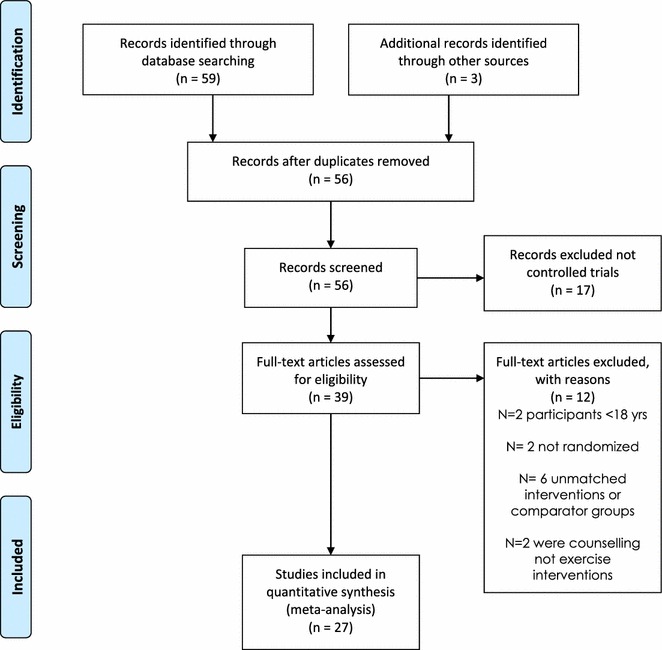
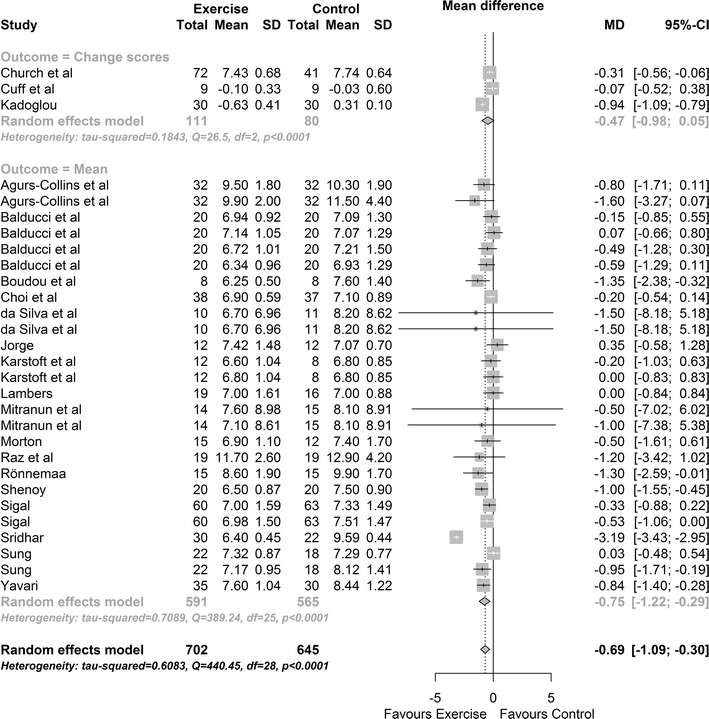
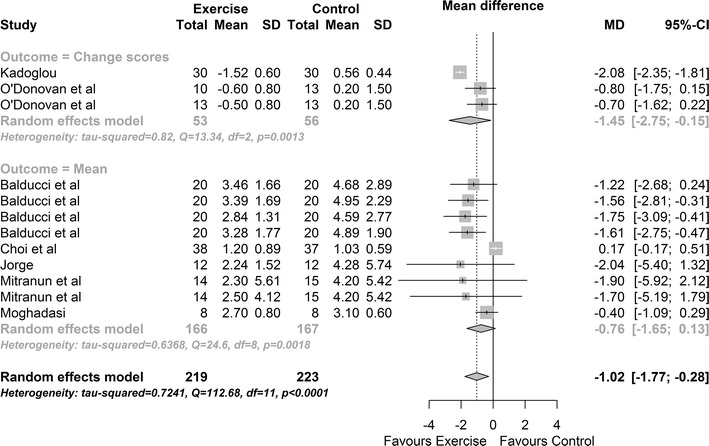
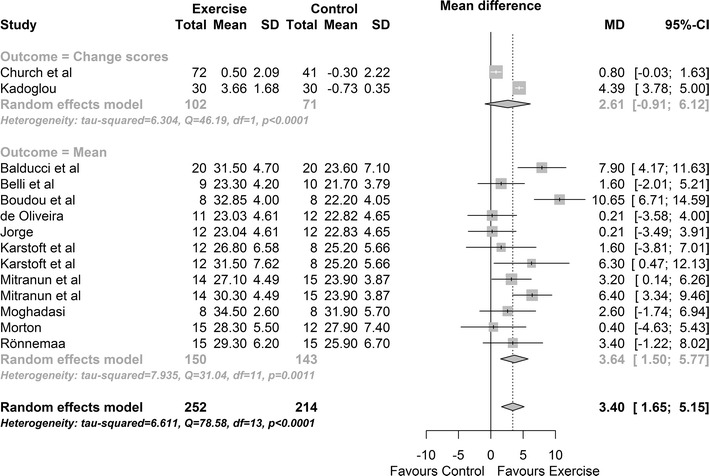
To establish if aerobic exercise training is associated with beneficial effects on clinical outcomes and glycaemic profile in people with type II diabetes. A systematic search was conducted to identify studies through a search of MEDLINE (1985 to Sept 1, 2016, Cochrane Controlled Trials Registry (1966 to Sept 1, 2016), CINAHL, SPORTDiscus and Science Citation Index. The search strategy included a mix of MeSH and free text terms for related key concepts. Searches were limited to prospective randomized or controlled trials of aerobic exercise training in humans with type II diabetes, aged >18 years, lasting >2 weeks. Our analysis included 27 studies (38 intervention groups) totalling 1372 participants, 737 exercise and 635 from control groups. The studies contain data from 39,435 patient-hours of exercise training. Our analyses showed improvements with exercise in glycosylated haemoglobin (HbA1C%) MD: −0.71%, 95% CI −1.11, −0.31; p value = 0.0005. There were significant moderator effects; for every additional week of exercise HbA1C% reduces between 0.009 and 0.04%, p = 0.002. For those exercising at vigorous intensity peak oxygen consumption (peak VO 2 ) increased a further 0.64 and 5.98 ml/kg/min compared to those doing low or moderate intensity activity. Homeostatic model assessment of insulin resistance (HOMA-IR) was also improved with exercise MD: −1.02, 95% CI −1.77, −0.28; p value = 0.007; as was fasting serum glucose MD: −12.53 mmol/l, 95% CI −18.94, −6.23; p value <0.0001; and serum MD: −10.39 IU, 95% CI −17.25, −3.53; p value = 0.003. Our analysis support existing guidelines that for those who can tolerate it, exercise at higher intensity may offer superior fitness benefits and longer program duration will optimize reductions in HbA1C%.
Overview
The claims and statistics of this paper haven’t been checked yet.
Run the check — free, no account needed. It reads the open-access text and checks the sources it cites.
Integrity signals
Registry
Cites
Statistics
Figures
Verification
Claims the paper makes
The claims and statistics of this paper haven’t been checked yet.
Run the check — free, no account needed. It reads the open-access text and checks the sources it cites.
Claims other papers make about this one
Each is checked against this paper’s own text: does it say what the citing paper says it does?
The check wasn’t confident either way, so it gives no verdict — never disputed.
In the citing paper
“none found the optimal type or dose of physical activity to verify the validity and reliability of these recommendations”
From Optimal Dose and Type of Physical Activity to Improve Glycemic Control in People Diagnosed With Type 2 Diabetes: A Systematic Review and Meta-analysis (2024) · cites this paper as [12]
Experimental — accuracy not yet measured
Self-check
Percentages, sums and reported differences re-computed from the paper’s own numbers.
The self-check needs the paper’s full text.
Citations
Cites
Bias in meta-analysis detected by a simple, graphical test
Egger, M., Smith, G. D., Schneider, M., & Minder, C. (1997) · BMJ · doi:10.1136/bmj.315.7109.629 · Cited by 56,722
Conducting Meta-Analyses in R with the metafor Package
Viechtbauer, W. (2010) · Journal of Statistical Software · doi:10.18637/jss.v036.i03 · Cited by 20,464
Exercise Training for Blood Pressure: A Systematic Review and Meta‐analysis
Cornelissen, V. A., & Smart, N. A. (2013) · Journal of the American Heart Association · doi:10.1161/jaha.112.004473 · Cited by 1,683 · cited 1×
“It is therefore perhaps surprising that studies comparing shorter and longer exercise program durations have produced non-uniform effects on peak VO2 [7, 8, 46].”
Self-citationChurch, T. S., Blair, S. N., Cocreham, S., Johannsen, N., Johnson, W., Kramer, K., Mikus, C. R., Myers, V., Nauta, M., Rodarte, R. Q., et al. (2010) · JAMA · doi:10.1001/jama.2010.1710 · Cited by 944
Snowling, N. J., & Hopkins, W. G. (2006) · Diabetes Care · doi:10.2337/dc06-1317 · Cited by 813
Position statement on physical activity and exercise intensity terminology.
Norton, K., Norton, L., & Sadgrove, D. (2010) · Journal of Science and Medicine in Sport · doi:10.1016/j.jsams.2009.09.008 · Cited by 804
Short, K. R., Vittone, J. L., Bigelow, M. L., Proctor, D. N., Rizza, R. A., Coenen-Schimke, J. M., & Nair, K. S. (2003) · Diabetes · doi:10.2337/diabetes.52.8.1888 · Cited by 631
Haddad, E., Wells, G. A., Sigal, R. J., Boul�, N. G., & Kenny, G. P. (2003) · Diabetologia · doi:10.1007/s00125-003-1160-2 · Cited by 601
Jelleyman, C., Yates, T., O'Donovan, G., Gray, L. J., King, J. A., Khunti, K., & Davies, M. J. (2015) · Obesity Reviews · doi:10.1111/obr.12317 · Cited by 588
Effective exercise modality to reduce insulin resistance in women with type 2 diabetes
Cuff, D. J., Meneilly, G. S., Martin, A., Ignaszewski, A., Tildesley, H. D., & Frohlich, J. J. (2003) · Diabetes Care · doi:10.2337/diacare.26.11.2977 · Cited by 545
Cited by
Sorted by citations
KANALEY, J. A., COLBERG, S. R., CORCORAN, M. H., MALIN, S. K., RODRIGUEZ, N. R., CRESPO, C. J., KIRWAN, J. P., & ZIERATH, J. R. (2022) · Medicine & Science in Sports & Exercise · doi:10.1249/mss.0000000000002800 · Cited by 931
American Diabetes Association Professional Practice Committee, ElSayed, N. A., McCoy, R. G., Aleppo, G., Balapattabi, K., Beverly, E. A., Briggs Early, K., Bruemmer, D., Echouffo-Tcheugui, J. B., Eichorst, B., et al. (2025) · Diabetes Care · doi:10.2337/dc25-s005 · Cited by 305
ElSayed, N. A., Aleppo, G., Bannuru, R. R., Beverly, E. A., Bruemmer, D., Collins, B. S., Darville, A. K., Ekhlaspour, L., Hassanein, M. M., Hilliard, M. E., et al. (2023) · Diabetes Care · doi:10.2337/dc24-s005 · Cited by 366
Ostman, C., Smart, N. A., Morcos, D., Duller, A., Ridley, W. E., & Jewiss, D. (2017) · Cardiovascular Diabetology · doi:10.1186/s12933-017-0590-y · Cited by 250
Self-citationDe Nardi, A. T., Tolves, T., Lenzi, T. L., Signori, L. U., & Silva, A. M. V. D. (2018) · Diabetes Research and Clinical Practice · doi:10.1016/j.diabres.2017.12.017 · Cited by 191
Metadata
- Authors
- Grace, A., Chan, E., Giallauria, F., Graham, P. L., & Smart, N. A.
- Affiliations
- University of New England (AU)
- Griffith University (AU)
- Federico II University Hospital (IT)
- Macquarie University (AU)
- Corresponding author
- Smart, Neil A.
- Venue
- Cardiovascular Diabetology
- Published
- 2017-03-14
- Volume
- 16
- Issue
- 1
- Pages
- 37-37
- ISSN
- 1475-2840 (ISSN-L)
- PMC
- PMC5351065
- OpenAlex
- W2600366653
- Cited by
- 174
- References
- 52
- Citations by year
- 2026: 6 · 2025: 22 · 2024: 15 · 2023: 41 · 2022: 23 · 2021: 15 · 2020: 12 · 2019: 21 · 2018: 15 · 2017: 4
- FWCI
- 1.75
- Type
- journal article
- Language
- en
- Open access
- gold
- doi.org
- Licence
- cc-by
- Locations
- Cardiovascular Diabetology (publishedVersion, cc-by)
- Europe PMC (PubMed Central) (publishedVersion, cc-by)
- PubMed Central (publishedVersion, cc-by)
- PubMed (publishedVersion)
- Griffith Research Online (submittedVersion, cc-by)
- RUNE (Research UNE) (submittedVersion)
- Topics
- Health Sciences › Medicine › Public Health, Environmental and Occupational Health › Physical Activity and Health
- Health Sciences › Medicine › Physiology (medical) › Cardiovascular and exercise physiology
- Health Sciences › Medicine › Endocrinology, Diabetes and Metabolism › Diabetes, Cardiovascular Risks, and Lipoproteins
- Keywords
- type 2 diabetes, aerobic exercise training, exercise intensity, glycemic control, HbA1c, insulin resistance, HOMA-IR, fasting serum glucose, peak oxygen uptake, exercise duration
- MeSH terms
- Blood Glucose, Diabetes Mellitus, Type 2, Physical Exertion, Humans, Body Mass Index, Randomized Controlled Trials as Topic, Treatment Outcome
About these checks
Registry, retraction, Cites and statistics results are computed, not judged, with one exception: a printed reference that no index lists is read once by a model before it counts as a citation error. Claims are extracted by a model and kept only when their quote appears verbatim in the text; each cited source is then checked, with a model’s help, for whether it says what the claim relies on. Those verdicts can be wrong — read the claim’s quote and the cited source before relying on one.
Statistics and arithmetic are recomputed, not judged.
Confidence bands are shown only for fields calibrated on our annotated test set. None is calibrated yet, so no band is shown.
What counts as a claim ›How we measure confidence ›How we check this ›
Are you an author, or do you see a problem with this page? Request a review
