

Comparative effects of microvascular and macrovascular disease on the risk of major outcomes in patients with type 2 diabetes
Open accessThe DOI matches its Crossref record; 36 of the 36 references it cites were found in a registry or an index.
Abstract
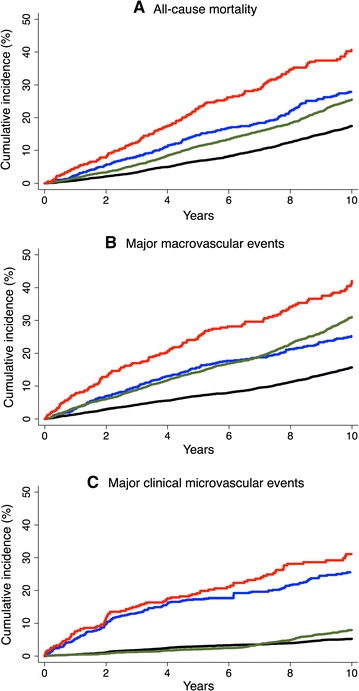
BACKGROUND: Microvascular disease is associated with a high risk of macrovascular events in patients with type 2 diabetes, but the impact of macrovascular disease on the risk of microvascular events remains unknown. We sought to evaluate the respective effects of prior microvascular and macrovascular disease on the risk of major outcomes, including microvascular events, in these patients. METHODS: Participants in the Action in Diabetes and Vascular Disease: PreterAx and DiamicroN Modified-Release Controlled Evaluation (ADVANCE) trial (n = 11,140) and the ADVANCE-ON post-trial study (n = 8494) were categorized into 4 groups at baseline: dual absence of microvascular or macrovascular disease (n = 6789), presence of microvascular disease alone (n = 761), macrovascular disease alone (n = 3196), and both (n = 394). Outcomes were all-cause mortality, major macrovascular events (MACE), and major clinical microvascular events. RESULTS: All-cause mortality, MACE, and major clinical microvascular events occurred in 2265 (20%), 2166 (19%), and 807 (7%) participants respectively, during a median follow-up of 9.9 (inter-quartile interval 5.6-10.9) years. The adjusted hazard ratios [95% CI] of death, MACE, and major clinical microvascular events were each greater in patients with baseline microvascular disease (1.43 [1.20-1.71], 1.64 [1.37-1.97], and 4.74 [3.86-5.82], respectively), macrovascular disease (1.43 [1.30-1.57], 2.04 [1.86-2.25], and 1.26 [1.06-1.51]) or both (2.01 [1.65-2.45], 2.92 [2.40-3.55], and 6.30 [4.93-8.06]) compared with those without these conditions. No interaction was observed between baseline microvascular and macrovascular disease for these events. The addition of microvascular disease (change in c-statistic [95% CI] 0.005 [0.002-0.008], p = 0.02) or macrovascular disease (0.005 [0.002-0.007], p < 0.0001) considered separately or together (0.011 [0.007-0.014], p < 0.0001) improved the discrimination and the classification (integrated discrimination improvement (IDI): 0.013 [0.010-0.016], p < 0.001; net reclassification improvement (NRI): 0.021 [0.011-0.032], p < 0.001) of the risk of all-cause mortality. Microvascular disease improved discrimination (0.009 [0.003-0.014]) and classification (IDI: 0.008 [0.006-0.010]; NRI: 0.011 [0.001-0.020]) of MACE. Baseline macrovascular disease modestly enhanced IDI (0.002 [0.001-0.002]) and NRI (0.041 [0.002-0.087]), but not discrimination, of major clinical microvascular events. CONCLUSIONS: Microvascular and macrovascular disease are independently associated with the 10-year risk of death, MACE, and major clinical microvascular events in patients with type 2 diabetes. The coexistence of these conditions was associated with the highest risks.
Overview
The claims and statistics of this paper haven’t been checked yet.
Free: it reads the open-access text and checks the first 5 claims that cite a source we can check. Create a free account to check every claim.
Integrity signals
Registry
Cites
Statistics
Figures
Verification
Claims the paper makes
The claims and statistics of this paper haven’t been checked yet.
Free: it reads the open-access text and checks the first 5 claims that cite a source we can check. Create a free account to check every claim.
Claims other papers make about this one
Each is checked against this paper’s own text: does it say what the citing paper says it does?
The source backs part of the claim, not all of it — or backs it for a different population, condition or comparison.
In the citing paper
“A study by Mohammedi et al. [79] found that major peripheral arterial disease (PAD) presenting as lower-extremity ulceration or amputation and peripheral revascularization is associated with increased risk of death and CV events in people with T2DM.”
From Prevalence of cardiovascular disease in type 2 diabetes: a systematic literature review of scientific evidence from across the world in 2007–2017 (2018) · cites this paper as [79]
Experimental — accuracy not yet measured
Self-check
Percentages, sums and reported differences re-computed from the paper’s own numbers.
The self-check needs the paper’s full text.
Citations
Cites
A Proportional Hazards Model for the Subdistribution of a Competing Risk
Fine, J. P., & Gray, R. J. (1999) · Journal of the American Statistical Association · doi:10.1080/01621459.1999.10474144 · Cited by 14,290 · cited 1×
“We also evaluated the associations of microvascular and macrovascular disease at baseline on the risk of MACE and major clinical microvascular events after treating non-renal and noncardiovascular death as a competing risk using the Fine and Gray method [13].”
MethodIntensive blood glucose control and vascular outcomes in patients with type 2 diabetes
(2008) · New England Journal of Medicine · doi:10.1056/nejmoa0802987 · Cited by 7,397
Oxidative stress and diabetic complications
Giacco, F., & Brownlee, M. (2010) · Circulation Research · doi:10.1161/circresaha.110.223545 · Cited by 5,461
The Pathobiology of Diabetic Complications
Brownlee, M. (2005) · Diabetes · doi:10.2337/diabetes.54.6.1615 · Cited by 5,339
(2013) · Kidney International Supplements · doi:10.1038/kisup.2012.73 · Cited by 3,206
Andrassy, K. M. (2013) · Kidney International · doi:10.1038/ki.2013.243 · Cited by 2,496
The J-Curve Phenomenon in Hypertension
Kang, Y.-Y., & Wang, J.-G. (2016) · Pulse · doi:10.1159/000446922 · Cited by 1,530
Pencina, M. J., & D'Agostino, R. B. (2004) · Statistics in Medicine · doi:10.1002/sim.1802 · Cited by 1,444 · cited 1×
“Harrell’s c-statistic [12], net reclassification improvement (NRI) and integrated discrimination improvement (IDI) were used to compare discrimination and classification of primary outcomes, assessed using survival methodology, between two prognostic models: basic model and basic model plus baseline history of microva…”
MethodLow Wang, C. C., Hess, C. N., Hiatt, W. R., & Goldfine, A. B. (2016) · Circulation · doi:10.1161/circulationaha.116.022194 · Cited by 1,155
Cited by
Items 101–118 of 118
Desyamitha, P. D., Dwipayana, I. M. P., & Purnamasidhi, . A. W. (2024) · Research Society and Development · doi:10.33448/rsd-v13i2.44950
刘, 震. (2024) · Advances in Clinical Medicine · doi:10.12677/acm.2024.143748
Reyes, E. B., Cheng-Bromeo, P. V. C., & Santos, N. J. C. (2025) · Philippine journal of cardiology. · doi:10.69944/pjc.06659058d5
Phan, F., Andréelli, F., Broussaud, T., Boussouar, S., Jeannin, A.-C., Laroche, S., Toulgoat, A., Gallo, A., Bourron, O., & Redheuil, A. B. (2026) · Cardiovascular Diabetology · doi:10.1186/s12933-026-03314-w
“This approach aligns with previous findings [47] which suggested that combining microvascular and macrovascular markers can improve risk prediction and stratification.”
Mohammedi, K., Préaubert, N., Cariou, T., Rigalleau, V., Foussard, N., Piazza, L., Bairras-Martin, C., Couffinhal, T., Bezin, J., & Bénard, A. (2021) · Figshare · doi:10.6084/m9.figshare.14213640
Self-citationCamoin, M., Velho, G., Saulnier, P.-J., Potier, L., Abouleka, Y., Carpentier, C., Dubois, S. G., Larroumet, A., Rigalleau, V., Gand, E., et al. (2022) · Figshare · doi:10.6084/m9.figshare.19736409
Self-citationKumosani, T. A., Alnefayee, A. M., Barbour, E. K., Qari, M., Yaghmoor, S., Ahmed, T. A., Al-Bogami, T. J., & Moselhy, S. (2025) · Journal of Biological Research - Bollettino della Società Italiana di Biologia Sperimentale · doi:10.4081/jbr.2025.13600
Camoin, M., Velho, G., Saulnier, P.-J., Potier, L., Abouleka, Y., Carpentier, C., Dubois, S. G., Larroumet, A., Rigalleau, V., Gand, E., et al. (2022) · Figshare · doi:10.6084/m9.figshare.19736406
Self-citationMohammedi, K., Préaubert, N., Cariou, T., Rigalleau, V., Foussard, N., Piazza, L., Bairras-Martin, C., Couffinhal, T., Bezin, J., & Bénard, A. (2021) · Figshare · doi:10.6084/m9.figshare.14213643
Self-citationCamoin, M., Velho, G., Saulnier, P.-J., Potier, L., Abouleka, Y., Carpentier, C., Dubois, S. G., Larroumet, A., Rigalleau, V., Gand, E., et al. (2022) · Figshare · doi:10.6084/m9.figshare.19736400
Self-citationCamoin, M., Velho, G., Saulnier, P.-J., Potier, L., Abouleka, Y., Carpentier, C., Dubois, S. G., Larroumet, A., Rigalleau, V., Gand, E., et al. (2022) · Figshare · doi:10.6084/m9.figshare.19736403
Self-citationShang, B., Lu, Y., Wei, C., Li, Y., Yang, Q., Li, Y., Jiang, S., & Su, Y. (2026) · Frontiers in Endocrinology · doi:10.3389/fendo.2026.1696240 · Cited by 1
Sacchetta, L., Gallo, S., Chiriacò, M., Tumino, D., Carrubba, N., Caruso, I., Molfetta, S. D., Anastasiou, I. A., Tentolouris, N., Rebelos, E., et al. (2026) · Nutrition Metabolism and Cardiovascular Diseases · doi:10.1016/j.numecd.2026.104716
Edens, M. A., Rosien, L., van Dijk, P. R., & Bilo, H. J. G. (2026) · Journal of Diabetes and its Complications · doi:10.1016/j.jdiacomp.2026.109363
Due, O. T., Dao, A. S., Ly, Q. T., Kieu, T. T. M., & Le, H. M. (2026) · Cost Effectiveness and Resource Allocation · doi:10.1186/s12962-026-00797-y
ĐƯỜNG HUYẾT MAO MẠCH VÀ HBA1C TRONG QUẢN LÝ ĐÁI THÁO ĐƯỜNG TÝP 2: MỐI LIÊN HỆ VÀ ỨNG DỤNG LÂM SÀNG
Duong, T., Lam, K. K. Y., & Trân, N. B. (2026) · Tạp chí Dinh dưỡng và Thực phẩm · doi:10.56283/1859-0381/1034
“Bên cạnh đó, biến chứng tại hệ thống vi mạch và đại mạch thường diễn tiến cùng lúc với mức độ rủi ro cao ở người mắc ĐTĐ týp 2 gia tăng nguy cơ mắc bệnh tim mạch (CVD) và tỉ lệ tử vong toàn cầu [26].”
Anguiano-Marcos, I., Flores‐Escobar, S., García‐Álvarez, Y., Tardáguila‐García, A., Lázaro‐Martínez, J. L., & Álvaro‐Afonso, F. J. (2026) · Journal of Clinical Medicine · doi:10.3390/jcm15187278
“…perfusion does not necessarily translate into immediate normalization of tissue oxygenation, particularly in individuals with diabetes, for which persistent microvascular dysfunction may continue to impair oxygen delivery despite successful restoration of arterial blood flow [4,18,19].”
Metadata
- Authors
- Mohammedi, K., Woodward, M., Marre, M., Colagiuri, S., Cooper, M., Harrap, S., Mancia, G., Poulter, N., Williams, B., Zoungas, S., & Chalmers, J.
- Affiliations
- The University of Sydney (AU)
- Inserm (FR)
- Baker Heart and Diabetes Institute (AU)
- The Royal Melbourne Hospital (AU)
- IRCCS Istituto Auxologico Italiano (IT)
- Imperial College London (GB)
- National Institute for Health and Care Research (GB)
- Corresponding author
- Mohammedi, Kamel
- ORCID
- Venue
- Cardiovascular Diabetology
- Published
- 2017-07-27
- Volume
- 16
- Issue
- 1
- Pages
- 95-95
- ISSN
- 1475-2840 (ISSN-L)
- PMC
- PMC5530952
- OpenAlex
- W2740555108
- Semantic Scholar
- 67d9c86ab4c099438a24b17f2ae6b60ea2b58895
- Cited by
- 111
- References
- 36
- Citations by year
- 2026: 7 · 2025: 12 · 2024: 10 · 2023: 5 · 2022: 23 · 2021: 16 · 2020: 10 · 2019: 7 · 2018: 13 · 2017: 8
- FWCI
- 8.22
- Type
- journal article
- Language
- en
- Open access
- gold
- doi.org
- Licence
- cc-by
- Locations
- Cardiovascular Diabetology (publishedVersion, cc-by)
- PubMed Central (publishedVersion, cc-by)
- PubMed (publishedVersion)
- UNSWorks (University of New South Wales, Sydney, Australia) (submittedVersion, cc-by-nc-nd)
- Minerva Access (University of Melbourne) (submittedVersion, cc-by)
- Monash University Research Portal (Monash University) (submittedVersion, cc-by)
- BOA (University of Milano-Bicocca) (submittedVersion, cc-by)
- DOAJ (DOAJ: Directory of Open Access Journals) (submittedVersion, cc-by-sa)
- UCL Discovery (University College London) (submittedVersion)
- Spiral (Imperial College London) (submittedVersion, cc-by)
- Funders
- National Institute for Health and Care Research (NF-SI-0509-10222, NF-SI-0514-10011)
- Société Francophone du Diabète
- Association Diabète Risque Vasculaire
- Medical Research Council (MC_PC_13090)
- Topics
- Health Sciences › Medicine › Endocrinology, Diabetes and Metabolism › Diabetes Treatment and Management
- Health Sciences › Medicine › Endocrinology, Diabetes and Metabolism › Diabetes, Cardiovascular Risks, and Lipoproteins
- Health Sciences › Medicine › Endocrinology, Diabetes and Metabolism › Diabetes Management and Research
- Keywords
- type 2 diabetes, microangiopathy, macroangiopathy, major adverse cardiovascular events, all-cause mortality, cardiovascular risk stratification, ADVANCE trial, cardiovascular risk prediction models, diabetes complications, microvascular complications, macrovascular complications
- MeSH terms
- Adult, Aged, Blood Glucose, Diabetes Mellitus, Type 2, Diabetic Angiopathies, Drug Combinations, Female, Gliclazide, Humans, Hypoglycemic Agents, Indapamide, Male, Middle Aged, Risk Factors, Treatment Outcome, Perindopril, Microvessels
About these checks
Registry, retraction, Cites and statistics results are computed, not judged, with one exception: a printed reference that no index lists is read once by a model before it counts as a citation error. Claims are extracted by a model and kept only when their quote appears verbatim in the text; each cited source is then checked, with a model’s help, for whether it says what the claim relies on. Those verdicts can be wrong — read the claim’s quote and the cited source before relying on one.
Statistics and arithmetic are recomputed, not judged.
Confidence bands are shown only for fields calibrated on our annotated test set. None is calibrated yet, so no band is shown.
What counts as a claim ›How we measure confidence ›How we check this ›
Are you an author, or do you see a problem with this page? Request a review
Data sources
Bibliographic data: Semantic Scholar, OpenAlex, Crossref.
Contains information from the Semantic Scholar Academic Graph Datasets, made available under the ODC Attribution License (ODC-BY 1.0).
Semantic Scholar’s data is described in: Kinney, R., et al. (2023). The Semantic Scholar Open Data Platform. arXiv:2301.10140.
