

Comparative effects of microvascular and macrovascular disease on the risk of major outcomes in patients with type 2 diabetes
Open accessThe DOI matches its Crossref record; 36 of the 36 references it cites were found in a registry or an index.
Abstract
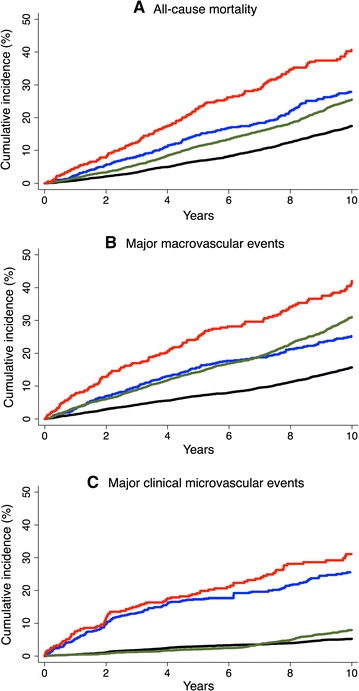
BACKGROUND: Microvascular disease is associated with a high risk of macrovascular events in patients with type 2 diabetes, but the impact of macrovascular disease on the risk of microvascular events remains unknown. We sought to evaluate the respective effects of prior microvascular and macrovascular disease on the risk of major outcomes, including microvascular events, in these patients. METHODS: Participants in the Action in Diabetes and Vascular Disease: PreterAx and DiamicroN Modified-Release Controlled Evaluation (ADVANCE) trial (n = 11,140) and the ADVANCE-ON post-trial study (n = 8494) were categorized into 4 groups at baseline: dual absence of microvascular or macrovascular disease (n = 6789), presence of microvascular disease alone (n = 761), macrovascular disease alone (n = 3196), and both (n = 394). Outcomes were all-cause mortality, major macrovascular events (MACE), and major clinical microvascular events. RESULTS: All-cause mortality, MACE, and major clinical microvascular events occurred in 2265 (20%), 2166 (19%), and 807 (7%) participants respectively, during a median follow-up of 9.9 (inter-quartile interval 5.6-10.9) years. The adjusted hazard ratios [95% CI] of death, MACE, and major clinical microvascular events were each greater in patients with baseline microvascular disease (1.43 [1.20-1.71], 1.64 [1.37-1.97], and 4.74 [3.86-5.82], respectively), macrovascular disease (1.43 [1.30-1.57], 2.04 [1.86-2.25], and 1.26 [1.06-1.51]) or both (2.01 [1.65-2.45], 2.92 [2.40-3.55], and 6.30 [4.93-8.06]) compared with those without these conditions. No interaction was observed between baseline microvascular and macrovascular disease for these events. The addition of microvascular disease (change in c-statistic [95% CI] 0.005 [0.002-0.008], p = 0.02) or macrovascular disease (0.005 [0.002-0.007], p < 0.0001) considered separately or together (0.011 [0.007-0.014], p < 0.0001) improved the discrimination and the classification (integrated discrimination improvement (IDI): 0.013 [0.010-0.016], p < 0.001; net reclassification improvement (NRI): 0.021 [0.011-0.032], p < 0.001) of the risk of all-cause mortality. Microvascular disease improved discrimination (0.009 [0.003-0.014]) and classification (IDI: 0.008 [0.006-0.010]; NRI: 0.011 [0.001-0.020]) of MACE. Baseline macrovascular disease modestly enhanced IDI (0.002 [0.001-0.002]) and NRI (0.041 [0.002-0.087]), but not discrimination, of major clinical microvascular events. CONCLUSIONS: Microvascular and macrovascular disease are independently associated with the 10-year risk of death, MACE, and major clinical microvascular events in patients with type 2 diabetes. The coexistence of these conditions was associated with the highest risks.
Overview
The claims and statistics of this paper haven’t been checked yet.
Free: it reads the open-access text and checks the first 5 claims that cite a source we can check. Create a free account to check every claim.
Integrity signals
Registry
Cites
Statistics
Figures
Verification
Claims the paper makes
The claims and statistics of this paper haven’t been checked yet.
Free: it reads the open-access text and checks the first 5 claims that cite a source we can check. Create a free account to check every claim.
Claims other papers make about this one
Each is checked against this paper’s own text: does it say what the citing paper says it does?
The source backs part of the claim, not all of it — or backs it for a different population, condition or comparison.
In the citing paper
“A study by Mohammedi et al. [79] found that major peripheral arterial disease (PAD) presenting as lower-extremity ulceration or amputation and peripheral revascularization is associated with increased risk of death and CV events in people with T2DM.”
From Prevalence of cardiovascular disease in type 2 diabetes: a systematic literature review of scientific evidence from across the world in 2007–2017 (2018) · cites this paper as [79]
Experimental — accuracy not yet measured
Self-check
Percentages, sums and reported differences re-computed from the paper’s own numbers.
The self-check needs the paper’s full text.
Citations
Cites
A Proportional Hazards Model for the Subdistribution of a Competing Risk
Fine, J. P., & Gray, R. J. (1999) · Journal of the American Statistical Association · doi:10.1080/01621459.1999.10474144 · Cited by 14,290 · cited 1×
“We also evaluated the associations of microvascular and macrovascular disease at baseline on the risk of MACE and major clinical microvascular events after treating non-renal and noncardiovascular death as a competing risk using the Fine and Gray method [13].”
MethodIntensive blood glucose control and vascular outcomes in patients with type 2 diabetes
(2008) · New England Journal of Medicine · doi:10.1056/nejmoa0802987 · Cited by 7,397
Oxidative stress and diabetic complications
Giacco, F., & Brownlee, M. (2010) · Circulation Research · doi:10.1161/circresaha.110.223545 · Cited by 5,461
The Pathobiology of Diabetic Complications
Brownlee, M. (2005) · Diabetes · doi:10.2337/diabetes.54.6.1615 · Cited by 5,339
(2013) · Kidney International Supplements · doi:10.1038/kisup.2012.73 · Cited by 3,206
Andrassy, K. M. (2013) · Kidney International · doi:10.1038/ki.2013.243 · Cited by 2,496
The J-Curve Phenomenon in Hypertension
Kang, Y.-Y., & Wang, J.-G. (2016) · Pulse · doi:10.1159/000446922 · Cited by 1,530
Pencina, M. J., & D'Agostino, R. B. (2004) · Statistics in Medicine · doi:10.1002/sim.1802 · Cited by 1,444 · cited 1×
“Harrell’s c-statistic [12], net reclassification improvement (NRI) and integrated discrimination improvement (IDI) were used to compare discrimination and classification of primary outcomes, assessed using survival methodology, between two prognostic models: basic model and basic model plus baseline history of microva…”
MethodLow Wang, C. C., Hess, C. N., Hiatt, W. R., & Goldfine, A. B. (2016) · Circulation · doi:10.1161/circulationaha.116.022194 · Cited by 1,155
Endothelial Function and Oxidative Stress in Cardiovascular Diseases
Higashi, Y., Noma, K., Yoshizumi, M., & Kihara, Y. (2009) · Circulation Journal · doi:10.1253/circj.cj-08-1102 · Cited by 798
Follow-up of blood-pressure lowering and glucose control in type 2 diabetes
Zoungas, S., Chalmers, J., Neal, B., Billot, L., Li, Q., Hirakawa, Y., Arima, H., Monaghan, H., Joshi, R., Colagiuri, S., et al. (2014) · New England Journal of Medicine · doi:10.1056/nejmoa1407963 · Cited by 626 · cited 1×
“Outcomes were adjudicated by an independent End Point Adjudication Committee in the ADVANCE trial, through to the end of randomized allocation, and were reported by investigators without adjudication in the ADVANCE-ON study, in accordance with its pre-specified protocol [10].”
MethodSelf-citationLee, J. M., Jung, J.-H., Hwang, D., Park, J., Fan, Y., Na, S.-H., Doh, J.-H., Nam, C.-W., Shin, E.-S., & Koo, B.-K. (2016) · Journal of the American College of Cardiology · doi:10.1016/j.jacc.2015.12.053 · Cited by 347 · cited 1×
“For instance, a high index of microcirculatory resistance and low coronary flow reserve were recently found associated with poor cardiovascular prognosis in patients with intermediate coronary stenosis (29% with type 2 diabetes) [20].”
BackgroundA novel component of the metabolic syndrome: The oxidative stress
Hopps, E., Noto, D., Caimi, G., & Averna, M. R. (2010) · Nutrition, Metabolism and Cardiovascular Diseases · doi:10.1016/j.numecd.2009.06.002 · Cited by 335 · cited 1×
“Moreover, oxidative stress is associated with many other accelerating conditions including insulin resistance, metabolic syndrome, hypertension, dyslipidaemia, and obesity, leading to both microvascular and macrovascular disease [25, 31].”
BackgroundOxidative stress, inflammation, endothelial dysfunction and incidence of type 2 diabetes
Odegaard, A. O., Jacobs, D. R., Sanchez, O. A., Goff, D. C., Reiner, A. P., & Gross, M. D. (2016) · Cardiovascular Diabetology · doi:10.1186/s12933-016-0369-6 · Cited by 286
Sörensen, B. M., Houben, A. J. H. M., Berendschot, T. T. J. M., Schouten, J. S. A. G., Kroon, A. A., van der Kallen, C. J. H., Henry, R. M. A., Koster, A., Sep, S. J. S., Dagnelie, P. C., et al. (2016) · Circulation · doi:10.1161/circulationaha.116.023446 · Cited by 249
Brownrigg, J. R. W., Hughes, C. O., Burleigh, D., Karthikesalingam, A., Patterson, B. O., Holt, P. J., Thompson, M. M., de Lusignan, S., Ray, K. K., & Hinchliffe, R. J. (2016) · The Lancet Diabetes & Endocrinology · doi:10.1016/s2213-8587(16)30057-2 · Cited by 242 · cited 2×
“Microvascular disease and risk of MACE Our findings support previous studies showing that microvascular disease is an important predictor of future macrovascular disease and death [6, 15].”
BackgroundResultDiabetes Mellitus Induces Bone Marrow Microangiopathy
Oikawa, A., Siragusa, M., Quaini, F., Mangialardi, G., Katare, R. G., Caporali, A., van Buul, J. D., van Alphen, F. P. J., Graiani, G., Spinetti, G., et al. (2010) · Arteriosclerosis, Thrombosis, and Vascular Biology · doi:10.1161/atvbaha.109.200154 · Cited by 231 · cited 1×
“The remodeling of bone marrow involves neurovascular changes and vascular abnormalities comparable to the known microangiopathy seen in the kidney and the retina [34].”
BackgroundNot Available, N. A., & Committee, A. M. (2001) · Diabetologia · doi:10.1007/s001250100612 · Cited by 180
Patel, H., Chen, J., Das, K. C., & Kavdia, M. (2013) · Cardiovascular Diabetology · doi:10.1186/1475-2840-12-142 · Cited by 179
Krentz, A. J., Clough, G., & Byrne, C. D. (2007) · Diabetes, Obesity and Metabolism · doi:10.1111/j.1463-1326.2007.00670.x · Cited by 168
Mohammedi, K., Woodward, M., Hirakawa, Y., Zoungas, S., Williams, B., Lisheng, L., Rodgers, A., Mancia, G., Neal, B., Harrap, S., et al. (2016) · Diabetes Care · doi:10.2337/dc16-0588 · Cited by 117 · cited 1×
“Microvascular disease and risk of MACE Our findings support previous studies showing that microvascular disease is an important predictor of future macrovascular disease and death [6, 15].”
ResultSelf-citationon behalf of the ADVANCE Collaborative Group, Mohammedi, K., Woodward, M., Hirakawa, Y., Zoungas, S., Colagiuri, S., Hamet, P., Harrap, S., Poulter, N., Matthews, D. R., et al. (2016) · Cardiovascular Diabetology · doi:10.1186/s12933-016-0446-x · Cited by 117 · cited 1×
“We recently reported that the history of peripheral arterial disease was associated with the risk of severe diabetic retinopathy, but not renal endpoints in ADVANCE and ADVANCE-ON studies [19].”
BackgroundSelf-citationDoney, A. S. F., Lee, S., Leese, G., Morris, A. D., & Palmer, C. N. A. (2005) · Circulation · doi:10.1161/circulationaha.104.509224 · Cited by 113
Circulating Progenitor Cell Count Predicts Microvascular Outcomes in Type 2 Diabetic Patients
Rigato, M., Bittante, C., Albiero, M., Avogaro, A., & Fadini, G. P. (2015) · The Journal of Clinical Endocrinology & Metabolism · doi:10.1210/jc.2015-1687 · Cited by 97 · cited 1×
“The reduced levels of circulating progenitor cells improve the prediction of both macrovascular and microvascular events [32, 33].”
BackgroundKontopantelis, E., Springate, D. A., Reeves, D., Ashcroft, D. M., Rutter, M. K., Buchan, I. E., & Doran, T. (2014) · Diabetologia · doi:10.1007/s00125-014-3473-8 · Cited by 87
Fadini, G. P., Rigato, M., Cappellari, R., Bonora, B. M., & Avogaro, A. (2017) · Diabetes Care · doi:10.2337/dc16-1755 · Cited by 86 · cited 2×
“A recent study has shown lower CD34+ and CD34+CD133+ cells in type 2 diabetic patients with cardiovascular events compared to those without [32].”
Backgroundvon Scholten, B. J., Hasbak, P., Christensen, T. E., Ghotbi, A. A., Kjær, A., Rossing, P. R., & Hansen, T. W. (2015) · Diabetologia · doi:10.1007/s00125-015-3799-x · Cited by 81
Continued efforts to translate diabetes cardiovascular outcome trials into clinical practice
Avogaro, A., Fadini, G. P., Sesti, G., Bonora, E., & Prato, S. D. (2016) · Cardiovascular Diabetology · doi:10.1186/s12933-016-0431-4 · Cited by 55 · cited 1×
“However, it is still unknown why intensive glucose control does not yield the same benefit on macrovascular events as observed for microvascular outcomes [23].”
BackgroundRosa, C. M., Xavier, N. P., Henrique Campos, D., Fernandes, A. A. H., Cezar, M. D. M., Martinez, P. F., Cicogna, A. C., Gimenes, C., Gimenes, R., Okoshi, M. P., et al. (2013) · Cardiovascular Diabetology · doi:10.1186/1475-2840-12-152 · Cited by 48
Reinhard, H., Wiinberg, N., Hansen, P. R., Kjær, A., Petersen, C. L., Winther, K., Parving, H., Rossing, P. R., & Jacobsen, P. K. (2011) · Cardiovascular Diabetology · doi:10.1186/1475-2840-10-71 · Cited by 31 · cited 2×
“Atherosclerosis is more prevalent in diabetic patients with microvascular disease compared to those without [21, 22].”
BackgroundPrediction of 10‐year vascular risk in patients with diabetes: the AD‐ON risk score
Woodward, M., Hirakawa, Y., Kengne, A. P., Matthews, D. R., Zoungas, S., Patel, A. A., Poulter, N. R., Grobbee, R., Cooper, M. E., Jardine, M., et al. (2016) · Diabetes Obesity and Metabolism · doi:10.1111/dom.12614 · Cited by 28 · cited 1×
“Of note, both ACR and retinopathy were independent components of the 10-year prognostic vascular risk score recently reported by our group in the ADVANCE-ON stud [14].”
BackgroundSelf-citationvon Scholten, B. J., Hansen, C. S., Hasbak, P., Kjær, A., Rossing, P. R., & Hansen, T. W. (2016) · Diabetes · doi:10.2337/db16-0437 · Cited by 27 · cited 1×
“Other studies reported a high prevalence of coronary microvascular dysfunction in patients with type 2 diabetes free for known cardiovascular disease [17, 18].”
BackgroundCordero, A., López‐Palop, R., Carrillo, P., Arribas, J. M., Bertomeu‐González, V., Frutos, A., García-Carrilero, M., Gunturiz, C., & Bertoméu, V. (2016) · The American Journal of Cardiology · doi:10.1016/j.amjcard.2015.12.057 · Cited by 25 · cited 1×
“Background Type 2 diabetes is a leading cause of microvascular complications and confers an excess risk of cardiovascular disease and death [1, 2].”
Backgroundon behalf of the SMART Study Group, Bots, S. H., van der Graaf, Y., Nathoe, H. M., de Borst, G. J., Kappelle, J. L. J., Visseren, F. L. J., & Westerink, J. (2016) · Cardiovascular Diabetology · doi:10.1186/s12933-016-0418-1 · Cited by 24 · cited 1×
“Background Type 2 diabetes is a leading cause of microvascular complications and confers an excess risk of cardiovascular disease and death [1, 2].”
Backgroundthe DiaRegis Study Group, Bramlage, P., Gitt, A. K., Schneider, S., Deeg, E., & Tschöpe, D. (2014) · BMC Cardiovascular Disorders · doi:10.1186/1471-2261-14-162 · Cited by 9
Cited by
Einarson, T. R., Acs, A., Ludwig, C., & Panton, U. H. (2018) · Cardiovascular Diabetology · doi:10.1186/s12933-018-0728-6 · Cited by 2,312
“[79] found that major peripheral arterial disease (PAD) presenting as lower-extremity ulceration or amputation and peripheral revascularization is associated with increased risk of death and CV events in people with T2DM.”
BackgroundDiabetes, Hypertension, and Cardiovascular Disease: Clinical Insights and Vascular Mechanisms
Petrie, J. R., Guzik, T. J., & Touyz, R. M. (2018) · Canadian Journal of Cardiology · doi:10.1016/j.cjca.2017.12.005 · Cited by 1,787
“There are some benefits with respect to macrovascular complications, but this is dependent on the profile of individual drug classes and even appears to be different for agents within the same class.88 The role of BP lowering to improve prognosis in T2D has been established since the UK Prospective Diabetes Study (UKP…”
BackgroundInfluentialAdvanced Glycation End Products and Diabetes Mellitus: Mechanisms and Perspectives
Khalid, M., Petroianu, G., & Adem, A. (2022) · Biomolecules · doi:10.3390/biom12040542 · Cited by 879
“Microvascular and macrovascular complications are the leading cause of morbidity and mortality in people with type 2 diabetes mellitus [4,5].”
BackgroundEarly detection of type 2 diabetes mellitus using machine learning-based prediction models
Kopitar, L., Kocbek, P., Cilar, L., Sheikh, A., & Stiglic, G. (2020) · Scientific Reports · doi:10.1038/s41598-020-68771-z · Cited by 369
Kosiborod, M., Gomes, M. B., Nicolucci, A., Pocock, S., Rathmann, W., Shestakova, M. V., Watada, H., Shimomura, I., Chen, H., Cid-Ruzafa, J., et al. (2018) · Cardiovascular Diabetology · doi:10.1186/s12933-018-0787-8 · Cited by 262
Metadata
- Authors
- Mohammedi, K., Woodward, M., Marre, M., Colagiuri, S., Cooper, M., Harrap, S., Mancia, G., Poulter, N., Williams, B., Zoungas, S., & Chalmers, J.
- Affiliations
- The University of Sydney (AU)
- Inserm (FR)
- Baker Heart and Diabetes Institute (AU)
- The Royal Melbourne Hospital (AU)
- IRCCS Istituto Auxologico Italiano (IT)
- Imperial College London (GB)
- National Institute for Health and Care Research (GB)
- Corresponding author
- Mohammedi, Kamel
- ORCID
- Venue
- Cardiovascular Diabetology
- Published
- 2017-07-27
- Volume
- 16
- Issue
- 1
- Pages
- 95-95
- ISSN
- 1475-2840 (ISSN-L)
- PMC
- PMC5530952
- OpenAlex
- W2740555108
- Cited by
- 111
- References
- 36
- Citations by year
- 2026: 7 · 2025: 12 · 2024: 10 · 2023: 5 · 2022: 23 · 2021: 16 · 2020: 10 · 2019: 7 · 2018: 13 · 2017: 8
- FWCI
- 8.22
- Type
- journal article
- Language
- en
- Open access
- gold
- doi.org
- Licence
- cc-by
- Locations
- Cardiovascular Diabetology (publishedVersion, cc-by)
- PubMed Central (publishedVersion, cc-by)
- PubMed (publishedVersion)
- UNSWorks (University of New South Wales, Sydney, Australia) (submittedVersion, cc-by-nc-nd)
- Minerva Access (University of Melbourne) (submittedVersion, cc-by)
- Monash University Research Portal (Monash University) (submittedVersion, cc-by)
- BOA (University of Milano-Bicocca) (submittedVersion, cc-by)
- DOAJ (DOAJ: Directory of Open Access Journals) (submittedVersion, cc-by-sa)
- UCL Discovery (University College London) (submittedVersion)
- Spiral (Imperial College London) (submittedVersion, cc-by)
- Funders
- National Institute for Health and Care Research (NF-SI-0509-10222, NF-SI-0514-10011)
- Société Francophone du Diabète
- Association Diabète Risque Vasculaire
- Medical Research Council (MC_PC_13090)
- Topics
- Health Sciences › Medicine › Endocrinology, Diabetes and Metabolism › Diabetes Treatment and Management
- Health Sciences › Medicine › Endocrinology, Diabetes and Metabolism › Diabetes, Cardiovascular Risks, and Lipoproteins
- Health Sciences › Medicine › Endocrinology, Diabetes and Metabolism › Diabetes Management and Research
- Keywords
- type 2 diabetes, microangiopathy, macroangiopathy, major adverse cardiovascular events, all-cause mortality, cardiovascular risk stratification, ADVANCE trial, cardiovascular risk prediction models, diabetes complications, microvascular complications, macrovascular complications
- MeSH terms
- Adult, Aged, Blood Glucose, Diabetes Mellitus, Type 2, Diabetic Angiopathies, Drug Combinations, Female, Gliclazide, Humans, Hypoglycemic Agents, Indapamide, Male, Middle Aged, Risk Factors, Treatment Outcome, Perindopril, Microvessels
About these checks
Registry, retraction, Cites and statistics results are computed, not judged, with one exception: a printed reference that no index lists is read once by a model before it counts as a citation error. Claims are extracted by a model and kept only when their quote appears verbatim in the text; each cited source is then checked, with a model’s help, for whether it says what the claim relies on. Those verdicts can be wrong — read the claim’s quote and the cited source before relying on one.
Statistics and arithmetic are recomputed, not judged.
Confidence bands are shown only for fields calibrated on our annotated test set. None is calibrated yet, so no band is shown.
What counts as a claim ›How we measure confidence ›How we check this ›
Are you an author, or do you see a problem with this page? Request a review
Data sources
Bibliographic data: Semantic Scholar, OpenAlex, Crossref.
Contains information from the Semantic Scholar Academic Graph Datasets, made available under the ODC Attribution License (ODC-BY 1.0).
Semantic Scholar’s data is described in: Kinney, R., et al. (2023). The Semantic Scholar Open Data Platform. arXiv:2301.10140.
