

Effects of exenatide and open-label SGLT2 inhibitor treatment, given in parallel or sequentially, on mortality and cardiovascular and renal outcomes in type 2 diabetes: insights from the EXSCEL trial
Open accessThe DOI matches its Crossref record; 46 of the 46 references it cites were found in a registry or an index.
Abstract
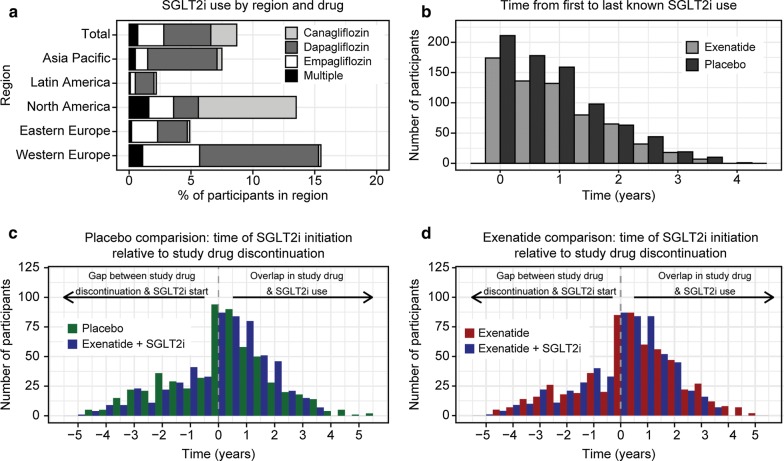
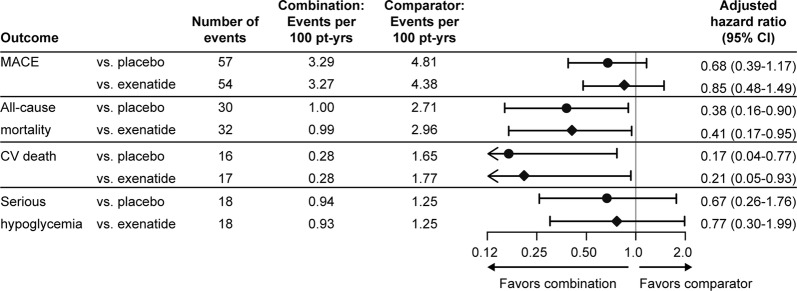
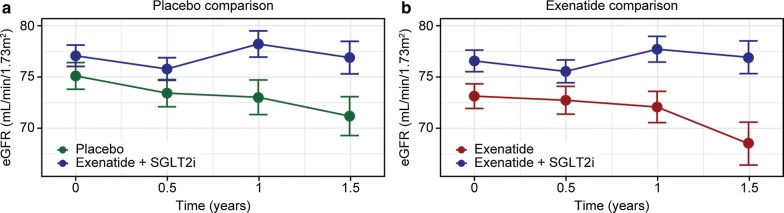
Background: Sodium-glucose cotransporter-2 inhibitors (SGLT2i) and glucagon-like peptide-1 receptor agonists (GLP-1 RA) improve cardiovascular and renal outcomes in patients with type 2 diabetes through distinct mechanisms. However, evidence on clinical outcomes in patients treated with both GLP-1 RA and SGLT2i is lacking. We aim to provide insight into the effects of open-label SGLT2i use in parallel with or shortly after once-weekly GLP-1 RA exenatide (EQW) on cardiorenal outcomes. Methods: In the EXSCEL cardiovascular outcomes trial EQW arm, SGLT2i drop-in occurred in 8.7% of participants. These EQW+SGLT2i users were propensity-matched to: (1) placebo-arm participants not taking SGLT2i (n = 572 per group); and to (2) EQW-arm participants not taking SGLT2i (n = 575), based on their last measured characteristics before SGLT2i initiation, and equivalent study visit in comparator groups. Time-to-first major adverse cardiovascular event (MACE) and all-cause mortality (ACM) were compared using Cox regression analyses. eGFR slopes were quantified using mixed model repeated measurement analyses. Results: In adjusted analyses, the risk for MACE with combination EQW+SGLT2i use was numerically lower compared with both placebo (adjusted hazard ratio 0.68, 95% CI 0.39–1.17) and EQW alone (0.85, 0.48–1.49). Risk of ACM was nominally significantly reduced compared with placebo (0.38, 0.16–0.90) and compared with EQW (0.41, 0.17–0.95). Combination EQW+SGLT2i use also nominally significantly improved estimated eGFR slope compared with placebo (+ 1.94, 95% CI 0.94–2.94 mL/min/1.73 m 2/year) and EQW alone (+ 2.38, 1.40–3.35 mL/min/1.73 m 2/year). Conclusions: This post hoc analysis supports the hypothesis that combinatorial EQW and SGLT2i therapy may provide benefit on cardiovascular outcomes and mortality. Trial registration Clinicaltrials.gov, Identifying number: NCT01144338, Date of registration: June 15, 2010.
Overview
The claims and statistics of this paper haven’t been checked yet.
Free: it reads the open-access text and checks the first 5 claims that cite a source we can check. Create a free account to check every claim.
Integrity signals
Registry
Cites
Statistics
Figures
Verification
Claims the paper makes
The claims and statistics of this paper haven’t been checked yet.
Free: it reads the open-access text and checks the first 5 claims that cite a source we can check. Create a free account to check every claim.
Claims other papers make about this one
Each is checked against this paper’s own text: does it say what the citing paper says it does?
The source backs part of the claim, not all of it — or backs it for a different population, condition or comparison.
In the citing paper
“Importantly, GLP1-RA can be used in combination with SGLT2i, and many patients with DKD may benefit from both therapies although this has not yet been explored in detail in clinical trials [27,28].”
From Glucagon-like peptide-1 receptor agonists in diabetic kidney disease: a review of their kidney and heart protection (2023) · cites this paper as [27]
Experimental — accuracy not yet measuredThe cited source says what the claim attributes to it.
In the citing paper
“A post hoc analysis of data from the Exenatide Study of Cardiovascular Event Lowering (EXSCEL) has suggested that the combination of exenatide once weekly (EQW) plus openlabel SGLT2i reduces all-cause mortality rates and attenuates the decline in eGFR compared with treatment with EQW alone (244).”
Self-check
Percentages, sums and reported differences re-computed from the paper’s own numbers.
The self-check needs the paper’s full text.
Citations
Cites
R: A Language and Environment for Statistical Computing
R Core Team (2025) · doi:10.32614/r.manuals · Cited by 352,181
Empagliflozin, Cardiovascular Outcomes, and Mortality in Type 2 Diabetes
Zinman, B., Wanner, C., Lachin, J. M., Fitchett, D., Bluhmki, E., Hantel, S., Mattheus, M., Devins, T., Johansen, O. E., Woerle, H. J., et al. (2015) · New England Journal of Medicine · doi:10.1056/nejmoa1504720 · Cited by 12,315
Canagliflozin and Cardiovascular and Renal Events in Type 2 Diabetes
Neal, B., Perkovic, V., Mahaffey, K. W., de Zeeuw, D., Fulcher, G., Erondu, N., Shaw, W., Law, G., Desai, M., & Matthews, D. R. (2017) · New England Journal of Medicine · doi:10.1056/nejmoa1611925 · Cited by 7,830
Semaglutide and Cardiovascular Outcomes in Patients with Type 2 Diabetes
Marso, S. P., Bain, S. C., Consoli, A., Eliaschewitz, F. G., Jódar, E., Leiter, L. A., Lingvay, I., Rosenstock, J., Seufert, J., Warren, M. L., et al. (2016) · New England Journal of Medicine · doi:10.1056/nejmoa1607141 · Cited by 6,900
Dapagliflozin and Cardiovascular Outcomes in Type 2 Diabetes
Wiviott, S. D., Raz, I., Bonaca, M. P., Mosenzon, O., Kato, E. T., Cahn, A., Silverman, M. G., Zelniker, T. A., Kuder, J. F., Murphy, S. A., et al. (2019) · New England Journal of Medicine · doi:10.1056/nejmoa1812389 · Cited by 6,382
Canagliflozin and Renal Outcomes in Type 2 Diabetes and Nephropathy
Perkovic, V., Jardine, M. J., Neal, B., Bompoint, S., Heerspink, H. J. L., Charytan, D. M., Edwards, R., Agarwal, R., Bakris, G., Bull, S., et al. (2019) · New England Journal of Medicine · doi:10.1056/nejmoa1811744 · Cited by 6,189
Self-citationLevey, A. S., Coresh, J., Greene, T., Stevens, L. A., Zhang, Y. (., Hendriksen, S., Kusek, J. W., & Van Lente, F. (2006) · Annals of Internal Medicine · doi:10.7326/0003-4819-145-4-200608150-00004 · Cited by 5,725
MatchIt : Nonparametric Preprocessing for Parametric Causal Inference
Ho, D. E., Imai, K., King, G., & Stuart, E. A. (2011) · Journal of Statistical Software · doi:10.18637/jss.v042.i08 · Cited by 4,385 · cited 3×
“MatchIt: nonparametric preprocessing for parametric casual inference.”
MethodInfluentialGerstein, H. C., Colhoun, H. M., Dagenais, G. R., Diaz, R., Lakshmanan, M., Pais, P., Probstfield, J., Riesmeyer, J. S., Riddle, M. C., Rydén, L., et al. (2019) · The Lancet · doi:10.1016/s0140-6736(19)31149-3 · Cited by 3,163 · cited 1×
“While the majority of evidence supports this MACE benefit in subjects with ASCVD, there is some evidence that this benefit may extend to high-risk subjects without a previous CV event [4, 21].”
BackgroundZelniker, T. A., Wiviott, S. D., Raz, I., Im, K., Goodrich, E. L., Bonaca, M. P., Mosenzon, O., Kato, E. T., Cahn, A., Furtado, R. H. M., et al. (2019) · The Lancet · doi:10.1016/s0140-6736(18)32590-x · Cited by 2,845
Effects of once-weekly exenatide on cardiovascular outcomes in type 2 diabetes
Holman, R. R., Bethel, M. A., Mentz, R. J., Thompson, V. P., Lokhnygina, Y., Buse, J. B., Chan, J. C., Choi, J., Gustavson, S. M., Iqbal, N., et al. (2017) · New England Journal of Medicine · doi:10.1056/nejmoa1612917 · Cited by 2,162
Self-citationHeerspink, H. J. L., Perkins, B. A., Fitchett, D. H., Husain, M., & Cherney, D. Z. I. (2016) · Circulation · doi:10.1161/circulationaha.116.021887 · Cited by 1,376
Self-citationLiraglutide and renal outcomes in type 2 diabetes
Mann, J. F. E., Ørsted, D. D., Brown-Frandsen, K., Marso, S. P., Poulter, N. R., Rasmussen, S., Tornøe, K., Zinman, B., & Buse, J. B. (2017) · New England Journal of Medicine · doi:10.1056/nejmoa1616011 · Cited by 1,253
Self-citationA critical appraisal of propensity‐score matching in the medical literature between 1996 and 2003
Austin, P. C. (2008) · Statistics in Medicine · doi:10.1002/sim.3150 · Cited by 1,249
Doubly robust estimation of causal effects
Funk, M. J., Westreich, D., Wiesen, C., Stürmer, T., Brookhart, M. A., & Davidian, M. (2011) · American Journal of Epidemiology · doi:10.1093/aje/kwq439 · Cited by 1,158
Austin, P. C., Grootendorst, P., & Anderson, G. M. (2007) · Statistics in Medicine · doi:10.1002/sim.2580 · Cited by 1,137
Zelniker, T. A., Wiviott, S. D., Raz, I., Im, K., Goodrich, E. L., Furtado, R. H. M., Bonaca, M. P., Mosenzon, O., Kato, E. T., Cahn, A., et al. (2019) · Circulation · doi:10.1161/circulationaha.118.038868 · Cited by 781
Gerstein, H. C., Colhoun, H. M., Dagenais, G. R., Diaz, R., Lakshmanan, M., Pais, P., Probstfield, J., Botros, F. T., Riddle, M. C., Rydén, L., et al. (2019) · The Lancet · doi:10.1016/s0140-6736(19)31150-x · Cited by 638 · cited 1×
“In general GLP-1 RA trials point to a strong effect on new persistent macroalbuminuria [22–24], but there is limited evidence of improvement on eGFR-based endpoints: sustained eGFR decline of 40–50% for dulaglutide [23], and a small reduction in eGFR decline with liraglutide and dulaglutude in participants with modera…”
BackgroundBethel, M. A., Patel, R. A., Merrill, P., Lokhnygina, Y., Buse, J. B., Mentz, R. J., Pagidipati, N. J., Chan, J. C., Gustavson, S. M., Iqbal, N., et al. (2018) · The Lancet Diabetes & Endocrinology · doi:10.1016/s2213-8587(17)30412-6 · Cited by 599
Self-citationHallow, K. M., Helmlinger, G., Greasley, P. J., McMurray, J. J. V., & Boulton, D. W. (2018) · Diabetes, Obesity and Metabolism · doi:10.1111/dom.13126 · Cited by 499
Self-citationFrías, J. P., Guja, C., Hardy, E., Ahmed, A., Dong, F., Öhman, P., & Jabbour, S. A. (2016) · The Lancet Diabetes & Endocrinology · doi:10.1016/s2213-8587(16)30267-4 · Cited by 398
Zinman, B., Bhosekar, V., Busch, R., Holst, I., Ludvik, B., Thielke, D., Thrasher, J., Woo, V., & Philis-Tsimikas, A. (2019) · The Lancet Diabetes & Endocrinology · doi:10.1016/s2213-8587(19)30066-x · Cited by 376
SGLT2 Inhibitors and the Diabetic Kidney
Fioretto, P., Zambon, A., Rossato, M., Busetto, L., & Vettor, R. (2016) · Diabetes Care · doi:10.2337/dcs15-3006 · Cited by 348
Dapagliflozin and Cardiovascular Outcomes in Type 2 Diabetes
(2019) · New England Journal of Medicine · doi:10.1056/nejmc1902837 · Cited by 290
Ludvik, B., Frías, J. P., Tinahones, F. J., Wainstein, J., Jiang, H., Robertson, K. E., García-Pérez, L.-E., Woodward, D. B., & Milicevic, Z. (2018) · The Lancet Diabetes & Endocrinology · doi:10.1016/s2213-8587(18)30023-8 · Cited by 266
Combination therapy with GLP ‐1 receptor agonist and SGLT2 inhibitor
DeFronzo, R. A. (2017) · Diabetes, Obesity and Metabolism · doi:10.1111/dom.12982 · Cited by 192
How to Select Covariates to Include in the Analysis of a Clinical Trial
Raab, G. M., Day, S., & Sales, J. (2000) · Controlled Clinical Trials · doi:10.1016/s0197-2456(00)00061-1 · Cited by 182
The gut–renal axis: do incretin-based agents confer renoprotection in diabetes?
Muskiet, M. H. A., Smits, M. M., Morsink, L. M., & Diamant, M. (2014) · Nature Reviews Nephrology · doi:10.1038/nrneph.2013.272 · Cited by 181
Giugliano, D., Maiorino, M. I., Bellastella, G., Longo, M., Chiodini, P., & Esposito, K. (2019) · Diabetes, Obesity and Metabolism · doi:10.1111/dom.13847 · Cited by 153
GLP-1 receptor agonists and reduction of cardiometabolic risk: Potential underlying mechanisms
Rizzo, M., Nikolic, D., Patti, A. M., Mannina, C., Montalto, G., McAdams, B. S., Rizvi, A. A., & Cosentino, F. (2018) · Biochimica et Biophysica Acta (BBA) - Molecular Basis of Disease · doi:10.1016/j.bbadis.2018.05.012 · Cited by 152
Lower Risk of Death With SGLT2 Inhibitors in Observational Studies: Real or Bias?
Suissa, S. (2018) · Diabetes Care · doi:10.2337/dc17-1223 · Cited by 129
Rationale and design of the EXenatide Study of Cardiovascular Event Lowering (EXSCEL) trial
Holman, R. R., Bethel, M. A., George, J., Sourij, H., Doran, Z., Keenan, J., Khurmi, N. S., Mentz, R. J., Oulhaj, A., Buse, J. B., et al. (2016) · American Heart Journal · doi:10.1016/j.ahj.2015.12.009 · Cited by 108
Self-citationInsulin and glucose-lowering agents for treating people with diabetes and chronic kidney disease
Lo, C., Toyama, T., Wang, Y., Lin, J., Hirakawa, Y., Jun, M., Cass, A., Hawley, C. M., Pilmore, H., Badve, S. V., et al. (2018) · Cochrane Database of Systematic Reviews · doi:10.1002/14651858.cd011798.pub2 · Cited by 100
Cardiovascular Protection by Sodium Glucose Cotransporter 2 Inhibitors: Potential Mechanisms
Staels, B. (2017) · The American Journal of Medicine · doi:10.1016/j.amjmed.2017.04.009 · Cited by 92
Fulcher, G., Matthews, D. R., Perkovic, V., de Zeeuw, D., Mahaffey, K. W., Mathieu, C., Woo, V., Wysham, C., Capuano, G., Desai, M., et al. (2016) · Diabetes, Obesity and Metabolism · doi:10.1111/dom.12589 · Cited by 91
SGLT2 inhibitors: a novel choice for the combination therapy in diabetic kidney disease
Zou, H., Zhou, B., & Xu, G. (2017) · Cardiovascular Diabetology · doi:10.1186/s12933-017-0547-1 · Cited by 91
The Ascending GLP-1 Road From Clinical Safety to Reduction of Cardiovascular Complications
Drucker, D. J. (2018) · Diabetes · doi:10.2337/dbi18-0008 · Cited by 78
Mentz, R. J., Bethel, M. A., Gustavson, S., Thompson, V. P., Pagidipati, N. J., Buse, J. B., Chan, J. C., Iqbal, N., Maggioni, A. P., Marso, S. P., et al. (2017) · American Heart Journal · doi:10.1016/j.ahj.2017.02.005 · Cited by 64
Self-citationGoncalves, E., & Bell, D. S. H. (2018) · Diabetes Therapy · doi:10.1007/s13300-018-0420-6 · Cited by 61 · cited 1×
“Given the largely distinct mechanisms, beyond glycemic control, through which GLP-1 RA and SGLT2i are hypothesized to exert their cardiorenal effects, there is considerable interest in how the combination of these two classes would effect long-term outcomes [5, 6].”
BackgroundJabbour, S. A., Frías, J. P., Guja, C., Hardy, E., Ahmed, A., & Öhman, P. (2018) · Diabetes, Obesity and Metabolism · doi:10.1111/dom.13206 · Cited by 55
SGLT-2 Inhibitor Therapy Added to GLP-1 Agonist Therapy in the Management of T2DM
Saroka, R. M., Kane, M. P., Busch, R. S., Watsky, J., & Hamilton, R. A. (2015) · Endocrine Practice · doi:10.4158/ep15877.or · Cited by 45
Hussein, H., Zaccardi, F., Khunti, K., Seidu, S., Davies, M. J., & Gray, L. J. (2019) · Diabetic Medicine · doi:10.1111/dme.13898 · Cited by 43
Clegg, L. E., Heerspink, H. J. L., Penland, R. C., Tang, W., Boulton, D. W., Bachina, S., Fox, R. D., Fenici, P., Thuresson, M., Mentz, R. J., et al. (2018) · Diabetes Care · doi:10.2337/dc18-1871 · Cited by 33
Self-citationChen, W. J. Y., Diamant, M., de Boer, K., Harms, H. J., Robbers, L. F. H. J., van Rossum, A. C., Kramer, M. H. H., Lammertsma, A. A., & Knaapen, P. (2017) · Cardiovascular Diabetology · doi:10.1186/s12933-017-0549-z · Cited by 27
Gonçalves, E., & Bell, D. S. H. (2017) · Diabetes Obesity and Metabolism · doi:10.1111/dom.12897 · Cited by 17
Jabbour, S. A., Guja, C., Hardy, E., Bhattacharya, S., Öhman, P. K., & Frías, J. P. (2018) · Diabetes · doi:10.2337/db18-104-lb · Cited by 9
Research works printed but not linked: 2
- Stuart DEHaKIaGKaEA MatchIt: nonparametric preprocessing for parametric casual inference J Stat Softw 2011 42 8 1 28
- Goncalves E Bell DSH Combination treatment of SGLT2 inhibitors and GLP-1 receptor agonists: symbiotic effects on metabolism and cardiorenal risk Diabetes Ther 2018 9 3 919 926 10.1007/s13300-018-0420-6 29623594 PMC5984923 · DOI · Paper page
Cited by
Davies, M. J., Aroda, V. R., Collins, B. S., Gabbay, R. A., Green, J., Maruthur, N. M., Rosas, S. E., Del Prato, S., Mathieu, C., Mingrone, G., et al. (2022) · Diabetes Care · doi:10.2337/dci22-0034 · Cited by 2,104
“A post hoc analysis of data from the Exenatide Study of Cardiovascular Event Lowering (EXSCEL) has suggested that the combination of exenatide once weekly (EQW) plus openlabel SGLT2i reduces all-cause mortality rates and attenuates the decline in eGFR compared with treatment with EQW alone (244).”
MethodSelf-citationDavies, M. J., Aroda, V. R., Collins, B. S., Gabbay, R. A., Green, J., Maruthur, N. M., Rosas, S. E., Del Prato, S., Mathieu, C., Mingrone, G., et al. (2022) · Diabetologia · doi:10.1007/s00125-022-05787-2 · Cited by 1,048
“A post hoc analysis of data from the EXenatide Study of Cardiovascular Event Lowering (EXSCEL) has suggested that the combination of exenatide once-weekly (EQW) plus open-label SGLT2i reduces allcause mortality rates and attenuates the decline in eGFR compared with treatment with EQW alone [244].”
Self-citationCardiovascular and renal outcomes with efpeglenatide in type 2 diabetes
Gerstein, H. C., Sattar, N., Rosenstock, J., Ramasundarahettige, C., Pratley, R., Lopes, R. D., Lam, C. S. P., Khurmi, N. S., Heenan, L., Del Prato, S., et al. (2021) · New England Journal of Medicine · doi:10.1056/nejmoa2108269 · Cited by 829
Therapeutic pipeline in nonalcoholic steatohepatitis
Vuppalanchi, R., Noureddin, M., Alkhouri, N., & Sanyal, A. J. (2021) · Nature Reviews Gastroenterology & Hepatology · doi:10.1038/s41575-020-00408-y · Cited by 278
Oxidative Stress: A Culprit in the Progression of Diabetic Kidney Disease
Wang, N., & Zhang, C. (2024) · Antioxidants · doi:10.3390/antiox13040455 · Cited by 218
Metadata
- Authors
- Clegg, L. E., Penland, R. C., Bachina, S., Boulton, D. W., Thuresson, M., Heerspink, H. J. L., Gustavson, S., Sjöström, C. D., Ruggles, J. A., Hernandez, A. F., Buse, J. B., Mentz, R. J., & Holman, R. R.
- Affiliations
- AstraZeneca (United States) (US)
- Statisticon (Sweden) (SE)
- University Medical Center Groningen (NL)
- AstraZeneca (Sweden) (SE)
- Duke University (US)
- University of North Carolina at Chapel Hill (US)
- University of Oxford (GB)
- Corresponding author
- Clegg, Lindsay E.
- ORCID
- Venue
- Cardiovascular Diabetology
- Published
- 2019-10-22
- Volume
- 18
- Issue
- 1
- Pages
- 138-138
- ISSN
- 1475-2840 (ISSN-L)
- PMC
- PMC6805385
- OpenAlex
- W2981486868
- Cited by
- 94
- References
- 46
- Citations by year
- 2026: 7 · 2025: 12 · 2024: 15 · 2023: 12 · 2022: 11 · 2021: 14 · 2020: 23
- FWCI
- 9.73
- Type
- journal article
- Language
- en
- Open access
- gold
- doi.org
- Licence
- cc-by
- creativecommons.org/licenses/by/4.0 (tdm)
- creativecommons.org/licenses/by/4.0 (vor)
- Locations
- Cardiovascular Diabetology (publishedVersion, cc-by)
- Europe PMC (PubMed Central) (publishedVersion, cc-by)
- PubMed Central (publishedVersion, cc-by)
- PubMed (publishedVersion)
- DOAJ (DOAJ: Directory of Open Access Journals) (submittedVersion, cc-by-sa)
- University of Groningen research database (University of Groningen / Centre for Information Technology) (submittedVersion, cc-by)
- Funders
- AstraZeneca
- Topics
- Health Sciences › Medicine › Endocrinology, Diabetes and Metabolism › Diabetes Treatment and Management
- Health Sciences › Medicine › Cardiology and Cardiovascular Medicine › Heart Failure Treatment and Management
- Health Sciences › Medicine › Nephrology › Chronic Kidney Disease and Diabetes
- Keywords
- exenatide, SGLT2 inhibitors, type 2 diabetes, combination therapy, major adverse cardiovascular events, all-cause mortality, estimated glomerular filtration rate, renal outcomes, cardiovascular outcomes, EXSCEL trial, GLP-1 receptor agonists, propensity score matching, post hoc analysis, drug safety and efficacy
- MeSH terms
- Sodium-Glucose Transporter 2 Inhibitors, Exenatide, Aged, Cardiovascular Diseases, Cause of Death, Diabetes Mellitus, Type 2, Drug Administration Schedule, Drug Therapy, Combination, Female, Glomerular Filtration Rate, Humans, Kidney, Male, Middle Aged, Risk Factors, Time Factors, Multicenter Studies as Topic, Randomized Controlled Trials as Topic, Treatment Outcome, Risk Assessment, Incretins
About these checks
Registry, retraction, Cites and statistics results are computed, not judged, with one exception: a printed reference that no index lists is read once by a model before it counts as a citation error. Claims are extracted by a model and kept only when their quote appears verbatim in the text; each cited source is then checked, with a model’s help, for whether it says what the claim relies on. Those verdicts can be wrong — read the claim’s quote and the cited source before relying on one.
Statistics and arithmetic are recomputed, not judged.
Confidence bands are shown only for fields calibrated on our annotated test set. None is calibrated yet, so no band is shown.
What counts as a claim ›How we measure confidence ›How we check this ›
Are you an author, or do you see a problem with this page? Request a review
Data sources
Bibliographic data: Semantic Scholar, OpenAlex, Crossref.
Contains information from the Semantic Scholar Academic Graph Datasets, made available under the ODC Attribution License (ODC-BY 1.0).
Semantic Scholar’s data is described in: Kinney, R., et al. (2023). The Semantic Scholar Open Data Platform. arXiv:2301.10140.
