

Nutritional biomarkers and heart failure requiring hospitalization in patients with type 2 diabetes: the SURDIAGENE cohort
Open accessThe DOI matches its Crossref record; 32 of the 32 references it cites were found in a registry or an index.
Abstract
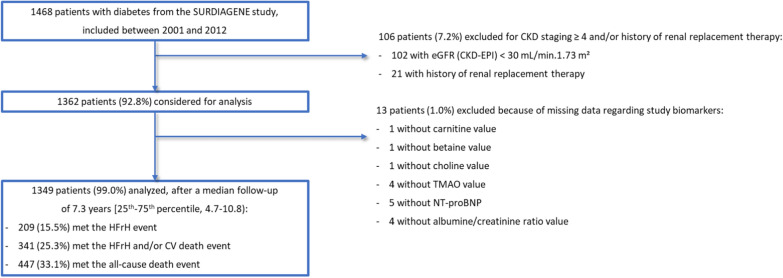
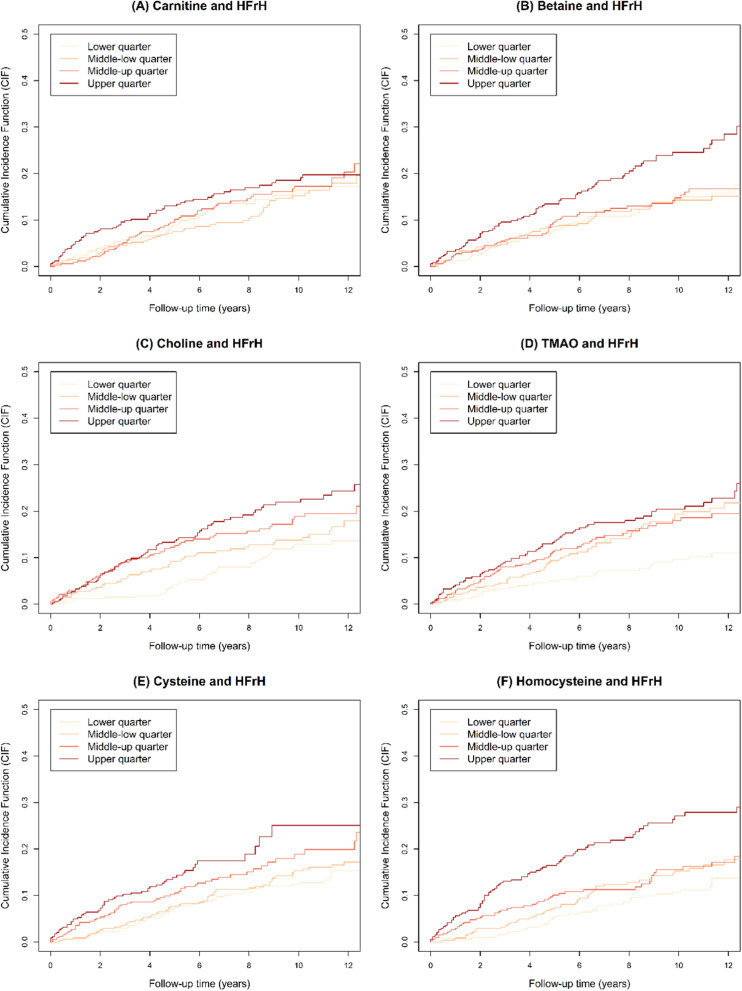
Background: Heart failure (HF) is a growing complication and one of the leading causes of mortality in people living with type 2 diabetes (T2D). Among the possible causes, the excess of red meat and the insufficiency of vegetables consumption are suspected. Such an alimentation is associated with nutritional biomarkers, including trimethylamine N -oxide (TMAO) and its precursors. Here, we aimed to study these biomarkers as potential prognostic factors for HF in patients with T2D. Methods: We used the SURDIAGENE (SURvival DIAbetes and GENEtics) study, a large, prospective, monocentric cohort study including 1468 patients with T2D between 2001 and 2012. TMAO and its precursors (trimethylamine [TMA], betaine, choline, and carnitine) as well as thio-amino-acids (cysteine, homocysteine and methionine) were measured by liquid chromatography-tandem mass spectrometry. The main outcome was HF requiring Hospitalization (HFrH) defined as the first occurrence of acute HF leading to hospitalization and/or death, established by an adjudication committee, based on hospital records until 31st December 2015. The secondary outcomes were the composite event HFrH and/or cardiovascular death and all-cause death. The association between the biomarkers and the outcomes was studied using cause-specific hazard-models, adjusted for age, sex, history of coronary artery disease, NT-proBNP, CKD-EPI-derived eGFR and the urine albumin/creatinine ratio. Hazard-ratios (HR) are expressed for one standard deviation. Results: The data of interest were available for 1349/1468 of SURDIAGENE participants (91.9%), including 569 (42.2%) women, with a mean age of 64.3 ± 10.7 years and a median follow-up of 7.3 years [25th–75th percentile, 4.7–10.8]. HFrH was reported in 209 patients (15.5%), HFrH and/or cardiovascular death in 341 (25.3%) and all-cause death in 447 (33.1%). In unadjusted hazard-models, carnitine (HR = 1.20, 95% CI [1.05; 1.37]), betaine (HR = 1.34, [1.20; 1.50]), choline (HR = 1.35, [1.20; 1.52]), TMAO (HR = 1.32, [1.16; 1.50]), cysteine (HR = 1.38, [1.21; 1.58]) and homocysteine (HR = 1.28, [1.17; 1.39]) were associated with HFrH, but not TMA and methionine. In the fully adjusted models, none of these associations was significant, neither for HFrH nor for HFrH and/or CV death, when homocysteine only was positively associated with all-cause death (HR = 1.16, [1.06; 1.27]). Conclusions: TMAO and its precursors do not appear to be substantial prognosis factors for HFrH, beyond usual cardiac- and kidney-related risk factors, whereas homocysteine is an independent risk factor for all-cause death in patients with T2D.
Overview
The claims and statistics of this paper haven’t been checked yet.
Free: it reads the open-access text and checks the first 5 claims that cite a source we can check. Create a free account to check every claim.
Integrity signals
Registry
Cites
Statistics
Figures
Verification
Claims the paper makes
The claims and statistics of this paper haven’t been checked yet.
Free: it reads the open-access text and checks the first 5 claims that cite a source we can check. Create a free account to check every claim.
Claims other papers make about this one
Each is checked against this paper’s own text: does it say what the citing paper says it does?
The source backs part of the claim, not all of it — or backs it for a different population, condition or comparison.
In the citing paper
“For external validation, we used adjudication data from the SUR DIAGENE cohort, comprising a total of 88 hospital reports, with 28 as positive controls and 60 as negative controls [19,20].”
From Assessing large language models for acute heart failure classification and information extraction from French clinical notes (2025) · cites this paper as [20]
Experimental — accuracy not yet measured
Self-check
Percentages, sums and reported differences re-computed from the paper’s own numbers.
The self-check needs the paper’s full text.
Citations
Cites
Toprak, O., Kurt, H., Sarı, Y., Şarkış, C., Us, H., & Kırık, A. (2017) · Kidney and Blood Pressure Research · doi:10.1159/000468530 · Cited by 29,627
A New Equation to Estimate Glomerular Filtration Rate
Levey, A. S., Stevens, L. A., Schmid, C. H., Zhang, Y. (., Castro, A. F., Feldman, H. I., Kusek, J. W., Eggers, P., Van Lente, F., Greene, T., et al. (2009) · Annals of Internal Medicine · doi:10.7326/0003-4819-150-9-200905050-00006 · Cited by 25,603 · cited 2×
“uACR (mg/mmol) 3 [1; 10] 2 [1; 9] 7 [2; 31] < 0.”
MethodMcDonagh, T. A., Metra, M., Adamo, M., Gardner, R. S., Baumbach, A., Böhm, M., Burri, H., Butler, J., Čelutkienė, J., Chioncel, O., et al. (2021) · European Heart Journal · doi:10.1093/eurheartj/ehab670 · Cited by 19,442
A Proportional Hazards Model for the Subdistribution of a Competing Risk
Fine, J. P., & Gray, R. J. (1999) · Journal of the American Statistical Association · doi:10.1080/01621459.1999.10474144 · Cited by 14,290 · cited 2×
“Diabetes duration (y) 12 [6; 20] 11 [5; 19] 18 [12; 27] < 0.”
Method2021 ESC guidelines for the diagnosis and treatment of acute and chronic heart failure
McDonagh, T. A., Metra, M., Adamo, M., Gardner, R. S., Baumbach, A., Böhm, M., Burri, H., Butler, J., Čelutkienė, J., Chioncel, O., et al. (2021) · European Heart Journal · doi:10.1093/eurheartj/ehab368 · Cited by 13,344
Food in the Anthropocene: the EAT–Lancet Commission on healthy diets from sustainable food systems
Willett, W., Rockström, J., Loken, B., Springmann, M., Lang, T., Vermeulen, S., Garnett, T., Tilman, D., DeClerck, F., Wood, A., et al. (2019) · The Lancet · doi:10.1016/s0140-6736(18)31788-4 · Cited by 10,880 · cited 1×
“A 2019 initiative, the EAT-Lancet commission on healthy diet, recommended to consider 14 key items for universal healthy diet [8].”
Background2016 ESC Guidelines for the Diagnosis and Treatment of Acute and Chronic Heart Failure
Ponikowski, P., Voors, A. A., Anker, S. D., Bueno, H., Cleland, J. G. F., Coats, A. J. S., Falk, V., González-Juanatey, J. R., Harjola, V.-P., Jankowska, E. A., et al. (2016) · European Journal of Heart Failure · doi:10.1002/ejhf.592 · Cited by 5,866
Sacks, F. M., Svetkey, L. P., Vollmer, W. M., Appel, L. J., Bray, G. A., Harsha, D., Obarzanek, E., Conlin, P. R., Miller, E. R., Simons-Morton, D. G., et al. (2001) · New England Journal of Medicine · doi:10.1056/nejm200101043440101 · Cited by 5,638
Estruch, R., Ros, E., Salas-Salvadó, J., Covas, M.-I., Corella, D., Arós, F., Gómez-Gracia, E., Ruiz-Gutiérrez, V., Fiol, M., Lapetra, J., et al. (2018) · New England Journal of Medicine · doi:10.1056/nejmoa1800389 · Cited by 3,616
Introduction to the Analysis of Survival Data in the Presence of Competing Risks
Austin, P. C., Lee, D. S., & Fine, J. P. (2016) · Circulation · doi:10.1161/circulationaha.115.017719 · Cited by 2,653
Homocysteine Lowering with Folic Acid and B Vitamins in Vascular Disease
(2006) · New England Journal of Medicine · doi:10.1056/nejmoa060900 · Cited by 1,729
Risk factors, mortality, and cardiovascular outcomes in patients with type 2 diabetes
Rawshani, A., Rawshani, A., Franzén, S., Sattar, N., Eliasson, B., Svensson, A.-M., Zethelius, B., Miftaraj, M., McGuire, D. K., Rosengren, A., et al. (2018) · New England Journal of Medicine · doi:10.1056/nejmoa1800256 · Cited by 1,475 · cited 1×
“In addition to microvascular complications, cardiovascular disease is one of the leading causes of morbidity and mortality in patients with diabetes [2, 3].”
BackgroundMortality and cardiovascular disease in type 1 and type 2 diabetes
Rawshani, A., Rawshani, A., Franzén, S., Eliasson, B., Svensson, A.-M., Miftaraj, M., McGuire, D. K., Sattar, N., Rosengren, A., & Gudbjörnsdottir, S. (2017) · New England Journal of Medicine · doi:10.1056/nejmoa1608664 · Cited by 1,389 · cited 2×
“uACR (mg/mmol) 3 [1; 10] 2 [1; 9] 7 [2; 31] < 0.”
BackgroundLow Wang, C. C., Hess, C. N., Hiatt, W. R., & Goldfine, A. B. (2016) · Circulation · doi:10.1161/circulationaha.116.022194 · Cited by 1,155
Tang, W. H. W., Wang, Z., Fan, Y., Levison, B., Hazen, J. E., Donahue, L. M., Wu, Y., & Hazen, S. L. (2014) · Journal of the American College of Cardiology · doi:10.1016/j.jacc.2014.02.617 · Cited by 681 · cited 1×
“Of interest, the plasma concentration of TMAO was reported to be higher in those patients with HF compared to the others [27, 28].”
ResultHomocysteine lowering interventions for preventing cardiovascular events
Martí-Carvajal, A. J., Solà, I., Lathyris, D., & Salanti, G. (2009) · Cochrane Database of Systematic Reviews · doi:10.1002/14651858.cd006612.pub2 · Cited by 520
Trøseid, M., Ueland, T., Hov, J. R., Svardal, A., Gregersen, I., Dahl, C. P., Aakhus, S., Gude, E., Bjørndal, B., Halvorsen, B., et al. (2015) · Journal of Internal Medicine · doi:10.1111/joim.12328 · Cited by 464 · cited 2×
“Of interest, the plasma concentration of TMAO was reported to be higher in those patients with HF compared to the others [27, 28].”
ResultSalehi-Abargouei, A., Maghsoudi, Z., Shirani, F., & Azadbakht, L. (2013) · Nutrition · doi:10.1016/j.nut.2012.12.018 · Cited by 429 · cited 1×
“71 suggesting a significant benefit of this dietary approach, in an analysis in which subjects with T2D were excluded [22].”
ResultSauerbrei, W., Meier-Hirmer, C., Benner, A., & Royston, P. (2006) · Computational Statistics & Data Analysis · doi:10.1016/j.csda.2005.07.015 · Cited by 351 · cited 3×
“Cysteine (μmol/L) 23 [13; 39] 23 [13; 39] 23 [14; 40] 0.”
MethodInfluentialMartínez-González, M. A., Sánchez-Tainta, A., Corella, D., Salas-Salvadó, J., Ros, E., Arós, F., Gómez-Gracia, E., Fiol, M., Lamuela-Raventós, R. M., Schröder, H., et al. (2014) · The American Journal of Clinical Nutrition · doi:10.3945/ajcn.113.071431 · Cited by 309 · cited 2×
“uACR (mg/mmol) 3 [1; 10] 2 [1; 9] 7 [2; 31] < 0.”
BackgroundOhkuma, T., Komorita, Y., Peters, S. A. E., & Woodward, M. (2019) · Diabetologia · doi:10.1007/s00125-019-4926-x · Cited by 279 · cited 1×
“Recently, a large meta-analysis considering over 12 million individuals evidenced a two-fold greater risk of HF in individuals with type 2 diabetes (T2D) compared to those without, both in men and women [4].”
BackgroundGlycemic Index, Glycemic Load, and Cardiovascular Disease and Mortality
Jenkins, D. J. A., Dehghan, M., Mente, A., Bangdiwala, S. I., Rangarajan, S., Srichaikul, K., Mohan, V., Avezum, A., Díaz, R., Rosengren, A., et al. (2021) · New England Journal of Medicine · doi:10.1056/nejmoa2007123 · Cited by 233 · cited 2×
“However, when scrutinizing the effect of different outcomes, it turned out that glycemic index and load were associated with atherosclerosisrelated cardiovascular events but not with HF [5].”
BackgroundSandesara, P. B., O’Neal, W. T., Kelli, H. M., Samman-Tahhan, A., Hammadah, M., Quyyumi, A. A., & Sperling, L. S. (2018) · Diabetes Care · doi:10.2337/dc17-0755 · Cited by 130 · cited 2×
“Particularly, we found a greater risk of HFrH in those participants with diabetic retinopathy, in accordance with previous reports on microvascular disease and HFrH [18, 19].”
ResultHomocysteine-lowering interventions for preventing cardiovascular events
Martí-Carvajal, A. J., Solà, I., & Lathyris, D. (2015) · Cochrane Database of Systematic Reviews · doi:10.1002/14651858.cd006612.pub4 · Cited by 113
Li, W., Huang, A., Zhu, H., Liu, X., Huang, X., Huang, Y., Cai, X., Lu, J., & Huang, Y. (2020) · The Medical Journal of Australia · doi:10.5694/mja2.50781 · Cited by 105 · cited 2×
“Introducing data on gut microbiota, which is clearly a key explanation when studying this metabolite, is well-above the scope of this paper but should be addressed in future studies [26].”
BackgroundTromp, J., Lim, S. L., Tay, W. T., Teng, T. K., Chandramouli, C., Ouwerkerk, W., Wander, G., Sawhney, J. P. S., Yap, J. J. L., MacDonald, M. R., et al. (2019) · Diabetes Care · doi:10.2337/dc18-2515 · Cited by 88 · cited 1×
“Particularly, we found a greater risk of HFrH in those participants with diabetic retinopathy, in accordance with previous reports on microvascular disease and HFrH [18, 19].”
ResultPrognostic Value of the Insertion/Deletion Polymorphism of the ACE Gene in Type 2 Diabetic Subjects
Hadjadj, S., Fumeron, F., Roussel, R., Saulnier, P.-J., Gallois, Y., Ankotche, A., Travert, F., Khalil, C. A., Miot, A., Alhenc-Gelas, F., et al. (2008) · Diabetes Care · doi:10.2337/dc07-2079 · Cited by 77
Self-citationPlasma Trimethylamine N-Oxide and Risk of Cardiovascular Events in Patients With Type 2 Diabetes
Croyal, M., Saulnier, P.-J., Aguesse, A., Gand, E., Ragot, S., Roussel, R., Halimi, J.-M., Ducrocq, G., Cariou, B., Montaigne, D., et al. (2020) · The Journal of Clinical Endocrinology & Metabolism · doi:10.1210/clinem/dgaa188 · Cited by 70 · cited 2×
“We previously evidenced the association between markers of red meat consumption (trimethylamine N-oxide [TMAO] and related metabolites) and the occurrence of major adverse cardiovascular events (MACE), but also mortality in patients with T2D [7].”
BackgroundSelf-citationInfluence of Microvascular Disease on Cardiovascular Events in Type 2 Diabetes
Verma, S., Wanner, C., Zwiener, I., Ofstad, A. P., George, J. T., FITCHETT, D. H., & Zinman, B. (2019) · Journal of the American College of Cardiology · doi:10.1016/j.jacc.2019.03.002 · Cited by 48 · cited 1×
“This point was previously suggested in the EMPAREG Outcome study where the greater risk of HF was significantly associated with a greater number of microvascular complications [17].”
ResultElevated homocysteine levels in patients with heart failure: A systematic review and meta-analysis
Jin, N., Huang, L., Hong, J. Y., Zhao, X., Chen, Y., Hu, J., Cong, X., Xie, Y., & Pu, J. (2021) · Medicine · doi:10.1097/md.0000000000026875 · Cited by 41
The Future of Meat: Health Impact Assessment with Randomized Evidence
Ferreira, J. P., Sharma, A., & Zannad, F. M. (2020) · The American Journal of Medicine · doi:10.1016/j.amjmed.2020.11.007 · Cited by 29 · cited 2×
“[20] However, no specific mention of HF was available to our knowledge.”
BackgroundTotal Plasma Homocysteine and Arteriosclerotic Outcomes in Type 2 Diabetes with Nephropathy
Friedman, A. N., Hunsicker, L. G., Selhub, J., & Bostom, A. G. (2005) · Journal of the American Society of Nephrology · doi:10.1681/asn.2004100846 · Cited by 26 · cited 1×
“Very similar results were found in patients from the IDNT trial, with T2D and overt nephropathy [29].”
Result
Research works printed but not linked: 1
- IDF Atlas 9th edition and other resources [Internet]. https://diabetesatlas.org/en/resources/. Accessed 30 Apr 2021.
Cited by
Gut Microbiota-Derived TMAO: A Causal Factor Promoting Atherosclerotic Cardiovascular Disease?
Canyelles, M., Borràs, C., Rotllan, N., Tondo, M., Escolà-Gil, J. C., & Blanco-Vaca, F. (2023) · International Journal of Molecular Sciences · doi:10.3390/ijms24031940 · Cited by 194
Mapping the metabolic reprogramming induced by sodium-glucose cotransporter 2 inhibition
Kogot‐Levin, A., Riahi, Y., Abramovich, I., Mosenzon, O., Agranovich, B., Kadosh, L., Schyr, R. B., Kleiman, D., Hinden, L., Cerasi, E., et al. (2023) · JCI Insight · doi:10.1172/jci.insight.164296 · Cited by 58
“Furthermore, it has been recently reported that, in the SURDIAGENE (SURvival DIAbetes and GENEtics) study with a large, prospective cohort of patients with type 2 diabetes, betaine and homocysteine were associated with hospitalization for heart failure and/or mortality and that homocysteine was an independent predicto…”
Trimethylamine N-oxide: a meta-organismal axis linking the gut and fibrosis
Jang, J. W., Capaldi, E., Smith, T. L., Verma, P., Varga, J., & Ho, K. J. (2024) · Molecular Medicine · doi:10.1186/s10020-024-00895-8 · Cited by 54
“( Wargny et al. 2022) Thus, while most studies demonstrate the clinical utility of using TMAO to establish cardiovascular disease prognosis and outcome, these latter studies suggest the need for further research to elucidate the precise role of TMAO on the mortality of patients with cardiovascular…”
BackgroundTMAO and diabetes: from the gut feeling to the heart of the problem
Jaworska, K., Kuś, M., & Ufnal, M. (2025) · Nutrition and Diabetes · doi:10.1038/s41387-025-00377-8 · Cited by 49
“However, after adjusting for eGFR, the association became insigni fi cant [95].”
Martin, D., Bonneau, M., Lefeuvre‐Orfila, L., Horeau, M., Hazon, M., Demay, R., Lecommandeur, E., Boumpoutou, R., Guillotel, A., Guillemot, P., et al. (2025) · Cell Reports · doi:10.1016/j.celrep.2025.115448 · Cited by 27
Self-citation
Metadata
- Authors
- Wargny, M., Croyal, M., Ragot, S., Gand, E., Jacobi, D., Trochu, J.-N., Prieur, X., Le May, C., Goronflot, T., Cariou, B., Saulnier, P.-J., Hadjadj, S., for the SURDIAGENE study group, Marechaud, R., Javaugue, V., Hulin-Delmotte, C., Llatty, P., Ducrocq, G., Roussel, R., Rigalleau, V., Pucheu, Y., Montaigne, D., Halimi, J.-M., Gatault, P., Sosner, P., & Gellen, B.
- Affiliations
- Centre National de la Recherche Scientifique (FR)
- Inserm (FR)
- Centre Hospitalier Universitaire de Poitiers (FR)
- Centre Hospitalier Universitaire de Nantes (FR)
- Corresponding author
- Hadjadj, Samy
- ORCID
- Wargny, Matthieu
- Croyal, Mikaël
- Ragot, Stéphanie
- Gand, Elise
- Jacobi, David
- Trochu, Jean-Noël
- Prieur, Xavier
- Goronflot, Thomas
- Cariou, Bertrand
- Saulnier, Pierre-Jean
- Hadjadj, Samy
- Javaugue, Vincent
- Roussel, Ronan
- Rigalleau, Vincent
- Montaigne, David
- Halimi, Jean-Michel
- Gatault, Philippe
- Sosner, Philippe
- Gellen, Barnabas
- Venue
- Cardiovascular Diabetology
- Published
- 2022-06-09
- Volume
- 21
- Issue
- 1
- Pages
- 101-101
- ISSN
- 1475-2840 (ISSN-L)
- PMC
- PMC9185908
- OpenAlex
- W4281654645
- Cited by
- 21
- References
- 32
- Citations by year
- 2026: 6 · 2025: 5 · 2024: 3 · 2023: 5 · 2022: 2
- FWCI
- 2.61
- Type
- journal article
- Language
- en
- Open access
- gold
- doi.org
- Licence
- cc-by
- creativecommons.org/licenses/by/4.0 (tdm)
- creativecommons.org/licenses/by/4.0 (vor)
- Locations
- Cardiovascular Diabetology (publishedVersion, cc-by)
- PubMed Central (publishedVersion, cc-by)
- PubMed (publishedVersion)
- HAL (submittedVersion, cc-by)
- DOAJ (DOAJ: Directory of Open Access Journals) (submittedVersion)
- Funders
- Fondation de France
- Société Francophone du Diabète
- Topics
- Health Sciences › Medicine › Cardiology and Cardiovascular Medicine › Heart Failure Treatment and Management
- Health Sciences › Medicine › Public Health, Environmental and Occupational Health › Nutritional Studies and Diet
- Health Sciences › Medicine › Cardiology and Cardiovascular Medicine › Cardiovascular Function and Risk Factors
- Keywords
- heart failure hospitalization, type 2 diabetes, trimethylamine N-oxide, trimethylamine, L-carnitine, thiamine, thiamine pyrophosphate, dietary biomarkers, prognostic factors, cardiovascular mortality, all-cause mortality, vegetable consumption, thiamine deficiency
- MeSH terms
- Aged, Betaine, Carnitine, Choline, Cysteine, Diabetes Mellitus, Type 2, Female, Heart Failure, Homocysteine, Hospitalization, Humans, Male, Methionine, Middle Aged, Prospective Studies, Risk Factors, Cohort Studies, Biomarkers
About these checks
Registry, retraction, Cites and statistics results are computed, not judged, with one exception: a printed reference that no index lists is read once by a model before it counts as a citation error. Claims are extracted by a model and kept only when their quote appears verbatim in the text; each cited source is then checked, with a model’s help, for whether it says what the claim relies on. Those verdicts can be wrong — read the claim’s quote and the cited source before relying on one.
Statistics and arithmetic are recomputed, not judged.
Confidence bands are shown only for fields calibrated on our annotated test set. None is calibrated yet, so no band is shown.
What counts as a claim ›How we measure confidence ›How we check this ›
Are you an author, or do you see a problem with this page? Request a review
Data sources
Bibliographic data: Semantic Scholar, OpenAlex, Crossref.
Contains information from the Semantic Scholar Academic Graph Datasets, made available under the ODC Attribution License (ODC-BY 1.0).
Semantic Scholar’s data is described in: Kinney, R., et al. (2023). The Semantic Scholar Open Data Platform. arXiv:2301.10140.
