

The DOI matches its Crossref record; 4 of the 4 references it cites were found in a registry or an index.
Association of dietary fiber intake with newly-diagnosed type 2 diabetes mellitus in middle-aged Chinese population
Open accessAbstract
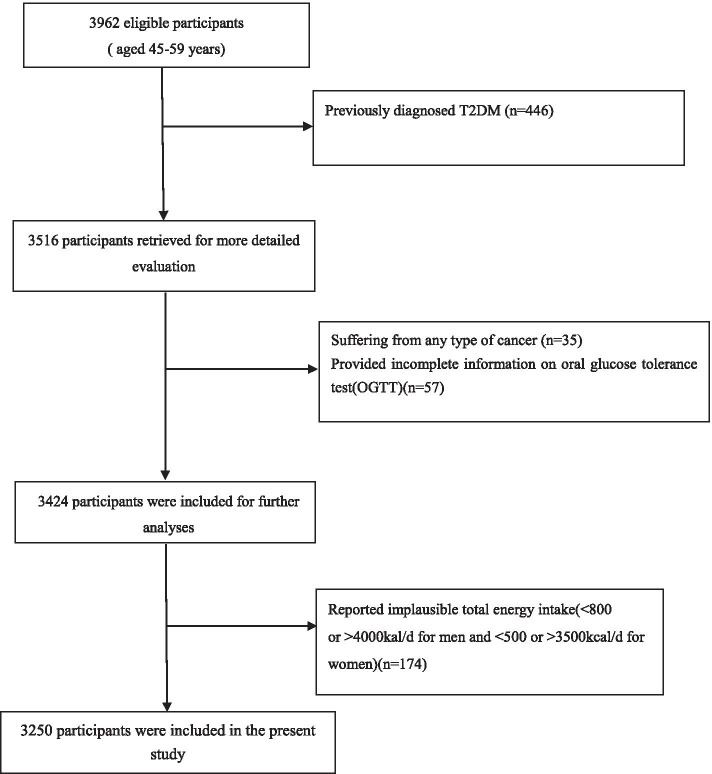
Background: Epidemiological evidence concerning dietary fiber on newly-diagnosed type 2 diabetes mellitus (T2DM) is sparse. Therefore, the purpose of this study was to investigate the relationship between dietary fiber intake and newly-diagnosed T2DM in a middle-aged Chinese population. Methods: Using data from the Hangzhou Nutrition and Health Survey collected between June 2015 and December 2016, we investigated the associations between dietary patterns and the risk of chronic non- communicable diseases. Anthropometric measurements and samples collection for biochemical assays are conducted by the well-trained staff and nurse, respectively. Multivariable logistic regression analysis was used to analyze the effect of dietary fiber intake on the risk of newly-diagnosed T2DM in crude and adjusted models. Results: Among 3250 participants, 182 (5.6%) people were identified as newly-diagnosed T2DM. Pearson correlation coefficients revealed a significant inverse association of total dietary fiber with BMI, SBP, DBP, HbA1c and LDL-C in all participants, participants with and without T2DM ( P < 0.05). Compared with the study participants in the first quartile (Q1, the lowest consumption)of dietary fiber intake, participants in the fourth quartile (Q4) had a lower prevalence of newly-diagnosed T2DM(OR = 0.70; 95%CI:0.49-1.00; P < 0.05), after adjustment for potential confounders. Conclusions: In this middle-aged Chinese population, higher intake of dietary fiber was significantly associated with lower risk of newly-diagnosed T2DM. However, our findings need to be confirmed in future large-scale prospective studies.
Overview
The claims and statistics of this paper haven’t been checked yet.
Run the check — free, no account needed. It reads the open-access text and checks the sources it cites.
Integrity signals
Registry
Cites
Statistics
Figures
Verification
Claims the paper makes
The claims and statistics of this paper haven’t been checked yet.
Run the check — free, no account needed. It reads the open-access text and checks the sources it cites.
Claims other papers make about this one
Each is checked against this paper’s own text: does it say what the citing paper says it does?
The cited source says what the claim attributes to it.
In the citing paper
“The participants had a low dietary fiber intake (9 g/d), which is in line with observations by others (11.7 g/d) and well below recommended levels (25.0 g/d).14”
From Eight-Week Supplementation With Bifidobacterium lactis HN019 and Functional Constipation: A Randomized Clinical Trial (2024) · cites this paper as [14]
Self-check
Percentages, sums and reported differences re-computed from the paper’s own numbers.
The self-check needs the paper’s full text.
Citations
Cites
Gut bacteria selectively promoted by dietary fibers alleviate type 2 diabetes
Zhao, L., Zhang, F., Ding, X., Wu, G., Lam, Y. Y., Wang, X., Fu, H., Xue, X., Lu, C., Ma, J., et al. (2018) · Science · doi:10.1126/science.aao5774 · Cited by 2,304
Effects of Dietary Fiber and Its Components on Metabolic Health
Lattimer, J. M., & Haub, M. D. (2010) · Nutrients · doi:10.3390/nu2121266 · Cited by 1,333
Nutrition therapy recommendations for the management of adults with diabetes
Evert, A. B., Boucher, J. L., Cypress, M., Dunbar, S. A., Franz, M. J., Mayer-Davis, E. J., Neumiller, J. J., Nwankwo, R., Verdi, C. L., Urbanski, P., et al. (2013) · Diabetes Care · doi:10.2337/dc13-2042 · Cited by 1,129
Nutrition therapy recommendations for the management of adults with diabetes
Evert, A. B., Boucher, J. L., Cypress, M., Dunbar, S. A., Franz, M. J., Mayer-Davis, E. J., Neumiller, J. J., Nwankwo, R., Verdi, C. L., Urbanski, P., et al. (2014) · Diabetes Care · doi:10.2337/dc14-s120 · Cited by 766
Research works printed but not linked: 27
- Horlyck-Romanovsky MF, Sumner AE. Treating T2DM by ensuring insulin access is a global challenge. Nat Rev Endocrinol. 2019;15:135–7. · DOI
- International Diabetes Federation. IDF Diabetes Atlas-8th edition. Diabetes Atlas. 2017. http://diabetesatlas.org/resources/2017-atlas.html.
- Yang SH, Dou KF, Song WJ. Prevalence of diabetes among men and women in China. N Engl J Med. 2010;362:1090–101. · DOI · Paper page
- Zimmet P, Shi Z, El-Osta A, Ji L. Epidemic T2DM, early development and epigenetics: implications of the Chinese famine. Nat Rev Endocrinol. 2018;14:738–46. · DOI
- Zhang N, Du SM, Ma GS. Current lifestyle factors that increase risk of T2DM in China. Eur J Clin Nutr. 2017;71:832–8. · DOI
- Shu L, Shen XM, Li C, Zhang XY, Zheng PF. Dietary patterns are associated with type 2 diabetes mellitus among middle-aged adults in Zhejiang Province, China. Nutr J. 2017;16:81. · DOI
- Yao B, Fang H, Xu W, et al. Dietary fiber intake and risk of type 2 diabetes: a dose-response analysis of prospective studies. Eur J Epidemiol. 2014;29:79–88. · DOI · Paper page
- Kyrø C, Tjønneland A, Overvad K, et al. Higher Whole-Grain Intake Is Associated with Lower Risk of Type 2 Diabetes among Middle-Aged Men and Women: The Danish Diet, Cancer, and Health Cohort. J Nutr. 2018;148:1434–44. · DOI
- Wannamethee SG, Whincup PH, Thomas MC, Sattar N. Associations between dietary fiber and inflammation, hepatic function, and risk of type 2 diabetes in older men: potential mechanisms for the benefits of fiber on diabetes risk. Diabetes Care. 2009;32:1823–5. · DOI
- Hindy G, Sonestedt E, Ericson U, Jing XJ, Zhou Y, Hansson O, et al. Role of TCF7L2 risk variant and dietary fibre intake on incident type 2 diabetes. Diabetologia. 2012;55:2646–54. · DOI
- Hopping BN, Erber E, Grandinetti A, et al. Dietary fiber, magnesium, and glycemic load alter risk of type 2 diabetes in a multiethnic cohort in Hawaii. J Nutr. 2010;140:68–74. · DOI
- Lindström J, Peltonen M, Eriksson JG, Louheranta A, Fogelholm M, Uusitupa M, et al. High-fibre, low-fat diet predicts long term weight loss and decreased type 2 diabetes risk: the Finnish diabetes prevention study. Diabetologia. 2006;49:912–20. · DOI · Paper page
- Montonen J, Knekt P, Järvinen R, Aromaa A, Reunanen A. Whole-grain and fiber intake and the incidence of type 2 diabetes. Am J Clin Nutr. 2003;77:622–9. · DOI
- Zheng PF, Shu L, Zhang XY, et al. Association between dietary patterns and the risk of hypertension among Chinese: a cross-sectional study. Nutrients. 2016;8:239. · DOI
- Institute of Nutrition and Food Safety, China CDC. China Food Composition 2002. Beijing: Peking University Medical Press; 2002.
- Esmaillzadeh A, Kimiaqar M, Mehrabi Y, Azadbakht L, Hu FB, Willett WC. Dietary patterns, insulin resistance, and prevalence of the metabolic syndrome in women. Am J Clin Nutr. 2007;85:910–8. · DOI
- Yu XL, Shu L, Shen XM, Zhang XY, Zheng PF. Gender difference on the relationship between hyperuricemia and nonalcoholic fatty liver disease among Chinese: An observational study. Medicine (Baltimore). 2017;96:e8164. · DOI
- Zhai F, Wang H, Du S, He Y, Wang Z, Ge K, et al. Prospective study on nutrition transition in China. Nutr Rev. 2009;67(Suppl 1):S56–61. · DOI
- McGill CR, Fulgoni VL 3rd, Devareddy L. Ten-year trends in fiber and whole grain intakes and food sources for the United States population: national health and nutrition examination survey 2001-2010. Nutrients. 2015;7(2):1119–30. · DOI · Paper page
- US Department of Agriculture and US Department of Health and Human Services. Dietary guidelines for Americans, 2010 7th Edition.
- Wen W, Shu XO, Li H, Yang G, Ji BT, Cai H, et al. Dietary carbohydrates, fiber, and breast cancer risk in Chinese women. Am J Clin Nutr. 2009;89:283–9. · DOI
- Silva FM, Kramer CK, de Almeida JC, et al. Fiber intake and glycemic control in patients with type 2 diabetes mellitus: a systematic review with metaanalysis of randomized controlled trials. Nutr Rev. 2013;71:790–801. · DOI
- Jiang J, Qiu H, Zhao G, et al. Dietary fiber intake is associated with HbA1c level among prevalent patients with type 2 diabetes in Pudong New Area of Shanghai, China. PLoS One. 2012;7:e46552. · DOI
- Francelino Andrade E, Vieira Lobato R, Vasques Araujo T, et al. Effect of beta-glucans in the control of blood glucose levels of diabetic patients: a systematic review. Nutr Hosp. 2014;31:170–7.
- Liu S, Willett WC, Manson JE, Hu FB, Rosner B, Colditz G. Relation between changes in intakes of dietary fiber and grainproducts and changes in weight and development of obesityamong middle-aged women. Am J Clin Nutr. 2003;78:920–7. · DOI · Paper page
- Musso G, Gambino R, De Michieli F, Cassader M, Rizzetto M, Durazzo M, et al. Dietary habits and their relations to insulin resistance and postprandial lipemia in nonalcoholic steatohepatitis. Hepatology. 2003;37:909–16. · DOI
- Liese AD, Roach AK, Sparks KC, et al. Whole-grain intakeand insulin sensitivity: the insulin resistance AtherosclerosisStudy. Am J Clin Nutr. 2003;78:965–71. · DOI
Cited by
Sorted by citations
Cheng, J., Gao, C., Ala-Jaakkola, R., Forssten, S. D., Saarinen, M., Hibberd, A., Ouwehand, A. C., Ibarra, A., Li, D., Nordlund, A., et al. (2024) · JAMA Network Open · doi:10.1001/jamanetworkopen.2024.36888 · Cited by 17
Metadata
- Authors
- Jin, F., Zhang, J., Shu, L., & Han, W.
- Affiliations
- Zhejiang Hospital (CN)
- Corresponding author
- Han, Wei
- Venue
- Nutrition Journal
- Published
- 2021-09-27
- Volume
- 20
- Issue
- 1
- Pages
- 81-81
- ISSN
- 1475-2891 (ISSN-L)
- PMC
- PMC8477519
- OpenAlex
- W3204465957
- Cited by
- 27
- References
- 4
- Citations by year
- 2026: 5 · 2025: 5 · 2024: 8 · 2023: 7 · 2022: 2
- FWCI
- 2.63
- Type
- journal article
- Language
- en
- Open access
- gold
- doi.org
- Locations
- Nutrition Journal (publishedVersion, cc-by)
- Europe PMC (PubMed Central) (publishedVersion, other-oa)
- PubMed Central (publishedVersion, cc-by)
- PubMed (publishedVersion)
- DOAJ (DOAJ: Directory of Open Access Journals) (submittedVersion, cc-by-sa)
- Funders
- the joint construction of projects by provinces and the ministry of education (2014PYA002)
- Traditional Chinese Medicine Research Project of Zhejiang (2020ZB009)
- Topics
- Health Sciences › Nursing › Nutrition and Dietetics › Food composition and properties
- Health Sciences › Medicine › Public Health, Environmental and Occupational Health › Nutritional Studies and Diet
- Health Sciences › Medicine › Endocrinology, Diabetes and Metabolism › Diabetes, Cardiovascular Risks, and Lipoproteins
- Keywords
- dietary fiber intake, type 2 diabetes, newly diagnosed diabetes, middle-aged adults, Chinese population, diabetes risk, dietary habits, glycemic control, HbA1c, LDL cholesterol, blood pressure, body mass index
- MeSH terms
- China, Diabetes Mellitus, Type 2, Dietary Fiber, Humans, Middle Aged, Prospective Studies, Risk Factors
About these checks
Registry, retraction, Cites and statistics results are computed, not judged, with one exception: a printed reference that no index lists is read once by a model before it counts as a citation error. Claims are extracted by a model and kept only when their quote appears verbatim in the text; each cited source is then checked, with a model’s help, for whether it says what the claim relies on. Those verdicts can be wrong — read the claim’s quote and the cited source before relying on one.
Statistics and arithmetic are recomputed, not judged.
Confidence bands are shown only for fields calibrated on our annotated test set. None is calibrated yet, so no band is shown.
What counts as a claim ›How we measure confidence ›How we check this ›
Are you an author, or do you see a problem with this page? Request a review
