

Age-period-cohort analysis of suicide mortality by gender among white and black Americans, 1983–2012
Open accessThe DOI matches its Crossref record; 45 of the 48 references it cites were found in a registry or an index.
Abstract
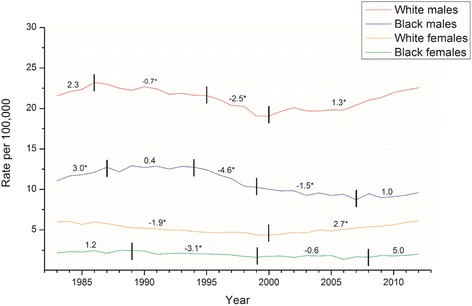
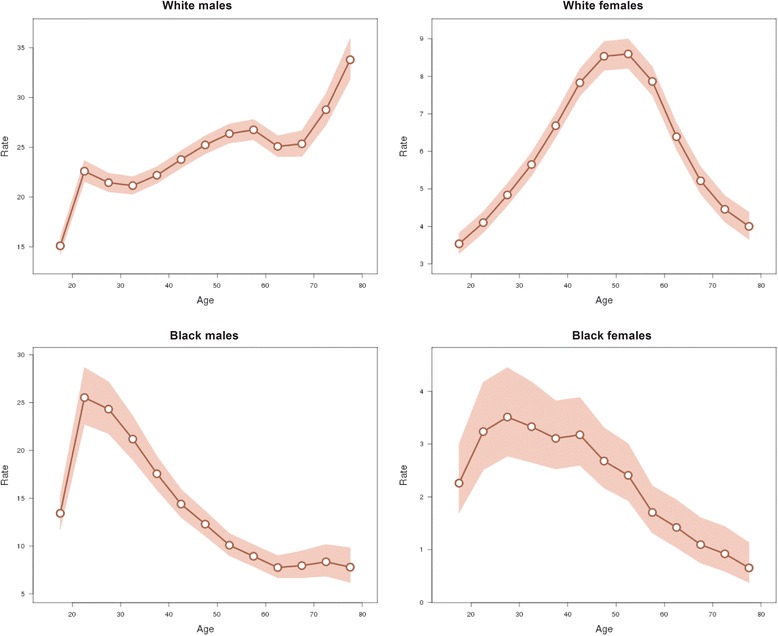
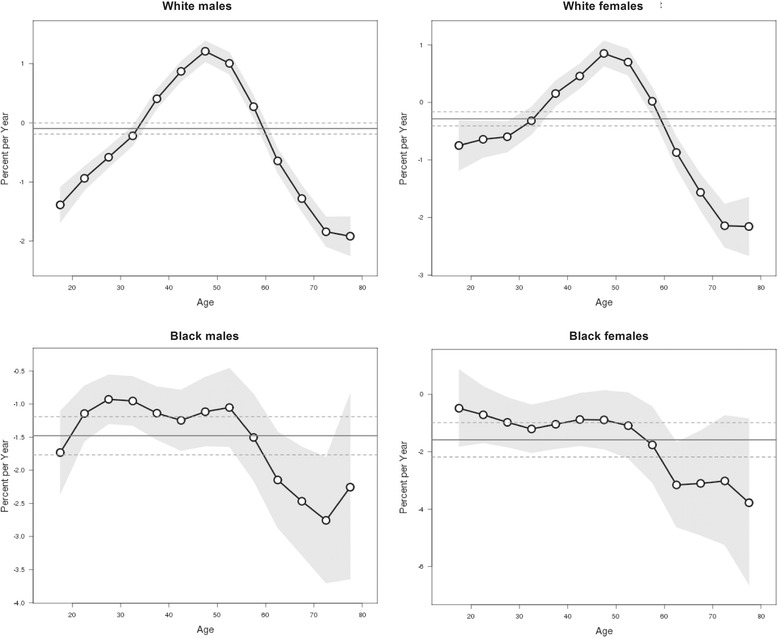
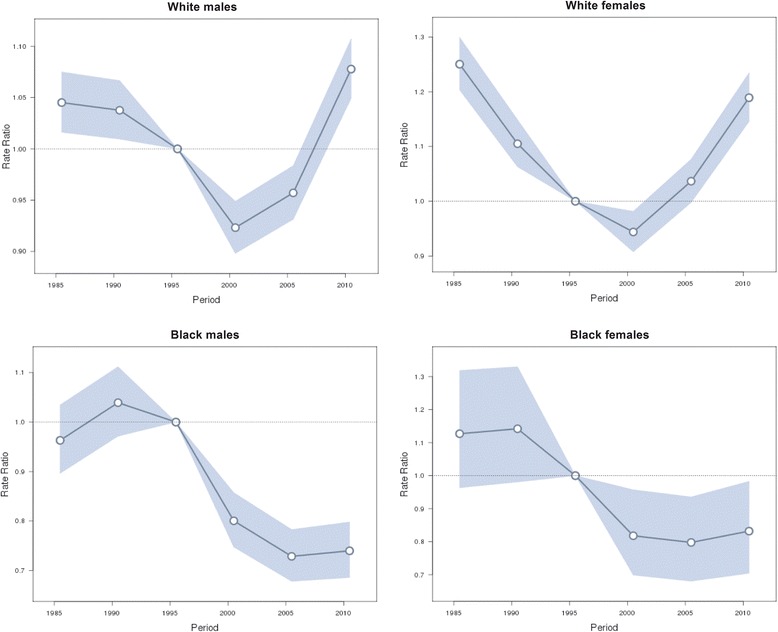
BACKGROUND: Previous studies suggested that the racial differences in U.S. suicide rates are decreasing, particularly for African Americans, but the cause behind the temporal variations has yet to be determined. This study aims to investigate the long-term trends in suicide mortality in the U.S. between 1983 and 2012 and to examine age-, period-, and cohort-specific effects by gender and race. METHOD: Suicide mortality data were collected from the Web-based Injury Statistics Query and Reporting System (WISQARS) and analyzed with the Joinpoint regression and age-period-cohort (APC) analysis. RESULTS: We found that although age-standardized rate of suicide in white males, white females, black males, and black females all changed at different degrees, the overall situation almost has not changed since these changes offset each other. By APC analysis, while the age effect on suicide demonstrate an obvious difference between white males and females (with the peak at 75 to 79 for white males and 45 to 54 for white females), young black people are predominantly susceptible to suicide (risk peaks in early 20s for black males and late 20s for black females). Cohort effects all showed a descending trend, except that in white males and females which showed an obvious increase peaked in around cohort 1960. There was a similar period effect trend between different genders in the same race group, but between the races, differences were found in the period before 1990 and after 2000. CONCLUSION: We confirmed that the distinction in age-specific suicide rate patterns does exist by gender and by race after controlling for period and cohort effects, which suggested that minorities' age patterns of suicide may have been masked up by the white people in the whole population. The differences of period effects and cohort effects between white and black Americans were likely to be mainly explained by the difference in race susceptibility to economic depression.
Overview
The claims and statistics of this paper haven’t been checked yet.
Free: it reads the open-access text and checks the first 5 claims that cite a source we can check. Create a free account to check every claim.
Integrity signals
Registry
Cites
Statistics
Figures
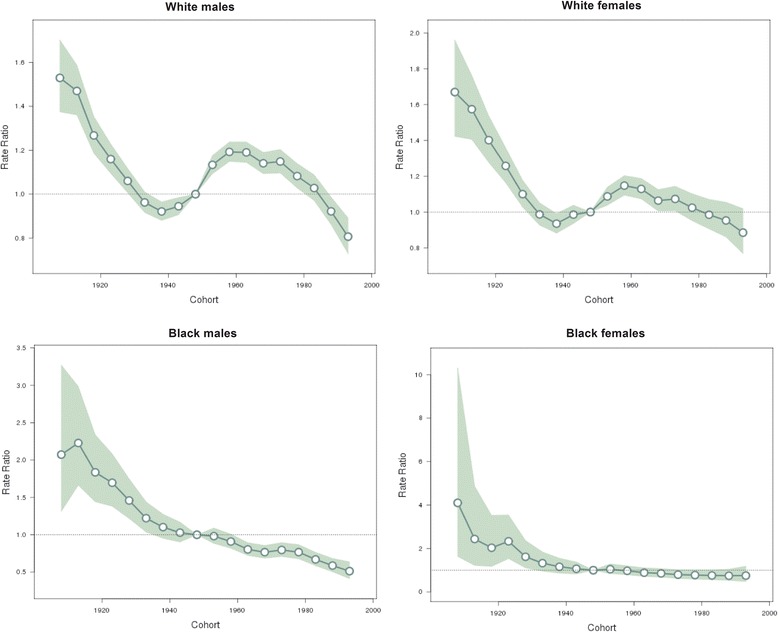
Verification
Claims the paper makes
The claims and statistics of this paper haven’t been checked yet.
Free: it reads the open-access text and checks the first 5 claims that cite a source we can check. Create a free account to check every claim.
Claims other papers make about this one
Each is checked against this paper’s own text: does it say what the citing paper says it does?
The cited source says what the claim attributes to it.
In the citing paper
“In the US, research using suicide mortality data up to 2012 demonstrated different age effect patterns for Black and White populations [17].”
From Age, period, and cohort effects on suicide death in the United States from 1999 to 2018: moderation by sex, race, and firearm involvement (2021) · cites this paper as [17]
In the citing paper
“Specifically, risk for suicide is highest in adolescence and young adulthood for Black, Asian/Pacific Islander, and American Indian individuals, in contrast to higher risk in middle age and later life for White individuals (1, 2).”
From Structural Racism and Suicide Prevention for Ethnoracially Minoritized Youth: A Conceptual Framework and Illustration Across Systems (2022) · cites this paper as [1]
Self-check
Percentages, sums and reported differences re-computed from the paper’s own numbers.
The self-check needs the paper’s full text.
Citations
Cites
Suicide: A study in sociology.
Durkheim, E. (2004) · Comprehending suicide: Landmarks in 20th–century suicidology. · doi:10.1037/10406-003 · Cited by 3,944 · cited 12×
“Keywords: Suicide, APC analysis, Race, Gender, United States”
BackgroundInfluentialNock, M. K., Borges, G., Bromet, E. J., Cha, C. B., Kessler, R. C., & Lee, S. (2008) · Epidemiologic Reviews · doi:10.1093/epirev/mxn002 · Cited by 2,897
Estimating average annual per cent change in trend analysis
Clegg, L. X., Hankey, B. F., Tiwari, R., Feuer, E. J., & Edwards, B. K. (2009) · Statistics in Medicine · doi:10.1002/sim.3733 · Cited by 1,256
Age standardization of death rates: implementation of the year 2000 standard.
Anderson, R. N., & Rosenberg, H. M. (1998) · PubMed · Cited by 1,118
A Web Tool for Age–Period–Cohort Analysis of Cancer Incidence and Mortality Rates
Rosenberg, P. S., Check, D. P., & Anderson, W. F. (2014) · Cancer Epidemiology, Biomarkers & Prevention · doi:10.1158/1055-9965.epi-14-0300 · Cited by 819 · cited 3×
“Other useful estimable parameters such as longitudinal age trend (age trend + period trend) and cross-sectional age trend (age trend − period trend) can be obtained too [24].”
BackgroundMethodInfluential(2001) · PubMed · Cited by 612
(2016) · PubMed · Cited by 580
The Intrinsic Estimator for Age‐Period‐Cohort Analysis: What It Is and How to Use It
Yang, Y., Schulhofer‐Wohl, S., Fu, W. J., & Land, K. C. (2008) · American Journal of Sociology · doi:10.1086/587154 · Cited by 503 · cited 1×
“The cohort effects of the young people and the extremely old must be interpreted with caution due to the few number of observations in both groups and their bigger standard errors than other groups [33].”
BackgroundAn Outcome Evaluation of the SOS Suicide Prevention Program
Aseltine, R. H., & DeMartino, R. (2004) · American Journal of Public Health · doi:10.2105/ajph.94.3.446 · Cited by 463
Increase in state suicide rates in the USA during economic recession
Reeves, A., Stuckler, D., McKee, M., Gunnell, D., Chang, S.-S., & Basu, S. (2012) · The Lancet · doi:10.1016/s0140-6736(12)61910-2 · Cited by 347 · cited 1×
“Socioeconomic factors could also influence certain cohort effects because those in middle age may be more vulnerable to economic stress [41, 45].”
Background
Cited by
Alvarez, K., Polanco-Roman, L., Samuel Breslow, A., & Molock, S. (2022) · American Journal of Psychiatry · doi:10.1176/appi.ajp.21101001 · Cited by 139
Chen, X., Sun, Y., Li, Z., Yu, B., Gao, G., & Wang, P. (2018) · Social Psychiatry and Psychiatric Epidemiology · doi:10.1007/s00127-018-1593-z · Cited by 89
Yu, B., & Chen, X. (2019) · JAMA Network Open · doi:10.1001/jamanetworkopen.2019.11383 · Cited by 84
Yazdi-Ravandi (2018) · doi:10.1016/j.ajp.2018.08.019 · Cited by 80
Recent trends in the rural–urban suicide disparity among veterans using VA health care
Shiner, B. R., Peltzman, T., Cornelius, S. L., Gui, J., Forehand, J. A., & Watts, B. V. (2020) · Journal of Behavioral Medicine · doi:10.1007/s10865-020-00176-9 · Cited by 66
The androgen model of suicide completion
Lenz, B., Röther, M., Bouna-Pyrrou, P., Mühle, C., Tektas, O. Y., & Kornhuber, J. (2018) · Progress in Neurobiology · doi:10.1016/j.pneurobio.2018.06.003 · Cited by 62
Martínez-Alés, G., Pamplin, J. R., Rutherford, C., Gimbrone, C., Kandula, S., Olfson, M., Gould, M. S., Shaman, J., & Keyes, K. M. (2021) · Molecular Psychiatry · doi:10.1038/s41380-021-01078-1 · Cited by 52
Francis, D. B. (2018) · Journal of Health Communication · doi:10.1080/10810730.2018.1506837 · Cited by 47
“Identifying health communication strategies to persuade young Black men to seek mental health help is critical, as suicide rates have increased noticeably among this population in the past few years (Bridge et al., 2015; Wang et al., 2016).”
BackgroundIvey-Stephenson (2020) · doi:10.1097/nnr.0000000000000424 · Cited by 41
“Unfortunately, prevalence rates of suicidal behaviors continue to increase into adulthood—which highlights the importance of primary prevention efforts from early adolescence—and throughout the transition into early adulthood and beyond (Han et al., 2018; Wang et al., 2016).”
BackgroundAge and sex trends for suicide in Brazil between 2000 and 2016.
Martini, M., da Fonseca, R. C., de Sousa, M. H., de Azambuja Farias, C., Cardoso, T. D. A., Kunz, M., Longaray, V. K., & Magalhães, P. V. D. S. (2019) · Social Psychiatry and Psychiatric Epidemiology · doi:10.1007/s00127-019-01689-8 · Cited by 33
Correlated Poisson models for age‐period‐cohort analysis
Chernyavskiy, P., Little, M. P., & Rosenberg, P. S. (2017) · Statistics in Medicine · doi:10.1002/sim.7519 · Cited by 33
“We examined 3 fixed effects structures for brain and breast cancer incidence: (1) most parsimonious model (intercept, linear age trend, linear cohort trend); (2) most parsimonious model with cubic age, period, and cohort splines; and (3) most parsimonious model with all traditional APC deviation parameters.”
BackgroundMethodInfluentialLv, Y., Sui, L., Lv, H., Zheng, J., Feng, H., & Jing, F. (2025) · Frontiers in Public Health · doi:10.3389/fpubh.2025.1543180 · Cited by 29
“Age effects illustrate variance in risk across age groups; period effects capture uniform temporal shifts affecting all groups; and cohort effects reflect risk variations among peers born during the same timeframe (25–27).”
Temporal Trends of Suicide Mortality in Mainland China: Results from the Age-Period-Cohort Framework
Wang, Z., Wang, J., Bao, J., Gao, X., Yu, C., & Xiang, H. (2016) · International Journal of Environmental Research and Public Health · doi:10.3390/ijerph13080784 · Cited by 29
“black population [44,45], which also showed the riskiest life stage for suicide was the youth.”
BackgroundSelf-citationSalway, T. J., Gesink, D., Ferlatte, O., Rich, A. J., Rhodes, A. E., Brennan, D. J., & Gilbert, M. (2020) · Social Psychiatry and Psychiatric Epidemiology · doi:10.1007/s00127-020-01946-1 · Cited by 26
Chernyavskiy, P., Little, M. P., & Rosenberg, P. S. (2017) · Statistical Methods in Medical Research · doi:10.1177/0962280217713033 · Cited by 26
Wang, Z., Hu, Y., & Peng, F. (2021) · Frontiers in Public Health · doi:10.3389/fpubh.2021.749295 · Cited by 20
“Third, an ecological fallacy was possible since the interpretation of results from the population level in APC analysis did not necessarily apply to individuals (12).”
ResultSelf-citationSui, L., Lv, Y., Feng, K. X., & Jing, F. J. (2025) · Frontiers in Public Health · doi:10.3389/fpubh.2025.1538406 · Cited by 20
The Effects of Age, Period, and Cohort on Mortality from Ischemic Heart Disease in China
Chang, J., Li, B., Li, J., & Sun, Y. (2017) · International Journal of Environmental Research and Public Health · doi:10.3390/ijerph14010050 · Cited by 17
Mortalidad por suicidio en España (1984-2018): análisis edad-período-cohorte
Cayuela, L., Gayango, A. S., Sánchez-Trincado, P. A., Rodríguez‐Domínguez, S., Quiles, A. A. V., & Cayuela, A. (2020) · Revista de Psiquiatría y Salud Mental · doi:10.1016/j.rpsm.2020.05.010 · Cited by 14
Circumstances preceding the suicide of Asian Pacific Islander Americans and White Americans
Wong, Y. J., Wang, L., Li, S., & Liu, H. (2016) · Death Studies · doi:10.1080/07481187.2016.1275888 · Cited by 13
“Finally, in light of previous research showing that suicide risk varied as a function of gender and age for diverse racial groups (e.g., Wang et al., 2016), we tested Race �Gender and Race � Age moderation effects on the seven outcomes.”
MethodNguyen, T., & O’Neill, C. (2025) · Journal of Affective Disorders · doi:10.1016/j.jad.2025.02.049 · Cited by 12
Khalid, Z., Momotaz, H., Briggs, F. B. S., Cassidy, K. A., Chaytor, N. S., Fraser, R., Janevic, M. R., Jobst, B. C., Johnson, E. K., Scal, P. B., et al. (2019) · Journal of Multidisciplinary Healthcare · doi:10.2147/jmdh.s227184 · Cited by 11
Kaur, N., Hamilton, A. D., Chen, Q., Hasin, D. S., Cerdá, M., Martins, S. S., & Keyes, K. M. (2022) · American Journal of Epidemiology · doi:10.1093/aje/kwac010 · Cited by 10
Estimates of suicide mortality in women residents in northeast brazilian states from 1996 to 2018
Dantas, E. S. O., Farias, Y. M. F., Resende, E. B., Silva, G. W. D. S., da Silva, P. G., & Meira, K. C. (2021) · Ciência & Saúde Coletiva · doi:10.1590/1413-812320212610.29552020 · Cited by 9
The influence of the age-period-cohort effects on male suicide in Brazil from 1980 to 2019
Rodrigues, W. T. D. S., Simões, T. C., Magnago, C., Dantas, E. S. O., Guimarães, R. M., de Jesus, J. C., Fernandes, S. M. B. D. A., & Meira, K. C. (2023) · PLoS ONE · doi:10.1371/journal.pone.0284224 · Cited by 9
Temporal trends in suicide related emergency calls by age group and gender from 2014 to 2023
Marco, M., Escobar-Hernández, P., Sánchez‐Sáez, F., López‐Quílez, A., Montagud-Andrés, M., Lila, M., & Gracia, E. (2025) · Scientific Reports · doi:10.1038/s41598-025-07700-4 · Cited by 10
“However, most studies treat gender and age as separate variables, with only a minority delving into their interconnected dynamics within suicide trends 30,31 .”
Factors Associated with Cocaine Consumption among Suicide Victim
Abreu, L. C. C., Conceição, S. D. S., de Carvalho, D. S. B., Machado, A. C. P., Lyrio, A. O., Souza, E. S., Souza, C. S., de Matos, P. J. D. S., Batista, J. E. T., Gomes, J. D. A., et al. (2022) · International Journal of Environmental Research and Public Health · doi:10.3390/ijerph192114309 · Cited by 9
Study on the burden of digestive diseases among Chinese residents in the 21st century
Gong, S., Zhang, Y., Wang, Y., Yang, X., Cheng, B., Song, Z., & Liu, X. (2024) · Frontiers in Public Health · doi:10.3389/fpubh.2023.1314122 · Cited by 9
Yu, B., & Chen, X. (2020) · Epidemiology and Psychiatric Sciences · doi:10.1017/s204579602000092x · Cited by 7
Ramazani, Y., Abdi, A., Rezaeian, S., Najafi, F., Aliyavari, Z., & Moradinazar, M. (2025) · Scientific Reports · doi:10.1038/s41598-025-85861-y · Cited by 5
Hou, F., Li, J., Liu, H., & Caine, E. D. (2025) · The British Journal of Psychiatry · doi:10.1192/bjp.2025.6 · Cited by 4
Martínez‐Alés, G., Gimbrone, C., Rutherford, C. G., Keyes, K. M., & López‐Cuadrado, T. (2022) · International Journal of Public Health · doi:10.3389/ijph.2022.1604538 · Cited by 5
Forrester, M. B. (2016) · Public Health · doi:10.1016/j.puhe.2016.10.015 · Cited by 2
Gender Ratio of Intentional Self-harm Death in Korea
Park, S., & Lim, D. O. (2018) · Journal of Health Informatics and Statistics · doi:10.21032/jhis.2018.43.1.113 · Cited by 2
“미국의 자살통계 (1983-2012)에서 성에 따라 연령별 자살률의 차별 양상이 존재하는 것 으로 보고되었으며[20], 남자에서 일산화탄소 중독, 교수, 추락과 같은”
Sifat, M. S., Kuo, C. C.-L., Yoo, J. H., Holder, S., & Green, K. M. (2023) · Journal of Black Psychology · doi:10.1177/00957984211061920 · Cited by 1
“On average, African Americans are more frequently exposed to violence, and traumatic stress (Droege et al., 2017; Morrison & Downey, 2000), yet are less likely to seek mental health treatment for depression or suicidal ideation than Caucasians (Balis & Postolache, 2008; Wang et al., 2016).”
BackgroundAfrican American Women and Their Experiences with Behavioral Health: Implications for Rehabilitation
Blakeney, K. M. (2017) · OpenSIUC (Southern Illinois University Carbondale)
PADRÕES ESPAÇO-TEMPORAIS DO SUICÍDIO NO ESTADO DE PERNAMBUCO, BRASIL
Beringuel, B. M., do Bonfim, C. V., & Silva, A. S. (2020) · Revista Baiana Saúde Pública · doi:10.22278/2318-2660.2018.v42.n3.a3077
Accuracy of Death Certificate Data in Reporting Suicide in the United States
Palmer, M. N. (2020) · ScholarWorks (Walden University) · Cited by 5
Duarte, T. S. B. (2022) · Digital Library of Theses and Dissertations (Universidade de São Paulo) · doi:10.11606/d.6.2022.tde-26072022-134753
de Lima, F. C. D. S., Martins, W. D. A., Rosa, M. L. G., & Nunes, S. H. (2022) · Cadernos Saúde Coletiva · doi:10.1590/1414-462x202230030233
Study the Dynamic Thiol -Disulfide Homeostasis in patients with Diabetes type I and type 2
(2023) · Journal of Population Therapeutics and Clinical Pharmacology · doi:10.47750/jptcp.2023.30.04.049
Lannoy, S., Barr, P. B., Gillespie, N. A., Stephenson, M. E., & Edwards, A. C. (2026) · Archives of Suicide Research · doi:10.1080/13811118.2026.2648604
“…body of literature indeed shows higher risks of non-fatal STB in females compared to males, as well as in individuals who identify as American Indian or White compared to Black (Bornheimer et al., 2022; Carter et al., 2022; Ivey-Stephenson et al., 2022; Wang et al., 2016; Xiao & Lindsey, 2021).”
Metadata
- Authors
- Wang, Z., Yu, C., Wang, J., Bao, J., Gao, X., & Xiang, H.
- Affiliations
- Wuhan University (CN)
- Nationwide Children's Hospital (US)
- Corresponding author
- Yu, Chuanhua
- Xiang, Huiyun
- Venue
- International Journal for Equity in Health
- Published
- 2016-07-13
- Volume
- 15
- Issue
- 1
- Pages
- 107-107
- ISSN
- 1475-9276 (ISSN-L)
- PMC
- PMC4944259
- OpenAlex
- W2468018418
- Cited by
- 40
- References
- 48
- Citations by year
- 2026: 1 · 2025: 6 · 2024: 1 · 2023: 3 · 2022: 6 · 2021: 3 · 2020: 6 · 2019: 3 · 2018: 5 · 2017: 3 · 2016: 3
- FWCI
- 6.25
- Type
- journal article
- Language
- en
- Open access
- gold
- doi.org
- Licence
- cc-by
- Locations
- International Journal for Equity in Health (publishedVersion, cc-by)
- Europe PMC (PubMed Central) (publishedVersion, cc-by)
- PubMed Central (publishedVersion, cc-by)
- PubMed (publishedVersion)
- Funders
- National Natural Science Foundation of China (81273179)
- Fundamental Research Funds for the Central Universities (2015305020201)
- China Scholarship Council (201506270087)
- Topics
- Social Sciences › Psychology › Clinical Psychology › Suicide and Self-Harm Studies
- Social Sciences › Sociology and Political Science › Homicide, Infanticide, and Child Abuse
- Health Sciences › Medicine › Oncology › Global Cancer Incidence and Screening
- Keywords
- suicide mortality, racial disparities, African Americans, White Americans, gender differences, age-period-cohort analysis, temporal trends, age-specific suicide rates, cohort effects, period effects, economic depression, suicide risk
- MeSH terms
- Adolescent, Adult, Age Factors, Aged, Black or African American, Female, Gender Identity, Humans, Male, Middle Aged, Sex Factors, Suicide, United States, Cohort Studies, White People, Racial Groups, Young Adult
About these checks
Registry, retraction, Cites and statistics results are computed, not judged, with one exception: a printed reference that no index lists is read once by a model before it counts as a citation error. Claims are extracted by a model and kept only when their quote appears verbatim in the text; each cited source is then checked, with a model’s help, for whether it says what the claim relies on. Those verdicts can be wrong — read the claim’s quote and the cited source before relying on one.
Statistics and arithmetic are recomputed, not judged.
Confidence bands are shown only for fields calibrated on our annotated test set. None is calibrated yet, so no band is shown.
What counts as a claim ›How we measure confidence ›How we check this ›
Are you an author, or do you see a problem with this page? Request a review
Data sources
Bibliographic data: Semantic Scholar, OpenAlex, Crossref.
Contains information from the Semantic Scholar Academic Graph Datasets, made available under the ODC Attribution License (ODC-BY 1.0).
Semantic Scholar’s data is described in: Kinney, R., et al. (2023). The Semantic Scholar Open Data Platform. arXiv:2301.10140.
