

Age-period-cohort analysis of suicide mortality by gender among white and black Americans, 1983–2012
Open accessThe DOI matches its Crossref record; 45 of the 48 references it cites were found in a registry or an index.
Abstract
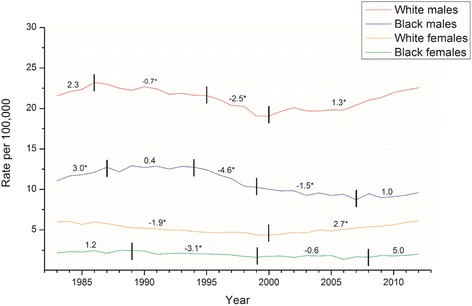
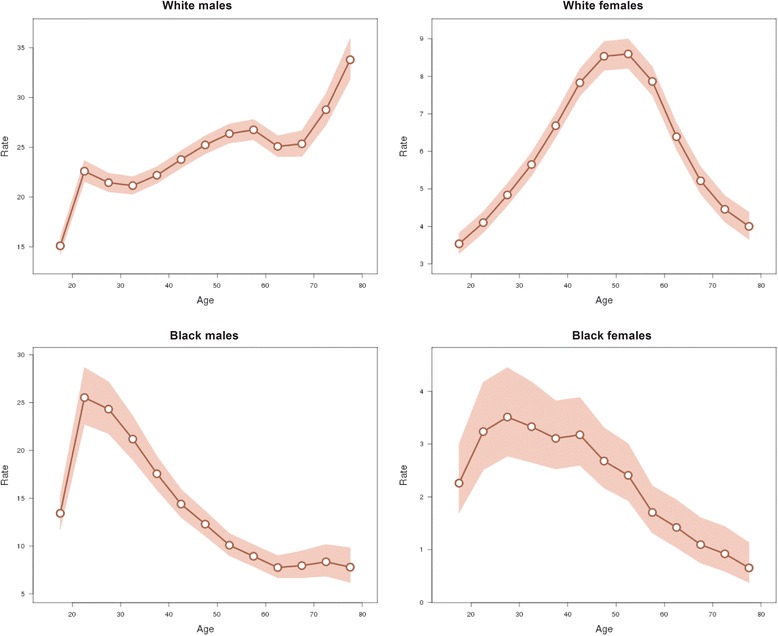
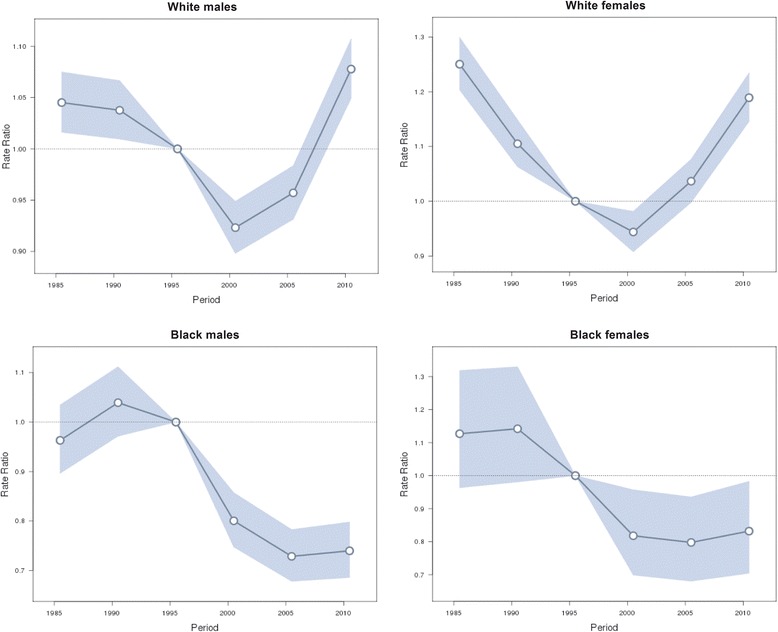
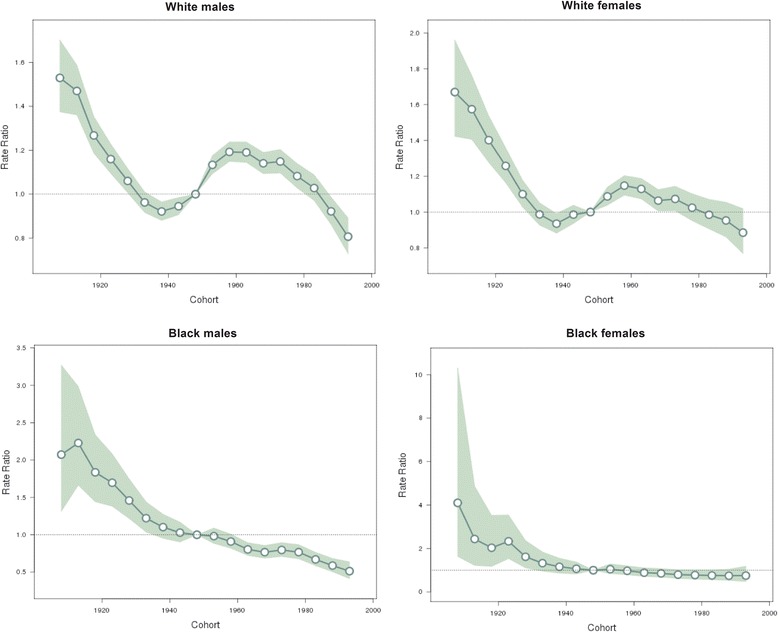
BACKGROUND: Previous studies suggested that the racial differences in U.S. suicide rates are decreasing, particularly for African Americans, but the cause behind the temporal variations has yet to be determined. This study aims to investigate the long-term trends in suicide mortality in the U.S. between 1983 and 2012 and to examine age-, period-, and cohort-specific effects by gender and race. METHOD: Suicide mortality data were collected from the Web-based Injury Statistics Query and Reporting System (WISQARS) and analyzed with the Joinpoint regression and age-period-cohort (APC) analysis. RESULTS: We found that although age-standardized rate of suicide in white males, white females, black males, and black females all changed at different degrees, the overall situation almost has not changed since these changes offset each other. By APC analysis, while the age effect on suicide demonstrate an obvious difference between white males and females (with the peak at 75 to 79 for white males and 45 to 54 for white females), young black people are predominantly susceptible to suicide (risk peaks in early 20s for black males and late 20s for black females). Cohort effects all showed a descending trend, except that in white males and females which showed an obvious increase peaked in around cohort 1960. There was a similar period effect trend between different genders in the same race group, but between the races, differences were found in the period before 1990 and after 2000. CONCLUSION: We confirmed that the distinction in age-specific suicide rate patterns does exist by gender and by race after controlling for period and cohort effects, which suggested that minorities' age patterns of suicide may have been masked up by the white people in the whole population. The differences of period effects and cohort effects between white and black Americans were likely to be mainly explained by the difference in race susceptibility to economic depression.
Overview
The claims and statistics of this paper haven’t been checked yet.
Free: it reads the open-access text and checks the first 5 claims that cite a source we can check. Create a free account to check every claim.
Integrity signals
Registry
Cites
Statistics
Figures
Verification
Claims the paper makes
The claims and statistics of this paper haven’t been checked yet.
Free: it reads the open-access text and checks the first 5 claims that cite a source we can check. Create a free account to check every claim.
Claims other papers make about this one
Each is checked against this paper’s own text: does it say what the citing paper says it does?
The cited source says what the claim attributes to it.
In the citing paper
“In the US, research using suicide mortality data up to 2012 demonstrated different age effect patterns for Black and White populations [17].”
From Age, period, and cohort effects on suicide death in the United States from 1999 to 2018: moderation by sex, race, and firearm involvement (2021) · cites this paper as [17]
In the citing paper
“Specifically, risk for suicide is highest in adolescence and young adulthood for Black, Asian/Pacific Islander, and American Indian individuals, in contrast to higher risk in middle age and later life for White individuals (1, 2).”
From Structural Racism and Suicide Prevention for Ethnoracially Minoritized Youth: A Conceptual Framework and Illustration Across Systems (2022) · cites this paper as [1]
Self-check
Percentages, sums and reported differences re-computed from the paper’s own numbers.
The self-check needs the paper’s full text.
Citations
Cites
Suicide: A study in sociology.
Durkheim, E. (2004) · Comprehending suicide: Landmarks in 20th–century suicidology. · doi:10.1037/10406-003 · Cited by 3,944 · cited 12×
“Keywords: Suicide, APC analysis, Race, Gender, United States”
BackgroundInfluentialNock, M. K., Borges, G., Bromet, E. J., Cha, C. B., Kessler, R. C., & Lee, S. (2008) · Epidemiologic Reviews · doi:10.1093/epirev/mxn002 · Cited by 2,897
Estimating average annual per cent change in trend analysis
Clegg, L. X., Hankey, B. F., Tiwari, R., Feuer, E. J., & Edwards, B. K. (2009) · Statistics in Medicine · doi:10.1002/sim.3733 · Cited by 1,256
Age standardization of death rates: implementation of the year 2000 standard.
Anderson, R. N., & Rosenberg, H. M. (1998) · PubMed · Cited by 1,118
A Web Tool for Age–Period–Cohort Analysis of Cancer Incidence and Mortality Rates
Rosenberg, P. S., Check, D. P., & Anderson, W. F. (2014) · Cancer Epidemiology, Biomarkers & Prevention · doi:10.1158/1055-9965.epi-14-0300 · Cited by 819 · cited 3×
“Other useful estimable parameters such as longitudinal age trend (age trend + period trend) and cross-sectional age trend (age trend − period trend) can be obtained too [24].”
BackgroundMethodInfluential(2001) · PubMed · Cited by 612
(2016) · PubMed · Cited by 580
The Intrinsic Estimator for Age‐Period‐Cohort Analysis: What It Is and How to Use It
Yang, Y., Schulhofer‐Wohl, S., Fu, W. J., & Land, K. C. (2008) · American Journal of Sociology · doi:10.1086/587154 · Cited by 503 · cited 1×
“The cohort effects of the young people and the extremely old must be interpreted with caution due to the few number of observations in both groups and their bigger standard errors than other groups [33].”
BackgroundAn Outcome Evaluation of the SOS Suicide Prevention Program
Aseltine, R. H., & DeMartino, R. (2004) · American Journal of Public Health · doi:10.2105/ajph.94.3.446 · Cited by 463
Increase in state suicide rates in the USA during economic recession
Reeves, A., Stuckler, D., McKee, M., Gunnell, D., Chang, S.-S., & Basu, S. (2012) · The Lancet · doi:10.1016/s0140-6736(12)61910-2 · Cited by 347 · cited 1×
“Socioeconomic factors could also influence certain cohort effects because those in middle age may be more vulnerable to economic stress [41, 45].”
BackgroundKeyes, K. M., Utz, R. L., Robinson, W., & Li, G. (2010) · Social Science & Medicine · doi:10.1016/j.socscimed.2009.12.018 · Cited by 292 · cited 1×
“even different statistical methods [36] may result in different cohort effects, it is often hard to indirectly com-”
BackgroundEtiology and prognosis of pregnancy-related pelvic girdle pain; design of a longitudinal study
Bastiaanssen, J. M., de Bie, R. A., Bastiaenen, C. H., Heuts, A., Kroese, M. E., Essed, G. G., & van den Brandt, P. A. (2005) · BMC Public Health · doi:10.1186/1471-2458-5-1 · Cited by 288
Age-Period-Cohort Analysis: New Models, Methods, and Empirical Applications
Yang, Y., & Land, K. C. (2016) · Chapman & Hall/CRC eBooks · doi:10.1201/b13902 · Cited by 280
Leading Causes of Unintentional and Intentional Injury Mortality: United States, 2000–2009
Rockett, I. R. H., Regier, M. D., Kapusta, N. D., Coben, J. H., Miller, T. R., Hanzlick, R. L., Todd, K. H., Sattin, R. W., Kennedy, L. W., Kleinig, J., et al. (2012) · American Journal of Public Health · doi:10.2105/ajph.2012.300960 · Cited by 229 · cited 1×
“have been declined [3, 5], and has overtaken car crashes as the leading cause of injury mortality since 2009 [6].”
BackgroundA Consideration of the Validity and Reliability of Suicide Mortality Data
O'Carroll, P. W. (1989) · Suicide and Life-Threatening Behavior · doi:10.1111/j.1943-278x.1989.tb00362.x · Cited by 218
Prosperity as a Cause of Death
Eyer, J. (1977) · International Journal of Health Services · doi:10.2190/9wa2-rvl3-mt9d-el9d · Cited by 140
Introduction to the theme:the economy, medicine, and health.
Eyer, J. (1977) · PubMed · Cited by 134
US Suicide Rates by Age Group, 1970–2002: An Examination of Recent Trends
McKeown, R. E., Cuffe, S. P., & Schulz, R. M. (2006) · American Journal of Public Health · doi:10.2105/ajph.2005.066951 · Cited by 119 · cited 1×
“economy flourished amid the 1990s, with correspondingly lower unemployment rates [43], coincided with the time all gender and race groups experienced a downward trend of period effect.”
BackgroundMuggeo, V. M. R. (2010) · Statistics in Medicine · doi:10.1002/sim.3850 · Cited by 100
Phillips, J. A. (2014) · Social Science & Medicine · doi:10.1016/j.socscimed.2014.05.038 · Cited by 96 · cited 3×
“Our findings are consistent with Phillips’s APC analysis [12] of the whole American population without separating race, which showed that age curves of suicide for males and females displayed different patterns.”
BackgroundResultExplaining the Rise in Youth SuicidePreprint
Cutler, D., Glaeser, E. L., & Norberg, K. E. (2001) · SSRN Electronic Journal · doi:10.2139/ssrn.263440 · Cited by 89
Understanding Recent Changes in Suicide Rates among the Middle-Aged: Period or Cohort Effects?
Phillips, J. A., Robin, A. V., Nugent, C. N., & Idler, E. L. (2010) · Public Health Reports® · doi:10.1177/003335491012500510 · Cited by 85 · cited 1×
“Socioeconomic factors could also influence certain cohort effects because those in middle age may be more vulnerable to economic stress [41, 45].”
BackgroundSuicide rates for females and males by race and ethnicity : United States, 1999 and 2014
Curtin, S. C., Warner, M., & Hedegaard, H. B. (2016) · Cited by 85
Ethnic Differences in Adolescent Suicide in the United States.
Balis, T. G., & Postolache, T. T. (2008) · PubMed · Cited by 84
Age–period–cohort analysis of Swiss suicide data, 1881–2000
Ajdacic‐Gross, V., Bopp, M., Gostynski, M., Lauber, C., Gutzwiller, F. S., & Rössler, W. (2005) · European Archives of Psychiatry and Clinical Neuroscience · doi:10.1007/s00406-005-0627-1 · Cited by 80 · cited 1×
“General risk factors for suicide identified in previous researches include [35] mental disorders (especially depression and schizophrenia), coincident behavior (shifts between more or less lethal methods; abuse of alcohol and illicit drugs) and sociocultural context (various social cohesions; psychological factors).”
BackgroundHu, G., Wilcox, H. C., Wissow, L. S., & Baker, S. P. (2008) · American Journal of Preventive Medicine · doi:10.1016/j.amepre.2008.07.005 · Cited by 75 · cited 1×
“Suicide, a serious public health problem worldwide [1], is defined as fatal, intentional, self-inflicted injury with the intent to end life [2].”
BackgroundIntroduction: Suicidal Behaviors in the African American Community
Crosby, A. E., & Molock, S. D. (2006) · Journal of Black Psychology · doi:10.1177/0095798406290552 · Cited by 68 · cited 1×
“The fact that suicide among the black population is a youthful phenomenon is not a new finding [29, 30].”
BackgroundGibbs, J. T. (1988) · Suicide and Life-Threatening Behavior · doi:10.1111/j.1943-278x.1988.tb00143.x · Cited by 66 · cited 1×
“The fact that suicide among the black population is a youthful phenomenon is not a new finding [29, 30].”
BackgroundJoe, S. (2006) · Journal of Black Psychology · doi:10.1177/0095798406290465 · Cited by 66 · cited 1×
“We speculate that it was likely to be caused by the deindustrialization in 1980s, whose impact disproportionately burdened Black families and communities [44].”
BackgroundInfluence of cohort effects on patterns of suicide in England and Wales, 1950–1999
Gunnell, D., Middleton, N., Whitley, E., Dorling, D., & Frankel, S. (2003) · British Journal of Psychiatry · doi:10.1192/bjp.182.2.164 · Cited by 60
Age-Period-Cohort Analysis of Suicide Mortality Rates in Spain, 1959–1991
Granizo, J. J., Güallar, E., & Rodríguez‐Artalejo, F. (1996) · International Journal of Epidemiology · doi:10.1093/ije/25.4.814 · Cited by 54 · cited 3×
“many developed countries such as Japan [9], England and Wales [7], Spain [10], Sweden [11], and the U.”
BackgroundWoodbury, M. A., Mantón, K. G., & Blazer, D. G. (1988) · International Journal of Epidemiology · doi:10.1093/ije/17.2.356 · Cited by 50 · cited 1×
“by gender and race using APC analysis, the only study we found [15] was completed nearly 30 years ago.”
MethodMortality data from the National Vital Statistics System.
(1989) · PubMed · Cited by 44
Age–period–cohort analysis of the suicide rate in Korea
Park, C., Jee, Y. H., & Jung, K. J. (2016) · Journal of Affective Disorders · doi:10.1016/j.jad.2016.01.021 · Cited by 43 · cited 1×
“The declines of cohort effect were also reported in other countries [34] such as European countries and South Korea.”
ResultSuicide in England and Wales 1946–1985: an age‐period‐cohort analysis
Surtees, P. G., & Duffy, J. C. (1989) · Acta Psychiatrica Scandinavica · doi:10.1111/j.1600-0447.1989.tb10247.x · Cited by 42 · cited 5×
“many developed countries such as Japan [9], England and Wales [7], Spain [10], Sweden [11], and the U.”
BackgroundMethodInfluentialOdagiri, Y., Uchida, H., & Nakano, M. (2009) · Asia Pacific Journal of Public Health · doi:10.1177/1010539509348242 · Cited by 41 · cited 4×
“Odagiri Y, Uchida H, Nakano M. Gender differences in age, period, and birth-cohort effect on suicide mortality rate in Japan 1985–2006.”
BackgroundInfluentialPatterns of lung cancer mortality in 23 countries: Application of the Age-Period-Cohort model
Liaw, Y., Huang, Y., & Lien, G. (2005) · BMC Public Health · doi:10.1186/1471-2458-5-22 · Cited by 37 · cited 1×
“Since occurrence of suicide in those under 15 years old is very rare, and evaluations on individuals over 80 involve deaths from other competing causes [19, 20], only rates for those between 15 and 79 years old were considered in this study.”
BackgroundSocial Correlates of Suicide by Age
Stack, S. J. (1991) · Springer eBooks · doi:10.1007/978-1-4899-0724-0_14 · Cited by 35 · cited 2×
“The reason why suicide risk peaked in old age in white males is probably because retirement, death of relatives (especially spouse) and/or friends, physical limitations to mobility, and serious illness all contribute to more severe isolation in later life [12, 28].”
BackgroundKeyes, K. M., & Li, G. (2011) · Springer eBooks · doi:10.1007/978-1-4614-1599-2_22 · Cited by 35
Wang, Z., Bao, J., Yu, C., Wang, J., & Li, C. (2015) · International Journal of Environmental Research and Public Health · doi:10.3390/ijerph121214993 · Cited by 34 · cited 1×
“Age, period, and cohort analysis (APC analysis) has been widely used for decades to evaluate the character and nature of patterns in the prevalence/mortality of numerous health problems [7, 8], which could reveal an indepth understanding of factors behind the observed temporal trends.”
MethodSelf-citationEconomic recession and suicide
Hawton, K., & Haw, C. (2013) · BMJ · doi:10.1136/bmj.f5612 · Cited by 32
Mortality of colorectal cancer in Taiwan, 1971–2010: temporal changes and age–period–cohort analysis
Su, S., Huang, J., Jian, Z.-H., Ho, C., Lung, C.-C., & Liaw, Y. (2012) · International Journal of Colorectal Disease · doi:10.1007/s00384-012-1521-8 · Cited by 30 · cited 1×
“Since occurrence of suicide in those under 15 years old is very rare, and evaluations on individuals over 80 involve deaths from other competing causes [19, 20], only rates for those between 15 and 79 years old were considered in this study.”
BackgroundAllebeck, P., Brandt, L., Nordström, P., & Åsgård, U. (1996) · Acta Psychiatrica Scandinavica · doi:10.1111/j.1600-0447.1996.tb10617.x · Cited by 27 · cited 3×
“many developed countries such as Japan [9], England and Wales [7], Spain [10], Sweden [11], and the U.”
BackgroundChung, R. Y., Yip, B. H. K., Chan, S. S. M., & Wong, S. Y. S. (2015) · Depression and Anxiety · doi:10.1002/da.22431 · Cited by 17
Trends in racial differences in U.S. suicide statistics
McIntosh, J. L. (1989) · Death Studies · doi:10.1080/07481188908252304 · Cited by 10 · cited 1×
“that the vast majority of suicides involve white people (the suicide rate of white people is more than twice as high as the whole nonwhite population [14]).”
Background
Cited by
Alvarez, K., Polanco-Roman, L., Samuel Breslow, A., & Molock, S. (2022) · American Journal of Psychiatry · doi:10.1176/appi.ajp.21101001 · Cited by 139
Chen, X., Sun, Y., Li, Z., Yu, B., Gao, G., & Wang, P. (2018) · Social Psychiatry and Psychiatric Epidemiology · doi:10.1007/s00127-018-1593-z · Cited by 89
Yu, B., & Chen, X. (2019) · JAMA Network Open · doi:10.1001/jamanetworkopen.2019.11383 · Cited by 84
Yazdi-Ravandi (2018) · doi:10.1016/j.ajp.2018.08.019 · Cited by 80
Recent trends in the rural–urban suicide disparity among veterans using VA health care
Shiner, B. R., Peltzman, T., Cornelius, S. L., Gui, J., Forehand, J. A., & Watts, B. V. (2020) · Journal of Behavioral Medicine · doi:10.1007/s10865-020-00176-9 · Cited by 66
Metadata
- Authors
- Wang, Z., Yu, C., Wang, J., Bao, J., Gao, X., & Xiang, H.
- Affiliations
- Wuhan University (CN)
- Nationwide Children's Hospital (US)
- Corresponding author
- Yu, Chuanhua
- Xiang, Huiyun
- Venue
- International Journal for Equity in Health
- Published
- 2016-07-13
- Volume
- 15
- Issue
- 1
- Pages
- 107-107
- ISSN
- 1475-9276 (ISSN-L)
- PMC
- PMC4944259
- OpenAlex
- W2468018418
- Cited by
- 40
- References
- 48
- Citations by year
- 2026: 1 · 2025: 6 · 2024: 1 · 2023: 3 · 2022: 6 · 2021: 3 · 2020: 6 · 2019: 3 · 2018: 5 · 2017: 3 · 2016: 3
- FWCI
- 6.25
- Type
- journal article
- Language
- en
- Open access
- gold
- doi.org
- Licence
- cc-by
- Locations
- International Journal for Equity in Health (publishedVersion, cc-by)
- Europe PMC (PubMed Central) (publishedVersion, cc-by)
- PubMed Central (publishedVersion, cc-by)
- PubMed (publishedVersion)
- Funders
- National Natural Science Foundation of China (81273179)
- Fundamental Research Funds for the Central Universities (2015305020201)
- China Scholarship Council (201506270087)
- Topics
- Social Sciences › Psychology › Clinical Psychology › Suicide and Self-Harm Studies
- Social Sciences › Sociology and Political Science › Homicide, Infanticide, and Child Abuse
- Health Sciences › Medicine › Oncology › Global Cancer Incidence and Screening
- Keywords
- suicide mortality, racial disparities, African Americans, White Americans, gender differences, age-period-cohort analysis, temporal trends, age-specific suicide rates, cohort effects, period effects, economic depression, suicide risk
- MeSH terms
- Adolescent, Adult, Age Factors, Aged, Black or African American, Female, Gender Identity, Humans, Male, Middle Aged, Sex Factors, Suicide, United States, Cohort Studies, White People, Racial Groups, Young Adult
About these checks
Registry, retraction, Cites and statistics results are computed, not judged, with one exception: a printed reference that no index lists is read once by a model before it counts as a citation error. Claims are extracted by a model and kept only when their quote appears verbatim in the text; each cited source is then checked, with a model’s help, for whether it says what the claim relies on. Those verdicts can be wrong — read the claim’s quote and the cited source before relying on one.
Statistics and arithmetic are recomputed, not judged.
Confidence bands are shown only for fields calibrated on our annotated test set. None is calibrated yet, so no band is shown.
What counts as a claim ›How we measure confidence ›How we check this ›
Are you an author, or do you see a problem with this page? Request a review
Data sources
Bibliographic data: Semantic Scholar, OpenAlex, Crossref.
Contains information from the Semantic Scholar Academic Graph Datasets, made available under the ODC Attribution License (ODC-BY 1.0).
Semantic Scholar’s data is described in: Kinney, R., et al. (2023). The Semantic Scholar Open Data Platform. arXiv:2301.10140.
