

The DOI matches its Crossref record; 69 of the 69 references it cites were found in a registry or an index.
Concentrations of persistent organic pollutants in maternal and cord blood from the maternal-infant research on environmental chemicals (MIREC) cohort study
Abstract
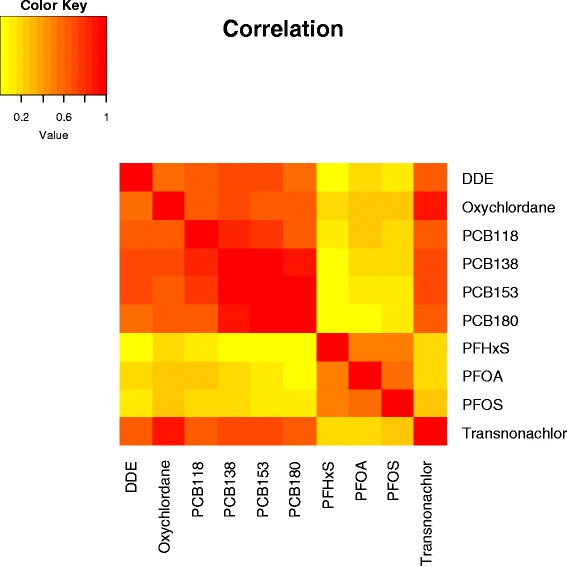
BACKGROUND: Pregnant women are an especially important population to monitor for environmental exposures given the vulnerability of the developing fetus. During pregnancy and lactation chemical body burdens may change due to the significant physiological changes that occur. Developmental exposures to some persistent organic pollutants (POPs) have been linked with adverse health outcomes. METHODS: First trimester maternal and cord blood plasma concentrations of several POPs including polychlorinated biphenyls (PCBs), organochlorine pesticides (OCs), polybrominated diphenyl ethers (PBDE)s and perfluoroalkyl substances (PFASs) were measured in samples from 1983 pregnant women enrolled in the Maternal-Infant Research on Environmental Chemicals (MIREC) cohort. Predictors of exposure were also identified. RESULTS: In maternal plasma, there was >90 % detection for the perfluoroalkyl substances (PFASs) perfluorooctanoic acid (PFOA), perfluoroctane sulfonate (PFOS), perfluorohexane sulfonate (PFHxS), and dichlorodiphenyldichloroethylene (DDE), oxychlordane and PCB 138 and 153. Cord blood plasma had much lower detection rates with low or very limited detection for most PCBs and PBDEs. The PFASs were the most frequently detected (23-64 %) chemical class in cord plasma. In a subset of 1st and 3rd trimester paired samples, PFAS concentrations were found to be strongly correlated and had ICCs ranging from 0.64 (PFOA) to 0.83 (PFHxS). The cord:maternal plasma concentration ratios ranged from 0.14 (PFOS) to 0.87 (oxychlordane, lipid adjusted). Similar to other studies, we found parity, maternal age, income, education, smoking status, pre-pregnancy BMI and fish consumption to be significant predictors for most chemicals. Those participants who were foreign-born had significantly higher concentrations of organochlorinated pesticides and PCBs. CONCLUSIONS: In the MIREC study, multiple chemical contaminants were quantified in the plasma of pregnant women. In cord plasma PFOA had the highest detection rate. However, compared to other Canadian and international population studies, the MIREC participants had lower contaminant concentrations of these substances.
Overview
The claims and statistics of this paper haven’t been checked yet.
Run the check — free, no account needed. It reads the open-access text and checks the sources it cites.
Integrity signals
Registry
Cites
Statistics
Figures
Verification
Claims the paper makes
The claims and statistics of this paper haven’t been checked yet.
Run the check — free, no account needed. It reads the open-access text and checks the sources it cites.
Claims other papers make about this one
Each is checked against this paper’s own text: does it say what the citing paper says it does?
The source backs part of the claim, not all of it — or backs it for a different population, condition or comparison.
In the citing paper
“Another factor contributing to the different number of total samples per compound was the varying number of study participants, ranging from 11 (Midasch et al. Citation2007) to 865 (Fisher et al. Citation2016).”
From The transplacental transfer efficiency of per- and polyfluoroalkyl substances (PFAS): a first meta-analysis (2022) · cites this paper as Fisher et al. 2016
Experimental — accuracy not yet measuredIn the citing paper
“Per- and polyfluorinated substances (PFAS), ubiquitously present in the environment and biota, are transferred to the fetus via the placenta.”
From The transplacental transfer efficiency of per- and polyfluoroalkyl substances (PFAS): a first meta-analysis (2022) · cites this paper as Fisher et al. 2016
Self-check
Percentages, sums and reported differences re-computed from the paper’s own numbers.
The self-check needs the paper’s full text.
Citations
Cites
Generalized, Linear, and Mixed Models
McCulloch, C. E., & Searle, S. R. (2000) · Wiley Series in Probability and Statistics · doi:10.1002/0471722073 · Cited by 2,994
Perfluoroalkyl Acids: A Review of Monitoring and Toxicological Findings
Lau, C., Anitole, K., Hodes, C., Lai, D., Pfahles-Hutchens, A., & Seed, J. (2007) · Toxicological Sciences · doi:10.1093/toxsci/kfm128 · Cited by 2,620
Neurobehavioural effects of developmental toxicity
Grandjean, P., & Landrigan, P. J. (2014) · The Lancet Neurology · doi:10.1016/s1474-4422(13)70278-3 · Cited by 1,886
Environmental chemicals in pregnant women in the United States: NHANES 2003–2004
Woodruff, T. J., Zota, A. R., & Schwartz, J. M. (2011) · Environmental Health Perspectives · doi:10.1289/ehp.1002727 · Cited by 930
Chlorinated hydrocarbon levels in human serum: Effects of fasting and feeding
Phillips, D. L., Pirkle, J. L., Burse, V. W., Bernert, J. T., Henderson, L. O., & Needham, L. L. (1989) · Archives of Environmental Contamination and Toxicology · doi:10.1007/bf01055015 · Cited by 884
(2012) · Cited by 634
Perfluorinated Chemicals and Fetal Growth: A Study within the Danish National Birth Cohort
Fei, C., McLaughlin, J. K., Tarone, R. E., & Olsen, J. (2007) · Environmental Health Perspectives · doi:10.1289/ehp.10506 · Cited by 625
Partition of Environmental Chemicals between Maternal and Fetal Blood and Tissues
Needham, L. L., Grandjean, P., Heinzow, B., Jørgensen, P. J., Nielsen, F., Patterson, D. G., Sjödin, A., Turner, W. E., & Weihe, P. (2011) · Environmental Science & Technology · doi:10.1021/es1019614 · Cited by 406
Wilford, B. H., Shoeib, M., Harner, T., Zhu, J., & Jones, K. C. (2005) · Environmental Science & Technology · doi:10.1021/es050759g · Cited by 387
Maternal levels of perfluorinated chemicals and subfecundity
Fei, C., McLaughlin, J. K., Lipworth, L., & Olsen, J. (2009) · Human Reproduction · doi:10.1093/humrep/den490 · Cited by 385
Research works printed but not linked: 3
- Health Canada. Report on Human Biomonitoring of Environmental Chemicals in Canada: Results of the Canadian Health Measures Survey Cycle 1 (2007-2009). Ottawa: Health Canada; 2010. http://www.hc-sc.gc.ca/ewh-semt/pubs/contaminants/chms-ecms/index-eng.php . Accessed 12 Apr 2016.
- CDC. Fourth National Report on Human Exposure to Environmental Chemicals: Updated Tables, August 2014. Atlanta: U.S. Department of Health and Human Services; 2014.
- UNEP. Guidance on Alternative Flame Retardants to the Use of Commercial Pentabromodiphenyether. Oslo, Norway: United National Environment Program; 2009.
Cited by
Risk to human health related to the presence of perfluoroalkyl substances in food
Panel), E. P. O. C. I. T. F. C. (. C., Schrenk, D., Bignami, M., Bodin, L., Chipman, J. K., del Mazo, J., Grasl‐Kraupp, B., Hogstrand, C., Hoogenboom, L. (., Leblanc, J., et al. (2020) · EFSA Journal · doi:10.2903/j.efsa.2020.6223 · Cited by 989
Ballesteros, V., Costa, O., Iñiguez, C., Fletcher, T., Ballester, F., & Lopez-Espinosa, M.-J. (2017) · Environment International · doi:10.1016/j.envint.2016.10.015 · Cited by 242
Garg, S., Kumar, P., Mishra, V., Guijt, R., Singh, P., Dumée, L. F., & Sharma, R. S. (2020) · Journal of Water Process Engineering · doi:10.1016/j.jwpe.2020.101683 · Cited by 205
Appel, M., Forsthuber, M., Ramos, R., Widhalm, R., Granitzer, S., Uhl, M., Hengstschläger, M., Stamm, T., & Gundacker, C. (2022) · Journal of Toxicology and Environmental Health, Part B · doi:10.1080/10937404.2021.2009946 · Cited by 104
“2011), transplacental transfer (Cai et al. 2020; Fisher et al. 2016; Wang et al. 2019), and breastfeeding (Loccisano et al.”
BackgroundMixtures of persistent organic pollutants are found in vital organs of late gestation human fetuses
Björvang, R. D., Vinnars, M.-T., Papadogiannakis, N., Gidlöf, S., Mamsen, L. S., Mucs, D., Kiviranta, H., Rantakokko, P., Ruokojärvi, P., Lindh, C. H., et al. (2021) · Chemosphere · doi:10.1016/j.chemosphere.2021.131125 · Cited by 64
Metadata
- Authors
- Fisher, M., Arbuckle, T. E., Liang, C. L., LeBlanc, A., Gaudreau, E., Foster, W. G., Haines, D., Davis, K., & Fraser, W. D.
- Venue
- Environmental Health
- Published
- 2016-05-04
- Volume
- 15
- Issue
- 1
- ISSN
- 1476-069X
- PMC
- PMC4855498
- Cited by
- 150
- References
- 69
- Language
- en
- Funders
- Health Canada (CA)
- CIHR
- Ontario Ministry of the Environment
About these checks
Registry, retraction, Cites and statistics results are computed, not judged, with one exception: a printed reference that no index lists is read once by a model before it counts as a citation error. Claims are extracted by a model and kept only when their quote appears verbatim in the text; each cited source is then checked, with a model’s help, for whether it says what the claim relies on. Those verdicts can be wrong — read the claim’s quote and the cited source before relying on one.
Statistics and arithmetic are recomputed, not judged.
Confidence bands are shown only for fields calibrated on our annotated test set. None is calibrated yet, so no band is shown.
What counts as a claim ›How we measure confidence ›How we check this ›
Are you an author, or do you see a problem with this page? Request a review
How to cite
Cite CoChat for the checks on this page, and the paper for its own findings.
- This page
- CoChat. (2026). Citation check: Concentrations of persistent organic pollutants in maternal and cord blood from the maternal-infant research on environmental chemicals (MIREC) cohort study. https://app.cochat.ai/papers/10.1186/s12940-016-0143-y
- The paper
- Fisher, M., Arbuckle, T. E., Liang, C. L., LeBlanc, A., Gaudreau, E., Foster, W. G., Haines, D., Davis, K., & Fraser, W. D. (2016). Concentrations of persistent organic pollutants in maternal and cord blood from the maternal-infant research on environmental chemicals (MIREC) cohort study. Environmental Health. https://doi.org/10.1186/s12940-016-0143-y
Data sources
Bibliographic data: Semantic Scholar, OpenAlex, Crossref.
Contains information from the Semantic Scholar Academic Graph Datasets, made available under the ODC Attribution License (ODC-BY 1.0).
Semantic Scholar’s data is described in: Kinney, R., et al. (2023). The Semantic Scholar Open Data Platform. arXiv:2301.10140.
