

Extracellular matrix remodeling in tumor progression and immune escape: from mechanisms to treatments
Open accessThe DOI matches its Crossref record; 626 of the 626 references it cites were found in a registry or an index.
Abstract
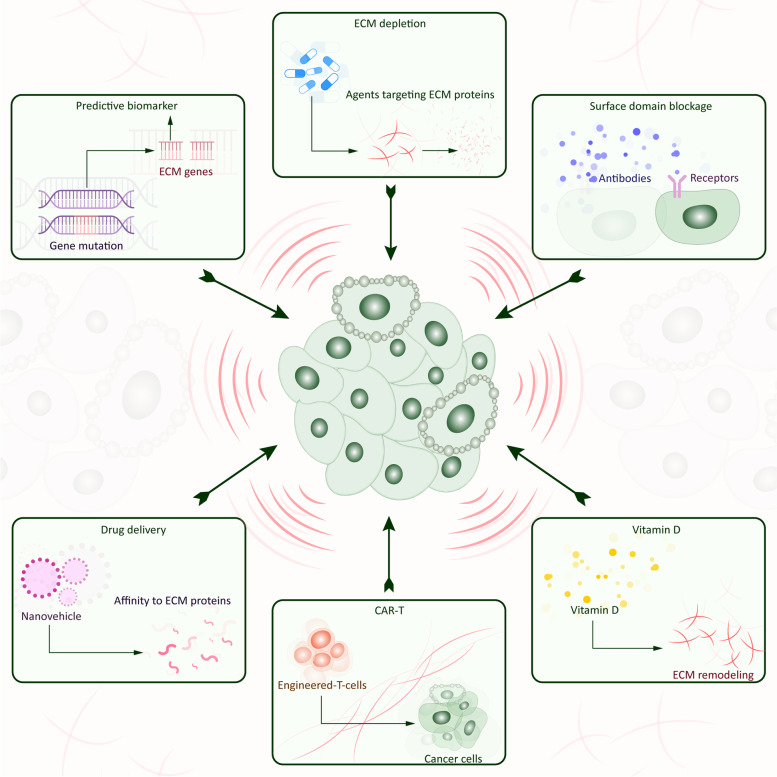
The malignant tumor is a multi-etiological, systemic and complex disease characterized by uncontrolled cell proliferation and distant metastasis. Anticancer treatments including adjuvant therapies and targeted therapies are effective in eliminating cancer cells but in a limited number of patients. Increasing evidence suggests that the extracellular matrix (ECM) plays an important role in tumor development through changes in macromolecule components, degradation enzymes and stiffness. These variations are under the control of cellular components in tumor tissue via the aberrant activation of signaling pathways, the interaction of the ECM components to multiple surface receptors, and mechanical impact. Additionally, the ECM shaped by cancer regulates immune cells which results in an immune suppressive microenvironment and hinders the efficacy of immunotherapies. Thus, the ECM acts as a barrier to protect cancer from treatments and supports tumor progression. Nevertheless, the profound regulatory network of the ECM remodeling hampers the design of individualized antitumor treatment. Here, we elaborate on the composition of the malignant ECM, and discuss the specific mechanisms of the ECM remodeling. Precisely, we highlight the impact of the ECM remodeling on tumor development, including proliferation, anoikis, metastasis, angiogenesis, lymphangiogenesis, and immune escape. Finally, we emphasize ECM "normalization" as a potential strategy for anti-malignant treatment.
Overview
The claims and statistics of this paper haven’t been checked yet.
Free: it reads the open-access text and checks the first 5 claims that cite a source we can check. Create a free account to check every claim.
Integrity signals
Registry
Cites
Statistics
Figures
Verification
Claims the paper makes
The claims and statistics of this paper haven’t been checked yet.
Free: it reads the open-access text and checks the first 5 claims that cite a source we can check. Create a free account to check every claim.
Claims other papers make about this one
Each is checked against this paper’s own text: does it say what the citing paper says it does?
The cited source says what the claim attributes to it.
In the citing paper
“inhibiting lysyl oxidase (LOX) family enzymes, which are involved in the crosslinking of ECM proteins collagen and elastin, can reduce matrix stiffness and improve drug delivery to tumor cells [219].”
From Mechanisms and Strategies to Overcome Drug Resistance in Colorectal Cancer (2025) · cites this paper as [219]
Self-check
Percentages, sums and reported differences re-computed from the paper’s own numbers.
The self-check needs the paper’s full text.
Citations
Cites
2 retracted
Items 601–626 of 626
Rittling, S. R., Wejse, P. L., Yagiz, K., Warot, G. A., & Hui, T. (2014) · British Journal of Cancer · doi:10.1038/bjc.2014.10 · Cited by 17 · cited 1×
“Importantly, orally OPN administration suppresses tumor growth in mice with normal immune function, highlights the significance of endogenous OPN in promoting tumor progression [528].”
BackgroundYu, M.-H., Yang, T., Ho, H.-H., Huang, H., Chan, K., & Wang, C. (2018) · Journal of Agricultural and Food Chemistry · doi:10.1021/acs.jafc.8b00958 · Cited by 17
Twarock, S., Reichert, C., Bach, K., Reiners, O., Kretschmer, I., Gorski, D. J., Gorges, K., Grandoch, M., & Fischer, J. W. (2019) · British Journal of Pharmacology · doi:10.1111/bph.14808 · Cited by 17 · cited 1×
“The combination of 4-MU and anti-metabolic therapy (dichloroacetate, the pyruvate dehydrogenase kinase inhibitor) strikingly suppresses esophageal cancer progression in vitro and in vivo [576].”
BackgroundIradyan, M. A., Iradyan, N., Hulin, P., Hambardzumyan, A. A., Gyulkhandanyan, A., de Sousa, R. A., Hessani, A., Roussakis, C., Bollot, G., Bauvais, C., et al. (2019) · Cancers · doi:10.3390/cancers11081094 · Cited by 17 · cited 1×
“Targeting EGFR is effective for anoikis suppression [180].”
BackgroundHeparanase is a novel biomarker for immune infiltration and prognosis in breast cancer
Yang, W., Shi, L., Wang, X., & Yang, G. (2021) · Aging · doi:10.18632/aging.203489 · Cited by 16 · cited 1×
“High expression of heparinase has been detected in a variety of tumor patients and is significantly associated with poor prognosis in patients with head and neck squamous cell carcinoma [57], breast cancer [58], and gastric cancer [59].”
BackgroundSelf-citationBawazeer, S., Sabry, D., Mahmoud, R. H., El‐hanbuli, H., Yassen, N. N., & AbdelHafez, M. N. (2018) · Molecular Biology Reports · doi:10.1007/s11033-018-4394-2 · Cited by 15 · cited 1×
“SPARC-deficient microenvironment in breast cancer reduced primary tumor growth and lung metastasis, possibly due to the macrophages with SPARC-deficiency and unable to support stroma formation and collagen deposition [69, 70].”
BackgroundSyndecan-Mediated Ligation of ECM Proteins Triggers Proliferative Arrest of Disseminated Tumor Cells
Shibue, T., Reinhardt, F., & Weinberg, R. A. (2019) · Cancer Research · doi:10.1158/0008-5472.can-19-1165 · Cited by 15 · cited 1×
“Before obvious formation of distant metastasis, systemic dissemination of quiescent tumor cells has been existed depending on normal ECM-cell adhesion-induced syndecan-1 activation [169].”
BackgroundHyaluronan Promotes Tumor Lymphangiogenesis and Intralymphantic Tumor Growth in Xenografts
Guo, L., Zou, K., Ju, J., & Xie, H. (2005) · Acta Biochimica et Biophysica Sinica · doi:10.1111/j.1745-7270.2005.00083.x · Cited by 15 · cited 1×
“HA increases expression of VEGF-C and VEGF-D in tumorstromal interfaces to mediate lymphangiogenesis [439, 440].”
BackgroundChen, H., Zhou, Z., Luo, Y., Luo, Q., & Fan, J. (2021) · Cell Biology International · doi:10.1002/cbin.11699 · Cited by 14 · cited 1×
“Moreover, in glioblastoma, YKL-40 induces the synergic effect of syndecan-1 and β5 integrin and FAK/ERK-dependent VEGF secretion and VEGFR2 expression [416, 417].”
BackgroundTavianatou, A., Piperigkou, Z., Koutsakis, C., Barbera, C., Beninatto, R., Franchi, M., & Karamanos, N. K. (2021) · FEBS Journal · doi:10.1111/febs.15734 · Cited by 14
The clinical significance of CCBE1 expression in human colorectal cancer
Zhao, Y., Liu, H., Xiao, L.-M., Jin, C., Zhang, Z., & Yang, C. (2018) · Cancer Management and Research · doi:10.2147/cmar.s181770 · Cited by 14 · cited 1×
“Besides, high expression of CCBE1 is associated with tumor progression and drug resistance in gastrointestinal stromal tumor [452] and colorectal cancer [453].”
BackgroundSelf-citationZhang, X., Huang, J., You, F., Li, W., & Zou, Z. (2019) · Journal of Cellular Physiology · doi:10.1002/jcp.28746 · Cited by 13 · cited 1×
“And High expression of LOXL2 in tumor tissues predicts poor survival in cervical cancer [384], neck squamous cell carcinoma [385], hepatoma carcinoma [386] and other cancer patients [387].”
BackgroundOpposing Effects of Heparanase and Heparanase-2 in Head & Neck Cancer
Doweck, I., & Feibish, N. (2020) · Advances in experimental medicine and biology · doi:10.1007/978-3-030-34521-1_37 · Cited by 12 · cited 1×
“High expression of heparinase has been detected in a variety of tumor patients and is significantly associated with poor prognosis in patients with head and neck squamous cell carcinoma [57], breast cancer [58], and gastric cancer [59].”
BackgroundAngenendt, L., Mikesch, J., Görlich, D., Busch, A., Arnhold, I., Rudack, C., Hartmann, W., Wardelmann, E., Berdel, W. E., Stenner, M., et al. (2018) · Cellular Oncology · doi:10.1007/s13402-018-0389-1 · Cited by 11 · cited 1×
“Clinical examinations have detected a profound association of collagen fiber orientation disorder to poor prognosis in breast cancer [307–309], Gastric cancer [310], and salivary gland cancer [311].”
BackgroundBanerji, A., Das, S., & Chatterjee, A. (2008) · Journal of Environmental Pathology Toxicology and Oncology · doi:10.1615/jenvironpatholtoxicoloncol.v27.i2.60 · Cited by 11 · cited 1×
“Fibronectin In vitro Coculture of cancer cell and fibronectin enhances MMP9 expression and MMP2 activation [232]”
BackgroundJuengel, E., Natsheh, I. Y., Najafi, R., Rutz, J., Tsaur, I., Haferkamp, A., Chun, F. K. ‐., & Blaheta, R. A. (2019) · Cancers · doi:10.3390/cancers11060777 · Cited by 11 · cited 1×
“For instance, β1 integrin alteration physiologically maintains mammary gland proliferation and is associated with accelerated cell cycle and temsirolimus resistance in bladder cancer [100, 101].”
BackgroundFibulin-3 Has Anti-Tumorigenic Activities in Cutaneous Squamous Cell Carcinoma
Wang, X., Zhang, Q., Li, C., Qu, X., Yang, P., Jia, J., Song, L., Fan, W., Jing, H., & Zheng, Y. (2019) · Journal of Investigative Dermatology · doi:10.1016/j.jid.2019.01.022 · Cited by 10 · cited 1×
“Cutaneous squamous carcinoma Fibulins Fibulin-3 inhibits Akt signaling pathway and suppresses tumor progression [235]”
BackgroundSelf-citationExtracellular Matrix Degradation Products Downregulate Neoplastic Esophageal Cell Phenotype
Saldin, L. T., Patel, S., Zhang, L., Huleihel, L., Hussey, G. S., Nascari, D. G., Quijano, L. M., Li, X., Raghu, D., Bajwa, A. K., et al. (2019) · Tissue Engineering Part A · doi:10.1089/ten.tea.2018.0105 · Cited by 10 · cited 1×
“Homologous esophageal ECM treatment hinders malignant proliferation and suggests a suppression of cell cycle in neoplastic esophageal cells [162].”
BackgroundImaging in translational cancer research
Kurz, F. T., & Schlemmer, H. (2022) · Cancer Biology and Medicine · doi:10.20892/j.issn.2095-3941.2022.0677 · Cited by 10 · cited 1×
“Moreover, RGDs can be used as developing agent such as a positron-emission tomography (PET) tracer to demonstrate the edge and volume of tumor, suggesting a potential role of ECM-associated monoclonal antibodies in oncogenic imaging [584, 585].”
BackgroundLecchi, M., Verderio, P., Cappelletti, V., Santis, F. D., Paolini, B., Monica, M. A. T., Sangaletti, S., Pupa, S. M., Iorio, M. V., Bianchi, G., et al. (2021) · Molecular Oncology · doi:10.1002/1878-0261.12912 · Cited by 9
Emerging lymphae for the fountain of life
Marchiò, S., Astanina, E., & Bussolino, F. (2013) · The EMBO Journal · doi:10.1038/emboj.2013.13 · Cited by 9 · cited 1×
“ECM remodeling and lymphangiogenesis in cancer The lymphatic system is indispensable for the collection and cycling of tissue-extravasated fluids, macromolecules and immune cells into the bloodstream, especially for tumor metastasis through lymphatic vessel [434].”
BackgroundThe effects of YKL-40 on angiogenic potential of HUVECs are partly mediated by syndecan-4
Sun, W., Xue, Q., Zhao, Y., & Sun, W. (2021) · International Journal of Medical Sciences · doi:10.7150/ijms.55406 · Cited by 9 · cited 1×
“Syndecan-4 may also participate in the YKL-40-induced vessel formation [419].”
BackgroundKomemi, O., Shochet, G. E., Pomeranz, M., Fishman, A., Pasmanik‐Chor, M., Drucker, L., Matalon, S. T., & Lishner, M. (2018) · International Journal of Cancer · doi:10.1002/ijc.31861 · Cited by 8 · cited 1×
“Another research finds out that a short-time contact between placenta ECM and Erα+ breast cancer cells stimulate α5 integrin-dependent autophagy and paclitaxel resistance in cancer cells, highlights the critical role of ECM in chemoresistance [552].”
BackgroundNagano, M., Hoshino, D., Toshima, J., Seiki, M., & Koshikawa, N. (2020) · Cancer Science · doi:10.1111/cas.14665 · Cited by 8 · cited 1×
“Poly peptide of NH2-terminal fragment of zinc finger FYVE-type containing 21 (ZF21), which is the binding region of FAK, reduces metastasis progression [591].”
BackgroundCollagen Organization Does Not Influence T-Cell Distribution in Stroma of Human Pancreatic Cancer
Kamionka, E.-M., Qian, B., Groß, W., Bergmann, F., Hackert, T., Beretta, C. A., Dross, N., & Ryschich, E. (2021) · Cancers · doi:10.3390/cancers13153648 · Cited by 8 · cited 1×
“Further investigation using 3D matrices and time-lapse microscopy unveils the distribution of T cell within pancreatic tumor tissue doesn’t correlate to the orientation of collagen alignment [479].”
MethodLuo, L., Jx, Y., Luo, T., Liu, D., Wu, G.-H., & He, J. (2021) · PubMed · doi:10.26355/eurrev_202112_27411 · Cited by 5 · cited 1×
“MMP-2, -3, -9 and -14 are overexpressed and associated with ECM remodeling in a variety of malignant tumors [44, 45].”
Background
Cited by
Immune evasion in cancer: mechanisms and cutting-edge therapeutic approaches
Tufail, M., Jiang, C.-H., & Li, N. (2025) · Signal Transduction and Targeted Therapy · doi:10.1038/s41392-025-02280-1 · Cited by 363
The Interplay between Extracellular Matrix Remodeling and Cancer Therapeutics
Prakash, J., & Shaked, Y. (2024) · Cancer Discovery · doi:10.1158/2159-8290.cd-24-0002 · Cited by 366
“Specifically, myeloid cells such as macrophages and neutrophils secrete metalloproteinase family enzymes and neutrophil elastase (NE), promoting degradation of both the interstitial ECM and the basement membrane (6).”
BackgroundMa, C., Yang, C., Peng, A., Sun, T., Ji, X., Mi, J., Wei, L., Shen, S., & Feng, Q. (2023) · Molecular Cancer · doi:10.1186/s12943-023-01876-x · Cited by 284
“Angiogenesis is a complex molecular process involving endothelial cell activation, proliferation, and migration to form new blood vessels and vasculature [28, 29].”
BackgroundExtracellular matrix stiffness: Mechanisms in tumor progression and therapeutic potential in cancer
Zhang, M., & Zhang, B. (2025) · Experimental Hematology & Oncology · doi:10.1186/s40164-025-00647-2 · Cited by 269
“The reason is that tumor tissues with higher stiffness not only highly express key molecules essential to EMT induced by stiffness [55] but also induce EMT by activating the FAK/Src signaling pathway and stimulating the expression of receptor tyros-ine-protein phosphatase kappa [56].”
Cancer associated fibroblasts in cancer development and therapy
Jia, H., Chen, X., Zhang, L., & Chen, M. (2025) · Journal of Hematology & Oncology · doi:10.1186/s13045-025-01688-0 · Cited by 224
“The balance between ECM deposition and degradation is crucial for maintaining ECM homeostasis, but this balance can be dysregulated in tumor microenvironments [68] (Fig.”
Metadata
- Authors
- Yuan, Z., Li, Y., Zhang, S., Wang, X., Dou, H., Yu, X., Zhang, Z., Yang, S., & Xiao, M.
- Affiliations
- Harbin Medical University (CN)
- Central South University (CN)
- Corresponding author
- Yang, Shanshan
- Xiao, Min
- Venue
- Molecular Cancer
- Published
- 2023-03-11
- Volume
- 22
- Issue
- 1
- Pages
- 48-48
- ISSN
- 1476-4598 (ISSN-L)
- PMC
- PMC10007858
- OpenAlex
- W4323971780
- Cited by
- 977
- References
- 625
- Citations by year
- 2026: 304 · 2025: 385 · 2024: 242 · 2023: 45
- FWCI
- 32.03
- Type
- journal article
- Language
- en
- Open access
- gold
- doi.org
- Licence
- cc-by
- creativecommons.org/licenses/by/4.0 (tdm)
- creativecommons.org/licenses/by/4.0 (vor)
- Locations
- Molecular Cancer (publishedVersion, cc-by)
- PubMed Central (publishedVersion, cc-by)
- PubMed (publishedVersion)
- DOAJ (DOAJ: Directory of Open Access Journals) (submittedVersion, cc-by-sa)
- Funders
- Natural Science Foundation of Heilongjiang Province, China (LH2021H076)
- National Natural Science Foundation of China, China (81872460, 81872145)
- Topics
- Life Sciences › Biochemistry, Genetics and Molecular Biology › Cell Biology › Cellular Mechanics and Interactions
- Life Sciences › Biochemistry, Genetics and Molecular Biology › Cancer Research › Protease and Inhibitor Mechanisms
- Life Sciences › Biochemistry, Genetics and Molecular Biology › Molecular Biology › TGF-β signaling in diseases
- Keywords
- extracellular matrix remodeling, tumor progression, immune evasion, tumor microenvironment, extracellular matrix stiffness, anoikis, metastasis, angiogenesis, lymphangiogenesis, immunosuppression, immunotherapy resistance, cancer therapy
- MeSH terms
- Extracellular Matrix, Humans, Immunotherapy, Neoplasms, Tumor Microenvironment
About these checks
Registry, retraction, Cites and statistics results are computed, not judged, with one exception: a printed reference that no index lists is read once by a model before it counts as a citation error. Claims are extracted by a model and kept only when their quote appears verbatim in the text; each cited source is then checked, with a model’s help, for whether it says what the claim relies on. Those verdicts can be wrong — read the claim’s quote and the cited source before relying on one.
Statistics and arithmetic are recomputed, not judged.
Confidence bands are shown only for fields calibrated on our annotated test set. None is calibrated yet, so no band is shown.
What counts as a claim ›How we measure confidence ›How we check this ›
Are you an author, or do you see a problem with this page? Request a review
Data sources
Bibliographic data: Semantic Scholar, OpenAlex, Crossref.
Contains information from the Semantic Scholar Academic Graph Datasets, made available under the ODC Attribution License (ODC-BY 1.0).
Semantic Scholar’s data is described in: Kinney, R., et al. (2023). The Semantic Scholar Open Data Platform. arXiv:2301.10140.
