

Effects of omega-3 carboxylic acids on lipoprotein particles and other cardiovascular risk markers in high-risk statin-treated patients with residual hypertriglyceridemia: a randomized, controlled, double-blind trial
Open accessThe DOI matches its Crossref record; 51 of the 52 references it cites were found in a registry or an index.
Abstract
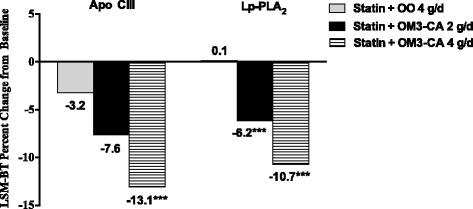
BACKGROUND: This study examined the effects of a mixture of highly bioavailable omega-3 carboxylic acids (OM3-CA) on nuclear magnetic resonance spectroscopy-assessed lipoprotein particle concentrations and sizes and other cardiovascular risk markers in statin-treated patients with fasting triglycerides (TG) ≥ 2.3 mmol/L (200 mg/dL) and <5.6 mmol/L (500 mg/dL) and at high cardiovascular risk. METHODS: After a diet lead-in and statin-stabilization period, 647 patients were randomly assigned to receive capsules of control (olive oil, OO) 4 g/d, OM3-CA 2 g/d (plus OO 2 g/d), or OM3-CA 4 g/d for 6 weeks. RESULTS: Compared with OO, low-density lipoprotein (LDL) particle size was increased with OM3-CA 2 g/d (p < 0.01) and 4 g/d (p < 0.001), and very low-density lipoprotein (VLDL) and high-density lipoprotein (HDL) particle sizes were decreased with both OM3-CA dosages vs. OO (p < 0.001 and p < 0.05 for VLDL and HDL, respectively). Total VLDL/chylomicron remnant particle concentration was reduced by 8.5 and 16.0 % with OM3-CA 2 and 4 g/d, respectively, vs. a 6.9 % reduction with OO (p < 0.001 for OM3-CA 4 g/d vs. OO). Total HDL particle concentration was also reduced by 1.5 and 3.2 % with OM3-CA 2 and 4 g/d, respectively, vs. a 0.6 % increase with OO (at least p < 0.05 for both comparisons). Changes in total LDL particle concentration were not significantly different for OO vs. OM3-CA at either dosage. Apolipoprotein (Apo) CIII levels decreased by 7.6 and 13.1 % with OM3-CA 2 and 4 g/d, respectively, vs. 3.2 % with OO (p < 0.001 for OM3-CA 4 g/d vs. OO). Lipoprotein-associated phospholipase A2 (Lp-PLA2) mass was reduced by 6.2 and 10.7 % with OM3-CA 2 and 4 g/d, respectively, vs. a 0.1 % increase with OO (p < 0.001 for both vs. OO). There were no significant differences between treatments in high-sensitivity C-reactive protein responses. CONCLUSION: OM3-CA were associated with shifts in lipoprotein particle sizes and concentrations, and reductions in Apo CIII and Lp-PLA2, in patients with hypertriglyceridemia while taking a statin. TRIAL REGISTRATION: ClinicalTrials.gov Identifier NCT01408303.
Overview
The claims and statistics of this paper haven’t been checked yet.
Free: it reads the open-access text and checks the first 5 claims that cite a source we can check. Create a free account to check every claim.
Integrity signals
Registry
Cites
Statistics
Figures
Verification
Claims the paper makes
The claims and statistics of this paper haven’t been checked yet.
Free: it reads the open-access text and checks the first 5 claims that cite a source we can check. Create a free account to check every claim.
Claims other papers make about this one
Each is checked against this paper’s own text: does it say what the citing paper says it does?
The cited source says what the claim attributes to it.
In the citing paper
“deed, such an effect on LDL particle size is supported by the results of more recent studies of HTG.”
From Omega-3 Fatty Acids for the Management of Hypertriglyceridemia: A Science Advisory From the American Heart Association (2019) · cites this paper as [25]
The cited source says what the claim attributes to it.
In the citing paper
“In this study and another of O3AEE, there was a modest increase in LDL particle size.”
From Omega-3 Fatty Acids for the Management of Hypertriglyceridemia: A Science Advisory From the American Heart Association (2019) · cites this paper as [25]
Self-check
Percentages, sums and reported differences re-computed from the paper’s own numbers.
The self-check needs the paper’s full text.
Citations
Cites
Detection, evaluation, and treatment of high blood cholesterol in adults (Adult Treatment Panel III)
Grundy, S. M., Becker, D. M., Clark, L. T., Cooper, R., Denke, M. A., Howard, J. L., Hunninghake, D. B., Illingworth, D. R., Luepker, R. V., McBride, P. E., et al. (2002) · Civil War Book Review · Cited by 12,198
Grundy, S. M., Cleeman, J. I., Merz, C. N. B., Brewer, H. B., Clark, L. T., Hunninghake, D. B., Pasternak, R. C., Smith, S. C., & Stone, N. J. (2004) · Circulation · doi:10.1161/01.cir.0000133317.49796.0e · Cited by 6,902
Clinical application of C-reactive protein for cardiovascular disease detection and prevention
Ridker, P. M. (2003) · Circulation · doi:10.1161/01.cir.0000053730.47739.3c · Cited by 2,513 · cited 2×
“hs-CRP is an inflammatory marker, and an elevated level is associated with increased CVD risk [16, 43].”
BackgroundMethodCholesterol efflux capacity, high-density lipoprotein function, and atherosclerosis
Khera, A. V., Cuchel, M., de la Llera-Moya, M., Rodrigues, A., Burke, M. F., Jafri, K., French, B. C., Phillips, J. A., Mucksavage, M. L., Wilensky, R. L., et al. (2011) · New England Journal of Medicine · doi:10.1056/nejmoa1001689 · Cited by 1,943 · cited 1×
“If confirmed in humans, this would have potential clinical relevance, because cholesterol efflux capacity has been found to be a better predictor of CVD risk than the HDL-C concentration [27].”
BackgroundJones, P. H., Davidson, M. H., Stein, E. A., Bays, H. E., McKenney, J. M., Miller, E., Cain, V. A., & Blasetto, J. W. (2003) · The American Journal of Cardiology · doi:10.1016/s0002-9149(03)00530-7 · Cited by 1,398
Self-citationLoss-of-Function Mutations in APOC3, Triglycerides, and Coronary Disease
The TG and HDL Working Group of the Exome Sequencing Project, N. H. (2014) · New England Journal of Medicine · doi:10.1056/nejmoa1307095 · Cited by 1,071
Loss-of-Function Mutations in APOC3 and Risk of Ischemic Vascular Disease
Jørgensen, A. B., Frikke-Schmidt, R., Nordestgaard, B. G., & Tybjærg-Hansen, A. (2014) · New England Journal of Medicine · doi:10.1056/nejmoa1308027 · Cited by 919 · cited 1×
“Moreover, loss-of-function polymorphisms in the Apo CIII gene (APOC3) have been associated with lower TG and reduced coronary and ischemic vascular disease risks [13–15].”
BackgroundPollin, T. I., Damcott, C. M., Shen, H., Ott, S. H., Shelton, J., Horenstein, R. B., Post, W., McLenithan, J. C., Bielak, L. F., Peyser, P. A., et al. (2008) · Science · doi:10.1126/science.1161524 · Cited by 688 · cited 1×
“Moreover, loss-of-function polymorphisms in the Apo CIII gene (APOC3) have been associated with lower TG and reduced coronary and ischemic vascular disease risks [13–15].”
Background
Cited by
Skulas-Ray, A. C., Wilson, P. W. F., Harris, W. S., Brinton, E. A., Kris-Etherton, P. M., Richter, C. K., Jacobson, T. A., Engler, M. B., Miller, M., Robinson, J. G., et al. (2019) · Circulation · doi:10.1161/cir.0000000000000709 · Cited by 512
Emerging Mechanisms of Cardiovascular Protection for the Omega-3 Fatty Acid Eicosapentaenoic Acid
Mason, R. P., Libby, P., & Bhatt, D. L. (2020) · Arteriosclerosis, Thrombosis, and Vascular Biology · doi:10.1161/atvbaha.119.313286 · Cited by 407
Lechner, K., von Schacky, C., McKenzie, A. L., Worm, N., Nixdorff, U., Lechner, B., Kränkel, N., Halle, M., Krauss, R. M., & Scherr, J. (2020) · European Journal of Preventive Cardiology · doi:10.1177/2047487319869400 · Cited by 371
The Roles of ApoC-III on the Metabolism of Triglyceride-Rich Lipoproteins in Humans
Borén, J., Packard, C. J., & Taskinen, M.-R. (2020) · Frontiers in Endocrinology · doi:10.3389/fendo.2020.00474 · Cited by 196
Emerging Evidence that ApoC-III Inhibitors Provide Novel Options to Reduce the Residual CVD
Taskinen, M.-R., Packard, C. J., & Borén, J. (2019) · Current Atherosclerosis Reports · doi:10.1007/s11883-019-0791-9 · Cited by 103
Tsartsou, E., Proutsos, N., Castanas, E., & Kampa, M. (2019) · Frontiers in Nutrition · doi:10.3389/fnut.2019.00006 · Cited by 84
Detopoulou, P., Demopoulos, C. A., & Antonopoulou, S. (2021) · Nutrients · doi:10.3390/nu13020462 · Cited by 85
Therapeutic potential of pro-resolving mediators in diabetic kidney disease
Vartak, T., Godson, C., & Brennan, E. P. (2021) · Advanced Drug Delivery Reviews · doi:10.1016/j.addr.2021.113965 · Cited by 72
Thota, R. N., Ferguson, J. J. A., Abbott, K. A., Dias, C. B., & Garg, M. L. (2018) · Food & Function · doi:10.1039/c8fo00348c · Cited by 65
Triglycerides, Atherosclerosis, and Cardiovascular Outcome Studies: Focus on Omega-3 Fatty Acids
Handelsman, Y., & Shapiro, M. D. (2016) · Endocrine Practice · doi:10.4158/ep161445.ra · Cited by 60
Miller, M. J., Ballantyne, C. M., Bays, H. E., Granowitz, C. B., Doyle, R. T., Juliano, R. A., & Philip, S. (2019) · The American Journal of Cardiology · doi:10.1016/j.amjcard.2019.05.057 · Cited by 52
Sahebkar, A., Simental-Mendía, L. E., Mikhailidis, D. P., Pirro, M., Banach, M., Sirtori, C. R., & Reiner, Ž. (2018) · Annals of Medicine · doi:10.1080/07853890.2018.1511919 · Cited by 48
Ballantyne, C. M., Bays, H. E., Braeckman, R. A., Philip, S., Stirtan, W. G., Doyle, R. T., Soni, P. N., & Juliano, R. A. (2016) · Journal of Clinical Lipidology · doi:10.1016/j.jacl.2016.02.008 · Cited by 47
O’Connell, T. D., Mason, R. P., Budoff, M. J., Návar, A. M., & Shearer, G. C. (2020) · European Heart Journal Supplements · doi:10.1093/eurheartj/suaa115 · Cited by 47
Maki, K. C., Lawless, A. L., Kelley, K., Kaden, V. N., Geiger, C. J., Palacios, O. M., & Dicklin, M. R. (2016) · European Journal of Clinical Nutrition · doi:10.1038/ejcn.2016.169 · Cited by 41
Self-citationMaki, K. C., Palacios, O. M., Lindner, E., Nieman, K. M., Bell, M., & Sorce, J. (2017) · Journal of Nutrition · doi:10.3945/jn.117.248641 · Cited by 38
Self-citationKim, C. H., Han, K. A., Yu, J., Lee, S. H., Jeon, H. K., Kim, S. H., Kim, S. Y., Han, K. H., Won, K., Kim, D.-B., et al. (2018) · Clinical Therapeutics · doi:10.1016/j.clinthera.2017.11.007 · Cited by 36
Metabolism of Triglyceride-Rich Lipoproteins
Borén, J., & Taskinen, M. (2021) · Handbook of experimental pharmacology · doi:10.1007/164_2021_520 · Cited by 30
Ide, K., Koshizaka, M., Tokuyama, H., Tokuyama, T., Ishikawa, T., Maezawa, Y., Takemoto, M., & Yokote, K. (2018) · Lipids in Health and Disease · doi:10.1186/s12944-018-0706-8 · Cited by 29
The Road to Approval: a Perspective on the Role of Icosapent Ethyl in Cardiovascular Risk Reduction
Wang, X., Verma, S., Mason, R. P., & Bhatt, D. L. (2020) · Current Diabetes Reports · doi:10.1007/s11892-020-01343-7 · Cited by 24
Maki, K. C., Palacios, O. M., Buggia, M., Trivedi, R., Dicklin, M. R., & Maki, C. E. (2018) · Clinical Therapeutics · doi:10.1016/j.clinthera.2018.10.014 · Cited by 24
Self-citationKaviani, S., Taylor, C. M., Stevenson, J. L., Cooper, J. A., & Paton, C. M. (2019) · BMC Nutrition · doi:10.1186/s40795-018-0262-7 · Cited by 21
Lechner, K., Scherr, J., Lorenz, E., Lechner, B., Haller, B., Krannich, A., Halle, M., Wachter, R., Duvinage, A., & Edelmann, F. (2021) · Clinical Research in Cardiology · doi:10.1007/s00392-021-01925-9 · Cited by 21
Masuda, D., Miyata, Y., Matsui, S., & Yamashita, S. (2019) · Atherosclerosis · doi:10.1016/j.atherosclerosis.2019.11.014 · Cited by 19
Eicosapentaenoic acid vs. docosahexaenoic acid for the prevention of cardiovascular disease
Sweeney, T. E., Gaine, S. P., & Michos, E. D. (2023) · Current Opinion in Endocrinology, Diabetes & Obesity · doi:10.1097/med.0000000000000796 · Cited by 18
The future of n-3 polyunsaturated fatty acid therapy
Davidson, M. H., & Benes, L. B. (2016) · Current Opinion in Lipidology · doi:10.1097/mol.0000000000000353 · Cited by 18
Self-citationJun, J. E., Jeong, I., Yu, J. M., Kim, S. R., Lee, I. K., Han, K. A., Choi, S. H., Kim, S., Park, H. K., Mok, J., et al. (2019) · Diabetes & Metabolism Journal · doi:10.4093/dmj.2018.0265 · Cited by 20
Controversies in the Use of Omega-3 Fatty Acids to Prevent Atherosclerosis
Quispe, R., Alfaddagh, A., Kazzi, B., Zghyer, F., Marvel, F. A., Blumenthal, R. S., Sharma, G., & Martin, S. S. (2022) · Current Atherosclerosis Reports · doi:10.1007/s11883-022-01031-9 · Cited by 17
Grytten, E., Laupsa‐Borge, J., Bohov, P., Bjørndal, B., Strand, E., Skorve, J., Nordrehaug, J. E., Berge, R. K., Rostrup, E., Mellgren, G., et al. (2021) · Clinical Nutrition · doi:10.1016/j.clnu.2021.03.040 · Cited by 15
Omega-3 carboxylic acids monotherapy and combination with statins in the management of dyslipidemia
Benes, L. B., Bassi, N. S., & Davidson, M. H. (2016) · Vascular Health and Risk Management · doi:10.2147/vhrm.s58149 · Cited by 13
Self-citationTani, S., Matsuo, R., Kawauchi, K., Yagi, T., Atsumi, W., & Hirayama, A. (2017) · Heart and Vessels · doi:10.1007/s00380-017-1082-4 · Cited by 12
Schiano, E., Annunziata, G., Ciampaglia, R., Iannuzzo, F., Maisto, M., Tenore, G. C., & Novellino, E. (2020) · Frontiers in Nutrition · doi:10.3389/fnut.2020.586178 · Cited by 11
Ueda, M., Wolska, A. T., Burke, F. M., Escobar, M., Walters, L. L., Lalic, D., Hegele, R. A., Remaley, A. T., Rader, D. J., & Dunbar, R. L. (2020) · Case Reports in Endocrinology · doi:10.1155/2020/1865489 · Cited by 10
Self-citationDunbar, R. L., Gaudet, D., Davidson, M. H., Rensfeldt, M., Yang, H., Nilsson, C. A. M., Kvarnström, M., & Oscarsson, J. (2020) · Lipids in Health and Disease · doi:10.1186/s12944-020-01295-7 · Cited by 10
Self-citationCalderón-Pérez, L., Companys, J., Solà, R., Pedret, A., & Valls, R. M. (2022) · Nutrition Reviews · doi:10.1093/nutrit/nuac101 · Cited by 8
Adipose tissue macrophages and atherogenesis – a synergy with cholesterolaemia
Poledne, R., & Lesná, I. K. (2021) · Physiological Research · doi:10.33549//physiolres.934745 · Cited by 7
Advances in diagnosis and potential therapeutic options for familial chylomicronemia syndrome
Benes, L. B., Brandt, E. J., & Davidson, M. H. (2018) · Expert Opinion on Orphan Drugs · doi:10.1080/21678707.2018.1419863 · Cited by 6
Self-citationNam, G. E., Myung, S., & Choi, Y. (2017) · European Journal of Lipid Science and Technology · doi:10.1002/ejlt.201700111 · Cited by 6
Fukase, T., Dohi, T., Nishio, R., Takeuchi, M., Takahashi, N., Chikata, Y., Endo, H., Doi, S., Nishiyama, H., Okai, I., et al. (2024) · Frontiers in Cardiovascular Medicine · doi:10.3389/fcvm.2024.1430203 · Cited by 5
Simental-Mendía, L. E., Simental-Mendía, M. A., Barragán‐Zuñiga, L. J., & Aguillón-Marín, P. (2025) · Journal of clinical lipidology · doi:10.1016/j.jacl.2025.12.013 · Cited by 4
The Evolving Role of Omega 3 Fatty Acids in Cardiovascular Disease: Is Icosapent Ethyl the Answer?
Lakshmanan, S., & Budoff, M. J. (2021) · Heart International · doi:10.17925/hi.2021.15.1.7 · Cited by 4
Tackling Residual Atherosclerotic Risk in Statin-Treated Adults: Focus on Emerging Drugs
Takata, K., & Nicholls, S. J. (2018) · American Journal of Cardiovascular Drugs · doi:10.1007/s40256-018-0312-1 · Cited by 4
Self-citationInvestigational drugs in development for hypertriglyceridemia: a coming-of-age story
Rhainds, D., Brodeur, M. R., & Tardif, J. (2019) · Expert Opinion on Investigational Drugs · doi:10.1080/13543784.2019.1696772 · Cited by 4
Hande, L. N., Kjellmo, C. A., Pettersen, K., Ljunggren, S., Karlsson, H., Cederbrant, K., Marcusson‐Ståhl, M., Hovland, A., & Lappegård, K. T. (2022) · Biomedicines · doi:10.3390/biomedicines10081809 · Cited by 3
Manubolu, V. S., Budoff, M. J., & Lakshmanan, S. (2022) · Heart International · doi:10.17925/hi.2022.16.1.2 · Cited by 3
A narrative review of impacts of apolipoproteins on atherosclerotic coronary plaques
Fukase, T., & Dohi, T. (2026) · npj Cardiovascular Health · doi:10.1038/s44325-026-00104-x · Cited by 2
Borja, M. S., Hammerson, B., Tang, C., Juarez-Serrano, L., Savinova, O. V., Harris, W. S., Oda, M. N., & Shearer, G. C. (2024) · PLoS ONE · doi:10.1371/journal.pone.0296052 · Cited by 2
Lechner, K., Scherr, J., Lorenz, E., Lechner, B., Haller, B., Halle, M., Wachter, R., Duvinage, A., & Edelmann, F. (2021) · Research Square · doi:10.21203/rs.3.rs-551004/v1
動脈硬化 = The journal of Japan Atherosclerosis Society
日本動脈硬化研究会, & 日本動脈硬化学会 (2002) · Medical Entomology and Zoology
Dunbar, R. L., Gaudet, D., Davidson, M., Rensfeldt, M., Yang, H., Nilsson, C. A. M., Kvarnström, M., & Oscarsson, J. (2020) · Figshare · doi:10.6084/m9.figshare.12401081
Self-citationKana, I. D. E. (2018) · Institutional Repositories DataBase (IRDB) · doi:10.20776/105302
Ng, W. H., Aghakishiyeva, E., Markus, H. S., & Harshfield, E. L. (2026) · Neurology · doi:10.1212/wnl.0000000000218409
Metadata
- Authors
- Dunbar, R. L., Nicholls, S. J., Maki, K. C., Roth, E. M., Orloff, D. G., Curcio, D., Johnson, J., Kling, D., & Davidson, M. H.
- Affiliations
- University of Pennsylvania (US)
- South Australian Health and Medical Research Institute (AU)
- MB Clinical Research and Consulting (United States) (US)
- Sterling Research Group (US)
- Medpace (United States) (US)
- The Princeton Festival (US)
- AstraZeneca (United States) (US)
- Corresponding author
- Dunbar, Richard L.
- ORCID
- Venue
- Lipids in Health and Disease
- Published
- 2015-09-02
- Volume
- 14
- Issue
- 1
- Pages
- 98-98
- ISSN
- 1476-511X (ISSN-L)
- PMC
- PMC4557761
- OpenAlex
- W2136794447
- Cited by
- 52
- References
- 52
- Citations by year
- 2026: 2 · 2025: 1 · 2024: 2 · 2022: 5 · 2021: 9 · 2020: 8 · 2019: 9 · 2018: 5 · 2017: 5 · 2016: 5
- FWCI
- 4.81
- Type
- journal article
- Language
- en
- Open access
- gold
- doi.org
- Licence
- cc-by
- Locations
- Lipids in Health and Disease (publishedVersion, cc-by)
- Europe PMC (PubMed Central) (publishedVersion, cc-by)
- PubMed Central (publishedVersion, cc-by)
- PubMed (publishedVersion)
- Funders
- Saint Luke's Health System
- National Institutes of Health
- National Heart, Lung, and Blood Institute (K23HL091130)
- Topics
- Health Sciences › Nursing › Nutrition and Dietetics › Fatty Acid Research and Health
- Health Sciences › Medicine › Cardiology and Cardiovascular Medicine › Lipoproteins and Cardiovascular Health
- Health Sciences › Medicine › Cardiology and Cardiovascular Medicine › Lipid metabolism and disorders
- Keywords
- statin-treated patients, lipoprotein particle size, LDL particle size, apolipoprotein C-III, apolipoprotein A-II, apolipoprotein E, apolipoprotein B, apolipoprotein A-I, apolipoprotein B-100
- MeSH terms
- Olive Oil, Aged, Anticholesteremic Agents, C-Reactive Protein, Cardiovascular Diseases, Docosahexaenoic Acids, Double-Blind Method, Female, Humans, Lipoproteins, HDL, Cholesterol, LDL, Male, Middle Aged, Triglycerides, Eicosapentaenoic Acid, Hypertriglyceridemia, Cholesterol, VLDL, Hydroxymethylglutaryl-CoA Reductase Inhibitors, Chylomicron Remnants, Apolipoprotein C-III, Phospholipases A2
About these checks
Registry, retraction, Cites and statistics results are computed, not judged, with one exception: a printed reference that no index lists is read once by a model before it counts as a citation error. Claims are extracted by a model and kept only when their quote appears verbatim in the text; each cited source is then checked, with a model’s help, for whether it says what the claim relies on. Those verdicts can be wrong — read the claim’s quote and the cited source before relying on one.
Statistics and arithmetic are recomputed, not judged.
Confidence bands are shown only for fields calibrated on our annotated test set. None is calibrated yet, so no band is shown.
What counts as a claim ›How we measure confidence ›How we check this ›
Are you an author, or do you see a problem with this page? Request a review
Data sources
Bibliographic data: Semantic Scholar, OpenAlex, Crossref.
Contains information from the Semantic Scholar Academic Graph Datasets, made available under the ODC Attribution License (ODC-BY 1.0).
Semantic Scholar’s data is described in: Kinney, R., et al. (2023). The Semantic Scholar Open Data Platform. arXiv:2301.10140.
