

Effects of omega-3 carboxylic acids on lipoprotein particles and other cardiovascular risk markers in high-risk statin-treated patients with residual hypertriglyceridemia: a randomized, controlled, double-blind trial
Open accessThe DOI matches its Crossref record; 51 of the 52 references it cites were found in a registry or an index.
Abstract
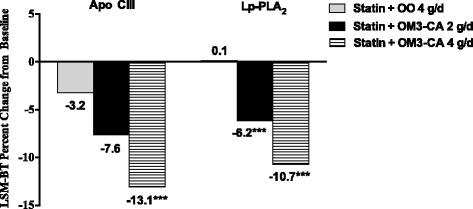
BACKGROUND: This study examined the effects of a mixture of highly bioavailable omega-3 carboxylic acids (OM3-CA) on nuclear magnetic resonance spectroscopy-assessed lipoprotein particle concentrations and sizes and other cardiovascular risk markers in statin-treated patients with fasting triglycerides (TG) ≥ 2.3 mmol/L (200 mg/dL) and <5.6 mmol/L (500 mg/dL) and at high cardiovascular risk. METHODS: After a diet lead-in and statin-stabilization period, 647 patients were randomly assigned to receive capsules of control (olive oil, OO) 4 g/d, OM3-CA 2 g/d (plus OO 2 g/d), or OM3-CA 4 g/d for 6 weeks. RESULTS: Compared with OO, low-density lipoprotein (LDL) particle size was increased with OM3-CA 2 g/d (p < 0.01) and 4 g/d (p < 0.001), and very low-density lipoprotein (VLDL) and high-density lipoprotein (HDL) particle sizes were decreased with both OM3-CA dosages vs. OO (p < 0.001 and p < 0.05 for VLDL and HDL, respectively). Total VLDL/chylomicron remnant particle concentration was reduced by 8.5 and 16.0 % with OM3-CA 2 and 4 g/d, respectively, vs. a 6.9 % reduction with OO (p < 0.001 for OM3-CA 4 g/d vs. OO). Total HDL particle concentration was also reduced by 1.5 and 3.2 % with OM3-CA 2 and 4 g/d, respectively, vs. a 0.6 % increase with OO (at least p < 0.05 for both comparisons). Changes in total LDL particle concentration were not significantly different for OO vs. OM3-CA at either dosage. Apolipoprotein (Apo) CIII levels decreased by 7.6 and 13.1 % with OM3-CA 2 and 4 g/d, respectively, vs. 3.2 % with OO (p < 0.001 for OM3-CA 4 g/d vs. OO). Lipoprotein-associated phospholipase A2 (Lp-PLA2) mass was reduced by 6.2 and 10.7 % with OM3-CA 2 and 4 g/d, respectively, vs. a 0.1 % increase with OO (p < 0.001 for both vs. OO). There were no significant differences between treatments in high-sensitivity C-reactive protein responses. CONCLUSION: OM3-CA were associated with shifts in lipoprotein particle sizes and concentrations, and reductions in Apo CIII and Lp-PLA2, in patients with hypertriglyceridemia while taking a statin. TRIAL REGISTRATION: ClinicalTrials.gov Identifier NCT01408303.
Overview
The claims and statistics of this paper haven’t been checked yet.
Free: it reads the open-access text and checks the first 5 claims that cite a source we can check. Create a free account to check every claim.
Integrity signals
Registry
Cites
Statistics
Figures
Verification
Claims the paper makes
The claims and statistics of this paper haven’t been checked yet.
Free: it reads the open-access text and checks the first 5 claims that cite a source we can check. Create a free account to check every claim.
Claims other papers make about this one
Each is checked against this paper’s own text: does it say what the citing paper says it does?
The cited source says what the claim attributes to it.
In the citing paper
“deed, such an effect on LDL particle size is supported by the results of more recent studies of HTG.”
From Omega-3 Fatty Acids for the Management of Hypertriglyceridemia: A Science Advisory From the American Heart Association (2019) · cites this paper as [25]
The cited source says what the claim attributes to it.
In the citing paper
“In this study and another of O3AEE, there was a modest increase in LDL particle size.”
From Omega-3 Fatty Acids for the Management of Hypertriglyceridemia: A Science Advisory From the American Heart Association (2019) · cites this paper as [25]
Self-check
Percentages, sums and reported differences re-computed from the paper’s own numbers.
The self-check needs the paper’s full text.
Citations
Cites
Detection, evaluation, and treatment of high blood cholesterol in adults (Adult Treatment Panel III)
Grundy, S. M., Becker, D. M., Clark, L. T., Cooper, R., Denke, M. A., Howard, J. L., Hunninghake, D. B., Illingworth, D. R., Luepker, R. V., McBride, P. E., et al. (2002) · Civil War Book Review · Cited by 12,198
Grundy, S. M., Cleeman, J. I., Merz, C. N. B., Brewer, H. B., Clark, L. T., Hunninghake, D. B., Pasternak, R. C., Smith, S. C., & Stone, N. J. (2004) · Circulation · doi:10.1161/01.cir.0000133317.49796.0e · Cited by 6,902
Clinical application of C-reactive protein for cardiovascular disease detection and prevention
Ridker, P. M. (2003) · Circulation · doi:10.1161/01.cir.0000053730.47739.3c · Cited by 2,513 · cited 2×
“hs-CRP is an inflammatory marker, and an elevated level is associated with increased CVD risk [16, 43].”
BackgroundMethodCholesterol efflux capacity, high-density lipoprotein function, and atherosclerosis
Khera, A. V., Cuchel, M., de la Llera-Moya, M., Rodrigues, A., Burke, M. F., Jafri, K., French, B. C., Phillips, J. A., Mucksavage, M. L., Wilensky, R. L., et al. (2011) · New England Journal of Medicine · doi:10.1056/nejmoa1001689 · Cited by 1,943 · cited 1×
“If confirmed in humans, this would have potential clinical relevance, because cholesterol efflux capacity has been found to be a better predictor of CVD risk than the HDL-C concentration [27].”
BackgroundJones, P. H., Davidson, M. H., Stein, E. A., Bays, H. E., McKenney, J. M., Miller, E., Cain, V. A., & Blasetto, J. W. (2003) · The American Journal of Cardiology · doi:10.1016/s0002-9149(03)00530-7 · Cited by 1,398
Self-citationLoss-of-Function Mutations in APOC3, Triglycerides, and Coronary Disease
The TG and HDL Working Group of the Exome Sequencing Project, N. H. (2014) · New England Journal of Medicine · doi:10.1056/nejmoa1307095 · Cited by 1,071
Loss-of-Function Mutations in APOC3 and Risk of Ischemic Vascular Disease
Jørgensen, A. B., Frikke-Schmidt, R., Nordestgaard, B. G., & Tybjærg-Hansen, A. (2014) · New England Journal of Medicine · doi:10.1056/nejmoa1308027 · Cited by 919 · cited 1×
“Moreover, loss-of-function polymorphisms in the Apo CIII gene (APOC3) have been associated with lower TG and reduced coronary and ischemic vascular disease risks [13–15].”
BackgroundPollin, T. I., Damcott, C. M., Shen, H., Ott, S. H., Shelton, J., Horenstein, R. B., Post, W., McLenithan, J. C., Bielak, L. F., Peyser, P. A., et al. (2008) · Science · doi:10.1126/science.1161524 · Cited by 688 · cited 1×
“Moreover, loss-of-function polymorphisms in the Apo CIII gene (APOC3) have been associated with lower TG and reduced coronary and ischemic vascular disease risks [13–15].”
BackgroundDarapladib for Preventing Ischemic Events in Stable Coronary Heart Disease
The STABILITY Investigators (2014) · New England Journal of Medicine · doi:10.1056/nejmoa1315878 · Cited by 579
Omega-3 fatty acids and coronary heart disease risk: clinical and mechanistic perspectives
Harris, W. S., Miller, M., Tighe, A. P., Davidson, M. H., & Schaefer, E. J. (2008) · Atherosclerosis · doi:10.1016/j.atherosclerosis.2007.11.008 · Cited by 552 · cited 1×
“Some, but not all, studies have shown increases in LDL-C with omega-3 fatty acids therapy in patients with high or very high TG [17–19].”
ResultSelf-citationOtvos, J. D., Collins, D., Freedman, D. S., Shalaurova, I., Schaefer, E. J., McNamara, J. R., Bloomfield, H. E., & Robins, S. J. (2006) · Circulation · doi:10.1161/circulationaha.105.565135 · Cited by 547
Sacks, F. M., Alaupovic, P., Moye, L. A., Cole, T. G., Sussex, B., Stampfer, M. J., Pfeffer, M. A., & Braunwald, E. (2000) · Circulation · doi:10.1161/01.cir.102.16.1886 · Cited by 490
O’Donoghue, M. L., Braunwald, E., White, H. D., Steen, D. P., Lukas, M. A., Tarka, E., Steg, P. G., Hochman, J. S., Bode, C., Maggioni, A. P., et al. (2014) · JAMA · doi:10.1001/jama.2014.11061 · Cited by 456
Ginsberg, H. N., Le, N. A., Goldberg, I. J., Gibson, J. C., Rubinstein, A., Wang-Iverson, P., Norum, R., & Brown, W. V. (1986) · Journal of Clinical Investigation · doi:10.1172/jci112713 · Cited by 424 · cited 1×
“The role that Apo CIII plays in the pathogenesis of hypertriglyceridemia is becoming increasingly evident [9, 10, 31].”
BackgroundWhy do omega-3 fatty acids lower serum triglycerides?
Harris, W. S., & Bulchandani, D. (2006) · Current Opinion in Lipidology · doi:10.1097/01.mol.0000236363.63840.16 · Cited by 398
Mechanisms for the Hypotriglyceridemic Effect of Marine Omega-3 Fatty Acids
Davidson, M. H. (2006) · The American Journal of Cardiology · doi:10.1016/j.amjcard.2005.12.024 · Cited by 374
Self-citationOmega-3 fatty acid supplementation accelerates chylomicron triglyceride clearance
Park, Y., & Harris, W. S. (2003) · Journal of Lipid Research · doi:10.1194/jlr.m200282-jlr200 · Cited by 348
Safety and Efficacy of Omacor in Severe Hypertriglyceridemia
Harris, W. S., Ginsberg, H. N., Arunakul, N., Shachter, N. S., Windsor, S. L., Adams, M., Berglund, L., & Osmundsen, K. (1997) · European Journal of Cardiovascular Prevention & Rehabilitation · doi:10.1177/174182679700400511 · Cited by 306
Wei, M. Y., & Jacobson, T. A. (2011) · Current Atherosclerosis Reports · doi:10.1007/s11883-011-0210-3 · Cited by 284 · cited 8×
“Subjects included in the study were men and nonpregnant, non-lactating women ≥18 years of age with fasting TG ≥2.3 mmol/L (200 mg/dL) and 5.6 mmol/L (500 mg/dL) (after the statin/diet lead-in), at high risk for a future cardiovascular event, and at or near the NCEP goal for low-density lipoprotein cholesterol (LDL-C)…”
BackgroundInfluentialApolipoprotein C-III: understanding an emerging cardiovascular risk factor
Ooi, E. M. M., Barrett, P. H. R., Chan, D. C., & Watts, G. F. (2008) · Clinical Science · doi:10.1042/cs20070308 · Cited by 282 · cited 1×
“Elevated levels of both Apo CIII [8, 9, 11, 12] and Lp-PLA2 [28–30] have been associated with increased CVD event risk beyond that attributable to traditional risk factors.”
BackgroundJacobson, T. A., Glickstein, S. B., Rowe, J. D., & Soni, P. N. (2012) · Journal of Clinical Lipidology · doi:10.1016/j.jacl.2011.10.018 · Cited by 263 · cited 8×
“Subjects included in the study were men and nonpregnant, non-lactating women ≥18 years of age with fasting TG ≥2.3 mmol/L (200 mg/dL) and 5.6 mmol/L (500 mg/dL) (after the statin/diet lead-in), at high risk for a future cardiovascular event, and at or near the NCEP goal for low-density lipoprotein cholesterol (LDL-C)…”
BackgroundInfluentialSafety and efficacy of Omacor in severe hypertriglyceridemia
Harris, W. S., Ginsberg, H. N., Arunakul, N., Shachter, N. S., Windsor, S. L., Adams, M., Berglund, L., & Osmundsen, K. (1997) · Journal of Cardiovascular Risk · doi:10.1097/00043798-199710000-00011 · Cited by 252
Kastelein, J. J. P., Maki, K. C., Susekov, A., Ezhov, M., Nordestgaard, B. G., Machielse, B. N., Kling, D., & Davidson, M. H. (2014) · Journal of Clinical Lipidology · doi:10.1016/j.jacl.2013.10.003 · Cited by 233 · cited 1×
“6 mmol/L [500 mg/dL]) [3] and to statin-treated patients with TG ≥2.”
BackgroundSelf-citationTriacylglycerol-rich lipoproteins and the generation of small, dense low-density lipoprotein
Packard, C. J. (2003) · Biochemical Society Transactions · doi:10.1042/bst0311066 · Cited by 225
ChREBP: A Glucose-activated Transcription Factor Involved in the Development of Metabolic Syndrome
IIZUKA, K., & HORIKAWA, Y. (2008) · Endocrine Journal · doi:10.1507/endocrj.k07e-110 · Cited by 221
Pownall, H. J., Brauchi, D., Kilinç, C., Osmundsen, K., Pao, Q., Payton-Ross, C., Gotto, A. M., & Ballantyne, C. M. (1999) · Atherosclerosis · doi:10.1016/s0021-9150(98)00301-3 · Cited by 179 · cited 1×
“Some, but not all, studies have shown increases in LDL-C with omega-3 fatty acids therapy in patients with high or very high TG [17–19].”
ResultLow-Density Lipoproteins Containing Apolipoprotein C-III and the Risk of Coronary Heart Disease
Mendivil, C. O., Rimm, E. B., Furtado, J., Chiuve, S. E., & Sacks, F. M. (2011) · Circulation · doi:10.1161/circulationaha.111.056986 · Cited by 136
C-reactive protein and risk of cardiovascular disease: Evidence and clinical application
Ridker, P. M., Bassuk, S. S., & Toth, P. P. (2003) · Current Atherosclerosis Reports · doi:10.1007/s11883-003-0004-3 · Cited by 119
Maki, K. C., Orloff, D. G., Nicholls, S. J., Dunbar, R. L., Roth, E. M., Curcio, D., Johnson, J., Kling, D., & Davidson, M. H. (2013) · Clinical Therapeutics · doi:10.1016/j.clinthera.2013.07.420 · Cited by 104 · cited 6×
“6 mmol/L (500 mg/dL) and at high risk for a cardiovascular disease (CVD) event [4].”
BackgroundMethodResultInfluentialSelf-citationApolipoprotein CIII links dyslipidemia with atherosclerosis
Kawakami, A., & Yoshida, M. (2009) · Journal of Atherosclerosis and Thrombosis · doi:10.5551/jat.e607 · Cited by 98 · cited 3×
“Elevated levels of both Apo CIII [8, 9, 11, 12] and Lp-PLA2 [28–30] have been associated with increased CVD event risk beyond that attributable to traditional risk factors.”
BackgroundFoxO1 and hepatic lipid metabolism
Sparks, J. D., & Dong, H. H. (2009) · Current Opinion in Lipidology · doi:10.1097/mol.0b013e32832b3f4c · Cited by 96
Anderson, J. L. (2008) · The American Journal of Cardiology · doi:10.1016/j.amjcard.2008.04.015 · Cited by 89
Maki, K. C., Bays, H. E., Dicklin, M. R., Johnson, S. L., & Shabbout, M. (2011) · Journal of Clinical Lipidology · doi:10.1016/j.jacl.2011.09.001 · Cited by 81
Self-citationMaki, K. C., McKenney, J. M., Reeves, M. S., Lubin, B. C., & Dicklin, M. R. (2008) · The American Journal of Cardiology · doi:10.1016/j.amjcard.2008.03.078 · Cited by 81 · cited 3×
“The increased cholesterol is probably the result of an increase in mean LDL particle size, because trials in mixed dyslipidemia have consistently shown no increase in LDL particle concentration [5, 7].”
BackgroundInfluentialSelf-citationRidker, P. M., MacFadyen, J. G., Wolfert, R. L., & Koenig, W. (2012) · Clinical Chemistry · doi:10.1373/clinchem.2011.180281 · Cited by 79
Davidson, M. H., Maki, K. C., Bays, H., Carter, R., & Ballantyne, C. M. (2009) · Journal of Clinical Lipidology · doi:10.1016/j.jacl.2009.08.001 · Cited by 71
Self-citationGinsberg (2011) · doi:10.1161/atvbaha.110.221846 · Cited by 64
Davidson, M. H., Rooney, M. W., Drucker, J. L., Griffin, H. E., Oosman, S., & Beckert, M. (2009) · Clinical Therapeutics · doi:10.1016/j.clinthera.2009.12.007 · Cited by 55
Self-citationBeneficial effects of omega-3 fatty acids in the proteome of high-density lipoprotein proteome
Burillo, E., Mateo‐Gállego, R., Cenarro, A., Fiddyment, S., Bea, A. M., Jorge, I., Vázquez, J., & Civeira, F. (2012) · Lipids in Health and Disease · doi:10.1186/1476-511x-11-116 · Cited by 53
Docosahexaenoic acid suppresses the expression of FoxO and its target genes
Chen, Y.-J., Chen, C.-C., Li, T., Wang, P.-H., Liu, L.-R., Chang, F.-Y., Wang, Y.-C., Yu, Y., Lin, S., Mersmann, H. J., et al. (2012) · The Journal of Nutritional Biochemistry · doi:10.1016/j.jnutbio.2011.11.003 · Cited by 52
Effects of fenofibrate on atherogenic dyslipidemia in hypertriglyceridemic subjects
Davidson, M. H., Bays, H. E., Stein, E., Maki, K. C., Shalwitz, R. A., & Doyle, R. (2006) · Clinical Cardiology · doi:10.1002/clc.4960290609 · Cited by 51 · cited 1×
“In the present study, the results of the exploratory analysis of the relationship between LDL particle size and TG changes demonstrate that on-treatment TG level is an important determinant of the change in LDL particle size, and provide further support for the proposed threshold phenomenon, wherein TG must drop below…”
ResultSelf-citationFish Oil Promotes Macrophage Reverse Cholesterol Transport in Mice
Nishimoto, T., Pellizzon, M. A., Aihara, M., Stylianou, I. M., Billheimer, J. T., Rothblat, G., & Rader, D. J. (2009) · Arteriosclerosis, Thrombosis, and Vascular Biology · doi:10.1161/atvbaha.109.187252 · Cited by 51
Omega-3 polyunsaturated fatty acids in the treatment of hypertriglyceridaemia
Pirillo, A., & Catapano, A. L. (2013) · International Journal of Cardiology · doi:10.1016/j.ijcard.2013.06.040 · Cited by 50
Nora Morgado, T., Rigotti, A., & Valenzuela, A. (2005) · Annals of Nutrition and Metabolism · doi:10.1159/000088935 · Cited by 46
Genetics of arterial structure and function: towards new biomarkers for aortic stiffness?
Yasmin, Y., & O’Shaughnessy, K. M. (2008) · Clinical Science · doi:10.1042/cs20070369 · Cited by 40
Toth, P. P., McCullough, P. A., Wegner, M. S., & Colley, K. J. (2010) · Expert Review of Cardiovascular Therapy · doi:10.1586/erc.10.18 · Cited by 29
Kleber, M. E., Wolfert, R. L., Delgado, G., Grammer, T. B., Dietz, S., Winkelmann, B. R., Boehm, B. O., & März, W. (2011) · PubMed · Cited by 18
Epanova ® and Hypertriglyceridemia: Pharmacological Mechanisms and Clinical Efficacy
Kataoka, Y., Uno, K., Puri, R., & Nicholls, S. J. (2013) · Future Cardiology · doi:10.2217/fca.13.4 · Cited by 13
Self-citationGundry, S. R., & Epstein, J. (2011) · Circulation · Cited by 2
Cited by
Skulas-Ray, A. C., Wilson, P. W. F., Harris, W. S., Brinton, E. A., Kris-Etherton, P. M., Richter, C. K., Jacobson, T. A., Engler, M. B., Miller, M., Robinson, J. G., et al. (2019) · Circulation · doi:10.1161/cir.0000000000000709 · Cited by 512
Emerging Mechanisms of Cardiovascular Protection for the Omega-3 Fatty Acid Eicosapentaenoic Acid
Mason, R. P., Libby, P., & Bhatt, D. L. (2020) · Arteriosclerosis, Thrombosis, and Vascular Biology · doi:10.1161/atvbaha.119.313286 · Cited by 407
Lechner, K., von Schacky, C., McKenzie, A. L., Worm, N., Nixdorff, U., Lechner, B., Kränkel, N., Halle, M., Krauss, R. M., & Scherr, J. (2020) · European Journal of Preventive Cardiology · doi:10.1177/2047487319869400 · Cited by 371
The Roles of ApoC-III on the Metabolism of Triglyceride-Rich Lipoproteins in Humans
Borén, J., Packard, C. J., & Taskinen, M.-R. (2020) · Frontiers in Endocrinology · doi:10.3389/fendo.2020.00474 · Cited by 196
Emerging Evidence that ApoC-III Inhibitors Provide Novel Options to Reduce the Residual CVD
Taskinen, M.-R., Packard, C. J., & Borén, J. (2019) · Current Atherosclerosis Reports · doi:10.1007/s11883-019-0791-9 · Cited by 103
Metadata
- Authors
- Dunbar, R. L., Nicholls, S. J., Maki, K. C., Roth, E. M., Orloff, D. G., Curcio, D., Johnson, J., Kling, D., & Davidson, M. H.
- Affiliations
- University of Pennsylvania (US)
- South Australian Health and Medical Research Institute (AU)
- MB Clinical Research and Consulting (United States) (US)
- Sterling Research Group (US)
- Medpace (United States) (US)
- The Princeton Festival (US)
- AstraZeneca (United States) (US)
- Corresponding author
- Dunbar, Richard L.
- ORCID
- Venue
- Lipids in Health and Disease
- Published
- 2015-09-02
- Volume
- 14
- Issue
- 1
- Pages
- 98-98
- ISSN
- 1476-511X (ISSN-L)
- PMC
- PMC4557761
- OpenAlex
- W2136794447
- Cited by
- 52
- References
- 52
- Citations by year
- 2026: 2 · 2025: 1 · 2024: 2 · 2022: 5 · 2021: 9 · 2020: 8 · 2019: 9 · 2018: 5 · 2017: 5 · 2016: 5
- FWCI
- 4.81
- Type
- journal article
- Language
- en
- Open access
- gold
- doi.org
- Licence
- cc-by
- Locations
- Lipids in Health and Disease (publishedVersion, cc-by)
- Europe PMC (PubMed Central) (publishedVersion, cc-by)
- PubMed Central (publishedVersion, cc-by)
- PubMed (publishedVersion)
- Funders
- Saint Luke's Health System
- National Institutes of Health
- National Heart, Lung, and Blood Institute (K23HL091130)
- Topics
- Health Sciences › Nursing › Nutrition and Dietetics › Fatty Acid Research and Health
- Health Sciences › Medicine › Cardiology and Cardiovascular Medicine › Lipoproteins and Cardiovascular Health
- Health Sciences › Medicine › Cardiology and Cardiovascular Medicine › Lipid metabolism and disorders
- Keywords
- statin-treated patients, lipoprotein particle size, LDL particle size, apolipoprotein C-III, apolipoprotein A-II, apolipoprotein E, apolipoprotein B, apolipoprotein A-I, apolipoprotein B-100
- MeSH terms
- Olive Oil, Aged, Anticholesteremic Agents, C-Reactive Protein, Cardiovascular Diseases, Docosahexaenoic Acids, Double-Blind Method, Female, Humans, Lipoproteins, HDL, Cholesterol, LDL, Male, Middle Aged, Triglycerides, Eicosapentaenoic Acid, Hypertriglyceridemia, Cholesterol, VLDL, Hydroxymethylglutaryl-CoA Reductase Inhibitors, Chylomicron Remnants, Apolipoprotein C-III, Phospholipases A2
About these checks
Registry, retraction, Cites and statistics results are computed, not judged, with one exception: a printed reference that no index lists is read once by a model before it counts as a citation error. Claims are extracted by a model and kept only when their quote appears verbatim in the text; each cited source is then checked, with a model’s help, for whether it says what the claim relies on. Those verdicts can be wrong — read the claim’s quote and the cited source before relying on one.
Statistics and arithmetic are recomputed, not judged.
Confidence bands are shown only for fields calibrated on our annotated test set. None is calibrated yet, so no band is shown.
What counts as a claim ›How we measure confidence ›How we check this ›
Are you an author, or do you see a problem with this page? Request a review
Data sources
Bibliographic data: Semantic Scholar, OpenAlex, Crossref.
Contains information from the Semantic Scholar Academic Graph Datasets, made available under the ODC Attribution License (ODC-BY 1.0).
Semantic Scholar’s data is described in: Kinney, R., et al. (2023). The Semantic Scholar Open Data Platform. arXiv:2301.10140.
