

The DOI matches its Crossref record; 96 of the 97 references it cites were found in a registry or an index.
The clinical relevance of omega-3 fatty acids in the management of hypertriglyceridemia
Open accessAbstract
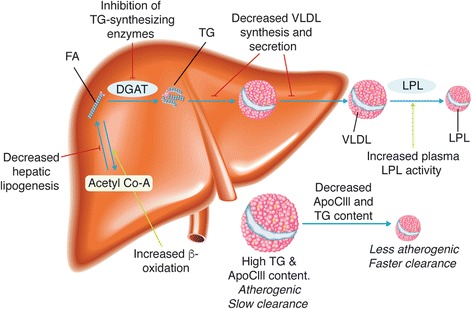
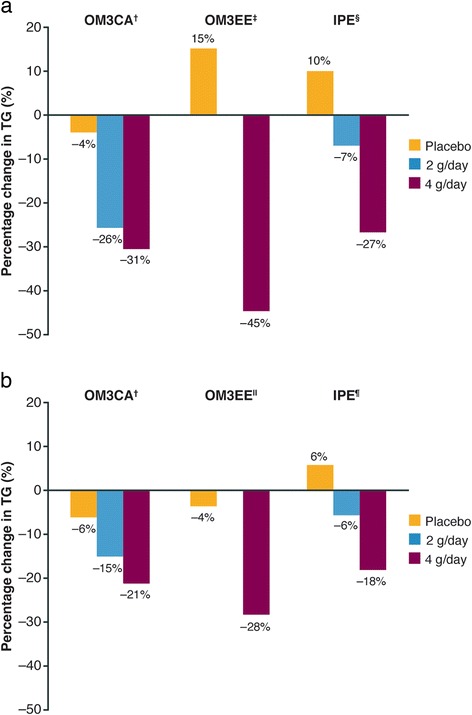
Hypertriglyceridemia (triglycerides > 150 mg/dL) affects ~25 % of the United States (US) population and is associated with increased cardiovascular risk. Severe hypertriglyceridemia (≥ 500 mg/dL) is also a risk factor for pancreatitis. Three omega-3 fatty acid (OM3FA) prescription formulations are approved in the US for the treatment of adults with severe hypertriglyceridemia: (1) OM3FA ethyl esters (OM3EE), a mixture of OM3FA ethyl esters, primarily eicosapentaenoic acid (EPA) and docosahexaenoic acid (DHA) (Lovaza®, Omtryg™, and generics); (2) icosapent ethyl (IPE), EPA ethyl esters (Vascepa®); and (3) omega-3 carboxylic acids (OM3CA), a mixture of OM3FAs in free fatty acid form, primarily EPA, DHA, and docosapentaenoic acid (Epanova®). At approved doses, all formulations substantially reduce triglyceride and very-low-density lipoprotein levels. DHA-containing formulations may also increase low-density lipoprotein cholesterol. However, this is not accompanied by increased non-high-density lipoprotein cholesterol, which is thought to provide a better indication of cardiovascular risk in this patient population. Proposed mechanisms of action of OM3FAs include inhibition of diacylglycerol acyltransferase, increased plasma lipoprotein lipase activity, decreased hepatic lipogenesis, and increased hepatic β-oxidation. OM3CA bioavailability (area under the plasma concentration-time curve from zero to the last measurable concentration) is up to 4-fold greater than that of OM3FA ethyl esters, and unlike ethyl esters, the absorption of OM3CA is not dependent on pancreatic lipase hydrolysis. All three formulations are well tolerated (the most common adverse events are gastrointestinal) and demonstrate a lack of drug-drug interactions with other lipid-lowering drugs, such as statins and fibrates. OM3FAs appear to be an effective treatment option for patients with severe hypertriglyceridemia.
Overview
The claims and statistics of this paper haven’t been checked yet.
Run the check — free, no account needed. It reads the open-access text and checks the sources it cites.
Integrity signals
Registry
Cites
Statistics
Figures
Verification
Claims the paper makes
The claims and statistics of this paper haven’t been checked yet.
Run the check — free, no account needed. It reads the open-access text and checks the sources it cites.
Claims other papers make about this one
Each is checked against this paper’s own text: does it say what the citing paper says it does?
The source backs part of the claim, not all of it — or backs it for a different population, condition or comparison.
In the citing paper
“Combined EPA + DHA formulations, such as omega-3 carboxylic acids and ethyl esters, effectively lower TG levels by reducing hepatic VLDL synthesis and enhancing fatty acid oxidation [87].”
From Targeting triglycerides for cardiovascular risk reduction (2026) · cites this paper as [87]
Experimental — accuracy not yet measured
Self-check
Percentages, sums and reported differences re-computed from the paper’s own numbers.
The self-check needs the paper’s full text.
Citations
Cites
Detection, evaluation, and treatment of high blood cholesterol in adults (Adult Treatment Panel III)
Grundy, S. M., Becker, D. M., Clark, L. T., Cooper, R., Denke, M. A., Howard, J. L., Hunninghake, D. B., Illingworth, D. R., Luepker, R. V., McBride, P. E., et al. (2002) · Civil War Book Review · Cited by 12,198
Standards of Medical Care in Diabetes
Power, D. V. (2006) · Diabetes Care · doi:10.2337/diacare.29.02.06.dc05-1593 · Cited by 8,676
Stone, N. J., Robinson, J. G., Lichtenstein, A. H., Bairey Merz, C. N., Blum, C. B., Eckel, R. H., Goldberg, A. C., Gordon, D., Levy, D., Lloyd-Jones, D. M., et al. (2014) · Circulation · doi:10.1161/01.cir.0000437738.63853.7a · Cited by 7,081
Standards of medical care in diabetes—2014
American Diabetes Association (2014) · Diabetes Care · doi:10.2337/dc14-s014 · Cited by 4,572
Stone, N. J., Robinson, J. G., Lichtenstein, A. H., Bairey Merz, C. N., Blum, C. B., Eckel, R. H., Goldberg, A. C., Gordon, D., Levy, D., Lloyd-Jones, D. M., et al. (2014) · Journal of the American College of Cardiology · doi:10.1016/j.jacc.2013.11.002 · Cited by 3,845
Fish Consumption, Fish Oil, Omega-3 Fatty Acids, and Cardiovascular Disease
Kris-Etherton, P. M., Harris, W. S., & Appel, L. J. (2002) · Circulation · doi:10.1161/01.cir.0000038493.65177.94 · Cited by 3,707
ESC/EAS Guidelines for the management of dyslipidaemias
Reiner, Ž., Catapano, A. L., De Backer, G., Graham, I., Taskinen, M.-R., Wiklund, O., Agewall, S., Alegria, E., Chapman, M. J., Durrington, P., et al. (2011) · European Heart Journal · doi:10.1093/eurheartj/ehr158 · Cited by 3,549
Complementary and Alternative Medicine Use Among Adults and Children: United States, 2007
Barnes, P. M., Bloom, B. E., & Nahin, R. L. (2008) · PsycEXTRA Dataset · doi:10.1037/e623942009-001 · Cited by 3,144
Kavey, R., Simons-Morton, D., & de Jesus, J. D. (2011) · Pediatrics · doi:10.1542/peds.2009-2107c · Cited by 2,131
Cited by
Sorted by citations
The Short Overview on the Relevance of Fatty Acids for Human Cardiovascular Disorders
Шрамко, В. С., Polonskaya, Y. V., Kashtanova, E. V., Stakhneva, E. M., & Ragino, Y. I. (2020) · Biomolecules · doi:10.3390/biom10081127 · Cited by 221
Gioxari, A., Kaliora, A. C., Marantidou, F., & Panagiotakos, D. P. (2017) · Nutrition · doi:10.1016/j.nut.2017.06.023 · Cited by 203
Schunck, W., Konkel, A., Fischer, R., & Weylandt, K. H. (2017) · Pharmacology & Therapeutics · doi:10.1016/j.pharmthera.2017.10.016 · Cited by 211
Dellinger, R. W., Santos, S. R., Morris, M., Evans, M., Alminana, D., Guarente, L., & Marcotulli, E. (2017) · npj Aging and Mechanisms of Disease · doi:10.1038/s41514-017-0016-9 · Cited by 181
Marine Natural Products in Clinical Use
Haque, N., Parveen, S., Tang, T., Wei, J., & Huang, Z. (2022) · Marine Drugs · doi:10.3390/md20080528 · Cited by 172
Metadata
- Authors
- Backes, J., Anzalone, D., Hilleman, D., & Catini, J.
- Affiliations
- University of Kansas (US)
- AstraZeneca (United States) (US)
- Creighton University (US)
- Corresponding author
- Backes, James
- Venue
- Lipids in Health and Disease
- Published
- 2016-07-22
- Volume
- 15
- Issue
- 1
- Pages
- 118-118
- ISSN
- 1476-511X (ISSN-L)
- PMC
- PMC4957330
- OpenAlex
- W2487890137
- Cited by
- 195
- References
- 97
- Citations by year
- 2026: 8 · 2025: 20 · 2024: 20 · 2023: 20 · 2022: 26 · 2021: 29 · 2020: 25 · 2019: 15 · 2018: 9 · 2017: 20 · 2016: 1
- FWCI
- 2.01
- Type
- journal article
- Language
- en
- Open access
- gold
- doi.org
- Licence
- cc-by
- Locations
- Lipids in Health and Disease (publishedVersion, cc-by)
- PubMed Central (publishedVersion, cc-by)
- PubMed (publishedVersion)
- Creighton Digital Repository (CDR) (submittedVersion)
- KU ScholarWorks (The University of Kansas) (submittedVersion, cc-by)
- Funders
- AstraZeneca
- Topics
- Health Sciences › Nursing › Nutrition and Dietetics › Fatty Acid Research and Health
- Health Sciences › Medicine › Cardiology and Cardiovascular Medicine › Lipid metabolism and disorders
- Health Sciences › Medicine › Cardiology and Cardiovascular Medicine › Lipoproteins and Cardiovascular Health
- Keywords
- omega-3 fatty acids, severe hypertriglyceridemia, triglyceride-lowering therapy, icosapent ethyl, eicosapentaenoic acid, docosahexaenoic acid, docosapentaenoic acid, VLDL, non-HDL cholesterol, lipoprotein lipase, hepatic lipogenesis, fatty acid beta-oxidation, bioavailability, drug-drug interactions, cardiovascular risk, pancreatitis
- MeSH terms
- Adult, Hypolipidemic Agents, Biological Availability, Docosahexaenoic Acids, Drug Combinations, Esters, Humans, Lipoprotein Lipase, Cholesterol, LDL, Lipoproteins, VLDL, Liver, Oxidation-Reduction, Triglycerides, Eicosapentaenoic Acid, Hypertriglyceridemia, Fatty Acids, Omega-3, Lipogenesis, Diacylglycerol O-Acyltransferase
About these checks
Registry, retraction, Cites and statistics results are computed, not judged, with one exception: a printed reference that no index lists is read once by a model before it counts as a citation error. Claims are extracted by a model and kept only when their quote appears verbatim in the text; each cited source is then checked, with a model’s help, for whether it says what the claim relies on. Those verdicts can be wrong — read the claim’s quote and the cited source before relying on one.
Statistics and arithmetic are recomputed, not judged.
Confidence bands are shown only for fields calibrated on our annotated test set. None is calibrated yet, so no band is shown.
What counts as a claim ›How we measure confidence ›How we check this ›
Are you an author, or do you see a problem with this page? Request a review
