

Differential associations among social support, health promoting behaviors, health-related quality of life and subjective well-being in older and younger persons: a structural equation modelling approach
Open accessThe DOI matches its Crossref record; 68 of the 69 references it cites were found in a registry or an index.
Abstract
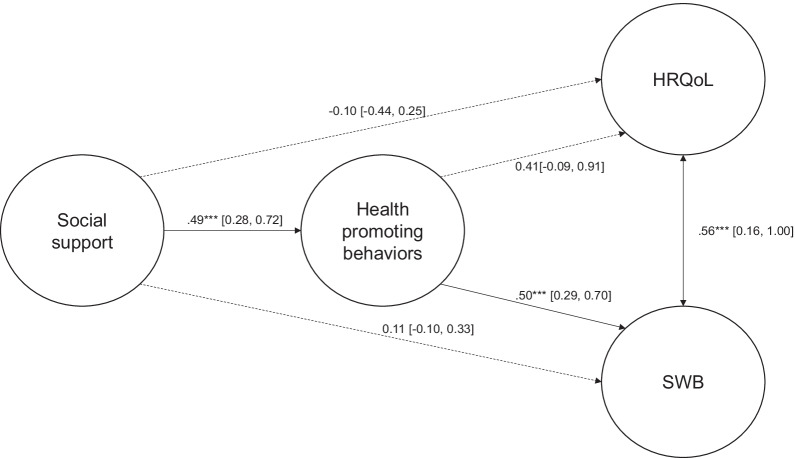
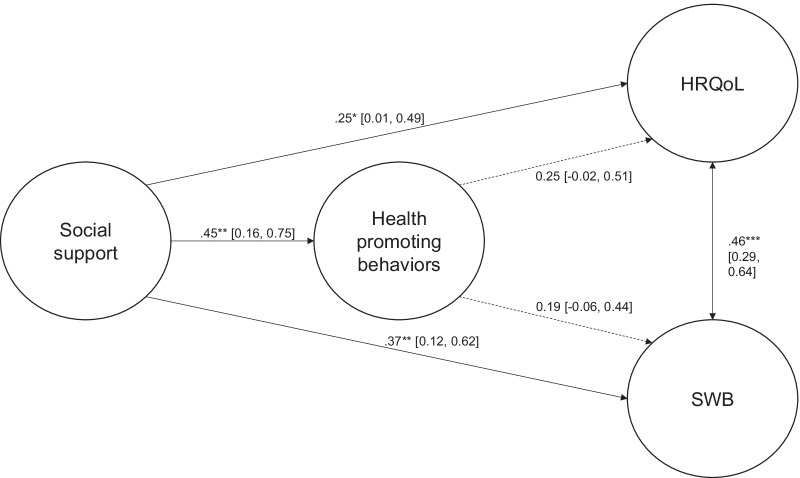
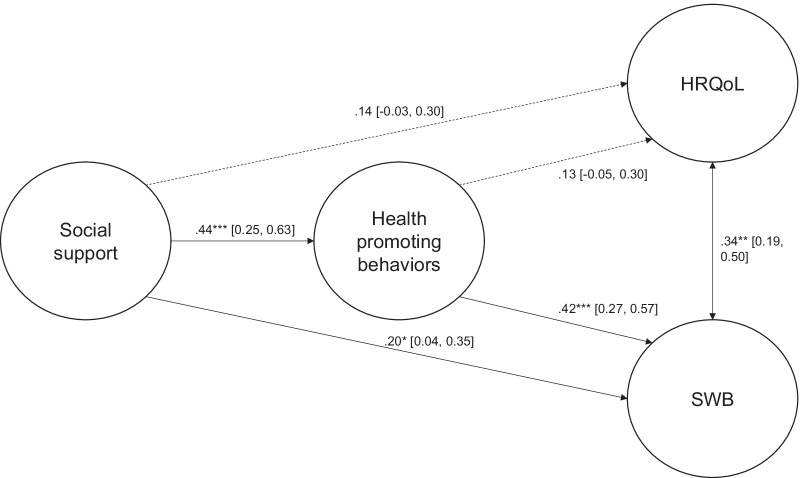
Background: Extensive studies have confirmed social support as a critical protective factor of people’s health-related quality of life (HRQoL) and subjective well-being (SWB). However, health promoting behaviors as a potential mechanism and age differences in this mechanism has received fewer attention. This study aims to examine the associations among social support, health promoting behaviors, HRQoL and SWB in older and younger persons in Hong Kong. Method: A convenience sample of both younger (12–35 years old) and older persons (55 years old and above) were recruited from three non-government organizations to complete a survey. Structural Equation Model (SEM) was conducted to test both the measurement model and structural models to examine the relationship between social support, health promoting behaviors, HRQoL and SWB. Multi-group SEM was also performed and compared to test whether there were significant age differences in the pathways between the key variables. Results: A final sample of 408 participants (older-persons: N = 200 (mean age: 71.63 (8.16); 180/200 female), younger-persons: N = 208 (mean age: 18.10 (5.04); 155/208 female) were included in the final analysis. Results showed that social support was positively associated with SWB directly and indirectly through health promoting behaviors for the whole sample (CFI = .95, IFI = .94, RMSEA = .07, SRMR = 0.056). Results suggested that the association between the variables differed across age samples. While social support showed a positive association with health promoting behaviors for both younger and older persons, how each of them associated with HRQoL and SWB was different. Conclusion: Findings suggest that the pathway which social support linked with HRQoL and SWB might differ across age groups. Age-specific strategies should be considered when promoting HRQoL and SWB among the younger and older population.
Overview
The claims and statistics of this paper haven’t been checked yet.
Free: it reads the open-access text and checks the first 5 claims that cite a source we can check. Create a free account to check every claim.
Integrity signals
Registry
Cites
Statistics
Figures
Verification
Claims the paper makes
The claims and statistics of this paper haven’t been checked yet.
Free: it reads the open-access text and checks the first 5 claims that cite a source we can check. Create a free account to check every claim.
Claims other papers make about this one
Each is checked against this paper’s own text: does it say what the citing paper says it does?
The cited source says what the claim attributes to it.
In the citing paper
“The evidence suggests that adopting a healthy lifestyle not only reduces the risk of NCDs but also enhances well-being and improves quality of life [5–8].”
From Psychometric validation and measurement invariance of the Health-Promoting Lifestyle Profile II in Honduran university students (2025) · cites this paper as [7]
Self-check
Percentages, sums and reported differences re-computed from the paper’s own numbers.
The self-check needs the paper’s full text.
Citations
Cites
Structural equation modeling in practice: A review and recommended two-step approach
Anderson, J. C., & Gerbing, D. W. (1988) · Psychological Bulletin · doi:10.1037/0033-2909.103.3.411 · Cited by 41,941
Comparative fit indexes in structural models.
Bentler, P. M. (1990) · Psychological Bulletin · doi:10.1037/0033-2909.107.2.238 · Cited by 25,266
EuroQol: a new facility for the measurement of health-related quality of life
(1990) · Health Policy · doi:10.1016/0168-8510(90)90421-9 · Cited by 15,736
Testing Structural Equation Models.
Mueller, C. W., Bollen, K. A., & Long, J. S. (1994) · Contemporary Sociology · doi:10.2307/2074955 · Cited by 14,120
Taking time seriously: A theory of socioemotional selectivity.
Carstensen, L. L., Isaacowitz, D. M., & Charles, S. T. (1999) · American Psychologist · doi:10.1037//0003-066x.54.3.165 · Cited by 5,377 · cited 1×
“The Socioemotional Selectivity Theory [42, 43] proposes that individuals’ social goals change with age.”
BackgroundMechanisms Linking Social Ties and Support to Physical and Mental Health
Thoits, P. A. (2011) · Journal of Health and Social Behavior · doi:10.1177/0022146510395592 · Cited by 4,076
Social and emotional patterns in adulthood: Support for socioemotional selectivity theory
Carstensen, L. L. (1992) · Psychology and Aging · doi:10.1037/0882-7974.7.3.331 · Cited by 2,174 · cited 1×
“The Socioemotional Selectivity Theory [42, 43] proposes that individuals’ social goals change with age.”
BackgroundSocial Support Measurement and Intervention: A Guide for Health and Social Scientists
(2000) · Oxford University Press eBooks · doi:10.1093/med:psych/9780195126709.001.0001 · Cited by 1,830
Health, Health-Related Quality of Life, and Quality of Life: What is the Difference?
Karimi, M., & Brazier, J. (2016) · PharmacoEconomics · doi:10.1007/s40273-016-0389-9 · Cited by 1,646
The Health-Promoting Lifestyle Profile: development and psychometric characteristics.
Walker, S. N., Sechrist, K. R., & Pender, N. J. (1987) · PubMed · Cited by 1,602
Chida, Y., & Steptoe, A. (2008) · Psychosomatic Medicine · doi:10.1097/psy.0b013e31818105ba · Cited by 1,592
Social isolation, loneliness and health in old age: a scoping review
Courtin, E., & Knapp, M. (2017) · Health & Social Care in the Community · doi:10.1111/hsc.12311 · Cited by 1,463 · cited 1×
“It may be particularly important for older persons, as they are more likely to experience social isolations and health declines [72].”
BackgroundThe Health-Promoting Lifestyle Profile: Development and Psychometric Characteristics
WALKER, S. N., SECHRIST, K. R., & PENDER, N. J. (1987) · Nursing Research · doi:10.1097/00006199-198703000-00002 · Cited by 1,427
Netz, Y., Wu, M.-J., Becker, B. J., & Tenenbaum, G. (2005) · Psychology and Aging · doi:10.1037/0882-7974.20.2.272 · Cited by 1,012
Social Relationships and Health
Cohen, S., Gottlieb, B. H., & Underwood, L. G. (2000) · Social Support Measurement and Intervention · doi:10.1093/med:psych/9780195126709.003.0001 · Cited by 903
Leisure and Subjective Well-Being: A Model of Psychological Mechanisms as Mediating Factors
Newman, D. B., Tay, L., & Diener, E. (2014) · Journal of Happiness Studies · doi:10.1007/s10902-013-9435-x · Cited by 887 · cited 1×
“Health promoting behaviors can also boost SWB by generating autonomy, mastery, meaning and affiliation [25].”
BackgroundSocial modeling of eating: A review of when and why social influence affects food intake and choice
Cruwys, T., Bevelander, K. E., & Hermans, R. C. J. (2015) · Appetite · doi:10.1016/j.appet.2014.08.035 · Cited by 680
Gillison, F. B., Rouse, P., Standage, M., Sebire, S. J., & Ryan, R. M. (2019) · Health Psychology Review · doi:10.1080/17437199.2018.1534071 · Cited by 543
Su, R., Tay, L., & Diener, E. (2014) · Applied Psychology: Health and Well-Being · doi:10.1111/aphw.12027 · Cited by 511
Twenty years of social capital and health research: a glossary
Moore, S., & Kawachi, I. (2017) · Journal of Epidemiology and Community Health · doi:10.1136/jech-2016-208313 · Cited by 423
Bowling, A., Gabriel, Z., Dykes, J., Dowding, L. M., Evans, O., Fleissig, A., Banister, D., & Sutton, S. (2003) · The International Journal of Aging and Human Development · doi:10.2190/bf8g-5j8l-ytrf-6404 · Cited by 359
Health‐Promoting Behaviors and Psychosocial Well‐Being of University Students in Hong Kong
Lee, R. L. T., & Loke, A. J. T. Y. (2005) · Public Health Nursing · doi:10.1111/j.0737-1209.2005.220304.x · Cited by 343
Measuring Social Integration and Social Networks
Brissette, I., Cohen, S., & Seeman, T. E. (2000) · Social Support Measurement and Intervention · doi:10.1093/med:psych/9780195126709.003.0003 · Cited by 323 · cited 1×
“Social support is broadly defined as one’s perception that they are being cared for and that assistance would be available when needed [15, 16].”
BackgroundGlobal action on the social determinants of health
Donkin, A., Goldblatt, P., Allen, J., Nathanson, V., & Marmot, M. (2018) · BMJ Global Health · doi:10.1136/bmjgh-2017-000603 · Cited by 306
Segrin, C., & Taylor, M. (2007) · Personality and Individual Differences · doi:10.1016/j.paid.2007.01.017 · Cited by 305
Summarizing health-related quality of life (HRQOL): development and testing of a one-factor model
Yin, S., Njai, R., Barker, L., Siegel, P. Z., & Liao, Y. (2016) · Population Health Metrics · doi:10.1186/s12963-016-0091-3 · Cited by 304
Role of social support in lifestyle-focused weight management interventions
Verheijden, M. W., Bakx, J. C., van Weel, C., Koelen, M. A., & van Staveren, W. A. (2005) · European Journal of Clinical Nutrition · doi:10.1038/sj.ejcn.1602194 · Cited by 281 · cited 1×
“It is mainly provided by family members, close friends, or the community [17].”
BackgroundAttendance at Religious Services and Mortality in a National Sample
Musick, M. A., House, J. S., & Williams, D. R. (2004) · Journal of Health and Social Behavior · doi:10.1177/002214650404500206 · Cited by 278
Social Support and Physical Health: Models, Mechanisms, and Opportunities
Uchino, B. N., Bowen, K., Kent de Grey, R., Mikel, J., & Fisher, E. B. (2018) · Principles and Concepts of Behavioral Medicine · doi:10.1007/978-0-387-93826-4_12 · Cited by 257
Sheets, R. L., & Mohr, J. J. (2009) · Journal of Counseling Psychology · doi:10.1037/0022-0167.56.1.152 · Cited by 248
A happy choice: wellbeing as the goal of government
FRIJTERS, P., CLARK, A. E., KREKEL, C., & LAYARD, R. (2020) · Behavioural Public Policy · doi:10.1017/bpp.2019.39 · Cited by 222
Reeves, D., Blickem, C., Vassilev, I., Brooks, H., Kennedy, A., Richardson, G., & Rogers, A. (2014) · PLoS ONE · doi:10.1371/journal.pone.0098340 · Cited by 213 · cited 1×
“Other studies have also shown that people who are married [35, 36], have a larger social network [37, 38], or involved in religious communities [39] have a higher chance of adopting optimal health behaviors.”
BackgroundStage of Regular Exercise and Health-Related Quality of Life
Laforge, R. G., Rossi, J. S., Prochaska, J. O., Velicer, W. F., Levesque, D. A., & McHorney, C. A. (1999) · Preventive Medicine · doi:10.1006/pmed.1998.0429 · Cited by 170
Sterrett, E. M., Jones, D. J., McKee, L. G., & Kincaid, C. (2011) · American Journal of Community Psychology · doi:10.1007/s10464-011-9429-y · Cited by 169 · cited 1×
“High levels of perceived social support might have a positive influence on psychosocial functioning and protection from mental health problems [58, 59].”
BackgroundDumuid, D., Olds, T., Lewis, L. K., Martin-Fernández, J. A., Katzmarzyk, P. T., Barreira, T., Broyles, S. T., Chaput, J.-P., Fogelholm, M., Hu, G., et al. (2017) · The Journal of Pediatrics · doi:10.1016/j.jpeds.2016.12.048 · Cited by 148
(2004) · Journal of School Health · doi:10.1111/j.1746-1561.2004.tb07933.x · Cited by 148
Schmitz, N., Kruse, J., & Kügler, J. (2004) · Preventive Medicine · doi:10.1016/j.ypmed.2004.04.034 · Cited by 147
Meaning of quality of life for older adults: Importance of human functioning components
Levasseur, M., Tribble, D. S., & Desrosiers, J. (2008) · Archives of Gerontology and Geriatrics · doi:10.1016/j.archger.2008.08.013 · Cited by 147
Assessing the Use of a Feedback Module to Model EQ-5D-5L Health States Values in Hong Kong
Wong, E. L. Y., Ramos-Goñi, J. M., Cheung, A. W. L., Wong, A. Y. K., & Rivero-Arias, O. (2018) · The Patient - Patient-Centered Outcomes Research · doi:10.1007/s40271-017-0278-0 · Cited by 139
Self-citationHealth related quality of life and psychological wellbeing in patients with dilated cardiomyopathy
Steptoe, A., Mohabir, A., Mahon, N. G., & McKenna, W. J. (2000) · Heart · doi:10.1136/heart.83.6.645 · Cited by 124
Shariferad, G., Tol, A., Tavassoli, E., & Shojaeezadeh, D. (2013) · Journal of Education and Health Promotion · doi:10.4103/2277-9531.108006 · Cited by 124
Richmond, C. A. M., & Ross, N. A. (2008) · Social Science & Medicine · doi:10.1016/j.socscimed.2008.06.028 · Cited by 121
How Does Residents’ Satisfaction with Community Services Influence Quality of Life (QOL) Outcomes?
Sirgy, M. J., Gao, T., & Young, R. F. (2008) · Applied Research in Quality of Life · doi:10.1007/s11482-008-9048-4 · Cited by 120
Behrens, G., Fischer, B., Kohler, S., Park, Y., Hollenbeck, A. R., & Leitzmann, M. F. (2013) · European Journal of Epidemiology · doi:10.1007/s10654-013-9796-9 · Cited by 117
The impact of a healthy lifestyle on Disability-Adjusted Life Years: a prospective cohort study
May, A. M., Struijk, E. A., Fransen, H. P., Onland-Moret, N. C., de Wit, G. A., Boer, J. M., van der Schouw, Y. T., Hoekstra, J., Bueno-de-Mesquita, H. B., Peeters, P. H., et al. (2015) · BMC Medicine · doi:10.1186/s12916-015-0287-6 · Cited by 114 · cited 1×
“There is ample evidence that individuals who engaged in health promoting behaviors would report better health and lower levels of disease and morbidity [23, 24].”
BackgroundMorsch, C. M., Gonçalves, L. F., & Barros, E. (2006) · Journal of Clinical Nursing · doi:10.1111/j.1365-2702.2006.01349.x · Cited by 108
Addressing the Social Determinants of Mental Health: If Not Now, When? If Not Us, Who?
Shim, R. S., & Compton, M. T. (2018) · Psychiatric Services · doi:10.1176/appi.ps.201800060 · Cited by 107
Measuring the quality of later life
O'boyle, C. A. (1997) · Philosophical Transactions of the Royal Society of London. Series B: Biological Sciences · doi:10.1098/rstb.1997.0173 · Cited by 106
Health-Promoting Lifestyles and Depression in Urban Elderly Chinese
Hua, Y., Wang, B., Wallen, G. R., Shao, P., Ni, C., & Hua, Q. (2015) · PLoS ONE · doi:10.1371/journal.pone.0117998 · Cited by 89
Health promotion lifestyle profile‐II: Chinese version short form
Teng, H., Yen, M., & Fetzer, S. (2010) · Journal of Advanced Nursing · doi:10.1111/j.1365-2648.2010.05353.x · Cited by 87
Østhus, T. B. H., Preljevic, V., Sandvik, L., Leivestad, T., Nordhus, I. H., Dammen, T., & Os, I. (2012) · Health and Quality of Life Outcomes · doi:10.1186/1477-7525-10-46 · Cited by 76
Zhang, Y., Yeager, V. A., & Hou, S. (2016) · Journal of Applied Gerontology · doi:10.1177/0733464816661945 · Cited by 72
Marital Status and Health Behavior in Middle-aged Korean Adults
Yim, H. J., Park, H. A., Kang, J., Kim, K.-W., Cho, Y. G., Hur, Y. I., & Choi, O. J. E. (2012) · Korean Journal of Family Medicine · doi:10.4082/kjfm.2012.33.6.390 · Cited by 58
LaRocca, M. A., & Scogin, F. R. (2015) · Clinical Gerontologist · doi:10.1080/07317115.2014.990598 · Cited by 52
Social Control of Health Behaviors: A Comparison of Young, Middle-Aged, and Older Adults
Tucker, J. S., Klein, D. J., & Elliott, M. N. (2004) · The Journals of Gerontology Series B: Psychological Sciences and Social Sciences · doi:10.1093/geronb/59.4.p147 · Cited by 49
Fernández, B. R., Warner, L. M., Knoll, N., Montenegro‐Montenegro, E., & Schwarzer, R. (2015) · Appetite · doi:10.1016/j.appet.2014.12.223 · Cited by 47
Determinants of healthy lifestyle and its related factors among elderly people
Sadeghi, R., Zanjani, S. E., Tol, A., Mohebbi, B., Jelyani, K. N., & Moradi, A. (2015) · Journal of Education and Health Promotion · doi:10.4103/2277-9531.171817 · Cited by 47
Kim, C., Schlenk, E. A., Kim, D. J., Kim, M., Erlen, J. A., & Kim, S. (2015) · Journal of Advanced Nursing · doi:10.1111/jan.12682 · Cited by 42
Brief Inventory of Thriving: A comprehensive measurement of wellbeing
Duan, W., Guan, Y., & Gan, F. (2016) · Chinese Sociological Dialogue · doi:10.1177/2397200916665230 · Cited by 41
Getting healthcare staff more active: The mediating role of self‐efficacy
Mo, P. K. H., Blake, H., & Batt, M. E. (2010) · British Journal of Health Psychology · doi:10.1111/j.2044-8287.2010.02007.x · Cited by 38
Self-citationPerceived partner responsiveness predicts smoking cessation in single-smoker couples
Britton, M., Haddad, S., & Derrick, J. L. (2018) · Addictive Behaviors · doi:10.1016/j.addbeh.2018.08.026 · Cited by 29
Tessier, P., Lelorain, S., & Bonnaud‐Antignac, A. (2012) · European Journal of Cancer Care · doi:10.1111/j.1365-2354.2012.01344.x · Cited by 26
Application of the PRECEDE Model to Understanding Mental Health Promoting Behaviors in Hong Kong
Mo, P. K. H., & Mak, W. W. S. (2006) · Health Education & Behavior · doi:10.1177/1090198108317409 · Cited by 26
Self-citationMurillo, R., Pirzada, A., Wu, D., Gallo, L. C., Thomas, S., Ostrovsky, N. W., Penedo, F. J., Perreira, K. M., Reina, S. A., Horn, L. V., et al. (2019) · Journal of Behavioral Medicine · doi:10.1007/s10865-019-00082-9 · Cited by 25
The effect of health on social capital; a longitudinal observation study of the UK
Downward, P. M., Rasciute, S., & Kumar, H. (2020) · BMC Public Health · doi:10.1186/s12889-020-08577-w · Cited by 23
Adolescents’ health choices related rights, duties and responsibilities: An integrative review
Moilanen, T., Pietilä, A., Coffey, M., & Kangasniemi, M. K. (2016) · Nursing Ethics · doi:10.1177/0969733016654316 · Cited by 19
Wong, E. L., Yeoh, E., Slaap, B., Tam, W., Cheung, A. W. L., Wong, A., & Chan, D. C. C. (2015) · Value in Health · doi:10.1016/j.jval.2015.03.167 · Cited by 17
Self-citationLifestyle for stress buffer and reverse cell aging
Nyandra, M., & Suryasa, I. W. (2019) · International Journal of Health Sciences · doi:10.29332/ijhs.v3n1.276 · Cited by 7
Research works printed but not linked: 2
- Finney SJ, DiStefano C. Non-normal and categorical data in structural equation modeling. Struct Eq Model: Second Course. 2006;10(6):269-314.
- Ranatunga RVSPK, Priyanath HMS, Megama RGN. Methods and rules-of- thumb in the determination of minimum sample size when applying structural equation modelling: a review. J Soc Sci Res. 2020;15(2):102-9.
Cited by
Zhang, Y., & Sun, L. (2024) · Frontiers in Public Health · doi:10.3389/fpubh.2024.1312841 · Cited by 78
Non-Pharmacological Interventions for Pain Management in Hemodialysis: A Narrative Review
Kassim, M. A. K., Pantazi, A. C., Nori, W., Tuta, L. A., Bălașa, A. L., Mihai, C. M., Mihai, L., Frecuș, C. E., Lupu, V. V., Lupu, A., et al. (2023) · Journal of Clinical Medicine · doi:10.3390/jcm12165390 · Cited by 51
Impact of family and social support in enhancing psychological well-being of young adults in China
Chen, J. (2025) · BMC Psychology · doi:10.1186/s40359-025-03093-1 · Cited by 34
Li, Z., Qin, S., Zhu, Y., Zhou, Q., Yi, A., Mo, C., Gao, J., Chen, J., Wang, T., Feng, Z., et al. (2025) · PLoS ONE · doi:10.1371/journal.pone.0325029 · Cited by 27
Bujang, M. A., Lai, W. H., Hon, Y. K., Yap, E. P. P., Tiong, X. T., Ratnasingam, S., Kim, A. R. J., Husin, M., Jee, Y. Y. H., Ahmad, N. F. D., et al. (2023) · Heliyon · doi:10.1016/j.heliyon.2023.e22668 · Cited by 22
Metadata
- Authors
- Mo, P. K. H., Wong, E. L. Y., Yeung, N. C. Y., Wong, S. Y. S., Chung, R. Y., Tong, A. C. Y., Ko, C. C. Y., Li, J., & Yeoh, E.-K.
- Affiliations
- Chinese University of Hong Kong (HK)
- UNSW Sydney (AU)
- Corresponding author
- Wong, Eliza L. Y.
- ORCID
- Venue
- Health and Quality of Life Outcomes
- Published
- 2022-03-04
- Volume
- 20
- Issue
- 1
- Pages
- 38-38
- ISSN
- 1477-7525 (ISSN-L)
- PMC
- PMC8895671
- OpenAlex
- W4214919500
- Cited by
- 48
- References
- 69
- Citations by year
- 2026: 12 · 2025: 15 · 2024: 11 · 2023: 10
- FWCI
- 10.32
- Type
- journal article
- Language
- en
- Open access
- gold
- doi.org
- Licence
- cc-by
- creativecommons.org/licenses/by/4.0 (tdm)
- creativecommons.org/licenses/by/4.0 (vor)
- Locations
- Health and Quality of Life Outcomes (publishedVersion, cc-by)
- PubMed Central (publishedVersion, cc-by)
- PubMed (publishedVersion)
- DOAJ (DOAJ: Directory of Open Access Journals) (submittedVersion, cc-by-sa)
- Funders
- The Hong Kong Jockey Club Charities Trust (2017/0096/B)
- Topics
- Health Sciences › Health Professions › General Health Professions › Health and Wellbeing Research
- Social Sciences › Psychology › Clinical Psychology › Health and Well-being Studies
- Health Sciences › Medicine › Public Health, Environmental and Occupational Health › Aging, Health, and Disability
- Keywords
- social support, health-promoting behaviors, health-related quality of life, subjective well-being, age differences, older adults, young adults, mediation
- MeSH terms
- Latent Class Analysis, Adolescent, Adult, Aged, Aged, 80 and over, Child, Cross-Sectional Studies, Female, Health Promotion, Humans, Middle Aged, Quality of Life, Surveys and Questionnaires, Social Support, Young Adult
About these checks
Registry, retraction, Cites and statistics results are computed, not judged, with one exception: a printed reference that no index lists is read once by a model before it counts as a citation error. Claims are extracted by a model and kept only when their quote appears verbatim in the text; each cited source is then checked, with a model’s help, for whether it says what the claim relies on. Those verdicts can be wrong — read the claim’s quote and the cited source before relying on one.
Statistics and arithmetic are recomputed, not judged.
Confidence bands are shown only for fields calibrated on our annotated test set. None is calibrated yet, so no band is shown.
What counts as a claim ›How we measure confidence ›How we check this ›
Are you an author, or do you see a problem with this page? Request a review
Data sources
Bibliographic data: Semantic Scholar, OpenAlex, Crossref.
Contains information from the Semantic Scholar Academic Graph Datasets, made available under the ODC Attribution License (ODC-BY 1.0).
Semantic Scholar’s data is described in: Kinney, R., et al. (2023). The Semantic Scholar Open Data Platform. arXiv:2301.10140.
