

Interventions to improve team effectiveness within health care: a systematic review of the past decade
Open accessThe DOI matches its Crossref record; 332 of the 336 references it cites were found in a registry or an index.
Abstract
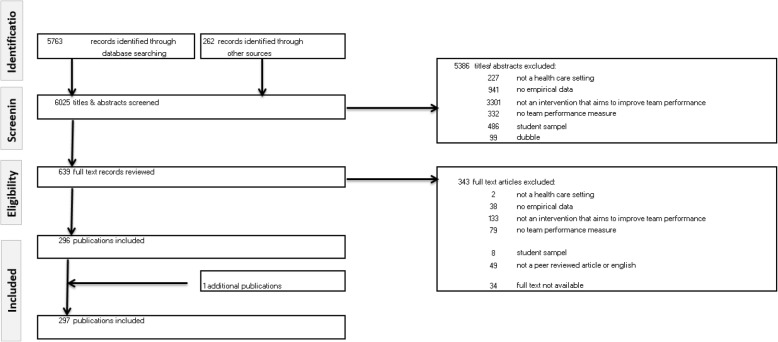
Background: A high variety of team interventions aims to improve team performance outcomes. In 2008, we conducted a systematic review to provide an overview of the scientific studies focused on these interventions. However, over the past decade, the literature on team interventions has rapidly evolved. An updated overview is therefore required, and it will focus on all possible team interventions without restrictions to a type of intervention, setting, or research design. Objectives: To review the literature from the past decade on interventions with the goal of improving team effectiveness within healthcare organizations and identify the “evidence base” levels of the research. Methods: Seven major databases were systematically searched for relevant articles published between 2008 and July 2018. Of the original search yield of 6025 studies, 297 studies met the inclusion criteria according to three independent authors and were subsequently included for analysis. The Grading of Recommendations, Assessment, Development, and Evaluation Scale was used to assess the level of empirical evidence. Results: Three types of interventions were distinguished: (1) Training , which is sub-divided into training that is based on predefined principles (i.e. CRM: crew resource management and TeamSTEPPS: Team Strategies and Tools to Enhance Performance and Patient Safety), on a specific method (i.e. simulation), or on general team training. (2) Tools covers tools that structure (i.e. SBAR: Situation, Background, Assessment, and Recommendation, (de)briefing checklists, and rounds), facilitate (through communication technology), or trigger (through monitoring and feedback) teamwork. (3) Organizational (re)design is about (re)designing structures to stimulate team processes and team functioning . (4) A programme is a combination of the previous types. The majority of studies evaluated a training focused on the (acute) hospital care setting. Most of the evaluated interventions focused on improving non-technical skills and provided evidence of improvements. Conclusion: Over the last decade, the number of studies on team interventions has increased exponentially. At the same time, research tends to focus on certain interventions, settings, and/or outcomes. Principle-based training (i.e. CRM and TeamSTEPPS) and simulation-based training seem to provide the greatest opportunities for reaching the improvement goals in team functioning.
Overview
The claims and statistics of this paper haven’t been checked yet.
Free: it reads the open-access text and checks the first 5 claims that cite a source we can check. Create a free account to check every claim.
Integrity signals
Registry
Cites
Statistics
Figures
Verification
Claims the paper makes
The claims and statistics of this paper haven’t been checked yet.
Free: it reads the open-access text and checks the first 5 claims that cite a source we can check. Create a free account to check every claim.
Self-check
Percentages, sums and reported differences re-computed from the paper’s own numbers.
The self-check needs the paper’s full text.
Citations
Cites
Audit and feedback: effects on professional practice and healthcare outcomes
Ivers, N., Jamtvedt, G., Flottorp, S., Young, J. M., Odgaard-Jensen, J., French, S. D., O'Brien, M. A., Johansen, M., Grimshaw, J., & Oxman, A. D. (2012) · Cochrane Database of Systematic Reviews · doi:10.1002/14651858.cd000259.pub3 · Cited by 5,485
Interprofessional education: effects on professional practice and healthcare outcomes
Reeves, S., Perrier, L., Goldman, J., Freeth, D., & Zwarenstein, M. (2013) · Cochrane Database of Systematic Reviews · doi:10.1002/14651858.cd002213.pub3 · Cited by 1,946
Teamwork and patient safety in dynamic domains of healthcare: A review of the literature
MANSER, T. (2009) · Acta Anaesthesiologica Scandinavica · doi:10.1111/j.1399-6576.2008.01717.x · Cited by 1,322 · cited 1×
“A lack of teamwork is often identified as a primary point of vulnerability for quality and safety of care [1, 2].”
BackgroundThe Evolution of Crew Resource Management Training in Commercial Aviation
Helmreich, R. L., Merritt, A. C., & Wilhelm, J. A. (1999) · The International Journal of Aviation Psychology · doi:10.1207/s15327108ijap0901_2 · Cited by 1,111 · cited 1×
“CRM aims to prevent and manage errors through avoiding errors, trapping errors before they are committed, and mitigating the consequences of errors that are not trapped [325].”
BackgroundAssociation Between Implementation of a Medical Team Training Program and Surgical Mortality
Neily, J., Mills, P. D., Young-Xu, Y., Carney, B. T., West, P., Berger, D. H., Mazzia, L. M., Paull, D. E., & Bagian, J. P. (2010) · JAMA · doi:10.1001/jama.2010.1506 · Cited by 1,040 · cited 4×
“MTT combines training, implementation of tools (briefings, debriefing, and other projects), and follow-up coaching [5, 304, 305, 316].”
BackgroundMethodInfluentialWhat Do We Know about Health Care Team Effectiveness? A Review of the Literature
Lemieux-Charles, L., & McGuire, W. L. (2006) · Medical Care Research and Review · doi:10.1177/1077558706287003 · Cited by 844 · cited 1×
“healthcare settings vary significantly, which challenges the generalizability [327].”
BackgroundTraining and simulation for patient safety
Aggarwal, R., Mytton, O. T., Derbrew, M., Hananel, D., Heydenburg, M., Issenberg, B., MacAulay, C., Mancini, M. E., Morimoto, T., Soper, N., et al. (2010) · Quality and Safety in Health Care · doi:10.1136/qshc.2009.038562 · Cited by 739 · cited 1×
“Simulation-based training uses a specific method as its core, namely, simulation, which refers to “a technique to replace or amplify real-patient experiences with guided experiences, artificially contrived, that evokes or replicates substantial aspects of the real world in a fully interactive manner” [326].”
Introduction of surgical safety checklists in Ontario, Canada
Urbach, D. R., Govindarajan, A., Saskin, R., Wilton, A. S., & Baxter, N. N. (2014) · New England Journal of Medicine · doi:10.1056/nejmsa1308261 · Cited by 627 · cited 1×
“…Anaesthesiology Improvement in information exchange, knowledge of critical information, perception of safety in anaesthesia teams, perceived teamwork A Urbach et al. 2014 [242] Surgical safety checklist Operating room Implementation is not associated with significant reductions in operative…”
Lingard, L. (2008) · Archives of Surgery · doi:10.1001/archsurg.2007.21 · Cited by 596 · cited 2×
“Improvement in unplanned admission rates and number of wound complications D Lingard et al. 2008 [251] Team briefing structured by a checklist General surgery Improvement in number of communication failures and proactive and collaborative team communication C Low et al. 2013 [232] “Flow checklists”…”
BackgroundMethodTeam-training in healthcare: a narrative synthesis of the literature
Weaver, S. J., Dy, S. M., & Rosen, M. A. (2014) · BMJ Quality & Safety · doi:10.1136/bmjqs-2013-001848 · Cited by 535
Research works printed but not linked: 2
- Donaldson MS, Corrigan JM, Kohn LT. To err is human: building a safer health system: National Academies Press; 2000.
- Fernandez R, Pearce M, Grand JA, Rench TA, Jones KA, Chao GT, et al. A randomized comparison study to evaluate the effectiveness of a computer-based teamwork training intervention on medical teamwork and patient care performance. Acad Emerg Med. 2013;20:S125.
Cited by
European Resuscitation Council Guidelines 2021: Adult advanced life support
Soar, J., Böttiger, B. W., Carli, P., Couper, K., Deakin, C. D., Djärv, T., Lott, C., Olasveengen, T., Paal, P., Pellis, T., et al. (2021) · Resuscitation · doi:10.1016/j.resuscitation.2021.02.010 · Cited by 1,225
Opportunities and challenges for contactless healthcare services in the post-COVID-19 Era
Lee, S. M., & Lee, D. (2021) · Technological Forecasting and Social Change · doi:10.1016/j.techfore.2021.120712 · Cited by 282
“For example, in the case of healthcare collaboration, a variety of operational strategies are required for value co-creation between patients and medical staff based on a oneto-many rather than a one-to-one approach (Buljac-Samardzic et al., 2020; Lee, 2019).”
BackgroundImproving Patient Outcomes Through Effective Hospital Administration: A Comprehensive Review
Bhati, D., Deogade, M. S., & Kanyal, D. (2023) · Cureus · doi:10.7759/cureus.47731 · Cited by 179
“Strategies for improving patient outcomes are in Table 1 [23-28].”
European Resuscitation Council Guidelines 2025 Adult Advanced Life Support
Soar, J., Böttiger, B. W., Carli, P. A., Carmona, F., Cimpoesu, D. C., Cole, G., Couper, K., D’Arrigo, S., Deakin, C. D., Ek, J. E., et al. (2025) · Resuscitation · doi:10.1016/j.resuscitation.2025.110769 · Cited by 337
Abildgren, L., Lebahn-Hadidi, M., Mogensen, C. B., Toft, P., Nielsen, A. B., Frandsen, T. F., Steffensen, S. V., & Hounsgaard, L. (2022) · Advances in Simulation · doi:10.1186/s41077-022-00207-2 · Cited by 162
“[33] explored interventions that improved team effectiveness and concluded that SBT enhances teamwork, though interventions studies were limited to specific situations, settings and outcomes.”
Background
Metadata
- Authors
- Buljac-Samardzic, M., Doekhie, K. D., & van Wijngaarden, J. D. H.
- Affiliations
- Erasmus University Rotterdam (NL)
- ORCID
- Doekhie, Kirti D.
- Venue
- Human Resources for Health
- Published
- 2020-01-08
- Volume
- 18
- Issue
- 1
- Pages
- 2-2
- ISSN
- 1478-4491 (ISSN-L)
- PMC
- PMC6950792
- OpenAlex
- W2999221681
- Cited by
- 515
- References
- 336
- Citations by year
- 2026: 84 · 2025: 103 · 2024: 108 · 2023: 67 · 2022: 68 · 2021: 61 · 2020: 23
- FWCI
- 8.80
- Type
- journal article
- Language
- en
- Open access
- gold
- doi.org
- Licence
- cc-by
- creativecommons.org/licenses/by/4.0/ (tdm)
- creativecommons.org/licenses/by/4.0/ (vor)
- Locations
- Human Resources for Health (publishedVersion, cc-by)
- PubMed Central (publishedVersion, cc-by)
- PubMed (publishedVersion)
- EUR Research Repository (Erasmus University Rotterdam) (publishedVersion, other-oa)
- EUR Research Repository (Erasmus University Rotterdam) (submittedVersion, other-oa)
- RePub (Erasmus University Rotterdam) (submittedVersion, other-oa)
- DOAJ (DOAJ: Directory of Open Access Journals) (submittedVersion, cc-by-sa)
- EUR Research Repository (Erasmus University Rotterdam) (submittedVersion, cc-by)
- Funders
- Erasmus Medisch Centrum
- Topics
- Social Sciences › Psychology › Social Psychology › Team Dynamics and Performance
- Health Sciences › Medicine › Public Health, Environmental and Occupational Health › Patient Safety and Medication Errors
- Health Sciences › Health Professions › General Health Professions › Interprofessional Education and Collaboration
- Keywords
- team-based intervention, team effectiveness, healthcare teamwork, team training, crew resource management, TeamSTEPPS, simulation-based training, SBAR, organizational redesign, non-technical skills, patient safety, communication technology, monitoring and feedback, acute hospital care
- MeSH terms
- Delivery of Health Care, Humans, Patient Care Team, Quality Improvement
About these checks
Registry, retraction, Cites and statistics results are computed, not judged, with one exception: a printed reference that no index lists is read once by a model before it counts as a citation error. Claims are extracted by a model and kept only when their quote appears verbatim in the text; each cited source is then checked, with a model’s help, for whether it says what the claim relies on. Those verdicts can be wrong — read the claim’s quote and the cited source before relying on one.
Statistics and arithmetic are recomputed, not judged.
Confidence bands are shown only for fields calibrated on our annotated test set. None is calibrated yet, so no band is shown.
What counts as a claim ›How we measure confidence ›How we check this ›
Are you an author, or do you see a problem with this page? Request a review
Data sources
Bibliographic data: Semantic Scholar, OpenAlex, Crossref.
Contains information from the Semantic Scholar Academic Graph Datasets, made available under the ODC Attribution License (ODC-BY 1.0).
Semantic Scholar’s data is described in: Kinney, R., et al. (2023). The Semantic Scholar Open Data Platform. arXiv:2301.10140.
